Artificial intelligence is changing how people work, study, create, and solve problems. Tools such as ChatGPT, Google Gemini, Claude, and other AI systems can answer questions, write content, explain topics, create ideas, and help with many daily tasks.
But the quality of an AI response often depends on the quality of the prompt. A vague prompt can produce a vague answer. A clear prompt can produce a useful and focused answer.
This is where prompt engineering becomes important.
Prompt engineering is the process of writing and improving instructions for AI systems. It helps large language models understand what you want and how you want the answer.
You do not need to be a programmer to learn prompt engineering. Anyone can learn the basic methods.
This prompt engineering guide explains how to write better prompts, how prompts work, common prompt engineering techniques, useful examples, and best practices.
What Is Prompt Engineering in AI?
Prompt engineering is the process of creating clear instructions for an artificial intelligence system.
A prompt can be a question, command, task, or set of instructions.
For example:
Basic prompt:
Write about artificial intelligence.
This prompt is very broad.
A better prompt could be:
Explain artificial intelligence to a college student in simple English. Use short paragraphs and give three real-world examples.
The second prompt gives the AI more information. It explains the to
pic, audience, language, style, and expected examples.
This is the basic idea behind prompt engineering in AI.
Prompt engineering does not mean using complicated words. In many cases, simple and clear instructions work better.
Why Is Prompt Engineering Important?
AI models can process a large amount of information. However, they still need clear instructions.
Good prompts can help you:
- Get more relevant answers
- Reduce unnecessary information
- Control the tone of a response
- Create better content
- Generate useful ideas
- Summarize long information
- Analyze data
- Write code
- Learn difficult topics
- Improve research
- Save time
Good prompts are especially useful when working with large language models.
A well-designed prompt gives the model a better understanding of the task.
This is why effective prompts for AI are becoming useful in education, business, marketing, software development, research, customer service, and many other fields.
How Do AI Prompts Engineering Work?
To understand prompt engineering, it helps to understand the basic idea behind AI prompts.
Large language models are trained on large amounts of text and other data. They learn patterns in language and use those patterns to generate responses.
When you enter a prompt, the model processes your instructions and generates an answer based on its training and the information available in the conversation.
For example, imagine you ask:
Explain SEO.
The AI may provide a general explanation.
Now change the prompt:
Explain SEO to a beginner who has never worked in digital marketing. Use five simple examples and avoid technical terms.
The second prompt gives the AI more context.
This is why large language models prompt engineering focuses on how instructions, context, examples, and output requirements affect the generated response.
The Basic Structure of a Good Prompt
A strong prompt does not always need many words.
A useful structure is:
Role + Task + Context + Requirements + Output Format
For example:
Act as an SEO expert. Explain keyword research to a beginner. The reader has no
SEO experience. Use simple English and give five practical examples. Present the answer with headings and bullet points.
This prompt contains several useful elements.
1. Role
Tell the AI what role it should take.
Example:
Act as a content writer.
2. Task
Explain what you want the AI to do.
Example:
Write a 1,500-word article about AI in education.
3. Context
Give important background information.
Example:
The article is for college students who are new to AI.
4. Requirements
Add important rules.
Example:
Use simple English and short sentences.
5. Output Format
Tell the AI how to organize the response.
Example:
Use H2 headings, bullet points, examples, and FAQs.
This structure is one of the most useful prompt design strategies for beginners.
How to Write Better Prompts: Step-by-Step Guide
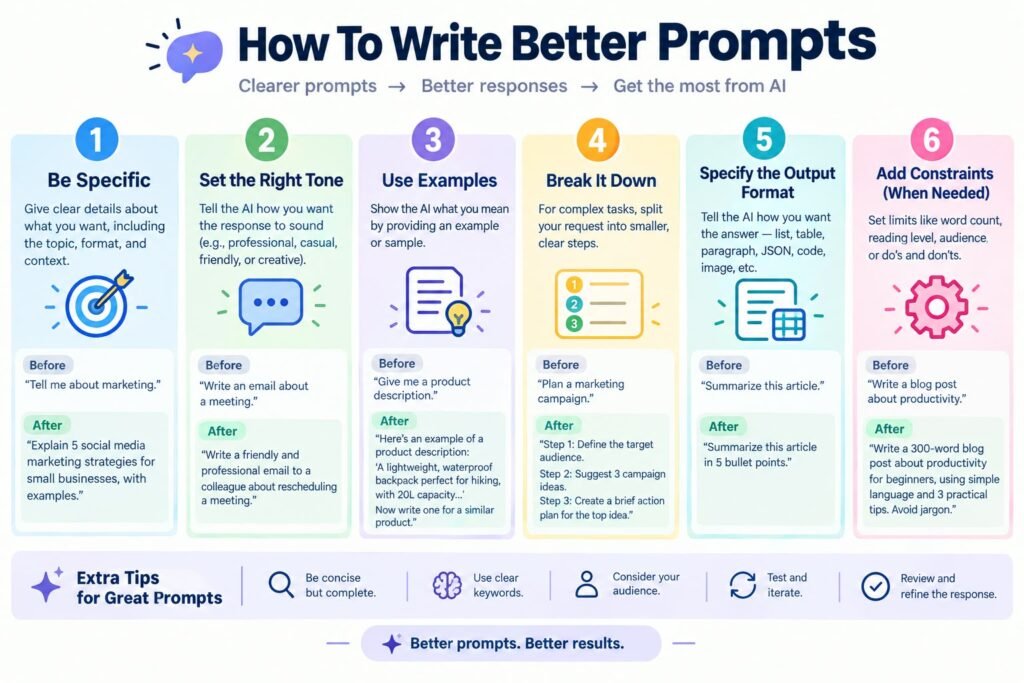
Learning how to write better prompts becomes easier when you follow a simple process.
Step 1: Define Your Goal
Start by deciding what you want from the AI.
Do not start writing the prompt before you understand the goal.
For example, your goal may be:
- Write an article
- Summarize a report
- Explain a concept
- Create a study plan
- Generate ideas
- Analyze text
- Write code
- Improve an email
Instead of saying:
Help me with SEO.
Say:
Explain the basic SEO process for a beginner website owner.
The second prompt has a clear goal.
Step 2: Give the AI Context
Context helps the AI understand your situation.
Compare these two prompts:
Write an email.
And:
Write a professional email to a client explaining that the project deadline needs to move by three days because of a technical issue.
The second prompt gives useful context.
Context can include:
- Target audience
- Business type
- Industry
- User experience
- Project background
- Content purpose
- Location
- Technical requirements
You do not need to include every detail. Include information that can change the answer.
Step 3: Be Specific
Specific instructions often produce better results.
Instead of:
Write about AI.
Try:
Write a beginner-friendly article explaining how generative AI works. Cover its benefits, limitations, common applications, and three real-world examples.
Specificity is one of the most important prompt engineering techniques.
Step 4: Define Your Audience
The same topic can require different answers for different audiences.
For example:
Explain machine learning to a child.
is different from:
Explain machine learning to a software engineer.
When creating a prompt, tell the AI who will read or use the answer.
You can specify:
- Students
- Developers
- Business owners
- Marketing professionals
- Beginners
- Researchers
- Teachers
- Customers
Step 5: Specify the Tone
Tell the AI how the response should sound.
Common tone instructions include:
- Professional
- Friendly
- Simple
- Formal
- Conversational
- Educational
- Persuasive
- Concise
- Technical
For example:
Explain the topic in a friendly and simple tone.
This gives the AI a clear writing direction.
Step 6: Specify the Output Format
AI can produce the same information in many formats.
You can request:
- Paragraphs
- Bullet points
- Tables
- Checklists
- Step-by-step guides
- FAQs
- JSON
- Code
- Email format
For example:
Compare ChatGPT and Gemini in a table. Include features, strengths, limitations, and ideal use cases.
Output instructions make AI responses easier to use.
Prompt Engineering Examples
The best way to understand prompt engineering is through examples.
Example 1: Simple Prompt
Write about digital marketing.
This prompt is too broad.
Improved Prompt
Explain digital marketing to a beginner. Cover SEO, social media marketing, email marketing, paid advertising, and content marketing. Use simple English and provide one example for each type.
The improved prompt gives the AI a clear structure.
Example 2: Content Writing Prompt
Weak Prompt
Write a blog about AI.
Better Prompt
Write a 1,500-word beginner-friendly blog about how generative AI is changing digital marketing. Use simple English, short paragraphs, H2 and H3 headings, practical examples, and a short FAQ section.
This is a good example of AI prompt writing.
Example 3: Study Prompt
Weak Prompt
Teach me machine learning.
Better Prompt
Act as a machine learning tutor. Teach me machine learning from beginner to intermediate level. Explain one concept at a time, use simple examples, and give me a short quiz after each lesson.
This approach can turn AI into an interactive learning assistant.
Example 4: Coding Prompt
Weak Prompt
Write Python code.
Better Prompt
Write a Python program that reads a CSV file and calculates the average value of each numeric column. Explain the code step by step and include error handling for missing files.
The second prompt defines the programming language, task, input, output, and explanation requirements.
Prompt Engineering Techniques You Should Know
Different tasks require different methods.
Here are some useful prompt engineering methods.
Zero-Shot Prompting
Zero-shot prompting means asking the AI to complete a task without providing examples.
Example:
Classify this review as positive, negative, or neutral: “The product arrived late but works well.”
The AI must understand the task from the instruction alone.
Few-Shot Prompting
Few-shot prompting provides examples before asking the AI to complete the task.
Example:
Positive: “The service was excellent.”
Negative: “The service was terrible.”
Neutral: “The service was acceptable.”
Classify this review: “The service was good but slow.”
Examples help show the expected pattern.
Role Prompting
Role prompting tells the AI to act from a particular professional perspective.
Example:
Act as an experienced SEO consultant and review this website structure.
Role instructions can help provide a specific perspective.
Chain-of-Thought-Style Guidance
For complex tasks, asking the model to work through a problem carefully can improve the result.
Instead of:
Solve this problem.
Try:
Solve this problem carefully. Identify the key information, explain the method, and provide the final answer.
For user-facing content, it is often better to request a clear explanation rather than asking for hidden internal reasoning.
Constraint-Based Prompting
Constraints define what the AI should or should not do.
For example:
Write a 500-word article. Use simple English. Do not use technical jargon. Include five examples and a conclusion.
Constraints make the task easier to control.
Iterative Prompting
You do not need to create the perfect prompt on your first attempt.
You can improve the result through multiple prompts.
For example: Write an introduction about AI.
Then: Make the introduction more engaging.
Then: Make it shorter and easier to read.
Then: Add a strong opening sentence.
This process is called iterative prompt optimization.
Prompt Optimization: How to Improve AI Responses
Prompt optimization means improving a prompt to get a better result.
If the AI gives a poor response, do not always blame the AI.
First, check your prompt.
Ask:
- Was the task clear?
- Did I provide enough context?
- Did I define the audience?
- Did I specify the format?
- Did I explain the expected length?
- Did I provide examples?
- Did I mention important restrictions?
For example, instead of:
Give me SEO keywords.
Try:
Generate SEO keywords for a blog about prompt engineering. Group them into primary, secondary, semantic, and long-tail keywords. Focus on beginner and student search intent.
The second prompt provides a much clearer task.
Prompt Engineering Best Practices
Following a few simple rules can improve your results.
1. Use Clear Language
Avoid unnecessary complexity.
Write:
Explain this concept in simple English.
instead of creating a long and confusing instruction.
2. Give Relevant Context
More information is not always better.
Give the information that matters to the task.
3. Set Clear Expectations
Tell the AI what a successful answer should contain.
For example:
Include five examples and a short conclusion.
4. Use Examples When Necessary
Examples can show the AI what you want.
This is especially useful for:
- Classification
- Formatting
- Writing style
- Data extraction
- Content structure
5. Break Complex Tasks Into Steps
Large tasks can be divided into smaller tasks.
For example:
- Research the topic.
- Create an outline.
- Identify keywords.
- Write the introduction.
- Draft each section.
- Review the content.
- Improve readability.
This can make complex workflows easier to manage.
6. Ask the AI to Check Its Output
You can ask:
Review the answer for missing information, unclear statements, and repetition.
This can help improve the final result.
7. Test Different Prompts
Prompt engineering is often an iterative process.
Try different versions and compare the results.
Prompt Engineering for Students
AI can be a powerful learning tool when used responsibly.
Prompt engineering for students can help with:
- Understanding difficult concepts
- Creating study plans
- Practicing questions
- Summarizing notes
- Learning languages
- Generating project ideas
- Reviewing writing
- Preparing presentations
- Creating quizzes
For example:
Act as my biology tutor. Explain photosynthesis in simple English. Use a real-world example and then give me five quiz questions.
This is more useful than:
Explain photosynthesis.
Students can also ask AI to teach through questions rather than simply giving answers.
For example:
Teach me basic statistics using questions. Do not give me the answer immediately. Let me try first and then provide feedback.
This approach can encourage active learning.
How Prompt Engineering Helps Students Learn AI
Learning prompt engineering can also help students understand how modern AI systems work.
Students can experiment with:
- Different instructions
- Different examples
- Different formats
- Different levels of context
- Different question styles
This can become a practical introduction to generative AI prompts and large language models.
Prompt Engineering Tools
Several AI platforms can be used to practice prompt engineering.
Examples include:
- ChatGPT
- Google Gemini
- Claude
- Microsoft Copilot
- Other generative AI platforms
Each system may respond differently to the same prompt.
This makes experimentation important.
You can create one prompt and test it across multiple AI systems. Then compare:
- Accuracy
- Relevance
- Clarity
- Response length
- Reasoning quality
- Formatting
- Creativity
This process can help you understand practical prompt engineering applications.
Prompt Engineering vs Fine-Tuning
Prompt engineering and fine-tuning are different approaches.
Prompt engineering changes the instructions given to an existing model.
Fine-tuning involves training a model further using specific data so that it becomes better suited to a particular task or style.
For example, a company may use prompt engineering to tell an AI:
Answer customer questions in a friendly and professional tone.
Fine-tuning may be considered when a company needs a model to consistently perform a specialized task based on a custom dataset.
Therefore, prompt engineering is usually easier and faster to test.
Difference Between Prompt Engineering and Fine-Tuning
| Prompt Engineering | Fine-Tuning |
| Changes the prompt | Changes model behavior through additional training |
| Usually easier to test | Requires training data and technical setup |
| Can be changed quickly | Usually requires a training process |
| Useful for many general tasks | Useful for specialized behavior |
| Does not modify model weights | Modifies model weights |
The choice depends on the use case.
Prompt Engineering vs Training Data
Prompt engineering and training data also serve different purposes.
Training data helps a model learn patterns during model development.
A prompt provides instructions at the time of use.
Think of it this way:
Training data teaches the model.
A prompt tells the model what you want it to do now.
Both are important, but they solve different problems.
Conversational AI Prompt Engineering
Conversational AI systems need prompts that support natural interaction.
For example, a customer support system may need to:
- Understand user questions
- Maintain conversation context
- Provide accurate answers
- Follow company rules
- Avoid unsupported claims
- Ask useful follow-up questions
A good conversational prompt might say:
You are a customer support assistant. Answer questions using the information provided by the company knowledge base. If the information is unavailable, clearly say that you do not have enough information.
This creates useful boundaries for the AI.
Semantic Prompt Design
Semantic prompt design focuses on meaning and context.
The goal is to make the intent of the prompt clear.
For example:
Give me a summary.
is unclear.
A more semantic prompt is:
Summarize the following 2,000-word report in 150 words. Focus on the main findings, key risks, and recommended actions. Use simple language.
The second prompt provides a clearer meaning and purpose.
Common Prompt Engineering Mistakes
Many beginners make simple mistakes when creating prompts.
Mistake 1: Being Too Vague
Bad:
Tell me about marketing.
Better:
Explain five important digital marketing channels for small businesses.
Mistake 2: Giving Too Many Conflicting Instructions
If your prompt says:
Make the answer very detailed but keep it under 100 words.
the instructions may conflict.
Create realistic requirements.
Mistake 3: Not Defining the Audience
A technical answer may not work for a beginner.
Tell the AI who will use the response.
Mistake 4: Expecting Perfect Results
AI can make mistakes.
Always review important information.
Mistake 5: Ignoring Context
The AI may not know important information about your project unless you provide it.
Mistake 6: Using One Prompt for Everything
Different tasks require different approaches.
A research prompt should not be identical to a creative writing prompt.
Prompt Engineering Tips for Better Results
Here are some practical prompt engineering tips:
- Start with a clear goal.
- Use direct instructions.
- Add relevant context.
- Define your audience.
- Specify the desired tone.
- Mention the output format.
- Add examples when useful.
- Set reasonable constraints.
- Break large tasks into smaller steps.
- Review the AI response.
- Improve the prompt based on the result.
- Test multiple versions.
The key is to treat prompt writing as a process.
Prompt Engineering Projects for Beginners
If you want to practice prompt engineering, start with small projects.
Project 1: AI Study Assistant
Create prompts that help students learn different subjects.
Project 2: Content Generator
Build a prompt system for creating blog outlines, titles, FAQs, and social posts.
Project 3: Customer Support Assistant
Create prompts for answering common customer questions.
Project 4: Resume Assistant
Create prompts that help users improve resumes and cover letters.
Project 5: Research Assistant
Create prompts that summarize documents and organize research notes.
These prompt engineering projects for beginners can help you understand how different instructions affect AI responses.
How to Optimize Prompts for LLMs
If you want to know how to optimize prompts for LLMs, focus on clarity and structure.
Start with the main task.
Then add context.
Next, explain the expected output.
Finally, add restrictions or examples if needed.
For example:
Analyze the following customer reviews. Classify each review as positive, negative, or neutral. Give one short reason for each classification. Return the result in a table.
This prompt is clear, structured, and easy for an LLM to follow.
LLM prompt optimization often involves testing different instructions and measuring the quality of the output.
A Practical Prompt Template
You can use this simple template for many tasks:
Role: Act as [role].
Task: Your task is to [specific task].
Context: The content is for [audience/use case].
Requirements: [important requirements].
Tone: Use a [tone] tone.
Format: Present the answer as [format].
Goal: The final response should [desired result].
For example:
Act as an experienced content writer. Write an article about prompt engineering for college students. Use simple English and short sentences. Explain key concepts with practical examples. Include headings, bullet points, and FAQs. Make the article educational and easy to understand.
This template can be adapted for many AI tasks.
The Future of Prompt Engineering in AI
The role of prompt engineering will continue to change as AI models become more capable.
Modern AI systems are becoming better at understanding natural language. This means users may not always need highly detailed prompts.
However, clear instructions will remain useful.
The future may combine prompt engineering with:
- AI agents
- Retrieval-augmented generation
- Structured outputs
- Multimodal AI
- Automated workflows
- AI evaluation
- Custom models
- Enterprise AI systems
As AI becomes part of more business and education workflows, the ability to communicate clearly with AI will remain valuable.
The focus may move from simple prompt writing to broader AI prompt crafting, workflow design, testing, and AI system management.
Learning how to write better prompts is becoming an important AI skill.
A good prompt does not need to be complicated. It needs to be clear. Start by defining your goal. Add useful context. Explain the task. Identify your audience. Set requirements and specify the output format.
Then test the result.
If the answer is not useful, improve the prompt and try again. This simple process is at the heart of prompt engineering.
Whether you are a student, content creator, marketer, developer, researcher, or business professional, learning effective prompt design can help you get more value from generative AI.
The best way to learn is to practice.
Write a prompt. ,Test it, Review the result. Improve it. Repeat.
Over time, you will become better at AI prompt writing, LLM prompt design, and creating effective instructions for modern AI systems.
Know More:
Other AI related links
Explore more useful guides from KnowledgeScribe.
”FAQs”
What is prompt engineering in AI?
Prompt engineering is the process of designing clear instructions for AI models. It helps guide an AI system toward a useful and relevant response.
How do I write better prompts for ChatGPT?
Start with a clear goal. Add context, define the audience, specify the output format, and explain important requirements. You can also provide examples when necessary.
What are the best prompt engineering techniques?
Useful techniques include role prompting, zero-shot prompting, few-shot prompting, constraint-based prompting, structured prompts, and iterative prompt optimization.
Is prompt engineering difficult?
No. Basic prompt engineering can be learned without programming skills. The main skill is learning how to communicate tasks clearly.
Can students learn prompt engineering?
Yes. Students can learn prompt engineering through simple experiments, study prompts, AI projects, and practical exercises.
What is the difference between prompt engineering and fine-tuning?
Prompt engineering changes the instructions given to an AI model. Fine-tuning involves additional model training using specific data.
How can I optimize prompts for LLMs?
Use clear instructions, relevant context, examples, output requirements, and reasonable constraints. Test different versions and compare the results.
What are some prompt engineering applications?
Prompt engineering can be used for content creation, education, customer service, coding, research, data analysis, marketing, productivity, and AI assistants.


