How Students Can Use AI in 2026 for Learning Without Cheating
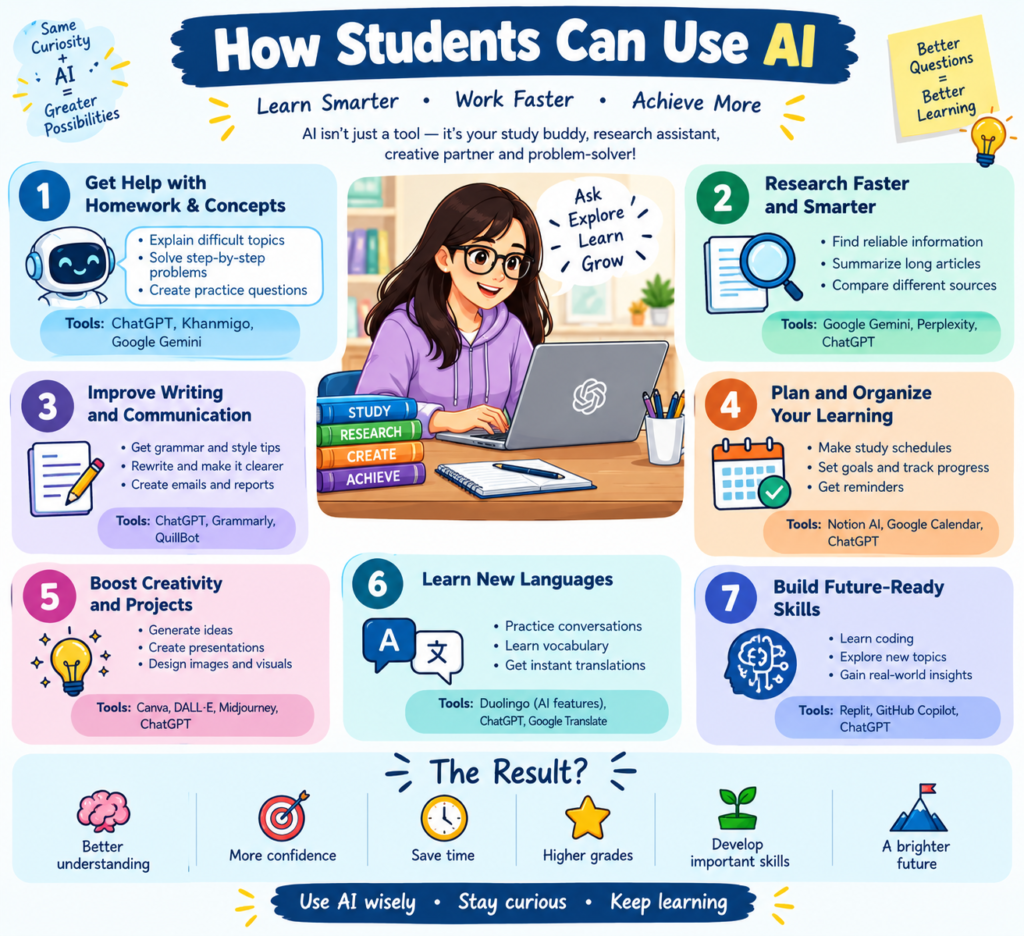
Artificial intelligence (AI) is changing the way students learn. Today, students can use AI to understand difficult topics, practice questions, improve writing, and plan their studies. Many AI learning tools are easy to use. They can also save time and make learning more enjoyable.
However, there is one important question: How can students use AI without cheating?
The answer is simple. Students should use AI to support learning, not replace their own thinking. AI can explain a topic, but students must understand it. AI can suggest ideas, but students must develop their own answers. AI can help with homework, but students must follow their school or college rules.
Responsible AI use helps students learn with confidence. It also protects academic integrity and builds important skills for the future.
In this guide, you will learn how students can use AI for studying, homework, research, and exam preparation without crossing academic boundaries. You will also discover practical AI study techniques, common mistakes, and the best AI learning practices for students.
1. What Is AI for Students?
AI for students means using artificial intelligence to support education and personal learning. These tools can explain information, answer questions, create practice exercises, and organize study tasks.
For example, a student may use an AI study assistant to understand a science lesson. Another student may use an AI tool to practice English grammar. A college student may use an AI research assistant to explore a topic before reading academic papers.
AI can support different learning needs. It can help beginners understand basic ideas. It can also help advanced students explore complex subjects.
Common uses of AI in learning include:
- Explaining difficult topics in simple language.
- Creating practice questions and quizzes.
- Summarizing notes for revision.
- Helping students plan their study time.
- Checking grammar and spelling.
- Suggesting research questions.
- Providing feedback on practice answers.
- Supporting language learning.
These AI educational tools can make studying more flexible. Students can ask questions whenever they need help. Still, AI is not always correct. It can provide outdated facts, incorrect answers, or made-up references. Students should check important information with textbooks, teachers, and trusted sources.
The goal is not to let AI do all the work. The goal is to use AI to understand more, practice better, and become an independent learner.
2. Understand the Difference Between Learning and Cheating
Before using AI for studying, students should understand the difference between helpful support and dishonest work. Ethical AI usage means using technology in a way that supports learning and follows academic rules. Cheating happens when students use AI in a way that breaks those rules or misrepresents someone else’s work as their own.
Consider these examples.
Using AI to learn:
- Asking AI to explain a difficult mathematics formula.
- Requesting practice questions before an exam.
- Using AI feedback to find grammar mistakes.
- Asking for an outline before writing an essay.
- Reviewing AI explanations and checking them against course materials.
Using AI to cheat:
- Submitting an AI-written essay as your own when this is not allowed.
- Using AI during a test when the rules prohibit it.
- Copying AI answers without understanding them.
- Inventing research sources or citations.
- Hiding AI assistance when disclosure is required.
The same tool can be used in both ways. What matters is the purpose, the method, and the rules of the assignment. For example, a teacher may allow AI for brainstorming but prohibit AI-generated final answers. In another class, AI use may be limited to spelling and grammar checks.
Students should read assignment instructions carefully. If the rules are unclear, they should ask their teacher.
A simple rule to remember: Use AI to improve your understanding, not to pretend that you know something you have not learned.
3. Use AI to Understand Difficult Topics
One of the best ways to use AI for studying is to ask for explanations. Sometimes, a textbook explanation may feel too difficult. A student may read the same paragraph several times and still feel confused. AI can explain the topic in different ways.
For example, a student studying photosynthesis could ask: “Explain photosynthesis in simple English for a class 8 student. Use a daily-life example and explain each step.”
The AI may provide a simpler explanation with an example. The student can then return to the textbook and connect the explanation with the lesson. Students can also ask follow-up questions, such as:
- Why does this process happen?
- Can you give me another example?
- What is the difference between these two concepts?
- Can you explain this step by step?
- What mistakes do students often make with this topic?
This approach makes AI in learning more useful. Students are not simply collecting answers. They are asking questions and building understanding. Another useful technique is to ask AI to explain the same concept at three levels: beginner, intermediate, and advanced.
Start with the beginner explanation. Move to the next level when the basic idea becomes clear. However, students should not accept every explanation as fact. Check key details against reliable learning materials.
4. Use AI as a Study Assistant, Not an Answer Machine
An AI study assistant can support daily learning. But students should decide how to use it. Instead of asking AI to complete an entire assignment, ask it to guide you through the process.
For example, suppose you are solving a mathematics problem. You can ask: “Help me solve this problem one step at a time. Do not give me the final answer until I try each step.”
This approach encourages active learning. You must think about the problem before moving forward.
You can use a similar method for other subjects.
For science, ask AI to explain an experiment and then quiz you on its results.
For history, ask AI to compare two historical events and help you identify their similarities and differences.
For English, ask AI to review a paragraph and explain why certain sentences are unclear.
For programming, ask AI to explain an error message and suggest ways to find the problem. Try to fix the code yourself before reviewing a complete solution.
These methods help students build problem-solving skills. They also reduce the risk of depending too much on AI.
Remember that an answer machine gives you information. A good study assistant helps you learn how to find, understand, and use information.
5. Get AI Homework Help Without Plagiarism
Homework gives students a chance to practice what they learn in class. AI homework help can be useful when students get stuck, but it should not replace their own effort. The best approach is to attempt the work first.
Read the question carefully. Write down what you already know. Try to solve the problem or create an initial answer. If you cannot move forward, ask AI for guidance. For example, you could write:
“I am working on a school assignment about water pollution. Please explain the main causes and effects. Give me questions that will help me develop my own answer. Do not write the assignment for me.”
This prompt supports learning without asking AI to produce work for submission. After receiving guidance, research the topic using trusted sources. Make notes in your own words. Then prepare your answer based on your understanding.
Here are some useful rules for AI for homework assistance without plagiarism:
- Try the question yourself before asking AI.
- Ask for hints instead of complete answers.
- Understand every fact you include.
- Verify information with reliable sources.
- Write your final response in your own words.
- Cite sources when required.
- Follow your teacher’s AI policy.
- Disclose AI assistance when the assignment requires it.
Changing a few words in an AI-generated answer does not automatically make it original work. You must understand the ideas and develop your own response. If AI use is prohibited for a particular assignment, do not use it for that task. You can still ask your teacher for approved learning resources or extra practice.
6. Create Personalized Study Plans With AI
Every student has different strengths, weaknesses, and learning habits. Some students understand a topic quickly but struggle to remember it. Others need more time to solve practice questions.
AI-powered learning can help students build personalized study plans.
A useful plan should include learning goals, study sessions, practice tasks, and revision time.
For example, a student preparing for a science exam in two weeks can ask:
“Create a 14-day science study plan. I can study for one hour each day. Include time for learning new topics, solving questions, reviewing mistakes, and revising important concepts.”
The student should then adjust the plan based on the exam syllabus and available time.
A good study plan may include:
- Daily learning: Study one topic at a time.
- Active recall: Close the book and explain what you remember.
- Practice questions: Test your knowledge without looking at answers.
- Revision: Review difficult topics regularly.
- Progress checks: Identify what needs more attention.
- Rest breaks: Avoid studying for long periods without a break.
AI can also help students create a weekly schedule around classes, homework, and other activities.
However, a plan is useful only when you follow it. Do not spend more time creating study plans than studying.
Review your progress every few days. If a topic is still difficult, give it more time. If you understand it well, move to the next topic.
Personalized study plans work best when students stay responsible for their own learning decisions.
7. Use AI to Prepare for Exams
Exam preparation is another useful area for AI learning tools.
Students can use AI to test their knowledge before an exam. They can also identify weak areas and practice answering questions under time limits.
One helpful method is to ask AI to create a quiz from a topic you have already studied.
For example:
“Create 10 practice questions about the human digestive system for a class 9 student. Ask one question at a time. Wait for my answer, then explain what I got right or wrong.”
This method makes revision more active. It also gives students a chance to correct mistakes before the exam.
AI can help with several exam preparation tasks:
- Create multiple-choice questions.
- Generate short-answer practice questions.
- Explain incorrect answers.
- Test important definitions.
- Create flashcards from your notes.
- Prepare a revision checklist.
- Simulate an oral exam.
- Help organize mock tests.
Students should not rely only on AI-generated questions. Review the official syllabus, textbook exercises, teacher-provided notes, and past papers when available.
AI may misunderstand a topic or produce questions that do not match the exam format.
A strong exam strategy combines AI practice with trusted course materials.
Most importantly, students should answer questions without looking at the explanation first. The purpose is to test what they know, not just read correct answers.
8. Improve Writing Skills With Responsible AI Use
Writing assignments help students develop communication, reasoning, and research skills. AI can support this process without taking over the student’s work.
For example, a student may write a first draft of an essay and ask AI to identify unclear sentences.
A useful prompt is:
“Review my essay for grammar, clarity, and sentence structure. Explain the main problems and suggest improvements. Keep my ideas and writing style. Do not rewrite the entire essay.”
This type of feedback can help students understand their mistakes.
AI can also help students learn how to write better introductions, organize paragraphs, and connect ideas.
Students can use it to:
- Check spelling and grammar.
- Identify repeated words.
- Improve sentence clarity.
- Understand common writing mistakes.
- Practice writing topic sentences.
- Learn how to structure an argument.
- Compare different ways to express an idea.
However, students should not assume that every suggested change is better. Review each suggestion and decide whether it improves the writing.
When an assignment requires independent writing, students must follow the teacher’s rules about AI assistance.
Do not use AI to disguise copied content or make someone else’s work appear original. Academic integrity requires honesty about the work you submit.
The goal should be to become a stronger writer over time, not to produce a perfect-looking essay without learning how to write.
9. Use AI as a Research Assistant
Research can be challenging for students. They may struggle to choose a topic, find useful information, or organize their notes.
An AI research assistant can help students begin the research process.
For example, a student researching renewable energy may ask AI to suggest research questions, explain key terms, or identify different sides of a debate.
AI can also help students create a list of topics to investigate.
However, there is an important limitation: AI-generated information is not automatically reliable. It may produce false facts, incorrect statistics, or references to sources that do not exist.
Students should follow a careful research process.
Step 1: Choose a clear topic.
Define what you want to learn. A focused topic is easier to research than a broad one.
Step 2: Ask AI for research questions.
Use the suggestions to identify areas that need further investigation.
Step 3: Find real sources.
Look for books, academic papers, government websites, educational institutions, and other trusted publications.
Step 4: Read the original material.
Do not rely only on an AI summary. Read the source and identify the information that supports your work.
Step 5: Check every important claim.
Confirm names, dates, figures, and quotations.
Step 6: Cite your sources.
Follow the citation style required by your teacher or institution.
AI can help organize research, but it cannot replace the student’s responsibility to verify information. Students should also respect copyright, privacy, and research rules. Never upload confidential information or another person’s private work into an AI tool without permission.
10. Build Critical Thinking Skills With AI
Critical thinking means examining information, checking evidence, and making reasoned decisions. It is one of the most important skills students can develop. Using AI without questioning its answers can weaken independent thinking. Using AI to challenge your ideas can strengthen it.
For example, after reading about climate change, a student may ask AI to explain different arguments about a related policy. The student can then examine the evidence and decide which claims are supported by reliable research.
Students can also use prompts such as:
- What assumptions does this argument make?
- What evidence would support this claim?
- What are the weaknesses in this explanation?
- Can you provide a different viewpoint?
- Which parts of this answer need fact-checking?
- What questions should I ask before accepting this conclusion?
These questions encourage deeper thinking.
Another useful technique is to answer a question independently before asking AI. Then compare your answer with the AI response. Look for missing points, unsupported claims, and differences in reasoning. Do not automatically assume the AI answer is better.
Students should learn to explain why they agree or disagree with an answer. They should also be able to defend their conclusions with evidence. AI is most useful when it becomes a partner for questioning and practice, rather than a replacement for judgment.
11. Develop Self-Directed Learning Habits
Self-directed learning means taking responsibility for your own education. You set goals, choose learning methods, track progress, and identify what you need to improve. AI can support this process, but students must remain in control.
For example, if you want to learn basic coding, you can use AI to create a beginner study plan. You can then complete exercises, ask questions, and review your progress.
A simple learning cycle looks like this:
- Set a clear learning goal.
- Study the topic using reliable materials.
- Practice what you have learned.
- Ask AI for help when you get stuck.
- Test your understanding without assistance.
- Review your mistakes.
- Adjust your next study session.
This process helps students become more independent.
AI can also suggest additional exercises when you finish a lesson. If you find a topic easy, request a more challenging problem. If you struggle, ask for a simpler explanation and another example. Keep a record of what you learn and which topics still need work.
Do not measure progress only by how quickly you finish tasks. Measure it by how well you can explain a concept, solve a problem, or apply a skill without AI. The real value of AI for students is not just faster learning. It is the ability to become more confident and independent learners.
12. Choose AI Learning Tools Carefully
There are many AI tools for students learning, but not every tool is suitable for every task. Some tools support general questions and explanations. Others focus on writing, mathematics, language learning, research, or note organization.
Students should choose tools based on their learning goals. Here are some categories to consider:
General AI assistants: These can explain topics, generate practice questions, and help organize ideas.
Writing assistants: These can identify grammar errors, suggest clearer sentences, and provide writing feedback.
Math learning tools: These can help explain calculations and show the steps used to solve problems.
Flashcard and quiz tools: These can support memory practice and self-testing.
Research tools: These can help students explore topics and discover sources, depending on the tool’s features.
Note-taking tools: These can help organize study materials and summarize information.
Before using any tool, consider the following questions:
- Does it explain answers or only provide results?
- Can I verify its information?
- Is it suitable for my age and learning needs?
- Does it protect my personal information?
- Is the free version sufficient for my task?
- Does my school allow its use?
- Will it help me learn, or make me dependent on it?
Students should also review privacy settings and avoid sharing passwords, personal records, confidential assignments, or sensitive information. The best AI educational tools are not necessarily the ones with the most features. They are the ones that help you understand concepts, practice skills, and learn responsibly.
13. Follow Digital Literacy and Privacy Rules
Digital literacy means knowing how to find, evaluate, and use information online. It also includes understanding the limits and risks of digital tools. AI makes digital literacy even more important.
AI-generated answers can sound confident even when they are wrong. Images, quotations, statistics, and references may also be misleading. Students should develop a habit of checking information before using it.
For example, if AI provides a statistic for a school project, look for the original report. If it names a book or academic paper, confirm that the source exists and supports the claim. Students should also understand how their information may be processed by an AI service.
Follow these basic privacy practices:
- Never share your password with an AI tool.
- Avoid entering private student records.
- Do not upload confidential school documents without permission.
- Check the tool’s privacy policy and settings.
- Ask permission before sharing another person’s information.
- Follow age restrictions and school technology rules.
Digital literacy also means knowing when not to use AI. If a teacher wants students to complete a task independently, respect that requirement. If a task is designed to test personal knowledge, complete it without unauthorized assistance.
Responsible AI use involves both honest learning and safe technology habits.
14. Common AI Study Mistakes to Avoid
AI can be helpful, but poor habits can reduce its value. Here are some common mistakes students should avoid.
Copying answers without understanding them
An answer may look correct, but copying it does not prove that you understand the topic. Ask for explanations and test yourself afterward.
Trusting every AI response
AI can make factual errors. Check important information against trusted sources.
Using AI for every task
If you ask AI to solve every problem, you may miss opportunities to develop independent skills. Try first, then seek guidance.
Submitting AI-generated work as your own
This may violate academic rules. Follow assignment instructions and disclose assistance when required.
Ignoring citations
AI-generated references may be inaccurate or invented. Verify every source and cite the original material.
Using AI during restricted assessments
Do not use AI during exams or tests unless the rules clearly permit it.
Sharing private information
Avoid entering sensitive details into AI tools. Protect your information and respect other people’s privacy.
Focusing only on speed
Finishing an assignment quickly is not the same as learning. Give yourself time to understand, practice, and revise. Avoiding these mistakes helps students gain the benefits of AI without sacrificing academic integrity.
15. Best AI Learning Practices for Students
Students can build a simple set of rules for responsible AI use.
- First, understand the purpose of each assignment. If the task is designed to test independent work, follow the stated restrictions.
- Second, attempt difficult questions before asking for help. This makes it easier to identify exactly where you need support.
- Third, ask clear questions. Tell the AI your education level, the topic, and the type of explanation you need.
- Fourth, request hints, examples, and feedback rather than complete answers. This encourages active learning.
- Fifth, verify important facts. Use textbooks, academic sources, and trusted educational websites.
- Sixth, write and solve problems independently whenever required. Your submitted work should accurately reflect your own effort and understanding.
- Seventh, disclose AI use when your school or institution requires it. Follow the requested format.
Finally, review your learning without AI. Try to explain the topic from memory, answer practice questions, or teach the concept to another person.
These habits make AI study techniques for students more effective. They also help learners become more responsible, confident, and independent.
16. A Simple Example of Ethical AI Use
Imagine that a student has to write an assignment about the causes of air pollution.
The student has read the chapter but does not understand how to organize the information.
Instead of asking AI to write the entire assignment, the student follows these steps.
First, the student asks for guidance.
They request a simple explanation of the main causes of air pollution.
Second, the student studies the explanation.
They compare the information with their textbook and note the key ideas.
Third, the student conducts research.
They find reliable sources about vehicle emissions, industrial pollution, and other relevant causes.
Fourth, the student creates an outline.
They organize the assignment into an introduction, main causes, effects, and conclusion.
Fifth, the student writes a draft.
They explain the topic in their own words using the information they have verified.
Sixth, the student requests feedback.
They ask AI to identify unclear sentences and grammar mistakes, provided this assistance is allowed.
Finally, the student checks the work.
They verify the facts, add required citations, and make sure the final submission follows the teacher’s rules. In this example, AI supports the learning process without replacing the student’s effort.
The student learns about air pollution, practices research, develops writing skills, and completes the assignment honestly. This is a practical example of how students can use AI without cheating.
How Ai Help Students to understanding
AI is becoming an important part of modern education. It can help students understand difficult topics, practice for exams, improve writing, organize research, and manage their study time.
However, the value of AI depends on how students use it.
Responsible AI use means asking questions, checking information, practicing independently, and following academic rules. It also means protecting personal information and being honest about the work you submit.
Students should treat AI as a learning assistant, not a replacement for their own effort. Use it to explore ideas, receive feedback, and improve your understanding. Then test your knowledge without assistance.
The best way to learn with AI ethically is to stay curious, think critically, and take responsibility for your education.
When students combine AI learning tools with reliable resources, regular practice, and academic integrity, they can build skills that support both academic success and lifelong learning.
Know More:
”FAQs”
1. How can students use AI without cheating?
Students can use AI to understand difficult topics, generate practice questions, organize study plans, and receive feedback. They should complete their own work, follow assignment rules, verify information, and disclose AI use when required.
2. Is using AI for studying considered cheating?
No, not automatically. Using AI for explanations, revision, and practice is often acceptable. However, rules vary by school, teacher, and assignment. Students should always check the relevant policy before using AI.
3. Can students use ChatGPT for education responsibly?
Yes. Students can use ChatGPT to explain concepts, create quizzes, practice languages, and review their writing. They should verify facts, protect private information, and avoid submitting AI-generated work as their own when this is not allowed.
4. How can AI help students with homework?
AI can explain instructions, provide hints, break problems into steps, and help students identify mistakes. Students should attempt the homework first and use AI to understand the process rather than copy complete answers.
5. What are the best AI learning practices for students?
The best practices include trying tasks independently, asking specific questions, requesting explanations, checking facts, citing sources, following academic rules, and testing knowledge without AI assistance.
6. Can AI improve critical thinking skills?
AI can support critical thinking when students question its answers, examine evidence, compare viewpoints, and identify weak arguments. Simply copying answers or accepting every response can reduce independent thinking.
7. How can students avoid plagiarism when using AI?
Students should research original sources, write in their own words, cite borrowed ideas, verify AI-generated references, and follow institutional rules for AI assistance. Rewriting copied content alone does not guarantee original work.
8. Are AI educational tools safe for students?
Some tools can be useful, but students should check age requirements, privacy policies, and school rules. They should avoid sharing passwords, sensitive personal information, or confidential documents.
9. Can AI create a personalized study plan?
Yes. AI can suggest a study schedule based on subjects, available time, and learning goals. Students should adjust the plan to match their syllabus, review progress, and focus on areas that need improvement.
10. What is the main benefit of responsible AI use in education?
Responsible AI use can make learning more flexible and personalized. It can help students understand concepts, practice skills, and manage their time while preserving independent thinking, academic integrity, and personal responsibility.