
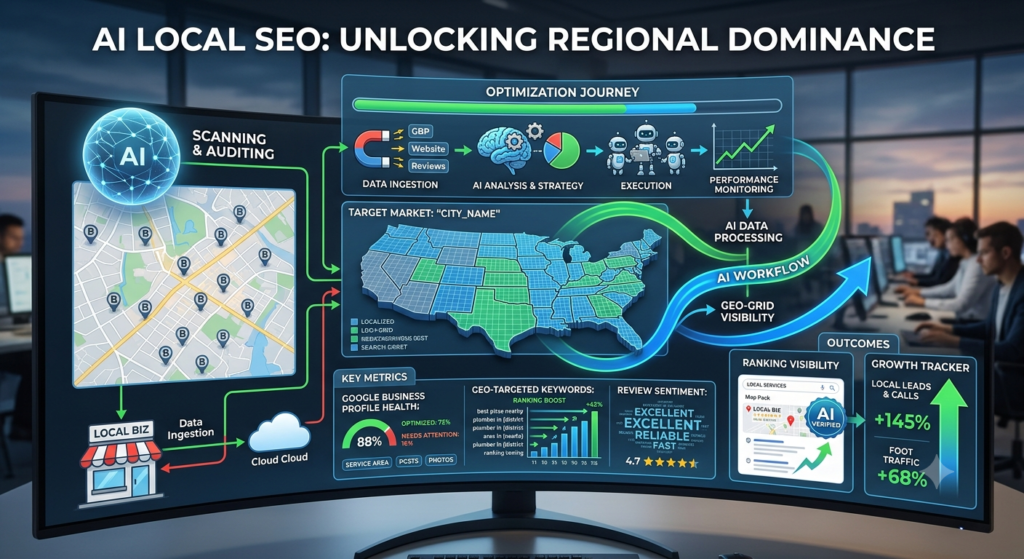
How AI Can Help Local Businesses Improve Local SEO
Local customers often search online before choosing a nearby business. They may look for a restaurant, repair service, medical clinic, clothing store, or digital agency. If your business doesn’t appear in relevant local search results, potential customers may choose a competitor instead.
This is where AI local SEO becomes valuable. Artificial intelligence can help businesses understand customer searches, improve website content, manage online listings, and make better marketing decisions. It can also reduce the time spent on repetitive SEO tasks.
Traditional SEO often requires hours of research, writing, tracking, and updating. AI makes many of these activities faster. Business owners can use AI-powered tools to identify local keywords, discover content opportunities, monitor reviews, and improve their online presence.
However, AI isn’t a magic solution. It works best when combined with real business knowledge, accurate information, and a clear local marketing strategy.
In this guide, we’ll explore how AI can help local businesses improve local SEO, attract nearby customers, and build stronger visibility in search engines.
1. AI and Local SEO: Understanding
Local SEO is the process of improving a business’s visibility in search results for location-based searches. It helps businesses connect with customers who are searching for products or services in a particular area.
For example, someone might search for:
- Best restaurant near me
- Electrician in Jaipur
- Affordable dentist in Delhi
- Digital marketing agency near me
- Best furniture shop in my area
Search engines use several signals to determine which businesses are relevant to these searches.
AI makes this process easier by helping businesses study search behavior, organize information, and improve their websites.
How AI Changes Local Search
Artificial intelligence can process large amounts of information quickly. It can identify patterns in search terms, understand common customer questions, and suggest improvements.
For example, a local bakery may use AI to discover that people search for birthday cakes, custom cakes, and eggless cakes in its neighborhood.
The bakery can use these insights to create relevant website pages and improve its business listing.
AI can support activities such as:
- Finding location-based keywords.
- Studying competitors.
- Creating website content.
- Improving business descriptions.
- Monitoring customer reviews.
- Tracking keyword performance.
- Finding missing business listings.
- Identifying local content opportunities.
The main advantage is efficiency. Instead of completing every task manually, business owners can use AI to organize their work and make informed decisions.
Traditional SEO vs AI-Powered SEO
|
Traditional SEO |
AI-Powered SEO |
|
Manual keyword research |
AI-assisted keyword discovery |
|
Manual content planning |
Automated content suggestions |
|
Individual review monitoring |
Faster review analysis |
|
Manual competitor research |
AI-supported competitor analysis |
|
Repeated data checking |
Automated reporting |
|
Manual content updates |
AI-assisted optimization |
AI doesn’t replace traditional SEO principles. It improves the way businesses apply them.
2. Benefits of AI for Local Businesses
Small businesses often have limited budgets and fewer employees. Managing marketing, customer service, sales, and daily operations can become difficult.
AI-powered SEO gives these businesses access to tools that can simplify important marketing activities.
Better Local Visibility
AI helps businesses discover what nearby customers are searching for.
For example, a plumbing company may discover that customers frequently search for emergency plumbing services, bathroom pipe repairs, and water leakage solutions.
These insights help the company create useful service pages and improve its local visibility.
Saves Time and Money
Many SEO activities require repeated work. AI can speed up keyword grouping, content outlines, reporting, and review analysis.
This allows business owners to spend more time serving customers.
Better Customer Understanding
AI tools can identify common questions and customer interests.
A beauty salon, for example, may discover that people frequently ask about bridal makeup, party makeup, hair treatments, and skincare services.
The business can use these insights to create relevant pages and social media content.
Smarter Marketing Decisions
Instead of choosing keywords based on guesswork, businesses can study search trends and performance data.
AI can help answer questions such as:
- Which services receive the most search interest?
- Which pages need improvement?
- What questions do customers ask?
- Which locations generate more leads?
- What content should be published next?
Improved Local Customer Acquisition
Better local search optimization can help businesses attract people who are already interested in their products or services.
These visitors may be more likely to call, request directions, visit a store, or complete a purchase.
However, increased visibility doesn’t guarantee sales. Businesses must also provide good service, clear pricing, useful information, and a positive customer experience.
3. AI-Powered Local Keyword Research
Keyword research is one of the most important parts of local SEO optimization. It helps businesses understand the words and phrases customers use when searching online.
AI makes keyword research faster by identifying related terms, search patterns, and customer intent.
Finding Location-Based Keywords
A local business should focus on keywords that describe its services and target locations.
For example, a digital marketing agency in Jaipur might target:
- Digital marketing agency in Jaipur
- SEO services in Jaipur
- Local SEO company in Jaipur
- Affordable SEO services near me
- Website development agency in Jaipur
AI SEO tools can suggest related keywords and organize them into useful groups.
Understanding Search Intent
Search intent explains what a person wants when entering a search query.
There are four common types.
|
Navigational |
ABC Dental Clinic Jaipur |
Brand visibility |
|
Search Intent |
Example |
Business Opportunity |
|
Informational |
What is local SEO? |
Educational content |
|
Commercial |
Best dentist in Jaipur |
Comparison pages |
|
Transactional |
Book dentist appointment |
Service and booking pages |
Understanding intent helps businesses create the right content for each audience.
AI-Powered Local Keyword Research Techniques
Here are practical ways to use AI:
- Enter your main service and business location into an AI tool.
- Ask it to suggest related local search terms.
- Group keywords according to search intent.
- Identify questions customers may ask.
- Compare keyword ideas with actual search data.
- Select relevant keywords for individual website pages.
For example, a home cleaning company could ask an AI tool to suggest keywords related to deep cleaning, sofa cleaning, kitchen cleaning, and apartment cleaning.
The business should then verify keyword opportunities using reliable SEO research tools.
Avoid Keyword Stuffing
Adding the same keyword repeatedly doesn’t make a website more useful.
Use natural variations, relevant service names, and location terms where they make sense.
A page should answer customer questions instead of simply repeating search phrases.
4. Google Business Profile Optimization Using AI
A Google Business Profile is an important part of local SEO.
It allows eligible businesses to display information such as their address, phone number, opening hours, photos, services, and customer reviews on Google Search and Maps.
AI tools can help businesses manage and improve this information.
Creating Better Business Descriptions
AI can help write clear and informative business descriptions.
For example, a local dental clinic can use AI to prepare a description that explains its services, location, and approach to patient care.
However, all details must be checked before publishing.
Improving Business Categories and Services
AI can suggest suitable business categories and service descriptions based on the business type.
For example, a car repair shop may offer:
- General car servicing
- Brake repairs
- Engine diagnostics
- Battery replacement
- Vehicle inspection
The business should select accurate categories from Google’s available options rather than adding unrelated categories to attract traffic.
Planning Google Business Profile Posts
Businesses can use AI to prepare content ideas for updates, events, announcements, and seasonal offers.
A restaurant might publish updates about a new menu, holiday opening hours, or special dining options.
AI can also help create different versions of a post for testing.
Using AI for Profile Improvement
A simple workflow includes:
- Review your existing business information.
- Identify missing or outdated details.
- Use AI to suggest clearer descriptions.
- Prepare relevant posts and updates.
- Check that all information is accurate.
- Monitor customer interactions.
Google requires businesses to represent themselves accurately. Read its official Business Profile guidelines.
Remember that AI suggestions should never replace accurate business information.
5. AI Content Optimization for Local SEO
Content helps search engines understand what a business offers and helps customers decide whether a service meets their needs.
AI content optimization can make content planning and improvement easier.
Creating Local Website Content
Businesses can use AI to prepare content for:
- Homepage descriptions
- Service pages
- Location pages
- Blog articles
- Frequently asked questions
- Product descriptions
- Local guides
For example, a pest control company could create separate pages explaining termite treatment, mosquito control, and rodent removal.
Each page should provide useful details about the service.
Creating Location-Based Pages
A business serving multiple areas may need pages that explain its services in each location.
For example, a cleaning company operating in several parts of Jaipur could create relevant pages for its service areas.
However, each page should offer genuine local value.
Simply replacing one city name with another across hundreds of nearly identical pages is a poor strategy.
Useful location pages should include relevant service information, actual coverage details, customer questions, and local knowledge.
Improving Existing Content
AI can review website content and suggest improvements.
It can help identify:
- Missing information
- Unclear headings
- Long paragraphs
- Repeated phrases
- Missing FAQs
- Weak calls to action
- Opportunities for internal links
A human editor should review every important change.
Building Helpful Local Content
A local hardware store might publish articles about choosing paint, selecting home improvement tools, or preparing a house for the rainy season.
A fitness center could publish beginner workout guides and explain its training programs.
Such content supports a stronger local online presence because it answers real customer questions.
AI should help with research and organization, not produce large amounts of generic content without meaningful human input.
6. Managing Local Citations With AI
Local citations are online mentions of a business’s name, address, and phone number.
They may appear in business directories, industry websites, local portals, and other online resources.
Consistent business information helps customers identify and contact the correct business.
Why Local Citations Matter
Imagine that a restaurant displays one phone number on Google and a different number on a business directory.
Customers may become confused.
Incorrect addresses and outdated opening hours can also reduce trust.
Local citation management helps businesses maintain accurate information across online platforms.
How AI Helps Manage Citations
AI can assist with:
- Finding possible business directory listings.
- Comparing business information.
- Identifying inconsistent details.
- Organizing citation records.
- Preparing correction requests.
- Monitoring listing changes.
AI citation management tools can save time when a business has multiple locations.
However, businesses should verify each directory and avoid submitting information to low-quality websites simply to increase the number of citations.
Maintaining Consistent Business Information
Create a central record containing:
|
Business Detail |
Information to Maintain |
|
Business name |
Official trading name |
|
Address |
Correct physical address |
|
Phone number |
Active contact number |
|
Website |
Official website |
|
Opening hours |
Current operating hours |
|
Business category |
Accurate business type |
|
Services |
Available products and services |
Review this information regularly.
For businesses with multiple branches, maintain separate records for every genuine location.
7. AI for Customer Reviews and Reputation Management
Customer reviews can influence how people view a business.
A potential customer may compare several local businesses before deciding where to spend money. Positive experiences, helpful responses, and honest feedback can build trust.
AI can make business reviews management more organized.
Monitoring Customer Feedback
AI tools can analyze reviews and identify common topics.
For example, a hotel may receive comments about room cleanliness, staff behavior, breakfast, and check-in services.
AI can group these comments into categories.
This helps management understand what customers appreciate and where improvements are needed.
Writing Professional Review Responses
AI can suggest polite and professional responses to customer reviews.
For a positive review, it might prepare a short thank-you message.
For a negative review, it can suggest an apology and a suitable response.
However, businesses should personalize these messages rather than publishing identical automated replies.
Handling Negative Reviews
Negative reviews should not be ignored.
A practical process includes:
- Read the complete review.
- Understand the customer’s concern.
- Check the relevant business records.
- Prepare a respectful response.
- Offer a suitable way to resolve the issue.
- Improve the service if necessary.
Never use AI to create fake reviews or misleading customer feedback.
Authentic customer experiences are more valuable than artificial ratings.
8. Improving Local Search Rankings With AI
Local search rankings depend on several factors.
Google explains that local results are mainly influenced by relevance, distance, and prominence.
AI can help businesses improve the information and marketing activities related to these factors.
Improving Relevance
Relevance describes how well a business matches a customer’s search.
AI can help identify missing service information, suggest useful website content, and improve business descriptions.
For example, a restaurant that offers vegetarian food should clearly explain its menu and relevant services.
Understanding Location and Distance
Distance relates to how far a business is from the person searching.
AI cannot change the physical distance between a customer and a business.
However, it can help businesses understand their service areas and create useful location-based content.
Building Prominence
Prominence relates to how well-known a business is.
Businesses can strengthen their online presence through:
- Genuine customer reviews
- Relevant local links
- Quality website content
- Accurate business listings
- Local media mentions
- Community involvement
AI can help identify opportunities, but real business reputation must be earned.
Improving Map Pack Rankings
The Google local map pack displays selected businesses for relevant searches.
Appearing there can help businesses attract attention from nearby customers.
AI can support profile improvement, keyword research, review analysis, and local content planning.
However, no AI tool can guarantee a map pack position.
9. Local SEO Automation With AI
Many SEO tasks are repeated every week or month.
AI SEO automation can help businesses organize these tasks and reduce manual work.
Automating Keyword Monitoring
Businesses can use SEO platforms to monitor selected keywords.
AI-supported reporting can help identify changes in rankings and traffic.
Automating Content Planning
AI can prepare a content calendar based on seasonal demand, customer questions, and business services.
For example, an air conditioning company may plan articles about summer maintenance before temperatures increase.
Automating Review Analysis
Some platforms can collect review data and summarize recurring customer concerns.
This helps managers identify service problems more quickly.
Creating an Efficient SEO Workflow
A simple monthly workflow could look like this:
|
Activity |
AI Assistance |
Human Responsibility |
|
Keyword research |
Generate ideas |
Verify relevance |
|
Content creation |
Prepare drafts |
Add expertise |
|
Profile updates |
Suggest improvements |
Check accuracy |
|
Review monitoring |
Identify patterns |
Respond personally |
|
Citation management |
Find inconsistencies |
Approve corrections |
|
Performance reports |
Summarize data |
Make decisions |
Automation should save time without removing human quality checks.
10. Best AI Tools for Local SEO Optimization
Choosing the right software depends on business size, budget, and marketing needs.
There isn’t one tool that performs every local SEO activity perfectly.
Here are some useful options.
ChatGPT
ChatGPT can help with keyword ideas, website content, service descriptions, FAQs, review response drafts, and marketing plans.
It works well as a general research and writing assistant.
Semrush
Semrush provides SEO research features that can help businesses study keywords, competitors, website performance, and content opportunities.
Its local marketing features can also support local visibility management.
BrightLocal
BrightLocal focuses on local SEO activities such as local rank tracking, citation management, and reputation monitoring.
Moz Local
Moz Local helps businesses manage local listings and maintain consistent business information across supported platforms.
Google Business Profile
Google Business Profile is essential for managing eligible business information on Google Search and Maps.
Google Search Console
Search Console helps website owners understand search performance, discover indexing issues, and monitor search queries.
Choosing the Right Software
|
Tool |
Main Use |
Suitable For |
|
ChatGPT |
Content and research assistance |
Small businesses |
|
Semrush |
Keyword and competitor research |
Growing businesses |
|
BrightLocal |
Local rankings and citations |
Local SEO campaigns |
|
Moz Local |
Listing management |
Multi-location businesses |
|
Google Business Profile |
Business information management |
Eligible local businesses |
|
Search Console |
Website search performance |
Website owners |
Before purchasing a subscription, check current pricing, available features, supported countries, and business requirements.
11. AI Local SEO Strategies for Small Businesses
Small businesses don’t need expensive marketing systems to benefit from AI.
A simple and consistent strategy can make a meaningful difference.
Start With One Main Location
Focus on your primary business location before targeting multiple areas.
Optimize your website, business profile, and contact information for that location.
Create Content Around Your Services
Build separate pages for your most important services.
For example, a local electrician could create pages about:
- Electrical repairs
- Home wiring
- Lighting installation
- Emergency electrician services
- Electrical inspections
Use AI to organize content ideas and identify questions customers may ask.
Target Neighborhood Searches
Neighborhood marketing can help businesses connect with customers in nearby areas.
A restaurant, salon, or repair service can publish useful information about the locations it genuinely serves.
Avoid targeting places where the business doesn’t operate.
Use AI to Understand Competitors
AI can help organize publicly available competitor information.
Study their services, website structure, content topics, customer reviews, and business listings.
Look for opportunities to provide better information rather than copying their strategy.
Build a Consistent Marketing Routine
A practical routine might include:
- Weekly review monitoring.
- Monthly keyword research.
- Regular business profile updates.
- Monthly website content improvements.
- Quarterly citation checks.
- Monthly performance reviews.
Consistency is more valuable than making hundreds of changes in one day.
12. Common AI Local SEO Mistakes to Avoid
AI offers many advantages, but incorrect use can damage a business’s online presence.
Here are common mistakes to avoid.
Publishing Unchecked AI Content
AI can sometimes produce inaccurate information.
Always verify prices, services, locations, contact details, and business claims before publishing.
Keyword Stuffing
Using the same keyword repeatedly makes content difficult to read.
Include related phrases naturally and focus on customer needs.
Creating Fake Business Listings
Never create false addresses or duplicate profiles to target additional locations.
Every listing should represent a genuine eligible business location.
Buying Fake Reviews
Fake reviews can damage trust and violate platform policies.
Encourage genuine customers to share honest experiences.
Ignoring Human Experience
AI doesn’t understand every detail of a local business.
Employees and owners know the services, customers, and local market better than a general AI tool.
Use that knowledge to improve AI-generated suggestions.
Expecting Instant Rankings
SEO takes time.
Results depend on competition, website quality, relevance, location, and other factors.
Avoid software that promises guaranteed first-page rankings.
13. Measuring Local SEO Performance
An effective SEO strategy requires regular measurement.
AI can help organize performance data and identify areas that need attention.
Important Local SEO Metrics
|
Metric |
What It Measures |
|
Organic traffic |
Visitors from unpaid search results |
|
Local keyword rankings |
Visibility for location-based searches |
|
Business Profile interactions |
Customer actions on the profile |
|
Website calls |
Calls generated through the website |
|
Direction requests |
Interest in visiting the location |
|
Customer reviews |
Feedback and reputation |
|
Conversion rate |
Visitors who complete desired actions |
|
Lead generation |
Enquiries from potential customers |
Use Google Analytics and Search Console
Google Analytics can help businesses understand website traffic and user behavior.
Google Search Console provides information about search queries, clicks, impressions, and indexing.
These tools provide useful information for evaluating local marketing strategies.
Review Performance Every Month
Create a simple monthly report.
Check which pages attract visitors, which keywords show improvement, and which services generate enquiries.
Use AI to summarize the data and suggest possible improvements.
However, verify its conclusions against the original reports.
The goal isn’t simply to increase website traffic. It’s to attract relevant visitors who may become customers.
Know More:
”FAQs”
1. How does AI help local businesses rank higher on Google?
AI helps businesses improve keyword research, website content, Google Business Profile information, review management, and local SEO reporting. These activities can support better search visibility when implemented correctly. However, AI cannot guarantee higher rankings.
2. What are the best AI tools for local SEO optimization?
Useful options include ChatGPT, Semrush, BrightLocal, and Moz Local. Google Business Profile and Google Search Console are also important tools for managing business information and monitoring website performance.
3. Can AI optimize Google Business Profiles?
Yes. AI can help prepare business descriptions, suggest service information, create post ideas, and draft review responses. Business owners must verify all information before publishing it.
4. How does AI improve local keyword research?
AI can generate related search terms, group keywords by intent, identify customer questions, and suggest location-based content ideas. Businesses should verify keyword opportunities using reliable SEO research tools.
5. Can AI manage local citations?
AI-supported tools can help discover listings, identify inconsistent business information, and organize citation management tasks. Human verification is still necessary to ensure accuracy.
6. Is AI local SEO suitable for small businesses?
Yes. Small businesses can use AI to save time on keyword research, content planning, review analysis, and reporting. They can start with affordable tools and expand their marketing systems as the business grows.
7. Does AI-generated content improve local search rankings?
AI-generated content doesn't automatically receive a ranking advantage. Its value depends on accuracy, originality, usefulness, and relevance. Content should provide genuine value instead of simply targeting search engines.
8. What is the role of AI in near me searches?
AI can help businesses understand location-based search intent and improve relevant business information. Accurate location details, service information, and a well-maintained Business Profile can support local discovery.
9. How long does local SEO take to show results?
There isn't a fixed timeline. Results depend on competition, website condition, business reputation, location, and the quality of SEO work. Businesses should monitor performance regularly rather than expect immediate improvements.
10. Can AI replace professional local SEO services?
AI can automate or simplify many SEO activities, but it cannot replace every part of professional SEO work. Strategy, technical expertise, local market knowledge, quality control, and customer understanding still require human involvement.


