How Students Can Use Artificial Intelligence to Improve Their Learning Experience
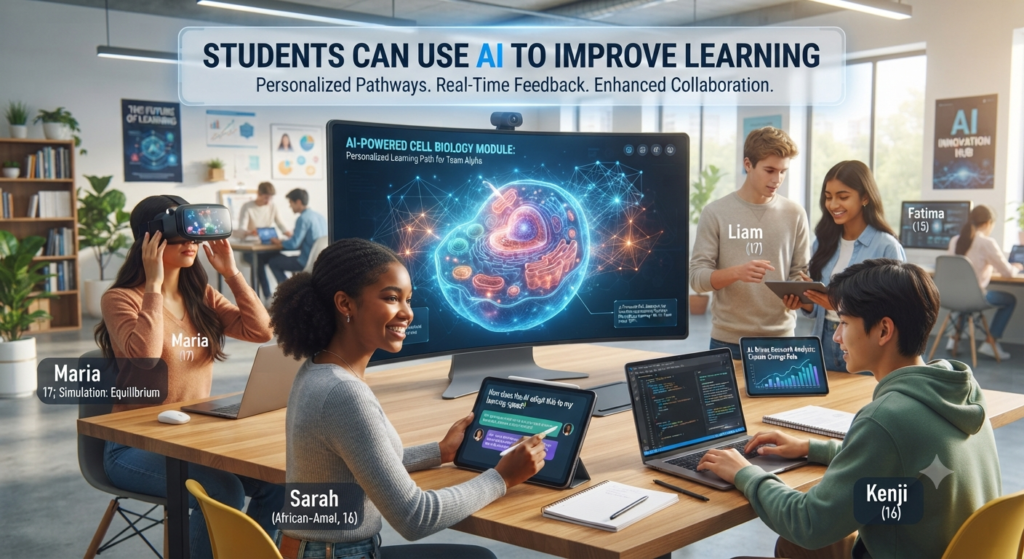
Education is changing rapidly. Technology has made learning easier, faster, and more accessible than ever before. One of the biggest changes is the use of Artificial Intelligence (AI). Today, students can use AI to understand difficult subjects, complete research, improve writing, and prepare for exams.
Artificial Intelligence for Students is becoming an important part of modern education. It provides smart solutions that help learners study at their own pace. Students no longer need to depend only on textbooks or classroom explanations. They can also use digital tools to explore new topics and solve academic problems.
For example, a student who struggles with mathematics can ask an AI tool to explain a problem step by step. Another student can use an AI study assistant to create revision notes from a long chapter. These tools make learning more flexible and interactive.
However, AI isn’t a replacement for teachers or personal effort. It works best when students use it as a learning partner.
In this article, we’ll explore 15 powerful ways students can use AI to improve their learning experience, discover useful AI learning tools, and understand how to use this technology responsibly.
Know More: How AI Is Changing Software Developer Jobs: 9 Powerful Trends
1. Students Can Use AI to Improve Learning: Understanding
Artificial intelligence refers to computer systems that can perform tasks that usually require human intelligence. These tasks include understanding language, finding patterns, answering questions, and generating content.
In education, AI helps students access information, receive learning support, and improve their study methods.
What Is Artificial Intelligence for Students?
Artificial Intelligence for Students means using AI-powered technology to support academic activities.
These activities include:
- Understanding difficult topics.
- Preparing study notes.
- Practising questions.
- Improving writing skills.
- Learning new languages.
- Organizing study schedules.
- Exploring career opportunities.
AI tools can understand student questions and provide explanations based on their requests. Some tools can also adjust learning activities according to a student’s progress.
For example, a student learning science can ask an AI chatbot to explain photosynthesis in simple language. The tool can provide a basic explanation, examples, and practice questions.
This makes AI useful for both beginners and advanced learners.
How AI Is Changing Modern Education
Traditional education often follows the same learning method for every student. However, students have different abilities, interests, and learning speeds.
AI in Education makes it possible to offer more flexible learning experiences.
Modern AI-based education systems can:
- Identify learning gaps.
- Recommend suitable learning materials.
- Provide instant explanations.
- Support independent learning.
- Help teachers understand student progress.
- Make digital learning more interactive.
Machine learning in education also helps systems identify patterns in student performance. These insights can help teachers understand which subjects need more attention.
As a result, AI is supporting a shift towards personalized education and smarter classrooms.
2. 15 Powerful Ways Students Can Use AI for Learning
AI can support almost every stage of a student’s learning journey. From understanding basic concepts to preparing for future careers, the right tools can make daily study activities easier.
Here are 15 practical ways students can use artificial intelligence to improve their academic performance.
1. Get Personalized Learning Experiences
Every student learns differently. Some understand topics through examples, while others prefer diagrams, videos, or written explanations.
Personalized Learning uses AI to make education more suitable for individual needs.
AI learning platforms can recommend lessons based on a student’s knowledge and progress. They can also provide additional exercises when a student struggles with a topic.
For example, a student learning mathematics may find algebra difficult. An AI-powered learning system can suggest beginner exercises before introducing advanced problems.
How students can use it:
- Ask AI to explain topics at different difficulty levels.
- Request examples based on everyday situations.
- Create a learning plan for individual subjects.
- Practise topics that need improvement.
- Request additional exercises after completing a lesson.
This approach supports self-paced learning and helps students build confidence.
2. Use AI as a Smart Study Assistant
Students often spend a lot of time searching for answers and organizing study materials.
An AI Study Assistant can make these activities easier.
Tools such as ChatGPT can answer questions, explain concepts, create practice tests, and suggest study strategies.
For example, students can enter a question about history and request a simple explanation with important dates and events.
They can also ask AI to create flashcards for quick revision.
Useful activities include:
- Asking subject-related questions.
- Creating chapter summaries.
- Generating multiple-choice questions.
- Preparing revision schedules.
- Explaining difficult terms.
A virtual learning assistant can also help students study independently when teachers or classmates aren’t available.
3. Understand Difficult Subjects Step by Step
Some subjects require more explanation and practice than others.
Mathematics, physics, chemistry, and computer science can be challenging for many students.
AI for Learning can help break complex topics into smaller and easier steps.
For example, instead of asking an AI tool for the answer to a mathematical problem, students can request a step-by-step explanation.
This helps them understand the method rather than simply copying the result.
Students can use prompts such as:
- Explain this topic in simple language.
- Give me three examples of this concept.
- Explain the solution step by step.
- Show me common mistakes students make.
- Create five practice questions about this topic.
This method supports deeper understanding and improves problem-solving skills.
4. Get Homework and Assignment Support
Homework is an important part of education. It allows students to practice what they’ve learned in class. However, students sometimes struggle to understand assignment instructions or organize their ideas.
AI Homework Helper tools can provide guidance during these situations.
Students can use AI to understand questions, identify important points, and create an assignment structure. For example, if a student receives an assignment about environmental pollution, they can ask AI to suggest relevant topics such as air pollution, water pollution, and waste management.
AI can also help students identify areas that need further research.
Important: Students should prepare their own final answers and follow their institution’s academic integrity rules. AI-generated work should not be submitted as original research without proper verification and disclosure where required.
5. Improve Research and Information Gathering
Research is an important academic skill.
Students need to collect information, compare different viewpoints, and understand reliable sources before preparing projects or reports.
AI tools can make the initial research process more organized.
For example, students researching renewable energy can ask AI to suggest relevant subtopics:
- Solar energy.
- Wind energy.
- Hydropower.
- Renewable energy challenges.
- Environmental benefits.
AI can also help create research questions and organize information into categories.
However, AI-generated information isn’t always accurate. Students should verify important facts using reliable sources, academic papers, and official websites.
For academic research, resources such as Google Scholar can help students find scholarly articles and research publications.
6. Improve Writing and Grammar Skills
Writing is an essential skill for school, college, and professional life.
Students regularly prepare essays, reports, presentations, and assignments. AI tools can help them improve the quality of their writing.
AI-powered writing assistants can identify grammar mistakes, suggest better sentence structures, and explain unclear expressions.
Students can use these tools to:
- Correct spelling mistakes.
- Improve sentence clarity.
- Find repeated words.
- Organize paragraphs.
- Improve vocabulary.
- Understand grammar rules.
For example, a student can write a paragraph and ask an AI tool to identify grammar mistakes without changing the original meaning.
This helps students understand their writing weaknesses and improve gradually.
7. Learn New Languages More Easily
Learning a new language requires regular practice.
Students need to improve vocabulary, pronunciation, grammar, reading, and speaking skills.
AI chatbots can support these activities through interactive conversations.
For example, students learning English can ask an AI chatbot to act as a conversation partner.
They can practice daily conversations, learn new words, and receive feedback on sentence structure.
Ways to use AI for language learning:
- Practice everyday conversations.
- Translate unfamiliar words.
- Learn grammar through examples.
- Create vocabulary exercises.
- Practice interview questions.
- Write short paragraphs for feedback.
This makes language learning more flexible and encourages students to practice regularly.
8. Prepare for Exams with AI Study Tools
Exam preparation requires planning, revision, and practice.
Students often have limited time to revise large amounts of information.
AI Study Tools can help organize this process.
For example, students can provide a list of topics and ask AI to create a seven-day revision timetable.
They can also request quizzes based on their syllabus.
AI can generate:
- Multiple-choice questions.
- Short-answer questions.
- Flashcards.
- Practice tests.
- Chapter summaries.
- Topic-wise revision plans.
These resources help students test their knowledge before an examination.
However, students should always compare AI-generated questions with their actual syllabus and study materials.
9. Improve Time Management and Productivity
Managing time is one of the biggest challenges students face.
Classes, assignments, examinations, personal activities, and extracurricular work can make daily schedules difficult to manage.
Student Productivity Tools powered by AI can help students organize their responsibilities.
For example, a student can provide a list of assignments and deadlines and ask AI to create a weekly study plan.
The tool can divide larger tasks into smaller activities.
Practical productivity strategies:
- Create daily study schedules.
- Set realistic learning goals.
- Divide large assignments into smaller tasks.
- Identify priority activities.
- Plan regular revision sessions.
- Track completed activities.
These strategies can reduce confusion and help students develop better study habits.
10. Create Better Notes and Summaries
Taking notes helps students remember important information.
However, writing notes from long lectures, textbooks, or research materials can take considerable time.
AI Learning Tools can help students organize information into shorter and clearer formats.
Students can use AI to create:
- Chapter summaries.
- Important topic lists.
- Revision notes.
- Key definitions.
- Question-and-answer sets.
- Concept comparisons.
For example, students can provide their own lecture notes and ask AI to organize them under suitable headings.
They should still review the original material to make sure important information hasn’t been missed.
11. Learn Coding and Technical Skills
Technology-related subjects are becoming increasingly important.
Students interested in software development, computer science, and engineering can use AI tools to support their learning.
AI coding assistants can explain programming concepts, identify errors, and suggest improvements.
For example, a beginner learning Python can ask an AI tool to explain variables, loops, functions, and conditional statements.
Students can also request small coding exercises to practise their skills.
AI can support coding education by helping students:
- Understand programming languages.
- Identify coding errors.
- Learn basic algorithms.
- Practice problem-solving.
- Understand code examples.
- Build small learning projects.
Students should try solving problems independently before checking AI-generated solutions. This develops real programming knowledge.
12. Develop Creative Thinking and Problem-Solving Skills
Education isn’t only about memorizing information.
Students also need creativity, critical thinking, and the ability to solve unfamiliar problems.
Generative AI in Education can support creative activities by suggesting ideas and different approaches.
For example, students preparing a science project can ask AI to suggest project ideas related to renewable energy.
Similarly, students working on a business assignment can explore different business models and marketing strategies.
AI can help students explore possibilities, but they should evaluate ideas independently.
The goal should be to use AI as a starting point for original thinking, not as a replacement for creativity.
13. Track Academic Progress with Learning Analytics
Students sometimes find it difficult to identify which subjects need more attention.
Learning analytics uses educational data to understand learning patterns and performance.
Some AI-powered learning platforms can track quiz results, completed lessons, and learning activities.
This information can help students understand their strengths and weaknesses.
For example, if a student consistently performs poorly in algebra exercises, the platform may recommend additional practice.
Students can use this information to:
- Identify weak subjects.
- Monitor learning progress.
- Set improvement goals.
- Review completed lessons.
- Focus on important topics.
These insights can support better academic planning.
14. Explore Career Options and Future Skills
Education should prepare students for future opportunities.
However, many students aren’t sure which career path they should choose.
AI tools can help students explore different career options based on their interests, skills, and educational background.
For example, a student interested in technology can explore careers in:
- Software development.
- Data analysis.
- Cybersecurity.
- Artificial intelligence.
- Digital marketing.
- Cloud computing.
AI can also suggest skills that may be useful for a particular career.
Students can use these suggestions to plan courses, projects, internships, and practical learning activities.
However, career decisions should also consider personal interests, real-world experience, and guidance from teachers or career professionals.
15. Support Collaborative and Group Learning
Group learning allows students to exchange ideas and learn from one another.
AI tools can make group projects easier to organize.
Students can use AI to prepare discussion questions, divide project tasks, and create presentation outlines.
For example, a group working on a climate change project can use AI to organize the presentation into different sections.
Each member can research a specific topic and contribute their findings.
AI can also help explain different viewpoints and identify areas that need further discussion.
This approach supports teamwork, communication, and collaborative problem-solving.
3. Best AI Tools for Students to Improve Learning
Many AI-powered platforms are available to support different educational activities.
The best tool depends on the student’s needs, subject, and learning goals.
Here are some popular options.
|
AI Tool |
Main Purpose |
How Students Can Use It |
|
ChatGPT |
AI conversations and explanations |
Understand subjects and generate practice questions |
|
Google Gemini |
Research and learning assistance |
Explore topics and organize information |
|
Grammarly |
Writing improvement |
Check grammar and sentence clarity |
|
Quizlet |
Study and flashcards |
Practice vocabulary and revision |
|
Khan Academy Khanmigo |
AI-supported tutoring |
Explore guided learning |
|
Wolfram Alpha |
Mathematical and scientific support |
Understand calculations and concepts |
|
Perplexity |
AI-assisted research |
Explore topics and find sources |
|
Canva |
Design and presentations |
Create educational presentations |
Students should choose tools based on their actual learning requirements rather than using every available application.
A combination of a few useful tools is often enough.
4. Major Benefits of AI in Student Learning
Artificial Intelligence in Education offers several advantages when used correctly.
Personalized Education
AI can provide learning suggestions based on individual needs. Students can study at their own speed and focus on difficult topics.
Faster Access to Information
Students can ask questions and receive explanations without spending hours searching through different resources.
Better Student Engagement
Interactive quizzes, virtual assistants, and personalized exercises can make learning more interesting.
Improved Academic Performance
Regular practice, feedback, and better study planning can help students improve their understanding of different subjects.
Flexible Learning Opportunities
Digital learning tools allow students to access educational support beyond traditional classroom hours.
Better Independent Learning
AI encourages students to ask questions, explore new topics, and take responsibility for their education.
These benefits make Smart Learning with AI an important part of modern educational innovation.
5. Challenges and Limitations of AI in Education
Although AI offers many benefits, students should understand its limitations.
Incorrect Information
AI tools can sometimes generate incorrect or misleading answers.
Students should verify important information using textbooks, teachers, academic publications, and trusted websites.
Overdependence on AI
Using AI for every assignment can reduce independent thinking and problem-solving skills.
Students should attempt tasks themselves before asking AI for assistance.
Privacy Concerns
Some AI platforms collect user information.
Students should avoid sharing personal details, passwords, private documents, or sensitive academic information.
Academic Integrity
Submitting AI-generated assignments as entirely original work may violate institutional rules.
Students should understand their institution’s AI policies and use these tools responsibly.
Limited Human Understanding
AI cannot fully replace the experience, judgment, and personal guidance provided by teachers.
Human interaction remains important for emotional support, classroom discussions, and deeper learning.
6. How to Use AI Effectively for Studying
Getting useful results from AI depends on how students interact with it.
Simply asking broad questions may not always produce helpful answers.
Here are some practical strategies.
Write Clear Prompts
Provide enough information about the subject and learning objective.
Instead of asking:
“Explain science.”
Ask:
“Explain photosynthesis in simple language for a school student. Include the process, an example, and five practice questions.”
Clear instructions usually produce more useful responses.
Ask Follow-Up Questions
Don’t stop after receiving the first answer.
Ask AI to explain unfamiliar terms, provide examples, or simplify difficult concepts.
Use AI for Practice
Request quizzes, exercises, and mock tests.
Try answering questions independently before checking the solutions.
Verify Important Information
Compare AI responses with reliable educational resources.
This is especially important for scientific facts, statistics, research, and academic references.
Build a Regular Study Routine
Use AI to prepare a weekly timetable and organize your learning activities.
However, make sure your schedule includes breaks, independent reading, and practical exercises.
Treat AI as a Learning Partner
The main purpose of AI should be to support understanding.
Students should think critically, ask questions, and develop their own knowledge instead of depending completely on generated answers.
7. The Future of AI in Education
Artificial intelligence will continue to influence how students access and understand educational content.
Future AI Learning Platforms may offer more advanced personalization, interactive tutoring, and learning support.
Intelligent learning systems may become better at identifying knowledge gaps and recommending suitable educational activities.
Some important developments may include:
- More advanced AI tutoring systems.
- Personalized digital classrooms.
- AI-powered learning assistants.
- Interactive educational simulations.
- Improved learning analytics.
- More accessible multilingual education.
- Better support for students with different learning needs.
Large Language Models for Learning may also support more natural conversations between students and educational systems.
However, the future of education shouldn’t depend on technology alone.
Teachers, educational institutions, parents, and students will continue to play important roles in creating effective learning environments.
The most successful approach will combine human guidance with responsible AI use.
”FAQs”
1. How can students use artificial intelligence for studying?
Students can use artificial intelligence to understand difficult subjects, create notes, prepare for exams, improve writing, practise languages, and organize study schedules. AI tools can also provide personalized explanations and practice questions.
2. What are the best AI tools for students to improve learning?
Some popular options include ChatGPT, Google Gemini, Grammarly, Quizlet, Khan Academy Khanmigo, Wolfram Alpha, and Perplexity. Each tool supports different learning activities, so students should select applications based on their needs.
3. Can AI help students improve academic performance?
Yes. AI can support academic improvement through personalized learning, practice exercises, instant explanations, and better study planning. However, results depend on regular practice, independent thinking, and responsible tool usage.
4. Is ChatGPT useful for students?
Yes. ChatGPT can help students understand concepts, generate practice questions, summarize study materials, improve writing, and explore unfamiliar subjects. Students should verify important information and follow their institution's academic guidelines.
5. Can AI replace teachers in education?
No. AI can provide additional learning support, but it cannot fully replace teachers. Teachers offer human guidance, emotional support, classroom interaction, and professional judgment that are essential to education.
6. Is AI safe for students to use?
AI can be useful when students follow basic safety practices. They should avoid sharing sensitive information, verify generated answers, and use trusted educational platforms. Parents and teachers should also guide younger students.
7. How does AI support personalized learning?
AI-powered systems can analyze learning activities and suggest lessons based on student progress. They can recommend additional exercises, provide different explanations, and support self-paced learning.
8. What are the disadvantages of using AI in education?
Common disadvantages include incorrect information, overdependence, privacy risks, reduced independent problem-solving, and possible academic integrity issues. Students should use AI as a supporting resource rather than a replacement for learning.
9. Can college students use AI for assignments and research?
Yes. College students can use AI to brainstorm ideas, organize research, understand difficult concepts, and improve writing. However, they should verify sources, produce their own academic work, and follow university guidelines.
10. Will artificial intelligence change the future of education?
Yes. AI is likely to make education more personalized, interactive, and accessible. AI tutoring, intelligent learning systems, and digital learning platforms may become increasingly important in future classrooms.


