
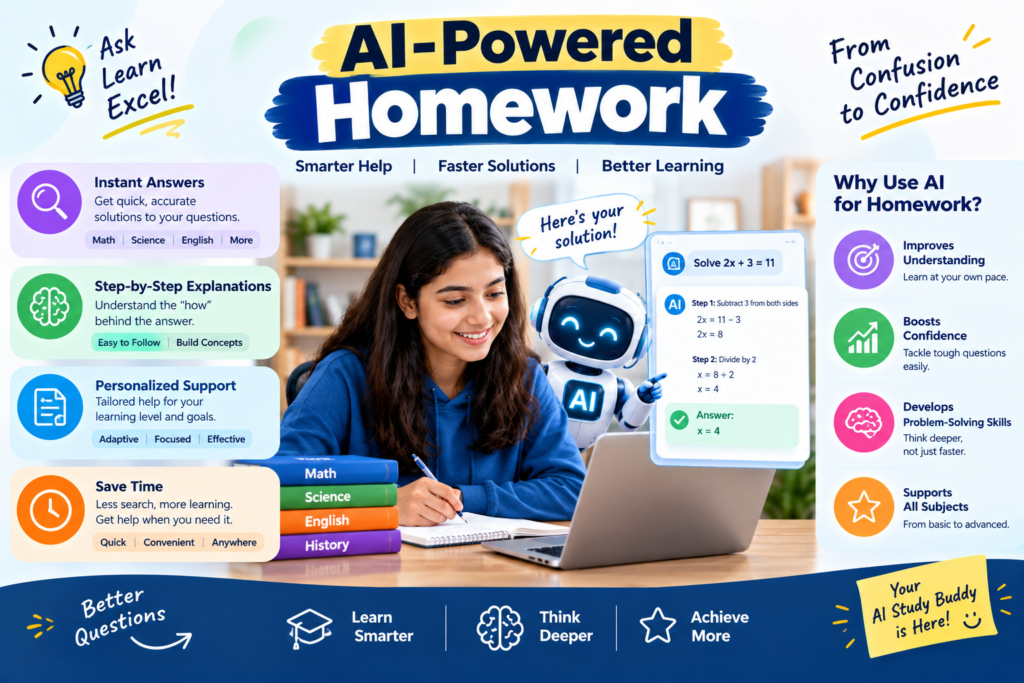
AI-Powered Homework and Its Impact on Learning
Artificial intelligence is changing education in many ways. One of the biggest changes is how students complete homework. Today, learners can use AI homework help to understand difficult topics, solve practice problems, improve their writing, and prepare for exams.
In the past, students often had to wait for a teacher or search through books to find answers. Now, AI-powered homework tools can provide explanations in seconds. Students can ask follow-up questions, review mistakes, and explore topics at their own pace.
However, technology alone doesn’t guarantee better learning. Students still need to think, practice, and develop their own skills. When used correctly, AI can support these goals. When used carelessly, it can make students depend on ready-made answers.
The key is to use artificial intelligence as a learning partner, not as a replacement for learning.
In this guide, we’ll explore the benefits of AI for homework assistance, its effects on student learning, and practical ways to use AI study tools responsibly.
What Is AI-Powered Homework?
AI-powered homework refers to the use of artificial intelligence to help students understand lessons, practice skills, and complete academic tasks. These tools use technologies such as natural language processing, machine learning, and generative AI to respond to questions and provide learning support.
For example, a student who struggles with algebra can ask an AI tool to explain an equation step by step. A student writing an essay can request feedback on grammar, structure, and clarity. The goal isn’t just to find answers. It’s to make learning easier to understand and more accessible.
How AI Homework Tools Work
AI homework tools process the information a student provides and generate a response based on patterns learned during training, available context, and the tool’s capabilities.
A typical learning session may work like this:
- A student enters a question or uploads permitted study material.
- The AI reviews the request.
- It generates an explanation, suggestion, or practice activity.
- The student reviews the response and asks follow-up questions.
- The student applies the knowledge to solve the problem independently.
For instance, a learner who doesn’t understand photosynthesis can ask for a simple explanation, a real-life example, and a short quiz. This makes digital learning support more interactive. Still, AI responses can contain errors, so important facts should be checked against trusted textbooks, teachers, or educational sources.
Common Types of AI Homework Tools
Different tools support different learning needs. Some focus on writing, while others help with mathematics, languages, research, or exam preparation.
|
Tool Type |
Main Purpose |
Example Use |
|
AI tutors |
Explain difficult concepts |
Understand a science lesson |
|
Writing assistants |
Improve grammar and structure |
Review an essay draft |
|
Math tools |
Explain calculations |
Practice algebra |
|
Language tools |
Support vocabulary and grammar |
Learn English |
|
Research assistants |
Organize information |
Explore a project topic |
|
AI quiz tools |
Generate practice questions |
Prepare for an exam |
|
Study planners |
Organize revision tasks |
Build a weekly study plan |
These tools can save time and help students find new ways to understand a topic. However, their value depends on how students use them. A useful rule is simple: ask AI to explain the work before asking it to produce the work.
7 Powerful Benefits of AI Homework Help
AI homework help can make study sessions more flexible, personal, and engaging. The following seven benefits explain how it may support students when used responsibly.
1. Personalized Learning Support
Every student learns at a different pace. Some understand a topic after one explanation, while others need several examples. Traditional classroom teaching may not always allow teachers to give each learner individual attention. AI learning assistance can help fill part of this gap.
Students can request explanations that match their current level. They can also ask the AI to simplify complex ideas, provide examples, or explain a concept in different ways. For example, a student struggling with fractions could ask for a basic explanation using pizza slices. Once the concept becomes clear, the student could move to more difficult exercises.
This approach supports personalized learning because students can control the pace and depth of their practice. Students may feel more comfortable asking questions when they don’t understand something. They can review difficult lessons without feeling rushed.
However, personalized explanations aren’t always correct or suitable for every learner. Students should compare important information with reliable educational materials.
2. Instant Feedback and Error Correction
Feedback is an important part of learning. It helps students identify mistakes and understand how to improve. Without timely feedback, a student may continue practicing a method incorrectly. AI tools can sometimes identify errors quickly and suggest improvements.
For example, a student working on an English paragraph might receive suggestions about punctuation, grammar, and sentence structure. A mathematics learner might ask why a particular calculation produces the wrong result. An AI tutor can explain the steps and suggest where to check the work.
This type of automated feedback makes homework more interactive. Instead of waiting until the next class, students can review mistakes during their study session.
However, students shouldn’t accept every correction without thinking. AI systems may misunderstand a question or suggest an incorrect solution. The best approach is to review feedback, understand the reason behind it, and confirm important answers using trusted sources.
3. Better Study Habits and Time Management
Homework often involves several subjects, deadlines, and revision tasks. Students may struggle to decide what to study first. AI study tools can help learners organize their workload.
For example, students can ask an AI assistant to create a weekly revision schedule based on their available study time. They can divide a large assignment into smaller tasks and set realistic goals.
Useful applications include:
- Creating daily study plans.
- Breaking large assignments into manageable steps.
- Generating revision questions.
- Summarizing notes for review.
- Organizing topics by difficulty.
- Planning practice sessions before exams.
These smart homework solutions can reduce confusion and help students make better use of their time. However, homework automation should focus on planning and repetitive tasks, not replacing the student’s thinking.
A well-organized schedule is helpful only when students follow it and complete the learning activities themselves.
4. Improved Access to Learning Resources
Not every student has access to private tutoring or additional educational support. AI-powered study assistance can provide explanations and practice opportunities at relatively low cost, depending on the tool and its available features.
A student can explore a topic outside classroom hours, review difficult concepts, or practice a new language. Some educational AI apps also support multiple languages, which may help learners understand unfamiliar concepts. For example, a student learning science in English could request a simpler explanation before reviewing the formal terminology in a textbook.
This flexibility can make educational support more accessible. However, access isn’t equal for everyone. Students may still need a reliable internet connection, a suitable device, or a paid subscription to use certain features. Schools and educators should consider these differences when introducing AI into homework activities.
5. Support for Different Learning Needs
Students have different strengths, challenges, and learning preferences. Some benefit from short explanations. Others prefer examples, diagrams, practice questions, or repeated instruction.
AI homework tools can offer different ways to explore a subject.
A student might request:
- A simple explanation of a complex concept.
- Examples based on everyday situations.
- Short quizzes after each topic.
- A step-by-step problem-solving guide.
- A summary of important points.
- Practice questions with increasing difficulty.
These options can help students approach difficult subjects with greater confidence.
Still, AI is not a replacement for specialist educational support or a teacher’s understanding of a student’s needs. Its explanations may not always be accessible or appropriate. Used carefully, it can provide an additional layer of support alongside classroom teaching and established learning resources.
6. Greater Student Engagement
Homework can feel repetitive, especially when students don’t understand the purpose of an exercise. AI can make practice more interactive by generating quizzes, asking follow-up questions, and offering examples connected to a student’s interests.
For example, a student who enjoys sports could ask for mathematics problems involving scores, averages, or distances. A history learner could request a timeline quiz or a set of questions about a historical event.
These activities may increase student engagement by making practice more varied. AI can also encourage students to explore topics beyond their assigned homework. A learner who becomes interested in space science, for instance, can ask additional questions and investigate related concepts.
However, engagement doesn’t always mean learning. A student may enjoy interacting with AI without developing a strong understanding of the subject. Teachers and students should therefore focus on meaningful practice, clear learning goals, and measurable progress.
7. Better Preparation for Exams
Exam preparation requires regular revision, practice, and a clear understanding of important concepts. AI homework tools can help students prepare by generating sample questions, explaining difficult topics, and organizing revision sessions.
A learner preparing for a biology exam might request a quiz on cell structure. After answering the questions, the student can review mistakes and revisit weak areas. Students can also use AI to create flashcards, practice vocabulary, or develop revision plans.
These activities can support active learning because students must recall information rather than simply read it. Still, generated questions may not match the actual exam syllabus or difficulty level.
Students should use their official syllabus, class notes, textbooks, and teacher guidance as the foundation of their preparation.
Impact of AI-Powered Homework on Learning
The impact of AI-powered homework on learning depends on how the technology is used. When students use AI to understand concepts, check their reasoning, and practice independently, it can support learning effectiveness. When they copy answers without understanding them, it may weaken important academic skills.
Effects on Critical Thinking
Critical thinking involves examining information, comparing ideas, identifying errors, and reaching logical conclusions. AI can support these skills when students use it to explore different approaches to a problem.
For example, a student could ask an AI assistant to explain two possible solutions to a mathematics problem. The student could then compare the methods and decide which one is easier to understand. Learners can also ask AI to challenge their arguments, identify gaps in their reasoning, or provide questions that test their understanding.
However, students should not treat AI-generated responses as unquestionable facts.
A useful method is to ask three questions:
- Does this answer make sense?
- Can I explain why it is correct?
- Can I verify it using a trusted source?
These questions encourage independent judgment. The aim should be to use AI to strengthen reasoning rather than outsource it.
Effects on Academic Performance
Academic performance depends on several factors, including prior knowledge, motivation, study habits, teaching quality, and practice. AI assignment help may support performance by making explanations more accessible and helping students identify mistakes earlier.
For example, regular practice with an AI tutor may help a learner understand a difficult topic before an exam. Feedback on a writing draft may also help a student improve clarity and organization.
However, access to AI doesn’t automatically lead to higher grades.
Students who rely on copied answers may complete homework quickly but struggle to explain the material during tests or classroom discussions.
To assess whether AI improves homework performance, students should consider more than assignment completion.
They should also review:
- Their ability to solve similar problems without AI.
- Their understanding of key concepts.
- Their performance on independent tests.
- Their ability to explain their reasoning.
- Their progress over time.
These measures provide a more useful picture of learning than homework scores alone.
AI and Independent Learning
Independent learning means taking responsibility for understanding, practicing, and reviewing academic material. AI can support this process by allowing students to ask questions, request additional examples, and practice at their own pace.
For example, a student who finds a lesson difficult can first try solving the assigned questions independently. If they become stuck, they can ask AI for a hint rather than a complete answer. After reviewing the explanation, the student can attempt a similar question without assistance.
This process builds a stronger connection between guidance and independent practice.
The challenge is to avoid becoming dependent on the tool. Students should gradually reduce their reliance on hints as their understanding improves. Teachers can also design assignments that require personal reasoning, practical application, and explanations in the student’s own words. Ultimately, AI should help learners become more independent, not more dependent.
Popular Types of AI Homework Tools for Students
Different AI assignment help tools serve different purposes. Choosing the right tool depends on the subject, the student’s needs, and school policies.
Writing and Assignment Assistance
Writing assistants can help students review grammar, improve sentence clarity, organize ideas, and identify areas that need more explanation. For example, a student writing an essay can request feedback on the introduction or ask whether the argument follows a logical order.
AI can also help generate brainstorming questions or suggest an outline for a research project.However, students should write and review their own work. Submitting AI-generated content as personal work may violate school or university rules.
The best use of writing assistance is to improve a student’s own draft.
Math and Science Support
Mathematics and science often require students to understand processes, formulas, and relationships. AI tutors can explain a method step by step and generate additional practice problems.
For instance, a student learning equations can request a basic example, solve it independently, and then ask for feedback. Science learners can use AI to review definitions, compare concepts, and explore examples from everyday life.
Yet, AI may make calculation errors or produce explanations that appear correct but contain faulty reasoning. Important answers should be checked against textbooks or reliable subject resources.
Research and Language Learning
AI research assistants can help students brainstorm project topics, develop research questions, and organize information. Language-learning tools can provide vocabulary exercises, grammar explanations, conversation practice, and feedback on writing.
For research assignments, students should verify facts and use credible sources. AI-generated citations may be inaccurate or entirely fabricated, so every reference must be checked. Students should also follow the rules of their school or institution when using AI for academic work.
For additional guidance, visit UNESCO’s guidance on generative AI in education and research.
This resource discusses important considerations for the responsible use of generative AI in educational settings.
Risks and Challenges of AI Homework
AI offers useful learning opportunities, but it also creates challenges that students, teachers, and families need to understand.
Overdependence on AI
One of the biggest risks is allowing AI to do too much of the work.
If students use AI to answer every question, they may miss the practice needed to build knowledge and problem-solving skills.
For example, copying a complete mathematics solution doesn’t guarantee that a student understands the formula.
Similarly, submitting an AI-written essay may prevent a learner from developing writing and research skills.
To avoid this problem, students should attempt assignments independently before asking for help.
They can request hints, explanations, or feedback instead of finished answers.
A simple rule works well: use AI when you are stuck, but make sure you can complete similar work on your own afterward.
Accuracy and Academic Honesty
AI systems can generate incorrect, outdated, or misleading information.
These mistakes may be difficult to notice because the responses often sound confident.
Students should verify important claims using textbooks, trusted websites, and teacher guidance.
Academic honesty is another important issue. Some schools permit AI-assisted brainstorming but prohibit AI-generated answers in graded assignments.
Students should understand the rules that apply to each task and disclose AI use when required.
They should also avoid presenting generated work as entirely their own.
Responsible AI use means being honest about assistance while remaining accountable for the final submission.
Privacy and Digital Access
Some AI tools request uploaded files, personal details, or account information. Students should avoid sharing sensitive information, including passwords, private records, and unnecessary personal data.
They should review the tool’s privacy settings and follow their school’s technology policies. Digital access is another challenge. Not every learner has a suitable device, a reliable connection, or access to paid features.
Schools should consider these limitations before making AI tools a required part of homework. Fair access, privacy protection, and clear guidance are essential for responsible educational technology.
How to Use AI for Homework Effectively
Students can gain more from AI homework help by following a structured learning process.
A Step-by-Step Learning Method
Step 1: Read the question carefully.
Understand the assignment before using AI. Identify the main task and the concepts involved.
Step 2: Try solving it yourself.
Spend some time thinking about the problem. Write down what you know and where you are stuck.
Step 3: Ask for guidance.
Request a simple explanation, a relevant example, or a hint. Avoid asking for a complete answer when you want to develop your skills.
Step 4: Review the explanation.
Read the response carefully. Check important facts and compare the method with your class notes.
Step 5: Complete the task independently.
Use what you’ve learned to write your own answer or solve the problem again without assistance.
Step 6: Test your understanding.
Ask AI to generate a similar practice question. Solve it independently to check whether you’ve learned the concept.
Step 7: Reflect on your progress.
Identify what you understood, what remains difficult, and which topics need more practice. This process turns AI-powered study assistance into an active learning experience.
Best Practices for Students and Teachers
Students and teachers can make AI-supported homework more effective by setting clear expectations.
|
Best Practice |
Why It Helps |
|
Use AI for explanations |
Supports conceptual understanding |
|
Ask for hints first |
Encourages independent problem-solving |
|
Verify important facts |
Reduces the risk of misinformation |
|
Follow academic policies |
Protects academic integrity |
|
Review mistakes |
Helps identify knowledge gaps |
|
Practice without AI |
Tests genuine understanding |
|
Protect personal information |
Supports digital safety |
|
Use trusted learning resources |
Improves the quality of study |
Teachers can also create assignments that ask students to explain their reasoning, compare different solutions, or reflect on how they solved a problem. Such tasks help educators assess understanding rather than simply checking whether an answer is correct.
The Future of Homework With Artificial Intelligence
The future of homework with artificial intelligence may involve more personalized practice, interactive tutoring, and faster feedback. As educational technology develops, AI tools may become better at adapting explanations to different learning levels and identifying topics that students need to review.
For example, a future learning platform might notice that a student repeatedly struggles with fractions and recommend extra practice before introducing more advanced concepts. AI may also help teachers identify common learning difficulties across a class. This information could guide lesson planning and targeted support.
However, these possibilities depend on the quality of the technology, the available data, and the way schools implement it. Human guidance will remain important. Teachers understand classroom context, student motivation, social development, and individual circumstances in ways that automated systems may not.
The most effective approach is likely to combine AI capabilities with teacher expertise and student effort. Schools should also establish clear rules for privacy, fairness, accuracy, and responsible use.
The goal isn’t to automate every part of homework. It’s to make learning more meaningful, accessible, and effective.
AI-powered homework is creating new opportunities for students to learn, practice, and improve their academic skills. From personalized explanations to automated feedback, these tools can make homework more flexible and engaging.
However, the impact of AI-powered homework on learning depends on how students use the technology.
Students who ask questions, review mistakes, verify information, and practice independently can use AI to strengthen their understanding. Those who rely on ready-made answers may miss important learning opportunities.
Teachers and parents also have an important role in encouraging responsible use and protecting academic integrity.
Know More:
”FAQs”
1. What is AI-powered homework?
AI-powered homework uses artificial intelligence to help students understand lessons, solve practice problems, improve writing, and prepare for exams. These tools can provide explanations, suggestions, and feedback based on a student's questions.
2. What are the benefits of AI homework help?
AI homework help can provide personalized explanations, instant feedback, extra practice, study planning, and flexible learning support. Its benefits depend on whether students use it to understand concepts rather than simply copy answers.
3. Does AI improve homework performance?
AI may improve homework performance by helping students identify mistakes and understand difficult topics. However, results vary based on the student's learning habits, the tool's accuracy, and the quality of instruction. Independent practice is still essential.
4. Are AI homework tools suitable for school students?
AI homework tools can support school students when used with appropriate guidance. Parents and teachers should help students choose suitable tools, protect their privacy, verify information, and follow school policies.
5. Can AI replace teachers in homework assistance?
No. AI can provide additional explanations and practice, but teachers offer human judgment, emotional support, classroom context, and guidance tailored to individual needs. AI works best as a supporting tool rather than a replacement for teachers.
6. How can students use AI without cheating?
Students should attempt their homework first, request hints or explanations, verify information, and write their own answers. They should follow school policies and disclose AI assistance when required.
7. What are the main risks of AI-powered homework?
The main risks include overdependence, inaccurate information, privacy concerns, unequal access, and academic dishonesty. Students can reduce these risks by checking answers, protecting personal data, and practicing independently.
8. What is the future of AI homework tools?
AI homework tools may offer more personalized explanations, adaptive practice, and faster feedback. Their success will depend on responsible implementation, reliable information, teacher involvement, and a focus on genuine learning.