Have you ever listened to a video and wondered whether a real person was speaking? Today, artificial intelligence can create voices that sound clear, natural, and human-like. Some tools can even copy the sound of a person’s voice with their permission.
This technology is known as AI voice generation and voice cloning. It helps people create videos, audiobooks, podcasts, online lessons, and translated content. It also makes digital services easier to use for people who have difficulty speaking or reading.An AI voice generator can turn a written script into spoken words within seconds. Voice cloning goes a step further by creating a voice that resembles a particular speaker. Both technologies are becoming more useful as artificial intelligence improves.
However, there are risks. Someone could copy a person’s voice without permission, create fake audio, or use a synthetic voice to trick another person. These concerns make responsible use important. In this guide, we’ll explain how AI voice generators work, explore seven powerful applications, compare synthetic voices with human voices, and discuss the risks and ethics of voice cloning.
What Is an AI Voice Generator?
An AI voice generator is a tool that uses artificial intelligence to create spoken audio. It can read written text aloud, produce a selected voice, or generate speech in different languages.
For example, a student could enter a paragraph into a text-to-speech AI tool. The software would turn the paragraph into an audio recording. The student could then listen to it while studying or traveling. AI-generated voices can sound calm, friendly, professional, or expressive. Some tools also let users change the speaking speed, tone, pronunciation, and pauses.
What Is AI Voice Cloning?
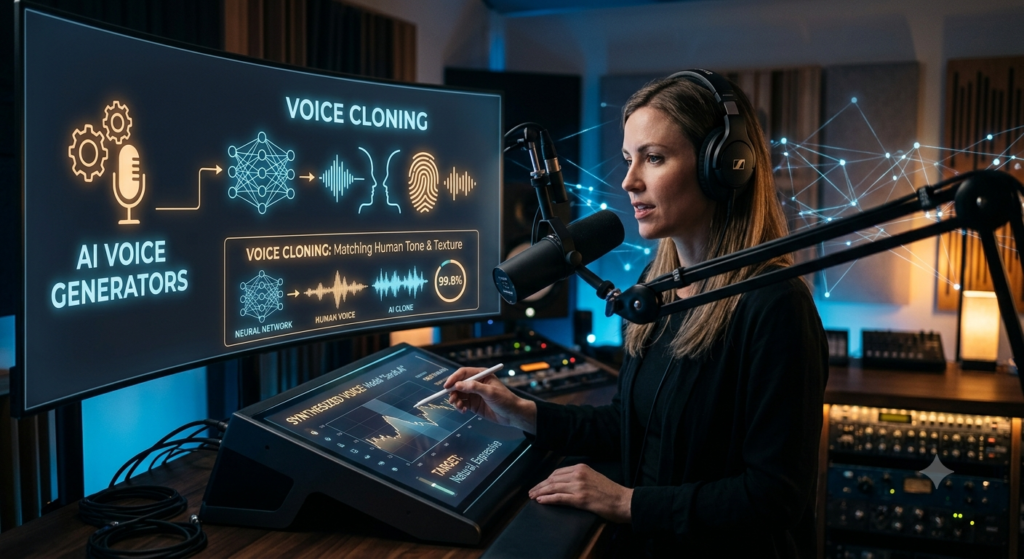
Voice cloning is a type of synthetic voice technology that creates a digital voice resembling a specific person’s voice. A system may learn from approved voice recordings and use them to reproduce speech patterns. Depending on the tool, it may need a short recording or a larger collection of audio.
The resulting voice might resemble the original speaker’s accent, pitch, rhythm, and tone. More advanced systems can also create speech that wasn’t included in the original recordings.For example, a content creator might use an authorized voice clone to narrate new videos without recording every sentence manually.
Voice cloning doesn’t reproduce a person’s thoughts or identity as a whole. It imitates aspects of their voice. The result may still contain errors or sound different from the original speaker.
How Do AI Voice Generators Work?
Most modern AI voice tools use machine learning and neural networks. These systems learn patterns from speech and use those patterns to generate new audio.
The process usually follows these steps:
- Text or audio input: The user enters a script or supplies an authorized voice recording.
- Language processing: The system identifies words, sentence structure, and pronunciation.
- Voice modeling: The AI selects a general voice or uses a permitted voice profile.
- Speech generation: The system creates an audio signal that represents the requested speech.
- Audio processing: The tool may adjust pauses, volume, speed, and sound quality.
- Export: The user downloads or integrates the finished audio.
Not every system follows the same process. Some tools generate speech directly from text, while others use multiple models to process language, voice characteristics, and audio.
Difference Between AI Voice Cloning and Text-to-Speech
Although these technologies are related, they serve different purposes.
| Feature | Standard Text-to-Speech AI | Voice Cloning |
| Main purpose | Reads text aloud | Creates speech resembling a specific voice |
| Voice selection | Usually uses preset voices | Uses an authorized speaker’s voice characteristics |
| Voice recording | Often unnecessary | Usually required for voice creation |
| Common use | Accessibility and narration | Personalized narration and approved voice replication |
| Main concern | Audio quality and accuracy | Consent, identity, and misuse |
| Best for beginners | Simple reading tasks | Projects requiring a specific voice |
In short, text-to-speech AI focuses on converting text into speech. Voice cloning focuses on reproducing characteristics of a particular voice. Some platforms combine both features, allowing users to type text and generate speech using an authorized cloned voice.
How Voice Cloning Technology Works
Voice cloning depends on several technologies that help computers understand and reproduce patterns in human speech.
A human voice contains many details. These include pitch, tone, pronunciation, accent, timing, and emotional expression. AI systems analyze these patterns to create speech that sounds similar to the original recording.
Neural Networks and Deep Learning
Neural networks are computer models designed to learn patterns from data. Deep learning uses networks with multiple layers to learn more complex patterns.
In voice generation, these models can learn how sounds relate to words and how speech changes across sentences.
For example, the word “record” can have different pronunciation patterns depending on whether it’s used as a noun or a verb. A speech model may use language context to select the appropriate pronunciation.
Modern AI speech synthesis can also learn how people pause, stress important words, and change their tone.
However, a model doesn’t understand speech in exactly the same way a human does. It learns statistical patterns from its training data and uses them to generate an output.
The Role of GANs in Voice Cloning
Generative adversarial networks, or GANs, are a type of machine learning architecture.
A GAN uses two competing models:
- A generator creates synthetic data.
- A discriminator attempts to distinguish generated data from real data.
During training, these models improve through competition. In some audio-generation systems, GAN-based methods help produce realistic speech waveforms or improve audio quality.
However, GANs aren’t the only method used for voice cloning. Modern speech systems may use different combinations of neural networks, acoustic models, and neural audio generators.
Diffusion Models for Audio
Diffusion models are another approach to generating content. They learn to create data by reversing a process that gradually adds noise.
In audio generation, diffusion models can learn to produce speech or other sounds from a noisy representation.
These models may help generate detailed audio and support expressive speech. Their performance depends on the model design, training data, and computing resources.
Large Language Models in Voice Generation
Large language models, or LLMs, can help voice systems understand and prepare the text that will be spoken.
For example, an AI assistant might use an LLM to draft an answer, simplify a paragraph, or translate a sentence. A separate speech model then turns that text into audio.
This creates a connected workflow:
User question → Language model → Written response → Speech model → Spoken answer
Some systems combine language and audio capabilities more closely. Multimodal AI voice synthesis can work with text, audio, and sometimes visual information.
These developments make AI voice assistants more flexible. Still, users should remember that a natural-sounding voice doesn’t guarantee that the information is correct.
Seven Powerful Uses of AI Voice Technology
AI voice generators are useful across education, business, entertainment, accessibility, and communication. The following examples show how people can apply synthetic speech in practical ways.
1. Education and Student Learning
AI voice generators can make educational content easier to access and understand.
Students can convert study notes, textbook passages, and revision materials into audio. They can listen while commuting, walking, or reviewing lessons away from a screen.
Teachers can also use AI narration to prepare learning materials for online classes.
Examples of AI voice cloning in education include:
- Creating authorized audio versions of course materials.
- Producing consistent narration for recorded lessons.
- Making multilingual learning resources.
- Providing audio instructions for online assignments.
- Creating accessible content for students who struggle with reading.
For instance, a teacher could prepare an English lesson and create approved versions in Hindi and other languages. Students could listen to the lesson and read the text at the same time.
However, schools should not clone a teacher’s voice without permission. Students should also avoid submitting synthetic speech as their own recorded work when an assignment requires an authentic recording.
2. Business and Customer Support
Businesses can use AI voice tools to improve communication and reduce repetitive recording work. A company might use synthetic speech for product demonstrations, training videos, automated announcements, and customer support systems. AI voice assistants can also answer common questions, guide users through basic processes, and provide spoken information around the clock.
Common applications include:
- Automated customer service.
- Product tutorials and demonstrations.
- Employee training.
- Spoken website instructions.
- Internal learning materials.
- Voice-enabled applications.
For example, a software company could produce one product tutorial and generate approved narration in several languages. However, automated systems should clearly identify themselves when needed. Customers should have a way to contact a human representative when the AI cannot solve their problem.
3. Podcasts, Videos, and Digital Content
Content creators often need clear narration for videos, podcasts, presentations, and educational media. AI narration software can turn a script into audio without requiring a recording studio. This can help creators who have limited equipment, time, or recording experience. AI podcast tools may also help produce introductions, draft voiceovers, or create additional language versions of existing episodes.
Useful applications include:
- Explainer videos.
- Audiobooks.
- Social media videos.
- Educational podcasts.
- Training presentations.
- Authorized dubbing and localization.
For example, a creator could prepare a video about artificial intelligence and use a synthetic voice to narrate the script. The creator should still review the audio carefully. Incorrect pronunciation, unnatural pauses, and unsuitable emotional tone can reduce the quality of the final content.
4. Accessibility and Assistive Communication
Accessibility is one of the most valuable uses of synthetic speech. People with speech difficulties may use assistive communication systems to express themselves. Depending on the person’s needs, a personalized voice may help preserve a familiar way of speaking. Text-to-speech systems can also help people with visual impairments, reading difficulties, or certain learning needs.
Examples include:
- Reading digital documents aloud.
- Speaking typed messages.
- Providing audio navigation.
- Creating accessible learning materials.
- Supporting communication through assistive devices.
Personalized AI voices may be especially meaningful for people who are at risk of losing their ability to speak because of a medical condition. Where appropriate and chosen by the individual, recording a voice in advance may help create a personalized speech option for future use. Such projects require careful handling of voice recordings, clear consent, and strong privacy protections.
5. Multilingual Communication and AI Dubbing
AI dubbing tools can help adapt videos, training materials, and presentations for audiences who speak different languages. A system may translate a script, generate speech in another language, and adjust the timing to fit the video. Some tools can preserve aspects of the original speaker’s voice across languages, provided the required permissions are in place.
This can help educational organizations, businesses, and creators reach a wider audience. However, translation and speech generation can introduce errors. Idioms, cultural references, humor, and technical terms may not transfer correctly between languages. Human review is important, especially for legal, medical, educational, or other high-impact content.
6. Personalized Voice Assistants
AI voice assistants can help users interact with technology through speech. A person may ask a voice assistant to explain a topic, summarize information, set a reminder, or guide them through an application.
Personalized AI voices can make these interactions more comfortable or suitable for a particular brand or user group.
For example, a learning application could offer a choice of speaking styles and languages. A user might select a slower voice for difficult topics or a familiar voice for regular lessons.
Personalization should remain optional. Users should be able to change the voice, disable speech features, and control how their audio data is used.
7. Marketing, Training, and Virtual Voice Production
Businesses can use synthetic speech to create product explainers, advertising drafts, internal presentations, and training resources. Virtual voice production may also reduce the need to re-record an entire script when a small section changes.
For example, a company could update a product demonstration by editing the script and generating new narration. This may be faster than arranging a new recording session. However, marketing teams should follow advertising rules and obtain permission when using a recognizable person’s voice.They should never use voice cloning to create a false endorsement or make it appear that someone supports a product when they don’t.
Benefits of Synthetic Voice Technology
AI voice generation offers several practical benefits when used responsibly.
Faster Content Production
Traditional recording may require a microphone, a quiet room, editing software, and repeated takes. AI voice tools can simplify many of these steps.
This can be useful for creators who need to produce frequent updates.
Lower Production Costs
Some AI voice tools reduce the need for expensive recording equipment or studio time. However, high-quality platforms, commercial licenses, and professional editing may still involve costs.
Better Accessibility
Synthetic speech can make written information available in audio form. It can support people who prefer listening or need assistive communication.
Support for Multiple Languages
AI speech synthesis can help organizations prepare content for audiences who speak different languages.
The quality of pronunciation and translation varies, so important material should receive human review.
Flexible Voice and Speech Settings
Many tools let users adjust speed, tone, pronunciation, and pauses. These controls can help match audio to a lesson, presentation, or video.
Easier Content Updates
If a script changes, a user may only need to regenerate the affected section. This can save time during content updates.
Overall, synthetic voice technology can make audio production more accessible and flexible. Its value depends on the quality of the output and the care taken to use it ethically.
Risks and Privacy Concerns of AI Voice Cloning
Despite its benefits, voice cloning creates serious risks. A convincing voice recording can influence what people believe, especially when they trust the person who appears to be speaking.
Deepfake Voice and Audio Fraud
A deepfake voice is synthetic audio designed to imitate a real person’s voice or create speech that appears to come from someone else.
Criminals may use such audio to impersonate family members, company leaders, public figures, or employees.
For example, a person might receive a call that sounds like their manager requesting an urgent money transfer. The voice may seem familiar, but the request could be fraudulent.
Common warning signs include:
- Unexpected requests for money.
- Pressure to act immediately.
- Requests for passwords or verification codes.
- Unusual payment instructions.
- Requests to keep a transaction secret.
A familiar voice alone isn’t proof of identity.
If a request involves money or sensitive information, contact the person through a separate, trusted channel. For business payments, follow established approval procedures.
Privacy and Unauthorized Voice Cloning
Voice recordings can contain personal information. They may also reveal details about a person’s identity, language, accent, or speaking habits.
Uploading recordings to an unknown platform may create privacy risks, especially if the service stores audio or uses it for model training.
Before uploading a recording, check:
- What data the platform collects.
- How long recordings are retained.
- Whether the provider uses recordings to train models.
- Who can access generated voice profiles.
- How to delete recordings and account data.
- Whether commercial use is allowed.
Users should avoid uploading private conversations, confidential meetings, or another person’s voice without authorization.
Risks of AI Voice Cloning for Students
Students may face specific risks when using synthetic voice applications.
A voice recording could be copied from a public video or social media account and used to impersonate the student. Fake audio could also be created to spread rumors, bully classmates, or damage someone’s reputation.
Other risks include:
- Sharing voice recordings with untrusted applications.
- Using tools that collect more personal data than necessary.
- Believing fake audio without checking its source.
- Violating school rules about AI-generated assignments.
- Cloning a teacher or classmate without consent.
Students should use trusted services, protect their accounts, and follow school policies. If someone creates fake audio using their voice, they should save evidence, report the content to the platform, and seek help from a trusted adult or appropriate authority.
Misinformation and Loss of Trust
Synthetic speech can make false statements sound convincing. A fabricated recording may be shared without context, leading people to believe that a person said something they never said.
This can harm individuals, organizations, and public discussion.
AI-generated audio may also make it harder to trust genuine recordings. For this reason, organizations should use clear disclosure practices and reliable methods to verify important communications.
How AI Voice Cloning Impacts Privacy
The privacy impact depends on how recordings are collected, processed, stored, and shared.
A voice clone may remain available after the original recording is deleted if the provider retains a voice model or backup. The exact situation depends on the service’s policies and technical design.
Users should therefore review data deletion procedures before creating a voice profile.
Organizations should limit access to voice models, set retention periods, and obtain permission before generating or publishing synthetic speech.
AI Voice Ethics: How to Use Voice Technology Responsibly
Voice AI ethics focuses on using synthetic speech in ways that respect people, protect their rights, and reduce harm.
A responsible approach doesn’t require avoiding AI voice technology altogether. Instead, it requires clear rules about consent, transparency, security, and accountability.
1. Obtain Clear Consent
Before cloning a person’s voice, obtain permission from the person who owns or controls the voice rights.
Consent should explain what the voice will be used for, where the audio may appear, and whether the voice model may be retained or reused.
Permission to publish one recording shouldn’t automatically be treated as permission to create unlimited new speech.
2. Disclose AI-Generated Speech
When people could reasonably mistake synthetic speech for a real recording, clear disclosure can help prevent confusion. For example, a video description might state that the narration uses an AI-generated voice. Businesses should be especially careful when synthetic speech represents a customer, employee, public figure, or other identifiable person.
3. Protect Voice Data
Voice recordings and voice models should receive suitable security protections.
Organizations can limit access, encrypt stored data, remove unnecessary recordings, and provide clear procedures for handling deletion requests.
Users should also choose providers that explain their privacy practices in understandable language.
4. Avoid Deception and Impersonation
Voice cloning shouldn’t be used to trick people into sharing confidential information, sending money, or believing a false statement.
It shouldn’t be used to create fake endorsements, misleading evidence, or unauthorized imitations intended to harm another person.
5. Review Generated Content
AI-generated audio can contain errors, mispronunciations, misleading statements, or unsuitable emotional expressions.
A human reviewer should check important content before publication.
This is especially important in education, healthcare, legal communication, financial services, and public announcements.
6. Follow Relevant Laws and Platform Policies
AI voice regulation differs across countries and may depend on privacy, fraud, intellectual property, consumer protection, and data-protection laws. Before using voice cloning commercially, review the laws that apply to the people, services, and audiences involved. For further information about responsible AI principles, see the UNESCO Recommendation on the Ethics of Artificial Intelligence.
Responsible AI voice technology should help people communicate without removing their control over their own identity.
AI Voice Generator vs. Human Voice: Which Is Better?
AI-generated voices and human recordings each have strengths. The best option depends on the purpose of the project.
| Factor | AI-Generated Voice | Human Voice |
| Production speed | Often very fast | May require recording and editing |
| Cost | Can be lower for repeated work | Varies by talent and production needs |
| Consistency | Can maintain a stable sound | May vary between recording sessions |
| Emotional expression | Improving, but may sound unnatural | Often offers nuanced expression |
| Editing | Text changes can be regenerated | Changes may require re-recording |
| Personal connection | Depends on context and delivery | Often feels direct and personal |
| Privacy concerns | Includes voice-model and data risks | Includes recording and consent risks |
| Best applications | Scalable narration and routine content | Interviews, personal messages, and nuanced performances |
AI voice generation is useful when speed, consistency, and repeated production matter. Human narration may be better when a project depends on personal experience, natural emotion, or direct interaction. A combined approach can work well. For example, a business might use AI narration for standard tutorials and human speakers for interviews or important customer messages. Neither approach is automatically better in every situation. Quality, transparency, audience needs, and consent should guide the decision.
How Students Can Use AI Voice Tools Safely
Students can benefit from AI voice technology without putting their privacy or academic integrity at risk.
Practical Uses for Learning
Students may use AI-generated speech to:
- Listen to revision notes.
- Practice pronunciation in a new language.
- Review difficult reading material.
- Create narration for presentations.
- Improve accessibility while studying.
- Listen to their own written work to identify unclear sentences.
For example, a student preparing for an exam could convert a chapter summary into audio. Listening to the summary while following the written text may help with revision.
A Simple AI Voice Cloning Tutorial for Students
If a school project genuinely requires voice cloning, follow a consent-based process.
- Choose a suitable tool. Review its privacy policy, age requirements, and usage rules.
- Obtain permission. Use your own voice or a voice you have explicit permission to clone.
- Prepare a recording. Follow the platform’s instructions and avoid including private conversations.
- Create the voice profile. Use the tool’s approved process.
- Enter a short script. Check the pronunciation and meaning before generating the full recording.
- Review the output. Listen for errors, unnatural pauses, or misleading delivery.
- Label the content. Make it clear when synthetic speech could be mistaken for a real recording.
- Delete unnecessary data. Remove voice samples and profiles when appropriate and supported by the service.
Students should never clone a teacher, classmate, or public figure without permission. They should also follow assignment rules about AI assistance.
How to Choose Best AI Voice Generator for Beginners
The best AI voice generator for beginners depends on the intended use. A student creating revision audio has different needs from a business producing multilingual training videos. Rather than choosing a tool based only on how realistic its voice sounds, consider the full experience.
| Feature | Why It Matters |
| Ease of use | Helps beginners create audio without complex setup |
| Voice quality | Affects clarity and listening comfort |
| Language support | Determines which languages and accents are available |
| Voice cloning | Needed only when an authorized personalized voice is required |
| Privacy controls | Helps protect recordings and voice profiles |
| Export options | Determines how audio can be used in projects |
| Commercial license | Clarifies whether business use is permitted |
| Pricing | Helps users stay within their budget |
| Accessibility features | Supports users with different communication needs |
Questions to Ask Before Using a Tool
- Can I use the generated audio for my intended purpose?
- Does the platform require proof of consent for voice cloning?
- Does it store recordings or voice models?
- Can I delete my voice data?
- Does the service clearly explain its limitations?
- Can I export audio in a suitable format?
- Are there limits on usage, downloads, or commercial rights?
Beginners should start with standard text-to-speech when they only need narration. Voice cloning adds extra responsibilities and isn’t necessary for every project. Always check the provider’s current terms before publishing audio, especially when the content is commercial or uses an identifiable person’s voice.
The Future of Voice Technology
The future of voice technology will likely include more natural speech, faster generation, better multilingual support, and closer connections between text, audio, and other forms of AI.
These improvements may make voice tools more useful in education, customer service, accessibility, entertainment, and everyday communication.
More Natural and Expressive Speech
AI systems are improving their ability to handle pauses, emphasis, pronunciation, and speaking style.
This may make synthetic speech easier to understand and more suitable for longer content.
However, a natural sound doesn’t mean that the speech is accurate or trustworthy. Users will still need to check important information.
Real-Time Translation and Dubbing
Real-time speech translation may help people communicate across language barriers.
For example, a multilingual meeting system could translate spoken comments and produce speech in another language. Such systems could help international teams and learners.
The main challenges will include translation accuracy, privacy, latency, and preserving the meaning of the original speaker.
Multimodal AI Voice Synthesis
Multimodal AI systems can process or generate more than one type of information, such as text and audio.
A future learning assistant might read a lesson, answer questions aloud, and adjust its explanations based on a student’s requests.
A video platform might also coordinate speech, subtitles, and translated audio within a single workflow.
These features could make digital communication more flexible, but they will require strong safeguards.
Better Detection and Authentication
As synthetic audio becomes more convincing, tools for verifying audio sources will become increasingly important.
Possible approaches include cryptographic signatures, secure recording systems, content provenance information, and audio detection methods.
No single detection system is perfect. Audio can be compressed, edited, or altered in ways that affect detection results.
For high-risk decisions, people should combine technical checks with trusted verification procedures.
Stronger Rules and Responsible Innovation
Governments, businesses, and technology providers will continue to face questions about consent, privacy, fraud, and disclosure. Clear policies can help users understand what is permitted and what happens to their recordings.
Organizations that build transparency and consent into their systems may be better prepared to earn public trust. The future of AI voice technology will depend not only on better models but also on the choices made by developers, businesses, educators, and users.
AI voice generators and voice cloning are changing the way people create and experience spoken content. They can support education, improve accessibility, speed up content production, and help businesses communicate across languages. However, these benefits come with responsibilities. Synthetic voices can be misused for fraud, impersonation, misinformation, and privacy violations. A voice that sounds real shouldn’t automatically be treated as genuine evidence.
The best approach is to use AI voice tools with clear permission, strong privacy practices, transparent disclosure, and human review. Students should protect their recordings, businesses should establish responsible policies, and developers should make their systems safer and easier to understand.
As synthetic voice technology advances, responsible AI voice generation will be just as important as realistic speech. When people use these tools thoughtfully, AI can make communication more accessible and creative without sacrificing trust.
Know More :
”FAQs”
1. What is AI voice cloning?
AI voice cloning is a technology that creates synthetic speech resembling a particular person's voice. It uses machine learning to reproduce characteristics such as pitch, tone, and pronunciation. It should be used with appropriate consent and safeguards.
2. How do AI voice generators work?
AI voice generators use trained machine learning models to convert text or other inputs into speech. The models learn patterns related to language, pronunciation, timing, and sound. Some tools also allow users to create or select personalized voice profiles.
3. What is the difference between AI voice cloning and text-to-speech?
Text-to-speech converts written text into spoken audio using an available voice. Voice cloning creates a voice that resembles a particular speaker. Some tools combine both technologies to generate new text using an authorized cloned voice.
4. What are the main risks of AI voice cloning?
The main risks include impersonation, fraud, privacy violations, fake recordings, reputational harm, and unauthorized use of someone's identity. Users can reduce these risks by obtaining consent, protecting recordings, and verifying important requests through trusted channels.
5. Can students use AI voice generators for education?
Yes. Students can use them to listen to study notes, practice pronunciation, review lessons, and create accessible learning materials. They should follow school policies, protect their personal information, and disclose AI assistance when required.
6. What are examples of AI voice cloning in education?
Examples include creating authorized narration for lessons, producing consistent course audio, supporting assistive communication, and preparing multilingual learning resources. Schools should obtain permission before cloning teachers' or students' voices.
7. How does AI voice cloning impact privacy?
Voice cloning may expose personal recordings, voice profiles, or other identifying information. Privacy risks depend on how a platform collects, stores, shares, and deletes data. Users should review the provider's policies and avoid uploading recordings without permission.
8. Are AI-generated voices better than human voices?
Neither is always better. AI voices are useful for fast, repeatable narration, while human voices often offer natural emotional expression and personal connection. The right choice depends on the audience, purpose, budget, and quality requirements.
9. Can AI voice generators create speech in different languages?
Yes. Many tools support multiple languages and accents. However, pronunciation, translation quality, and naturalness vary. Important audio should be reviewed by someone who understands the target language.
10. How can I identify a deepfake voice?
It may be difficult to identify a convincing deepfake by listening alone. Check the source of the recording, verify unusual requests through another trusted channel, and look for supporting evidence. Don't rely only on audio-detection software or the apparent sound of a voice.
11. Is voice cloning legal?
The answer depends on the country, the purpose, the person's consent, and applicable privacy, fraud, intellectual property, and other laws. Before using a cloned voice commercially, check the relevant laws and platform terms.
12. What is the future of AI voice technology?
AI voice technology is likely to improve in naturalness, multilingual communication, accessibility, and integration with digital assistants. At the same time, better consent systems, security measures, and ways to verify audio sources will be important.