Multimodal AI
Artificial intelligence is changing how people work, learn, and solve problems. Early AI systems often focused on one type of information. Some worked with text, while others identified objects in pictures or converted speech into written words.
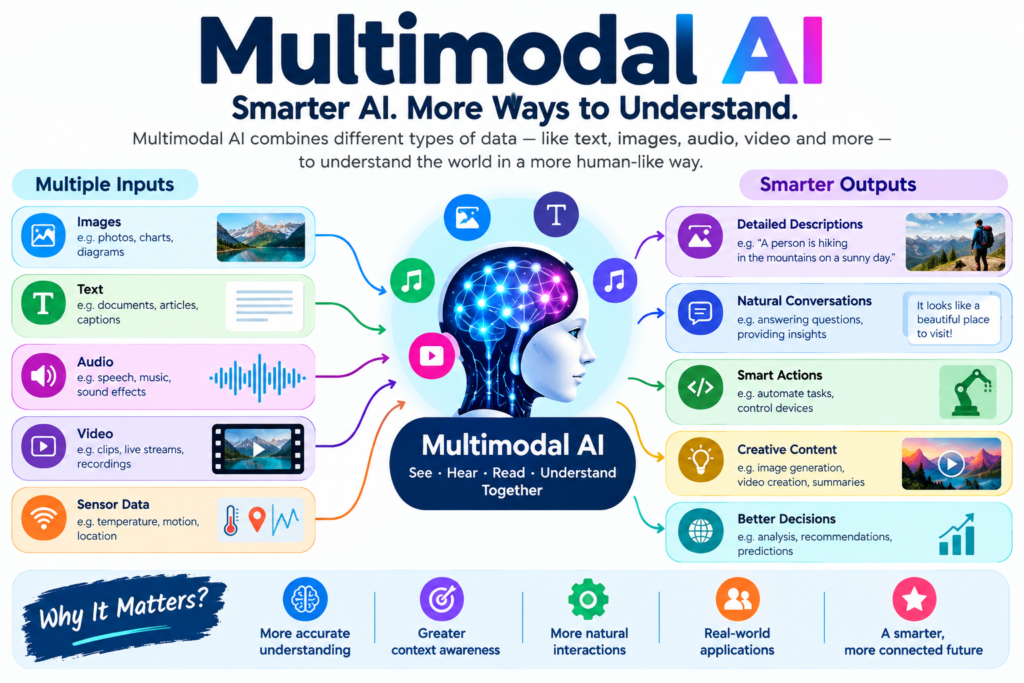
Today, AI can combine several types of information in one system. It can read a question, inspect an image, listen to a recording, and use details from a video to produce a useful response. This technology is called multimodal AI. The word multimodal means using more than one mode or type of information. These modes can include text, images, audio, video, and sensor data. For example, imagine uploading a picture of a broken bicycle and asking an AI assistant what might be wrong. The system can examine the picture, understand your question, identify visible parts, and suggest possible problems.
A text-only system may explain bicycle repairs, but it can’t directly inspect the picture unless it has image-processing capabilities. A multimodal system can combine both sources of information. This change opens new possibilities in healthcare, education, business, robotics, entertainment, and scientific research.
However, multimodal AI isn’t simply about collecting different data types. The system must also learn how these types relate to each other. It needs to connect words with objects, sounds with events, and video frames with actions. In this guide, we’ll explore multimodal AI in simple terms, examine real-world examples, and explain how beginners can start learning about it.
1. What Is Multimodal AI in Simple Terms?
Multimodal AI is a type of artificial intelligence that can process and connect two or more types of data. It helps machines understand information from different sources and use that information to complete a task.
Common data types include:
- Text: Questions, documents, messages, and written instructions.
- Images: Photographs, charts, diagrams, and medical scans.
- Audio: Speech, music, environmental sounds, and recordings.
- Video: Moving images, actions, and events over time.
- Sensor data: Temperature readings, motion signals, and other measurements.
A multimodal system can combine these inputs to build a more complete picture of a situation.
How Does Multimodal AI Differ From Traditional AI?
Traditional AI can be designed for a specific task, such as detecting spam emails or identifying faces. Many such systems rely mainly on one type of input. Multimodal AI can combine different inputs when a task requires them. Consider an online learning platform. A learner may watch a science video, ask a question about a diagram, and request a spoken explanation. A multimodal system can connect the question with the visual content and provide an answer in text or speech. This ability makes multimodal learning useful for tasks that involve several types of information.
Multimodal vs. Unimodal AI
The difference between multimodal and unimodal AI is the number of data types a system can process within its design.
| Feature | Unimodal AI | Multimodal AI |
| Input types | One main type | Two or more types |
| Example | Text classification | Text and image analysis |
| Context | Limited to its supported input | Can combine different sources |
| Typical tasks | Speech recognition or image classification | Video question answering or image-based assistance |
| Complexity | Often simpler | Often more complex |
| Data needs | Data for a specific mode | Aligned data from multiple modes may be needed |
Neither approach is always better. A simple text classifier may be faster and cheaper for sorting emails. Multimodal AI is more useful when a task depends on both visual and written information.
What Are Multimodal Models?
Multimodal models are AI models designed to handle multiple data types. They may use separate components for different inputs and connect those components through shared representations or other integration methods.
For example, a model may use an image encoder to process a photograph and a language model to understand a question. The system then combines their outputs to generate an answer.
Some modern AI assistants support image understanding, speech interaction, and video-related tasks. Their exact capabilities vary by model and product version.
2. How Does Multimodal AI Work Step by Step?
Multimodal AI uses several stages to turn different types of information into a useful result. The exact process depends on the model, but most systems follow a similar pattern.
Step 1: Collect Multimodal Data
The first step is collecting the information needed for a task. A healthcare project might use medical images, written reports, and patient measurements. A video analysis system might use video frames, audio recordings, and subtitles. The data must be relevant to the task. It should also be collected and used with appropriate permission.
Step 2: Process Each Data Type
Different data types need different processing methods.
Text can be divided into tokens. Images can be converted into numerical representations. Audio can be processed as a waveform or transformed into a spectrogram. Video can be divided into frames, with timing information preserved when needed. These steps help the model work with information that computers can process.
Step 3: Create Numerical Representations
Neural networks transform the input into numerical features. These features represent useful patterns in the data. For example, an image model may learn features related to shapes, colors, objects, and spatial relationships. A language model may learn patterns in words and sentences. This process is a key part of multimodal representation learning.
Step 4: Connect Different Modalities
The system must connect information from different sources. Suppose a video shows a person opening an umbrella while the audio contains rain sounds. A multimodal model may connect the visual action with the sound. This stage can use multimodal fusion, which combines information from different data types. Fusion can happen early in processing, later in the network, or at several stages.
Step 5: Understand the Task
The model uses the available information to respond to an instruction or solve a problem.
For example, a user might ask, “What is happening in this video?” The model may analyze selected frames, consider audio when supported, and generate a description. However, the result depends on the quality of the input, the model’s training, and the task’s difficulty. The system may miss details or make mistakes.
Step 6: Generate an Output
The final result could be a written answer, spoken response, image caption, classification, summary, or recommendation. Some systems can also produce images, audio, or other forms of content.
A Simple Multimodal AI Workflow
| Stage | What Happens | Example |
| Input | Receive different data types | Question and photograph |
| Processing | Convert inputs into usable features | Image and text encoding |
| Alignment | Connect related information | Match words with objects |
| Reasoning | Use the combine d information | Identify a possible issue |
| Output | Produce a response | Explain the visible problem |
This workflow explains how AI understands text and images at a high level. Real systems can be more complex and may process multiple inputs in parallel.
3. The Role of Transformers in Multimodal AI
Transformers are a major technology behind many modern AI systems. They were first widely developed for sequence-processing tasks and are now used in language, vision, audio, and multimodal applications.
Their main strength is attention. Attention helps a model determine which parts of the available information are important to a task.
What Is Attention?
Imagine reading a paragraph about a dog catching a ball. If someone asks, “What did the dog catch?” you focus on the words related to the object. Attention mechanisms help models assign importance to different parts of an input. In multimodal systems, attention can also help connect information from different data types. For example, when a user asks about an object in an image, the model can use the question to guide its attention toward relevant visual features.
How Multimodal Transformers Work
Multimodal transformers may process text and image features in a shared architecture. Depending on the design, they can connect tokens from text with image patches, audio segments, or video frames. Some models use separate encoders before combining their outputs. Others allow different modalities to interact through attention layers.
These methods support tasks such as:
- Answering questions about images.
- Summarizing recorded conversations.
- Understanding spoken instructions.
- Matching descriptions with photographs.
- Analyzing selected video frames.
- Generating text from visual input.
The role of transformers in multimodal AI is important, but transformers aren’t the only possible architecture. Other neural network designs can also support multimodal learning.
GPT-4 and Multimodal Capabilities
GPT-4 introduced image-input capabilities in supported versions of the model family, alongside its text-based abilities. Newer AI systems have expanded multimodal interaction to include additional combinations of text, images, and audio. Capabilities vary across products, model versions, subscriptions, and interfaces. A feature available in one version may not be available in another.
For current technical details, consult the official OpenAI platform documentation. The wider lesson is that multimodal AI is becoming more flexible. Instead of forcing users to describe everything in words, supported systems can work directly with visual or audio information.
4. Seven Powerful Applications of Multimodal AI
Multimodal AI applications are growing because many real-world problems involve more than one source of information. The following examples show how combining data types can support useful tasks.
1. Healthcare and Medical Research
Healthcare professionals work with medical images, clinical notes, laboratory results, and patient histories. Multimodal healthcare AI can help analyze these different sources together.
For example, a research system might combine an X-ray image with a written report to support image review. Another system could study medical images alongside other clinical measurements to help researchers identify patterns.
Potential uses include:
- Medical image analysis.
- Clinical document organization.
- Research on disease patterns.
- Support for medical information retrieval.
- Summaries of complex patient records.
Multimodal healthcare AI must be designed with strong privacy protections and careful testing. A model’s output shouldn’t replace professional medical judgment or be treated as a confirmed diagnosis without appropriate validation.
2. Education and Personalized Learning
Multimodal AI in education can help students learn through text, pictures, spoken explanations, and video. A student might upload a photograph of a geometry problem and ask for a step-by-step explanation. Another learner might use speech to ask questions while studying a diagram.
Possible applications include:
- Explaining diagrams and charts.
- Creating summaries of lessons.
- Supporting language learning.
- Producing captions for learning materials.
- Helping students review recorded lectures.
These tools can improve access to information, but students should still verify answers and practice solving problems independently.
3. Business and Customer Support
Businesses receive information through emails, calls, screenshots, forms, and recorded demonstrations. Multimodal AI can help organize and analyze these sources.
For example, a customer may send a screenshot of an error message and describe the problem in a voice recording. A multimodal support assistant may use both inputs to suggest troubleshooting steps.
Business applications include:
- Customer service assistance.
- Document and image analysis.
- Product information support.
- Meeting summaries.
- Visual inspection of submitted forms.
Human review remains important when decisions affect money, contracts, or customer rights.
4. Robotics and Smart Machines
Robots need to understand their surroundings. They may use cameras, microphones, motion sensors, and written or spoken commands. Multimodal robotics combines these inputs to help a robot recognize objects, respond to instructions, and adapt to changing environments.
For example, a warehouse robot might use a camera to locate a package and sensors to estimate its position. A voice-enabled robot may also respond to a spoken request. These systems can support warehouse operations, manufacturing, research, and selected service tasks. However, real-world environments are unpredictable. Robots need reliable safety controls and should be tested carefully before operating around people.
5. Video Understanding and Media Analysis
Videos contain visual events, movement, timing, and sometimes speech or background sounds. Audio video AI can combine these details to create richer summaries. A system might summarize a training video, identify important scenes, or connect spoken statements with selected frames.
Possible uses include:
- Video summaries.
- Search across large media libraries.
- Lecture review.
- Sports footage analysis.
- Media accessibility tools.
The system may not process every frame in a long video. Some models sample frames or use other methods to reduce processing costs, so important events can be missed.
6. Accessibility and Communication
Multimodal systems can make information easier to access for people with different needs. For example, an image-description tool can explain visible objects to a user who cannot easily see them. Speech recognition can convert spoken words into text, while text-to-speech tools can read written content aloud.
When combined effectively, these features can support:
- Image descriptions.
- Speech-to-text conversion.
- Spoken responses.
- Visual assistance.
- Accessible learning materials.
Good accessibility tools should be tested with the people who use them. Clear language, low latency, privacy, and dependable output all matter.
7. Science and Environmental Research
Researchers often work with images, written records, sensor measurements, and time-based data. Multimodal data analysis can help connect these sources. For example, environmental researchers may compare satellite images with weather measurements. Scientists studying wildlife may combine camera footage with audio recordings.
These systems can help researchers organize data and identify patterns worth investigating. They don’t remove the need for careful experiments, statistical checks, or expert interpretation.
5. Multimodal Embeddings, Fusion, and Representation Learning
To combine information successfully, AI systems need ways to represent and connect different data types. Three important concepts are multimodal embeddings, multimodal fusion, and multimodal representation learning.
What Are Multimodal Embeddings?
An embedding is a list of numbers that represents information in a form a machine-learning model can use.
Multimodal embeddings can place related text, images, or other inputs into a shared numerical space. When the model learns useful relationships, matching text and images may have similar representations. For example, an image of a golden retriever may be close to the text description “a golden retriever playing in a garden” in a shared embedding space.
This can help with image search, product discovery, and matching captions to pictures. Embeddings don’t guarantee that a model fully understands an image or sentence. They capture learned patterns, which can still contain errors or bias.
What Is Multimodal Fusion?
Multimodal fusion combines information from different input types. Three common approaches are:
| Fusion Method | Description | Example |
| Early fusion | Combine features near the input stage | Join image and text features early |
| Intermediate fusion | Connect information within model layers | Use attention between text and image features |
| Late fusion | Combine separate model outputs | Merge audio and visual classifications |
Each method has trade-offs. Early fusion can preserve detailed relationships, while late fusion may be easier when separate models already exist. Intermediate fusion can allow deeper interaction between modalities.
Cross-Modal Learning
Cross-modal learning helps a model learn relationships between different data types. A training system may pair images with captions, audio with transcripts, or videos with descriptions. The model learns to connect information that refers to the same event or object. This is useful when a user searches for a picture using words or asks questions about a video.
Multimodal Knowledge Graphs
A knowledge graph represents information as connected entities and relationships. A multimodal knowledge graph can connect those relationships with images, audio, video, or other data. For example, a learning platform might connect a historical person to written facts, photographs, recorded speeches, and relevant video clips.
Such graphs can support information retrieval and help organize complex collections. Their usefulness depends on the quality of the relationships and the accuracy of the underlying data.
6. Key Benefits of Multimodal Artificial Intelligence
Multimodal artificial intelligence can offer several advantages when a task requires different forms of information.
Better Context
Text alone may not explain what is happening in a picture. An image alone may not reveal the user’s question. Combining them can provide useful context. This is particularly helpful when users need explanations of charts, diagrams, screenshots, or recorded events.
More Flexible Interaction
Users can interact with supported systems through text, images, or speech. They don’t always need to convert everything into written descriptions first. This can make digital tools easier to use in education, customer service, and accessibility settings.
Support for Complex Tasks
Some problems depend on several signals. A robot may need visual information and sensor readings. A researcher may need images and measurements. A business may need documents and recordings. Multimodal learning can help systems connect these sources and support more informed analysis.
Improved Search and Organization
Multimodal embeddings can help people search collections of images, documents, audio, and video using supported natural-language queries.
For example, a company may want to find product photographs that match a written description without knowing the exact file name.
More Natural AI Experiences
Multimodal generative AI can create responses in different formats. Depending on the system, it may describe a picture, answer a spoken question, generate text from audio, or produce other supported outputs.
However, these benefits aren’t automatic. They depend on the model, the quality of the data, and the way the system is used.
7. Multimodal AI Challenges and Limitations
Although multimodal AI has significant potential, it also faces technical, ethical, and practical challenges.
Data Quality and Alignment
A multimodal dataset may contain images, text, and audio that don’t match correctly. Poor alignment can teach a model the wrong relationships.
For example, an incorrect caption paired with a photograph can confuse a model during training.
Developers need to check data quality, remove unsuitable material, and ensure that the data represents the intended task.
Bias and Fairness
Training data may underrepresent certain people, languages, environments, or cultural settings. As a result, a model may work well for some groups but poorly for others.
Testing should cover a broad range of users and realistic situations. Developers should also monitor performance after deployment.
Privacy and Security
Images, audio, and video can contain personal information. A recording might reveal a person’s voice, face, location, or private surroundings.
Organizations should use appropriate consent, access controls, retention rules, and data-protection practices. Sensitive information shouldn’t be uploaded to a service without checking its policies and permissions.
Hallucinations and Incorrect Results
Multimodal models can produce answers that sound confident but are wrong. They may misread text in an image, misunderstand a spoken phrase, or describe an event that isn’t visible.
For high-impact decisions, users should verify important claims against trusted sources or qualified professionals.
High Computing Costs
Processing high-resolution images, long videos, and audio streams can require substantial computing resources.
Large multimodal datasets can also be expensive to store, label, and maintain. Developers may need to limit video frame sampling, compress data, or use smaller models to reduce costs.
Difficult Evaluation
A model may perform well at image classification but poorly at visual reasoning. It may transcribe speech accurately while missing the meaning of a conversation.
Therefore, multimodal systems need separate tests for each important capability, along with end-to-end tests that reflect real tasks.
Copyright and Responsible Use
Training and deployment may involve copyrighted content, personal recordings, or restricted datasets. Organizations need to consider licensing, consent, and applicable laws.
Responsible development also requires clear limits, human oversight where appropriate, and a plan for responding to errors.
8. A Beginner’s Guide to Multimodal AI Projects for Students
Students can learn multimodal AI by building small projects. You don’t need to train a huge model from scratch. Many beginner projects can use existing models, sample datasets, and accessible development tools.
Project 1: Image Question Answering
Goal: Build a simple tool that answers questions about an image.
Steps:
- Select a suitable image.
- Use a model that supports image input.
- Ask a question about visible content.
- Record the answer.
- Compare the answer with what a person can verify in the image.
Test several images and note when the model misses details.
Project 2: Audio Transcription and Summarization
Goal: Convert a short recording into text and create a summary.
Steps:
- Choose a short recording that you have permission to use.
- Transcribe the audio with a speech-recognition tool.
- Summarize the transcript.
- Compare the summary with the original recording.
- Record errors involving names, accents, or background noise.
This project demonstrates how audio processing and natural-language processing can work together.
Project 3: Search Images Using Text
Goal: Find images that match a written query.
Steps:
- Gather a small collection of suitable images.
- Generate image embeddings with a compatible model.
- Convert a text query into an embedding.
- Compare the representations using a similarity measure.
- Rank images by their similarity scores.
This project introduces multimodal embeddings and cross-modal search.
Project 4: Video Captioning
Goal: Create a short description of a video.
Steps:
- Use a short video that you own or have permission to analyze.
- Extract selected frames.
- Generate descriptions of the frames.
- Arrange the descriptions in time order.
- Review the result for missing actions or incorrect details.
A simple version can focus on video frames. A more advanced version can add audio and timestamps.
Project 5: A Multimodal Learning Assistant
Goal: Create a study helper that works with written notes and diagrams.
The system could accept a short passage and a related diagram, then answer questions about the material. Students should verify the answers and use the tool to support learning rather than replace their own work.
Tools and Skills to Learn
| Skill | Why It Matters |
| Python | Helps you build AI prototypes |
| Basic machine learning | Explains how models learn patterns |
| Natural-language processing | Supports text analysis |
| Computer vision | Helps process images and video |
| Neural networks | Provides the foundation for deep learning |
| Data handling | Helps prepare and evaluate datasets |
| Responsible AI | Supports privacy, safety, and fairness |
Start with one clear problem. Measure the results, document errors, and improve the system step by step. This approach teaches more than building a large project without evaluating its performance.
9. The Future of Multimodal AI Technology
The future of multimodal AI will likely involve more natural interaction, stronger connections between different data types, and wider use in specialized applications.
Real-Time Multimodal Interaction
AI systems are increasingly designed to respond to spoken questions, visual inputs, and other signals with less delay. In the future, this may support more useful assistants for learning, technical support, and hands-free tasks. Performance will depend on network speed, computing power, privacy choices, and model design.
Better Video and Audio Understanding
Researchers continue to explore methods for handling longer recordings, preserving timing, and connecting speech with visual events. Improved capabilities could help users search recorded meetings, review educational videos, and organize large media collections.
More Capable Robotics
Multimodal robotics may help machines connect spoken instructions with visual scenes and sensor readings. This could support more flexible robots in warehouses, factories, laboratories, and other controlled environments. Reliable physical safety remains essential.
Smaller and More Efficient Models
Not every task requires the largest available model. Smaller models, model compression, and efficient processing may make some multimodal applications cheaper and easier to run on local devices.
This could help with privacy-sensitive applications, although local processing still requires careful security design.
Specialized AI Systems
Future systems may focus on areas such as science, education, manufacturing, and healthcare. Specialized models can be designed and evaluated around the needs of a particular field.
They’ll still require suitable data, independent evaluation, and safeguards against unreliable results.
Human-AI Collaboration
Multimodal AI is likely to become a tool that helps people interpret information and complete tasks. It can support analysis, but people will remain responsible for decisions that require judgment, accountability, or professional expertise.
The most useful systems won’t simply process more data. They’ll need to provide accurate, understandable, and appropriately limited results.
Why Multimodal AI Matters
Multimodal AI is an important step in the development of artificial intelligence. It helps machines connect text, images, audio, video, and other data to support tasks that require information from different sources.
From healthcare research and education to customer service and robotics, multimodal applications offer new ways to analyze information and interact with technology. However, these systems aren’t perfect. They can make mistakes, reflect bias, expose sensitive information, and require significant computing resources. Careful evaluation and responsible use are essential.
For students and beginners, the best way to understand multimodal AI is to start with a small project. Try image question answering, audio transcription, or text-based image search. Observe the results, check for errors, and learn how different data types work together. As the technology develops, multimodal AI may make digital tools more flexible and accessible. Its greatest value will come from helping people solve real problems while keeping accuracy, privacy, and human judgment at the center.
”FAQs”
1. What Is Multimodal AI in Simple Terms?
Multimodal AI is artificial intelligence that can work with more than one type of information, such as text, images, audio, or video. For example, it can answer a question about a photograph when the model supports both text and image inputs.
2. How Does Multimodal AI Work Step by Step?
It receives data, processes each type, converts the information into numerical representations, connects relevant features, and generates an output. The exact process depends on the model's design and the task.
3. What Is the Difference Between Multimodal and Unimodal AI?
Unimodal AI focuses on one main data type, while multimodal AI combines two or more. A text classifier is an example of a unimodal system; an assistant that answers questions about images is an example of a multimodal system.
4. What Are Some Examples of Multimodal AI Applications?
Examples include image question answering, speech-based assistants, video summarization, medical image research, visual accessibility tools, text-to-image search, and robots that use cameras and sensors.
5. How Is Multimodal AI Used in Healthcare?
It can help researchers combine medical images, clinical notes, and other measurements to identify patterns or support information review. Clinical applications require careful validation, privacy safeguards, and professional oversight.
6. Can Students Learn Multimodal AI Without Advanced Coding Skills?
Yes. Beginners can start with existing AI tools and small projects, such as describing images, transcribing audio, or searching images with text. Basic Python and machine-learning knowledge become useful as projects grow.
7. What Are Multimodal Embeddings?
Multimodal embeddings are numerical representations that help a model connect different kinds of information. For example, a system can learn to match a photograph with a related text description.
8. What Are the Main Challenges of Multimodal AI?
Common challenges include poor data quality, bias, privacy risks, high computing costs, incorrect outputs, and difficult evaluation. These issues require testing, responsible data handling, and human review where appropriate.
9. Is Multimodal AI the Same as Generative AI?
No. Multimodal AI describes systems that process or combine multiple data types. Generative AI creates new content. A system can be both multimodal and generative when it accepts or produces several types of information.
10. What Is the Future of Multimodal AI?
Potential developments include faster voice-and-image interaction, better video understanding, more efficient models, specialized scientific applications, and more capable robots. Progress will depend on improvements in reliability, safety, cost, and data quality.