How AI Is Transforming Education: 10 Powerful Benefits
Education is changing as technology becomes a bigger part of daily life. Students can now learn through videos, digital books, online classes, and interactive tools. Teachers can use technology to prepare lessons, check work, and understand student progress. One of the biggest changes is the rise of artificial intelligence.
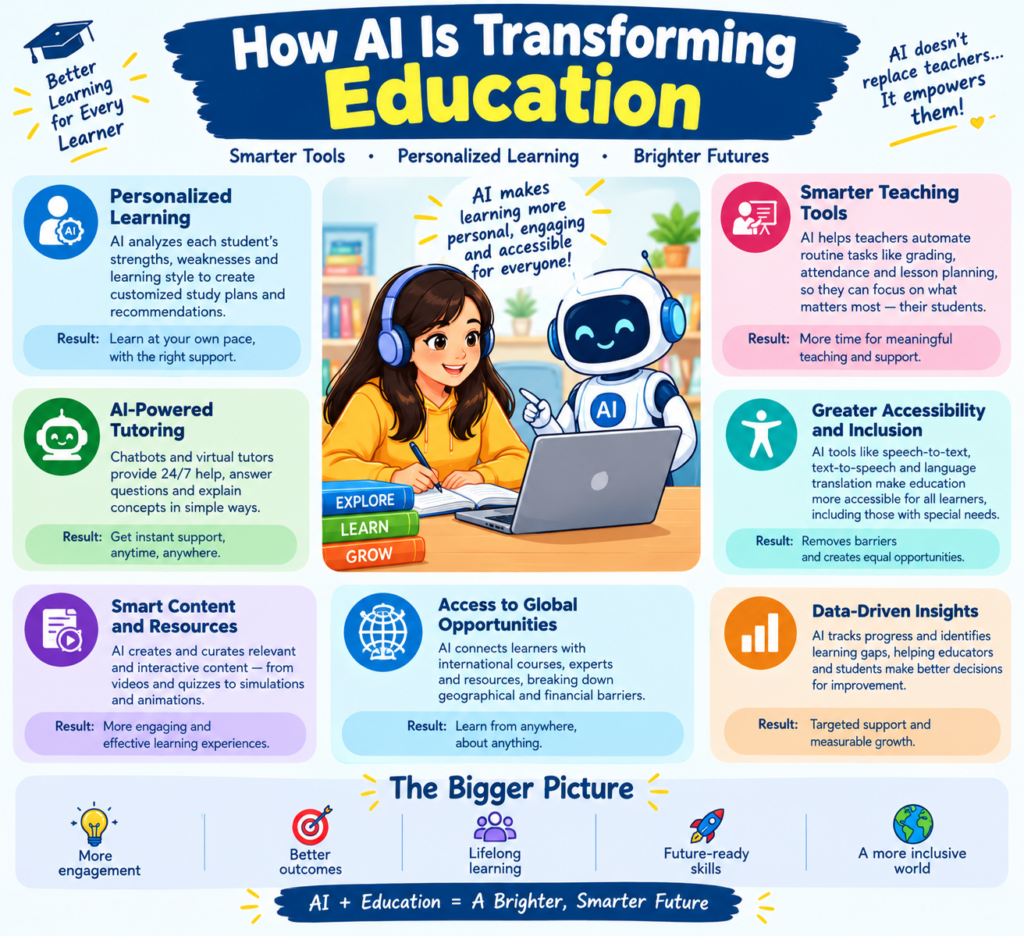
AI in education is changing how students learn and how teachers teach. It can explain difficult topics, suggest useful exercises, and help learners study at their own pace. It can also help teachers manage routine tasks and spend more time supporting students.
For example, a student who struggles with fractions may need extra practice. Another student may understand the topic quickly and want harder questions. A traditional lesson may not meet both needs at the same time. AI-powered learning platforms can help provide different activities for different learners.
However, technology alone cannot solve every problem in education. Students still need good teachers, clear lessons, useful feedback, and a safe place to learn. AI works best when it supports these needs rather than replacing human guidance.
In this article, we’ll explore how AI is transforming education, the benefits it offers, the challenges schools should consider, and the ways it may shape future learning.
1. How AI Is Transforming Education and Understanding AI in Education
Artificial intelligence, or AI, refers to computer systems that perform tasks that usually require human intelligence. These tasks may include understanding language, finding patterns, answering questions, and making predictions from data.
In education, AI can support both teaching and learning. It can help a student understand a lesson, help a teacher prepare practice questions, or help a school identify learning gaps.
What Is Artificial Intelligence in Education?
Artificial intelligence in education means using AI technology to improve educational activities. It can support lessons, assessments, student feedback, and learning plans.
Consider a student learning English. The student writes a short paragraph and submits it to an AI tool. The tool may identify spelling errors, suggest clearer sentences, and explain basic grammar rules. The student can then revise the paragraph and learn from the feedback.
A teacher can use a similar tool to prepare examples, create quizzes, or explain the same idea in simpler language.
Common uses include:
- Creating practice questions and quizzes.
- Explaining difficult concepts in simple words.
- Offering feedback on writing.
- Suggesting learning resources.
- Supporting students with disabilities.
- Helping teachers organize educational materials.
These examples show how AI education technology can make learning more flexible.
How AI Works in Learning
Many AI systems use machine learning. This is a method that helps computers identify patterns in data and use those patterns to perform tasks. For example, a digital learning platform may record which questions a student answers correctly. It may also track which topics take more time. The system can use this information to suggest additional practice.
This process can support adaptive learning, where learning activities change according to a student’s progress. Smart learning systems may also use language models to answer questions, explain concepts, and generate examples. However, their answers can sometimes be incorrect. Students and teachers should check important information against reliable sources.
Why AI Is Becoming Important
Classrooms often include students with different abilities, interests, and learning speeds. Teachers work hard to support these differences, but they have limited time. AI can provide extra support between lessons. Students may review a concept at home, practice a skill before an exam, or ask for another explanation when they feel confused.
AI can also support digital learning outside traditional classrooms. Students in remote areas may use online resources to access lessons that aren’t available nearby. Still, access to devices, electricity, internet services, and good learning materials remains important. AI can expand educational opportunities, but it cannot remove every barrier on its own.
10 Powerful Benefits of AI in Education
The benefits of AI in education go beyond faster access to information. When schools use it carefully, AI can support individual learning, improve feedback, and help teachers make better use of their time.
Here are ten important benefits.
1. Personalized Learning for Every Student
Every student learns differently. Some understand a topic after one explanation, while others need more examples and practice.
Personalized learning uses information about a learner’s needs to suggest suitable lessons and activities. An AI-powered platform may offer basic exercises to a student who is struggling and advanced problems to someone who is ready for a challenge.
For example, a student learning algebra may receive extra questions about equations after making repeated mistakes. Once the student improves, the platform may introduce more complex problems.
This approach can help students work at a comfortable pace. It can also help teachers identify topics that need more attention.
However, personalization should not limit students to what a system predicts they can do. Teachers should continue to encourage curiosity and offer new challenges.
2. Intelligent Tutoring Systems
Intelligent tutoring systems provide guidance that resembles some parts of one-to-one tutoring.
These systems may ask questions, offer hints, explain mistakes, and recommend another learning activity. A student studying science, for example, may receive a step-by-step explanation of how evaporation works.
The student can ask follow-up questions and review the explanation as needed.
AI tutors are especially useful for practice outside school hours. They may help students revise for tests or understand a topic before asking a teacher for more support.
Yet an AI tutor doesn’t fully understand a student’s emotions, personal circumstances, or every learning difficulty. Human teachers remain essential for deeper guidance and encouragement.
3. Faster Feedback and Assessment
Feedback helps students understand what they’ve done well and what they need to improve.
AI tools can review certain types of work quickly. They may check multiple-choice answers, identify common spelling errors, or highlight mistakes in a mathematical solution.
This can help students correct errors while the lesson is still fresh in their minds.
Teachers can also use assessment data to find common problems across a class. If many students struggle with the same question, the teacher can explain the topic again.
However, not every assignment can be judged fairly by an automated system. Creative writing, complex reasoning, and personal reflection often need human review.
4. Reduced Routine Work for Teachers
Teachers spend time preparing worksheets, organizing resources, writing instructions, and checking routine assignments.
AI tools can help with some of these tasks. A teacher may ask an AI assistant to create a draft quiz, suggest discussion questions, or rewrite instructions for younger learners.
This can save preparation time and allow teachers to focus more on teaching.
The teacher must still review the materials. AI-generated questions may contain errors, unclear wording, or unsuitable examples.
The goal isn’t to remove teachers from the learning process. It’s to reduce repetitive work so they can spend more time helping students.
5. Better Access to Learning Resources
Digital learning tools can make educational materials available beyond the classroom.
Students may use AI tools to summarize a long passage, explain a new word, or break a difficult topic into smaller steps. This can be helpful when a learner needs extra support after school. For example, a student studying the water cycle may ask for a simple explanation, a real-life example, and five practice questions.
AI can provide different forms of explanation to support understanding. Schools should still check the quality of these materials. Easy access is valuable only when the information is accurate and suitable for the student’s age and level.
6. Improved Support for Different Learning Needs
Some students benefit from additional tools to access educational content. Depending on the system, AI may support speech-to-text, text-to-speech, automatic captions, language translation, and simpler versions of written material.
These features can help learners who face language barriers or have certain accessibility needs. For example, a student who finds long passages difficult to read may use text-to-speech to listen to the lesson. Another student may use captions to follow a recorded lecture.
Accessibility tools should be selected according to individual needs. Schools must also consider whether the tools work well with the student’s language, device, and learning environment.
7. Support for Language Learning
Learning a new language requires regular practice with vocabulary, grammar, reading, listening, and writing. AI tools can offer conversation practice, explain grammar rules, and suggest corrections. Students can practice simple dialogues without worrying about making mistakes in front of a group.
For example, a learner studying English may practice introducing themselves, asking for directions, or preparing for a job interview. This type of practice can build confidence. Still, learners should also speak with real people to develop natural communication skills and understand cultural context.
8. Data-Driven Learning Decisions
Educational platforms can collect information about lesson completion, quiz results, and student progress. With appropriate safeguards, this information can help teachers understand where students need support.
Suppose a class performs poorly on a chapter about electricity. The teacher can review the results, identify common errors, and prepare a revision lesson. This is an example of data-driven learning.
Data should guide decisions rather than make them automatically. A low score may reflect a difficult question, limited internet access, or a stressful day. Teachers need context before deciding how to help.
9. More Flexible Learning Opportunities
AI supports learning across different settings. Students may use educational platforms at school, at home, or while studying independently.
A learner preparing for a competitive exam can create a revision plan, practice questions, and review weak topics. Another student can use digital tools to explore a subject beyond the school syllabus.
These options can support independent learning and help students build study habits.
However, flexibility works best with clear goals. Students may become distracted or rely too heavily on generated answers without checking their understanding.
10. New Opportunities for Educational Innovation
AI encourages schools and education providers to explore new ways to teach. Teachers may create interactive activities, virtual practice tasks, or examples based on students’ interests. Educational developers can also use AI to improve digital learning platforms.
For example, a geography lesson could combine maps, questions, and guided explanations to help students explore climate patterns. These innovations can make learning more engaging when they serve a clear educational purpose.
The most useful innovation isn’t necessarily the newest tool. It’s the one that helps students understand concepts, practice skills, and apply what they’ve learned.
3. AI Applications in Modern Education
AI applications in modern education appear in classrooms, online learning platforms, language tools, assessment systems, and school administration. Different tools serve different purposes. Schools should choose technology based on learning goals instead of adopting every new product.
AI-Powered Learning Platforms
AI-powered learning platforms combine digital lessons with features such as recommendations, progress tracking, practice questions, and feedback. Some systems adjust the order or difficulty of activities based on student performance. Others provide a digital tutor or suggest additional resources.
These platforms can support:
- School subjects such as mathematics and science.
- Language learning and writing practice.
- Exam preparation.
- Professional skills and online courses.
- Independent study and revision.
Students should use these tools to build understanding rather than simply complete tasks. For example, after receiving an explanation of a mathematics problem, a student should attempt a similar question without assistance. This helps show whether the concept has been learned.
Classroom Automation
Classroom automation uses technology to help manage repetitive tasks. AI may help teachers draft lesson plans, generate worksheets, prepare quiz questions, or organize learning materials. Some platforms can also assist with routine grading.
These features can be useful when teachers have large classes and limited preparation time. However, sensitive decisions should not be left entirely to automated systems. Teachers should check student records, review assessments, and make final decisions about learning support.
AI for Online and Remote Learning
Online education allows students to learn without attending a physical classroom every day. AI can make online learning more interactive by providing practice activities, answering basic questions, and suggesting useful lessons.
A student taking an online computer course, for example, may use an AI assistant to understand a programming error. The student can then test the correction and learn how the code works. This can improve the learning experience, but it doesn’t guarantee better results. Course quality, student motivation, internet access, and teacher support still matter.
Accessibility and Inclusion
Educational technology can help make learning materials easier to access. AI-assisted captions can support learners who have difficulty hearing recorded lessons. Speech tools can help students who prefer listening to text. Translation tools may help learners understand basic instructions in another language.
Schools should test these features before using them widely. Translation may miss important meaning, and speech recognition may struggle with accents or background noise.The purpose of accessible technology is to remove barriers, not to create new ones.
Content Creation and Lesson Planning
Teachers can use AI to create first drafts of educational content. For example, an educator may request:
- Five questions about a science chapter.
- A simple explanation of photosynthesis.
- A classroom activity about environmental protection.
- A vocabulary list for an English lesson.
- Different examples for beginner and advanced learners.
These drafts can save time, but they need human review. Teachers should check accuracy, reading level, cultural suitability, and alignment with the curriculum.
AI should support professional teaching skills, not replace them.
4. How AI Is Changing Classrooms
The impact of artificial intelligence on education is changing classroom routines as well as the way students approach learning.
In a traditional classroom, teachers often deliver the same lesson to an entire group. Students then complete exercises and receive feedback later.
With AI-supported teaching, students may have more opportunities to review a topic, practice at different levels, and receive immediate guidance.
From One-Size-Fits-All to Flexible Learning
A single lesson cannot always meet every student’s needs. AI learning systems may provide additional explanations for students who need support and extension tasks for those who are ready to move ahead.
Teachers can use these suggestions to plan group activities. For example, one group might review basic fractions while another solves more advanced problems.
This approach can make classroom time more useful, provided students still receive shared learning experiences and fair opportunities.
The Changing Role of Teachers
Teachers remain central to education because they do more than explain facts. They encourage students, manage classroom relationships, identify emotional needs, and help learners develop judgment and social skills.
AI can provide suggestions and learning materials, but teachers must decide how these tools fit into their lessons. The teacher’s role may increasingly include guiding students on how to evaluate AI answers, check evidence, protect personal information, and use digital tools responsibly.
Developing Critical Thinking and Creativity
AI can generate answers quickly, but students still need to understand whether those answers make sense. Teachers can use AI as a starting point for discussions and research tasks.
For example, students might ask an AI tool to explain a historical event. They can then compare its explanation with textbooks and trusted sources, identify missing details, and discuss different viewpoints.
This process helps students develop research skills and critical thinking. Students should also create their own work, express original ideas, and explain their reasoning. These skills are important even when AI tools are widely available.
Preparing Students for Future Careers
Many workplaces now use digital tools to organize information, automate routine work, and support decisions. Students who learn to use AI responsibly may develop useful skills for future study and employment.
They can practice asking clear questions, checking generated information, solving problems, and protecting data. Schools should also teach skills that technology cannot replace easily, such as teamwork, communication, empathy, creativity, and ethical judgment.
The aim is to prepare students to work effectively with technology while remaining independent thinkers.
5. Challenges and Risks of AI in Education
Although AI offers many opportunities, it also creates challenges. Schools need clear policies to protect students and maintain educational quality.
Data Privacy and Security
AI learning tools may collect information such as student names, learning progress, written work, and usage patterns. Schools must understand what information a tool collects, where it is stored, and who can access it.
Before using an AI platform, educators should:
- Review its privacy policy.
- Check whether student information is used to train AI models.
- Avoid entering sensitive personal information into public tools.
- Follow applicable data protection laws and school policies.
- Use appropriate account permissions and security settings.
Students should also learn not to share passwords, private records, or other sensitive details with AI systems.
Bias and Fairness
AI systems can produce unfair results when their training data or design does not represent all learners equally. For example, a speech tool may perform poorly for some accents. A translation system may misunderstand certain languages. An automated assessment tool may fail to recognize a valid answer written in an unexpected way.
Schools should test tools with diverse users and review their results regularly. Human oversight is especially important when technology influences grades, access to support, or other important educational decisions.
Incorrect Information
AI tools sometimes produce answers that sound convincing but contain errors. This can create problems when students use generated explanations without checking them. Teachers should show students how to verify claims using textbooks, trusted educational websites, and other reliable sources.
Students should also learn to ask where information came from and whether evidence supports it. An AI answer should be treated as a starting point for learning, not as proof that a statement is correct.
Overdependence on Technology
Students may become too dependent on AI if they use it to complete every assignment. For example, copying a generated essay may help a student finish homework quickly but prevent them from practicing writing, research, and reasoning.
Schools should set clear rules about acceptable AI use. Teachers can ask students to explain their answers, show their working, or complete parts of an assignment without assistance. These methods help teachers assess actual understanding.
The Digital Divide
Not every student has reliable internet access, a suitable device, or a quiet place to study. If schools rely heavily on AI, students with fewer resources may fall behind.
Schools should consider device access, offline alternatives, affordability, language support, and accessible design before adopting new systems. AI should help widen access to education rather than make existing gaps worse.
6. The Future of AI in Schools
The future of AI in schools will depend on how well educators combine technology with effective teaching. AI tools are likely to become more integrated into digital textbooks, learning platforms, assessment systems, and educational support services. However, the pace and impact of these changes will vary across schools and countries.
More Adaptive Learning Systems
Future smart learning systems may offer more flexible lessons based on student progress. A student could receive additional practice after a difficult topic and move to a new lesson after demonstrating understanding.
These systems may help teachers identify learning gaps earlier. Even so, teachers must check whether recommendations are useful and whether students are being challenged appropriately.
More Natural Learning Assistants
AI assistants may become better at explaining concepts in simple language, responding to follow-up questions, and supporting different learning activities. Students may use them to revise lessons, practice languages, or prepare questions for classroom discussions. Schools will need clear guidance on accuracy, privacy, and age-appropriate use.
Greater Use of Multilingual Education
AI translation and language tools may help learners access materials in different languages. This could be valuable in classrooms where students speak different home languages or are learning through a second language.
However, educational translation needs careful review. Some subjects rely on specific terms, and a poor translation may change the meaning of a lesson. Human educators and language specialists will continue to play an important role.
AI and Skills-Based Learning
Education is not only about memorizing information. Students also need practical skills that help them solve problems and adapt to change. AI tools can support practice in coding, writing, research, data analysis, and communication.
For example, students learning programming can use an AI assistant to explore errors in their code. They should still explain why the correction works and test it independently. This approach combines technology with active learning.
A Balanced Future for Education
The strongest educational systems will not necessarily be those that use the most AI. They will be those that select useful tools, train teachers, protect students, and measure whether learning improves. AI should support meaningful relationships, curiosity, and independent thought. It should not turn education into a process driven only by screens and data.
7. How Schools Can Adopt AI Successfully
Schools can introduce AI in a planned way rather than changing every classroom process at once.
Step 1: Identify a Clear Learning Goal
Start with a real problem. Perhaps students need more mathematics practice, teachers spend too much time preparing quizzes, or learners need better access to reading support. Choose a tool that addresses the problem directly.
Step 2: Select Suitable Tools
Compare tools based on cost, ease of use, privacy, accessibility, language support, and educational value. A tool should work for the students and teachers who will use it. Schools should also check whether the tool requires paid accounts or collects sensitive information.
Step 3: Train Teachers and Students
Provide training on how the tool works, what its limitations are, and when its output needs checking. Students should learn to use AI for explanations, practice, and feedback without submitting unverified answers as their own work. Teachers should know how to review generated materials and protect student information.
Step 4: Run a Small Pilot
Test the tool with a small group before expanding its use. Collect feedback from students and teachers. Check whether it saves time, supports learning, and creates any new problems. A pilot also gives the school a chance to adjust its rules and training.
Step 5: Measure Learning Outcomes
Set clear measures of success. These might include quiz performance, assignment quality, student participation, time spent on routine tasks, or teacher feedback.
Compare results with the original learning goals. If the tool doesn’t provide clear value, reconsider how it is being used.
Step 6: Review and Improve
AI technology changes quickly. Schools should regularly review tool performance, privacy settings, accessibility, and educational results. Keep students and parents informed about how AI is used and where human review remains necessary. Responsible implementation is an ongoing process, not a one-time decision.
AI is transforming education by creating new ways
AI is transforming education by creating new ways for students to learn and teachers to teach. From personalized lessons and intelligent tutoring systems to faster feedback and classroom automation, artificial intelligence can support many parts of the learning process. The benefits are promising, but schools must also address data privacy, incorrect information, bias, unequal access, and overdependence on technology.
The best approach is to use AI as a learning partner rather than a replacement for teachers or independent thinking. Students should use it to ask questions, practice skills, explore ideas, and improve their understanding. Teachers should guide its use and make sure educational decisions remain fair and meaningful.
Know More:
”FAQs”
1. What is AI in education?
AI in education means using artificial intelligence to support teaching, learning, assessment, and school activities. Examples include digital tutors, personalized learning platforms, writing feedback tools, and automated quiz generation.
2. How is AI transforming education?
AI is helping make learning more flexible and personalized. It can provide extra practice, explain difficult topics, offer faster feedback, and help teachers prepare educational materials. Its results depend on the quality of the tools and how they are used.
3. What are the main benefits of AI in education?
Key benefits include personalized learning, faster feedback, support for teachers, accessible learning resources, language practice, and data-informed teaching decisions. AI can also help students practice independently.
4. Can AI replace teachers in the future?
AI is not a full replacement for teachers. It can assist with routine tasks and explain certain concepts, but teachers provide human guidance, encouragement, social support, and professional judgment. These roles remain important for effective education.
5. What are some examples of AI tools for learning?
Examples include AI writing assistants, language-learning applications, adaptive mathematics platforms, digital tutoring systems, speech-to-text tools, and educational chatbots. Students should choose tools that suit their learning goals and follow school guidelines.
6. Is AI safe for students to use?
AI can be useful when used responsibly, but students need guidance. They should avoid sharing sensitive information, verify answers, and follow school rules. Parents and teachers should review the privacy and age requirements of educational tools.
7. How does AI improve student learning?
AI may help students by explaining concepts in different ways, offering practice questions, and providing feedback. Adaptive learning systems can also recommend topics that need more attention. However, improvement isn't guaranteed and should be measured through actual learning progress.
8. What is the future of AI in schools?
AI may become more common in personalized learning, digital tutoring, language support, lesson preparation, and learning assessment. Schools will need to balance these opportunities with privacy, fairness, accessibility, and human oversight.