Introduction to AI and the Changing Job Market
The job market is changing faster than ever. New technologies, digital platforms, and business needs are creating career opportunities across many industries. At the same time, some traditional roles are changing, while others are becoming less common.
For students, graduates, and working professionals, keeping up with these changes can be difficult. Choosing a career based only on current job openings may not always be the best decision. People also need to understand which skills will matter in the coming years.
This is where AI career opportunities become important.
Artificial intelligence can study large amounts of employment data, analyze hiring patterns, identify skill requirements, and highlight emerging job roles. It can help people understand where businesses are investing and which professional skills are becoming more valuable.
For example, AI can analyze thousands of job descriptions and identify a growing demand for skills such as machine learning, cloud computing, cybersecurity, and data analytics.
This information can help job seekers make better career decisions.
AI doesn’t simply recommend jobs. It can also support career exploration, skills assessment, professional development, and long-term career planning.
However, AI should be used as a career support tool rather than the only source of career advice. Human judgment, personal interests, practical experience, and professional guidance remain important.
In this article, we’ll explore seven powerful ways to use AI to identify career opportunities, discover emerging job roles, and prepare for future careers.
Know More: AI Video Generation: The Powerful Future of Video Content Creation 2026
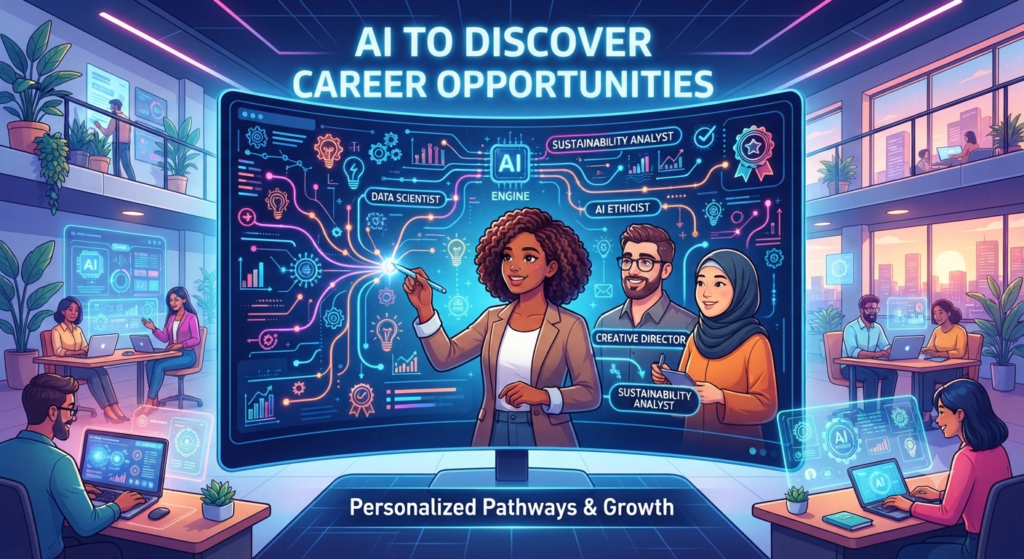
1. AI to Discover Career Opportunities
AI identifies career opportunities by collecting and analyzing information from different sources. These sources may include job portals, company career pages, industry reports, professional networks, and employment research.
Traditional career research often requires people to visit multiple websites and compare information manually.
AI can make this process faster.
It can identify patterns in hiring activity, compare job requirements, and highlight industries where demand for specific skills is increasing.
Let’s understand how it works.
Analyzing Job Market Trends
One of the most useful applications of AI is job market analysis.
AI systems can process thousands of job advertisements and identify patterns that may be difficult to notice manually.
For example, an AI system might discover that companies are increasingly looking for professionals with experience in:
- Artificial intelligence and machine learning
- Data science and analytics
- Cloud infrastructure
- Cybersecurity
- Digital marketing automation
- Software development
- Business intelligence
- Renewable energy technology
These patterns can provide useful information about changing employment needs.
AI can also compare job postings over different periods to identify changes in hiring activity.
Suppose a company posted 50 cybersecurity positions last year and 120 positions this year. This increase may indicate growing hiring demand.
However, one company’s hiring activity doesn’t prove an industry-wide trend. Reliable career research should compare several employers, locations, and time periods.
Identifying Growing Industries
AI can help people discover industries that are creating new professional opportunities.
Some industries are experiencing major changes because of technological development and changing customer expectations.
|
Industry |
Emerging Opportunities |
Important Skills |
|
Artificial Intelligence |
AI Engineer, AI Trainer |
Machine learning, Python |
|
Healthcare Technology |
Health Data Analyst |
Data analysis, healthcare systems |
|
Cybersecurity |
Security Analyst |
Network security, risk analysis |
|
FinTech |
Financial Data Analyst |
Financial modeling, analytics |
|
Renewable Energy |
Energy Analyst |
Environmental science, data |
|
E-commerce |
AI Marketing Specialist |
Digital marketing, automation |
|
Education Technology |
Learning Experience Designer |
Instructional design, technology |
AI tools can compare hiring information across these industries and identify professional opportunities that match a person’s interests.
For example, someone interested in healthcare and technology might discover opportunities in health informatics, medical data analysis, or healthcare AI.
This makes career exploration more focused.
Understanding Workforce Analytics
Workforce analytics involves studying employment data to understand workforce needs, skill shortages, hiring patterns, and employee trends.
Businesses use workforce analytics to make decisions about recruitment, training, and workforce development.
AI can help analyze:
- Which skills are becoming more important.
- Which departments need additional employees.
- Which industries are experiencing skill shortages.
- Which roles are changing because of automation.
- Which professional skills may be needed in the future.
For job seekers, these insights can provide a better understanding of the employment landscape.
For example, if organizations increasingly require employees who understand both business operations and AI technology, professionals may benefit from developing a combination of business and technical skills.
AI employment trends can therefore help individuals prepare for opportunities before they become widely recognized.
2. How AI Discovers Emerging Job Roles
Emerging job roles are positions that develop because of new technologies, changing business models, or evolving customer needs.
Some roles are entirely new. Others are traditional positions with additional responsibilities and technical requirements.
Artificial intelligence can help identify these changes by studying employment patterns and industry developments.
Analyzing Job Descriptions
Job descriptions contain valuable information about the skills and responsibilities employers need.
AI can analyze thousands of job descriptions to identify frequently mentioned skills, qualifications, and technologies.
For example, imagine that several companies start including generative AI, automation, and prompt engineering in their marketing job descriptions.
An AI system may identify this pattern and suggest that AI-focused marketing positions are becoming more relevant.
This can help job seekers discover roles such as:
- AI Marketing Specialist
- Generative AI Consultant
- AI Content Strategist
- Marketing Automation Analyst
- AI Search Optimization Specialist
The same approach works across other industries.
By analyzing job descriptions, AI can identify changes in professional requirements before they become obvious in traditional career reports.
Tracking New Skills and Technologies
New job roles often emerge when companies adopt new technologies.
For example, the growth of cloud computing increased demand for cloud engineers, cloud architects, and cloud security specialists.
Similarly, developments in artificial intelligence are creating opportunities in model development, AI implementation, automation, and responsible AI management.
AI tools can track skill requirements and identify combinations of skills that are appearing more frequently.
Consider the following examples:
|
Growing Skill Combination |
Potential Job Role |
|
AI + Business Strategy |
AI Business Consultant |
|
AI + Cybersecurity |
AI Security Specialist |
|
Data Science + Healthcare |
Healthcare Data Scientist |
|
AI + Marketing |
AI Marketing Analyst |
|
Machine Learning + Robotics |
Robotics AI Engineer |
|
AI + Legal Knowledge |
AI Compliance Specialist |
These combinations show how professionals can develop expertise across multiple fields.
A person doesn’t always need to become a software engineer to benefit from AI-related opportunities. Domain knowledge combined with AI literacy can also create valuable career options.
Predicting Future Job Opportunities
One important application of AI is identifying possible future employment trends.
AI-powered forecasting systems can study historical hiring data, technology investments, economic information, and industry developments.
They can use these patterns to estimate which occupations may experience growing or declining demand.
For example, increasing investment in cybersecurity may indicate a continued need for security professionals. Growth in automation may create opportunities for automation engineers and AI implementation specialists.
However, predictions aren’t guarantees.
Economic conditions, government policies, technological changes, and business decisions can influence employment demand.
Therefore, AI predictions should be compared with reliable labor market research.
Useful sources include:
- U.S. Bureau of Labor Statistics Occupational Outlook Handbook for occupational information and employment projections.
- World Economic Forum for global employment and skills research.
- LinkedIn for professional networking and job market exploration.
Combining AI analysis with reliable industry information can help people make more informed career decisions.
3. Using AI for Career Planning and Guidance
Choosing a career involves more than finding a job with a good salary.
People should also consider their interests, strengths, education, professional goals, and preferred working environment.
AI career planning tools can help organize this information and suggest suitable career paths.
Instead of searching randomly, users can explore opportunities based on their personal skills and goals.
AI-Powered Career Assessment Tools
Career assessment tools help individuals understand their interests, abilities, and professional preferences.
AI-powered career assessment tools can use information about education, work experience, technical knowledge, and personal interests to suggest possible career directions.
For example, a student with strong analytical skills and an interest in technology may receive recommendations for:
- Data Analyst
- Business Analyst
- Data Scientist
- Financial Analyst
- AI Research Assistant
A professional with experience in communication, business development, and digital marketing may explore:
- Growth Marketing Specialist
- Marketing Automation Manager
- AI Marketing Consultant
- Customer Experience Analyst
These recommendations can help users discover career options they might not have considered.
However, AI assessments should be treated as starting points. They can’t fully measure motivation, creativity, personal values, or real-world performance.
Finding Suitable Career Paths
AI can compare a person’s existing qualifications with the requirements of different job roles.
This process helps users understand which opportunities are realistic and what additional preparation may be needed.
For example:
|
Existing Background |
Suggested Career |
Skills to Develop |
|
Commerce graduate |
Financial Data Analyst |
Excel, SQL, Power BI |
|
Computer science student |
Machine Learning Engineer |
Python, ML, statistics |
|
Marketing professional |
AI Marketing Specialist |
AI tools, analytics |
|
HR professional |
People Analytics Specialist |
HR analytics, visualization |
|
Graphic designer |
AI Creative Specialist |
AI design tools, creative workflows |
This approach makes career exploration more practical. Instead of selecting a role simply because it’s popular, users can identify opportunities that build on their existing knowledge.
Creating a Personalized Learning Plan
Once someone identifies a suitable career, the next step is developing the required skills.
AI can help create a structured learning plan based on current abilities and career goals.
For example, someone interested in becoming a data analyst might receive a learning roadmap covering:
- Spreadsheet fundamentals.
- Basic statistics.
- SQL and database management.
- Data visualization.
- Power BI or Tableau.
- Practical data analysis projects.
- Interview preparation.
AI can also suggest learning resources, practice exercises, and project ideas.
A personalized learning plan can make professional development easier to manage.
However, users should verify course quality and focus on practical experience. Completing several online courses doesn’t automatically demonstrate job readiness.
A portfolio of relevant projects can provide stronger evidence of practical skills.
4. Best Ways to Use AI Tools for Career Exploration
AI tools are useful when people know how to ask the right questions.
Simply asking an AI chatbot to suggest a good career may produce broad recommendations.
A better approach is to provide specific information about your education, experience, interests, and goals.
Here are three practical ways to use AI for career exploration.
AI Job Matching
AI job matching compares a candidate’s qualifications with the requirements of available positions.
Recruitment platforms may use AI recruitment technology to analyze resumes, identify relevant skills, and recommend suitable job openings.
For job seekers, this can reduce the time spent searching through unrelated vacancies.
For example, a candidate with experience in SEO, content optimization, keyword research, and Google Analytics may discover opportunities such as:
- SEO Specialist
- Organic Growth Analyst
- Digital Marketing Strategist
- Search Marketing Consultant
- AI Search Optimization Specialist
AI job matching can also identify transferable skills.
A person working in customer support might discover opportunities in customer success, business operations, or customer experience analysis.
Still, automated matching systems aren’t perfect. Candidates should review job descriptions and apply when their qualifications genuinely match the position.
Resume and Skills Gap Analysis
AI can compare a resume with a target job description.
It can identify relevant experience, missing keywords, and skills that may need improvement.
For example, a job description might require:
- Python programming
- Data visualization
- SQL
- Statistical analysis
- Problem-solving
If a candidate has SQL and Excel experience but lacks Python and data visualization skills, AI can highlight these gaps.
A useful skills gap analysis includes:
|
Area |
Current Position |
Improvement Required |
|
Technical Skills |
Basic Excel |
Advanced Excel and SQL |
|
Data Analysis |
Beginner |
Practical analytics projects |
|
Communication |
Intermediate |
Business presentation skills |
|
Industry Knowledge |
Basic |
Industry research |
|
Experience |
Academic projects |
Real-world project experience |
This analysis can help candidates prepare more effectively.
However, AI-generated resume suggestions should always be reviewed for accuracy. Never include skills, qualifications, or work experience that you don’t actually have.
Exploring Different Industries
Many people limit their career searches to familiar industries.
AI can help them explore related fields where their existing skills may be useful.
For example, a teacher interested in technology may explore opportunities in educational technology, digital learning, instructional design, or AI-assisted education.
Similarly, a finance graduate may discover roles in financial technology, risk analytics, or automated financial reporting.
This broader approach can reveal professional opportunities that traditional job searches might miss.
5. Emerging Job Roles Created by Artificial Intelligence
Artificial intelligence is changing existing occupations and creating demand for new combinations of technical and business skills.
Not every emerging role is entirely new. Many positions are evolving as organizations introduce AI systems into their daily operations.
The following are examples of roles worth exploring.
AI and Machine Learning Careers
Potential roles:
- AI Engineer
- Machine Learning Engineer
- AI Research Scientist
- Generative AI Developer
- Natural Language Processing Specialist
These professionals build, train, evaluate, and improve AI systems.
They may work on recommendation engines, intelligent assistants, language models, predictive systems, and automation platforms.
Important skills include programming, mathematics, machine learning, data handling, and model evaluation.
These positions generally require strong technical knowledge, although entry requirements differ across employers.
Data and Analytics Careers
Potential roles:
- Data Analyst
- Data Scientist
- Business Intelligence Analyst
- Data Engineer
- Analytics Consultant
Organizations rely on data to understand customers, improve operations, and make business decisions.
AI increases the need for professionals who can organize data, interpret results, and communicate useful insights.
People interested in mathematics, statistics, business, and problem-solving may find this field worth exploring.
AI Ethics and Governance Careers
Potential roles:
- AI Governance Specialist
- AI Ethics Consultant
- AI Risk Analyst
- AI Compliance Specialist
- Responsible AI Researcher
AI systems can create concerns involving privacy, fairness, transparency, and security.
Organizations therefore need professionals who understand responsible AI practices and can help manage related risks.
These positions may require knowledge of law, technology, compliance, business processes, or public policy.
They demonstrate that artificial intelligence careers aren’t limited to programming.
Human-Centered AI Careers
Potential roles:
- AI Product Manager
- Human-AI Interaction Designer
- AI Trainer
- AI Implementation Consultant
- AI Customer Experience Specialist
These professionals help organizations make AI systems useful for real people.
For example, an AI product manager may coordinate developers, designers, business teams, and customers to develop an AI-powered product.
An AI implementation consultant may help businesses introduce automation into existing workflows.
These roles often combine communication, problem-solving, technical awareness, and business understanding.
6. How Students and Professionals Can Benefit from AI
AI career guidance can support people at different stages of their professional journeys.
The opportunities and requirements may differ depending on someone’s education, experience, and career goals.
Opportunities for Students
Students can use AI to explore careers before completing their education.
This can help them make better decisions about courses, internships, projects, and professional skills.
For example, a computer science student interested in artificial intelligence can use AI tools to:
- Compare AI-related job roles.
- Identify common employer requirements.
- Explore beginner-friendly learning resources.
- Find internship opportunities.
- Create a project portfolio.
- Prepare for technical interviews.
- Understand industry trends.
Students from non-technical backgrounds can also explore AI-related careers.
Business, commerce, design, healthcare, and humanities students may find opportunities where their subject knowledge combines with digital technology.
Starting career exploration early can make the transition from education to employment easier.
Opportunities for Working Professionals
Working professionals can use AI to identify new opportunities within their current industries.
For example, an HR professional may explore people analytics, AI recruitment technology, or workforce planning.
A marketing professional may develop expertise in marketing automation, AI-powered research, or predictive customer analytics.
A finance professional may explore financial data analysis and intelligent reporting.
AI can also help experienced professionals identify transferable skills and prepare for career advancement.
The key is to build on existing experience rather than assuming that a complete career change is always necessary.
Opportunities for Career Changers
Career changes can feel challenging because people may not know which of their existing skills are useful in another industry.
AI can help identify transferable abilities and related professional opportunities.
For example, a customer service professional may already have:
- Communication skills
- Problem-solving abilities
- Customer relationship experience
- Conflict resolution skills
- Product knowledge
These skills may be useful in customer success, sales operations, business development, and customer experience management.
AI can suggest possible career directions and identify additional skills required for each role.
Before making a transition, individuals should research qualifications, salary expectations, working conditions, and actual hiring demand.
7. Practical Steps to Find High-Demand Careers Using AI
Understanding AI is useful, but applying it to real career decisions is even more important.
The following seven-step process can help students and professionals use AI effectively.
Step 1: Identify Your Interests and Strengths
Start by listing your education, professional experience, interests, and existing skills.
Ask an AI tool to identify career paths that match your background.
Example prompt:
“Based on my education, skills, interests, and experience, suggest 10 career opportunities that match my profile. Explain the responsibilities and skills required for each role.”
Step 2: Research Growing Industries
Ask AI to compare different industries based on employment trends, technological developments, and skill requirements.
Don’t rely on a single prediction. Compare its findings with industry reports and official employment information.
Step 3: Discover Emerging Job Roles
Ask AI to identify new and evolving positions within your preferred industry.
Example prompt:
“Identify emerging job roles in digital marketing and artificial intelligence. Explain their responsibilities, required skills, and potential career paths.”
This can help uncover opportunities beyond familiar job titles.
Step 4: Analyze Required Skills
Select three to five roles that interest you.
Compare their job descriptions and identify the skills that appear most frequently.
Create a list of technical, analytical, communication, and industry-specific skills.
Step 5: Identify Your Skills Gaps
Compare your existing abilities with the requirements of your selected roles.
Ask AI to highlight missing skills and recommend practical ways to improve them.
Focus on skills that appear across multiple relevant job descriptions.
Step 6: Build Practical Experience
Learning is important, but employers also value the ability to apply knowledge.
Build projects, complete internships, participate in relevant activities, and create a professional portfolio.
For example, someone interested in data analytics could create a dashboard using publicly available datasets.
Someone interested in AI marketing could develop a sample campaign analysis using AI-assisted research.
Step 7: Track Job Market Changes
Career planning shouldn’t happen only once.
Review job descriptions, employer requirements, and industry developments regularly.
AI can help summarize changes and identify new skills that deserve attention.
A simple monthly career review can help you stay prepared for changing employment needs.
Benefits and Limitations of AI Career Guidance
AI offers several advantages for career planning, but it’s important to understand its limitations.
|
Benefits |
Limitations |
|
Analyzes large amounts of employment data |
Predictions may be inaccurate |
|
Identifies emerging job roles |
New roles may lack reliable historical data |
|
Suggests suitable career paths |
Recommendations may overlook personal preferences |
|
Identifies skills gaps |
AI may misunderstand qualifications |
|
Saves career research time |
Information may be outdated |
|
Supports personalized learning |
Learning quality still needs human review |
|
Helps compare job opportunities |
Automated matching may contain bias |
How to Use AI Responsibly
To get better results, follow these practices:
- Verify employment information using reliable sources.
- Compare AI recommendations with real job advertisements.
- Avoid sharing sensitive personal information with unknown platforms.
- Review AI-generated career assessments critically.
- Focus on practical skills and real experience.
- Speak with professionals working in your target industry.
- Reassess your career goals as industries change.
AI should support your decisions, not make them for you.
The strongest career planning approach combines technology, professional advice, personal interests, and continuous learning.
Artificial intelligence is changing how people explore careers, understand employment trends, and prepare for professional growth.
By analyzing job market data, identifying skill requirements, and recognizing emerging industries, AI can help individuals discover opportunities that may otherwise remain unnoticed.
From students planning their first careers to experienced professionals considering a career change, AI offers useful support at every stage of professional development.
The most effective approach is to combine AI-powered career guidance with personal interests, practical experience, continuous learning, and reliable industry research.
Remember that technology alone doesn’t guarantee career success. Your ability to learn, adapt, solve problems, and apply your skills will remain important.
Start by exploring your strengths, researching emerging job roles, and identifying the skills employers need. With a clear plan and the right resources, you can make more informed decisions and prepare for the changing world of work.
The future of work is evolving. Start exploring your next career opportunity today.
”FAQs”
1. How does AI identify career opportunities?
AI identifies career opportunities by analyzing job postings, employment data, industry reports, skill requirements, and hiring patterns. It uses this information to identify growing industries, in-demand skills, and emerging job roles. These insights help students and professionals explore suitable career paths.
2. How can I use AI to discover new career opportunities?
You can use AI tools to analyze your education, interests, professional experience, and existing skills. Ask them to suggest relevant job roles, identify growing industries, compare job descriptions, and highlight skills you need to develop. Always verify recommendations using real job market information.
3. What are the best AI career guidance tools?
Popular AI platforms that can support career exploration include ChatGPT, LinkedIn, Google Gemini, and Microsoft Copilot. Specialized career assessment and job-matching platforms can also help. The best choice depends on whether you need career research, resume analysis, job discovery, or skills assessment.
4. Can AI predict future job market trends?
AI can analyze historical employment information, job postings, technology developments, and industry data to identify possible future trends. However, predictions aren't guaranteed. Economic changes, government policies, and business decisions can affect employment demand.
5. Which emerging job roles are expected to create new opportunities?
Examples include AI engineers, machine learning specialists, AI governance professionals, data scientists, AI product managers, cybersecurity analysts, and automation consultants. Actual demand varies by industry, location, and employer requirements.
6. How can students use AI for career planning?
Students can use AI to explore career options, identify required qualifications, compare industries, discover internships, and create personalized learning plans. They can also use AI to generate project ideas and prepare for interviews.
7. Can AI help professionals change their careers?
Yes. AI can compare existing skills with the requirements of other occupations and identify transferable abilities. It can also suggest learning resources, relevant certifications, and possible career paths. Professionals should research their target industry before making a transition.
8. Are AI career recommendations always accurate?
No. AI recommendations depend on the quality, relevance, and accuracy of the information available. Some tools may provide outdated job information or overlook personal circumstances. Always verify important career decisions using reliable sources and professional advice.
9. What skills should I develop for future careers?
Useful skills include digital literacy, data analysis, communication, problem-solving, adaptability, critical thinking, and AI literacy. Technical skills such as programming, cybersecurity, cloud computing, and machine learning may also be valuable, depending on your chosen industry.
10. Will AI replace traditional jobs or create new opportunities?
AI will automate some tasks, change existing occupations, and create demand for new skills and professional roles. Its overall impact will differ across industries. People who continuously develop relevant skills and adapt to changing work requirements may be better prepared for future opportunities.


