
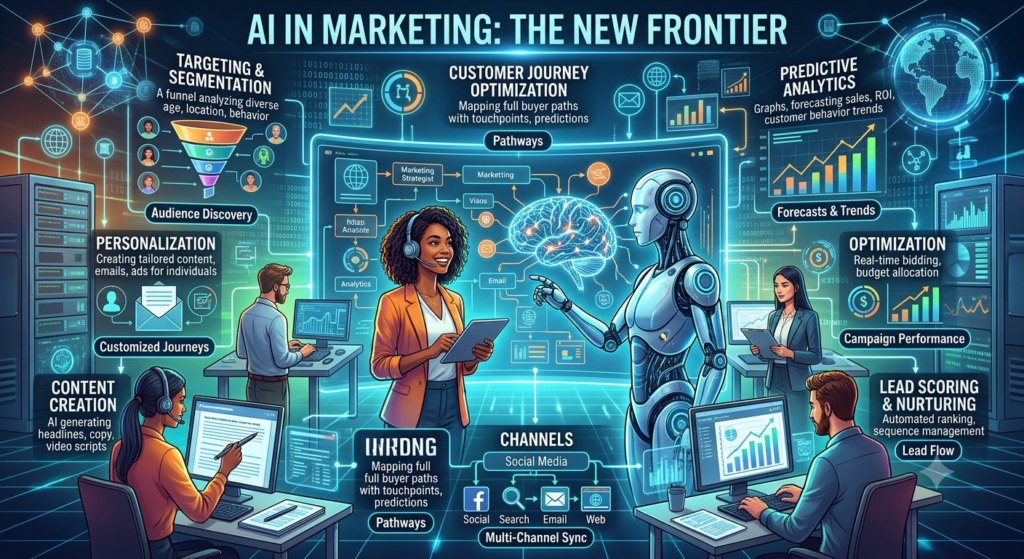
AI in Marketing: 10 Powerful Strategies, Tools, and Real-World Applications
Marketing has changed a lot in recent years. Businesses no longer depend only on manual research, basic advertisements, and guesswork. Today, they can use data and smart technology to reach the right people at the right time.
This is where AI marketing comes in.
AI marketing uses artificial intelligence to plan, create, manage, and improve marketing activities. It helps businesses understand customer needs, study market trends, and make better decisions. It can also reduce repetitive work and give marketing teams more time to focus on creative ideas.
For example, an online store can use AI to suggest products based on a customer’s past purchases. A digital marketing team can use AI tools to find keyword ideas, review website traffic, or create an email campaign. A small business can even use an AI chatbot to answer common questions.
These uses show why artificial intelligence in marketing is becoming important for businesses of all sizes. However, AI isn’t a magic solution. It works best when marketers combine technology with human judgment, reliable data, and clear business goals.
Why Is AI Important in Modern Marketing?
AI helps marketers work with large amounts of information. It can identify patterns that might take a person hours to find. It can also help teams test ideas and improve campaigns more quickly.
Key benefits include:
- Better targeting: Reach people who are more likely to need your product or service.
- Faster content creation: Develop drafts, outlines, and creative ideas in less time.
- Smarter decisions: Use marketing analytics to understand what works.
- Personalized experiences: Show customers more relevant messages and offers.
- Less manual work: Automate routine tasks such as reporting and email follow-ups.
- Improved efficiency: Use budgets and team resources more carefully.
The goal isn’t to replace marketers. It’s to help them make better use of their time, skills, and data.
2. Understanding AI Marketing
AI marketing combines artificial intelligence with marketing data, software, and business knowledge. Depending on the tool, it may use machine learning, natural language processing, predictive models, or generative AI.
Each technology has a different purpose.
Machine learning can find patterns in customer behavior. Natural language processing helps software understand and generate human language. Generative AI can create text, images, and other content based on instructions.
How Does Artificial Intelligence in Marketing Work?
Most AI marketing systems follow a simple process.
- Collect data: Gather suitable information from website visits, customer interactions, sales, or campaign reports.
- Analyze patterns: Use AI models to identify trends, common behaviors, and possible customer needs.
- Generate recommendations: Suggest audiences, content ideas, product recommendations, or campaign changes.
- Take action: A marketer or approved system uses these recommendations to update a campaign.
- Measure results: Review performance and use the findings to improve future activities.
For example, a company may discover that visitors who read several product pages are more likely to request a demo. An AI system can help identify similar behavior and suggest ways to reach those visitors.
Still, a pattern doesn’t always prove that one action caused another. Marketers must test recommendations before making major changes.
Traditional Marketing vs. AI-Powered Marketing
|
Area |
Traditional marketing |
AI-powered marketing |
|
Research |
Manual research and reports |
Faster pattern analysis |
|
Audience targeting |
Broad audience groups |
More detailed audience insights |
|
Content |
Mostly manual production |
AI-assisted creation and editing |
|
Email campaigns |
Fixed schedules |
Behavior-based automation |
|
Reporting |
Manual data review |
Automated summaries and analysis |
|
Optimization |
Periodic changes |
More frequent testing and adjustments |
Traditional methods still have value. AI adds new ways to improve them rather than making every older method unnecessary.
3. AI in Marketing Strategies and Tools
A successful AI marketing plan starts with a clear goal. Businesses should decide what they want to improve before choosing a tool. For one company, the goal may be to increase qualified leads. For another, it may be to improve customer retention or reduce the cost of advertising. Here are ten practical strategies businesses can consider.
Use AI for Customer Segmentation
Customer segmentation means dividing an audience into groups with similar needs or behaviors.
AI can help identify groups based on browsing activity, buying patterns, engagement, or other suitable data. Businesses can then create messages for each group.
For example, an online education company might identify separate groups of visitors interested in internships, courses, and job opportunities. Each group can receive more relevant information.
Improve Personalized Marketing
Personalized marketing gives people content that better matches their interests.
AI can help recommend products, suggest relevant articles, or adjust messages based on customer preferences. This can make a website or email feel more useful.
However, personalization should respect privacy. Businesses must use data responsibly and avoid making customers feel watched.
Apply Predictive Marketing
Predictive marketing uses historical data to estimate what may happen next.
AI models can help forecast demand, identify customers who may stop buying, or estimate which leads are more likely to convert.
These predictions aren’t guarantees. Their quality depends on the data, the model, and changing market conditions.
Automate Repetitive Campaign Tasks
Marketing automation can handle routine work such as sending welcome emails, updating lead records, and preparing reports.
AI can add recommendations or adapt certain actions based on customer behavior.
For example, a business can send a welcome email after a newsletter signup and follow up with relevant resources based on the subscriber’s stated interests.
Use AI for Lead Scoring
Lead scoring helps sales teams decide which prospects deserve attention first.
AI can review permitted signals, such as form submissions, page visits, and past conversion patterns, to estimate lead quality.
Sales teams should check these scores against actual results. A high score should guide a conversation, not replace it.
Optimize Marketing Budgets
AI tools can help compare campaign costs, conversion rates, and audience performance.
Marketers can use these insights to identify weak campaigns and test new budget allocations. Changes should be measured against business outcomes rather than clicks alone.
Improve Customer Support
AI chatbots and virtual assistants can answer common questions, explain products, and direct users to relevant pages.
They should also offer a clear route to human support when a question is complex, sensitive, or outside their knowledge.
Strengthen Content Planning
AI can group related topics, summarize audience questions, and suggest content gaps.
Editors can use these ideas to create useful articles, guides, videos, and social posts that match real customer needs.
Improve Customer Retention
AI can help identify changes in customer activity, such as declining engagement or fewer repeat purchases.
A business can respond with helpful support, relevant updates, or suitable offers. It should avoid sending excessive messages or treating predictions as facts about a person.
Test and Improve Campaigns
AI can help marketers develop alternative headlines, calls to action, and landing-page ideas.
Teams can then run controlled tests to find out which version performs better. Actual results should determine the winner, not the AI’s opinion.
4. Best AI Marketing Tools for Businesses
AI marketing tools cover many different tasks. Some help create content, while others support advertising, SEO, email campaigns, and analytics.
The best tool depends on your business needs, budget, existing software, and team skills.
The following are examples of established products and platforms, not a ranking. Features and pricing may change.
|
Tool |
Main purpose |
Practical use |
|
ChatGPT |
Research support and content assistance |
Generate outlines, brainstorm ideas, and summarize information |
|
Jasper |
Marketing content |
Develop brand-focused content drafts |
|
HubSpot |
CRM and marketing automation |
Manage leads, workflows, and customer communication |
|
Semrush |
SEO and competitive research |
Research keywords and review organic search performance |
|
Surfer |
Content optimization |
Review content structure and on-page SEO opportunities |
|
Mailchimp |
Email marketing |
Manage subscriber lists and automated campaigns |
|
Google Analytics |
Website analytics |
Measure traffic, engagement, and conversions |
|
Canva |
Visual content |
Create marketing graphics and campaign designs |
How to Choose the Right AI Marketing Tools
Before paying for a platform, ask these questions:
- Does it solve a real problem for your team?
- Does it support your current marketing workflow?
- Are the features available in your selected plan?
- Can it connect with your existing tools?
- Does it provide suitable privacy and security controls?
- Can you measure the value it creates?
Start with one or two tools. Learn how they perform before adding more software. A large collection of subscriptions won’t automatically produce better results. A small, well-managed toolkit is often more useful than several tools that do the same job.
5. AI in Content Marketing
Content marketing helps businesses attract, educate, and build trust with their audience. AI content creation can support this process by reducing the time spent on early drafts and repetitive tasks. However, useful content still needs accurate information, original thinking, and a clear purpose.
AI-Powered Content Marketing Strategies
Businesses can use AI to:
- Brainstorm article topics based on customer questions.
- Create blog outlines and initial drafts.
- Rewrite complex explanations in simpler language.
- Develop social media captions for different platforms.
- Suggest video scripts and podcast outlines.
- Organize content calendars.
- Repurpose long articles into shorter posts.
- Identify gaps in existing website content.
For example, a company that publishes career advice could turn one detailed guide into several social media posts, a short email, and a video outline. Each version should be edited for its audience and platform. Copying the same text everywhere may save time, but it rarely creates the best experience.
Best Practices for AI Content Creation
First, add real expertise. Include practical experience, original examples, and insights that generic AI drafts may miss.
Second, verify claims. Check statistics, names, dates, product details, and external references.
Third, avoid repetition. Don’t publish several articles that answer the same question in nearly identical ways.
Fourth, edit for your audience. Use clear language, helpful headings, short paragraphs, and relevant examples.
Finally, review the result. Content should be useful to readers, not written only to include keywords.
AI can help speed up content production, but human editors remain responsible for quality and trust.
6. Digital Marketing AI for SEO
Search engine optimization helps people discover a website through organic search. Digital marketing AI can support keyword research, content planning, technical analysis, and performance reviews.
AI SEO tools are useful when they help marketers understand search intent and improve the quality of their pages.
How AI SEO Tools Support Search Optimization
AI-assisted SEO workflows may include:
- Finding related search terms and topic clusters.
- Grouping keywords by search intent.
- Reviewing competitor content for topic gaps.
- Suggesting title tags and meta descriptions.
- Checking content structure and internal linking opportunities.
- Summarizing ranking and traffic trends.
- Identifying pages that may need updates.
Consider a website that covers jobs, courses, scholarships, and internships. AI can help organize related search terms into separate topic groups. The marketing team can then create dedicated pages that answer the needs of each audience.
AI SEO Example
Suppose a page receives impressions but few clicks.
A marketer can review the search queries, compare the title with the page content, and check whether the page answers the searcher’s question. AI may suggest clearer titles or missing subtopics.
The marketer should test changes and monitor results over time.
AI cannot guarantee a first-page ranking. Search visibility depends on many factors, including relevance, content quality, competition, technical performance, and changes to search systems.
For guidance, consult Google Search Central, which provides official information about creating search-friendly websites.
7. AI Advertising and Campaign Optimization
AI advertising uses automated systems and predictive models to help businesses select audiences, deliver ads, and manage campaigns. Many advertising platforms already use machine learning to make decisions about bidding and delivery.
How AI Improves Digital Marketing Campaigns
AI can support advertising in several ways:
- Audience selection: Identify audience groups that may be relevant to a campaign.
- Creative testing: Develop alternative ad headlines and descriptions.
- Budget management: Help adjust spending based on campaign performance.
- Conversion optimization: Analyze which actions lead to valuable outcomes.
- Performance analysis: Summarize campaign results and highlight unusual changes.
For example, a company promoting an online course might test different messages for beginners and experienced professionals. The team can compare qualified registrations rather than focusing only on clicks.
Measure More Than Clicks
A campaign with many clicks may still perform poorly if visitors don’t take meaningful action.
Track suitable metrics, such as:
- Cost per qualified lead
- Conversion rate
- Customer acquisition cost
- Return on advertising spend
- Revenue generated
- Lead-to-customer rate
Use these metrics together. No single number tells the whole story.
8. Email Marketing Automation with AI
Email marketing remains a practical way to share updates, educate leads, and maintain customer relationships.
AI can make email marketing automation more relevant by helping marketers choose topics, organize subscribers, and improve campaign timing.
Practical AI Email Marketing Ideas
Welcome emails: Send useful information after someone subscribes.
Behavior-based follow-ups: Share relevant resources after a person takes a permitted action.
Subject-line testing: Compare different subject lines to learn which attracts more attention.
Audience segmentation: Separate subscribers by interests, preferences, or engagement.
Re-engagement campaigns: Reach out to inactive subscribers with useful content or preference options.
For example, a training website might send course information to subscribers who have expressed interest in professional development. Another group interested in internships could receive application tips and opportunity updates.
The content should match the subscriber’s expectations. Businesses should also follow applicable consent, privacy, and unsubscribe requirements.
9. Marketing Analytics and Audience Insights
Marketing analytics helps teams understand what customers do and how campaigns perform.
AI can support data analysis by summarizing trends, identifying unusual changes, and helping marketers explore possible explanations.
Key Uses of AI in Marketing Analytics
- Review traffic sources and landing-page performance.
- Compare engagement across different content types.
- Identify pages with strong visits but weak conversions.
- Estimate future demand using historical patterns.
- Summarize changes in campaign performance.
- Find possible opportunities for conversion optimization.
Imagine that a landing page receives steady traffic but generates few sign-ups. An AI-assisted analysis may help the team examine device types, traffic sources, page engagement, and form completion.
The team can then test improvements such as a clearer headline, a shorter form, or a more relevant call to action.
However, analytics tools don’t always explain why a result occurred. A drop in conversions could reflect a technical issue, seasonal demand, a tracking error, or a change in traffic quality.
Check the underlying data before acting on an automated explanation.
10. Real-World Applications of AI in Marketing
Real-world applications of AI in marketing are easier to understand through practical business scenarios.
The following examples illustrate common uses. They are hypothetical examples, not claims about measured results from specific companies.
Example 1: An E-Commerce Business
An online store wants to improve product discovery.
It uses AI-assisted recommendations to show products related to a visitor’s interests and previous interactions. The team compares recommendation clicks, purchases, and average order value.
The business can then refine its product suggestions based on actual results.
Example 2: An Education Website
An education platform offers jobs, courses, internships, and funding information.
The marketing team uses search data and website analytics to understand what different visitors want. It creates separate landing pages and email journeys for each category.
AI helps group search queries, summarize engagement data, and suggest content topics. Human reviewers confirm that the information is correct and current.
Example 3: A Small Local Business
A local service provider wants to answer customer questions more quickly.
It uses a chatbot to explain opening hours, services, appointment options, and common policies. Difficult questions are sent to a staff member.
This approach can improve response coverage without requiring the owner to answer every routine question manually.
Example 4: A B2B Company
A business that sells software wants to improve lead quality.
It uses its CRM data to identify patterns among leads who become customers. The team tests an AI-assisted lead-scoring system and compares its recommendations with real sales outcomes.
Sales representatives still review important leads and use their knowledge of customer needs.
Example 5: A Digital Marketing Agency
An agency manages SEO, paid ads, content, and email campaigns for several clients.
It uses AI to summarize reports, suggest content ideas, and prepare initial campaign drafts. Team members review the work, check data accuracy, and tailor recommendations to each client.
The agency measures whether the new workflow reduces production time without lowering quality.
Lessons from These Examples
Across industries, several principles remain the same:
- Begin with a defined business problem.
- Use suitable data with clear permissions.
- Choose a tool that fits the task.
- Keep humans involved in important decisions.
- Measure business outcomes before expanding the system.
The value of AI comes from solving problems, not from using the newest technology.
11. Benefits of AI-Powered Marketing
AI-powered marketing can help businesses improve their daily work and make better use of customer data. Its value depends on how well the technology fits the company’s needs.
11.1 Faster Marketing Workflows
AI can prepare first drafts, summarize reports, organize research, and suggest campaign ideas. This reduces time spent on repetitive tasks.
Marketing teams can then spend more time on strategy, customer research, and creative decisions.
11.2 Better Customer Experiences
Customers often want quick answers and relevant information.
AI can help businesses provide personalized recommendations, faster support, and more useful content. When these experiences are designed well, customers can find what they need with less effort.
11.3 More Informed Decisions
Marketing teams often work with data from many sources. AI can help organize this information and highlight patterns that deserve further investigation.
Instead of relying only on assumptions, teams can use evidence to decide what to test next.
11.4 Improved Campaign Efficiency
Campaign automation can reduce manual work across advertising, email, and reporting.
For example, a team can automate routine reports and spend more time understanding why one campaign performs better than another.
11.5 Support for Business Growth
Smaller companies may not have large marketing teams. AI tools can help them complete more tasks with limited resources.
However, businesses must account for subscription costs, training, data quality, and review time. A tool is valuable when the benefits justify these costs.
12. Challenges and Limitations of AI Marketing
AI offers many opportunities, but businesses should understand its limits before adopting it.
12.1 Data Privacy and Security
AI systems may process customer details, browsing information, or business records.
Companies should collect only the information they need, follow applicable privacy laws, and use appropriate access controls. Sensitive information shouldn’t be entered into tools that aren’t approved to handle it.
12.2 Incorrect or Misleading Information
Generative AI can produce answers that sound convincing but contain errors. This is especially important in financial, legal, medical, and other sensitive marketing content. Teams must verify important claims before publication.
12.3 Limited Human Understanding
AI can recognize patterns in language and behavior, but it may miss social context, emotional meaning, or a customer’s unusual situation. Human judgment remains essential for brand voice, sensitive communication, and complex decisions.
12.4 Cost and Training
Some platforms require paid subscriptions, technical setup, or staff training. Businesses should calculate the total cost of using a tool, including integration and review time. A free tool isn’t necessarily the cheapest option if it creates extra work.
12.5 Bias and Unfair Targeting
AI systems can reproduce biases found in their training data or business records. For example, a lead-scoring system might favor one group because historical data reflects past business practices rather than genuine customer potential. Regular reviews can help identify unfair patterns and improve decision-making.
12.6 Overdependence on Automation
Automating every task can make marketing less personal and create errors at scale. Use automation for repeatable tasks, but keep human review for important decisions, public claims, and customer interactions that need empathy.
13. How to Implement AI in Marketing: A Step-by-Step Guide
Businesses don’t need to change their entire marketing system at once. A small, measured rollout is often a better starting point.
Step 1: Define a Clear Goal
Choose one problem that matters to the business.
Examples include:
- Reducing the time needed to prepare reports.
- Improving email conversion rates.
- Increasing qualified leads.
- Finding content gaps in organic search.
- Reducing response time for common customer questions.
A specific goal makes success easier to measure.
Step 2: Review Your Existing Data
Check whether your data is accurate, relevant, and properly collected. Look for duplicate records, missing information, inconsistent tracking, and unclear conversion events. Poor data can lead to poor recommendations.
Step 3: Select a Suitable Tool
Compare available platforms based on their features, costs, privacy controls, and compatibility with your current workflow. Don’t choose a tool simply because it’s popular. Choose one that solves your identified problem.
Step 4: Run a Small Pilot
Test the tool on a limited campaign or task. For example, use AI to prepare email drafts for one subscriber group before applying the workflow to the entire mailing list. A pilot helps reveal mistakes and training needs without putting every campaign at risk.
Step 5: Set Human Review Rules
Decide which tasks AI can handle independently and which require approval. Content publication, sensitive customer communication, budget changes, and important business claims may need extra checks.
Step 6: Measure Results
Compare performance with a reliable baseline.
|
Objective |
Suggested measurement |
|
Faster content production |
Time per approved article |
|
Better lead generation |
Qualified leads and cost per lead |
|
Stronger email campaigns |
Clicks, conversions, and unsubscribes |
|
Improved SEO |
Relevant organic traffic and conversions |
|
Better customer support |
Response time and resolution rate |
|
More efficient advertising |
Acquisition cost and return on ad spend |
Where possible, use controlled tests to separate the effect of AI from other changes.
Step 7: Improve and Expand
Review the results with your team. Identify what worked, what failed, and what needs adjustment. Expand only when the pilot demonstrates useful results and the risks are manageable.
A Simple 30-Day AI Marketing Plan
Days 1–7
Research and planning. Identify a marketing problem, review existing data, and set a measurable target.
Days 8–14
Tool selection and setup. Compare tools, configure a small workflow, and establish review rules.
Days 15–23
Testing, Run a pilot, check the quality of the results, and track the chosen metrics.
Days 24–30
Evaluation and improvement, Compare results with the baseline and decide whether to continue, revise, or expand. This plan provides a starting point. More complex integrations may need additional time.
14. The Future of AI in Marketing
The future of AI in marketing will likely involve more connected tools, stronger personalization, and greater use of automated decision support. Businesses should prepare for these changes while keeping customer trust at the center of their strategy.
14.1 More Advanced Personalization
AI systems may help businesses adapt website content, product recommendations, and communication to customer needs more effectively. The challenge will be to provide useful personalization without collecting excessive data or making customers uncomfortable.
14.2 Growth in AI-Powered Content Workflows
Content teams will likely continue using AI for research, drafting, editing, and repurposing material.
As basic content creation becomes easier, original research, practical expertise, strong storytelling, and reliable information will become even more important ways to stand out.
14.3 More Predictive Marketing
Businesses may use predictive models more widely to estimate demand, identify customer needs, and plan campaigns.
These models will still need regular testing because customer behavior and market conditions can change quickly.
14.4 More Connected Marketing Systems
AI tools may become better integrated with customer relationship management systems, analytics platforms, advertising tools, and email software.
Connected systems can reduce manual work, but businesses will need clear rules for data sharing, permissions, and accountability.
14.5 Greater Focus on Responsible AI
Privacy, transparency, fairness, and security will remain important.
Companies that explain how they use customer data and provide appropriate human support can build stronger relationships with their audiences.
How Businesses Can Prepare
To prepare for the future:
- Train marketing teams to use AI critically.
- Improve data quality and measurement.
- Build clear review and privacy policies.
- Test new tools against measurable goals.
- Keep human creativity and customer understanding central.
- Review automated systems regularly.
The most successful businesses won’t necessarily be those that use the most AI. They’ll be those that use it thoughtfully to create genuine value.
Build a Smarter Marketing Strategy with AI
AI in marketing gives businesses new ways to understand customers, improve campaigns, and reduce repetitive tasks. From AI content creation and SEO research to email marketing automation and predictive analytics, its applications cover almost every part of the marketing process.
However, buying tools isn’t enough. Businesses need clear goals, reliable data, suitable technology, and people who can interpret the results.
Start small. Choose one marketing challenge, test an appropriate solution, and measure the outcome. If the results are useful, improve the process and expand it carefully.
Remember that successful marketing is still about people. Technology can help businesses deliver the right message, but trust, creativity, relevance, and customer value make that message meaningful.
Know More:
”FAQs”
1. What is AI marketing?
AI marketing is the use of artificial intelligence to improve marketing activities. It can support content creation, customer segmentation, advertising, email automation, SEO, and data analysis. It helps businesses make informed decisions and reduce repetitive work.
2. What are the best AI marketing tools for businesses?
The best tools depend on your goals. ChatGPT can assist with research and content drafts. Semrush supports SEO research. HubSpot offers CRM and marketing automation features. Mailchimp supports email campaigns, while Google Analytics helps measure website performance. Compare features and pricing before choosing.
3. How does AI improve digital marketing campaigns?
AI can analyze campaign data, identify audience patterns, suggest creative ideas, and support budget optimization. Marketers can use these insights to test different approaches and improve conversion rates. Results should always be measured against clear business goals.
4. Can small businesses use AI in marketing?
Yes. Small businesses can use AI to create content drafts, answer common customer questions, analyze website traffic, and automate email communication. They can start with affordable tools and expand when they see measurable value.
5. Will AI replace digital marketers?
AI is more likely to change marketing roles than remove the need for marketers entirely. It can automate routine work, but businesses still need people for strategy, creative thinking, customer relationships, quality control, and ethical decisions.
6. Is AI-generated content good for SEO?
AI-generated content can support SEO when it provides accurate, original, and useful information. However, content created mainly to manipulate search rankings may perform poorly and can violate search engine spam policies. Human review, expertise, and reader value remain essential.
7. How can AI help with customer targeting?
AI can analyze suitable customer and campaign data to identify groups with similar interests or behaviors. Businesses can use these insights to tailor messages and offers. Targeting should respect privacy, avoid unfair discrimination, and comply with applicable laws.
8. What are the main risks of AI-powered marketing?
Key risks include inaccurate information, data privacy problems, biased predictions, excessive automation, and unexpected costs. Businesses can reduce these risks through human review, secure data practices, regular testing, and clear internal policies.
9. How much does AI marketing cost?
Costs vary widely. Some tools offer free plans, while others charge monthly or annual subscription fees. Enterprise platforms may require additional spending on integration, training, and support. Calculate the total cost and compare it with measurable benefits before purchasing.
10. What is the future of AI in marketing?
AI marketing is likely to become more integrated with analytics, advertising, content production, and customer management systems. Personalization and predictive analysis may also improve. Privacy, transparency, human oversight, and reliable measurement will remain important.