AI in Online Education: 9 Powerful Trends and Opportunities
Education is changing fast. Students can now learn from home, join online classes, and access study materials at any time. Technology has made learning easier for people around the world. Now, artificial intelligence (AI) is taking digital education to the next level.
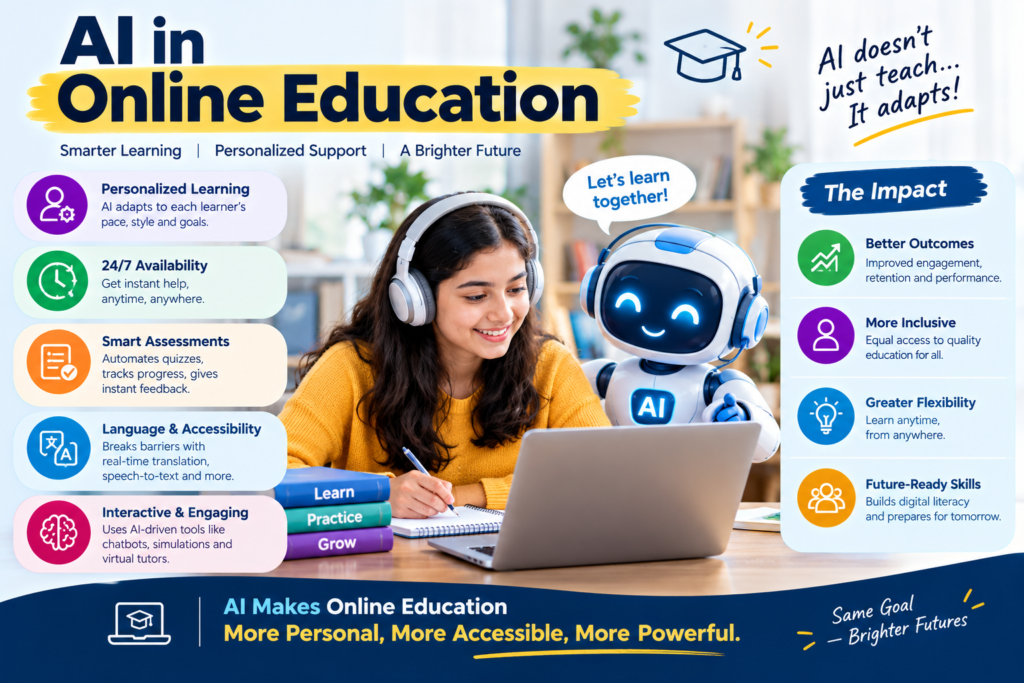
AI in online education helps students learn in new ways. It can explain difficult topics, suggest useful lessons, check assignments, and provide quick feedback. Teachers can also use AI to plan lessons, create quizzes, and understand student progress.
These changes are making online learning more flexible and personal. Students do not all learn at the same speed. Some need extra practice, while others are ready for advanced lessons. AI tools can help meet these different needs.
AI e-learning is also creating new opportunities for schools, colleges, training centers, and online course providers. They can use smart tools to improve lessons and support more learners.
However, AI is not a replacement for teachers. Human guidance, care, and judgment remain important. The best results come when educators use technology to support real learning.
In this article, we will explore nine powerful AI education trends, their benefits, the challenges they bring, and the opportunities they create for the future.
Understanding AI in Online Learning
What Is AI in Education?
Artificial intelligence is technology that can perform tasks that usually require human intelligence. These tasks include understanding language, finding patterns, answering questions, and making predictions.
In education, AI can support both students and teachers. For example, an AI tutor can explain a math problem step by step. A writing assistant can suggest ways to improve a paragraph. A learning platform can recommend lessons based on a student’s progress.
AI education tools use data, rules, and trained models to provide useful results. Different tools have different abilities. Some follow fixed instructions, while others can generate new text, images, questions, or explanations.
AI does not always give correct answers. Students and teachers should check important information before using it.
How AI E-Learning Works
AI-powered e-learning combines learning materials with smart digital tools. These tools can study learning patterns and respond to student needs.
For example, a student may struggle with fractions during an online math course. An AI learning system can identify repeated mistakes and suggest easier examples. Once the student improves, it can recommend more advanced exercises.
A typical AI online learning process includes these steps:
- Collect learning information: The platform records useful details, such as quiz results and lesson progress.
- Identify learning needs: AI looks for patterns that may show where a student needs help.
- Recommend resources: The system suggests lessons, practice tasks, or revision materials.
- Provide feedback: Students receive explanations and guidance.
- Review progress: Teachers can use learning reports to plan further support.
This process can make learning more responsive. Still, the quality of the results depends on the tool, the information available, and the way educators use it.
Why AI Is Changing Digital Education
Traditional online courses often provide the same material to every student. This approach can work well for some learners, but it may not meet everyone’s needs.
AI can help make online education more flexible. It can support students who need extra practice and offer new challenges to those who learn quickly.
Here are some important reasons why AI is changing digital education.
- Flexible learning: Students can study at a suitable time and pace.
- Quick feedback: AI tools can explain mistakes soon after an exercise.
- Better access: Translation, captions, and reading support can help more learners.
- Teacher support: Educators can save time on routine tasks.
- Useful insights: Educational analytics can help teachers understand progress.
- Personalized courses: Lessons can be adjusted to match learning goals.
These features are useful for schools, universities, professional training providers, and independent learners.
For example, a working professional may want to learn digital marketing after office hours. An AI-powered learning platform can suggest a study plan, provide practice questions, and help explain unfamiliar terms.
A teacher can also use AI to create different versions of a lesson for beginners and advanced learners. This makes it easier to support a class with different skill levels.
AI education trends are not only about new technology. They are also about improving the learning experience. The goal is to help students understand more, practice effectively, and develop skills they can use in real life.
9 Powerful AI Education Trends in Online Learning
1. Personalized Learning Experiences
Personalized learning is one of the most important trends in AI in online education. It helps students follow learning paths that match their goals, progress, and skill levels.
Every student has different strengths. One student may understand a topic after reading it once. Another may need videos, examples, and practice questions.
AI can help identify these differences. It can recommend lessons, suggest revision activities, and adjust the level of practice.
For example, an online English course may offer extra grammar exercises to a student who struggles with sentence structure. A student who performs well may move on to advanced writing tasks.
This approach is known as adaptive e-learning. It allows a learning platform to respond to student performance instead of following one fixed path.
The benefits include:
- Learning activities that match student needs.
- More practice on difficult topics.
- Better control over learning speed.
- Recommendations based on learning goals.
- Opportunities to review weak areas.
However, personalization should not limit students to a narrow set of topics. Teachers should review recommendations and encourage learners to explore new ideas.
2. AI-Powered Virtual Classrooms
Virtual classrooms allow teachers and students to meet online. AI can make these sessions more useful by supporting communication, lesson management, and student participation.
Some AI-powered virtual classrooms can generate meeting summaries, create captions, and organize discussion notes. Other tools can help teachers prepare activities and answer common questions.
For example, a teacher may run a live science lesson for students in different cities. Automatic captions can help students follow the discussion. A meeting summary can help absent students review the main ideas.
AI tools may also support language translation. This can help learners who speak different languages take part in online classes.
Useful features include:
- Automatic captions and transcripts.
- Meeting summaries and lesson notes.
- Translation support.
- Interactive quizzes and polls.
- Digital assistants for common questions.
These tools can improve access and reduce routine work. However, teachers should still lead discussions, encourage participation, and make sure students feel included.
3. Intelligent Tutoring Systems
Intelligent tutoring systems provide guided learning support. They can explain concepts, offer practice questions, and respond to student answers.
Unlike a simple search engine, an AI tutor may help a student work through a problem in several steps. It can ask follow-up questions and offer another explanation when the first one does not help.
Imagine a student learning basic programming. The student writes code but receives an error. An AI tutor can explain what the error means and suggest ways to find the problem.
This type of support can be useful when a teacher is not immediately available.
AI tutors can help students:
- Review difficult topics.
- Practice new skills.
- Understand common mistakes.
- Prepare for tests.
- Build confidence through regular practice.
Still, an AI tutor may misunderstand a question or provide incorrect information. Students should compare its answers with trusted learning materials and ask a teacher when something is unclear.
4. Automated Assessments and Feedback
Assessment helps teachers understand what students know. AI can make some parts of this process faster.
For example, AI tools can check multiple-choice answers, group common mistakes, and suggest feedback on written assignments. They may also help teachers create quizzes for different skill levels. Quick feedback allows students to correct mistakes before they become habits.
Consider an online grammar course. After completing a quiz, a student may receive an explanation of why a verb tense is incorrect. The student can then practice similar questions.
AI assessment tools can support:
- Quiz creation.
- Automatic scoring for suitable question types.
- Feedback on practice activities.
- Identification of common learning gaps.
- Progress reports for teachers.
However, automated grading needs careful review, especially for essays, creative work, and open-ended questions. A student’s ideas, reasoning, and effort may not fit a simple scoring pattern. Teachers should use AI assessments as support, not as the only measure of student ability.
5. AI Content Creation for Online Courses
Creating a good online course takes time. Teachers must prepare explanations, presentations, examples, exercises, and assessments. AI content creation tools can help speed up parts of this work. They can suggest lesson outlines, draft summaries, create practice questions, and simplify complex explanations.
For example, a trainer developing a course on online marketing could use AI to create an initial lesson plan. The trainer can then check the information, add practical examples, and adjust the material for the target audience.
AI can support course creators by helping them:
- Draft lesson outlines.
- Generate practice questions.
- Create summaries of long texts.
- Prepare examples for different skill levels.
- Develop ideas for interactive learning activities.
The final material still needs human review. AI-generated content may contain errors, outdated facts, or examples that do not fit the course. Course creators should also respect copyright, protect private information, and check the quality of their learning resources.
6. Educational Analytics and Student Progress
Educational analytics uses learning data to understand student behavior and performance. AI can help identify patterns that may be difficult to notice manually.
For example, an online course platform may show that many students leave a lesson before completing a quiz. This could suggest that the lesson is too long, unclear, or poorly organized.
Teachers can use these insights to improve their courses. AI-supported educational analytics may help educators:
- Track lesson completion.
- Review quiz performance.
- Identify topics that cause difficulty.
- Find patterns in student engagement.
- Plan additional learning support.
Learning analytics can also help course providers understand which lessons work well and which need improvement.
However, data must be handled responsibly. A low quiz score does not always mean that a student lacks ability. Internet access, personal commitments, language barriers, and other factors can affect results.
Analytics should guide thoughtful decisions rather than label students unfairly. Clear privacy rules and human judgment are essential.
7. Language Learning and Accessibility
AI can make online education more accessible to people with different language skills and learning needs.
Speech recognition tools can convert spoken words into text. Translation tools can help students understand content in another language. Text-to-speech tools can read digital materials aloud.
These features can support students who have difficulty reading small text, understanding spoken lessons, or learning in a second language.
AI can also help language learners practice conversations. A student learning English, for example, may use an AI tool to practise everyday dialogue and receive suggestions about grammar or vocabulary.
Possible applications include:
- Speech-to-text captions.
- Text-to-speech reading support.
- Translation of learning materials.
- Vocabulary practice.
- Conversation exercises.
- Simplified explanations of difficult concepts.
Accessibility tools should be tested with real users. Automated captions and translations can contain mistakes, especially when speakers have strong accents or use specialized terms.
The best approach combines AI features with accessible course design and support from educators.
8. AI-Powered Learning Management Systems
Learning management systems, often called LMS platforms, help organizations deliver courses, manage learners, and track progress.
AI can add useful features to these systems. It may recommend courses, answer common questions, summarize progress, or help administrators organize learning materials.
For example, a company training new employees can use an LMS to assign courses based on job roles. AI may recommend additional training when an employee needs to develop a particular skill.
For schools and online course providers, AI-powered e-learning platforms can support:
- Course recommendations.
- Automated reminders.
- Learner progress reports.
- Searchable course materials.
- Personalized practice activities.
- Basic student support.
These features can improve course management and make it easier for learners to find relevant resources. Still, organizations should compare platforms carefully. Important factors include cost, privacy, accessibility, integration, reliability, and the level of control teachers have over AI features.
9. Immersive and Interactive Learning
Interactive learning gives students opportunities to practise instead of only reading or watching lessons. AI can support simulations, guided activities, and virtual learning experiences. For example, a business student may practise a customer service conversation with an AI-powered character. A science student may explore a virtual experiment before entering a physical laboratory. Some learning systems also combine AI with augmented reality or virtual reality. These tools can create simulated environments for practice.
Potential uses include:
- Virtual science experiments.
- Job interview simulations.
- Customer service training.
- Language conversation practice.
- Technical skill demonstrations.
- Interactive problem-solving exercises.
These experiences can make lessons more engaging when they match the learning goal. However, advanced simulations can cost more than standard online courses. They also require suitable devices and reliable internet access. Educators should choose interactive tools because they improve understanding, not simply because they look impressive.
Opportunities of AI in E-Learning
The opportunities of AI in e-learning extend beyond schools and universities. Businesses, training providers, educational technology companies, and individual professionals can all benefit from better digital learning systems.
Opportunities for Students
Students can use AI to create study plans, review difficult topics, and practise new skills. They can also use it to explore subjects outside their regular courses.
For example, a student preparing for a job may use AI to practise interview questions or learn the basics of spreadsheet software.
Opportunities for Teachers
Teachers can use AI to reduce repetitive tasks and develop new learning activities. They can spend more time discussing ideas, helping struggling students, and providing personal guidance. AI can also support teachers who need to prepare materials for learners with different skill levels.
Opportunities for Businesses
Companies need employees who can adapt to new tools and changing job requirements. AI-supported training can help businesses deliver courses to teams in different locations.
A company can provide online training in communication, cybersecurity awareness, software use, and customer support. Learning reports can help managers identify areas where further training may be useful.
Opportunities for Entrepreneurs
AI creates opportunities for people who want to build education-related services.
Possible business ideas include:
- Online courses for specific careers.
- AI-supported language learning.
- Digital tutoring services.
- Educational content development.
- Learning analytics services.
- Training platforms for small businesses.
Entrepreneurs should begin with a clear learner problem. A useful service must offer accurate information, a good learning experience, and real value.
Opportunities for Career Growth
AI and online education are also creating demand for new skills. People interested in this field may explore roles such as instructional designer, e-learning developer, educational technology specialist, learning analyst, and AI learning content editor. These careers often require a mix of subject knowledge, communication skills, technical ability, and an understanding of how people learn.
Benefits of AI for Students and Educators
AI can improve different parts of the online learning process. Its value depends on the needs of the learner and the way the technology is used.
|
Benefit |
How it helps |
|
Personalization |
Matches activities to student needs and progress. |
|
Fast feedback |
Helps learners identify mistakes sooner. |
|
Flexible access |
Supports learning at different times and locations. |
|
Teacher support |
Reduces some repetitive preparation tasks. |
|
Better insights |
Helps educators review progress and course quality. |
|
Accessibility |
Provides features such as captions and reading support. |
|
Interactive practice |
Offers simulations and guided exercises. |
|
Skill development |
Supports ongoing learning for work and personal growth. |
These benefits can make online education more convenient and responsive. For example, a student can use an AI tutor to review a topic after class. The teacher can then use quiz results to plan the next lesson. Both activities support learning in different ways. AI can also help course providers improve their content. If many learners struggle with the same activity, the provider can review the instructions or add more examples.
However, technology alone does not guarantee better results. Clear teaching, suitable learning materials, regular practice, and student motivation remain essential.
Challenges and Responsible AI Use
Despite its benefits, AI in online education comes with important challenges. Schools and course providers should understand these risks before adopting new tools.
Accuracy and Reliability
AI tools can produce incorrect answers or confusing explanations. Students may accept these answers without checking them. Teachers should encourage learners to compare AI responses with textbooks, course materials, and reliable sources.
Data Privacy and Security
AI learning platforms may process student information, including assessment results and learning activity. Organizations should understand what data a tool collects, how it stores information, and who can access it. They should follow applicable privacy laws and avoid entering sensitive student details into unapproved tools.
Bias and Fairness
AI systems can produce unfair results if their training data or design does not represent different learners well.
For example, a speech tool may struggle to understand certain accents. An automated assessment system may also judge some writing styles less accurately than others.
Testing across different groups can help reveal these problems.
The Digital Divide
Not every student has a fast internet connection, a modern device, or a quiet place to study.
If courses depend too heavily on advanced AI tools, some learners may face additional barriers. Education providers should offer accessible alternatives and keep essential materials available in simple formats.
Overdependence on Technology
Students may rely on AI to complete assignments instead of learning the underlying skills.
Teachers can reduce this risk by asking students to explain their reasoning, show their work, and cite sources where appropriate. Course rules should clearly state when AI assistance is allowed.
Protecting Human Interaction
Education is about more than delivering information. Students also need encouragement, discussion, feedback, and social connection.
AI should support teachers rather than remove the human side of learning. A balanced approach combines digital convenience with meaningful communication.
How to Implement AI in Online Courses
Schools, teachers, and course creators do not need to adopt every AI tool at once. A small, focused plan is often more effective.
Step 1: Identify a Clear Learning Need
Start by finding a real problem. Students may need faster feedback, teachers may spend too much time creating quizzes, or learners may struggle to find suitable revision materials.
Choose a tool that addresses that problem.
Step 2: Select Suitable Online Teaching Tools
Compare available tools based on features, cost, ease of use, accessibility, privacy, and reliability.
Check whether the tool works with existing learning management systems. Make sure teachers and students can use it without unnecessary difficulty.
Step 3: Test With a Small Group
Run a short pilot course before introducing the tool to everyone.
Ask students and teachers about their experience. Check whether the tool saves time, improves understanding, and works as expected.
Step 4: Train Teachers and Students
Explain how the tool works, what its limits are, and when its output needs to be checked.
Provide clear rules for academic honesty, data protection, and responsible AI use.
Step 5: Measure the Results
Use suitable measures to review the pilot.
These may include:
- Course completion rates.
- Quiz results before and after implementation.
- Student feedback.
- Teacher preparation time.
- Accessibility and usability issues.
- Cost per learner.
Avoid relying on a single number. Combine learning results with feedback from students and educators.
Step 6: Improve the Learning Experience
Use the findings to make changes. Keep the features that provide value and remove those that create confusion or unnecessary work.
AI implementation should be an ongoing process. Regular review helps ensure that technology continues to support learning goals.
For further guidance on AI and education, visit UNESCO’s official website.
The Future of Online Education With AI
The future of online education with AI will likely involve more personalized, interactive, and flexible learning experiences.
AI tutors may become better at explaining difficult concepts. Learning management systems may offer more useful recommendations. Course creators may develop learning materials faster with AI support.
At the same time, educators will need to focus on skills that technology cannot fully replace. These include critical thinking, creativity, communication, teamwork, and ethical judgment.
Students will also need to learn how to use AI responsibly. They should know how to check information, ask clear questions, protect private data, and recognize the limits of automated answers.
Another important trend is the combination of AI with other technologies. Virtual reality, simulation tools, digital assessments, and accessible learning systems may work together to create richer learning experiences.
However, the future will not be the same for every school or student. Budgets, internet access, local needs, and educational policies will influence how quickly AI is adopted.
The most successful learning environments will focus on people first. They will use AI where it offers clear value, protect student rights, and give teachers the freedom to make informed decisions.
AI should help make education more useful and accessible. It should not become a goal in itself.
Students can use these tools to practise skills and understand difficult topics. Teachers can save time on routine work and focus more on individual support. Businesses and course providers can also create flexible training programs for different learners.
However, responsible use is essential. AI tools can make mistakes, collect sensitive information, and create barriers for some students. Education providers must consider accuracy, privacy, accessibility, and fairness when choosing their tools.
Know More:
”FAQs”
1. What is AI in online education?
AI in online education refers to the use of artificial intelligence to support teaching and learning through digital platforms. It can provide personalized lessons, answer questions, suggest practice activities, assess suitable assignments, and help teachers understand student progress.
2. How does AI improve online learning?
AI can improve online learning by offering quick feedback, recommending relevant resources, and helping students practise difficult topics. It can also support teachers with lesson preparation and learning analytics. The results depend on the accuracy of the tools and how well they fit the course.
3. What are the main AI trends in online education?
Important trends include adaptive learning, AI tutors, virtual classroom assistants, automated feedback, AI content creation, educational analytics, language support, intelligent learning management systems, and interactive simulations.
4. What are the benefits of AI for e-learning platforms?
AI can help e-learning platforms personalize course recommendations, support learners, identify learning gaps, and automate routine tasks. It can also help educators improve course content and provide more timely feedback.
5. Can AI replace teachers in online education?
No. AI can support many teaching tasks, but it cannot fully replace the judgment, empathy, guidance, and social connection that teachers provide. Human educators remain important for explaining complex ideas, evaluating individual needs, and creating supportive learning environments.
6. Is AI-powered e-learning suitable for beginners?
Yes. Beginners can use AI tools to receive simple explanations, practise basic skills, and review lessons at their own pace. They should choose reliable tools and check important answers against trusted learning materials.
7. What challenges does AI create in digital education?
Key challenges include incorrect information, data privacy risks, bias, unequal access to technology, and overdependence on automated tools. Education providers should address these risks through careful tool selection, clear policies, teacher training, and regular review.
8. What skills are useful for a career in AI and online education?
Useful skills include instructional design, digital content creation, communication, data analysis, learning management system administration, and responsible AI use. The best combination depends on the role and the industry.
9. What is the future of online education with AI?
The future may include more adaptive learning, smarter tutoring tools, improved accessibility, interactive virtual classrooms, and better learning analytics. Human guidance, privacy, and fair access will remain important as these technologies develop. AI in online education is creating new ways to teach, learn, and develop professional skills. From personalized lessons and intelligent tutors to virtual classrooms and educational analytics, AI offers many opportunities to improve digital learning.