1. AI Interview Preparation: How AI Is Changing Job Interview Preparation?
Getting a job isn’t only about having the right degree or work experience. You also need to explain your skills, share your achievements, and show employers why you’re a good fit for the position.
However, many candidates struggle with interviews. Some don’t know which questions to expect. Others find it difficult to explain their experience or speak confidently in front of recruiters.
This is where AI interview preparation can make a real difference.
Artificial intelligence is changing how people prepare for job interviews. Instead of depending only on books, friends, or traditional coaching, candidates can now use AI tools to practice questions, improve their answers, and receive instant feedback.
These tools can act like a personal interview coach. They can generate questions based on a job description, suggest better ways to structure answers, and help candidates identify areas that need improvement.
For example, a candidate applying for a digital marketing position can use AI to practice questions about SEO, content marketing, Google Analytics, and campaign management. A software developer can practice coding questions and technical discussions.
The best part? You don’t need years of interview experience to get started.
With the right approach, AI can help you prepare for different interview formats, improve your communication skills, and build confidence before meeting a recruiter.
In this guide, you’ll learn how to prepare for a job interview using artificial intelligence, which tools you can explore, and how to make your preparation more effective.
Know More: AI Digital Marketing Workflow: 7 Powerful Steps to Automate Marketing from Research to Reporting
2. What Is AI Interview Preparation?
AI interview preparation is the process of using artificial intelligence tools and software to practice and improve your interview performance.
These tools use technologies such as machine learning and natural language processing to understand questions, analyse responses, and provide useful suggestions.
Think of an AI interview coach as a practice partner. You can ask questions, share your answers, and receive suggestions to make your responses clearer and more relevant.
For example, you can enter a job description into an AI tool and ask it to generate 20 interview questions. It can create questions about your experience, technical knowledge, problem-solving ability, and communication skills.
You can then practice answering these questions before your actual interview.
How Does AI Interview Preparation Work?
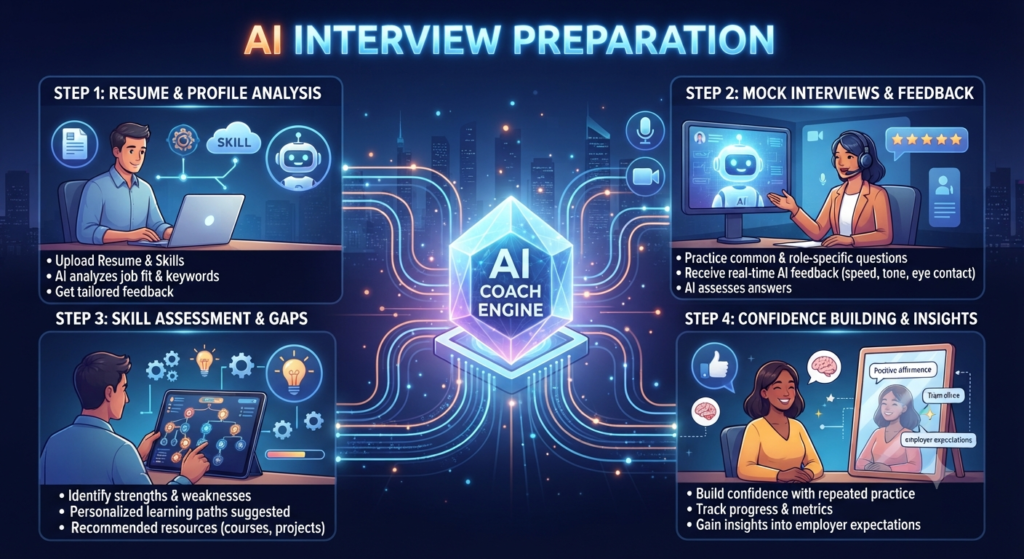
Most AI interview tools follow a simple process:
- Understand your target role: Enter the job title, company information, or job description.
- Generate questions: The tool creates relevant questions based on the position.
- Practice your answers: Respond through text, voice, or video, depending on the tool.
- Receive feedback: Review suggestions about answer structure, relevance, and clarity.
- Improve your performance: Practice again and work on your weak areas.
Some advanced platforms also offer speech analysis, interview simulations, and performance reports.
However, AI feedback isn’t always correct. Treat it as guidance rather than a final assessment of your abilities.
3. Why Is AI Important for Modern Job Interview Preparation?
The hiring process is becoming more competitive. Employers want candidates who understand the job, communicate clearly, and demonstrate practical skills.
Traditional preparation methods are still useful, but AI offers additional ways to practice.
Here are some important benefits.
3.1 Personalized Interview Practice
Every job has different requirements. A sales executive doesn’t need the same preparation as a software engineer.
AI tools can create questions based on your target position and experience level.
For example:
- A marketing candidate can practice questions about SEO, advertising, and lead generation.
- An HR candidate can prepare for recruitment, employee engagement, and conflict management questions.
- A developer can practice programming, debugging, and system design questions.
- A fresher can prepare questions about education, internships, and academic projects.
This makes interview preparation more focused.
3.2 Instant Feedback and Improvement
Getting feedback from an experienced person can be difficult. They may not always be available when you want to practice.
AI interview feedback tools can provide suggestions within seconds.
They may help you identify:
- Answers that are too long.
- Unclear explanations.
- Missing examples.
- Weak answer structures.
- Repeated words.
- Irrelevant information.
For instance, if your answer doesn’t explain your contribution to a project, AI may suggest adding a specific example.
3.3 Better Interview Confidence
Many candidates know their subject but feel nervous when answering questions.
Regular practice can help reduce this problem.
AI-powered mock interviews allow you to practice in a low-pressure environment. You can repeat difficult questions until you become comfortable explaining your thoughts.
3.4 Flexible and Affordable Learning
Traditional interview coaching may require appointments, travel, and additional expenses.
Some AI tools offer free plans or basic features that allow candidates to practice at their convenience.
You can prepare in the morning, during a lunch break, or after work.
3.5 Preparation for Different Interview Formats
AI can help you prepare for:
- One-to-one interviews.
- Technical interviews.
- Behavioral interviews.
- HR screening rounds.
- Panel interviews.
- Online video interviews.
- Situational interviews.
The goal isn’t to memorise every possible answer. It’s to become comfortable discussing your experience and solving problems.
4. Best AI Tools for Interview Practice
There are several AI career tools that can support interview preparation. Each offers different features, so choose according to your needs.
Here are some useful options.
4.1 ChatGPT for Interview Preparation
ChatGPT can help generate interview questions, improve answers, explain technical concepts, and conduct text-based practice interviews.
You can provide a job description and ask it to behave like a recruiter.
For example:
“Act as an experienced HR recruiter. I am applying for a Digital Marketing Executive position. Ask me 15 interview questions one at a time. Wait for my answer before asking the next question. After each answer, provide feedback on clarity, relevance, and confidence.”
You can also ask ChatGPT to:
- Generate behavioral interview questions.
- Explain difficult technical topics.
- Improve your introduction.
- Review your sample answers.
- Prepare questions to ask recruiters.
- Create a personalized interview preparation plan.
This makes ChatGPT a useful starting point for candidates who want flexible practice.
4.2 Google Interview Warmup
Google Interview Warmup is an interview practice resource designed to help people practice responses and reflect on their answers.
It has offered practice activities involving common questions and role-related topics.
Check its current availability and features before relying on it, as online tools can change over time.
4.3 Microsoft Copilot
Microsoft Copilot can help candidates research companies, understand job requirements, generate interview questions, and practice responses.
For example, you can ask it to explain the responsibilities of a business analyst and create a list of likely interview questions.
4.4 Yoodli
Yoodli is an AI-powered communication coaching platform. It can help users practice speaking and review aspects of their delivery.
Candidates can use communication feedback to work on speaking pace, filler words, and presentation skills.
4.5 Interviewing.io
Interviewing.io is known for technical interview practice, particularly for software engineering candidates.
It can be useful for people preparing for coding interviews and technical assessments.
Comparison of AI Interview Tools
|
AI Tool |
Main Purpose |
Suitable For |
|
ChatGPT |
Questions, answer improvement, practice |
Students and professionals |
|
Google Interview Warmup |
Interview question practice |
Job seekers |
|
Microsoft Copilot |
Research and question generation |
General candidates |
|
Yoodli |
Communication and speaking practice |
Candidates improving presentation |
|
Interviewing.io |
Technical interview practice |
Software engineers |
Before choosing any platform, check its current features, pricing, privacy policy, and availability.
5. How to Use AI for Job Interview Preparation: A Step-by-Step Guide
Using AI effectively requires more than asking random questions. You need a clear preparation process. Follow these steps to make your practice more useful.
Step 1: Understand the Job Description
Start by reading the job description carefully.
Identify the following:
- Required qualifications.
- Technical skills.
- Work responsibilities.
- Preferred experience.
- Communication requirements.
- Tools and software knowledge.
Next, paste the job description into an AI tool.
Use this prompt:
“Analyse this job description and identify the 10 most important skills and qualifications the employer expects. Also suggest the interview topics I should prepare for.”
AI can help you understand which areas deserve more attention.
Step 2: Generate Relevant Interview Questions
Once you understand the job requirements, ask AI to create questions.
Try this prompt:
“Generate 30 interview questions for a fresher applying for a Digital Marketing Executive position. Include HR questions, technical questions, behavioral questions, and situational questions. Arrange them from basic to advanced.”
This gives you a structured question list.
Step 3: Prepare Your Answers
Don’t immediately memorize AI-generated answers.
First, think about your actual skills and experiences.
Ask AI to help organize your ideas into clear responses.
For example:
“Help me structure an answer to ‘Tell me about yourself’. I am a recent graduate with knowledge of digital marketing, SEO, and content writing. Keep the answer natural and suitable for a one-minute introduction.”
Review the answer and replace anything that doesn’t reflect your real experience.
Step 4: Practice With Mock Interviews
A mock interview is a practice session that simulates a real interview.
Ask AI to act as a recruiter and ask one question at a time.
Try answering without reading prepared notes.
This will help you improve your ability to think and respond naturally.
Step 5: Request Detailed Feedback
After answering, ask AI to evaluate your response.
Use this prompt:
“Review my interview answer. Check whether it directly answers the question, includes relevant examples, and explains my contribution clearly. Identify three improvements and provide a better version without changing my actual experience.”
Focus on the feedback that helps you communicate more effectively.
Step 6: Practice Difficult Questions Again
Make a list of questions you find difficult.
These may include:
- What is your biggest weakness?
- Why should we hire you?
- Why do you want to work here?
- Tell me about a professional failure.
- How do you handle pressure?
Practice these questions until you can answer them clearly.
Step 7: Prepare Questions for the Recruiter
Remember, an interview isn’t only about answering questions.
You should also understand whether the company and role are right for you.
Ask AI to suggest thoughtful questions, such as:
- What would my main responsibilities be during the first three months?
- How does the company measure employee performance?
- What learning opportunities are available?
- What are the biggest challenges facing this team?
Choose questions that genuinely matter to you.
6. Use AI Mock Interviews to Practice Real Questions
One of the most useful applications of artificial intelligence interview prep is mock interviewing.
A mock interview helps you experience the question-and-answer process before your actual meeting.
Instead of simply reading questions, you practice responding as if you’re speaking to a recruiter.
How Does a Mock Interview AI Work?
Depending on the platform, the process may include:
- Selecting your target job role.
- Choosing an interview difficulty level.
- Receiving questions from an AI interviewer.
- Answering through text, voice, or video.
- Reviewing feedback and suggestions.
Some platforms also provide performance reports.
Example of an AI Mock Interview
Suppose you’re applying for an SEO Executive position.
The AI interviewer may ask:
Question 1: What is SEO?
You explain how search engine optimization helps improve a website’s visibility in organic search results.
Question 2: How do you perform keyword research?
You explain search intent, keyword difficulty, search volume, competitor analysis, and keyword relevance.
Question 3: How do you improve website rankings?
You discuss technical SEO, on-page optimization, content quality, backlinks, and user experience.
Question 4: How do you measure SEO performance?
You explain organic clicks, impressions, CTR, keyword rankings, conversions, and engagement.
After the practice session, ask AI to review your answers.
Tips for Better Mock Interview Results
- Answer questions without reading from a screen.
- Use real examples from your work or education.
- Keep answers focused.
- Avoid unnecessary technical terms.
- Practice difficult questions more often.
- Review feedback after each session.
Remember, the purpose of mock interviews is improvement, not perfection.
7. Prepare for Behavioral Interview Questions Using AI
Behavioral questions help employers understand how you’ve handled situations in the past.
Recruiters often ask these questions to learn about your teamwork, communication, leadership, and problem-solving abilities.
Some examples include:
- Tell me about a time you handled a difficult situation.
- Describe a project where you worked with a team.
- Tell me about a mistake you made and what you learned.
- How do you manage multiple responsibilities?
- Describe a situation where you solved a problem.
AI can generate questions based on your target job and help you structure your responses.
Use the STAR Method
The STAR method is a simple way to organize behavioral interview answers.
|
Element |
Meaning |
What to Explain |
|
S |
Situation |
Describe the situation |
|
T |
Task |
Explain your responsibility |
|
A |
Action |
Describe what you did |
|
R |
Result |
Share the outcome |
Example:
Question: Tell me about a time you solved a difficult problem.
- Situation: Our team was facing delays in completing a project.
- Task: I was responsible for organizing the remaining work.
- Action: I reviewed pending tasks, identified priorities, and coordinated with team members.
- Result: We improved task management and completed the remaining work more efficiently.
Use your own real experiences when preparing answers.
AI can help improve the structure, but it shouldn’t invent achievements or results.
8. Improve Technical Interview Preparation With AI
Technical interviews can be challenging because they test your practical knowledge and problem-solving abilities.
The questions depend on the position you’re applying for.
For example:
|
Job Role |
Important Preparation Topics |
|
Software Developer |
Programming, algorithms, debugging |
|
SEO Executive |
Keyword research, technical SEO, analytics |
|
Data Analyst |
Excel, SQL, statistics, data visualisation |
|
Digital Marketer |
SEO, PPC, social media, analytics |
|
Graphic Designer |
Design principles, software, portfolio |
|
HR Executive |
Recruitment, employee relations, HR processes |
AI can explain technical concepts in simple language.
You can also request practical questions and sample scenarios.
For example, a data analyst can ask:
“Generate 10 SQL interview questions for an entry-level data analyst. Include basic queries, joins, grouping, and practical examples. Explain the correct approach after I answer each question.”
A software developer can request coding challenges and ask AI to explain different solutions.
How AI Helps With Problem-Solving
AI can help you:
- Understand complex concepts.
- Practice coding problems.
- Review technical explanations.
- Explore alternative solutions.
- Identify gaps in your knowledge.
- Prepare for scenario-based questions.
However, don’t depend on AI-generated answers without checking them. Technical explanations can contain errors.
Practice solving problems independently so you can explain your reasoning during the interview.
9. Improve Communication Skills and Interview Confidence
Having technical knowledge isn’t enough if you can’t explain it clearly.
Communication skills play an important role in interviews.
Employers want candidates who can explain ideas, listen carefully, and respond professionally.
AI tools can support your communication skills development through regular practice.
9.1 Improve Answer Clarity
Ask AI to review your answers and identify confusing sentences.
For example:
“Rewrite my interview answer in simple, professional English. Keep the original meaning and make it easy to explain during a face-to-face interview.”
9.2 Reduce Filler Words
Words such as “um”, “actually”, “basically”, and “you know” can sometimes make answers less clear.
Speaking practice tools may help identify repeated filler words.
Work on pausing naturally instead of filling every silence.
9.3 Improve Speaking Confidence
Record yourself answering common questions.
Review your:
- Speaking speed.
- Voice clarity.
- Answer structure.
- Confidence.
- Use of examples.
- Professional language.
9.4 Develop Better Listening Skills
An interview isn’t a speech competition.
Listen to the complete question before responding. If something isn’t clear, politely ask the recruiter to explain.
AI can help you practice understanding different question formats, but real conversations with people are also important.
10. Use AI for Resume Optimization and Job Description Analysis
Your resume is often the first step in the hiring process.
If your resume doesn’t clearly explain your skills and experience, recruiters may find it difficult to understand your suitability for the role.
AI can help with resume optimization and interview preparation at the same time.
Match Your Resume With the Job Description
Upload or paste your resume and the target job description into an appropriate AI tool.
Ask:
“Compare my resume with this job description. Identify matching skills, missing relevant information, and areas where I should prepare for interview questions.”
This can help you identify topics recruiters may ask about.
For example, if your resume mentions Google Analytics, the recruiter may ask:
- How do you use Google Analytics?
- Which metrics do you track?
- How do you measure website performance?
- What is the difference between users and sessions?
Prepare to explain every skill and achievement mentioned in your resume.
Prepare for Questions About Your Experience
AI can generate questions based on your projects, internships, and previous responsibilities.
This is especially useful for experienced candidates who need to explain their work in detail.
However, never add skills or achievements simply because an AI tool recommends them. Your resume must remain accurate.
11. Prepare for Online and Video Interviews With AI
Online interviews have become a common part of modern recruitment.
Candidates may attend interviews through video conferencing platforms or recorded video assessments.
Video interview practice can help you become comfortable speaking in front of a camera.
What Should You Practice?
Focus on these areas:
Camera positioning: Keep your camera near eye level.
Lighting: Choose a well-lit location where your face is clearly visible.
Background: Use a clean and professional background.
Speaking: Speak clearly and avoid rushing.
Eye contact: Look towards the camera when addressing the interviewer.
Body language: Maintain a comfortable posture and natural expressions.
How AI Video Interview Practice Helps
Some AI tools offer video-based practice and may analyse aspects of speech or presentation.
They can help you review your delivery and identify areas for improvement.
However, don’t treat automated facial expression or emotion scores as reliable measures of personality or job suitability.
For additional guidance, read the University of Victoria’s interview preparation guide.
12. AI Interview Preparation Tips for Freshers and Students
Freshers often face a different challenge from experienced professionals.
They may have academic knowledge but limited workplace experience.
This can make it difficult to answer questions about teamwork, leadership, and professional achievements.
AI mock interview platforms for students can help candidates practice using examples from their education and everyday experiences.
Important Areas for Freshers
- Prepare Your Introduction
Practice explaining your education, interests, skills, and career goals.
- Discuss Academic Projects
Prepare to explain your project objectives, responsibilities, challenges, and results.
- Understand Your Skills
If you mention Excel, Python, SEO, or communication skills on your resume, prepare practical examples.
- Practice HR Questions
Prepare answers for questions about strengths, weaknesses, career goals, and teamwork.
- Improve English Communication
Use AI to practice professional conversations and improve sentence clarity.
A Sample AI Prompt for Freshers
“Act as an experienced HR interviewer. I am a fresher applying for my first job. Conduct a beginner-friendly mock interview with 15 questions. Include questions about my education, academic projects, strengths, weaknesses, communication skills, and career goals. Ask one question at a time and provide feedback after each answer.”
How Students Can Benefit From AI Interview Tools
Students can use AI to prepare for internships, campus placements, entry-level jobs, and graduate recruitment programmes.
Regular practice can help them understand recruiter expectations before attending actual interviews.
Most importantly, candidates should learn to explain their real abilities rather than trying to sound more experienced than they are.
13. Limitations of AI Interview Preparation
Although AI offers several advantages, it isn’t a complete replacement for human guidance or real interview experience.
Candidates should understand its limitations before depending on it.
13.1 AI Can Generate Incorrect Information
AI tools can sometimes provide outdated, incomplete, or incorrect answers.
Always verify important technical information and company-related facts.
13.2 AI Cannot Fully Understand Human Interaction
Real interviews involve emotions, unexpected questions, follow-up discussions, and personal connections.
AI cannot fully recreate these experiences.
Practising with friends, mentors, and professionals remains valuable.
13.3 Risk of Memorised Answers
One common mistake is memorising AI-generated responses.
This can make candidates sound unnatural.
Recruiters may also ask follow-up questions that require original thinking.
Use AI to understand how to structure answers, not to create a script that you repeat word for word.
13.4 Privacy Concerns
Some interview preparation platforms collect personal information, recordings, or uploaded documents.
Before using a platform:
- Read its privacy policy.
- Check how recordings are stored.
- Avoid sharing passwords or sensitive information.
- Remove unnecessary personal details from documents.
- Understand whether your data may be used for model training.
13.5 Automated Feedback Isn’t Always Fair
AI scoring systems may not accurately measure every communication style, accent, or personality.
A lower automated score doesn’t automatically mean you’re a poor candidate.
Use feedback as one source of information, not as a final judgement.
14. Best Practices for Getting Better Results From AI Interview Tools
To improve interview performance with AI tools, follow a consistent preparation routine.
Here are 10 useful practices.
- Use specific prompts: Mention your job title, experience level, and target industry.
- Share the job description: This helps AI generate relevant questions.
- Practice regularly: Spend 20–30 minutes on focused preparation.
- Answer naturally: Avoid reading prepared responses.
- Use real examples: Discuss genuine projects and experiences.
- Review feedback: Identify repeated weaknesses.
- Practice technical topics: Focus on skills required for the position.
- Record practice sessions: Review your speaking and presentation.
- Research the employer: Understand the company’s work and expectations.
- Get human feedback: Ask a mentor or friend to conduct a mock interview.
A Simple 7-Day AI Interview Preparation Plan
|
Day |
Preparation Activity |
Goal |
|
Day 1 |
Analyse resume and job description |
Understand job requirements |
|
Day 2 |
Generate common interview questions |
Build a question list |
|
Day 3 |
Practice HR and behavioral questions |
Improve answer structure |
|
Day 4 |
Practice technical questions |
Strengthen job-related knowledge |
|
Day 5 |
Conduct AI mock interviews |
Identify weak areas |
|
Day 6 |
Practice video and communication skills |
Improve presentation |
|
Day 7 |
Complete a full mock interview |
Review overall readiness |
This plan can be adjusted according to the difficulty of the position and your experience level.
15. The Future of AI-Powered Interview Coaching
Artificial intelligence is likely to play an increasingly important role in career development and recruitment.
Interview preparation tools are becoming more interactive and personalized.
Several developments may influence how candidates prepare in the coming years.
Personalized Learning Experiences
Future tools may offer more detailed preparation plans based on a candidate’s skills, career goals, and performance.
Real-Time Interview Practice
AI-powered platforms may provide more interactive simulations, allowing candidates to practice different interview situations.
Better Technical Preparation
AI tools may offer more advanced coding exercises, case studies, and role-specific assessments.
Improved Communication Coaching
Speech analysis and personalized feedback may help candidates identify communication weaknesses and improve their presentation.
Integration With Career Platforms
AI interview preparation may become more closely connected with resume tools, career platforms, job portals, and professional learning resources.
However, technology will remain a support system. Employers will continue to value genuine skills, practical experience, professional behavior, and human communication.
The candidates who combine AI preparation with real-world learning may be better prepared for changing recruitment expectations.
Build Interview Confidence With AI
Preparing for a job interview doesn’t have to be confusing or stressful. With the right approach, artificial intelligence can make the process more organized, practical, and flexible.
AI interview preparation helps candidates generate relevant questions, practice mock interviews, improve communication skills, and identify areas that need more attention.
From fresh graduates preparing for their first job to experienced professionals applying for senior positions, AI tools can support different career goals.
However, technology alone won’t guarantee interview success. You still need to develop practical knowledge, understand the employer’s expectations, and communicate your experience honestly.
Start with a clear preparation plan. Use AI to practice, review your answers, and work on your weaknesses. Combine digital tools with real conversations and professional guidance.
Remember, the goal isn’t to give perfect answers. It’s to demonstrate your skills, share your experiences, and show employers the value you can bring to their organization.
”FAQs”
Q1. How can I use AI for job interview preparation?
You can use AI to generate interview questions, practice mock interviews, improve answers, understand technical concepts, and review your communication skills. Start by sharing your target job description and asking AI to create a personalized preparation plan.
Q2. Can AI help me prepare for interviews?
Yes. AI can help you prepare for HR, technical, behavioral, and situational interviews. It can generate relevant questions, provide answer suggestions, and help you identify areas that need improvement. However, you should also practice with real people.
Q3. What are the best AI tools to practice interview questions?
Popular options include ChatGPT, Microsoft Copilot, Yoodli, and Interviewing.io. Google Interview Warmup is another resource to investigate, subject to its current availability. The best option depends on whether you need question generation, technical practice, or communication coaching.
Q4. How do I use ChatGPT for interview preparation?
Share your resume or job description with ChatGPT and ask it to generate relevant questions. You can then conduct a mock interview, practice answers, and request feedback. Ask it to evaluate clarity, relevance, answer structure, and the use of real examples.
Q5. Are there free AI interview coaching software options?
Some AI tools offer free access, trial plans, or limited features. ChatGPT and Microsoft Copilot can be useful starting points for question generation and practice. Always check the current pricing and feature limitations before choosing a platform.
Q6. Can freshers use AI mock interview platforms?
Absolutely. Freshers can use AI tools to practice introductions, HR questions, academic project discussions, technical topics, and communication skills. These tools can help students prepare for campus placements, internships, and their first professional interviews.
Q7. Can AI improve my interview confidence?
AI can help improve confidence through repeated practice and structured feedback. Mock interviews allow you to become familiar with common questions and practice explaining your thoughts. Confidence also develops through real conversations and experience.
Q8. Is AI interview preparation better than traditional coaching?
Both have advantages. AI offers flexible practice, quick feedback, and personalized questions. Traditional coaching provides human interaction, professional judgement, and personal guidance. Combining both approaches can make preparation more effective.
Q9. Can AI generate behavioural interview questions?
Yes. AI can generate behavioral questions based on your job role, experience level, and industry. It can also help you structure answers using the STAR method: Situation, Task, Action, and Result.
Q10. Should I memorise AI-generated interview answers?
No. Memorized answers can sound unnatural and may not fit unexpected follow-up questions. Use AI-generated answers as examples. Understand the main ideas and explain them in your own words using genuine experiences.


