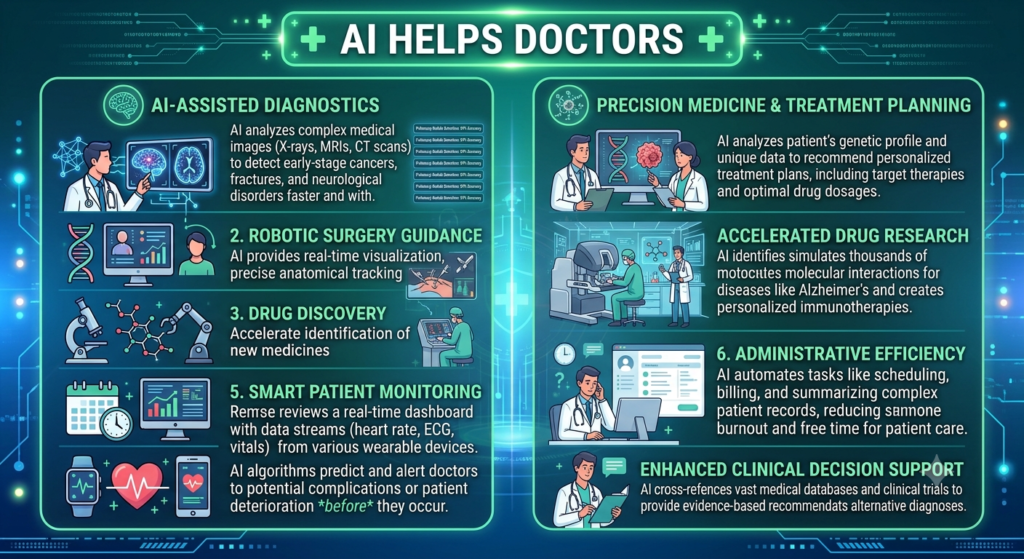
AI Help Doctors Make Better Decisions?
Artificial intelligence is changing how doctors find diseases, study medical records, and choose treatments. AI for Doctors can help turn large amounts of medical data into useful information. It can also highlight risks that may be difficult to notice during a busy consultation.
But can AI help doctors make better decisions in patient care? Yes, it can. When doctors use reliable AI tools with their medical knowledge, they can make more informed decisions, spot warning signs earlier, and plan care more effectively.
Artificial Intelligence in Healthcare is not just about robots or machines. It includes software that studies medical images, checks patient records, predicts health risks, and supports clinical decisions. Some tools help doctors read scans. Others help them review test results or identify possible drug interactions.
The goal is simple: give doctors better information so they can care for patients more effectively.
Still, AI isn’t perfect. It can make mistakes, miss important details, or produce results that don’t fit a patient’s needs. Doctors must review its suggestions and use their own judgment.
In this guide, we’ll explain how AI works in medicine, explore seven important benefits, examine real-world applications, and discuss the risks that healthcare professionals must consider.
1. Understanding AI in Healthcare Decision Making
AI in healthcare decision making means using computer systems to analyze medical information and help healthcare professionals choose suitable next steps.
These systems can process information such as:
- Medical history and previous diagnoses.
- Blood tests and laboratory reports.
- X-rays, CT scans, and MRI images.
- Heart rate, blood pressure, and oxygen levels.
- Current medicines and known allergies.
- Symptoms and lifestyle information.
- Results from earlier treatments.
A doctor may need to review several sources before making a diagnosis. AI can help organize this information and highlight patterns that deserve attention.
For example, a patient may visit a hospital with tiredness, dizziness, and unusual blood test results. An AI tool might flag a pattern that suggests the doctor should investigate a possible underlying condition. The doctor can then order suitable tests and consider other explanations.
This is how AI-assisted medical decisions can support clinical reasoning. The system offers information, but the doctor remains responsible for deciding what it means for the patient.
How AI Helps Doctors and Works in Medicine
AI systems use different technologies to analyze information.
Machine learning in healthcare allows software to learn patterns from examples in data. A model trained on suitable medical images, for instance, may learn to identify features associated with a particular disease.
Deep learning in medicine uses layered neural networks to analyze complex information. It is especially useful for tasks involving images, signals, and other large datasets.
Natural language processing helps software work with written information. It may assist with reviewing medical notes, organizing reports, or finding relevant details in electronic health records. Predictive analytics in healthcare uses available data to estimate the likelihood of future events, such as a patient’s risk of developing complications.
These methods aren’t interchangeable. Each has different strengths and limitations. A tool that performs well on medical images may not be suitable for predicting treatment outcomes.
What Doctors Do With AI
Doctors can use AI in several parts of the care process.
Diagnosis support
AI highlights suspicious patterns in scans, laboratory results, or other clinical information.
Treatment planning
AI can help doctors compare available options and review relevant clinical evidence.
Patient monitoring
AI can analyze changing vital signs and flag patterns that may need clinical review.
The best results come when these tools are used within a proper clinical process. Doctors must understand the patient’s condition, check the evidence, and consider factors that software may not capture.
2. Seven Powerful Ways AI Helps Doctors Make Better Decisions
AI healthcare solutions can support doctors at several stages of patient care. Here are seven important ways these tools may improve clinical decisions.
1. Faster and More Informed Diagnosis
Diagnosis can be difficult when several conditions cause similar symptoms. AI in medical diagnosis can help doctors review available information and identify possible explanations.
For example, a patient with chest discomfort may need an assessment of symptoms, medical history, an electrocardiogram, and blood tests. An AI-supported system may help organize relevant results or flag findings that require urgent attention.
This doesn’t mean AI can diagnose every condition. Instead, it can help doctors review evidence more systematically.
AI-assisted diagnosis may be especially helpful when medical teams handle large numbers of reports or complex cases. However, doctors must still consider alternative explanations and decide which tests are appropriate.
2. Earlier Detection of Diseases
Some diseases develop gradually. Early symptoms may be mild, and important changes may appear in medical tests before a patient feels seriously unwell.
AI for disease detection can help identify these changes in suitable clinical settings.
Examples include:
- Identifying signs of diabetic eye disease in retinal images.
- Highlighting suspicious areas in medical scans.
- Detecting patterns in heart rhythm recordings.
- Supporting the review of certain cancer screening images.
- Flagging changes in laboratory results that need further investigation.
AI systems can help doctors notice findings that deserve closer attention. Yet, a positive AI result doesn’t always mean a person has a disease. Further assessment may be necessary.
Similarly, a negative result doesn’t rule out every condition. The accuracy of a system depends on the task, the data, and the population in which it is used.
3. More Personalized Treatment Planning
Two patients with the same diagnosis may need different treatments. Their age, medical history, other illnesses, medicines, and personal preferences can all affect the best choice.
AI-assisted treatment planning can help doctors review these factors together.
In precision medicine, healthcare professionals use relevant information about an individual to guide prevention, diagnosis, and treatment. AI may help analyze genetic information, laboratory findings, and clinical records to identify patterns that support this approach.
For example, a specialist may use an appropriate clinical tool to review treatment evidence for a patient with cancer. The system might help organize information about tumor characteristics and available therapies.
The doctor must still consider clinical guidelines, potential side effects, the patient’s goals, and the strength of the evidence.
AI can support personalized care, but it shouldn’t recommend a treatment solely because a pattern appeared in past data.
4. Predicting Health Risks
Predictive analytics in healthcare can help doctors estimate the likelihood of certain health problems. Depending on the tool, it may analyze medical history, vital signs, laboratory results, and other relevant factors to identify patients who may need closer monitoring.
Potential applications include:
- Estimating the risk of hospital readmission.
- Identifying patients who may be at risk of complications.
- Supporting the monitoring of chronic diseases.
- Flagging changes that may indicate a patient’s condition is worsening.
- Helping healthcare teams plan follow-up care.
These predictions can help doctors act earlier. However, a prediction is not a certainty.
For example, a high-risk alert may lead a doctor to review a patient’s condition more closely. It shouldn’t automatically determine treatment without a proper clinical assessment.
5. Better Analysis of Medical Images
Medical imaging is one of the most visible applications of AI in medicine.
AI systems can examine X-rays, CT scans, MRI images, and retinal photographs. Depending on their design and validation, they may highlight unusual features, measure structures, or prioritize images that need urgent review.
This can support radiologists and other specialists who must interpret many images every day.
For example, an AI tool may flag a suspicious finding in a chest scan. The radiologist can examine the highlighted area, compare it with other findings, and decide whether further investigation is needed.
The system acts as an additional source of information. It doesn’t replace the need to interpret the entire image in the patient’s clinical context.
6. Safer Medication Decisions
Patients may take several medicines at the same time. Some drugs interact with each other, while others require special care because of allergies, kidney problems, or other health conditions.
Clinical decision support systems can help doctors and pharmacists review medication information.
Depending on the system, it may:
- Flag possible drug interactions.
- Highlight documented allergies.
- Identify unusual doses.
- Remind clinicians about relevant monitoring.
- Support checks for duplicate medicines.
These alerts can improve medication safety when they are accurate and relevant.
However, too many alerts can create alert fatigue. If doctors see frequent warnings that aren’t useful, they may become less likely to notice important ones.
For this reason, good AI healthcare technology should provide clear, relevant warnings that clinicians can review quickly.
7. Continuous Patient Monitoring
AI-powered patient monitoring can analyze data from hospital monitors, wearable devices, and other connected medical equipment.
Depending on the system, it may identify unusual changes in heart rate, oxygen levels, blood pressure, or other measurements.
For example, a hospital monitoring system may flag a pattern of changing vital signs. The care team can assess the patient and decide whether urgent action is needed.
Remote monitoring can also support some people living with long-term conditions. It may help healthcare teams review changes between appointments and identify when a patient needs further assessment. However, monitoring tools must be reliable and used appropriately. Technical problems, missing readings, or false alarms can affect the quality of the information.
AI should support timely clinical review rather than create a false sense of security.
3. Clinical Decision Support Systems: How They Work
Clinical Decision Support Systems (CDSS) are tools that help healthcare professionals make informed decisions. They may provide reminders, alerts, treatment guidelines, risk scores, or patient-specific recommendations.
Traditional systems often use predefined rules. AI-powered systems can also analyze patterns in data and generate predictions or recommendations based on their design.
How AI-Powered CDSS Works
An AI clinical decision support system may follow these steps:
- Collect relevant information: The system receives appropriate patient data from medical records, laboratory systems, or connected devices.
- Analyze the information: The software checks patterns, compares findings, or applies a trained model.
- Generate an alert or suggestion: It may flag a risk, identify an unusual result, or suggest that a clinician review a particular issue.
- Present supporting information: Some systems explain the alert or display relevant findings.
- Support the doctor’s decision: The doctor reviews the recommendation and decides what action is appropriate.
Imagine that a patient has diabetes and attends a routine appointment. An AI-enabled system may identify a pattern of blood sugar results that deserves attention. It may prompt the doctor to review the patient’s treatment plan, medication use, and other risk factors.
The doctor then decides whether to order more tests, change the treatment, or continue the current plan.
This is a practical example of how AI supports clinical decision making without taking control away from the healthcare professional.
Traditional vs. AI-Powered Decision Support
|
Feature |
Traditional CDSS |
AI-powered CDSS |
|
Main approach |
Often uses predefined rules |
May learn patterns from data |
|
Information analysis |
Follows programmed conditions |
Can analyze complex patterns |
|
Risk assessment |
Uses established rules or scores |
May estimate risks using trained models |
|
Adaptability |
Changes when rules are updated |
Depends on the model and update process |
|
Explainability |
Rules may be easy to inspect |
Some models are harder to explain |
|
Clinical role |
Provides alerts and guidance |
Provides alerts, predictions, or recommendations |
Neither approach is automatically better in every situation. A simple rule-based system may be more suitable for a clear medication safety check. An AI model may be useful when a task involves complex image analysis or large amounts of data.
The choice should depend on clinical evidence, safety, reliability, and the needs of the healthcare team.
Why Clinical Validation Matters
Before doctors rely on a medical AI tool, its performance should be evaluated for the intended use.
Important questions include:
- Has the tool been tested on suitable patient data?
- Does it perform well in the intended clinical setting?
- Are its limitations clearly documented?
- Does it work for different patient groups?
- Can clinicians understand and appropriately review its recommendations?
- Is there a process for monitoring errors after deployment?
The US Food and Drug Administration provides information about AI-enabled medical devices, including their evaluation and oversight. Requirements vary by country and by the purpose of the tool.
4. Real-World Applications of AI in Healthcare
Healthcare AI applications are growing across medical specialties. Their usefulness depends on the clinical task, the quality of the data, and the evidence supporting each tool.
AI in Emergency Care
Emergency departments often need to assess many patients in a short period. Doctors must identify people who need immediate attention while ensuring that other patients receive suitable care.
AI healthcare technology can support this process by organizing clinical information, analyzing selected test results, or identifying patterns associated with urgent conditions.
For instance, a validated system may help prioritize certain medical images for review. Another system may support risk assessment by combining relevant clinical findings.
However, AI shouldn’t be used as the sole basis for deciding who receives emergency treatment. Doctors and nurses must consider symptoms, examination findings, and changes in the patient’s condition.
AI in Chronic Disease Management
Long-term conditions such as diabetes, heart disease, and chronic kidney disease often require regular monitoring.
AI may help healthcare professionals review trends over time rather than looking at each test result separately.
Consider a patient with diabetes. A suitable system may analyze glucose readings and highlight recurring patterns. The doctor can then review diet, medication, activity, and other factors before deciding whether changes are needed.
Similarly, predictive healthcare analytics may help identify patients who need more frequent follow-up.
The main benefit is better organization of information. The doctor can focus on what the results mean for the patient’s health and what action may be appropriate.
AI in Radiology and Pathology
Radiologists and pathologists examine medical images and tissue samples to identify signs of disease.
AI tools can assist with selected tasks, such as highlighting suspicious areas, measuring features, or prioritizing cases. Some systems are designed for narrow tasks, while others support broader image analysis.
For example, an AI-enabled retinal imaging tool may help identify signs of diabetic retinopathy in a screening program. A trained clinician must still follow the relevant clinical pathway and confirm what action is needed.
These systems may help teams manage workloads and review information more efficiently. Their performance must be checked in the setting where they will be used.
AI in Hospital Management
AI in hospital management also matters for clinical decision making. Patient care depends on more than diagnosis and treatment. It also relies on staffing, equipment, appointments, and access to essential services.
Healthcare automation can help hospitals with tasks such as:
- Predicting patient admission volumes.
- Organizing appointment schedules.
- Supporting staff and bed planning.
- Reducing repetitive administrative work.
- Identifying delays in care pathways.
- Helping organize electronic medical records.
When administrative work becomes more efficient, healthcare professionals may have more time for direct patient care.
Still, hospital managers must check that automated systems support fair access and do not create unsafe staffing decisions or unnecessary delays.
AI in Research and Drug Development
AI can help researchers analyze large datasets, identify patterns, and explore possible drug targets. It can also support the study of how diseases develop and how different groups respond to treatment.
These applications may eventually inform clinical practice, but a promising research result isn’t the same as a proven medical treatment.
A potential therapy must undergo appropriate testing before doctors can recommend it as safe and effective. AI-generated findings also require scientific review and confirmation.
5. Benefits of AI for Doctors and Patients
The benefits of AI for doctors go beyond faster data processing. When properly designed and used, these systems can support better workflows, more consistent reviews, and more informed discussions about treatment.
Improved Access to Medical Information
Doctors must keep up with new research, clinical guidelines, and changes in medical practice. AI tools may help organize relevant information and locate material that deserves review.
For example, a clinician could use an approved clinical information tool to find guidance relevant to a patient’s condition. The doctor should check the source, date, and applicability before using it in a decision.
AI-generated summaries must not replace reading important evidence when the clinical situation requires careful review.
Better Use of Time
Doctors often spend significant time reviewing records and preparing notes. Suitable AI tools may help summarize patient histories, organize documentation, and automate selected administrative tasks.
This can reduce repetitive work, although the time saved depends on how well the tool fits the clinical workflow.
Any AI-generated note or summary should be checked for missing details, incorrect statements, and errors in medication or diagnosis information.
More Consistent Clinical Reviews
Human professionals can overlook information, especially when they are tired or handling many cases. AI can provide an additional check for specific patterns or risks.
For example, a medication alert may remind a clinician to review a potential interaction. A diagnostic tool may highlight a finding that needs further investigation.
However, consistent output doesn’t always mean correct output. A system may repeat the same mistake across many cases. Regular evaluation remains essential.
Potential Improvements in Patient Outcomes
Can AI improve patient outcomes? It can contribute to better outcomes when it helps clinicians detect a problem, select an appropriate action, or monitor a patient more effectively.
Possible benefits include earlier assessment of selected conditions, better monitoring, and improved medication safety.
Yet, these benefits aren’t guaranteed. A tool may perform well in a controlled test but have less value in a busy hospital. Some systems improve workflow without directly improving survival or recovery.
Healthcare organizations should measure outcomes that matter, such as diagnostic performance, treatment delays, safety events, patient experience, and health results.
Better Support for Underserved Areas
In areas with limited access to specialists, suitable AI systems may support screening, image review, and the organization of referrals.
For example, a screening program may use a validated tool to identify retinal images that require specialist assessment. This could help prioritize limited clinical resources.
AI is not a substitute for trained staff, reliable infrastructure, or access to treatment. It can only help when people can receive appropriate follow-up care.
AI and Patient Outcomes: A Balanced View
|
Potential benefit |
What it may improve |
Important limitation |
|
Diagnostic support |
Recognition of selected disease patterns |
Errors and false alarms remain possible |
|
Predictive analytics |
Identification of patients needing review |
Risk predictions aren’t certainties |
|
Medication alerts |
Detection of selected safety concerns |
Poor alerts can cause fatigue |
|
Workflow automation |
Time spent on routine tasks |
Human review remains necessary |
|
Remote monitoring |
Visibility into health trends |
Devices may miss or misread data |
|
Personalized care |
Analysis of individual patient information |
Recommendations need clinical validation |
The real value of AI depends on whether it improves care in practice, not simply whether the technology appears advanced.
6. Challenges and Risks of AI in Medical Decision Making
Despite its potential, AI in medicine presents important challenges. Understanding these risks helps doctors, hospitals, developers, and patients use healthcare technology responsibly.
Data Quality and Algorithmic Bias
AI systems learn from the data used to train and evaluate them. If those data don’t represent the patients who will use the system, its performance may vary across groups.
For example, a model trained mainly on images from one type of medical facility may not perform as well on images collected using different equipment or techniques.
This can lead to missed findings, unnecessary alerts, or unequal levels of care.
Healthcare organizations should evaluate systems on relevant patient populations and check their performance over time. They should also investigate whether errors occur more often in particular groups.
Privacy and Patient Data Security
Medical records contain highly personal information. AI healthcare solutions must protect this data from unauthorized access, misuse, and accidental disclosure.
Healthcare organizations should consider:
- Whether data collection is necessary for the intended task.
- Who can access patient information.
- How information is stored and transferred.
- Whether vendors meet relevant privacy and security requirements.
- How patients are informed about data use.
- What happens if a security incident occurs.
Doctors should avoid entering identifiable patient information into unapproved public AI tools. Hospitals need clear policies for using external systems and handling sensitive records.
Incorrect Recommendations and False Confidence
AI can produce an answer that sounds convincing but is wrong. Generative AI systems may invent facts, misread a report, or provide outdated information.
An AI model may also identify a pattern that appears meaningful but has little clinical value.
Doctors should check important claims against patient records, reliable medical references, and suitable clinical guidelines. They must also be ready to reject recommendations that conflict with the patient’s actual condition.
Explainability and Trust
Some AI models are difficult to interpret. They may generate a risk score without showing clearly which factors influenced the result.
This creates a problem when a doctor needs to explain a decision to a patient or understand why a recommendation was made.
Healthcare teams should prefer tools that provide appropriate explanations, document their limitations, and support meaningful clinical review.
A recommendation shouldn’t be trusted simply because it comes from a computer.
Accountability and Human Oversight
When AI contributes to a medical decision, responsibilities must remain clear. Doctors, healthcare organizations, developers, and regulators have different roles in ensuring safe use.
The World Health Organization emphasizes ethics, human rights, accountability, and responsible governance in its guidance on ethics and governance of AI for health.
Doctors need training, hospitals need clear procedures, and developers need to test their systems carefully.
Most importantly, patients should not be denied an appropriate clinical assessment because an AI system has produced a reassuring result.
7. Will AI Replace Doctors in the Future?
The question “Will AI replace doctors?” is becoming more common as medical technology advances. AI can perform some tasks quickly, but medicine involves far more than processing information.
Doctors need to understand symptoms, examine patients, discuss concerns, explain treatment choices, and respond to changing circumstances. They must also consider emotions, family situations, cultural needs, and personal preferences.
AI cannot reliably handle every part of this work on its own.
Why Human Judgment Still Matters
Consider a patient who reports ongoing stomach pain. An AI tool may list possible causes based on symptoms and medical history. However, the doctor must ask follow-up questions, perform an examination, and decide whether tests are needed.
The doctor may also notice signs of distress or details that weren’t included in the original information.
These factors can change the clinical decision.
Human judgment is also essential when the evidence is unclear or when several treatment options are reasonable. Doctors must explain the benefits and risks of each option and help patients make informed choices.
The Future: Doctors Working With AI
The most useful model is likely to involve doctors and AI working together.
In this model:
- AI reviews large amounts of data.
- AI highlights patterns and possible risks.
- Doctors check the results.
- Healthcare professionals consider the patient’s individual needs.
- Doctors and patients discuss suitable treatment options.
- The care team monitors results and changes the plan when needed.
AI can handle selected tasks while doctors focus on clinical reasoning, communication, and care.
The technology may change how doctors work, but better healthcare requires more than automation. It requires safe systems, trained professionals, and decisions that respect patients.
8. The Future of AI in Medical Decision Making
The future of AI in healthcare will depend on scientific progress, clinical evidence, regulation, and public trust. As healthcare technology develops, AI may become more useful in connecting information from medical records, laboratory tests, imaging, and monitoring devices.
More Personalized Healthcare
Precision medicine may benefit from systems that help doctors interpret genetic, clinical, and lifestyle information together.
For example, AI could help researchers identify patterns linked to how certain patient groups respond to specific treatments. Doctors may then use validated findings to support treatment planning.
However, personalizing care requires reliable data and evidence that recommendations improve outcomes. A complex model isn’t automatically better than a simpler, well-tested approach.
Smarter Clinical Decision Support
Future clinical decision support systems may provide more context-aware recommendations. Rather than displaying a generic warning, they may help clinicians understand why a particular result matters for a specific patient.
Useful improvements could include clearer explanations, fewer irrelevant alerts, and better integration with medical records.
These systems should also make it easier for doctors to identify uncertainty and review the evidence behind a recommendation.
AI Assistants for Healthcare Professionals
AI medical assistants may help doctors summarize records, draft clinical notes, organize information, and find relevant medical guidance. Such assistants could reduce administrative work when used with suitable privacy protections and review processes.
They must not invent patient details, alter clinical meaning, or generate treatment instructions without appropriate safeguards.
Wider Access to Healthcare AI
AI may support screening and basic clinical workflows in locations with limited access to specialists. However, access to technology alone won’t solve healthcare inequality. Hospitals also need reliable electricity, internet access, medical equipment, trained staff, and systems for referral and treatment.
The future of healthcare innovation should focus on useful and affordable tools that work for different communities.
Responsible Innovation Must Come First
Healthcare organizations should evaluate AI tools before using them in clinical practice. They should also monitor performance after deployment, investigate errors, and update procedures when needed.
The goal isn’t to use AI everywhere. It’s to use the right technology for the right task, with clear evidence and appropriate oversight.
9. How Students Can Learn About AI in Healthcare
Students interested in medicine, computer science, data science, or healthcare technology can begin learning about AI without advanced technical knowledge. Understanding the basics is a good first step.
A Beginner’s Learning Path
Step 1: Learn the basics of AI : Understand artificial intelligence, machine learning, deep learning, and the difference between predictions and diagnoses.
Step 2: Understand healthcare data : Learn about medical images, laboratory results, electronic health records, privacy, and data quality.
Step 3: Explore medical AI examples : Study how AI can support medical imaging, patient monitoring, clinical decision support, and disease screening.
Step 4: Study safety and ethics : Learn about bias, patient privacy, clinical validation, and the importance of human oversight.
Useful Resources for Students
- World Health Organization: AI and Health : guidance and information about responsible AI in healthcare.
- US FDA: AI-Enabled Medical Devices : information about medical AI applications and regulatory oversight.
Students should also learn how to assess scientific evidence. A demonstration or product advertisement doesn’t prove that an AI tool is safe or effective in clinical practice. For beginners, the key lesson is simple: AI can analyze information and support decisions, but understanding its limitations is just as important as understanding its capabilities.
AI Can Support Better Medical Decisions
AI is becoming an important part of healthcare innovation. It can help doctors analyze complex information, identify possible warning signs, plan treatments, and monitor patients more effectively.
From medical imaging and predictive analytics to clinical decision support systems, AI healthcare solutions offer many opportunities to improve the way healthcare professionals work.
However, AI should support doctors, not replace their judgment. Its recommendations must be reviewed, its limitations must be understood, and patient safety must remain the priority. The best results come when advanced technology works alongside medical knowledge, clinical experience, and patient preferences. Healthcare organizations must also ensure that these tools are tested, secure, fair, and suitable for the people who use them.
As artificial intelligence in medicine continues to develop, the most important question won’t simply be whether AI can make a prediction. It will be whether that prediction helps doctors make safer, more informed decisions and deliver better care. For students, medical professionals, and healthcare technology leaders, understanding both the benefits and the risks of AI is an important step toward the future of medicine.
Know More: