How AI Is Transforming Business Operations, Management, and Workflow Automation
Introduction to AI in Modern Business Operations
Businesses are changing faster than ever. Customers expect quick service, employees need better tools, and companies must manage more data every day. Traditional business methods can make these tasks slow and difficult. This is where artificial intelligence (AI) is making a major difference.
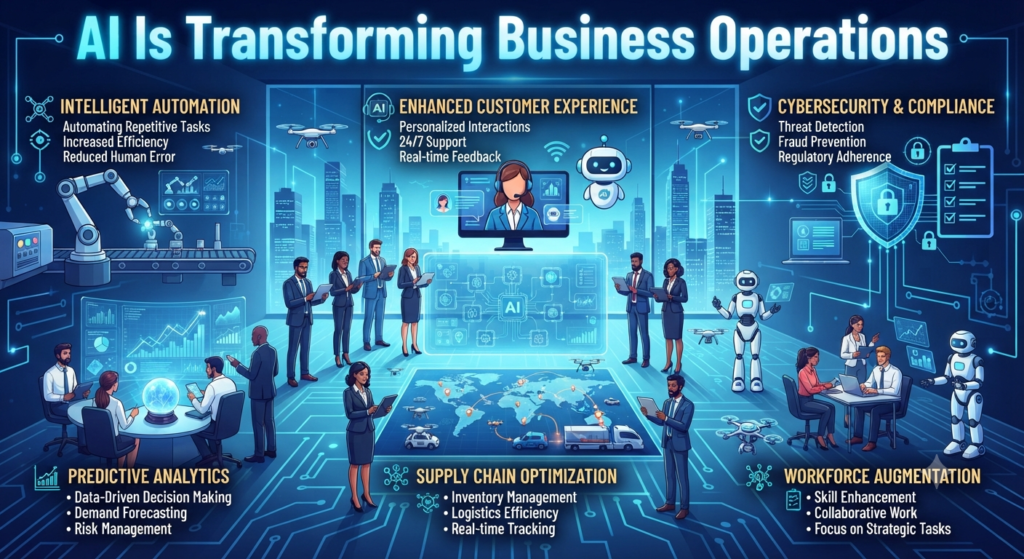
AI is changing how companies plan, work, communicate, and make decisions. It helps businesses handle routine tasks, study large amounts of data, and improve daily operations. As a result, teams can spend less time on manual work and more time on important business goals.
AI in business operations is no longer limited to large technology companies. Small businesses, startups, and growing enterprises are also using AI tools to improve their work. These tools can automate customer support, manage business data, track sales, and improve employee productivity.
For example, an online store can use AI to answer common customer questions. A manufacturing company can use AI to predict machine problems. A marketing team can use AI to study customer behavior and improve campaigns.
These examples show how AI can support different business activities.
AI also makes business management more effective. Managers can use smart dashboards, predictive reports, and automated alerts to understand what is happening across their teams. They can make faster decisions with better information.
In addition, AI workflow automation connects different business tasks. It reduces repeated work and helps information move between departments.
The result is a more connected, productive, and flexible business environment.
Let’s explore how AI is transforming business operations, management, and workflow automation.
Know More: AI for Social Media Marketing: 12 Powerful Tools and Strategies for Faster Growth
1. Understanding AI in Business Operations
What Is AI in Business Operations?
AI in business operations means using artificial intelligence to improve the way a company performs its daily activities.
It includes tools and systems that can study information, identify patterns, make predictions, and perform certain tasks with limited human input.
Traditional business processes often depend on manual work. Employees may need to enter data, check documents, prepare reports, answer emails, and update records.
These tasks take time. They can also lead to mistakes.
AI helps reduce this workload through intelligent systems.
For example:
- AI can sort incoming customer emails.
- AI can prepare basic business reports.
- AI can identify unusual financial activity.
- AI can predict product demand.
- AI can organize employee information.
- AI can help manage customer requests.
The main goal isn’t to replace every human task. It is to help people work better and make business processes more efficient.
How AI Works in Business Environments
AI systems use data, algorithms, and machine learning models to perform different activities.
Most business AI applications follow a simple process.
Step 1: Collect Data
AI systems collect information from business software, customer records, websites, databases, and other sources.
Step 2: Analyze Information
The system studies the data to identify patterns, problems, and useful insights.
Step 3: Generate Results
AI provides suggestions, predictions, reports, or automated actions.
Step 4: Improve Performance
Some AI systems learn from new information and feedback. This helps improve future results.
For example, a company can use AI to study its monthly sales data. The system may identify which products sell more during certain months. Managers can use these insights to plan inventory and marketing activities.
This creates data-driven business operations.
2. How AI Is Transforming Business Operations
AI is changing business operations by reducing manual work, improving accuracy, and helping teams complete tasks faster.
Here are some important ways it is creating change.
2.1 Automating Repetitive Business Tasks
Many companies spend a large amount of time on repeated activities.
These activities may include:
- Entering customer information.
- Preparing invoices.
- Sending follow-up emails.
- Updating spreadsheets.
- Managing appointment requests.
- Creating regular reports.
- Processing simple forms.
AI-powered tools can automate many of these activities.
For example, an AI system can read information from an invoice, identify the important details, and send the data to an accounting system.
Employees don’t need to enter every detail manually.
This improves speed and reduces common data-entry errors.
Automated business workflows also help teams follow the same process every time. This makes daily operations easier to manage.
2.2 Improving Business Decision-Making
Good decisions depend on good information.
However, businesses often collect more data than employees can review manually.
AI helps solve this problem.
It can analyze customer activity, sales performance, website traffic, employee productivity, and financial records.
Managers can use these insights to understand business performance.
For example, an AI system may identify that customer complaints increase after a particular service change. The management team can investigate the issue and take action.
AI can also help companies:
- Identify sales opportunities.
- Understand customer preferences.
- Study market trends.
- Predict product demand.
- Monitor business performance.
- Find operational problems.
This supports smart operational decision-making.
Still, AI recommendations should be reviewed when decisions have a major financial, legal, or human impact.
2.3 Enhancing Data Management
Business data comes from many sources.
Companies may use separate tools for sales, finance, marketing, customer support, and employee management.
Managing this information can become difficult.
AI business software can help organize data and make it easier to understand.
For example, an AI-powered system can identify duplicate records, classify customer information, and prepare useful summaries.
It can also help employees search large databases using simple questions.
Instead of checking many files, a manager may ask an AI assistant to summarize monthly sales performance.
This makes business information easier to access.
However, companies should use proper access controls and data protection policies when connecting AI tools to business information.
2.4 Improving Customer Experience
Customer experience plays an important role in business growth.
Customers expect quick answers, useful recommendations, and simple communication.
AI can help businesses meet these expectations.
For example, AI chatbots can answer common questions at any time. They can provide product details, explain services, and guide users through simple processes.
AI can also study customer behavior to understand their interests.
An online shopping company may recommend products based on previous searches and purchases.
A service company may use AI to identify customers who need additional support.
These applications improve communication and help businesses provide more relevant services.
3. The Role of AI in Business Management
Business management involves planning, organizing, monitoring, and controlling company activities.
Managers need to coordinate people, money, information, and resources.
AI management systems can support these responsibilities by providing useful data and automating routine management tasks.
3.1 Smarter Resource Management
Every business has limited resources.
These include employee time, equipment, money, materials, and technology.
Poor resource planning can increase costs and reduce productivity.
AI can study business requirements and help managers use resources more effectively.
For example, a logistics company can use AI to plan delivery routes. This may reduce unnecessary travel and improve delivery planning.
Similarly, a project management team can use AI to identify workload problems and suggest better task distribution.
AI can help managers understand:
- Which teams have too much work.
- Which resources are underused.
- Where delays are happening.
- Which activities need more support.
- How resources can be allocated more effectively.
This improves operational planning.
3.2 Predictive Operational Management
Traditional management often focuses on solving problems after they happen.
Predictive operational management takes a different approach.
It uses historical data and AI models to identify possible future problems.
For example, a manufacturing company can monitor machine performance. AI may detect unusual changes in temperature or vibration.
The company can then schedule maintenance before a major machine failure occurs.
This approach is known as predictive maintenance.
Other applications include:
- Predicting product demand.
- Identifying possible delivery delays.
- Forecasting cash flow.
- Monitoring inventory levels.
- Identifying unusual customer activity.
Predictive systems don’t guarantee that every problem will be prevented. However, they can give managers more time to prepare and respond.
3.3 Improving Team Productivity
Employees often spend time switching between different tools and handling administrative work.
AI productivity tools can reduce this burden.
For example, employees can use AI assistants to summarize meetings, organize tasks, prepare basic documents, and search internal information.
Managers can also use AI to track project progress and identify delays.
This allows teams to focus more on planning, problem-solving, and creative work.
The best results come when AI supports employees rather than removing human judgment from important tasks.
4. AI Workflow Automation and Business Process Automation
Workflow automation is one of the most useful applications of artificial intelligence.
A business workflow is a series of tasks that must be completed to achieve a specific result.
For example, a customer registration process may include:
- Collecting customer information.
- Verifying an email address.
- Checking submitted details.
- Creating a customer account.
- Sending a confirmation message.
When these activities are connected through software, the business can reduce manual work.
What Is AI Workflow Automation?
AI workflow automation uses artificial intelligence to manage, improve, or perform tasks within a business process.
Traditional automation follows fixed rules.
For example, a system may send an email whenever a customer submits a form.
AI-powered automation can do more.
It may read the customer’s message, understand the request, classify it, and send it to the correct department.
This makes intelligent workflow automation more flexible.
AI can work with different types of information, including:
- Text and emails.
- Images and documents.
- Customer records.
- Business reports.
- Voice messages.
- Sales information.
It can also support decisions within automated processes.
How Intelligent Workflow Automation Works
An intelligent workflow usually combines several technologies.
- Data Collection
The system receives information from forms, emails, databases, and business applications.
- Data Processing
AI studies the information and identifies its meaning.
- Task Assignment
The system sends work to the correct team or software application.
- Automated Execution
The system performs actions based on approved rules and business requirements.
- Performance Monitoring
Managers review results and improve the workflow when needed.
This approach connects different business activities into one process.
AI Workflow Automation Examples
The following examples show how businesses use AI to automate workflows.
|
Business Activity |
AI Automation Example |
Expected Benefit |
|
Customer Support |
AI chatbot handles common questions |
Faster responses |
|
Finance |
AI reads invoices and organizes details |
Less manual entry |
|
Human Resources |
AI sorts job applications |
Faster initial screening |
|
Marketing |
AI studies customer behavior |
Better campaign planning |
|
Sales |
AI identifies potential leads |
Better lead management |
|
Inventory |
AI predicts product demand |
Improved stock planning |
|
Project Management |
AI summarizes progress reports |
Better visibility |
|
IT Support |
AI classifies support tickets |
Faster ticket routing |
These examples show that AI workflow automation can support almost every business department.
Intelligent Process Automation vs Traditional Automation
Traditional automation is useful for simple, repeated tasks.
For example, a rule-based system can send a confirmation email after a form is submitted.
Intelligent process automation can understand more complex information.
It may read a customer request, identify the issue, and recommend the next action.
Here is a simple comparison:
|
Feature |
Traditional Automation |
Intelligent Automation |
|
Task handling |
Fixed rules |
Rules and AI-based analysis |
|
Data processing |
Structured data |
Structured and unstructured data |
|
Decision support |
Limited |
More advanced |
|
Adaptability |
Usually limited |
Can adapt within trained capabilities |
|
Human involvement |
Depends on workflow |
Needed for oversight and complex decisions |
Both methods have value. Businesses should choose the approach that fits their actual needs.
5. Key Benefits of AI in Business Management
AI provides several benefits when companies use it with clear goals and proper planning.
5.1 Increased Operational Efficiency
One of the biggest benefits of AI in business management is improved operational efficiency.
AI can reduce the time spent on routine activities.
Employees can complete certain tasks faster, while managers can access business information more easily.
For example, a team that prepares weekly reports manually may use AI to collect and summarize information.
This reduces repeated work.
AI-enhanced workflow efficiency also helps different departments share information more smoothly.
5.2 Reduced Operating Costs
Manual processes often require more employee time.
They can also create delays and errors.
Business process automation helps reduce unnecessary work.
For example, automated invoice processing can reduce the time needed to review and organize financial documents.
AI can also help companies manage inventory and avoid unnecessary stock purchases.
However, AI tools have their own costs. Businesses must consider software subscriptions, implementation, training, maintenance, and security.
The real goal should be better value, not automation at any cost.
5.3 Better Accuracy and Productivity
Human errors can happen during data entry, document processing, and repetitive work.
AI systems can help reduce some of these mistakes.
For example, AI tools can identify missing information in a form or highlight unusual values in a financial report.
Employees can then review the results.
This improves accuracy while allowing people to focus on more important tasks.
5.4 Faster Business Growth
Growing businesses need systems that can handle more customers and activities.
Manual processes can become difficult to manage as a company expands.
AI business software helps companies manage larger workloads without increasing every manual task.
For example, an online service company can use automated customer support to manage common questions from more users.
AI can also help identify new market opportunities and customer needs.
This supports business growth and long-term planning.
6. AI Applications Across Different Business Departments
AI is useful across many departments. Each team can apply it to different business challenges.
6.1 Marketing and Sales
Marketing teams use AI to study customer interests, prepare content ideas, analyze campaign performance, and improve targeting.
Sales teams can use AI to organize leads, summarize customer conversations, and identify follow-up opportunities.
Common applications include:
- Customer behavior analysis.
- Automated email campaigns.
- Lead scoring.
- Sales forecasting.
- Content research.
- Campaign reporting.
For example, a marketing team can use AI to identify which website pages attract more visitors.
It can then use this information to improve content and campaign planning.
6.2 Human Resources
HR teams manage recruitment, employee information, attendance, training, and internal communication.
AI can support these activities.
For example, an HR system can help organize applications and schedule interviews.
AI assistants can also answer common questions about company policies.
However, recruitment and employee decisions need human review. AI systems should not make unfair decisions based on protected personal characteristics or biased data.
6.3 Finance and Accounting
Finance departments manage invoices, payments, budgets, and financial reports.
AI can support these activities through document processing and data analysis.
Examples include:
- Invoice classification.
- Expense tracking.
- Financial report summaries.
- Unusual transaction detection.
- Cash flow forecasting.
- Payment reminders.
These applications can make finance workflows easier to manage.
6.4 Customer Support
Customer support teams often handle repeated questions.
AI chatbots can answer basic questions and guide users through common issues.
For complex problems, the system can send the request to a human support agent.
This creates a combination of automated support and human assistance.
6.5 Operations and Supply Chain
Operations teams manage production, inventory, logistics, and delivery.
AI can help forecast demand, monitor equipment, and improve delivery planning.
For example, a retailer can study previous sales and seasonal patterns to estimate future stock requirements.
This can improve inventory planning and reduce waste.
7. Popular AI Technologies for Business Automation
Several technologies work together to support intelligent business automation.
7.1 Machine Learning
Machine learning allows computer systems to identify patterns in data and make predictions.
Businesses use it for sales forecasting, customer segmentation, demand planning, and fraud detection.
7.2 Natural Language Processing
Natural Language Processing (NLP) helps computers understand and process human language.
It supports chatbots, email classification, document analysis, and automated customer communication.
7.3 Robotic Process Automation
Robotic Process Automation (RPA) uses software bots to perform repetitive computer tasks.
For example, an RPA bot can copy information from one system and enter it into another.
When combined with AI, RPA can support more complex workflows.
This combination is often called intelligent automation.
7.4 Predictive Analytics
Predictive analytics uses historical data and statistical or machine learning models to estimate future outcomes.
Businesses use it to predict demand, monitor risks, and support planning.
These technologies help companies build next-generation workflow automation systems.
8. How to Implement AI in Business Operations
AI implementation doesn’t need to start with a large project.
Businesses can begin with one process and expand after reviewing the results.
Here are practical steps.
Step 1: Identify Business Challenges
First, identify activities that take too much time or create repeated problems.
For example:
- Manual report preparation.
- Repeated customer questions.
- Slow invoice processing.
- Poor inventory planning.
- Difficult data management.
Choose a problem that has a clear business impact.
Step 2: Select the Right AI Tools
Different tools solve different problems.
A chatbot may support customer service, while an analytics platform may help managers understand business performance.
Before choosing a tool, consider:
- Business requirements.
- Integration options.
- Data security.
- Pricing.
- Ease of use.
- Training requirements.
- Technical support.
Avoid choosing a tool only because it is popular.
Step 3: Start with Small Automation Projects
Start with a process that is easy to measure.
For example, automate basic email classification or invoice data extraction.
Test the system with real business scenarios.
Allow employees to review its results before expanding the process.
Step 4: Train Employees
Employees should understand how the new system works.
Provide practical training and explain when human review is required.
This can reduce confusion and improve adoption.
Step 5: Monitor and Improve Performance
AI implementation should be reviewed regularly.
Track useful business metrics such as:
- Time saved.
- Processing accuracy.
- Operating costs.
- Customer response time.
- Employee productivity.
- Workflow completion rate.
Use these results to improve the system.
A successful AI strategy requires continuous improvement.
9. Challenges of AI Business Transformation
AI provides many opportunities, but businesses should also understand its limitations.
Data Privacy and Security
AI systems may process sensitive customer and company information.
Businesses need clear data protection policies, access controls, and secure integrations.
Implementation Costs
AI tools may require subscriptions, infrastructure, training, and technical support.
Companies should calculate the total cost before implementation.
Employee Training
Employees may need time to learn new systems.
Without proper training, even useful AI tools may not deliver the expected results.
Incorrect AI Outputs
AI systems can produce incorrect information or unreliable recommendations.
Businesses should use human review for important decisions.
Integration with Existing Systems
Some companies use older software that may not connect easily with new AI tools.
Integration planning is important for smooth operations.
Dependence on Automation
Not every task should be automated.
Human judgment remains important in areas such as leadership, customer relationships, business strategy, and complex problem-solving.
The best approach combines artificial intelligence with human experience.
10. Future of AI in Business Operations and Management
The future of business operations will likely involve more connected and intelligent systems.
AI technology is developing rapidly. Businesses are exploring new ways to automate tasks, analyze information, and manage digital operations.
Here are some important trends.
AI Agents and Autonomous Workflows
AI agents can perform multiple connected tasks within defined limits.
For example, an AI agent may collect information, prepare a report, and suggest the next action.
Businesses will need clear permissions and monitoring to manage these systems safely.
More Personalized Customer Experiences
AI can help companies understand customer needs and provide more relevant recommendations.
This may improve customer communication and service quality.
Intelligent Management Systems
Future management systems may combine project data, financial information, customer activity, and employee workflows.
Managers can use these systems to get a clearer view of business performance.
Better Predictive Planning
AI may help companies identify risks and opportunities earlier.
This can support inventory management, financial planning, maintenance, and demand forecasting.
Digital Operations Transformation
Businesses will continue connecting their software, data, and workflows.
This can create more flexible operations and improve coordination across departments.
Companies that adopt AI with a clear strategy may gain an advantage through better planning, faster processes, and improved customer service.
For additional information about business automation, explore the IBM guide to business automation.
Artificial intelligence is changing the way modern companies
Artificial intelligence is changing the way modern companies manage their daily activities. It helps businesses automate repeated tasks, improve workflows, understand data, and make better decisions.
AI in business operations is becoming an important part of digital transformation. From customer support and finance to marketing and supply chain management, AI offers practical ways to improve business performance.
AI workflow automation also helps companies connect different tasks and reduce manual work. This allows employees to focus on activities that require human knowledge, creativity, and judgment.
However, successful AI business transformation requires more than buying new software. Companies need clear goals, reliable data, employee training, and proper security practices.
The best approach is to start small, measure results, and improve processes over time.
Businesses that combine artificial intelligence with human experience can build more productive, flexible, and efficient operations for the future.
AI is transforming business operations by automating repetitive tasks, analyzing business data, improving decision-making, and supporting customer service. It helps companies save time, reduce manual work, and improve operational efficiency. The main benefits include better productivity, faster decisions, improved data management, reduced manual work, and more efficient resource planning. AI also helps managers identify business problems and plan future activities. AI workflow automation uses artificial intelligence to manage and perform tasks within business processes. It can understand information, classify requests, assign tasks, and support automated decisions. Common examples include AI chatbots, automated invoice processing, email classification, customer lead management, inventory forecasting, employee application screening, and automated business reporting. Small businesses can start by automating customer support, email responses, appointment scheduling, invoice processing, and data entry. They should choose affordable tools that solve specific business problems. AI can automate certain tasks, but it doesn't replace the need for human skills. Employees are still important for decision-making, communication, leadership, creative thinking, and problem-solving. AI works best as a tool that supports people. Robotic Process Automation follows predefined rules to perform repetitive tasks. AI automation can also analyze information, identify patterns, and support more flexible decisions. Businesses can combine both technologies to build intelligent automation systems. Companies can measure success through time saved, lower processing costs, fewer errors, faster customer responses, improved productivity, and higher workflow completion rates. AI workflow automation can benefit many types of businesses. However, not every process needs AI. Companies should first identify repeated tasks and evaluate whether automation can provide real value. The future will likely include more intelligent automation, AI agents, predictive analytics, connected management systems, and automated business intelligence. These technologies may help businesses make better decisions and manage complex operations.”FAQs”
1. How is AI transforming business operations?
2. What are the benefits of AI in business management?
3. What is AI workflow automation?
4. What are some AI workflow automation examples?
5. How can small businesses use AI to automate workflows?
6. Does AI replace human employees in business operations?
7. What is the difference between AI automation and robotic process automation?
8. How can companies measure the success of AI automation?
9. Is AI workflow automation suitable for every business?
10. What is the future of artificial intelligence in operational management?


