The Role of Artificial Intelligence in Employee Training and Development: 7 Powerful Ways to Transform Workforce Learning
Employees are one of the most valuable assets of any organization. Their knowledge, skills, and experience help businesses grow. However, workplace demands are changing quickly. New technologies, customer needs, and business goals require employees to learn new skills regularly.
Traditional training methods don’t always meet these needs. Classroom sessions, long presentations, and fixed learning materials may not work for every employee. Some people learn quickly, while others need more time and practice. As a result, companies need better ways to train their teams.
This is where AI in employee training makes a difference.
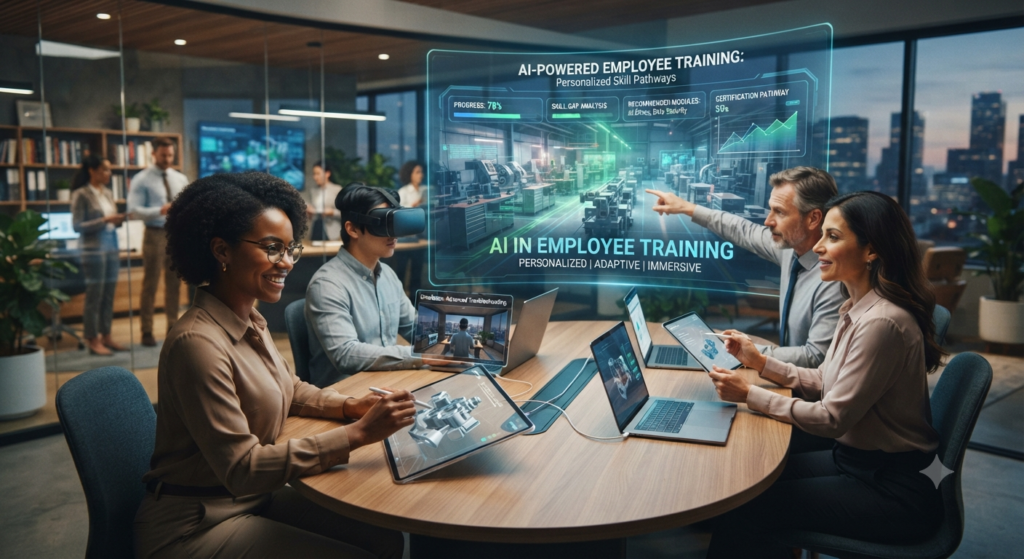
Artificial intelligence helps companies create smarter learning experiences. It can study employee progress, suggest useful courses, answer questions, and identify missing skills. It also helps training teams manage learning activities with less manual work.
AI-powered learning makes training more flexible and personal. Employees can learn at their own pace and focus on skills that matter to their jobs. At the same time, managers can understand training results through useful data.
The role of artificial intelligence in employee training and development goes beyond online courses. It supports employee growth, improves workplace performance, and helps organizations prepare for future challenges.
In this article, we’ll explore seven powerful ways AI is changing corporate training. We’ll also discuss its benefits, common challenges, useful tools, and future possibilities.
Know More : How AI Is Transforming Business Decision-Making in 2026
Understanding AI in Employee Training and Development
Artificial intelligence refers to computer systems that perform tasks that usually require human intelligence. These tasks include understanding language, finding patterns, analyzing information, and making recommendations.
In employee training, AI uses data and intelligent software to improve how people learn at work.
For example, an AI learning platform can study an employee’s test results and recommend courses based on weak areas. An AI assistant can answer questions about company policies. Another system can help managers identify skills that their teams need to develop.
What Is AI-Powered Learning?
AI-powered learning uses artificial intelligence to make education and training more effective.
Traditional training often follows the same plan for everyone. AI-based learning can adjust the experience based on individual needs.
For example, imagine two employees joining the same company.
The first employee has strong communication skills but limited technical knowledge. The second employee understands technical subjects but needs help with communication.
A traditional training program may give both employees the same lessons.
An AI-powered system can suggest different learning paths. The first employee may receive technical courses, while the second may receive communication exercises.
This approach makes personalized learning easier.
AI learning platforms can support:
- Personalized training recommendations.
- Automatic course suggestions.
- Learning progress tracking.
- Online assessments.
- Interactive learning activities.
- Skill gap analysis.
- Employee development planning.
These features help employees focus on useful knowledge instead of completing unnecessary training.
How AI Changes Traditional Corporate Training
Traditional corporate training usually depends on fixed schedules, classroom sessions, and standard learning materials.
AI changes this process by making training more flexible.
|
Traditional Training |
AI-Powered Training |
|
Same lessons for everyone |
Personalized learning paths |
|
Fixed training schedules |
Flexible learning access |
|
Manual progress tracking |
Automated learning analytics |
|
Limited feedback |
Faster feedback and recommendations |
|
General assessments |
Personalized skill assessments |
|
Instructor-dependent support |
AI-powered learning assistants |
This doesn’t mean human trainers are no longer important. Instead, AI helps trainers spend less time on repetitive tasks and more time supporting employees.
The best approach combines technology with human guidance.
7 Powerful Ways AI Transforms Employee Training
Artificial intelligence offers several opportunities to improve workplace learning. Here are seven important ways organizations can use it.
1. Personalized Learning Experiences
Every employee has different skills, interests, and learning needs.
Some employees prefer videos. Others learn better through reading, practical tasks, or interactive exercises. A single training method may not work for everyone.
AI helps solve this problem through personalized learning.
AI learning platforms can study employee performance, learning history, assessment results, and job responsibilities. Based on this information, they can recommend suitable learning materials.
For example, a sales employee who struggles with customer communication may receive courses on negotiation and active listening.
A software developer who wants to improve coding skills may receive advanced programming exercises.
This approach helps employees learn topics that are relevant to their work.
Key benefits include:
- Training based on individual skill levels.
- Better learning recommendations.
- Flexible learning schedules.
- More relevant educational content.
- Improved employee participation.
Personalized employee training using artificial intelligence can also help employees avoid spending time on subjects they already understand.
As a result, learning becomes more useful and engaging.
2. Automated Training Processes
Managing employee training can take a lot of time.
HR teams and learning managers often handle course assignments, attendance records, reminders, assessments, and progress reports.
Training automation helps reduce this workload.
AI training solutions can automate several activities, such as:
- Sending course reminders.
- Assigning training materials.
- Tracking course completion.
- Scheduling assessments.
- Creating progress reports.
- Recommending follow-up lessons.
For example, when a new employee joins a company, an AI-powered learning management system can suggest an onboarding program.
The system may assign lessons about company policies, workplace safety, communication, and job responsibilities.
Managers can then track progress without checking every activity manually.
Automation also helps organizations manage large staff training programs.
However, automated decisions should be reviewed when they affect important employee opportunities or performance evaluations.
3. Better Skill Gap Analysis
Companies need employees with the right skills to meet business goals.
However, identifying missing skills across a large workforce can be difficult.
AI makes this process easier through skill gap analysis.
AI systems can compare employee skills with job requirements. They can use assessment results, training records, work-related information, and manager feedback to identify areas that need improvement.
For example, a company planning to introduce new software may discover that many employees need training in data analysis.
AI can help identify this requirement and recommend suitable courses.
Skill gap analysis supports better workforce development.
It helps companies answer important questions:
- Which skills are missing from the team?
- Which employees need additional training?
- What skills will be important in the future?
- Which training programs should receive priority?
- Are employees ready for new responsibilities?
This information helps HR teams plan employee upskilling more effectively.
It also supports competency development and long-term career planning.
4. Real-Time Feedback and Assessment
Feedback plays an important role in employee development.
Employees need to understand what they’re doing well and where they can improve.
Traditional training assessments often provide results only after a course or examination. AI can make feedback faster and more useful.
For example, an AI-powered training platform can analyze answers during a learning activity and explain mistakes immediately.
An employee learning a new language may receive feedback on grammar and pronunciation.
A customer service employee may practice conversations with an AI assistant and receive suggestions for improving responses.
These activities help employees understand their progress.
AI can support different forms of training assessment:
- Multiple-choice tests.
- Interactive exercises.
- Simulated workplace situations.
- Knowledge checks.
- Practice conversations.
- Personalized feedback.
However, AI-generated feedback should be checked for accuracy, especially when evaluating complex skills.
Human trainers remain important for understanding communication, teamwork, leadership, and other skills that require context.
5. Improved Employee Engagement
Employees are more likely to complete training when learning feels interesting and relevant.
Long presentations and repetitive lessons can reduce interest.
AI workplace learning can make training more interactive.
For example, AI-powered systems can suggest short lessons based on employee interests. They can also provide quizzes, simulations, challenges, and practical activities.
Some platforms use progress indicators and learning goals to encourage regular participation.
Conversational AI for learning can also help employees ask questions without waiting for a trainer.
Imagine an employee who doesn’t understand a new workplace process. Instead of searching through multiple documents, the employee can ask an AI assistant for an explanation.
This makes learning easier to access.
Companies can improve employee engagement through:
- Short and focused learning activities.
- Interactive training exercises.
- Personalized recommendations.
- Quick access to learning support.
- Progress tracking.
- Relevant workplace examples.
The goal isn’t simply to make training entertaining. It is to help employees stay interested and understand what they learn.
6. Continuous Learning and Career Development
Employee development shouldn’t stop after onboarding.
Technology and business requirements change regularly. Employees need opportunities to improve their skills throughout their careers.
AI supports a continuous learning culture by recommending useful training based on employee goals and changing job requirements.
For example, an employee interested in becoming a team leader may receive recommendations for leadership, communication, and project management courses.
A junior developer may receive a learning path covering advanced programming, software architecture, and problem-solving.
This connects professional development with career development planning.
AI can also help organizations identify employees who may be ready for new responsibilities.
However, career decisions should never depend only on automated recommendations. Managers should consider employee interests, achievements, experience, and individual goals.
With the right approach, AI can help employees understand their career options and take practical steps toward growth.
7. Better Training Results Through Learning Analytics
Companies need to understand whether their training programs are working.
Simply counting course completions doesn’t show whether employees have learned useful skills.
Learning analytics helps organizations study training performance.
AI systems can analyze information such as:
- Course completion rates.
- Assessment results.
- Learning time.
- Employee participation.
- Knowledge retention.
- Skill development progress.
For example, a company may discover that employees who complete a particular training course perform better in a practical assessment.
This information can help learning managers improve the course.
AI can also identify lessons that employees find difficult and suggest changes to the learning material.
These insights support training effectiveness and employee performance improvement.
The important point is to measure meaningful outcomes, not just the number of completed courses.
How Companies Use AI for Staff Training
Organizations can use artificial intelligence in different ways depending on their business needs.
Some use AI to recommend online courses. Others use it for employee assessments, coaching, onboarding, and technical training.
Here are four common applications.
AI-Powered Learning Platforms
AI learning platforms help organizations manage employee education in one place.
These platforms often include course libraries, progress tracking, assessments, and learning recommendations.
Some systems can connect with an existing learning management system (LMS).
This makes it easier for companies to manage training activities across different departments.
For example, an organization may use an AI-based platform to train its sales, marketing, customer service, and technical teams.
Each department can receive learning materials related to its responsibilities.
When choosing an AI learning platform, companies should consider:
- Ease of use.
- Data security.
- Integration with existing systems.
- Course quality.
- Reporting features.
- Personalization options.
- Accessibility across devices.
The right platform should support business goals rather than simply offer more technology.
Intelligent Tutoring Systems
Intelligent tutoring systems provide learning support through AI.
They can explain topics, ask questions, provide practice exercises, and adjust lessons based on employee responses.
For example, a new employee learning financial software may use an intelligent tutor to understand basic functions.
If the employee struggles with a particular task, the system can provide additional explanations and practice activities.
These systems are useful for technical subjects and structured learning programs.
However, they should not replace experienced trainers when employees need complex explanations or practical guidance.
Generative AI and ChatGPT for Employee Training
Generative AI creates new content based on user instructions.
Tools such as ChatGPT can support employee education in several ways.
Companies can use ChatGPT for employee training to:
- Explain difficult topics in simple language.
- Create practice questions.
- Develop training outlines.
- Generate workplace examples.
- Summarize learning materials.
- Support role-playing exercises.
- Answer general learning questions.
For example, a new marketing employee can ask an AI assistant to explain search engine optimization.
The assistant can provide an introduction, explain important terms, and create practice questions.
Large language models in education can also support conversational learning.
Employees can ask follow-up questions and receive explanations based on their needs.
Generative AI workplace training can make learning more accessible. However, organizations must check AI-generated information before using it in official training materials.
Employees should also avoid sharing confidential company information with unapproved AI tools.
AI Coaching Platforms
AI coaching platforms provide additional learning support.
They may offer simulated conversations, personalized recommendations, and practice activities.
For example, a manager preparing for a performance review can practice communication with an AI-powered training assistant.
A sales employee can practice handling customer objections through simulated conversations.
These activities help employees build confidence before applying their skills in real situations.
AI coaching platforms are especially useful when combined with feedback from experienced managers and trainers.
Benefits of AI-Powered Training Programs for Organizations
AI offers benefits to both employees and businesses.
When implemented correctly, it can improve learning access, reduce repetitive work, and support better workforce planning.
Reduced Training Costs
Traditional training can involve travel, printed materials, classroom arrangements, and instructor fees.
Digital learning can reduce some of these expenses.
AI-powered systems can also automate repetitive administrative activities.
For example, an organization with several offices can provide common training materials through one digital platform.
Employees can access lessons without attending the same classroom session repeatedly.
This can reduce the cost of delivering large corporate training programs.
However, organizations must consider software subscriptions, implementation costs, employee support, and data protection when calculating savings.
Better Knowledge Retention
Completing a course doesn’t always mean an employee remembers everything.
People often forget information when they don’t use it regularly.
AI-powered learning can support knowledge retention through repeated practice and personalized revision.
For example, a platform may recommend a short revision lesson after an employee completes a course.
It may also provide quizzes based on earlier mistakes.
These activities help employees remember important information.
Practical exercises can further improve understanding because employees get opportunities to apply what they’ve learned.
Improved Workforce Readiness
Companies must prepare their employees for changing business requirements.
New technologies, customer expectations, and industry developments can create new skill requirements.
AI tools for workforce development and upskilling can help organizations identify these needs.
For example, a company planning to adopt AI tools may need employees with skills in data analysis, automation, and AI literacy.
An AI-powered development system can help managers identify suitable learning opportunities.
This supports workforce readiness and helps organizations prepare for future projects.
AI-based learning can also support internal mobility by helping employees identify skills needed for different roles.
Challenges of Using AI in Employee Development
Although AI offers many benefits, it also creates challenges.
Organizations should understand these issues before introducing new training technology.
- Data privacy: AI learning platforms may process employee information. Companies must protect personal data and follow applicable privacy requirements.
- Incorrect information: Generative AI tools can sometimes produce inaccurate answers. Training content should be reviewed by qualified people.
- Implementation costs: Software, integration, maintenance, and employee support can require investment.
- Technology skills: Some employees may need guidance before they can use AI learning tools effectively.
- Limited human interaction: Training shouldn’t depend entirely on automated systems. Employees still need discussions, mentoring, and practical support.
- Algorithmic bias: AI recommendations may be unfair if the data or system design contains bias. Organizations should regularly review important automated decisions.
- Employee resistance: Some workers may feel uncomfortable using new technology or worry that AI will monitor their performance.
Clear communication can help address these concerns.
Companies should explain why AI is being introduced, what information it uses, and how employees will benefit.
Best Practices for Implementing AI Training Solutions
Successful AI adoption requires planning.
Organizations shouldn’t introduce AI simply because it is a popular technology. They should first identify the training problems they want to solve.
Here are some useful practices.
- Identify training needs.
Study employee skills, business goals, and current training challenges. Decide which areas need improvement.
- Select the right AI tools.
Compare AI learning platforms based on features, security, integration, accessibility, and cost.
- Start with a small pilot program.
Test the system with one department or employee group. Collect feedback before expanding it across the organization.
- Combine AI with human support.
Use AI for recommendations, automation, and practice. Keep trainers and managers involved in mentoring and important assessments.
- Protect employee information.
Set clear data policies. Use approved systems and limit access to sensitive information.
- Measure training effectiveness.
Track skill improvements, assessment results, employee feedback, and workplace outcomes.
- Update learning materials regularly.
Review training content to ensure it remains accurate and relevant.
These steps can help organizations introduce AI in a practical and responsible way.
Future of AI in Corporate Learning and Development
The future of AI in corporate learning and development looks promising.
AI systems are becoming more capable of understanding individual learning needs and supporting interactive education.
Several developments may shape workplace training in the coming years.
More advanced personalization: AI systems may create learning paths that adjust continuously as employee skills improve.
Generative AI learning tools: Employees may receive more interactive lessons, practice activities, and explanations through AI assistants.
AI learning copilots: AI copilots may support employees while they perform daily tasks by providing instructions and relevant information.
Predictive skill analysis: Organizations may use learning analytics to identify future skill requirements and prepare employees in advance.
Virtual training environments: AI may support realistic simulations for customer service, leadership, technical operations, and workplace safety.
Multilingual learning support: AI translation and language tools may make corporate training more accessible to employees across different countries.
Integrated workforce development: Learning platforms may become more closely connected with HR systems, career planning, and employee development programs.
These developments could make workforce learning more flexible and accessible.
Still, the success of AI training will depend on responsible implementation, accurate information, employee trust, and human guidance.
Organizations that balance technology with human expertise will be better positioned to build a skilled workforce.
For additional information about artificial intelligence and education, visit the OECD’s AI in Education resources.
Artificial intelligence is changing how organizations approach employee education
Artificial intelligence is changing how organizations approach employee education and professional development.
From personalized learning and automated training to skill gap analysis and intelligent coaching, AI offers practical ways to improve workplace learning.
The role of artificial intelligence in employee training and development is not limited to saving time. It also helps organizations understand employee needs, improve training effectiveness, and prepare their workforce for future challenges.
However, successful AI adoption requires more than choosing the right software. Companies must protect employee information, provide accurate learning materials, and maintain human involvement in important training decisions.
AI should support trainers and employees, not replace the human side of learning.
Organizations that combine AI technology with practical experience, mentoring, and continuous learning can build stronger and more adaptable teams.
Ultimately, AI-powered learning can help create a workplace where employees keep growing, businesses keep improving, and learning becomes a continuous part of professional success.
”FAQs”
1. What is the role of artificial intelligence in employee training and development?
Artificial intelligence helps organizations improve employee training through personalized learning, automated assessments, skill gap analysis, and intelligent learning recommendations. It also helps employees develop relevant skills and supports continuous professional development.
2. How does AI improve employee learning experiences?
AI improves learning experiences by recommending courses based on employee needs, providing quick feedback, and adjusting learning activities according to individual progress. Employees can learn at their own pace and focus on areas where they need improvement.
3. What are the main benefits of AI-powered training programs for organizations?
The main benefits include reduced administrative work, personalized training, better learning analytics, improved knowledge retention, and more effective workforce development. AI can also help companies identify missing skills and plan employee upskilling.
4. How do companies use AI for staff training?
Companies use AI for onboarding, online learning, employee assessments, personalized course recommendations, and workplace simulations. Some organizations also use ChatGPT and other generative AI tools to explain concepts and create training materials.
5. Can ChatGPT be used for employee training?
Yes. ChatGPT can explain complex topics, create practice questions, summarize training materials, generate examples, and support interactive learning. However, companies should review AI-generated information and avoid sharing confidential information with unapproved tools.
6. What is an AI-powered learning platform?
An AI-powered learning platform is a digital system that uses artificial intelligence to support employee education. It may provide personalized course recommendations, learning analytics, assessments, automated reminders, and progress tracking.
7. Can AI replace human trainers in corporate training?
No. AI can support many training activities, but human trainers remain important for mentoring, leadership development, practical guidance, communication, and complex problem-solving. The best training programs combine AI technology with human expertise.
8. What challenges do companies face when adopting AI training solutions?
Common challenges include data privacy, implementation costs, inaccurate AI-generated content, employee resistance, algorithmic bias, and limited technology skills. Proper planning and human oversight can help organizations manage these issues.
9. How does AI help with employee upskilling?
AI analyzes employee skills and compares them with job requirements. It can identify skill gaps and recommend relevant courses, practice activities, and development plans. This helps employees prepare for new responsibilities and career opportunities.
10. What is the future of AI in corporate learning and development?
The future may include more personalized learning, AI coaching assistants, intelligent tutoring systems, predictive skill analysis, and interactive training simulations. These developments can help organizations create flexible learning environments and prepare employees for changing workplace demands.


