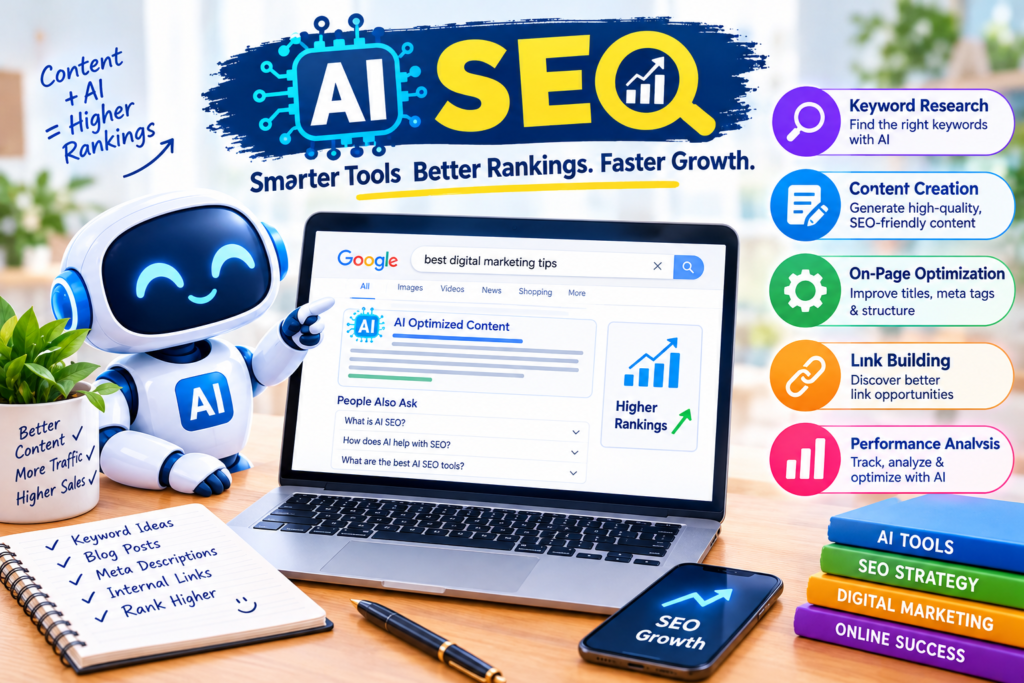
AI SEO : How to Optimize Content for AI Search Engines
Search engines are changing quickly. In the past, people mainly searched for information on Google or Bing and clicked links to find answers. Today, many users also ask questions through AI tools such as ChatGPT, Google Gemini, Claude, and Perplexity.
These tools can explain topics, compare products, summarize research, and recommend useful resources. Some AI search experiences also provide links to the websites used to prepare their answers.
This change has created a new area of digital marketing called AI SEO.
AI SEO helps website owners make their content useful, clear, trustworthy, and easy for search systems to discover. It builds on traditional search engine optimization while considering how AI-powered search and answer engines retrieve and present information.
For example, a traditional search query might be “best project management tools.” A conversational query could be “Which project management tool is best for a small team with a limited budget?”
To serve this user, content needs more than repeated keywords. It should answer the question, explain important differences, and provide relevant evidence.
The good news is that you don’t need a completely new website or a huge budget to get started. You can begin by improving your existing content, answering real questions, and making your pages easier to understand.
This guide explains what AI SEO is, how it works, and how to optimize content for AI search engines using practical, beginner-friendly techniques.
1. What Is AI SEO and How Does It Work?
AI SEO, or AI search engine optimization, is the process of improving online content so that search engines and AI-powered answer systems can discover, understand, retrieve, and potentially reference it. It combines traditional SEO practices with a stronger focus on meaning, context, direct answers, and information quality.
The goal isn’t simply to rank a webpage for one keyword. It’s also to make the page useful when someone asks a related question through an AI-powered search tool.
Understanding AI SEO Optimization
Traditional SEO often focuses on improving a webpage’s position in search results. AI SEO also considers how a page might contribute to an AI-generated answer. For example, imagine you publish an article about learning digital marketing. A traditional SEO approach might target the keyword “digital marketing course for beginners.”
An AI SEO approach would also answer related questions:
- What is digital marketing?
- Which skills should a beginner learn first?
- How long does it take to learn digital marketing?
- Which free tools can students use?
- How can beginners build a portfolio?
This broader approach helps create content that serves users with different but related needs.
AI SEO includes several connected practices:
- Semantic SEO: Helping search systems understand the meaning and relationships between topics.
- Search intent optimization: Matching content to what users actually want to know.
- Entity-based SEO: Clearly identifying people, organizations, products, places, and concepts.
- Generative engine optimization (GEO): Improving the usefulness and discoverability of content in generative search experiences.
- Technical SEO: Making pages accessible, crawlable, and indexable.
- Content quality: Providing accurate, original, relevant, and helpful information.
Why AI SEO Matters
AI-powered search is changing how people discover information. Users can ask longer questions, request comparisons, and receive summaries without visiting several websites.
This can affect website traffic. Some searches may lead to fewer clicks, while others may create new opportunities for qualified visitors.For businesses, AI visibility can support brand awareness and help potential customers discover services. For students and bloggers, it creates an additional reason to publish useful, well-organized content.
However, there is no guaranteed method for appearing in AI answers. Each platform uses different systems, and results can change over time. The most reliable starting point is to build content that deserves to be found and referenced.
2. How AI Search Engines Work
To optimize content for AI search engines, it helps to understand how these systems may produce answers.
Not every AI platform works in the same way. Some responses rely mainly on a model’s learned knowledge. Others can retrieve current information from the web, consult connected sources, or combine search results with a language model. Many AI search experiences use some combination of the following steps.
Step 1: Understand the User’s Question
Natural language processing helps AI systems interpret the meaning of a query.
A user might ask, “How can a small business get more customers without spending much on advertising?”
The system needs to understand the main topic, the user’s budget concern, and the desired outcome. Content that clearly addresses these needs is more useful than a page that merely repeats the phrase “small business advertising.”
Step 2: Find Relevant Information
Search-enabled systems may retrieve relevant pages, documents, or other sources. This process can involve crawling, indexing, keyword matching, semantic search, and other retrieval methods. A page’s content must be accessible to the relevant system if it is to be discovered through that route. However, access and indexing policies vary between platforms.
Step 3: Evaluate Context and Relevance
The system may compare retrieved information with the user’s question. Relevant factors can include the page’s subject, the clarity of its explanations, the freshness of time-sensitive information, and the credibility of supporting evidence. There is no single public ranking formula that applies to all AI search engines.
Step 4: Generate an Answer
A language model can use the available information to produce a natural-language response.Some systems provide citations or links to sources. Others may answer without displaying a complete list of references.
A technique called retrieval-augmented generation (RAG) combines information retrieval with text generation. It can help a model use external information rather than relying only on knowledge learned during training.
Step 5: Display Sources When Supported
Some platforms show links, citations, or source cards beside an answer. Well-structured content with clear claims and useful evidence may be easier to interpret and reference. Still, a citation depends on the platform, query, retrieved sources, and other factors.
3. Traditional SEO vs. AI SEO
Traditional SEO and AI SEO are closely related. AI SEO should generally extend a strong SEO foundation rather than replace it.
| Area | Traditional SEO | AI SEO |
| Main objective | Improve visibility in search results | Improve discoverability and potential inclusion in AI answers |
| Keywords | Target relevant search terms | Use terms, concepts, entities, and questions naturally |
| Content | Match search intent and provide value | Provide direct answers, context, evidence, and useful detail |
| Search experience | Often a list of links | May include summaries, conversations, and citations |
| Technical needs | Crawling, indexing, speed, and mobile usability | These remain important for systems that retrieve web content |
| Authority | Relevant links, reputation, and useful content | Trustworthy information and recognizable expertise can support credibility |
| Measurement | Rankings, impressions, clicks, and conversions | Traditional metrics plus available AI referral and citation data |
| Results | Search listings and other search features | Potential mentions, citations, recommendations, and AI search referrals |
Should You Stop Doing Traditional SEO?
No. Traditional SEO remains an important foundation for AI search optimization.
You should continue to:
- Research relevant keywords.
- Improve page titles and meta descriptions.
- Create useful content.
- Maintain a logical website structure.
- Earn relevant, genuine backlinks.
- Fix crawling and indexing issues.
- Monitor organic search performance.
Then add AI-focused improvements, such as clear question-based sections, stronger factual support, entity consistency, and content that answers complex queries. The best strategy is to combine both approaches.
4. Important AI SEO Ranking Factors
Many website owners want to know exactly how AI search engines rank content. The challenge is that different platforms use different systems, and their complete ranking methods aren’t publicly available.
Instead of relying on unsupported claims about secret ranking factors, focus on the following practical areas.
Content Relevance
Your page should directly address the user’s question.
If someone searches for “AI SEO for beginners,” an article should explain the basics before discussing advanced technical methods.
Relevant headings, examples, and explanations help readers understand the topic.
Accuracy and Evidence
Provide reliable information and support important claims with trustworthy sources.
For example, if an article explains a search engine’s crawling policy, link to its official documentation rather than relying on an unsupported statement.
Review statistics and platform features regularly because they can change.
Experience and Expertise
Google’s guidance on creating helpful content emphasizes people-first content and the value of demonstrating experience, expertise, authoritativeness, and trustworthiness.
These principles are useful when creating content for AI search, too, although they don’t represent a universal AI ranking formula.
You can demonstrate expertise through original examples, expert commentary, practical demonstrations, and transparent authorship.
Clear Content Structure
Use descriptive headings, short paragraphs, lists, and tables where they help readers.
For example, a section titled “How to Improve AI Search Visibility” is more informative than a vague heading such as “More Tips.”
Clear structure helps readers navigate a page and can help automated systems interpret its organization.
Website Accessibility
Search-enabled AI systems may depend on crawling or retrieval. Important content should be available in a format the relevant system can access.
Check your robots.txt rules, page status codes, canonical URLs, internal links, and sitemap.
Remember that allowing a crawler does not guarantee indexing, ranking, or citation.
Original Value
Publishing another article that repeats existing information may add little value. Provide something distinctive: a test, comparison, worked example, original dataset, practical checklist, or expert explanation. Original value gives users a reason to read your content and may make it more useful as a source.
5. Understand Search Intent Before Writing
Search intent is the reason behind a query. Understanding it is one of the most useful AI search optimization techniques. A user may want to learn a concept, compare solutions, find a particular website, or purchase a product. Your content should match that need.
Four Common Types of Search Intent
| Intent | Example Query | Suitable Content |
| Informational | What is AI SEO? | Beginner’s guide |
| Commercial investigation | Best AI SEO tools for small businesses | Comparison article |
| Transactional | Buy an SEO auditing tool | Product or pricing page |
| Navigational | Official Semrush website | Brand or destination page |
How to Identify Search Intent
Start by collecting primary and secondary keywords. Then examine the questions and problems connected to those terms. For an article targeting “how to optimize content for AI search engines,” users may expect:
- A simple explanation of AI SEO.
- A practical optimization process.
- Examples of well-structured content.
- Advice for different AI platforms.
- A checklist they can follow.
Use these expectations to organize the article.
Use Conversational Search Queries
AI search encourages people to ask complete questions. Instead of targeting only “AI SEO tools,” consider related questions such as:
- Which AI SEO tools are useful for beginners?
- How can I check whether my content appears in AI answers?
- How does semantic SEO help AI search?
- Can small websites get cited by AI search engines?
Don’t force every question into a separate page. Group closely related queries into a useful article and create separate pages only when the search intent warrants them.
6. Use Semantic SEO and Entity-Based SEO
Semantic SEO focuses on the meaning of content and the relationships between ideas.
Entity-based SEO focuses on clearly identifying things such as people, organizations, products, services, and concepts.
Together, these practices help create content with stronger topical relevance.
Build Content Around Topics, Not Just Keywords
Suppose your main topic is AI SEO.
Related concepts might include:
- Search intent
- Semantic search
- Large language models
- Retrieval-augmented generation
- Structured data
- Content authority
- AI-generated answers
- Generative engine optimization
These concepts are connected, but they shouldn’t be added just to increase keyword density. Include them when they help explain the main subject.
Create Topic Clusters
A topic cluster connects a main guide with supporting articles.
For example:
Pillar Page: AI SEO Guide
Main overview of AI search optimization
Semantic SEO
Topics and entities
Generative Engine Optimization
AI answer visibility
Technical AI SEO
Crawling and indexing
AI SEO Measurement
Visibility and referrals
Connect supporting pages to the pillar page and to relevant related articles with descriptive internal links.
This structure helps readers explore a subject in depth and gives search systems additional context about your website.
Keep Entity Information Consistent
If your business publishes content under different names, uses conflicting descriptions, or lists different contact information across major profiles, users may find it harder to identify the correct organization.
Use consistent business details, clear author profiles, accurate service descriptions, and appropriate internal links.
Consistency supports clarity, but it doesn’t guarantee inclusion in an AI knowledge graph or answer.
7. Create High-Quality, User-Focused Content
Strong content remains central to an effective AI SEO strategy.
Your goal should be to solve the reader’s problem better than a generic explanation can.
Answer the Main Question Early
Don’t make readers scroll through a long introduction before they find the answer.
For example:
Question: What is AI SEO?
AI SEO is the practice of improving website content so search engines and AI-powered answer systems can discover, understand, and potentially reference it.
After giving the direct answer, explain how the process works, provide examples, and discuss its limitations.
This format is useful for people and can make the page’s purpose clearer to automated systems.
Use Simple and Direct Language
Prefer familiar words and short sentences when they communicate the idea accurately.
Instead of writing:
“Implementation of advanced contextual content optimization methodologies facilitates improved semantic interpretability.”
Write:
“Clear content helps search systems understand what your page explains.”
Simple language doesn’t mean shallow content. You can discuss complex ideas while keeping each explanation easy to follow.
Add Examples and Original Insights
Consider a blog about AI tools for students.
A generic article might list five tools and describe each one.
A more useful article could also explain:
- Which task each tool supports.
- What its limitations are.
- How students can check the accuracy of results.
- Which options have free plans, where verified.
- How to choose a tool for a specific assignment.
Practical details help readers make decisions.
Demonstrate E-E-A-T Principles
E-E-A-T stands for Experience, Expertise, Authoritativeness, and Trustworthiness.
To strengthen these qualities:
- Add a clear author name and relevant background.
- Review important claims against reliable sources.
- Include original examples or practical experience.
- Update information that can become outdated.
- Correct errors promptly.
- Disclose relevant limitations and conflicts of interest.
These practices build reader confidence. Don’t treat E-E-A-T as a guaranteed formula for AI citations or search rankings.
Avoid Publishing Content at Scale Without Review
AI tools can help brainstorm, outline, edit, and organize information. But they can also produce inaccurate statements, repetitive text, and fabricated references. Use AI as an assistant rather than a substitute for editorial judgment. Every published article should have a clear purpose, accurate facts, useful insights, and a human quality review.
8. Apply Generative Engine Optimization (GEO)
Generative engine optimization, often called GEO, is the practice of improving content so it has a better chance of being discovered, understood, and referenced by generative search systems.
GEO overlaps with AI SEO, semantic SEO, and traditional SEO. It isn’t a separate magic technique. It is a practical way to think about content visibility in AI-generated answers.
Write Clear, Self-Contained Sections
Each major section should explain its topic without relying too heavily on information scattered across the page. For example, a section about schema markup should explain what it is, why it is used, and when it is appropriate. Readers shouldn’t need to search through several unrelated paragraphs to understand the basic idea.
Support Claims With Evidence
Where relevant, include:
- Links to official documentation.
- Credible research.
- Original tests.
- Expert quotes with permission and proper context.
- Accurate statistics with dates and sources.
Evidence helps readers assess the information and can make content more useful for systems that retrieve sources.
Include Useful Comparisons
Tables can help readers compare products, methods, or concepts.
For example:
| Optimization Method | Main Purpose | Example |
| Semantic SEO | Clarify topic meaning | Explain connected AI SEO concepts |
| Structured data | Describe supported page information | Add valid Article schema |
| Internal linking | Connect related resources | Link a GEO guide to an AI SEO pillar page |
| Original research | Add unique information | Publish findings from a documented test |
| Direct answers | Resolve specific questions | Define AI SEO near the start of the article |
Use tables when they improve understanding. Don’t add them only because you expect AI engines to prefer them.
Don’t Confuse GEO With Keyword Stuffing
Repeating “AI search engine optimization” dozens of times won’t automatically improve visibility. Instead, use relevant terms naturally and cover the subject thoroughly. A well-written article should be valuable even if the reader never sees its target keywords.
9. Improve Technical SEO and AI Indexing
Useful content can’t reach its intended audience through search if the relevant systems can’t access it. Technical SEO helps search engines and other supported crawlers discover and process website pages. However, different AI platforms have different crawler names, policies, and access requirements.
Check Crawling and Indexing
Review these areas:
- Robots.txt: Check whether important pages are blocked from relevant crawlers.
- HTTP status codes: Important pages should return the appropriate successful status.
- XML sitemap: Include canonical URLs for pages you want search engines to discover.
- Canonical tags: Identify the preferred version of duplicate or similar pages.
- Internal links: Make important pages reachable through normal links.
- JavaScript rendering: Check that essential content is available to the search systems you target.
- Page performance: Improve loading speed and usability, especially on mobile devices.
Google Search Console can help you inspect Google indexing and search performance. It doesn’t provide a complete report of visibility across every AI answer engine.
Understand AI Crawler Access
Some platforms use crawlers for search discovery, while others use separate crawlers for model training or different purposes. These functions aren’t interchangeable.
Before changing your robots.txt file, consult the platform’s official documentation and decide which access you want to allow. For example, OpenAI documents its crawler types and their purposes in its official web crawler guidance. Allowing a crawler doesn’t guarantee that your content will be selected, cited, or displayed in an answer.
Improve Website Experience
Good page performance helps people use your website comfortably. Check Core Web Vitals, mobile usability, navigation, readability, and layout stability. Remove unnecessary scripts and fix broken links.
For a business website, make sure service pages explain the actual services, target customers, benefits, and next steps. Technical SEO supports content discoverability. It cannot compensate for content that doesn’t answer the user’s question.
10. Use Schema Markup Correctly
Schema markup is structured data that describes information on a webpage in a format supported by search engines and other consuming systems.
It can help clarify the type of content a page contains.
Common schema types include:
- Article for suitable editorial content.
- Organization for business identity information.
- Person for relevant person profiles.
- Product for eligible product pages.
- BreadcrumbList for breadcrumb navigation.
- LocalBusiness for appropriate local business details.
- VideoObject for eligible video content.
Example of Article Schema
The following is a simplified JSON-LD example:
<script type=”application/ld+json”>
{
“@context”: “https://schema.org”,
“@type”: “Article”,
“headline”: “AI SEO: How to Optimize Content for AI Search Engines”,
“description”: “A practical guide to AI SEO and content optimization.”,
“author”: {
“@type”: “Organization”,
“name”: “Example Publishing Team”
}
}
</script>
Replace the example details with accurate information that matches the visible page. Validate the markup before publishing. Use the Google Rich Results Test for supported Google rich result features and the Schema.org documentation to review available types and properties.
Does Schema Markup Guarantee AI Citations?
No. Schema markup helps describe content, but it doesn’t guarantee indexing, rankings, rich results, or AI citations. Don’t add irrelevant schema types or mark up information that isn’t actually present on the page.
FAQ content can be useful for readers, but adding FAQ schema doesn’t guarantee that search engines will display an FAQ rich result. Use structured data to represent your content accurately, not to manipulate a ranking system.
Optimize Content for ChatGPT, Gemini, Claude, and Perplexity
Many beginners ask how to optimize a website for ChatGPT search or how to appear in Gemini responses.
The first thing to understand is that these platforms differ. Their available search features, retrieval methods, source selection, and citation behavior can change. There is no universal set of instructions that guarantees visibility on all of them.
Optimize Content for ChatGPT
For search-enabled ChatGPT experiences:
- Publish clear, useful pages.
- Make sure relevant content is accessible to the appropriate crawlers.
- Explain concepts directly.
- Support factual claims with reliable evidence.
- Maintain accurate business and author information.
- Review OpenAI’s official crawler documentation and applicable access controls.
A page can be well optimized and still not appear in a ChatGPT answer.
Optimize Content for Google Gemini
For Gemini and Google’s AI search experiences:
- Maintain a strong Google Search foundation.
- Make important content accessible and indexable.
- Answer user questions clearly.
- Use descriptive titles and headings.
- Follow Google’s people-first content and technical SEO guidance.
- Add structured data when it accurately represents the page.
Google’s SEO Starter Guide is a useful starting point. There is no separate keyword formula that guarantees inclusion in Google’s AI-generated answers.
Optimize Content for Claude AI
Claude may answer from its existing model knowledge, provided context, or supported search and retrieval capabilities, depending on the product experience. To improve the usefulness of your content as a potential source:
- Publish original and accurate information.
- Use clear definitions and logical sections.
- Include evidence for important claims.
- Maintain accessible web content where relevant.
- Review Anthropic’s current documentation for supported web access and crawler behavior.
Don’t assume that every Claude response retrieves live website content.
Optimize Content for Perplexity AI
Perplexity is known for search-oriented answers that can include citations.
Useful practices include:
- Answer the main question early.
- Provide original information and supporting evidence.
- Use descriptive headings and relevant internal links.
- Keep time-sensitive information up to date.
- Make important content accessible to the platform’s supported discovery systems.
Review Perplexity’s official documentation for current crawler and publisher guidance.
A Shared Strategy for AI Answer Engines
| Platform | Practical Focus |
| ChatGPT | Clear answers, source quality, and appropriate crawler access |
| Gemini | Strong Google SEO, useful content, and technical accessibility |
| Claude | Accurate explanations and accessible information where retrieval is supported |
| Perplexity | Relevant, evidence-backed content and search discoverability |
The common goal is to create information that is easy to understand, verify, and use. Platform-specific visibility must be assessed separately.
12. Build Topical Authority With Content Clusters
Topical authority refers to a website’s depth and consistency in covering a subject. It isn’t a single public score that guarantees rankings. A site that publishes several useful articles about AI SEO may serve readers better than a site with one short page covering many unrelated topics.
Plan Your Content Cluster
If your main subject is AI search optimization, you could create the following pages:
- AI SEO: A Beginner’s Guide.
- Traditional SEO vs. AI SEO.
- Generative Engine Optimization Explained.
- Semantic SEO for AI Search.
- Technical SEO for AI Crawlers.
- How to Measure AI Search Visibility.
- AI SEO Tools for Beginners.
- Common AI SEO Mistakes.
Start with a comprehensive pillar page, then publish supporting articles that answer distinct questions.
Use Internal Links Naturally
Link from supporting articles to your main guide and between related pages where doing so helps the reader. Use descriptive anchor text. For example, “learn more about generative engine optimization” tells readers more than “click here.” Avoid creating dozens of pages that target nearly identical queries with little unique value.
Earn Relevant External Links
External links from credible, relevant websites can support traditional SEO and help people discover your work. Ways to earn them include:
- Publishing original research.
- Creating useful resources and templates.
- Contributing expert commentary.
- Building relationships with relevant publishers.
- Sharing data or case studies that others may reference.
Avoid buying large numbers of low-quality links or using automated link schemes. Topical depth, useful content, and genuine reputation are more sustainable than shortcuts.
13. Measure AI Search Visibility and Performance
AI SEO measurement is still developing. Not every platform offers a complete dashboard showing how often your content is considered, retrieved, or cited. You can still track useful indicators and combine them with traditional SEO metrics.
Track Organic Search Performance
Use Google Search Console to review:
- Search impressions.
- Organic clicks.
- Click-through rate.
- Average search position.
- Queries that bring users to your site.
- Pages gaining or losing search visibility.
Use GA4 to analyze relevant landing pages, engaged sessions, referral sources, and conversions. These tools help measure search and website performance, but they don’t reveal every AI-generated answer in which your brand may appear.
Monitor AI Referral Traffic
Check your analytics reports for visits from AI-related referral sources where available.
Record the landing page, referral source, engagement, and conversion outcomes.
Keep in mind that not all AI traffic will be labeled clearly. Some visits may appear as direct traffic or under another source, depending on the platform and tracking setup.
Run Repeatable AI Visibility Checks
You can manually test a fixed set of relevant questions across supported AI platforms.
For example:
- What is AI SEO?
- Which AI SEO techniques should beginners use?
- How can a business improve its visibility in AI search?
- Which resources explain semantic SEO?
Record whether your brand or URL appears, which competitors are mentioned, and whether the answer includes a citation.
Repeat the test periodically using consistent questions and record the date, platform, and relevant context.
These checks are directional rather than a complete measurement of AI visibility. Results can vary by query, region, account, and product settings.
Create a Simple Reporting Table
| Metric | What It Tells You |
| Organic impressions | How often your pages appear in tracked search results |
| Organic clicks | Visits from organic search |
| AI referral sessions | Visits attributed to identifiable AI sources |
| Citation observations | Whether sampled AI answers reference your content |
| Branded searches | Interest in your brand in available search data |
| Conversions | Whether visitors complete meaningful actions |
The objective is to understand whether your content is becoming more discoverable and useful, not to chase a single AI visibility score.
14. Common AI SEO Mistakes to Avoid
AI SEO can sound complicated, but many problems come from basic content and technical mistakes.
Stuffing Keywords
Repeating a phrase unnaturally harms readability and may make content less useful. Better approach: Use your primary keyword in suitable places and cover related concepts naturally.
Publishing Generic AI Articles
An article can be grammatically correct but still lack original value.
Better approach: Add expert review, real examples, useful comparisons, and information that addresses the reader’s actual problem.
Believing Every AI Platform Works the Same Way
Different platforms use different retrieval systems, policies, and answer-generation methods.
Better approach: Maintain shared content standards while following platform-specific documentation.
Ignoring Technical Problems
Broken links, blocked pages, poor mobile usability, and rendering problems can interfere with content discovery and user experience.
Better approach: Audit important pages regularly and fix issues based on their impact.
Using Fake Statistics or Sources
Unsupported claims can damage trust and make your article less reliable.
Better approach: Verify facts, link to original sources, and clearly label estimates or limitations.
Expecting Instant Results
Publishing an article doesn’t mean it will be indexed immediately or cited by AI systems.
Better approach: Review performance over time, update content when necessary, and keep improving your website.
Ignoring the Reader
AI search optimization isn’t a reason to write only for machines.
Better approach: Make the article genuinely helpful first. Use technical and editorial improvements to make that value easier to discover.
15. AI SEO Checklist for Content Creators
Use this practical checklist before publishing a blog post or service page.
AI SEO checklist
0 / 21 complete
Research and planning :
- Choose one primary keyword and a clear search intent.
- Research related questions, entities, and secondary keywords.
- Review competing pages to identify missing information.
- Define the reader’s main problem and the page’s purpose.
Content quality :
- Answer the main question near the beginning.
- Use clear H1, H2, and H3 headings in a logical order.
- Add original examples, comparisons, or useful insights.
- Verify facts and cite trustworthy sources.
- Review grammar, readability, and repetition.
- Include relevant author and publication information.
On-page and technical SEO :
- Write a descriptive title, meta description, and URL.
- Add relevant internal links and useful external references.
- Check canonical tags, status codes, and indexing settings.
- Ensure important content is accessible to relevant crawlers.
- Use valid structured data where appropriate.
- Check mobile usability and page performance.
Measurement and maintenance :
- Submit or inspect the URL in relevant search tools.
- Track organic impressions, clicks, and conversions.
- Monitor identifiable AI referral traffic.
- Run repeatable AI visibility checks when relevant.
- Update outdated information and fix errors.
- Reset checklistCopy checklist
For beginners, the easiest way to use this checklist is to apply it to one important page first. Measure its performance, improve the content, and then repeat the process on other pages.
The Future of AI SEO
AI search will continue to develop as search engines and language models improve their ability to interpret questions and retrieve information. The future of AI SEO will likely involve a closer connection between traditional SEO, structured information, brand reputation, and content quality.
Search May Become More Conversational
Users increasingly expect to ask follow-up questions rather than start a new search for every detail. Content that explains a subject clearly and addresses related questions can support these research journeys.
Original Information Will Remain Valuable
AI tools can generate summaries quickly. As a result, original research, expert insight, first-hand experience, and well-supported analysis can help publishers offer value beyond a basic summary.
Visibility May Extend Beyond Website Clicks
A business may be mentioned in an AI answer even when the user doesn’t click through to its website.This makes it useful to track more than traffic alone, while recognizing that comprehensive brand-mention measurement may not be available.
SEO Skills Will Continue to Evolve
Students and digital marketers can benefit from learning:
- Technical SEO.
- Search intent and keyword research.
- Content strategy and editing.
- Semantic SEO and entity relationships.
- Analytics and measurement.
- AI-assisted research and fact-checking.
- Structured data and website accessibility.
You don’t need to master every topic at once. Start with the fundamentals and add new skills as your needs grow.
AI SEO is an important development in the way businesses, bloggers, and students approach online visibility. As more people use AI-powered tools to research questions and compare options, publishers need to make their information clear, reliable, and easy to discover. The most effective approach is to build on traditional SEO rather than abandon it. Understand search intent, use semantic SEO, publish original and trustworthy content, maintain a healthy technical foundation, and monitor performance across available channels.
Remember that AI search engines don’t all work the same way. No keyword, schema type, content format, or optimization technique guarantees a citation.
Start with one page. Answer its main question clearly, add useful evidence, improve its structure, and check its technical accessibility. Then measure the results and improve your content over time. The central principle of AI SEO is simple: create genuinely useful information, make it easy to understand, and help the right audience discover it.
Know More:
”FAQs”
1. What is AI SEO and how does it work?
AI SEO is the process of improving website content so search engines and AI-powered answer systems can discover, understand, and potentially reference it. It combines traditional SEO with clear answers, semantic relevance, trustworthy information, and technical accessibility.
2. How do I optimize content for AI search engines?
Start by understanding search intent. Answer the main question early, use descriptive headings, add reliable evidence, provide original insights, improve internal linking, and ensure important pages can be crawled and indexed by the systems you target.
3. Is AI SEO different from traditional SEO?
Yes, but the two overlap significantly. Traditional SEO focuses on search visibility, while AI SEO also considers how content may be retrieved or referenced in AI-generated answers. Technical SEO, helpful content, and search intent remain important to both.
4. How can I rank in AI search results?
There is no guaranteed method for ranking in AI-generated answers. Publish accurate and useful content, maintain strong technical SEO, support claims with evidence, build a clear topical structure, and follow the relevant platform's documentation. Monitor results over time.
5. How can I get cited by ChatGPT or Gemini?
Make your content relevant, clear, original, and accessible to the applicable discovery systems. Use trustworthy sources and answer questions directly. However, citations depend on the platform, query, retrieved sources, and other factors, so no technique can guarantee them.
6. What is generative engine optimization (GEO)?
Generative engine optimization is the practice of improving content so it can be discovered, understood, and potentially referenced by generative AI search systems. GEO commonly includes useful content, clear structure, relevant evidence, and strong technical foundations.
7. Do I need special AI SEO tools?
No. Beginners can start with Google Search Console, Google Analytics, a spreadsheet, and manual content reviews. Specialized tools may help monitor AI mentions, citations, or referral traffic, but their coverage and accuracy vary.
8. Does schema markup improve AI search visibility?
Schema markup helps describe webpage information in a structured format. It may help supported systems interpret the content, but it doesn't guarantee AI citations or higher rankings. Use accurate markup that matches the visible page.
9. Can beginners learn AI SEO for free?
Yes. Start with official SEO documentation, keyword research, website audits, and content optimization exercises. Google's SEO documentation and Schema.org are useful free resources. Practice on a blog or website and measure the results.
10. How often should I update content for AI SEO?
Review content based on its topic, accuracy, performance, and rate of change. Pages about fast-changing tools or platform features may need more frequent reviews than evergreen educational guides. Update information when it becomes outdated rather than changing pages without a clear reason.