
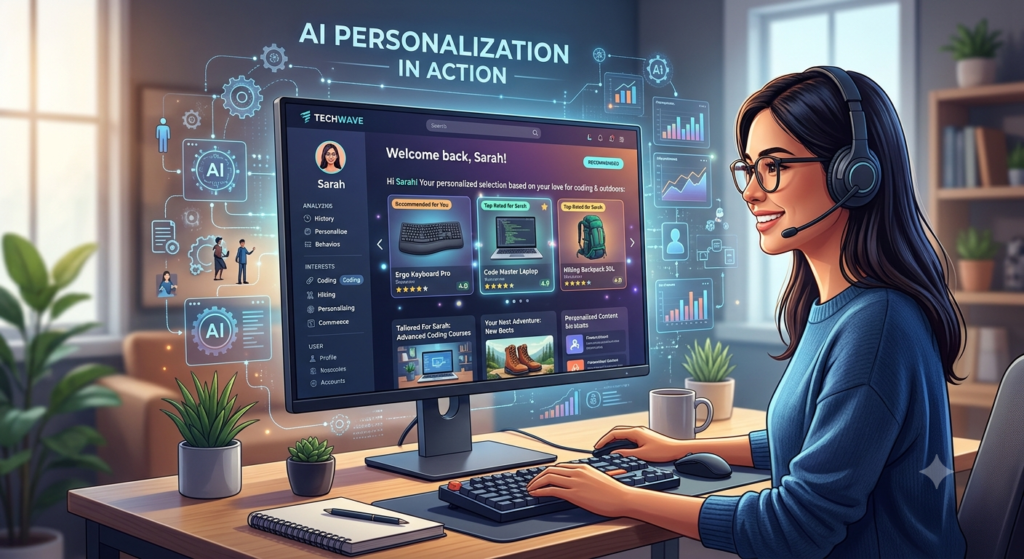
How AI Helps Marketers Personalize Website Content for Different Audiences
Imagine visiting an online store and seeing products that match your interests. The homepage displays items you recently searched for. The offers match your shopping habits. Even the articles seem relevant to your needs.
This isn’t magic. It’s the power of artificial intelligence.
Today, businesses need more than attractive websites. They need websites that understand visitors and deliver useful information. Every visitor has different needs, interests, and goals. Showing everyone the same message may not produce the best results.
This is where AI website personalization becomes valuable.
Artificial intelligence helps marketers study visitor behavior, understand customer preferences, and deliver relevant content. It can change website messages, product suggestions, images, offers, and calls to action based on user interests.
The result is a more useful and engaging browsing experience.
In this guide, we’ll explore how AI helps marketers personalize website content for different audiences, which tools they can use, and how businesses can build effective personalization strategies.
1. AI Website Personalization: Understanding
AI website personalization is the process of using artificial intelligence to customize website content according to visitor interests, behavior, preferences, and needs.
Traditional websites often display identical content to every visitor. However, AI-powered websites can provide different experiences to different people.
For example, imagine two visitors landing on the same clothing website.
The first visitor frequently searches for sportswear. The second visitor looks for formal clothing.
An intelligent website can show sports shoes and athletic clothing to the first visitor while displaying business suits and formal accessories to the second.
Both visitors access the same website, but their experiences are different.
How Does AI Website Personalization Work?
AI personalization uses several technologies to understand visitors and deliver relevant content.
These include:
- Machine learning: Studies visitor patterns and improves predictions.
- Natural language processing: Helps understand search queries and customer messages.
- Predictive analytics: Estimates what visitors may need next.
- Recommendation engines: Suggest relevant products, services, and articles.
- Behavioral analytics: Studies clicks, searches, browsing time, and interactions.
These technologies work together to improve content relevance.
Difference Between Traditional and AI-Powered Personalization
|
Traditional Personalization |
AI-Powered Personalization |
|
Uses fixed customer groups |
Identifies changing customer patterns |
|
Requires more manual work |
Automates many processes |
|
Often follows predefined rules |
Can learn from new data |
|
Provides limited customization |
Supports deeper customization |
|
Needs frequent manual updates |
Can adjust content automatically |
AI doesn’t replace marketing knowledge. Instead, it helps marketers make better decisions using information collected from website interactions.
Why Is It Important Today?
Customers expect websites to understand their needs. They don’t want to spend unnecessary time searching for relevant information. They prefer websites that make product discovery easier and provide useful recommendations.
Businesses can use AI-powered personalization to meet these expectations. It can help improve engagement, reduce unnecessary browsing, and create stronger relationships with customers.
2. Why Website Personalization Matters for Modern Marketing
Website visitors have different reasons for visiting a business website. Some want information. Others want to compare products. Some are ready to make a purchase, while others are only exploring available options.
A single marketing message cannot address every visitor’s needs. This is why personalized website content has become an important part of modern digital marketing.
2.1 Creates Better Customer Experiences
A personalized website makes it easier for visitors to find relevant information.
For example, a travel website can display family holiday packages to visitors searching for family destinations. It can show adventure trips to people exploring trekking and outdoor activities.
This improves the overall browsing experience.
Visitors can discover relevant information without searching through unrelated pages.
2.2 Improves Customer Engagement
Relevant content encourages visitors to interact with a website.
When people see useful recommendations, interesting articles, and suitable offers, they’re more likely to explore additional pages.
AI marketing personalization can improve engagement through:
- Personalized homepage messages.
- Relevant blog recommendations.
- Location-based offers.
- Customized product suggestions.
- Audience-specific landing pages.
- Relevant promotional banners.
These elements can encourage visitors to spend more time exploring a website.
However, engagement should be measured through meaningful actions rather than browsing time alone.
2.3 Supports Higher Conversion Rates
Conversion happens when visitors complete an important action. This could include purchasing a product, requesting a quotation, booking an appointment, or subscribing to a newsletter. AI can help marketers identify visitors who show strong purchase interest.
For example, a visitor who repeatedly checks pricing information may be interested in buying a service.The website could display a relevant consultation offer or a useful product comparison.
This doesn’t guarantee a conversion. However, it can remove barriers and make the buying process easier.
2.4 Reduces Irrelevant Marketing Messages
Sending identical offers to every visitor can reduce marketing effectiveness.
A student searching for online courses may not need a business training package. Similarly, someone looking for affordable products may not respond to premium offers.
AI helps businesses identify these differences.
Marketers can use audience segmentation and behavioral targeting to show suitable messages to different customer groups.
2.5 Strengthens Customer Relationships
Personalization can make customers feel understood.
When a business consistently provides relevant recommendations and useful information, visitors may develop greater trust in the brand.
However, personalization should always respect customer privacy.
Businesses must explain how they collect and use personal information. They should also provide suitable consent and privacy controls.
3. How AI Personalizes Website Content
AI personalization involves several connected processes. Understanding these processes helps marketers create effective strategies.
3.1 Collecting Website Visitor Data
The first step is collecting relevant information about website interactions.
Depending on user consent, available technology, and applicable privacy rules, businesses may analyze:
- Pages visited.
- Products viewed.
- Search queries.
- Links clicked.
- Content downloaded.
- Shopping cart activity.
- Previous purchases.
- Website traffic sources.
- Device and browsing information.
This information helps marketers understand what visitors are interested in.
For example, someone reading several articles about digital marketing may be interested in marketing courses, tools, or consulting services.
The website can use these signals to suggest relevant resources.
3.2 Analyzing Visitor Behavior
AI systems analyze collected information to identify patterns.
This process is known as visitor behavior analysis.
For example, an online store may discover that visitors who view running shoes frequently explore fitness clothing.
The recommendation system can use this pattern to suggest related products.
Similarly, an educational website may discover that visitors reading articles about medical careers frequently explore laboratory technician courses.
These insights help marketers understand relationships between different interests.
3.3 Creating Customer Segments
Customer segmentation means dividing website visitors into groups based on shared characteristics.
AI can identify groups using different signals.
Common segmentation categories include:
|
Segment |
Description |
Possible Content |
|
New visitors |
People visiting for the first time |
Introduction and popular content |
|
Returning visitors |
People who revisit the website |
Related resources |
|
Interested buyers |
Visitors exploring products |
Product comparisons |
|
Existing customers |
People who have purchased |
Relevant updates and support |
|
Information seekers |
Visitors researching a topic |
Educational articles |
|
High-intent visitors |
Visitors showing purchase interest |
Pricing and consultation information |
AI can also identify more detailed audience patterns.
Unlike fixed segmentation, machine learning models can update their predictions when visitor behavior changes.
3.4 Predicting User Intent
Understanding what visitors may want is an important part of personalization.
AI can analyze searches, page visits, and interactions to estimate user intent.
For example:
- Searching for a product name may indicate product interest.
- Visiting a pricing page may indicate buying interest.
- Reading beginner guides may indicate a need for basic information.
- Comparing several products may indicate evaluation.
These predictions help marketers deliver suitable content at different stages of the customer journey.
3.5 Delivering Personalized Content
After analyzing visitor information, the system can select relevant website content.
This may include:
- Different homepage headlines.
- Personalized product recommendations.
- Relevant promotional banners.
- Customized landing pages.
- Suggested blog articles.
- Location-specific information.
- Different calls to action.
The goal is simple: provide useful information at the right time.
3.6 Learning From New Interactions
AI-powered personalization isn’t a one-time process.
The system can continuously analyze new interactions and improve its recommendations.
For example, a visitor may initially show interest in premium products but later start exploring affordable alternatives.
An intelligent system can adjust its recommendations based on this change.
This flexibility makes AI useful for businesses with changing customer needs.
4. The Role of AI Audience Segmentation in Digital Marketing
Audience segmentation helps marketers understand that not every visitor belongs to the same customer group.
AI makes this process faster and more flexible.
4.1 Demographic Segmentation
Demographic segmentation groups audiences using appropriate information such as age range, language, or other relevant characteristics.
Businesses should use demographic data only when they have a lawful basis and a clear marketing purpose.
For example, an educational website may provide different course information based on the learner’s selected education level.
4.2 Geographic Segmentation
Location can influence customer interests and purchasing decisions.
A travel website can display destination information based on a visitor’s selected location.
An online retailer may show relevant shipping information for different regions.
This is particularly useful for businesses serving customers across multiple cities or countries.
4.3 Behavioral Targeting
Behavioral targeting focuses on how visitors interact with a website.
AI can identify patterns in browsing activity, searches, clicks, and previous purchases.
For example, visitors who repeatedly explore a particular product category may receive related recommendations.
However, businesses should avoid excessive tracking or sensitive profiling.
4.4 Interest-Based Segmentation
AI can identify content interests by analyzing the topics visitors explore.
A technology blog might identify readers interested in artificial intelligence, cybersecurity, software development, or digital marketing.
It can then recommend articles from the relevant category.
This approach supports content customization and improves content discovery.
5. Dynamic Content Personalization: Showing the Right Content
Dynamic content personalization means changing website elements according to visitor information or behavior.
Instead of manually creating separate websites for every audience, marketers can use systems that display different content within the same website structure.
5.1 Personalized Headlines
Headlines influence whether visitors continue reading.
A business website may display different messages for different audience groups.
For example:
- New visitors: “Discover Digital Marketing Solutions for Your Business.”
- Returning visitors: “Explore More Ways to Improve Your Marketing.”
- Interested customers: “Find the Right Marketing Package for Your Goals.”
The basic message remains connected to the brand, but the wording becomes more relevant.
5.2 Personalized Images and Banners
Images can influence how visitors understand products and services.
An online furniture store might show bedroom furniture to visitors exploring bedroom collections.
Visitors interested in office furniture may see workspace designs instead.
This makes the website more relevant without changing its overall structure.
5.3 Personalized Recommendations
Recommendation engines analyze visitor interests and identify suitable products or content.
Common recommendation methods include:
Collaborative filtering: Suggests items based on patterns among users with similar interests.
Content-based filtering: Recommends items that share characteristics with previously viewed content.
Hybrid recommendations: Combines multiple methods to improve relevance.
For example, an online learning platform can recommend advanced courses to learners who have completed beginner-level lessons.
5.4 Personalized Calls to Action
A call to action encourages visitors to complete a specific action.
Examples include:
- Get Started.
- Explore Courses.
- Request a Quote.
- View Products.
- Book a Consultation.
AI can help marketers select suitable calls to action based on visitor intent.
Someone researching a service may prefer a detailed guide, while a visitor exploring pricing may respond better to a consultation option.
6. How AI Improves Website Content Optimization
Creating useful content is only one part of successful digital marketing.
Marketers must also understand whether that content performs well.
AI content optimization helps businesses evaluate and improve their website content.
6.1 Identifying Content Gaps
AI tools can analyze existing website content and identify missing topics.
For example, a website publishing articles about digital marketing may discover that it lacks useful information about email automation, conversion optimization, and audience segmentation.
These insights can guide future content planning.
6.2 Improving Content Relevance
AI can help marketers understand which topics are relevant to different audiences.
A beginner may need simple explanations, while an experienced professional may prefer advanced strategies.
Marketers can use these insights to create content for different knowledge levels.
6.3 Supporting A/B Testing
A/B testing compares two or more versions of a website element.
For example, marketers can compare:
- Two homepage headlines.
- Different banner designs.
- Alternative button text.
- Different landing page layouts.
AI can help analyze testing results and identify patterns.
However, experiments should use reliable measurement methods. Marketers shouldn’t assume that a small difference in results is statistically meaningful.
6.4 Improving Content Recommendations
AI can recommend articles based on visitor interests.
A reader exploring website optimization may receive suggestions about conversion tracking, SEO, or content marketing.
This creates a more connected content experience.
6.5 Supporting Generative AI
Generative AI can help marketers create content variations for different audiences.
For example, it can draft:
- Different product descriptions.
- Audience-specific email messages.
- Alternative landing page headlines.
- Personalized promotional messages.
- Frequently asked questions.
Human review remains important.
Marketers should check accuracy, originality, brand voice, and relevance before publishing AI-generated content.
7. AI-Powered Website Personalization Examples
Understanding practical examples makes the concept easier to apply.
Here are some ways businesses can use AI across different industries.
7.1 E-Commerce Websites
E-commerce businesses often have large product catalogs.
AI can help customers discover relevant products through browsing history, purchase patterns, and product recommendations.
For example, someone exploring smartphones may receive suggestions for phone cases, chargers, and compatible accessories.
Personalized recommendations can also appear on product pages and shopping carts.
7.2 Educational Websites
Educational platforms serve students with different goals and knowledge levels.
AI can recommend courses based on selected interests, completed lessons, and learning progress.
For example, a student interested in healthcare careers may receive information about medical laboratory courses, nursing programs, or healthcare certifications.
The website can also recommend beginner-friendly resources before suggesting advanced learning materials.
7.3 Travel Websites
Travel websites can use personalization to improve destination discovery.
A visitor exploring mountain destinations may receive recommendations for trekking trips and nature stays.
Someone searching for family holidays may see family-friendly hotels and travel packages.
The system can also display relevant destination guides and seasonal information.
7.4 Financial Service Websites
Financial service providers can organize website information according to customer interests.
Visitors exploring business accounts may receive relevant information about business banking services.
People researching personal banking may see information about savings accounts and everyday banking features.
Financial recommendations require special care, accuracy, and compliance with applicable regulations.
7.5 News and Content Websites
News websites can recommend articles based on selected interests and reading patterns.
For example, readers interested in technology may receive more technology-related articles.
However, publishers should avoid creating overly narrow information experiences that limit exposure to different viewpoints.
7.6 SaaS and Business Websites
Software companies can personalize their website experiences according to business needs.
A small business owner may see information about affordable software plans.
A larger organization may receive information about advanced integrations and enterprise features.
This helps visitors find the information most relevant to their requirements.
8. Best AI Website Personalization Tools
Choosing the right software is an important part of implementing personalization.
Different platforms offer different features. The best choice depends on business size, website technology, budget, data requirements, and marketing objectives.
Here are some well-known options to evaluate.
|
Tool |
Main Capabilities |
Suitable For |
|
Dynamic Yield |
Personalization and experimentation |
E-commerce and larger businesses |
|
Optimizely |
Digital experience optimization and experimentation |
Marketing and product teams |
|
Adobe Target |
Testing and personalization |
Enterprise businesses |
|
Insider |
Cross-channel customer experience personalization |
Growing and large brands |
|
Salesforce Marketing Cloud |
Customer data and marketing automation |
Businesses using Salesforce |
|
Bloomreach |
Commerce personalization and customer experience |
Online retailers |
|
VWO |
Website testing and experience optimization |
Small and medium-sized businesses |
|
Google Analytics 4 |
Audience and behavioral analysis |
Businesses of different sizes |
How to Choose the Right Tool
Before purchasing a platform, consider these factors:
- Ease of use: Choose software your marketing team can operate.
- Integration: Check compatibility with your CMS, CRM, and analytics systems.
- Automation: Evaluate available personalization features.
- Reporting: Look for useful performance measurements.
- Privacy: Check consent management and data protection features.
- Pricing: Compare total costs with expected business value.
- Scalability: Make sure the platform can support future growth.
For smaller businesses, starting with analytics, audience insights, and simple recommendation features may be more practical than investing in an expensive enterprise platform.
9. How to Create an AI Website Personalization Strategy
A successful strategy requires more than installing software.
Marketers need clear goals, reliable data, useful content, and regular performance reviews.
Follow these steps to get started.
Step 1: Define Your Marketing Goals
Start by deciding what you want to achieve.
Your goals might include:
- Increasing website engagement.
- Improving product discovery.
- Generating more qualified leads.
- Improving conversion rates.
- Reducing unnecessary browsing.
- Increasing repeat visits.
Choose measurable objectives.
Step 2: Understand Your Audience
Study your existing website visitors.
Use analytics reports, customer feedback, search data, and relevant customer research.
Identify different audience groups and understand what information they need.
Step 3: Select Useful Data Sources
Choose data sources that support your marketing goals.
These may include website analytics, CRM records, customer surveys, and consent-based behavioral information.
Avoid collecting unnecessary personal data.
Step 4: Select Suitable AI Tools
Compare personalization platforms according to your requirements.
Start with tools that integrate with your existing website.
You don’t need every available AI feature from day one.
Step 5: Create Audience-Specific Content
Prepare content for different visitor groups.
For example, a software company may create separate messages for beginners, small businesses, and enterprise customers.
Make sure every version provides accurate and useful information.
Step 6: Launch a Small Personalization Campaign
Begin with one website section.
You could personalize:
- Homepage recommendations.
- Blog suggestions.
- Product listings.
- Landing page messages.
A small experiment makes it easier to identify problems.
Step 7: Measure Performance
Track meaningful metrics such as:
|
Metric |
What It Measures |
|
Conversion rate |
Percentage of visitors completing a goal |
|
Engagement rate |
Meaningful visitor interactions |
|
Click-through rate |
Percentage of users clicking an element |
|
Revenue per visitor |
Revenue generated per website visitor |
|
Lead generation |
Number of qualified leads |
|
Return visits |
Visitors coming back to the website |
Compare personalized experiences with suitable control groups.
This helps determine whether personalization actually improves results.
Step 8: Improve Your Strategy
Review performance regularly.
Remove irrelevant recommendations, update outdated content, and improve weak-performing campaigns.
Personalization should evolve with customer preferences.
10. Challenges of AI Marketing Personalization and Their Solutions
AI offers many opportunities, but businesses should also understand its limitations.
10.1 Data Privacy Concerns
Personalization often depends on customer information.
Collecting and using this information without proper safeguards can damage customer trust.
Solution: Follow applicable privacy laws, obtain consent where required, explain data practices, and provide appropriate privacy controls.
10.2 Poor Data Quality
Incorrect or incomplete information can produce irrelevant recommendations.
For example, outdated browsing information may cause a website to recommend products a visitor no longer needs.
Solution: Regularly review data quality and remove outdated or unnecessary records.
10.3 High Implementation Costs
Advanced personalization platforms can require significant investment.
Small businesses may struggle with software costs, integration, and technical resources.
Solution: Start with simple personalization features and expand gradually when results justify additional investment.
10.4 Excessive Personalization
Showing too many personalized messages can make a website feel uncomfortable.
Visitors may feel that the business knows too much about their activities.
Solution: Keep personalization useful, transparent, and limited to relevant website experiences.
10.5 Algorithmic Bias
AI models can produce unfair or inaccurate recommendations if their training data contains bias.
Solution: Review personalization outcomes, test different audience groups, and maintain human oversight.
10.6 Lack of Human Creativity
AI can identify patterns and generate content, but it doesn’t automatically understand every business situation.
Solution: Combine AI automation with human creativity, marketing experience, and editorial review.
11. The Future of AI-Powered Personalization
AI technology continues to develop.
Future personalization systems are likely to become more flexible, predictive, and closely connected with customer experience platforms.
11.1 Generative AI for Website Personalization
Generative AI can help create different content versions for different audiences.
For example, a business could generate alternative product descriptions, promotional messages, and educational content.
Human editors can then review and approve the content.
11.2 Predictive Customer Experiences
Predictive AI can estimate what visitors may need next.
For example, an online learning platform may recommend the next course based on a learner’s completed lessons and selected goals.
This can make the customer journey easier to navigate.
11.3 Real-Time Personalization
Real-time personalization allows websites to respond to visitor interactions quickly.
A visitor exploring a particular product category may see related recommendations during the same browsing session.
This can make the website experience more relevant.
11.4 Better Cross-Channel Personalization
Customers interact with businesses through websites, mobile applications, emails, and social platforms.
Future systems may provide more consistent experiences across these channels.
Businesses will need suitable consent, data integration, and privacy controls to make this work responsibly.
11.5 More Responsible AI Marketing
Privacy and transparency will remain important.
Successful businesses will need to balance automation with customer control.
The goal shouldn’t be to collect as much information as possible. It should be to use appropriate information to provide genuine value.
Make Every Website Visit More Relevant With AI
Website visitors have different interests, expectations, and goals. Treating every visitor in exactly the same way may cause businesses to miss valuable marketing opportunities.
AI website personalization helps marketers understand these differences and deliver more relevant website experiences.
From audience segmentation and behavioral targeting to personalized recommendations and dynamic content, AI provides several ways to improve digital marketing.
Businesses can use these technologies to make content discovery easier, support customer decisions, and create more meaningful interactions.
However, successful personalization requires more than advanced software. It needs accurate information, useful content, clear objectives, privacy protection, and regular performance reviews.
Start with a simple strategy. Understand your audience, choose suitable tools, and test personalized experiences.
As your understanding improves, expand your approach.
The future of digital marketing isn’t simply about publishing more content. It’s about helping the right people discover the right information at the right time.
And AI can make that process much more effective.
Know More:
”FAQs”
Q1. What Is AI Website Personalization?
AI website personalization uses artificial intelligence and machine learning to customize website content according to visitor interests, behavior, and preferences. It helps businesses display relevant messages, recommendations, offers, and information to different audience groups.
Q2. How Does AI Personalize Website Content?
AI analyzes website interactions, customer preferences, and available behavioral data. It uses this information to identify audience patterns and recommend suitable content. Depending on the platform, it can customize headlines, product suggestions, landing pages, and promotional messages.
Q3. What Are the Benefits of AI-Powered Personalization?
The main benefits include better content relevance, improved engagement, easier product discovery, more useful customer experiences, and opportunities to improve conversion rates. It can also help marketers automate repetitive content-targeting activities.
Q4. Which Are the Best AI Tools for Website Personalization?
Popular platforms include Dynamic Yield, Optimizely, Adobe Target, Insider, Bloomreach, and Salesforce Marketing Cloud. Google Analytics 4 can also help businesses understand audience behavior. The best platform depends on business needs, budget, website technology, and integration requirements.
Q5. Can Small Businesses Use AI Website Personalization?
Yes. Small businesses can start with basic audience segmentation, content recommendations, and analytics tools. They can personalize blog suggestions, landing pages, product categories, and calls to action without immediately investing in complex enterprise software.
Q6. How Does AI Website Personalization Improve Conversion Rates?
AI can help identify visitor interests and display relevant information at different stages of the buying journey. For example, visitors exploring product prices may receive comparison information or a consultation offer. This can make purchasing decisions easier, although results depend on the quality of the experience and the offer.
Q7. Is AI Website Personalization Safe for Customer Privacy?
It can be privacy-conscious when businesses follow applicable laws and use appropriate safeguards. Companies should collect only necessary information, obtain consent where required, explain their data practices, and provide suitable privacy controls.
Q8. What Is the Difference Between Content Personalization and Dynamic Content?
Content personalization is the broader process of making information relevant to different audiences. Dynamic content is one method of delivering personalization by changing website elements, such as headlines, images, recommendations, or offers, according to defined conditions or visitor information.
Q9. Can Generative AI Create Personalized Website Content?
Yes. Generative AI can create different versions of website copy, product descriptions, headlines, and promotional messages. However, marketers should review generated content for accuracy, originality, brand consistency, and compliance before publishing it.
Q10. How Can Marketers Measure Personalization Success?
Marketers can track conversion rates, click-through rates, engagement, qualified leads, revenue per visitor, and repeat visits. A/B testing and controlled experiments can help determine whether personalized experiences perform better than standard website content.

