

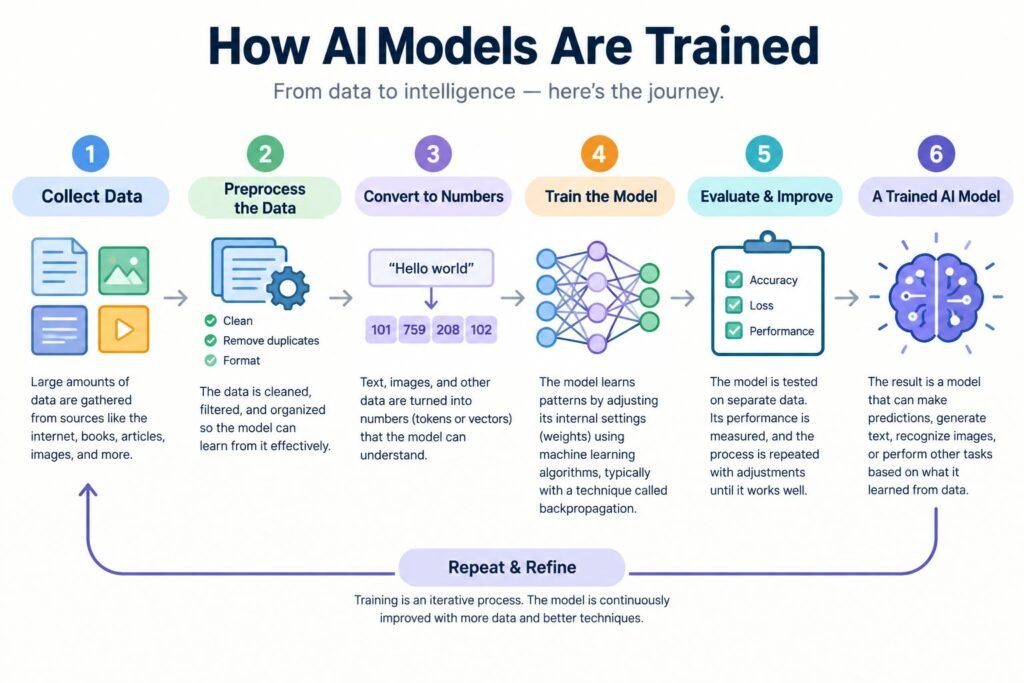
How AI Models Are Trained: Data, Algorithms, Training, and Fine-Tuning Explained
AI model training is the process that helps computers learn patterns from data and use those patterns to make predictions, decisions, or generate content. It is one of the most important parts of artificial intelligence and machine learning.
When people hear about AI, they often think about chatbots, image generators, recommendation systems, or self-driving cars. Behind all these systems is a trained model. The model learns from examples instead of being given a fixed rule for every possible situation.
But how are AI models trained step by step? What role do training datasets, algorithms, neural networks, and GPUs play? And what does fine-tuning mean?
This guide explains AI model training in simple language. It covers data preprocessing, supervised learning, unsupervised learning, reinforcement learning, gradient descent, backpropagation, model evaluation, hyperparameter tuning, transfer learning, and fine-tuning AI models.
By the end, you’ll have a clear beginner-friendly understanding of how modern AI systems learn.
Know more : The Ultimate Guide To Building A Website For Small Business In 2025, Important Tips
How AI Models Are Trained?
AI model training is the process of teaching a computer model to recognize patterns in data.
Imagine showing a child thousands of pictures of cats and dogs. Over time, the child starts noticing features such as shape, ears, eyes, fur, and body structure. The child can then identify a new picture. AI training works in a similar way, although the underlying mathematics is very different.
A machine learning model receives examples and adjusts its internal parameters to improve its results. During training, the model compares its prediction with the expected answer. The difference is measured using a loss function.
The model then changes its parameters to reduce that error.
A simple AI training cycle looks like this:
- Collect data.
- Clean and prepare the data.
- Choose an AI algorithm.
- Feed data into the model.
- Generate predictions.
- Calculate training loss.
- Update model parameters.
- Repeat the process.
- Evaluate the model.
- Tune and improve the model.
This cycle forms the foundation of machine learning training and deep learning training.
Why Is AI Model Training Important?
A model is only as useful as its ability to learn meaningful patterns.
Good AI model training can help a system:
- Make accurate predictions.
- Understand text and speech.
- Recognize objects in images.
- Recommend products or content.
- Detect fraud.
- Forecast demand.
- Generate text, images, audio, or code.
- Support business decisions.
The quality of the training process matters because poor data can produce poor results. In simple terms, an AI system can’t magically turn bad information into reliable knowledge.
This is why data quality, algorithm selection, evaluation, and model optimization are so important.
How AI Models Are Trained Step by Step?
The complete AI model training process can be divided into several stages.
Step 1: Define the AI Problem
Before collecting data, developers need to understand the problem.
For example, a company may want an AI system that predicts whether an email is spam.
The team needs to define:
- What is the input?
- What should the model predict?
- What data is available?
- How will success be measured?
- What level of accuracy is required?
A clear problem makes the rest of the training process easier.
For a spam detector, the input could be an email’s text and metadata. The output could be either “spam” or “not spam.”
Step 2: Collect Training Data
Training datasets are the foundation of machine learning.
Examples of training datasets include:
| AI Application | Example Training Data |
| Image recognition | Labeled images |
| Spam detection | Emails labeled spam/not spam |
| Speech recognition | Audio and transcripts |
| Recommendation systems | User activity and preferences |
| Fraud detection | Transaction records |
| Chatbots | Text conversations and documents |
| Self-driving systems | Images, video, maps, and sensor data |
Data can come from many sources. These may include internal business records, public datasets, sensors, user interactions, documents, websites, or synthetic data. However, collecting more data doesn’t automatically guarantee a better model. The data must also be relevant, accurate, diverse, and properly prepared.
Step 3: Perform Data Preprocessing
Data preprocessing prepares raw information for AI training. Raw data often contains errors, duplicates, missing values, inconsistent formats, or irrelevant information.
Common preprocessing tasks include:
- Removing duplicate records.
- Handling missing values.
- Correcting incorrect data.
- Standardizing formats.
- Removing unwanted noise.
- Labeling examples.
- Scaling numerical values.
- Converting text into machine-readable representations.
For language models, tokenization is an important part of preprocessing. Tokenization breaks text into smaller units called tokens. For example, a sentence may be divided into words, subwords, or other token units.
For image models, preprocessing may include resizing images, normalizing pixel values, or applying controlled transformations. Data preprocessing is important because clean and consistent input gives the model a better foundation for learning.
Step 4: Choose an AI Algorithm
The next step is selecting an appropriate AI algorithm. The choice depends on the problem and the type of data available. Three major learning approaches are supervised learning, unsupervised learning, and reinforcement learning.
Supervised Learning
In supervised learning, the model learns from labeled examples.
For example:
- Input: Image of a dog
- Label: Dog
The model learns the relationship between the input and the expected output. Supervised learning is widely used for classification and regression tasks.
Examples include:
- Spam detection.
- Sales prediction.
- Medical image classification.
- Credit risk prediction.
- Customer churn prediction.
Unsupervised Learning
Unsupervised learning works with data that doesn’t have predefined labels. The model looks for patterns or structures in the data.
For example, a retailer may have thousands of customer records but no predefined customer groups. An unsupervised algorithm can identify groups of customers based on purchasing behavior.
Common uses include:
- Customer segmentation.
- Anomaly detection.
- Pattern discovery.
- Data clustering.
- Dimensionality reduction.
Reinforcement Learning
Reinforcement learning uses rewards and penalties. An AI agent takes an action and receives feedback. Over many attempts, it learns which actions produce better results.
It can be used in areas such as:
- Robotics.
- Game playing.
- Resource management.
- Recommendation systems.
- Autonomous systems.
The difference between supervised and unsupervised learning is mainly the presence or absence of labeled training examples. Reinforcement learning uses feedback from interactions instead.
Step 5: Split the Dataset
A dataset is usually divided into separate parts.
The three common groups are:
- Training dataset.
- Validation dataset.
- Test dataset.
The training dataset is used to teach the model.
The validation dataset helps developers make decisions during model development, such as selecting hyperparameters. The test dataset is used to estimate how well the final model performs on previously unseen data.
A common mistake is evaluating a model only on data it has already seen. That can make the model appear better than it really is. The goal is generalization: the model should work well on new examples.
Step 6: Train the Model
Now the actual training begins. The model receives training examples and produces predictions. These predictions are compared with expected results. The difference is measured using a loss function.
For example, if a model predicts a 70% chance that an email is spam when the correct label is spam, the loss may be relatively low. If it predicts only a 5% chance, the loss may be much higher.
The model tries to reduce this loss.
What Is Training Loss?
Training loss is a numerical measure of how far the model’s predictions are from the desired outputs. A lower loss generally means the model is fitting the training data better, although lower training loss does not always mean better real-world performance. This is where gradient descent becomes important.
Step 7: Understand Gradient Descent
Gradient descent is one of the key ideas behind machine learning training. Think of a person trying to walk down a hill while looking for the lowest point. The person checks the slope and takes a step toward lower ground. Gradient descent works in a similar mathematical way. It estimates how model parameters should change to reduce the loss.The process is repeated many times.
In simplified form:
New parameter = Old parameter − Learning rate × Gradient
The learning rate controls the size of each update.
If the learning rate is too large, training may become unstable. If it is too small, training can take a very long time.
Step 8: Use Backpropagation in Neural Networks
Backpropagation is a major part of neural network training.
A neural network makes a prediction during the forward pass. The model then calculates the error.
During backpropagation, the error information is passed backward through the network. This helps determine how different parameters contributed to the error.
An optimizer then uses this information to update the model.
The basic cycle is:
Input → Neural Network → Prediction → Loss → Backpropagation → Parameter Update
This process can happen millions or billions of times for large models.
Step 9: Evaluate the Model
After training, developers need to measure performance.
Different tasks require different evaluation metrics.
For classification, common metrics include:
- Accuracy.
- Precision.
- Recall.
- F1 score.
- ROC-AUC.
For regression, metrics can include:
- Mean absolute error.
- Mean squared error.
- Root mean squared error.
For generative AI systems, evaluation can be more complex. Human evaluation, task-specific benchmarks, safety testing, factuality checks, and other measures may be used.
Model evaluation shouldn’t focus on one number alone. A model may have high overall accuracy but still perform poorly for certain groups or important edge cases.
Hyperparameter Tuning and Model Optimization
Not every training setting is learned automatically by the model.
Some settings are selected by developers. These are called hyperparameters.
Examples include:
- Learning rate.
- Batch size.
- Number of training epochs.
- Network depth.
- Dropout rate.
- Weight decay.
Hyperparameter tuning involves testing different combinations to find a configuration that provides good results.
Developers may use manual experiments, grid search, random search, or more advanced optimization methods.
Model optimization can also involve techniques that reduce memory usage, speed up training, or make inference more efficient.
How to Avoid Overfitting and Underfitting
Two common problems in machine learning are overfitting and underfitting.
Overfitting
Overfitting happens when a model learns the training data too closely.
It may perform very well on training examples but poorly on new examples.
Ways to reduce overfitting include:
- Using more quality training data.
- Applying regularization.
- Using dropout.
- Reducing model complexity.
- Early stopping.
- Data augmentation.
- Monitoring validation performance.
Underfitting
Underfitting happens when a model is too simple or hasn’t learned enough from the data.
It can result in poor performance on both training and unseen data.
Possible solutions include:
- Increasing model capacity.
- Training for longer.
- Improving features.
- Reducing excessive regularization.
- Using a better algorithm.
The goal is a good balance between learning useful patterns and generalizing to new data.
What Is Fine-Tuning in AI Models?
Fine-tuning AI models means taking a pretrained model and continuing its training on a smaller, task-specific or domain-specific dataset.
This approach is especially useful for modern AI systems.
Instead of training a huge model from scratch, developers can start with an existing pretrained model and adapt it.
For example, a general language model can be fine-tuned using high-quality examples from:
- Customer support.
- Legal documents.
- Healthcare content.
- Financial documents.
- Programming code.
- Company-specific information.
Fine-tuning can require significantly less compute, data, and time than training a large model from scratch.
What Is Transfer Learning?
Transfer learning uses knowledge learned from one task or dataset to improve performance on another related task.
For example, an image model trained on a large collection of general images can be adapted for a specific image classification problem.
Transfer learning is valuable because the model doesn’t have to start from zero.
It can provide:
- Faster development.
- Lower training costs.
- Better performance with limited data.
- Reduced computing requirements.
For a practical learning resource, the Hugging Face Transformers training documentation provides examples of preprocessing, model loading, training configuration, and fine-tuning.
How Large Language Models Are Trained
Large language models, or LLMs, are a major example of modern AI model training.
Models such as GPT-style systems use large neural networks and enormous collections of text and other data.
A simplified LLM training process looks like this:
- Collect and prepare large-scale data.
- Filter and clean the data.
- Tokenize text.
- Convert tokens into numerical representations.
- Feed batches of tokens into a neural network.
- Predict tokens or other training targets.
- Calculate the loss.
- Use backpropagation.
- Update model parameters.
- Repeat the process many times.
- Evaluate the resulting model.
- Apply additional training or fine-tuning.
Tokenization and Embeddings
Computers don’t directly understand words as humans do.
Tokenization converts text into tokens that a model can process.
Those tokens are represented using numerical vectors called embeddings.
Embeddings allow models to represent relationships between pieces of information in a mathematical space.
For example, words or concepts with related meanings may have similar representations.
Transformer Models
Many modern language models use the Transformer architecture.
Transformers became highly important because they can process relationships between tokens using an attention mechanism.
Attention helps a model determine which parts of an input are important when processing another part.
This ability supports tasks such as:
- Text generation.
- Translation.
- Summarization.
- Question answering.
- Classification.
- Code generation.
BERT training and GPT training are examples of different approaches to training Transformer-based language models.
The Role of AI Algorithms in Training
AI algorithms provide the methods used to learn patterns from data.
The algorithm and model architecture work together.
For example, a neural network may contain many layers and parameters. The training algorithm determines how those parameters are updated based on errors.
The role of algorithms includes:
- Finding patterns.
- Updating model parameters.
- Minimizing loss.
- Handling different data types.
- Supporting optimization.
- Improving prediction quality.
Choosing the right algorithm can make a major difference.
A simple problem may not need a huge deep learning model. In some cases, a smaller model can be faster, cheaper, easier to explain, and just as effective.
GPU Training and AI Infrastructure
Large-scale deep learning training can require significant computing power.
Graphics processing units, or GPUs, are widely used because they can perform many mathematical operations in parallel.
Large AI projects may use:
- Multiple GPUs.
- High-speed storage.
- Large memory systems.
- Distributed training.
- Specialized accelerators.
- Cloud computing platforms.
Cloud-based AI training allows teams to access computing resources without buying and maintaining all hardware themselves.
Model scalability is another important consideration. As datasets and models become larger, training systems need efficient methods for distributing computation.
Modern frameworks also support techniques such as mixed precision, gradient accumulation, and distributed training to improve efficiency.
AI Bias and Ethical AI Training
AI systems learn from data, so problems in the data can influence model behavior.
AI bias can appear when training data is incomplete, unbalanced, outdated, or reflects existing social biases.
Ethical AI training should consider:
- Data privacy.
- Consent.
- Fairness.
- Representation.
- Security.
- Transparency.
- Accountability.
- Responsible data use.
Developers should test models across relevant groups and scenarios.
AI explainability can also help users understand why a system produced a particular result. The exact level of explainability needed depends on the application.
For high-impact systems, responsible development requires more than achieving high accuracy. Teams also need to consider potential harm and how people will use the system.
How Training Changes an AI Model
An AI model contains parameters, sometimes called weights.
During training, these parameters change.
At the beginning, the model usually doesn’t know the useful patterns required for its task. Through repeated training examples, the optimization process gradually adjusts the parameters.
A simplified example is:
Data → Prediction → Loss → Gradient → Parameter Update → Better Prediction
This process repeats again and again.
The final trained model contains learned numerical patterns that allow it to produce predictions or outputs when it receives new input.
It’s important to remember that a model doesn’t “understand” information in exactly the same way humans do. Its behavior comes from learned mathematical relationships within the model.
AI Model Training vs Fine-Tuning
Training from scratch and fine-tuning are related but different.
| Feature | Training From Scratch | Fine-Tuning |
| Starting point | Random or newly initialized parameters | Pretrained model |
| Data requirement | Usually very large | Usually smaller |
| Computing cost | High | Often lower |
| Training time | Long | Usually shorter |
| Main purpose | Build general capabilities | Adapt existing capabilities |
| Example | Training a foundation model | Adapting a pretrained model for a specific task |
Fine-tuning is often a practical option when a strong pretrained model already exists.
A Simple Example of AI Model Training
Suppose a company wants to build a model that predicts whether a customer will cancel a subscription.
The workflow could look like this:
- Define the goal: Predict customer churn.
- Collect data: Gather historical customer records.
- Prepare data: Remove duplicates, handle missing values, and create useful features.
- Label data: Mark previous customers as churned or retained.
- Split data: Create training, validation, and test datasets.
- Choose an algorithm: Select a suitable classification method.
- Train: Feed the training examples into the model.
- Calculate loss: Measure prediction errors.
- Optimize: Update parameters.
- Evaluate: Test performance on unseen data.
- Tune: Adjust hyperparameters.
- Deploy: Put the model into the production system.
- Monitor: Track performance and data changes over time.
This example shows that AI training is not just about selecting an algorithm. Data quality, evaluation, infrastructure, and ongoing monitoring all matter.
Best Practices for AI Model Training
A strong AI training process should follow practical principles.
1. Start With a Clear Problem
Don’t begin with a complex model just because it’s popular. First define the business or technical problem.
2. Prioritize Data Quality
Clean, relevant, representative data can be more valuable than simply collecting massive amounts of data.
3. Keep Datasets Separate
Don’t allow test data to accidentally influence training decisions.
4. Monitor Training Loss and Validation Performance
Training loss alone doesn’t tell the whole story. Compare training and validation behavior.
5. Watch for Bias
Check whether performance differs across important groups or use cases.
6. Use Pretrained Models When Appropriate
Transfer learning and fine-tuning can reduce development time and computing costs.
7. Tune Carefully
Test learning rates, batch sizes, epochs, and other hyperparameters systematically.
8. Monitor After Deployment
Model performance can change when real-world data changes.
AI model training is the foundation of modern artificial intelligence. It allows computers to learn patterns from data instead of relying only on manually written rules.
The process starts with a clear problem and suitable training datasets. It then moves through data preprocessing, algorithm selection, dataset splitting, model training, loss calculation, gradient descent, backpropagation, evaluation, and optimization. For modern AI, the process can also include transfer learning and fine-tuning. Large language models use advanced architectures such as Transformers, tokenization, embeddings, and attention mechanisms to process large amounts of information.
At the same time, successful AI development isn’t only about building larger models. Data quality, responsible training, fairness, explainability, security, scalability, and ongoing evaluation are equally important. As AI continues to evolve, understanding the fundamentals of machine learning training and deep learning training will help students, developers, businesses, and technology professionals make better decisions about AI.
The key idea is simple: AI learns from examples, improves through optimization, and becomes useful when that learning is tested and applied responsibly.
Know More :
”FAQs”
1. How are AI models trained step by step?
AI models are generally trained by defining a problem, collecting data, preprocessing the data, selecting an algorithm, splitting the dataset, training the model, calculating loss, updating parameters, evaluating performance, tuning the model, and deploying it.
2. What is a training dataset in AI?
A training dataset is a collection of examples used to teach an AI or machine learning model. Depending on the task, it may contain text, images, audio, numerical records, video, labels, or other information.
3. What is fine-tuning in AI models?
Fine-tuning is the process of continuing the training of a pretrained model using a smaller dataset designed for a particular task or domain. It can make an existing model more useful for a specific application.
4. How does gradient descent work in machine learning?
Gradient descent adjusts model parameters in a direction that is expected to reduce the loss. The learning rate controls how large each update is. The process is repeated during training.
5. What is the difference between supervised and unsupervised learning?
Supervised learning uses labeled examples, while unsupervised learning looks for patterns in data without predefined labels. Supervised learning is common for prediction and classification, while unsupervised learning is useful for clustering and pattern discovery.
6. How are large language models trained?
Large language models are trained using large collections of data. Text is processed into tokens, passed through neural network architectures such as Transformers, and used in a training objective that updates model parameters. Later stages may include instruction tuning, fine-tuning, evaluation, and safety-focused training.
7. How can you avoid overfitting in machine learning?
You can reduce overfitting by using more quality data, regularization, dropout, data augmentation, early stopping, simpler models, and careful validation. The best method depends on the model and dataset.
8. Why are GPUs used for AI training?
GPUs can perform many numerical operations in parallel, making them well suited to the matrix and tensor calculations used in neural network training. Large models can also use multiple GPUs or distributed computing systems.
9. How does transfer learning improve AI models?
Transfer learning starts with knowledge learned from an existing model and adapts it to another task. This can reduce the amount of data, computing power, and training time required for the new task.
10. What are the ethical issues in AI model training?
Important issues include privacy, unfair bias, poor data representation, consent, security, transparency, copyright and data rights, and the potential impact of automated decisions. Ethical AI training should consider these risks throughout the model lifecycle.





Pingback: AI in Human Resources : Powerful Ways to Transform Recruitment, Training, and Employee Management in 2026