
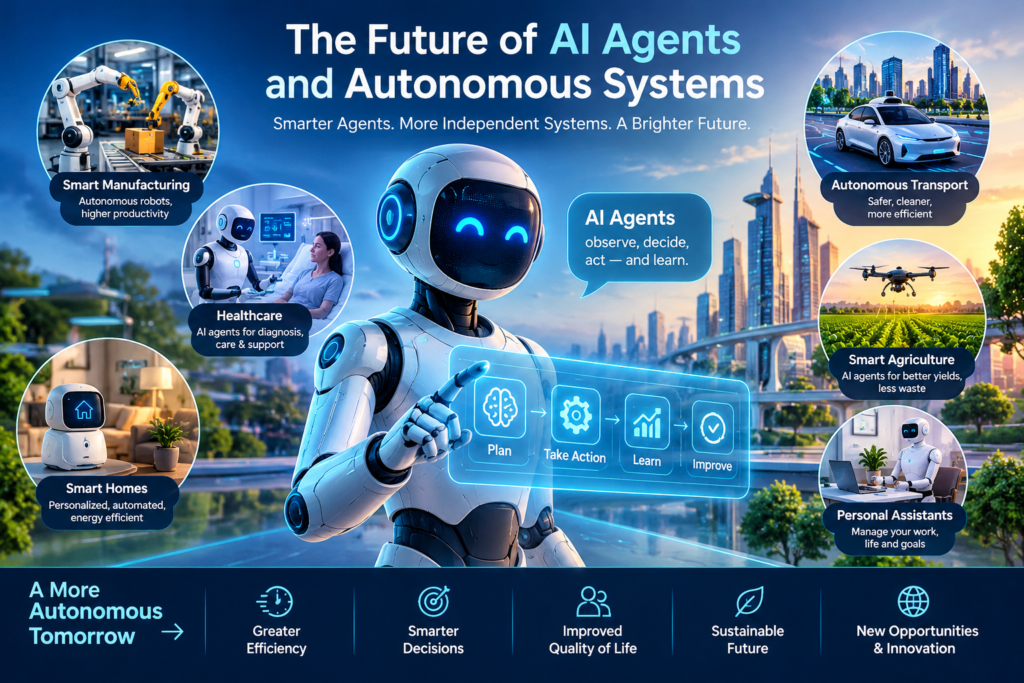
The Future of AI Agents and Autonomous Systems: 12 Powerful Trends Shaping 2026 and Beyond
The future of artificial intelligence is moving beyond simple chatbots. Today, AI agents can help people plan tasks, analyze information, use digital tools, and complete multi-step work. As these abilities improve, autonomous AI systems may change how businesses operate, how people learn, and how everyday services work.
Think about a digital assistant that doesn’t just answer a question. It can compare options, prepare a report, check the details, and ask for approval before taking action. That’s the promise of intelligent agents.
However, greater autonomy also brings new challenges. Businesses must consider security, accuracy, privacy, and human control. The goal isn’t to remove people from every process. It’s to help people work better with intelligent technology.
In this article, we’ll explore what AI agents are, how they work, why businesses are adopting them, and what the future of autonomous AI systems may look like in 2026 and beyond.
1. Understanding The Future of AI Agents and Autonomous Systems
AI agents are software systems designed to pursue a goal by observing information, making decisions, and taking actions. They can use artificial intelligence models, external tools, stored information, and feedback to complete tasks.
Traditional software usually follows a fixed set of instructions. An AI agent can often choose between different steps based on the information it receives.
For example, a traditional program might send the same reminder to every customer. An intelligent agent could review a customer’s request, identify the relevant account details, draft a suitable response, and send it for approval.
The exact level of independence depends on how the agent is designed.
1.1 What Are AI Agents and How Do They Work?
The question what are AI agents and how do they work has become important as businesses explore intelligent automation.
Most AI agents follow a simple process:
- Receive a goal: The user explains what needs to be done.
- Gather information: The agent checks relevant data, documents, or tools.
- Plan the work: It breaks a larger task into smaller steps.
- Take action: It performs permitted actions using available tools.
- Review the result: It checks whether the action achieved the goal.
- Adjust the plan: If necessary, it tries another approach or asks for help.
Consider an AI agent asked to prepare a competitor analysis. It might collect public information, compare products, organize findings, and create a report.
A reliable system should also identify missing information and avoid presenting guesses as facts.
This process is a key part of agentic AI. Rather than responding once and stopping, an agent can work through a sequence of connected actions.
1.2 Key Components of Intelligent Agents
An effective agent usually combines several components.
|
Component |
Purpose |
Example |
|
AI model |
Understands requests and generates plans |
Interpreting a customer question |
|
Memory |
Stores relevant information when permitted |
Remembering project requirements |
|
Tools |
Connects the agent to software and data |
Searching a database |
|
Planning |
Breaks goals into steps |
Preparing a research plan |
|
Feedback |
Checks results and detects errors |
Reviewing a report for missing sections |
|
Guardrails |
Limits unsafe or unauthorized actions |
Requiring approval before payment |
Machine learning agents may use patterns in data to improve predictions or select actions. Generative AI agents can also produce text, code, summaries, and other content. Not every agent contains every component. Its design depends on the task, available technology, and level of risk.
1.3 Autonomous Systems and AI Autonomy
An autonomous system can perform defined tasks with limited human intervention. Examples include warehouse robots, route-planning software, and systems that adjust energy use.
However, autonomy is not an all-or-nothing feature.
Some systems can only suggest the next action. Others can complete approved tasks independently. High-risk systems may need human approval at several stages.
This distinction matters because more autonomy doesn’t always mean better performance. A system should have enough freedom to complete its work, but not more freedom than the task requires.
2. AI Agents vs. Traditional Automation
Traditional automation is useful for predictable tasks. It follows rules, triggers, and workflows created in advance. AI agents can handle some tasks where the steps depend on changing information.
The difference is easiest to understand through examples.
|
Feature |
Traditional automation |
AI agents |
|
Workflow |
Usually predefined |
Can adapt within set limits |
|
Inputs |
Often structured |
Can handle varied information |
|
Decisions |
Rule-based |
May use model-based reasoning |
|
Task changes |
Often needs rule updates |
May adjust its plan |
|
Error handling |
Follows programmed responses |
May attempt recovery |
|
Human oversight |
Depends on the workflow |
Depends on risk and permissions |
Neither approach is always better. Traditional automation can be faster, simpler, and easier to test for repetitive work. AI agents may be more useful when a task requires interpretation, planning, or several connected actions.
2.1 How Agentic AI Changes Workflows
Agentic AI combines planning, tool use, and goal-based action. This allows software to handle a series of related tasks instead of performing just one operation.
For example, a support workflow could work like this:
- A customer submits a request.
- An agent identifies the type of problem.
- It checks the relevant help documents.
- It drafts a response based on the available evidence.
- It sends the response for approval when required.
- It records the outcome in the support system.
This is a practical example of AI task automation. It reduces manual work while keeping important decisions under human control.
AI workflows can also combine traditional rules with intelligent agents. A fixed rule might verify an account, while an AI agent interprets the customer’s message.
This combination can deliver more reliable results than using an AI model for every step.
2.2 When Should Businesses Use AI Agents?
AI agents are worth considering when a task:
- Involves several connected steps.
- Requires information from different sources.
- Includes frequent but manageable changes.
- Has clear success criteria.
- Can be monitored and corrected.
- Offers enough value to justify the cost.
For simple tasks, ordinary scripts may be the better choice. For sensitive decisions involving money, health, legal rights, or personal information, stronger controls and expert review are essential.
The best solution is the one that solves the problem safely, not the one with the most advanced technology.
3. Benefits of AI Agents in Business
The benefits of AI agents in business go beyond saving time. When properly designed, they can improve consistency, help employees find information, and make complex workflows easier to manage.
3.1 Faster Work and Better Productivity
Employees often spend hours collecting information, moving data between systems, writing routine messages, and preparing reports.
AI-powered agents can assist with many of these activities.
For example, a research agent could collect approved public information, organize it by topic, and prepare a first draft of a report. An employee could then review the evidence and improve the final result.
This approach gives people more time for planning, creativity, and decision-making.
3.2 Lower Operating Costs
AI automation may reduce the amount of manual work required for repetitive processes. It can also help teams manage higher workloads without increasing every part of their operations.
However, savings are not guaranteed. Businesses must account for software costs, model usage, integration, maintenance, security, and employee training.
A sensible approach is to measure the total cost of a process before and after introducing an agent.
Useful measures include:
- Time spent per task.
- Cost per completed task.
- Error and rework rates.
- Customer response times.
- Employee satisfaction.
- Percentage of tasks requiring human intervention.
These figures help organizations determine whether the investment is worthwhile.
3.3 Better Customer Experiences
AI assistants can help customers find information, track requests, and receive support outside normal working hours.
An advanced agent might gather the details of a request, check relevant policies, and recommend a suitable solution. If the request is unusual or sensitive, it can transfer the case to a human representative.
This balance is important. Customers benefit from faster service, while employees retain control over difficult situations.
3.4 Smarter Data Analysis
Businesses collect information from websites, sales systems, customer support platforms, and other sources. Turning this data into useful decisions can be difficult.
Intelligent agents can help summarize information, identify patterns, and suggest areas for further investigation.
For example, a marketing team could use an agent to compare website traffic, search performance, and content engagement. The agent might identify pages that deserve attention and prepare recommendations for the team.
Still, a recommendation is not proof. Teams should verify the underlying data before making important decisions.
3.5 Human-AI Collaboration
The strongest business applications often combine human expertise with machine speed.
AI agents can handle routine preparation and analysis. People can provide context, check assumptions, manage relationships, and take responsibility for important outcomes.
This form of human-AI collaboration is especially valuable when a task requires both efficiency and judgment.
4. Examples of AI-Powered Autonomous Agents
Examples of AI-powered autonomous agents can be found across many industries. Their abilities vary, and not every product described as an agent operates with the same level of independence.
4.1 Customer Service Agents
Customer service agents can classify questions, search help documents, draft replies, and update support records.
A well-designed system can recognize when it lacks enough information and transfer the request to a person.
This can reduce repetitive work without forcing customers to rely on automated answers for every problem.
4.2 Research and Content Agents
Research agents can collect information from approved sources, group findings, identify common themes, and create summaries.
Content teams can use them to build article outlines, review keyword groups, and identify missing topics.
However, human editors should check facts, source quality, originality, and search intent. Publishing unreviewed AI content can introduce errors and reduce reader trust.
4.3 Software Development Agents
Development agents can help explain code, write test cases, locate possible bugs, and suggest fixes.
Some systems can work across multiple files and run approved development tools. Even so, generated code needs review and testing before release.
Access to production systems should be limited, especially when an agent can change data or affect customers.
4.4 Finance and Operations Agents
Finance teams can use AI assistants to organize documents, categorize transactions, and flag unusual entries for review.
Operations agents can monitor inventory, prepare schedules, and identify delays.
High-impact actions, such as transferring money or approving significant expenses, should require strong authorization controls.
4.5 Education and Learning Agents
Educational agents can explain difficult ideas, create practice questions, and adjust exercises to a learner’s progress.
They can support teachers by preparing materials and identifying areas where students may need additional help.
They should complement teachers rather than replace professional judgment, personal interaction, or appropriate assessment.
5. Agentic AI Use Cases in 2026
In 2026, businesses are exploring agentic AI for research, customer support, software development, data analysis, and business operations. The important shift is from asking AI to produce an answer toward allowing it to complete a defined workflow.
The most useful applications tend to have clear goals, reliable data, and measurable outcomes.
5.1 Sales and Marketing
Marketing teams can use AI agents to support research, organize campaign data, draft content, and analyze performance.
A marketing agent might:
- Review approved campaign reports.
- Identify changes in traffic or engagement.
- Compare performance across channels.
- Prepare possible explanations.
- Recommend tests for the marketing team.
Sales teams can also use agents to summarize customer interactions and prepare follow-up drafts.
However, personalized messages should follow privacy rules, and important campaign changes should be reviewed before publication.
5.2 Search Engine Optimization
SEO is a useful example because it combines research, analysis, content planning, and ongoing measurement.
An SEO agent could help with:
- Keyword grouping and search intent analysis.
- Competitor content research.
- Website audit summaries.
- Internal linking suggestions.
- Content gap identification.
- Search performance reporting.
- Technical issue prioritization.
For example, an agent could review Search Console data and identify pages with many impressions but relatively few clicks. It could then suggest reviewing titles, descriptions, search intent, and ranking positions.
The agent should not assume that every low-click page has a poor title. Search features, query intent, rankings, and competition may also affect results.
A human SEO professional should verify the data, decide which changes matter, and measure the results after implementation.
5.3 IT and Software Operations
IT teams can use intelligent agents to review alerts, summarize system logs, and recommend troubleshooting steps.
A more advanced setup might gather evidence from several monitoring tools and prepare a response plan.
Yet the ability to recommend a fix is different from the ability to apply it safely. Actions that could interrupt a service, delete data, or change access permissions need strict controls.
5.4 Agentic AI in Business Operations
Businesses can connect agents to approved systems to manage routine work across departments.
For example, an order-processing workflow might check an order, verify inventory, prepare a delivery request, and notify the customer.
The organization can automate low-risk steps while requiring approval for exceptions.
This approach makes intelligent automation more practical because it combines flexibility with predictable rules.
6. The Future of Autonomous AI Systems
The future of autonomous AI systems will depend on improvements in reasoning, memory, tool access, coordination, and safety.
Some developments are already visible in AI products and research. Others remain emerging possibilities rather than guaranteed outcomes.
Here are 12 trends likely to shape the direction of AI agents and autonomous systems.
Trend 1: More capable digital agents
AI assistants are moving toward workflows that involve multiple steps, tools, and decisions. Future systems may handle more complex tasks while still asking people to approve important actions.
Trend 2: Multi-agent systems
Several specialized agents may work together, with one researching, another checking results, and a coordinator managing the overall task.
Trend 3: Better planning and reasoning
Improvements in reasoning models may help agents break down tasks, compare options, and detect missing steps. Complex tasks will still require verification.
Trend 4: Human-AI collaboration
More workflows may combine automated preparation with human review, helping teams retain control over important decisions.
Trend 5: Everyday autonomous systems
Homes, vehicles, and connected devices may use more intelligent systems to coordinate tasks and respond to changing conditions.
Trend 6: Connected AI ecosystems
Agents may connect with business applications, approved databases, and workflow platforms to reduce the need for manual data transfers.
Trend 7: Stronger security controls
Organizations will need better identity checks, limited permissions, activity logs, and safeguards against malicious instructions.
Trend 8: Smarter industrial automation
Factories and warehouses may combine robots, sensors, and AI planning to coordinate equipment and respond to operational changes.
Trend 9: More proactive analysis
Agents may monitor approved data and alert teams to unusual patterns, emerging problems, or opportunities for further investigation.
Trend 10: More local AI processing
Some autonomous computing tasks may run on local devices, reducing dependence on remote services and supporting faster responses in suitable settings.
Trend 11: More personalized assistance
With suitable consent and privacy controls, AI assistants may adapt explanations, learning materials, and digital services to individual needs.
Trend 12: Responsible autonomy
Testing, monitoring, transparency, and clear accountability will become increasingly important as agents gain access to more tools and data.
These trends point toward a future where AI systems can do more than answer questions. They may increasingly help people coordinate work, manage information, and make better-informed decisions.
However, progress won’t be uniform. Reliability, cost, regulation, and public trust will influence how quickly each application develops.
6.1 Multi-Agent Systems and Agent Orchestration
A multi-agent system uses two or more agents to work on a shared goal or related tasks.
Imagine a business preparing a market research report. One agent gathers public information, another compares competitors, and a third checks whether the report follows the required structure. A coordinating system combines their work.
This setup can divide a complex task into manageable parts. It can also create new problems if agents disagree, repeat work, or pass incorrect information to each other.
Agent orchestration helps manage these interactions. It defines which agent receives a task, what information it can access, when it should act, and when a person must intervene.
Good orchestration should include clear responsibilities, task limits, error handling, and a way to stop the workflow.
6.2 Generative AI Agents and Reasoning Models
Generative AI agents can produce content, write code, summarize documents, and create plans. Reasoning models may help them work through tasks that need several connected decisions.
Still, generating a convincing answer doesn’t guarantee that the answer is correct.
A dependable system may need to retrieve trusted information, run calculations, check the results, and cite its sources. It should also know when to ask for clarification.
As these technologies develop, businesses will need to judge systems by their measured performance, not just by how impressive their demonstrations appear.
6.3 Adaptive AI Systems and Learning From Feedback
Adaptive AI systems can adjust their behavior based on new inputs or feedback, depending on how they are designed.
For example, an agent may use a customer’s latest request to change its current plan. A separate learning process might use reviewed results to improve a future version of the system.
These are different capabilities. An agent does not automatically learn permanently from every conversation.
Businesses should control what information is stored, how long it is retained, and whether it can be used to improve models.
7. Autonomous Systems in Everyday Life
Autonomous systems are already present in several everyday settings. Their future development may make common services more responsive and easier to use.
7.1 Smart Homes
Smart home systems can control lights, heating, security devices, and appliances.
More advanced systems may coordinate several devices based on schedules, sensor readings, and user preferences. For example, a home system might reduce energy use when rooms are empty.
However, homeowners should be able to override automated actions and manage device permissions.
7.2 Transportation and Navigation
Navigation systems already suggest routes based on traffic conditions. Driver-assistance features can also support parking, braking, and lane awareness in vehicles that offer them.
More autonomous transportation may improve mobility in some settings, but safety depends on the technology, operating conditions, and legal requirements.
People should understand the limits of each system and follow the manufacturer’s instructions.
7.3 Healthcare Support
AI can help organize medical information, support administrative tasks, and assist professionals with selected forms of analysis.
Future applications may improve scheduling, documentation, and the coordination of care.
However, healthcare decisions require appropriate professional oversight. AI output should not be treated as a substitute for qualified medical judgment.
7.4 Education and Personal Productivity
AI assistants can help organize calendars, summarize learning materials, prepare study plans, and explain unfamiliar topics.
Students may use them to practice skills and identify areas that need more attention. Professionals may use them to manage documents and routine communications.
The best results come when users check important information and remain actively involved in their work.
8. Challenges, Risks, and Responsible AI
The growth of autonomous agents creates opportunities, but it also introduces risks. A system that can take action may cause more harm than a chatbot that only provides suggestions.
8.1 Accuracy and Reliability
AI systems can produce false information, misunderstand instructions, or select unsuitable actions.
Businesses should test agents against realistic tasks and measure both successful outcomes and failures. Important outputs should be checked against reliable sources.
8.2 Privacy and Data Protection
Agents may need access to customer records, internal documents, or business systems. Giving them unnecessary access increases the risk of data exposure.
Organizations should apply data minimization, access controls, retention limits, and relevant privacy laws.
8.3 Security and Unauthorized Actions
An agent connected to external tools may encounter malicious instructions or compromised information. It might also make an unintended change if its permissions are too broad.
Useful safeguards include:
- Giving each agent only the permissions it needs.
- Requiring approval for sensitive actions.
- Keeping records of important operations.
- Testing against malicious or misleading inputs.
- Providing a reliable emergency stop.
- Reviewing access and performance regularly.
8.4 Accountability and Human Oversight
Organizations must decide who is responsible when an agent makes a mistake.
Clear ownership helps teams investigate failures, correct problems, and improve their processes. People should understand what an agent can do, what it cannot do, and how to challenge its output.
For guidance, the NIST AI Risk Management Framework provides a useful starting point for identifying and managing AI-related risks.
8.5 Jobs and Workforce Changes
AI automation may change the tasks people perform at work. Some routine activities may require less manual effort, while new needs may emerge in system oversight, evaluation, integration, and governance.
The effects will differ across industries and occupations. Businesses should support employee training and assess how automation affects the quality of work.
The aim should be to use technology responsibly while helping people adapt to changing roles.
9. How Businesses Can Prepare for AI Automation
Businesses don’t need to automate everything at once. A practical starting point is to choose one process, test an agent, and measure the results.
9.1 Step 1: Identify a Suitable Task
Look for work that takes significant time, follows a clear goal, and has measurable results.
Good starting points include preparing reports, organizing documents, classifying support requests, and summarizing approved business data.
Avoid starting with tasks that involve major financial decisions or sensitive personal information.
9.2 Step 2: Set Clear Goals
Define what success means before selecting a tool.
For example, a company might aim to reduce report preparation time while maintaining accuracy. It should measure the current process first and compare the results after introducing the agent.
9.3 Step 3: Choose the Right Technology
Compare tools based on their capabilities, integration options, security, operating costs, and reliability.
Some tasks need a simple automation script. Others may benefit from an AI assistant or a more advanced autonomous agent.
Choose the simplest technology that meets the requirement.
9.4 Step 4: Set Permissions and Safeguards
Decide which data the agent can access and which actions it can perform.
Start with limited permissions. Require approval for high-impact actions, and maintain logs so the team can review what happened.
9.5 Step 5: Test Before Expanding
Run a pilot using realistic examples. Include difficult cases, incomplete information, and unexpected inputs.
Measure accuracy, completion time, cost, and the number of tasks requiring human intervention.
9.6 Step 6: Improve and Scale Gradually
Use the pilot results to improve instructions, data quality, and workflow design. Expand only when the system performs reliably enough for its intended purpose.
The following table summarizes this approach.
|
Stage |
Main activity |
Desired outcome |
|
Research |
Identify repetitive work |
Clear use case |
|
Planning |
Set targets and limits |
Measurable goals |
|
Selection |
Choose a suitable tool |
Appropriate technology |
|
Testing |
Evaluate real-world performance |
Evidence of reliability |
|
Deployment |
Introduce controlled access |
Safe operation |
|
Monitoring |
Review results and failures |
Continuous improvement |
A gradual approach reduces unnecessary risk and helps employees understand how AI fits into their work.
Building a Smarter Future With AI Agents
The future of AI agents and autonomous systems offers exciting possibilities. Intelligent agents can help businesses manage complex workflows, improve access to information, and reduce repetitive work. They may also support more personalized services across education, transportation, and everyday computing.
However, progress requires more than powerful AI models. Reliable data, secure integrations, clear permissions, and human oversight are essential for responsible adoption.
Businesses should begin with practical problems rather than trying to automate everything. They should measure results, learn from mistakes, and expand gradually.
Know More:
”FAQs”
1: What are AI agents and how do they work?
AI agents are software systems that use AI to pursue defined goals. They gather information, plan steps, use approved tools, and evaluate results. Depending on their design, they may complete tasks independently or request human approval.
2: What is the future of autonomous AI systems?
The future of autonomous AI systems may include better planning, improved tool use, coordinated multi-agent workflows, and more personalized assistance. Adoption will depend on reliability, affordability, security, and public trust.
3: What are the main benefits of AI agents in business?
Key benefits include faster workflows, reduced repetitive work, improved information access, support for data analysis, and more responsive customer service. Actual results depend on implementation quality, operating costs, and the suitability of the task.
4: What is the difference between AI agents and traditional automation?
Traditional automation usually follows predefined rules. AI agents can often interpret varied inputs, create plans, and select actions based on context. Both approaches have value, and businesses can combine them in the same workflow.
5: What are some examples of AI-powered autonomous agents?
Examples include research assistants, customer support agents, coding agents, document-processing systems, and approved workflow agents. Their autonomy varies, so businesses should check what each system can actually do before adopting it.
6: What are the major agentic AI use cases in 2026?
Common areas of exploration include software development, marketing research, SEO analysis, customer support, business reporting, IT operations, and document processing. The best use cases have clear goals and measurable outcomes.
7: Can AI agents replace human workers?
AI agents can automate certain tasks, but they don't automatically replace entire jobs. Their impact depends on the role, industry, and technology. Human judgment, creativity, communication, and accountability remain important in many types of work.
8: Are autonomous AI systems safe?
They can be useful when properly designed, tested, and monitored, but they aren't automatically safe. Organizations should use limited permissions, privacy protections, human oversight, activity logs, and safeguards for sensitive actions.
9: How can a small business start using AI agents?
A small business can begin with a low-risk task, such as summarizing documents or preparing internal reports. It should test the results, compare costs, protect its data, and expand only when the benefits are clear.
10: What skills will be useful in a future with AI agents?
Useful skills include critical thinking, data analysis, problem-solving, digital literacy, workflow design, communication, and AI evaluation. Understanding how to verify AI-generated information will also be valuable.