AI Model Distillation: How Smaller AI Models Are Created, Trained and Optimised
Artificial intelligence has experienced remarkable advancements in recent years, enabling machines to understand human language, recognise images, analyse complex information, and generate sophisticated responses.
Large artificial intelligence models have played an important role in this transformation. However, their growing computational requirements, infrastructure expenses, memory consumption, and energy demands have created challenges for businesses and developers.
Not every organisation has access to powerful computing infrastructure or the financial resources required to deploy large AI models.
This has increased interest in efficient artificial intelligence technologies, including AI model distillation.
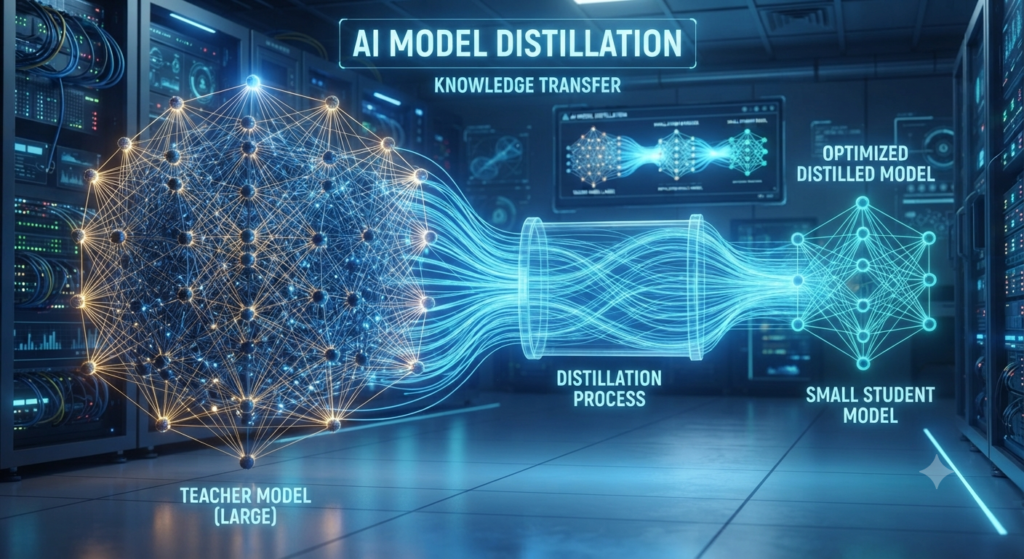
AI model distillation enables developers to transfer useful capabilities from larger, more complex AI models into smaller models that can operate with fewer computational resources.
The technique is particularly valuable for developing small language models, mobile AI applications, enterprise automation systems, and intelligent edge computing solutions.
By combining knowledge transfer with model optimisation, organisations can develop AI applications that balance performance, accuracy, speed, and operational costs.
In this comprehensive guide, we will explore what AI model distillation is, how it works, different distillation techniques, practical examples, benefits, limitations, and its future in artificial intelligence.
Know More: AI Social Media Content Calendar: 7 Easy Steps to Plan Better Content
What Is AI Model Distillation?
AI model distillation, also known as knowledge distillation, is a machine learning technique in which a smaller model learns from the outputs or internal representations of a larger, typically more capable model.
The larger model is commonly referred to as the teacher model, while the smaller model is called the student model.
The primary objective is to transfer useful knowledge from the teacher model to the student model while reducing computational complexity and resource requirements.
Instead of learning exclusively from original training data, the student model can learn from predictions, probability distributions, generated responses, or intermediate representations produced by the teacher model.
For example, imagine a large language model containing 70 billion parameters. Although it may perform sophisticated language processing tasks, deploying it can require substantial computing infrastructure.
Through knowledge distillation, developers may train a smaller model containing three billion parameters to reproduce selected capabilities of the larger model.
The resulting student model may require less memory and computational power while maintaining suitable performance for specific applications.
However, distillation does not guarantee that a smaller model will retain every capability of its teacher.
Why Is AI Model Distillation Important?
As artificial intelligence models become increasingly sophisticated, their computational requirements can create barriers to widespread adoption.
Training and deploying large neural networks often involves expensive hardware, specialised infrastructure, and considerable energy consumption.
AI model distillation provides an alternative approach by focusing on transferring useful capabilities rather than simply increasing model size.
|
AI Development Challenge |
How Model Distillation Helps |
|
High computational requirements |
Creates smaller models |
|
Expensive AI infrastructure |
Potentially reduces deployment costs |
|
Slow response generation |
Supports more efficient inference |
|
Limited device memory |
Reduces model storage requirements |
|
High energy consumption |
May reduce energy usage per task |
|
Mobile deployment limitations |
Enables compact AI applications |
|
Dependence on cloud infrastructure |
Supports local deployment |
|
Complex enterprise requirements |
Enables specialised student models |
These advantages make model distillation particularly relevant for organisations developing scalable and resource-efficient AI applications.
Teacher Model vs Student Model in AI
The teacher-student architecture is the foundation of traditional knowledge distillation.
Teacher-student knowledge distillation
The student learns to reproduce selected teacher capabilities by minimising differences between their outputs.
What Is a Teacher Model?
A teacher model is an artificial intelligence model that provides learning signals to another model.
It is generally larger, more complex, or more capable than the student model for the intended task.
Teacher models may contain extensive knowledge acquired through large-scale training.
Their predictions and representations help guide the student model during training.
What Is a Student Model?
A student model is typically a smaller artificial intelligence model designed to learn selected capabilities from the teacher model.
It generally contains fewer parameters and requires fewer computational resources.
The student model is trained to reproduce useful teacher behaviour while maintaining a more efficient architecture.
Teacher Model vs Student Model: Comparison Table
|
Feature |
Teacher Model |
Student Model |
|
Model Size |
Generally larger |
Generally smaller |
|
Parameters |
Typically more |
Typically fewer |
|
Computational Requirements |
Higher |
Lower |
|
Primary Role |
Provides learning signals |
Learns from the teacher |
|
Training Status |
Usually pretrained |
Trained during distillation |
|
Inference Speed |
Potentially slower |
Potentially faster |
|
Memory Requirements |
Generally higher |
Generally lower |
|
Deployment Cost |
Often higher |
Often lower |
|
Knowledge Coverage |
Typically broader |
Often more specialised |
|
Deployment Environment |
Cloud or powerful servers |
Cloud, local servers or edge devices |
How Does AI Model Distillation Work?
The knowledge distillation process involves several stages that enable a student model to learn from a teacher model.
Step 1: Select a Suitable Teacher Model
The first step involves identifying a teacher model with strong performance for the intended application.
For example, developers creating a customer support assistant may select a large language model capable of accurately answering product-related questions.
The teacher model should be evaluated for accuracy, reliability, domain knowledge, and suitability before distillation begins.
Step 2: Design the Student Model
Developers select or design a smaller model architecture according to the application’s performance requirements.
Important considerations include parameter count, memory limitations, target hardware, response latency, and expected accuracy.
The student architecture should provide sufficient capacity to learn the capabilities required for the intended application.
Step 3: Prepare the Training Dataset
A representative dataset is collected to support knowledge transfer.
Depending on the application, this dataset may contain text documents, images, customer queries, programming examples, or other relevant information.
High-quality and diverse training data helps the student model learn useful patterns.
Step 4: Generate Teacher Model Predictions
The teacher model processes training examples and produces outputs.
These outputs may include probability distributions, classifications, generated text, intermediate neural network representations, or other learning signals.
The student model uses these signals as additional training targets.
Step 5: Transfer Knowledge to the Student Model
The student model processes the same or related training examples and generates its own predictions.
A training objective measures differences between student predictions and teacher-provided targets.
The student’s parameters are updated to reduce these differences.
This process is repeated across numerous training examples.
Step 6: Evaluate Student Model Performance
The student model is tested using independent evaluation datasets.
Developers compare its performance with the teacher model and assess whether the smaller model meets application requirements.
Evaluation should consider accuracy, reliability, latency, throughput, memory consumption, and operational costs.
Step 7: Deploy and Monitor the Student Model
Once the student model achieves acceptable performance, it can be deployed within the intended environment.
Continuous monitoring helps identify unexpected errors, performance degradation, and changing application requirements.
Hard Labels vs Soft Labels in Knowledge Distillation
Understanding hard labels and soft labels is important for understanding traditional knowledge distillation.
What Are Hard Labels?
Hard labels represent definitive target categories.
For example, an image containing a dog may be labelled simply as “Dog.”
This provides the model with the correct category but does not necessarily explain relationships between alternative categories.
What Are Soft Labels?
Soft labels represent probability distributions generated by a teacher model.
Instead of identifying only one category, the teacher provides probabilities for multiple possible categories.
Hard labels vs soft labels
Illustrative example: classifying an image of a dog.
Hard labels
Dog
100%
Wolf
0%
Cat
0%
Bird
0%
Soft labels
Dog
80%
Wolf
15%
Cat
4%
Bird
1%
Soft labels communicate additional information about how the teacher relates different categories. Probabilities are hypothetical.
The soft labels indicate that the teacher considers a wolf more similar to a dog than a bird.
This additional information can help the student model learn relationships that are not explicitly represented in hard labels.
|
Comparison |
Hard Labels |
Soft Labels |
|
Output Format |
Definitive category |
Probability distribution |
|
Information Provided |
Correct class |
Relationships between classes |
|
Common Source |
Labelled training data |
Teacher model predictions |
|
Learning Signal |
Direct supervision |
Additional teacher knowledge |
|
Typical Application |
Supervised learning |
Knowledge distillation |
What Is Temperature in Knowledge Distillation?
Temperature is a mathematical parameter used to adjust the probability distribution produced by a model.
In traditional classification-based distillation, temperature modifies the softmax function used to convert model logits into probabilities.
A higher temperature generally produces a softer probability distribution, making relationships between alternative categories more visible.
A lower temperature generally produces a sharper distribution concentrated around the most probable category.
Interactive temperature demonstration
Observe how temperature changes a fixed set of hypothetical teacher logits.
Temperature
2.0
Sharp
Moderate
Soft
Dog
61.6%
Wolf
22.7%
Cat
10.7%
Bird
5.1%
Alternative categories receive more visible probabilities.Reset example
Selecting an appropriate temperature can help student models learn useful information from teacher predictions.
However, higher temperatures are not automatically better. Developers must evaluate temperature settings according to the model architecture and intended task.
Different Types of AI Model Distillation
Several knowledge distillation techniques have been developed to transfer different forms of information between AI models.
1. Response-Based Knowledge Distillation
Response-based distillation focuses on transferring the teacher model’s final predictions or output distributions.
The student model learns to reproduce these outputs.
This is one of the most widely recognised forms of knowledge distillation and can be applied to classification and language generation tasks.
2. Feature-Based Knowledge Distillation
Feature-based distillation transfers intermediate representations from the teacher model’s neural network layers.
Instead of learning exclusively from final predictions, the student learns how the teacher represents important information internally.
This approach can be valuable in computer vision and deep learning applications.
3. Relation-Based Knowledge Distillation
Relation-based distillation focuses on relationships between different training examples or internal model representations.
The student model learns structural relationships captured by the teacher.
This technique may improve the student’s ability to understand complex patterns.
4. Offline Knowledge Distillation
Offline distillation uses a teacher model that has already been trained.
The teacher remains fixed while the student learns from its outputs.
This approach is common because it separates teacher training from student training.
5. Online Knowledge Distillation
Online distillation involves training models simultaneously.
Knowledge may be exchanged between models during the training process.
This approach can reduce dependence on a separately pretrained teacher in certain architectures.
6. Self-Distillation
Self-distillation involves transferring knowledge within the same model architecture or between different versions of a model.
For example, predictions from a previously trained version may guide the training of another version.
Self-distillation can improve performance without necessarily reducing parameter count.
7. Multi-Teacher Distillation
Multi-teacher distillation uses multiple teacher models to provide learning signals to a student model.
Different teachers may specialise in different tasks, languages, or knowledge domains.
This approach can potentially help the student learn a broader range of capabilities.
Types of Knowledge Distillation: Comparison Table
|
Distillation Type |
Knowledge Transferred |
Common Applications |
|
Response-Based |
Final predictions |
Classification and language models |
|
Feature-Based |
Intermediate representations |
Computer vision |
|
Relation-Based |
Relationships between representations |
Complex pattern recognition |
|
Offline Distillation |
Pretrained teacher knowledge |
General model compression |
|
Online Distillation |
Knowledge during simultaneous training |
Collaborative model training |
|
Self-Distillation |
Knowledge from related model versions |
Performance improvement |
|
Multi-Teacher Distillation |
Outputs from multiple teachers |
Multi-domain applications |
These categories can overlap. For example, an offline distillation system may use both response-based and feature-based learning.
AI Model Distillation vs Model Quantisation vs Model Pruning
Knowledge distillation is frequently discussed alongside quantisation and pruning.
Although these techniques share the objective of improving model efficiency, they operate differently.
|
Feature |
Model Distillation |
Model Quantisation |
Model Pruning |
|
Primary Method |
Transfers knowledge |
Reduces numerical precision |
Removes selected model components |
|
Teacher Model |
Typically required |
Not required |
Not required |
|
Parameter Count |
Often reduced |
Usually unchanged |
May be reduced |
|
Additional Training |
Generally required |
Sometimes required |
Sometimes required |
|
Memory Reduction |
Through smaller architecture |
Through lower precision |
Through fewer stored components |
|
Main Advantage |
Efficient student models |
Reduced weight storage |
Reduced model complexity |
|
Potential Limitation |
Knowledge loss |
Precision-related errors |
Removal of useful components |
Developers can combine these techniques.
For example, a distilled student model may subsequently undergo quantisation to further reduce memory requirements.
AI Model Distillation vs Fine-Tuning
Fine-tuning and knowledge distillation both involve model training but serve different primary objectives.
Fine-tuning adapts an existing model to a particular task, dataset, or behavioural requirement.
Knowledge distillation trains a model using learning signals provided by another model.
|
Comparison |
Knowledge Distillation |
Fine-Tuning |
|
Main Objective |
Transfer model capabilities |
Adapt model behaviour |
|
Teacher Model |
Usually required |
Not necessarily required |
|
Model Size |
Often reduced |
Usually unchanged |
|
Training Targets |
Teacher outputs or features |
Task-specific training examples |
|
Deployment Goal |
Efficiency and capability transfer |
Specialised performance |
|
Common Use |
Creating smaller models |
Domain adaptation |
Both approaches can be combined to develop efficient and specialised artificial intelligence applications.
How Knowledge Distillation Works in Large Language Models
Large language models contain extensive capabilities but can require significant computing resources.
LLM distillation focuses on transferring selected language generation and reasoning capabilities into smaller models.
Instead of relying exclusively on human-written training examples, developers may use responses generated by a capable teacher model to train a student model.
These training examples may include question-answer pairs, summaries, programming solutions, structured outputs, and instruction-following examples.
The student learns to generate responses resembling useful teacher behaviour.
When developers have access to teacher logits or internal representations, they may use additional distillation objectives. When access is limited to generated text, they can train on teacher-generated responses, subject to applicable licensing and usage restrictions.
LLM distillation can support the development of small language models suitable for specialised business applications and local deployment.
However, student models may not retain the teacher’s full reasoning capabilities, multilingual performance, safety behaviour, or general knowledge.
Practical Example of AI Model Distillation
Consider a hypothetical e-commerce company developing an AI-powered customer support assistant.
The company initially uses a large language model containing 70 billion parameters.
Although the model provides useful responses, the company wants to reduce infrastructure requirements for routine customer queries.
Developers select a three-billion-parameter student model and prepare a dataset containing customer questions about product specifications, shipping policies, returns, and payment procedures.
The teacher model generates responses to these questions.
After reviewing the quality of the generated examples, developers train the student model to reproduce appropriate responses.
The resulting model is evaluated before deployment.
|
Performance Metric |
Teacher Model |
Student Model |
|
Parameters |
70 billion |
3 billion |
|
Task Accuracy |
96% |
93% |
|
Average Response Latency |
2.5 seconds |
0.8 seconds |
|
FP16 Weight Storage |
140 GB |
6 GB |
|
Hypothetical Monthly Operating Cost |
$1,000 |
$250 |
These figures are illustrative assumptions, not measured benchmark results.
Parameter reduction
95.7%
70B to 3B parameters
Latency reduction
68%
2.5s to 0.8s
Operating cost reduction
75%
$750 monthly savings
Accuracy difference
−3 pp
96% to 93% accuracy
This hypothetical example demonstrates the potential trade-off between model efficiency and task performance.
Businesses must determine whether the student model’s accuracy is sufficient for the intended application.
Top 10 Benefits of AI Model Distillation
1. Reduced Computational Requirements
Smaller student models generally require fewer computational resources, making them easier to deploy on suitable hardware.
2. Lower AI Inference Costs
Distilled models can reduce operational expenses for applications involving frequent or high-volume inference requests.
3. Faster Response Generation
Smaller architectures may improve response latency, particularly when deployed using optimised inference engines.
4. Reduced Memory Consumption
Models containing fewer parameters generally require less memory for storing their weights.
5. Improved Mobile AI Deployment
Compact models can support intelligent applications on compatible smartphones, tablets, and personal computers.
6. Potential Energy Efficiency
Distilled models may consume less electricity per comparable task, supporting more efficient AI infrastructure.
7. Greater Accessibility
Smaller models can make artificial intelligence development more accessible to startups, educational institutions, and small businesses.
8. Specialised AI Capabilities
Distillation can focus on transferring capabilities relevant to particular industries or business processes.
9. Improved Local Deployment Options
Organisations can potentially deploy distilled models within their own infrastructure instead of relying entirely on external cloud services.
10. Scalable Enterprise Automation
Efficient student models can support repetitive business workflows without requiring a large general-purpose model for every task.
Real-World Applications of AI Model Distillation
AI Model Distillation in Healthcare
Healthcare organisations can use distilled models for administrative document classification, medical terminology extraction, and internal information retrieval.
Local deployment may help organisations maintain greater control over sensitive information.
Clinical applications require extensive validation and qualified professional oversight.
AI Model Distillation in Education
Educational platforms can develop lightweight AI tutors, grammar correction tools, quiz generators, and subject-specific learning assistants.
Distilled models may also support offline educational applications on compatible devices.
AI Model Distillation in Banking and Finance
Financial institutions can use compact models to classify documents, analyse transaction descriptions, and automate routine customer support activities.
Specialised models may help reduce processing costs while maintaining suitable performance.
AI Model Distillation in E-Commerce
Online retailers can use distilled models to generate product descriptions, classify reviews, recommend products, and answer routine customer questions.
AI Model Distillation in Autonomous Systems
Distillation can help reduce computational requirements for perception models used in robotics and vehicle assistance systems.
Such applications require rigorous safety testing because prediction errors can have serious consequences.
AI Model Distillation in Cybersecurity
Compact machine learning models can support suspicious activity classification, network monitoring, and security alert prioritisation.
AI Model Distillation in Mobile Applications
Distilled models can enable local translation, text summarisation, intelligent keyboards, and conversational interfaces.
These applications can benefit from reduced memory requirements and potentially lower network dependence.
AI Model Distillation in Digital Marketing
Marketing teams can use specialised student models to classify customer interests, generate content drafts, categorise keywords, and automate repetitive reporting activities.
How AI Model Distillation Can Improve SEO Workflows
Search engine optimisation involves numerous repetitive activities that can benefit from efficient artificial intelligence.
A distilled language model trained for SEO-related tasks could help businesses process large amounts of content and structured information.
|
SEO Activity |
Potential Distilled Model Application |
|
Keyword Research |
Classify supplied keyword datasets |
|
Keyword Clustering |
Group semantically related queries |
|
Search Intent Analysis |
Categorise user search intent |
|
SEO Title Generation |
Generate title suggestions |
|
Meta Description Generation |
Produce metadata drafts |
|
Internal Linking |
Identify relevant article relationships |
|
Content Auditing |
Classify potential content issues |
|
Technical SEO |
Categorise crawl and audit findings |
|
Content Classification |
Assign topics and categories |
|
SEO Reporting |
Summarise verified analytics data |
For example, a website such as KnowledgeScribe.com could develop a lightweight content classification system trained to categorise articles according to their primary topics, target audiences, and search intent.
A specialised student model could help identify related articles and suggest contextual internal linking opportunities.
This approach could reduce dependence on larger AI models for routine content management tasks.
However, model distillation does not directly improve Google rankings. SEO performance continues to depend on content quality, relevance, technical accessibility, user experience, and other search-related factors.
Popular Examples of Distilled AI Models
Several established AI research projects demonstrate the practical use of knowledge distillation.
|
Model |
Teacher or Source Model |
Primary Application |
|
DistilBERT |
BERT |
Natural language understanding |
|
TinyBERT |
BERT |
Efficient language processing |
|
MobileBERT |
Specially designed teacher BERT |
Mobile NLP applications |
|
DistilGPT2 |
GPT-2 |
Text generation |
|
MiniLM |
Larger transformer models |
Efficient language understanding |
|
Distil-Whisper |
Whisper |
Automatic speech recognition |
|
DeepSeek-R1-Distill-Qwen |
DeepSeek-R1-generated training data |
Reasoning-oriented language tasks |
|
DeepSeek-R1-Distill-Llama |
DeepSeek-R1-generated training data |
Reasoning-oriented language tasks |
These examples illustrate different approaches to knowledge transfer and efficient model development. They are not a ranking of current model performance.
Popular Tools and Frameworks for Knowledge Distillation
Developers can use various machine learning frameworks and optimisation tools to implement knowledge distillation.
|
Tool |
Primary Purpose |
|
PyTorch |
Custom teacher-student training |
|
TensorFlow and Keras |
Neural network training and distillation |
|
Hugging Face Transformers |
Language model training and adaptation |
|
Hugging Face TRL |
Language model post-training workflows |
|
DeepSpeed |
Large-scale training optimisation |
|
NVIDIA TensorRT |
Optimised deployment after training |
|
ONNX Runtime |
Cross-platform model inference |
|
Optuna |
Hyperparameter optimisation |
|
MLflow |
Experiment tracking and model management |
Some of these tools support distillation training directly, while others support related activities such as evaluation, deployment, and inference optimisation.
How to Evaluate a Distilled AI Model
Evaluating a student model requires more than measuring its similarity to the teacher.
Developers must determine whether the student model delivers acceptable performance for real-world applications.
|
Evaluation Metric |
What It Measures |
|
Accuracy |
Proportion of correct predictions |
|
Precision |
Reliability of positive predictions |
|
Recall |
Ability to identify relevant examples |
|
F1 Score |
Balance between precision and recall |
|
Perplexity |
Language modelling prediction quality |
|
Task Success Rate |
Ability to complete intended tasks |
|
Inference Latency |
Time required to generate outputs |
|
Throughput |
Processing capacity per unit of time |
|
Memory Consumption |
Hardware memory requirements |
|
Cost per Request |
Operational expenses |
|
Hallucination Rate |
Frequency of unsupported outputs |
|
Safety Performance |
Reliability under safety-related evaluations |
The student model should be evaluated using independent test datasets rather than exclusively relying on examples generated during training.
Human evaluation may also be necessary for applications involving complex reasoning, factual accuracy, and specialised professional knowledge.
Challenges and Limitations of AI Model Distillation
Despite its advantages, knowledge distillation introduces several important challenges.
Knowledge Loss
Smaller models may not have sufficient capacity to reproduce every capability of larger teacher models.
Inherited Bias
Student models may reproduce biases, inaccuracies, and undesirable behaviours present in teacher outputs.
Training Data Quality
Poor-quality or unrepresentative training examples can reduce student model performance.
Computational Training Costs
Although the final model may be smaller, generating teacher outputs and training the student can still require substantial resources.
Reduced Generalisation
A student model trained for specialised tasks may perform poorly when encountering unfamiliar questions or domains.
AI Hallucinations
Distilled models can generate inaccurate or unsupported information, particularly when they learn from unreliable teacher responses.
Licensing and Intellectual Property
Developers must ensure that teacher model usage, generated training data, and student model distribution comply with applicable licences and contractual restrictions.
Security and Safety
Distillation may fail to preserve the teacher model’s safety behaviour. Student models require independent security and safety evaluation.
AI Model Distillation and Retrieval-Augmented Generation
Retrieval-Augmented Generation can complement knowledge distillation by providing smaller models with access to external information.
A distilled student model may have limited internal knowledge compared with its teacher.
RAG can help address this limitation by retrieving relevant information from trusted documents before the student generates a response.
Distilled AI model combined with RAG
This combination can be particularly valuable for customer support, educational platforms, enterprise knowledge management, and specialised information retrieval.
However, response quality still depends on the reliability of the retrieved information and the student’s ability to interpret it.
Future of AI Model Distillation
Knowledge distillation is likely to remain an important component of efficient artificial intelligence development.
As businesses increasingly adopt AI technologies, the demand for affordable, scalable, and resource-efficient models may continue to grow.
Future developments could focus on improved knowledge transfer techniques, reasoning distillation, multimodal learning, specialised student models, and efficient on-device AI.
Distillation may also become increasingly important for organisations seeking to reduce infrastructure costs and energy consumption.
Rather than relying exclusively on increasingly large AI models, developers may create ecosystems of specialised models designed for different applications.
Large teacher models could support the development of smaller student models for education, healthcare, enterprise automation, digital marketing, and intelligent consumer devices.
Nevertheless, successful implementation will require careful attention to accuracy, safety, data quality, licensing, and long-term model maintenance.
”FAQs”
1. What is AI model distillation in simple words?
AI model distillation is a machine learning technique in which a smaller AI model learns useful capabilities from a larger or more capable model.
2. What is the purpose of knowledge distillation?
The primary purpose is to transfer model capabilities while potentially reducing computational requirements, memory consumption, and deployment costs.
3. What is a teacher model in artificial intelligence?
A teacher model is an AI model that provides predictions, representations, or generated training examples to guide another model's learning process.
4. What is a student model?
A student model is a model trained to learn selected capabilities from a teacher model. It is often smaller and more computationally efficient.
5. Does knowledge distillation reduce model size?
Knowledge distillation often reduces model size by transferring capabilities to a smaller architecture. However, some forms of distillation focus on performance improvement without reducing parameter count.
6. What is the difference between distillation and quantisation?
Distillation transfers knowledge between models, while quantisation reduces the numerical precision used to represent model weights or computations.
7. Can a student model outperform its teacher?
Yes. A student model may outperform its teacher on specific tasks because of specialised training, regularisation, or differences in architecture. However, this is not guaranteed.
8. Does AI model distillation reduce inference costs?
Distillation can reduce inference costs when the resulting student model requires fewer computational resources and achieves sufficient task performance.
9. Is knowledge distillation used in large language models?
Yes. Knowledge distillation is used to transfer selected language processing, instruction-following, and reasoning capabilities into smaller language models.
10. Can distilled AI models run offline?
Yes. Some distilled models can operate offline on compatible hardware when all required model files and software are available locally.


