Introduction: Understanding AI and Employment
Artificial intelligence is changing the world of work. It can write content, analyze information, answer customer questions, create images, and complete tasks in minutes. Businesses are using AI to save time, reduce costs, and improve their services.
This change raises an important question: will AI replace jobs or create more career opportunities in the future?
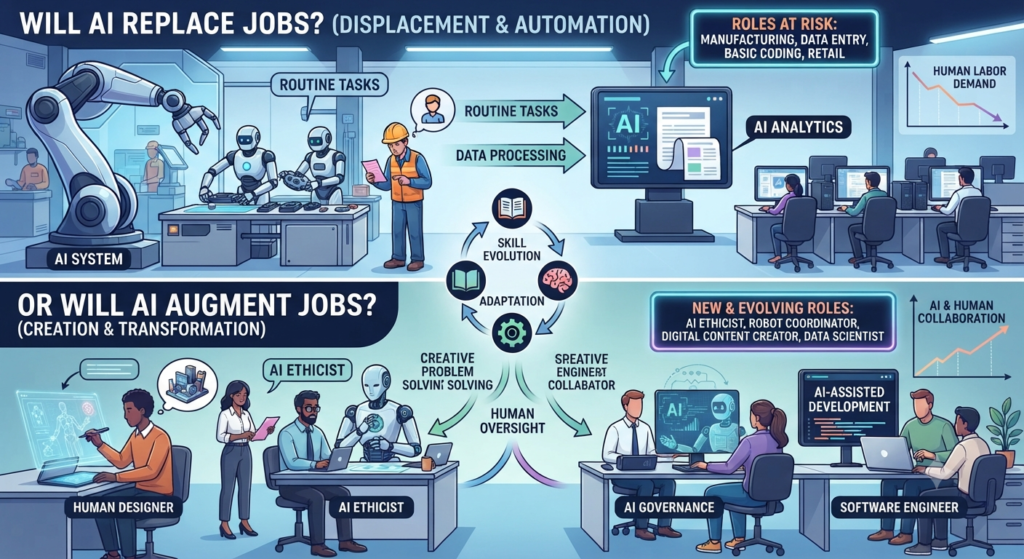
The answer isn’t as simple as yes or no. AI will replace some tasks, change many existing roles, and create new types of work. Some workers may face job losses. Others may find better opportunities by learning new skills and working with AI tools.
For example, AI can help a customer support team answer common questions. However, people are still needed to solve difficult problems, understand customer emotions, and handle special cases.
The same change is happening in marketing, healthcare, education, finance, software development, and many other industries.
According to the World Economic Forum’s Future of Jobs Report 2025, employers expect 170 million new jobs and 92 million displaced jobs by 2030. This represents a possible net increase of 78 million jobs. These figures cover several major economic and technological changes, not AI alone.
The International Labour Organization (ILO) also reports that one in four workers worldwide has some level of exposure to generative AI. However, most affected jobs are more likely to change than disappear completely.
This guide explains the impact of AI on jobs, the careers most at risk, the new opportunities emerging from AI, and the skills people need to succeed.
Know More: AI SQL Query Generator: 9 Powerful Ways How to Use AI to Generate SQL Queries and Analyze Databases
Will AI Replace Jobs and How AI Is Changing the Modern Workplace
AI is changing how companies manage daily work. It can process large amounts of data, find patterns, and complete repetitive tasks. As a result, employees can spend more time on work that needs human thinking and communication.
For example, a marketing team can use AI to study customer interests. A developer can use AI to find coding errors. A teacher can use AI to prepare learning materials.
These examples show how artificial intelligence jobs and workplace automation are changing the way people work.
How Workplace Automation Works
Workplace automation means using technology to complete tasks that people once performed manually.
AI takes this process further. Traditional automation follows fixed rules. AI systems can also work with language, recognize patterns, and make predictions based on data.
Here are some common examples:
- Customer service: AI chatbots answer common customer questions.
- Marketing: AI tools help research keywords and study customer behavior.
- Finance: AI helps identify unusual transactions and review financial records.
- Healthcare: AI supports medical image analysis and administrative work.
- Education: AI helps teachers prepare lessons and personalized study materials.
- Recruitment: AI helps organize applications and identify relevant candidate skills.
However, AI doesn’t always work without human support. Employees must check important results, correct mistakes, and make decisions.
AI vs. Traditional Automation
|
Traditional Automation |
Artificial Intelligence |
|
Follows fixed instructions |
Learns patterns from data |
|
Handles repeated tasks |
Supports different types of tasks |
|
Works within set rules |
Can respond to new inputs |
|
Usually needs manual updates |
May improve through training |
|
Focuses on routine work |
Can support knowledge-based work |
For example, a traditional system may send an automatic email after a purchase. An AI system may understand a customer’s question and prepare a suitable response.
This difference explains why AI can affect more types of work than earlier automation systems.
Will AI Replace Jobs in the Future?
Yes, AI will replace some jobs and tasks. However, it won’t replace every worker or every profession.
The impact of AI on jobs depends on the type of work, the industry, and the level of human involvement required.
Jobs that involve repeated tasks, fixed instructions, and large amounts of digital information may face greater changes. Jobs that require empathy, physical skills, personal trust, and complex decisions may be harder to automate fully.
The ILO’s 2025 research suggests that job transformation is a more likely outcome than complete job replacement for most occupations exposed to generative AI.
Jobs Most Affected by AI
Some roles may experience greater pressure because AI can perform parts of their daily work.
|
Job Role |
Possible AI Impact |
Reason |
|
Data entry operators |
High |
AI can extract and organize information |
|
Basic customer support agents |
High |
Chatbots can answer common questions |
|
Transcription workers |
High |
AI can convert speech into text |
|
Basic content writers |
Medium to high |
AI can prepare simple drafts |
|
Bookkeeping assistants |
Medium to high |
AI can organize routine financial records |
|
Telemarketing agents |
Medium to high |
AI can support automated customer outreach |
|
Graphic design assistants |
Medium |
AI can create basic design concepts |
|
Software developers |
Medium |
AI can assist with coding and testing |
|
Teachers |
Medium |
AI can support lesson preparation |
|
Healthcare professionals |
Lower for full replacement |
Patient care needs human judgment and interaction |
These levels are general estimates, not guaranteed predictions. The actual impact will depend on the tasks involved and how employers use AI.
Why Some Jobs Are More Vulnerable
There are several reasons why certain jobs face a greater risk of AI job replacement.
- Repetitive work
Jobs with repeated steps are easier to automate. AI can process similar requests much faster than manual methods.
- Digital information
AI works well with text, numbers, images, and other digital information. This makes some office and administrative tasks more exposed.
- Predictable processes
Tasks with clear instructions and expected results are easier to automate than work that requires flexible thinking.
- Low need for personal interaction
Jobs that involve limited human communication may face greater automation pressure.
- Cost-saving goals
Businesses may adopt AI to reduce operating costs and improve productivity. This can reduce the need for some types of manual work.
Still, exposure doesn’t mean automatic job loss. A company may use AI to support employees instead of removing their positions.
10 Powerful Ways AI Will Create New Career Opportunities
AI isn’t only changing existing jobs. It’s also creating demand for new skills, services, and professional roles.
As companies adopt artificial intelligence, they need people who can build AI systems, manage data, protect information, and make sure technology works correctly.
Here are ten important areas where new AI career opportunities are emerging.
1. AI and Machine Learning Engineers
AI and machine learning engineers build systems that can learn from data and perform specific tasks.
They help companies develop recommendation systems, prediction tools, chatbots, and intelligent software.
Common responsibilities:
- Developing machine learning models.
- Training AI systems.
- Testing model performance.
- Improving system accuracy.
- Working with large datasets.
People interested in mathematics, programming, and technology can explore this career path.
2. AI Data Analysts
AI systems need good data to produce useful results. Businesses need professionals who can collect, organize, study, and explain that data.
AI data analysts help companies understand customer behavior, sales performance, and market trends.
Important skills include:
- Excel and spreadsheet analysis.
- SQL.
- Data visualization.
- Statistical knowledge.
- AI-assisted analysis.
This career can suit people who enjoy research and problem-solving.
3. AI Prompt Specialists
AI tools respond to instructions called prompts. The quality of these instructions can affect the quality of the results.
Prompt specialists develop clear instructions to help AI tools complete specific tasks.
For example, a business may need prompts for customer support, marketing research, content planning, and internal reporting.
This role also requires subject knowledge. Knowing how to write a prompt is useful, but understanding the business problem is equally important.
4. AI Ethics and Governance Specialists
AI systems can produce incorrect, unfair, or harmful results. Companies need professionals who can review these systems and support responsible use.
AI ethics specialists study issues such as:
- Data privacy.
- Bias in AI decisions.
- Fairness.
- Transparency.
- Human oversight.
- Responsible AI policies.
As AI adoption grows, businesses will need stronger systems to manage these risks.
5. AI Cybersecurity Specialists
Cybersecurity is becoming more important as companies use AI and store more digital information.
AI cybersecurity specialists help protect business systems, customer records, and sensitive data.
Their work may include finding security risks, monitoring unusual activity, testing systems, and responding to threats.
Useful skills include networking, security testing, programming, and knowledge of AI-related risks.
6. AI Content and Marketing Strategists
AI can prepare articles, social media posts, advertisements, and marketing ideas. However, businesses still need people who understand audiences and business goals.
AI content and marketing strategists combine human creativity with AI tools.
Their responsibilities may include:
- Developing content strategies.
- Researching search intent.
- Reviewing AI-generated content.
- Managing marketing campaigns.
- Studying audience behavior.
- Measuring campaign performance.
People with digital marketing, SEO, communication, and research skills can explore this area.
7. Robotics and Automation Specialists
Robots are becoming more useful in factories, warehouses, hospitals, and other workplaces.
Robotics specialists design, operate, maintain, and improve automated machines.
They may work with sensors, software, mechanical systems, and AI-based control tools.
This field can create opportunities for people with engineering and technical training.
8. AI Product Managers
Companies need professionals who can turn AI technology into useful products.
AI product managers work with developers, designers, business teams, and customers. They identify problems and help teams build suitable solutions.
Their work often includes:
- Understanding customer needs.
- Planning product features.
- Managing development teams.
- Reviewing product performance.
- Setting business goals.
Strong communication and project management skills are important in this role.
9. AI Trainers and Quality Reviewers
AI systems need testing and feedback. They may produce incorrect answers, misunderstand instructions, or provide unsuitable information.
AI trainers and quality reviewers help improve system performance by reviewing outputs and identifying errors.
Some roles also involve preparing training data, checking language quality, and evaluating AI responses.
Knowledge of a particular industry or language can be valuable in this field.
10. Human-AI Collaboration Specialists
As companies introduce AI into their operations, employees need to learn how to use it properly.
Human-AI collaboration specialists help teams combine human skills with AI tools.
They may train employees, improve workflows, create guidelines, and measure productivity.
This career area can suit professionals with experience in business operations, training, management, and digital transformation.
AI Job Displacement vs. Job Creation
The debate around AI job replacement often focuses on two outcomes: job displacement and job creation.
Job displacement happens when technology reduces the need for certain roles or tasks.
Job creation happens when new products, services, and business needs generate employment.
Both can happen at the same time.
For example, AI may reduce the need for people to enter data manually. At the same time, companies may need data quality specialists, AI system administrators, and automation consultants.
Comparing AI Job Losses and New Opportunities
|
Area |
Possible Job Displacement |
Possible Job Creation |
|
Customer service |
Basic support tasks |
AI support managers |
|
Marketing |
Repetitive content production |
AI marketing strategists |
|
Finance |
Manual data processing |
AI risk analysts |
|
Healthcare |
Routine administrative work |
AI healthcare specialists |
|
Education |
Repeated learning tasks |
AI learning designers |
|
Technology |
Basic coding tasks |
AI engineers |
|
Manufacturing |
Repetitive manual operations |
Robotics technicians |
The World Economic Forum’s 2025 report provides an important example of this changing job market. It projects 170 million new jobs and 92 million displaced jobs by 2030 across several global trends.
However, new jobs don’t automatically go to people who lose existing jobs. Workers may need training, experience, and time to move into different careers.
This is why workforce adaptation is essential.
Industries Experiencing AI-Driven Changes
AI is affecting almost every major industry. Some sectors are adopting it faster because their work involves large amounts of information and digital processes.
1. Information Technology
IT companies use AI for software development, testing, cybersecurity, technical support, and data analysis.
Developers can use AI coding assistants to complete certain tasks faster. However, they still need to understand software architecture, security, and system requirements.
2. Healthcare
AI can support medical research, appointment management, medical image analysis, and patient record organization.
Healthcare professionals remain important because treatment decisions and patient care require human judgment.
3. Education
AI can help teachers create study materials, explain difficult topics, and provide additional learning support.
Students can also use AI for practice and research. However, teachers are still needed to guide learning and assess progress.
4. Banking and Finance
Banks use AI to study financial data, identify unusual transactions, and improve customer services.
This creates opportunities in financial technology, risk management, and AI-based fraud detection.
5. Manufacturing
Factories use AI-powered systems to monitor machines, improve production, and detect quality problems.
Robotics and automation can change factory jobs while increasing demand for technical maintenance and system management.
6. Retail and E-Commerce
Online stores use AI to recommend products, understand customer preferences, manage inventory, and support buyers.
This can increase demand for e-commerce analysts, AI marketing specialists, and customer experience professionals.
Skills Needed to Succeed in the AI Era
The future of employment will depend on more than technical knowledge. Workers will need a combination of digital, analytical, and human skills.
AI tools may change quickly, but the ability to learn and solve problems will remain valuable.
Technical Skills
People should consider learning skills that help them work with modern technology.
Examples include:
- Artificial intelligence fundamentals.
- Data analysis.
- Basic programming.
- Machine learning concepts.
- Cybersecurity awareness.
- Cloud computing.
- Digital marketing tools.
- Automation platforms.
You don’t need to master every technical skill. Start with the skills that match your career goals.
Human Skills
Human abilities remain important because technology cannot independently understand every personal, social, and business situation.
Important skills include:
- Communication.
- Creativity.
- Critical thinking.
- Problem-solving.
- Leadership.
- Teamwork.
- Emotional intelligence.
- Decision-making.
For example, AI can prepare a business proposal, but a professional must understand the client’s needs and decide whether the proposal makes sense.
Learning How to Work With AI
One of the most useful career skills is knowing how to use AI tools correctly.
Workers should learn how to:
- Give clear instructions to AI tools.
- Check information before using it.
- Identify incorrect or misleading results.
- Protect private and business information.
- Use AI to improve productivity.
- Combine AI results with personal knowledge.
The goal isn’t to compete with AI at every task. The goal is to become better at work by using technology responsibly.
How Workers Can Adapt to AI-Driven Job Market Changes
Workers don’t need to wait for major job changes before preparing for the future.
They can start learning new skills while continuing their current work or education.
Here are practical steps to prepare for the changing job landscape.
1. Understand Your Current Job
Start by reviewing your daily responsibilities.
Identify which tasks are repetitive and which require human judgment.
For example, an accountant may use AI to organize records but still needs to review financial decisions.
Understanding this difference helps you identify the skills worth developing.
2. Learn Relevant AI Tools
Choose tools that support your industry.
A marketer may learn AI research and content tools. A developer may explore coding assistants. A student may learn AI research and productivity applications.
Focus on practical use rather than collecting tool names.
3. Build a Strong Professional Portfolio
A portfolio shows what you can do.
Include projects that demonstrate your ability to solve real problems.
Examples include:
- An AI-assisted marketing campaign.
- A data analysis project.
- A simple chatbot.
- An automated business workflow.
- A website or software application.
- A research report.
A strong portfolio can help employers understand your skills.
4. Improve Your Communication Skills
Clear communication is useful in almost every profession.
Workers who can explain ideas, understand customer needs, and work with different teams may have an advantage.
Practice writing, speaking, presenting, and explaining technical information in simple language.
5. Keep Learning
The job market will continue to change as new tools and technologies become available.
Set aside regular time for learning. Take online courses, complete practical projects, attend workshops, and follow trusted industry resources.
6. Explore Emerging Career Options
Research careers that match your interests and strengths.
You might explore AI marketing, data analysis, cybersecurity, automation, or product management.
Don’t choose a career only because it is popular. Consider your abilities, interests, and long-term goals.
The Future of Employment in the AI Era
The future of employment will likely involve greater cooperation between people and machines.
AI will handle more routine digital tasks. Human workers will focus on areas that need judgment, creativity, communication, and responsibility.
However, the benefits of AI won’t be equal for everyone.
Some businesses may adopt AI faster than others. Some workers may receive better training and access to technology. Others may struggle to find new opportunities.
Governments, employers, educational institutions, and workers all have a role in managing this transition.
What Employers Need to Do
Businesses should help employees understand how AI will affect their roles.
They can:
- Provide AI training.
- Support internal career development.
- Introduce automation responsibly.
- Protect employee and customer data.
- Review AI-generated decisions.
- Create opportunities for reskilling.
What Educational Institutions Need to Do
Schools, colleges, and training centers should prepare students for a changing job market.
They should teach digital skills, critical thinking, communication, and practical AI knowledge.
Students should also gain real-world experience through internships, projects, and professional networking.
What Workers Need to Do
Workers should stay open to change.
They should understand new technologies, improve their professional skills, and explore opportunities in growing industries.
The changing job landscape may create challenges, but preparation can help people manage those changes.
Ultimately, AI is a tool. Its impact on employment will depend on how people, companies, and societies choose to use it.
AI Will Change Jobs, but Human Skills Will Still Matter
The question of whether AI will replace jobs or create new career opportunities has no single answer. AI will automate some tasks, change existing professions, and create demand for new skills. Certain workers may face job displacement, while others will benefit from new career paths.
The key is to understand the changing job market and prepare for it.Students should focus on practical learning. Working professionals should improve their digital skills. Businesses should support employee training and responsible AI adoption.
Most importantly, people shouldn’t view AI only as a threat. They should learn how to use it as a tool for growth. The future will belong to people who combine technology with human abilities such as creativity, communication, critical thinking, and problem-solving.
”FAQs”
1. Will AI replace jobs or create more career opportunities in the future?
AI will do both. It may replace certain repetitive tasks and reduce demand for some roles. At the same time, it can create new opportunities in AI development, data analysis, cybersecurity, robotics, and digital services. The overall impact will depend on technology adoption, business needs, and workforce adaptation.
2. Which jobs are most vulnerable to artificial intelligence automation?
Jobs involving repetitive digital tasks may face greater automation pressure. Examples include basic data entry, routine customer support, transcription, and simple administrative work. However, the actual risk depends on how much of a job can be automated and how much human judgment it requires.
3. What new careers are emerging because of AI technology?
Some growing career areas include AI engineering, machine learning, AI cybersecurity, AI governance, data analysis, robotics, AI product management, and AI quality evaluation. These careers require different levels of technical knowledge and professional experience.
4. Can AI replace software developers?
AI can help developers write code, identify errors, and complete routine programming tasks. However, software development also requires planning, system design, security, testing, and problem-solving. Developers who understand how to use AI effectively can improve their productivity.
5. How can students prepare for the future employment market?
Students can prepare by learning digital skills, understanding AI tools, completing practical projects, building portfolios, and gaining internship experience. Communication, creativity, and problem-solving are also important skills for future careers.
6. Is learning AI necessary for every professional?
Every professional doesn't need to become an AI engineer. However, understanding basic AI concepts and learning relevant tools can help people work more efficiently. The most useful AI knowledge depends on the person's profession and career goals.
7. Will AI reduce employment opportunities for freshers?
AI may change entry-level work, especially where beginners perform repetitive tasks. However, freshers can explore new roles by developing practical skills, building projects, learning AI tools, and gaining industry experience. Employers will still need people who can learn and contribute.
8. How can workers protect their careers from AI job replacement?
Workers can reduce their risk by developing skills that complement AI. These include communication, critical thinking, creativity, leadership, technical knowledge, and industry expertise. Regular learning and practical experience can also improve career flexibility.
9. Will AI create jobs in India?
AI can create opportunities in India's IT, healthcare, finance, education, manufacturing, and digital services sectors. Potential roles include AI developers, data analysts, automation specialists, cybersecurity professionals, and AI-enabled business consultants. Access to training and practical skills will be important.
10. What is the future of employment in the AI era?
The future of employment will likely include more AI-assisted work, new technical roles, changing job responsibilities, and greater demand for digital skills. Some jobs may decline, while others grow. Workers who continue learning and adapt to technology may be better prepared for these changes.


