The Role of Artificial Intelligence in Personalized Learning
Every student learns in a different way. Some students understand new topics quickly. Others need more time and practice. Some learn better through videos, while others prefer reading, examples, or practical activities.
However, traditional education often follows the same teaching method for everyone. Teachers usually have limited time to understand the individual needs of every student. As a result, some students may struggle, while others may not receive enough challenges.
Artificial intelligence is helping to change this situation.
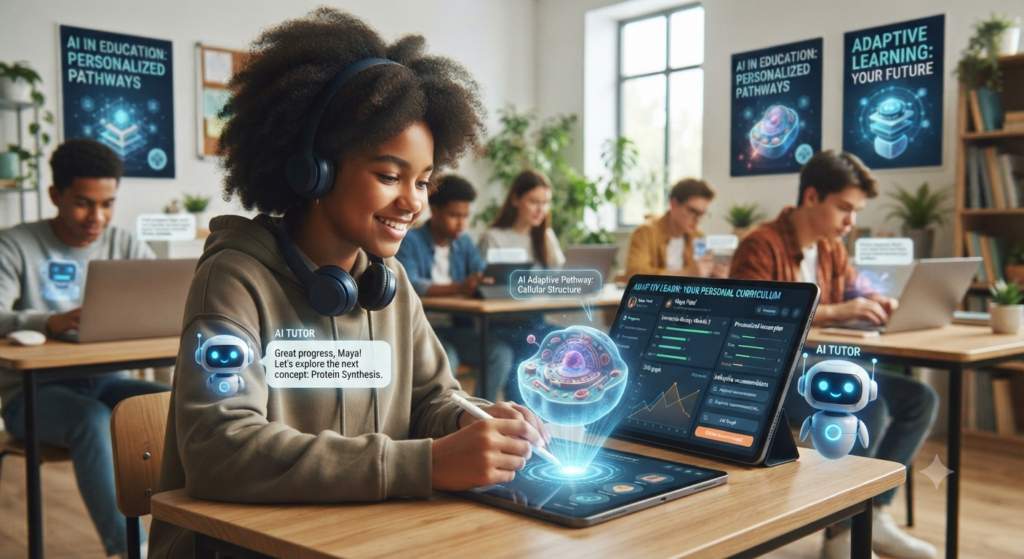
Artificial intelligence in personalized learning allows educational systems to understand student needs and provide learning experiences based on individual abilities, interests, and progress. It can suggest lessons, adjust question difficulty, track performance, and provide instant feedback.
AI doesn’t replace the teacher. Instead, it gives teachers better tools to support their students.
Today, AI learning platforms, adaptive learning systems, and intelligent tutoring systems are making education more flexible and accessible. These technologies can help students learn at their own pace and focus on areas where they need improvement.
In this article, we’ll explore how AI personalizes learning, its major benefits, practical examples, challenges, and future opportunities.
Know More: How AI Is Changing Software Developer Jobs: 9 Powerful Trends
AI Is Transforming Personalized Learning: Understanding
Artificial intelligence refers to computer technology that can perform tasks that normally require human intelligence. These tasks include understanding language, recognizing patterns, analyzing information, making predictions, and providing recommendations. In education, AI uses student information to improve the learning process. It can study quiz results, learning speed, completed lessons, and common mistakes.
Based on this information, an AI system can suggest what a student should learn next.
For example, imagine two students studying mathematics.
- Student A understands multiplication but struggles with division.
- Student B understands division but struggles with multiplication.
A traditional classroom may provide the same exercises to both students. However, an AI-powered system can identify their different needs and suggest separate exercises.
This is the basic idea behind personalized learning with AI.
What Is Personalized Learning?
Personalized learning is an educational approach that focuses on the individual needs of each student.
Instead of expecting every student to follow the same learning path, it allows them to study according to their abilities, interests, and goals.
It can include:
- Individual study plans.
- Flexible learning speed.
- Different teaching methods.
- Customized learning materials.
- Regular performance reviews.
- Individual feedback and support.
The main goal is to help every student understand a subject rather than simply complete a lesson.
Personalized education technology makes this approach easier to manage. Digital tools can organize lessons, monitor progress, and recommend useful resources.
How AI Works in Education
AI systems use data and machine learning to understand learning patterns.
The process usually follows four steps.
- Collect information: The platform records quiz results, completed lessons, and student activity.
- Analyze performance: AI studies the information to identify strengths and weaknesses.
- Suggest learning activities: The system recommends lessons, exercises, or videos.
- Improve recommendations: As students continue learning, the system updates its suggestions.
For example, if a student repeatedly makes mistakes in grammar exercises, the platform may recommend basic grammar lessons.
If the student improves, it can introduce more advanced exercises.
This creates a flexible learning process.
How Artificial Intelligence Creates Personalized Learning Experiences
One of the biggest advantages of artificial intelligence in personalized learning is its ability to adjust educational content according to student performance.
It doesn’t have to provide the same material to everyone. Instead, it can recommend different activities based on individual learning needs.
Here are five important ways AI creates customized learning experiences.
1. Adaptive Learning Systems
Adaptive learning is one of the most useful applications of AI in education. An adaptive learning system changes lesson difficulty according to student performance. For example, a student learning English may complete a grammar test. If the student answers most questions correctly, the system can introduce more advanced grammar exercises.
If the student struggles, it can provide simpler explanations and additional practice.
This approach helps students avoid two common problems:
- Lessons that are too difficult.
- Lessons that are too easy.
AI-based adaptive learning systems for students can make lessons more suitable for individual abilities.
They can also help students build confidence by allowing them to improve step by step.
2. Intelligent Tutoring Systems
Intelligent tutoring systems are digital tools that provide individual academic support.
They work like virtual tutors and can help students understand difficult subjects.
For example, a student studying physics may ask why an object falls toward the ground.
An intelligent tutoring system can explain gravity using simple language, examples, and step-by-step explanations.
These systems can also:
- Answer subject-related questions.
- Explain difficult concepts.
- Provide additional exercises.
- Identify common mistakes.
- Offer hints instead of giving direct answers.
The biggest advantage is availability.
Students can access these tools outside normal classroom hours and get support when they need it.
However, students should still verify important answers and use teachers as their primary academic guides.
3. AI-Powered Learning Recommendations
Most digital learning platforms contain a large amount of educational material.
Finding the right lesson can sometimes become difficult.
AI-powered recommendations help solve this problem.
These systems study student interests, performance, and previous activities. They then suggest relevant learning resources.
For example, a student interested in web development may receive recommendations for:
- HTML fundamentals.
- CSS tutorials.
- JavaScript exercises.
- Frontend development projects.
- Beginner programming courses.
These AI-driven recommendations help students discover relevant content without spending too much time searching.
They also support personalized learning pathways by connecting related topics.
4. Real-Time Student Performance Tracking
Understanding student progress is important for improving education.
Traditional assessment methods often depend on periodic tests and assignments. However, these methods may not show every learning difficulty.
AI-powered systems can provide more regular performance information.
They use learning analytics to study:
- Quiz scores.
- Lesson completion.
- Time spent on activities.
- Frequently repeated mistakes.
- Topic-level performance.
- Learning progress over time.
Teachers can use these insights to identify students who need additional support.
For example, if several students struggle with the same mathematics topic, the teacher can explain it again using a different method.
Student performance tracking also helps learners understand their own progress.
5. Personalized Learning Pathways
Every student has different educational goals.
Some want to improve academic performance. Others want to learn new skills or prepare for future careers.
AI can help create learning pathways based on these goals.
For example, a student interested in digital marketing may receive a learning plan covering:
- Marketing fundamentals.
- Search engine optimization.
- Social media marketing.
- Content creation.
- Analytics and reporting.
The platform can adjust this plan based on completed lessons and assessment results.
This approach makes learning more organized and goal-oriented.
Major Benefits of AI in Personalized Education
The benefits of AI in personalized education go beyond customized lessons.
AI can support students, teachers, parents, and educational institutions.
Let’s understand its major advantages.
Better Student Engagement
Students are more likely to remain interested when lessons match their abilities and interests.
AI tools can introduce quizzes, interactive exercises, educational games, and practical examples.
For instance, a student who enjoys science experiments may receive video demonstrations and interactive activities.
Another student may prefer written explanations and practice questions.
These customized learning experiences can make education more interesting.
AI can also help students understand their progress through visual reports and achievement tracking.
Learning at an Individual Pace
Not every student understands a topic at the same speed.
Some students need more examples, while others are ready to move forward.
AI learning platforms can support both groups.
Students can spend additional time on difficult topics without feeling pressured to follow the same schedule as everyone else.
Similarly, students who understand lessons quickly can explore advanced topics.
This creates a more flexible learning environment.
Faster Feedback and Support
Feedback helps students understand what they are doing right and where they need improvement.
In traditional classrooms, students may have to wait for teachers to check assignments.
AI systems can provide immediate feedback for many activities, such as multiple-choice questions and basic exercises.
For example, if a student selects an incorrect answer, the system can explain the mistake and suggest another exercise.
This allows students to correct misunderstandings earlier.
However, complex assignments still require human judgment and teacher feedback.
Improved Teaching Efficiency
Teachers manage many responsibilities, including lesson planning, assignments, assessments, and student support.
AI teaching tools can reduce some repetitive tasks.
They can help teachers:
- Prepare practice questions.
- Create lesson outlines.
- Organize educational materials.
- Review basic assessment results.
- Identify learning gaps.
- Suggest additional resources.
This can give teachers more time to focus on classroom discussions and individual student support.
AI should be viewed as a teaching assistant rather than a replacement for educators.
Support for Different Learning Needs
Students have different learning preferences and accessibility requirements.
Some may benefit from audio explanations, while others may need captions, simplified text, or additional examples.
AI-powered education can support these needs through features such as speech-to-text, text-to-speech, translation, and content simplification.
These features can make educational resources easier to access.
However, the quality of these tools can vary across languages and subjects.
Examples of AI in Personalized Learning
AI is already being used in different educational activities.
The following examples show how students and teachers can use these technologies.
AI Learning Platforms
AI learning platforms combine educational content with technology that can track student progress.
Some platforms adjust lesson difficulty and recommend exercises based on performance.
Examples include:
- Duolingo: Uses adaptive learning features to support language practice.
- Khan Academy: Offers personalized learning support through its educational platform and AI-powered Khanmigo.
- Quizlet: Provides digital study tools and AI-supported learning features.
- Coursera: Uses recommendations to help learners discover relevant courses.
These platforms show how digital learning platforms can support different educational goals.
Their features and availability may vary by subscription, location, and product version.
Virtual Learning Assistants
Virtual learning assistants help students with everyday study activities.
They can explain topics, create practice questions, summarize information, and suggest study resources.
For example, a student preparing for an examination can ask an AI assistant to explain a difficult chapter in simple English.
The assistant can also generate revision questions and provide examples.
This makes learning more interactive.
However, students should check the accuracy of AI-generated information before using it in assignments or examinations.
Generative AI in Education
Generative AI is changing how students create and understand educational content.
It can generate explanations, summaries, examples, questions, and study plans.
For example, students can use generative AI in education to:
- Summarize lengthy study material.
- Create flashcards.
- Explain difficult concepts.
- Generate practice questions.
- Improve writing skills.
- Translate educational content.
These tools can support different learning styles.
Still, students should use AI to improve their understanding rather than simply copy its answers.
ChatGPT for Personalized Learning
ChatGPT is one example of a conversational AI tool that students can use for study support.
Students can ask questions and request explanations based on their knowledge level.
For example, a student can write:
“Explain photosynthesis in simple English with three examples.”
ChatGPT can provide a basic explanation.
The student can then ask follow-up questions to understand the topic better.
Other possible uses include:
- Creating daily study schedules.
- Practicing a new language.
- Generating mathematics exercises.
- Preparing revision notes.
- Understanding difficult technical concepts.
- Practicing interview questions.
This makes ChatGPT for personalized learning a useful study option.
However, ChatGPT can sometimes provide incorrect or incomplete information. Students should verify important facts using textbooks, teachers, and trusted educational sources.
The Role of Teachers in AI-Powered Education
AI can provide useful learning support, but teachers remain essential to education.
A teacher understands classroom behavior, student emotions, learning difficulties, and social development.
These human qualities cannot be fully replaced by automated systems.
The best approach combines teacher experience with AI technology.
Teachers can use AI tools to understand student performance and prepare suitable learning activities.
For example, if a student consistently struggles with reading comprehension, the teacher can use performance reports to identify the problem.
The teacher can then provide additional reading exercises and personal guidance.
AI can also help teachers create different versions of the same lesson.
A basic version may support beginners, while an advanced version can challenge students who already understand the topic.
This combination supports student-centered learning.
It also allows teachers to spend more time on meaningful classroom activities.
Challenges of Using AI in Personalized Learning
Although AI offers many opportunities, it also creates challenges.
Educational institutions should understand these issues before introducing AI systems.
1. Student Data Privacy
AI learning platforms often collect student information to improve recommendations.
This information may include learning activity, assessment results, and personal details.
Educational institutions must protect this data.
They should choose trusted platforms, explain data collection practices, and follow applicable privacy laws.
2. Incorrect AI Recommendations
AI systems depend on the quality of their data and models.
Sometimes, they may recommend unsuitable content or misunderstand a student’s learning needs.
Teachers should review important recommendations and make decisions based on their professional judgment.
3. Limited Access to Technology
Not every student has access to a computer, smartphone, or reliable internet connection.
This can create differences in educational opportunities.
Schools should consider affordable devices, offline learning options, and accessible educational resources.
4. Overdependence on AI
Students may become too dependent on AI tools for answers.
This can reduce independent thinking if they stop solving problems themselves. Teachers should encourage students to question AI responses, research information, and complete tasks independently.
5. Bias and Fairness
AI systems may produce unfair recommendations if their training data does not represent different student groups. Educational institutions should review AI tools for accuracy, fairness, and accessibility.
Human supervision is important to ensure that every student receives equal learning opportunities.
Future of Personalized Learning With Artificial Intelligence
The future of personalized learning with artificial intelligence looks promising.
As AI technology develops, educational platforms may become better at understanding student needs and supporting different learning goals.
Several trends are likely to influence education.
More Advanced Adaptive Learning
Future adaptive systems may provide more accurate recommendations by studying learning patterns over time.
They may identify knowledge gaps earlier and suggest suitable activities before students fall behind.
Greater Use of Large Language Models
Large language models in education can make learning tools more conversational.
Students may interact with AI assistants to discuss topics, practice languages, and explore complex subjects.
These systems may also support teachers with lesson preparation and educational content development.
AI-Powered Study Assistants
AI-powered study assistants may become more useful for everyday learning.
They could help students organize study schedules, prepare revision plans, and understand difficult concepts.
Some tools may also connect learning activities with personal academic goals.
Better Learning Analytics
Education technology trends are moving toward more data-driven education.
Future systems may help schools understand learning progress across different subjects and student groups.
Predictive learning models may identify students who need additional support.
However, predictions should always be reviewed by teachers. Student performance can be affected by many factors that technology may not fully understand.
More Inclusive Education
AI may improve access to educational resources through automatic translation, speech recognition, captions, and simplified explanations.
These features could help students from different language backgrounds and students with accessibility needs.
The future goal should be simple: use technology to make quality education more accessible, flexible, and effective.
For additional guidance, explore UNESCO’s work on artificial intelligence in education.
”FAQs”
1. What is artificial intelligence in personalized learning?
Artificial intelligence in personalized learning refers to the use of AI technology to adjust educational content according to individual student needs. It can analyze performance, suggest lessons, track progress, and provide customized learning experiences.
2. How does AI improve personalized learning?
AI improves personalized learning by identifying student strengths and weaknesses. It can adjust lesson difficulty, recommend study materials, provide instant feedback, and create individual learning pathways.
3. What are the main benefits of AI in personalized education?
The main benefits include:
Individual learning support.
Flexible learning speed.
Better student engagement.
Faster feedback.
Personalized study recommendations.
Improved teaching efficiency.
These benefits depend on how well educational institutions implement and supervise AI tools.
4. What are some examples of AI in personalized learning?
Examples include adaptive learning platforms, intelligent tutoring systems, virtual learning assistants, and generative AI tools.
Platforms such as Duolingo, Khan Academy, Quizlet, and ChatGPT offer different features that can support personalized learning.
5. Can AI replace teachers in personalized learning?
No. AI can support teachers by organizing information, preparing learning materials, and identifying student performance patterns.
However, teachers provide emotional support, human interaction, guidance, and professional judgment. These roles remain essential to education.
6. How can students use ChatGPT for personalized learning?
Students can use ChatGPT to understand difficult topics, generate practice questions, prepare study plans, summarize lessons, and improve writing skills.
They should verify important information and use AI as a learning assistant rather than a replacement for independent study.
7. What are the biggest challenges of AI in personalized learning?
The main challenges include data privacy, incorrect recommendations, limited technology access, AI bias, and overdependence on automated tools.
Proper supervision and responsible implementation can help reduce these risks.
8. What is the future of personalized learning with artificial intelligence?
The future may include smarter adaptive learning systems, advanced virtual tutors, better learning analytics, and more accessible educational resources.
These developments could help students receive learning support that better matches their individual goals and abilities.


