How AI Is Transforming Online Education and Digital Learning
Education has changed a lot over the last few years. Students no longer need to sit in a traditional classroom to gain knowledge. They can attend online classes, watch recorded lessons, complete digital courses, and learn new skills from almost anywhere.
Technology has made education easier to access. However, artificial intelligence is taking this change to another level.
AI in Online Education is changing how students study, how teachers create lessons, and how educational platforms deliver information. AI can understand learning patterns, suggest useful resources, answer questions, and provide personal support.
For example, two students may study the same subject but have different learning needs. One may understand a topic quickly, while another may need more examples. An AI-powered learning platform can adjust lessons to match their progress.
This is one of the biggest advantages of Digital Learning with AI.
Artificial intelligence is also helping teachers save time. It can support lesson planning, quiz creation, student feedback, and other daily tasks. As a result, teachers can spend more time helping students understand difficult topics.
The use of AI in education is growing across schools, colleges, universities, and online learning platforms. It is also creating new opportunities for working professionals who want to learn new skills.
In this article, we’ll explore how AI is transforming online education, its major benefits, useful applications, challenges, and future possibilities.
Know More: AI-Powered Personalized Medicine: 10 Powerful Future Trends
How AI Is Transforming Online Education: Understanding
Artificial intelligence is a technology that allows computer systems to perform tasks that usually require human intelligence.
These tasks include understanding language, finding patterns, answering questions, analyzing information, and making predictions.
In education, AI helps learning platforms understand student needs and provide better learning experiences.
What Is Artificial Intelligence in Education?
Artificial Intelligence in Education refers to the use of AI technologies to improve teaching, learning, assessment, and educational management.
It combines different technologies, such as:
- Machine learning
- Natural language processing
- Generative AI
- Predictive analytics
- Speech recognition
- Computer vision
- Recommendation systems
These technologies support students and teachers in different ways.
For example, an AI tutoring system can explain a difficult mathematics problem step by step. A learning platform can recommend another lesson when a student struggles with a topic. A teacher can use generative AI to prepare practice questions.
AI doesn’t need to replace teachers to be useful. Instead, it can work as a support system that makes education more flexible and effective.
How AI Works in Online Learning Platforms
Online learning platforms collect information about how students use their courses.
This may include:
- Lessons completed by students.
- Time spent on different topics.
- Quiz and test results.
- Frequently repeated mistakes.
- Learning progress.
- Course preferences.
- Student interaction with learning materials.
AI systems can analyze this information and identify learning patterns.
For example, if a student repeatedly makes mistakes in English grammar, the platform may recommend additional grammar lessons.
If another student completes lessons quickly and performs well in tests, the platform may suggest more advanced content.
This process supports learning personalization.
Modern AI Education Technology can also connect with Learning Management Systems (LMS). This allows educational institutions to manage courses, track progress, and provide learning support from one digital environment.
10 Powerful Ways AI Is Transforming Online Education
AI is not limited to answering student questions. It is changing several parts of the education process.
Here are ten important ways artificial intelligence is improving digital learning.
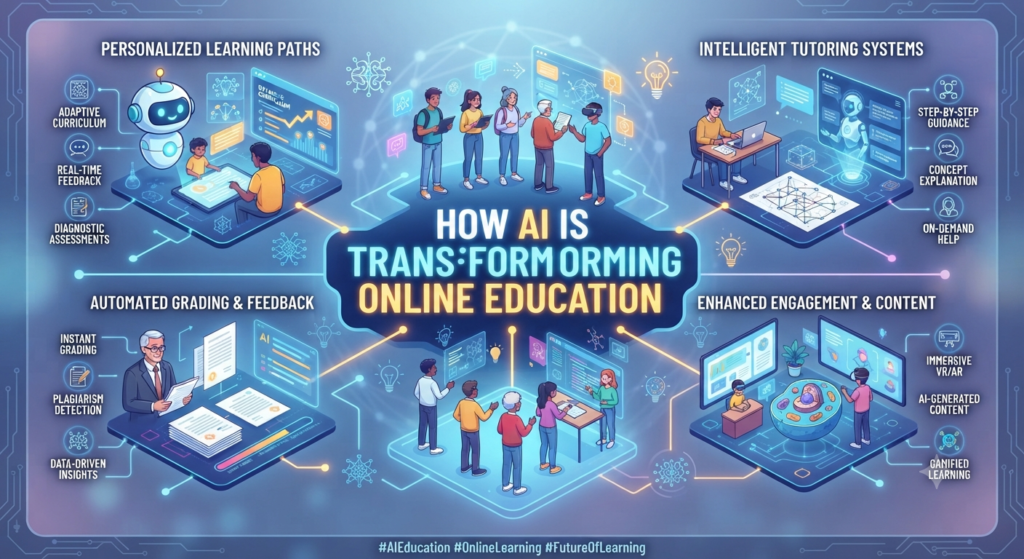
1. Personalized Learning Experiences
Every student learns differently.
Some students prefer reading. Others learn better through videos, examples, quizzes, or practical exercises.
Traditional teaching methods may not always meet these different needs. AI helps solve this problem through personalized online learning.
AI-powered platforms can study student performance and recommend suitable lessons.
For example:
- A beginner may receive basic lessons.
- An advanced learner may receive challenging exercises.
- A student who struggles with a topic may receive extra practice.
- A fast learner may move to the next learning level.
This approach makes education more flexible.
Adaptive education systems can also adjust lesson difficulty based on student progress. They help learners focus on topics that need more attention.
Example: A student learning programming may understand variables but struggle with loops. An AI-powered platform can recommend extra exercises on loops instead of asking the student to repeat the entire course.
The result is a more focused learning experience.
2. Intelligent AI Tutoring Systems
Students often need help outside regular class hours.
They may have questions while studying at night or while completing an online course. Waiting for a teacher or instructor isn’t always practical.
AI tutoring systems can provide learning support whenever students need it.
These systems can:
- Explain difficult concepts.
- Answer subject-related questions.
- Provide step-by-step examples.
- Generate practice questions.
- Help students revise lessons.
- Suggest additional learning materials.
An intelligent tutoring system can also respond to follow-up questions.
For example, a student may ask an AI tutor to explain a science concept in simple English. If the explanation is still unclear, the student can request another example.
Tools such as ChatGPT in Online Learning can support this process.
However, students should verify important information. AI tools can sometimes provide incorrect or incomplete answers.
AI tutors work best when they support teachers and trusted educational resources.
3. Automated Assessment and Instant Feedback
Assessment is an important part of education.
Teachers need to check assignments, evaluate tests, and understand student performance. This process can take a lot of time.
Educational Automation can make many assessment tasks easier.
AI-powered systems can help with:
- Automatic grading of selected question types.
- Multiple-choice quiz evaluation.
- Basic grammar checks.
- Practice test creation.
- Performance tracking.
- Feedback on learning activities.
Students can receive feedback soon after completing an activity.
This helps them understand mistakes while the topic is still fresh.
For example, an online English course may use AI to identify grammar mistakes and suggest corrections.
However, automated grading should not be the only method used for complex assignments. Creative writing, critical thinking, and open-ended answers may require human review.
Teachers should remain involved in important academic decisions.
4. AI-Powered Virtual Classrooms
Virtual classrooms have become an important part of modern education.
Students can attend live sessions, interact with teachers, share documents, and participate in group activities through online platforms.
AI can make these classrooms more useful.
AI-powered virtual classrooms may include:
- Automatic meeting transcripts.
- Live captions.
- Smart attendance support.
- Lesson summaries.
- Translation assistance.
- Automated note creation.
- Interactive learning activities.
For example, a student who misses a live class may use an AI-generated summary to review the main discussion.
Students who speak different languages may also benefit from translation and captioning tools.
This supports remote learning technology and makes online classes more accessible.
AI can also help teachers identify areas where students need additional explanations.
As digital classroom innovation continues, virtual learning may become more interactive and responsive.
5. Generative AI and Learning Content
Generative AI is one of the most important developments in modern education technology.
It can create new content based on user instructions.
Students and teachers can use it to prepare:
- Study notes.
- Practice questions.
- Lesson summaries.
- Flashcards.
- Learning guides.
- Sample assignments.
- Explanations of complex topics.
- Revision materials.
Generative AI in Education can also help teachers prepare different versions of the same lesson.
For example, a teacher may ask an AI tool to explain photosynthesis in simple language for beginners. The same tool can prepare a more advanced explanation for university students.
AI Course Creation is another growing application.
Course creators can use AI to develop lesson outlines, organize topics, prepare quizzes, and create supporting materials.
However, generated content needs human review. Teachers should check facts, examples, language, and educational quality before sharing it with students.
6. Improved Student Engagement
Keeping students interested is a major challenge in online education.
Students may lose focus when lessons are too long, difficult, or repetitive.
AI can help make learning more interactive.
For example, AI learning solutions can recommend quizzes, short activities, practice tasks, and educational games based on student interests.
AI chatbots for learning can also provide quick answers and guide students through course activities.
Some platforms use progress tracking, reminders, and achievement systems to encourage regular learning.
These features can support student engagement technology.
Consider a student learning digital marketing. Instead of only reading theory, the platform may recommend a practical SEO activity, a short quiz, and a case study.
This makes the learning process more active.
Still, engagement should not be measured only by clicks or time spent on a platform. Real learning depends on understanding, practice, and skill development.
7. Learning Analytics and Performance Tracking
Learning analytics helps teachers and educational institutions understand student progress.
AI can analyze learning data and identify patterns that may not be easy to notice manually.
For example, an educational platform may identify:
- Students who are falling behind.
- Topics with low completion rates.
- Lessons where many students make mistakes.
- Courses with strong engagement.
- Students who may need additional support.
These insights can help teachers make better decisions.
A teacher may notice that many students struggle with the same lesson. The teacher can then improve the explanation or provide extra learning materials.
Learning analytics can also help institutions improve their courses.
However, educational platforms must handle student information carefully. They should protect personal data and use clear privacy policies.
8. Language Learning and Accessibility
Language differences can make online education difficult for many students.
AI is helping reduce these barriers.
Modern language tools can support:
- Text translation.
- Speech-to-text conversion.
- Text-to-speech features.
- Grammar suggestions.
- Pronunciation practice.
- Live captions.
- Multilingual learning materials.
Students can use these features to understand lessons in languages they know better.
AI can also support learners with disabilities.
For example, text-to-speech tools can read digital learning materials aloud. Captions can help students follow video lessons. Speech recognition can support users who find typing difficult.
These features make digital education more inclusive.
However, AI-generated translations and accessibility features should be checked for accuracy, especially when lessons contain technical or subject-specific information.
9. Administrative Automation for Teachers and Institutions
Teachers have many responsibilities beyond teaching.
They may need to prepare schedules, organize course materials, respond to common questions, manage assignments, and update student records.
AI can help reduce some of this workload.
Educational institutions can use AI to support:
- Course scheduling.
- Student communication.
- Frequently asked questions.
- Basic document preparation.
- Learning resource organization.
- Assignment reminders.
- Administrative reporting.
AI chatbots can answer common questions about course dates, lesson access, and basic platform instructions.
This allows teachers and support teams to focus on more important tasks.
However, sensitive student matters and important academic decisions should remain under human supervision.
10. Continuous Learning and Skill Development
Education doesn’t end after graduation.
Technology and job requirements continue to change. Professionals need to learn new skills to remain competitive.
AI-powered education platforms can support continuous learning.
They can recommend courses based on a learner’s interests, existing skills, and learning progress.
For example, a person interested in web development may receive recommendations for:
- HTML and CSS.
- JavaScript.
- Frontend frameworks.
- Backend development.
- Database management.
- Practical development projects.
This creates a more organized learning path.
AI can also support career-focused education by suggesting relevant topics and learning resources.
For working professionals, this makes online education a practical way to improve skills without leaving their jobs.
Benefits of AI in Online Learning Platforms
AI offers several benefits to students, teachers, and educational institutions.
The biggest advantage is its ability to make learning more flexible and responsive.
|
Benefit |
How It Helps |
|
Personalized learning |
Matches lessons with student needs and progress. |
|
Faster feedback |
Helps students identify mistakes quickly. |
|
Flexible education |
Supports learning from different locations and schedules. |
|
Better accessibility |
Provides captions, translation, and speech tools. |
|
Teacher support |
Reduces repetitive administrative work. |
|
Learning analytics |
Helps identify student performance patterns. |
|
Interactive lessons |
Supports quizzes, activities, and AI tutors. |
|
Skill development |
Recommends relevant learning resources. |
|
Content creation |
Helps prepare notes, quizzes, and course materials. |
|
Better course management |
Supports digital learning administration. |
Benefits for Students
Students can receive more personalized support.
They can study at their own speed, ask questions, revise difficult topics, and access learning materials at convenient times.
AI also helps students explore subjects beyond their regular course content.
Benefits for Teachers
Teachers can use AI to prepare lessons, create assessments, organize learning materials, and understand student progress.
This can reduce repetitive work and provide more time for direct student support.
Benefits for Educational Institutions
Schools, colleges, and online education providers can use AI to improve course management, analyze learning performance, and support students at scale.
However, technology alone cannot guarantee better educational results. Good teaching methods, quality content, and student participation remain essential.
Popular AI Technologies Used in Digital Education
Different AI technologies support different educational activities.
Understanding these technologies helps explain how AI education platforms work.
|
AI Technology |
Educational Application |
|
Machine Learning |
Analyzes student performance and learning patterns. |
|
Natural Language Processing |
Understands questions and written responses. |
|
Generative AI |
Creates notes, quizzes, summaries, and explanations. |
|
Speech Recognition |
Converts spoken words into text. |
|
Predictive Analytics |
Identifies students who may need support. |
|
Recommendation Systems |
Suggests relevant courses and lessons. |
|
Computer Vision |
Supports image-based educational activities. |
|
Conversational AI |
Provides interactive question-and-answer support. |
Generative AI and LLM-Powered Education
Large Language Models (LLMs) are AI systems trained to understand and generate human-like text. They can support educational activities through natural conversations.
For example, a GPT Learning Assistant can explain a topic, create a revision plan, or generate practice questions.
LLM Powered Education can also support:
- Conversational learning AI.
- AI-driven educational content.
- Study planning.
- Language practice.
- Topic explanations.
- Course-related question answering.
Students can use ChatGPT in Online Learning to explore subjects and improve their understanding.
The quality of results depends on the instructions, available information, and human verification.
AI should be treated as a learning assistant, not as an unquestionable source of information.
How AI Is Changing the Roles of Students and Teachers
AI is changing how students and teachers participate in education.
However, it doesn’t remove the importance of human involvement.
The Changing Role of Students
Students are becoming more active participants in their learning journey.
Instead of depending only on classroom explanations, they can use AI tools to explore topics and practice independently.
Their responsibilities include:
- Asking clear questions.
- Checking information from reliable sources.
- Practicing new skills.
- Understanding concepts instead of copying answers.
- Following learning goals.
- Using AI responsibly.
Students also need digital literacy skills to understand the strengths and limitations of AI.
The Changing Role of Teachers
Teachers are moving towards a more supportive and guidance-focused role.
AI can help prepare materials and analyze learning patterns, but teachers provide important human judgment.
They understand student emotions, classroom behavior, social needs, and learning difficulties in ways that automated systems may not.
Teachers can use AI to save time while focusing on:
- Explaining difficult concepts.
- Encouraging critical thinking.
- Supporting students individually.
- Developing practical activities.
- Building communication skills.
- Evaluating creative work.
The future of education will likely depend on cooperation between teachers and intelligent learning systems.
Challenges and Limitations of AI in Education
Although AI provides many opportunities, it also creates challenges.
Educational institutions should understand these risks before adopting new technology.
1. Data Privacy and Security
AI-powered platforms may collect student information, including learning activity, assessment results, and personal details.
This information must be protected.
Educational providers should use secure systems, limit unnecessary data collection, and explain how student information is used.
2. Incorrect AI-Generated Information
AI systems can sometimes generate incorrect answers.
Students who accept every response without checking it may develop misunderstandings.
Teachers should encourage students to compare AI-generated information with textbooks, academic resources, and trusted websites.
3. Digital Access and Inequality
Not every student has access to a reliable internet connection, modern devices, or paid AI tools.
This can create differences in learning opportunities.
Educational institutions should consider affordable solutions and provide access to suitable technology.
4. Overdependence on AI
Students may become too dependent on AI for assignments, answers, and problem-solving.
This can reduce independent thinking and practical learning.
AI should support the learning process rather than complete every task for students.
5. Bias in AI Systems
AI systems learn from data. If the training data contains errors or bias, the system may produce unfair results.
Educational platforms should review AI systems regularly and provide ways for teachers to question automated decisions.
6. Limited Human Interaction
Online education can sometimes reduce direct communication between students and teachers.
AI cannot fully replace human encouragement, discussion, teamwork, and mentorship.
A balanced learning environment should combine technology with meaningful human interaction.
The Future of AI in Education Technology
The future of AI in education technology looks promising.
As AI systems improve, online learning platforms may become more adaptive, interactive, and accessible.
Several digital education trends are likely to influence the next stage of educational development.
More Advanced Personalized Learning
Future AI systems may provide more detailed learning recommendations.
They could adjust course content, practice activities, and learning speed based on student progress.
This may help students follow learning paths that better match their needs.
Smarter Virtual Classrooms
Virtual classrooms may include improved translation, automatic summaries, interactive learning activities, and real-time assistance.
These developments could make remote learning more engaging.
AI-Powered Career Learning
AI may help learners connect their current skills with future career goals.
For example, a student interested in data analytics may receive recommendations for statistics, spreadsheets, SQL, and data visualization.
This could make education more closely connected with practical career requirements.
Better Support for Lifelong Learning
Working professionals may use AI to identify skill gaps and discover suitable courses.
Learning platforms may provide more flexible training options for people who want to change careers or improve their professional knowledge.
Human-Centered Education
The most useful educational systems will not depend only on automation.
They will combine AI capabilities with human teaching, creativity, communication, and critical thinking.
The goal should be to improve learning outcomes, not simply introduce more technology.
How to Use AI Effectively for Online Learning
Students and teachers can get better results from AI by using it with clear learning goals.
Here are some practical ways to use AI tools.
1. Use AI to Understand Difficult Topics
Ask AI to explain a complex topic in simple language.
You can also request examples, comparisons, or step-by-step explanations.
2. Create a Personal Study Plan
Use an AI assistant to organize subjects, topics, revision sessions, and practice activities.
Review the plan regularly and adjust it according to your progress.
3. Generate Practice Questions
Ask AI to create quizzes based on the topics you’re studying.
Try answering the questions before checking the explanations.
4. Improve Writing and Communication
AI tools can help identify grammar mistakes and suggest clearer sentence structures.
Use the feedback to improve your own writing skills.
5. Research Additional Learning Resources
AI can suggest topics and keywords for further research.
Always check recommended information against reliable educational sources.
6. Avoid Copying AI Answers
Don’t use AI only to complete assignments.
Try solving problems independently before asking for hints or explanations.
7. Protect Personal Information
Avoid sharing passwords, private student records, or sensitive personal information with AI tools.
Check the privacy settings and policies of the platforms you use.
By following these practices, students can use AI as a valuable learning partner while developing independent skills.
AI Is Shaping the Future of Digital Learning
Artificial intelligence is creating new opportunities for students, teachers, and educational institutions.
From personalized online learning and intelligent tutoring systems to generative AI and smart virtual classrooms, technology is changing how people access and understand education.
AI can make learning more flexible. It can help students receive faster feedback, understand difficult subjects, and discover useful learning resources. Teachers can also use AI to reduce repetitive work and focus more on student development.
However, successful digital education requires more than advanced technology. Human guidance, accurate information, data privacy, and equal access remain important.
The future of AI in online education will depend on how effectively people combine technology with good teaching practices.
AI should not replace the human side of education. It should strengthen it.
As educational technology continues to develop, students and teachers who learn to use AI responsibly will have more opportunities to build knowledge, improve skills, and prepare for the future.
”FAQs”
1. How is AI transforming online education?
AI is transforming online education by making learning more personalized, interactive, and accessible. It helps students understand difficult topics, receive instant feedback, access AI tutors, and find suitable learning materials. It also helps teachers manage educational tasks and track student progress.
2. What are the main benefits of AI in online learning platforms?
The main benefits include personalized learning, faster feedback, automated assessments, improved student engagement, flexible education, and better learning analytics. AI also helps teachers prepare educational content and manage repetitive tasks.
3. Can AI replace teachers in online education?
No. AI can support teachers, but it cannot fully replace human teaching. Teachers provide emotional support, guidance, mentorship, critical thinking activities, and personal interaction. AI works best as a tool that helps teachers improve the learning experience.
4. How does ChatGPT help students with online learning?
ChatGPT can explain difficult subjects, summarize educational content, generate practice questions, help with writing, and create study plans. Students can use it as a learning assistant. However, they should verify important information and avoid depending on AI-generated answers without understanding them.
5. What is personalized learning with AI?
Personalized learning with AI means adjusting educational content according to individual student needs. AI can analyze learning progress, identify difficult topics, and recommend suitable lessons or exercises. This allows students to learn at a pace that works for them.
6. What are the challenges of using AI in education?
Common challenges include data privacy concerns, incorrect AI-generated information, digital inequality, algorithmic bias, and overdependence on technology. Educational institutions need proper policies, human supervision, and responsible AI practices to manage these risks.
7. What is the future of AI in education technology?
The future may include smarter virtual classrooms, advanced AI tutoring systems, more personalized courses, automated learning support, and better career-focused education. AI is also expected to support lifelong learning and professional skill development.
8. Which AI tools can students use for digital learning?
Students can explore tools such as ChatGPT for explanations and study support, Grammarly for writing assistance, Khan Academy's Khanmigo for guided learning, and language-learning tools such as Duolingo. Tool availability and features may vary by region and subscription.
9. Is AI-powered education suitable for beginners?
Yes. AI-powered education can help beginners understand basic concepts through simple explanations, examples, and guided practice. Students can ask questions whenever they need help and move forward at their own pace.
10. How can teachers use generative AI in education?
Teachers can use generative AI to prepare lesson outlines, create quizzes, generate study materials, summarize topics, and develop classroom activities. They should review all generated content before sharing it with students.


