

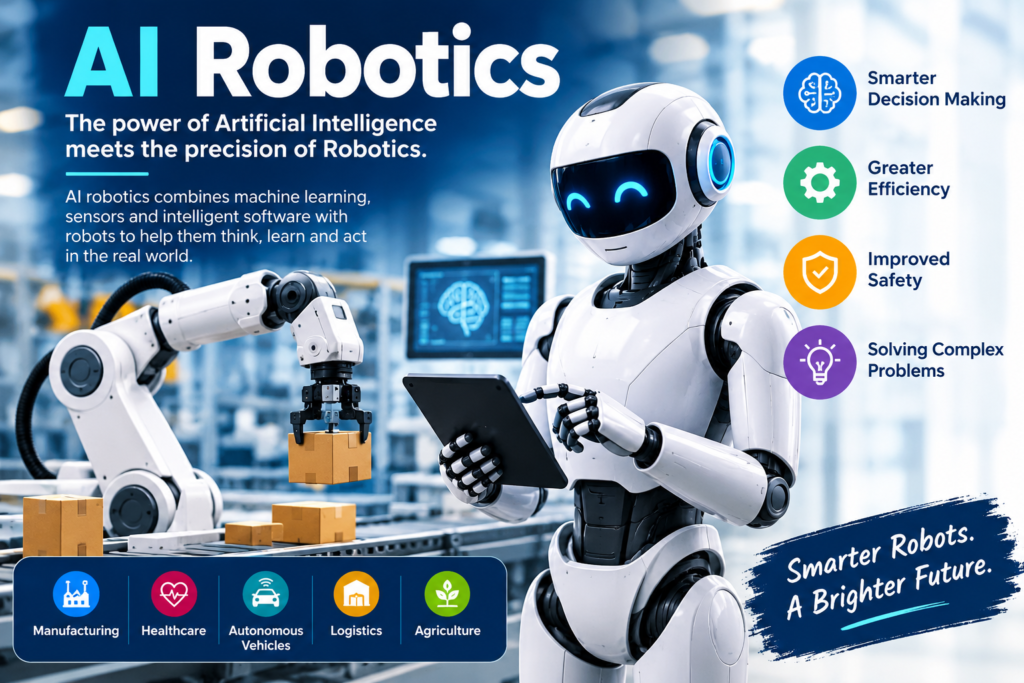
AI Robotics: 7 Powerful Ways How Artificial Intelligence Is Making Robots Smarter
AI robotics is changing how robots work, learn, and interact with people. In the past, robots mainly followed fixed instructions. Today, artificial intelligence helps robots understand their surroundings, recognize objects, solve problems, and make decisions. From factories and hospitals to schools and homes, AI-powered robotics is opening new possibilities. Smart robots can help workers, support doctors, assist students, and perform tasks that once needed human attention. But how does AI make robots smarter? What is the difference between AI robotics and traditional robotics? And how can students begin learning this technology? This guide explains AI robotics in simple English. It covers how intelligent robots work, their key technologies, real-world uses, benefits, challenges, student projects, and future trends.
What Is AI Robotics?
AI robotics is the combination of artificial intelligence and robotics. It helps robots understand information, learn from data, and choose actions based on their goals and surroundings. Traditional robots often follow a fixed set of commands. An AI-powered robot can use cameras, sensors, and AI models to respond to changes around it. For example, a basic robot may move along a fixed path. A smart robot can use cameras to detect an obstacle and find another route.
AI robotics brings together two important fields:
- Artificial intelligence (AI): Helps machines learn, recognize patterns, understand language, and make decisions.
- Robotics: Deals with designing, building, controlling, and operating robots.
When these fields work together, they create intelligent robots that can perform more flexible tasks.
What Is AI Robotics for Beginners?
For beginners, think of a robot as a machine with a body. It may have wheels, arms, cameras, sensors, or other parts. AI acts like a decision-making system. It processes information from the robot’s surroundings and helps it choose what to do next.
For example, a home-cleaning robot may use sensors to detect walls and furniture. A more advanced model can map rooms, recognize certain objects, and plan a cleaning route. The robot uses its physical parts to move. AI helps it decide how and where to move.
Not every robot needs AI, and not every AI system controls a physical robot. AI robotics combines both to solve real-world problems.
How AI Makes Robots Smarter
AI makes robots smarter by helping them process information, recognize patterns, learn from experience, and respond to new situations.
Here are the main ways artificial intelligence improves robots.
1. AI Helps Robots See and Understand Objects
Robots need information about their surroundings before they can act. Computer vision allows them to analyze images and video from cameras.
With computer vision in robotics, a robot may be able to:
- Recognize objects on a table.
- Identify people in its working area.
- Find products on a conveyor belt.
- Detect obstacles in its path.
- Read labels and visual markers.
For example, an AI-powered warehouse robot can use cameras to locate a package. It can then move toward the package and help transport it.
The quality of this process depends on the camera, lighting, training data, and AI model. A robot may still make mistakes when objects are hidden or conditions change.
2. Machine Learning Helps Robots Learn
Machine learning is an important part of modern AI robotics. It allows computer systems to learn patterns from data instead of relying only on manually written rules.
Engineers can train a robot using examples of objects, movements, or tasks. The robot’s AI model can then use what it learned to handle similar situations.
For example, a robot arm can learn to identify different shapes of products. It may then sort those products into separate containers.
The role of machine learning in robotics includes:
- Recognizing objects and patterns.
- Improving movement accuracy.
- Predicting the result of an action.
- Detecting unusual behavior.
- Supporting decisions in changing environments.
However, learning does not mean a robot understands the world like a human. It means its model has learned patterns that help it perform a task.
3. AI Helps Robots Make Decisions
A robot must often choose between several possible actions. AI can help it compare options and select an action based on its goals, rules, and available information.
Imagine a delivery robot moving along a footpath. It detects a person ahead. Instead of continuing forward, it may slow down, stop, or choose another route.
AI can help the robot interpret sensor information and select a suitable response.
Robots still need reliable control systems and safety rules. AI decisions should not replace essential safety mechanisms, especially when people are nearby.
4. AI Helps Robots Understand Human Language
Natural language processing (NLP) helps computers work with human language. When connected to speech recognition and language models, it can help robots respond to spoken or written instructions.
For example, a person might tell a service robot, “Please take this box to the storage room.”
The system may need to recognize the words, identify the requested task, locate the destination, and plan a safe route.
Natural language processing in robots can support:
- Voice-based commands.
- Customer assistance.
- Educational activities.
- Basic question answering.
- Communication with workers.
Generative AI can make these interactions more flexible. However, a language model may misunderstand a request or produce an incorrect answer. Robots need ways to verify instructions before carrying out actions that could cause harm.
5. AI Helps Robots Adapt to Changes
Traditional robots are often designed for predictable conditions. AI can help robots respond when their surroundings change.
For example, an industrial robot may need to handle products that arrive in slightly different positions. A vision system can help it locate each product before picking it up.
An autonomous mobile robot may also need to adjust its route when a corridor is blocked.
This ability to adapt is one reason AI-powered robotics is useful in factories, warehouses, hospitals, and other changing environments.
However, adaptation has limits. A robot trained for one task may struggle with unfamiliar objects, unusual lighting, or unexpected situations.
AI Robotics vs. Traditional Robotics
AI robotics and traditional robotics share many basic components, but they differ in how they handle information and make decisions.
| Feature | Traditional robotics | AI robotics |
| Main approach | Follows programmed rules | Can use learned patterns and AI models |
| Decision-making | Usually fixed and predictable | Can adapt decisions to available information |
| Learning | Does not usually learn from experience | Can improve through training or feedback |
| Object recognition | May use fixed sensors and rules | Can use AI-based vision systems |
| Flexibility | Best for stable, repeated tasks | Can support more varied tasks |
| Example | Robot welding the same part | Robot identifying different parts before welding |
Traditional robotics is still very useful. A machine that performs the same task thousands of times may not need advanced AI. AI robotics is most helpful when a task requires perception, changing decisions, language understanding, or adaptation.
What Is the Difference Between AI Robotics and Automation?
Automation means using technology to perform tasks with less human effort. It does not always require artificial intelligence. For example, a conveyor belt that moves products at a fixed speed is automated. A robot that uses computer vision to identify different products and sort them into suitable boxes combines automation with AI.
The main difference is that automation follows a process, while AI can help a system interpret information and choose how to carry out that process. In real workplaces, both technologies often work together. Automation provides reliable execution, while AI supports tasks that require recognition, prediction, or flexible decisions.
Key Technologies Behind AI-Powered Robotics
Several technologies work together to create intelligent robots. Each one has a different role.
1. Computer Vision
Computer vision allows robots to analyze images and video. It helps them recognize objects, estimate positions, inspect products, and understand parts of their environment. For example, industrial robots can use computer vision to identify defective products on a production line.
2. Machine Learning
Machine learning helps robots identify patterns in data. It can support object recognition, motion planning, quality inspection, and predictive maintenance. The robot’s performance depends on its training data, model design, and operating conditions.
3. Deep Learning
Deep learning uses artificial neural networks with many layers to learn complex patterns. It is useful for tasks such as image recognition, speech processing, and some forms of robot control.
Deep learning robots may recognize objects in busy environments or identify small defects that are difficult to detect using simple rules.
However, deep learning often needs substantial training data and computing resources.
4. Reinforcement Learning
Reinforcement learning trains an AI system through actions and feedback. During training, the system receives rewards or penalties based on its performance.
For example, a simulated robot may learn how to move an object toward a target. Actions that move it closer to the goal receive positive feedback. Reinforcement learning robots can be useful for research into walking, gripping, balancing, and navigation.
Much of this learning can happen in simulation before engineers test the robot in the physical world. Real-world testing remains important because simulations cannot capture every condition.
5. Sensors and Robotics Hardware
AI needs information from the physical world. Robots may use cameras, distance sensors, microphones, touch sensors, force sensors, and other devices.
These components help a robot detect nearby objects, estimate movement, measure contact forces, and monitor its surroundings.
The robot’s motors, wheels, or robotic arms then carry out its actions.
Reliable AI robotics depends on both good software and suitable hardware. A powerful AI model cannot compensate for a broken sensor or an unsafe mechanical design.
6. Generative AI Robotics
Generative AI can help robots interpret complex instructions, explain actions, or break a broad request into smaller tasks.
For example, a user might ask a robot, “Help me prepare the meeting room.”
An AI system could turn that request into smaller steps, such as identifying chairs, checking the room layout, and locating supplies. The robot would still need suitable hardware, verified object recognition, and safe action planning to perform those tasks.
Generative AI robotics is an emerging area of development. It can improve how people communicate with robots, but it does not automatically give a robot reliable physical skills.
7. AI Robotics Knowledge Graphs
A knowledge graph represents information as connected entities and relationships.
For example, a robot assisting in a warehouse might use a structured knowledge system that connects products, storage locations, delivery tasks, and safety rules.This information can help an AI system reason about relationships and find relevant facts.
AI robotics knowledge graphs may be useful when a robot needs more structured information than raw sensor data alone can provide. Their value depends on the accuracy and freshness of the stored information.
How Do Robots Learn With AI Step by Step?
Robots do not all learn in the same way. Some use models trained before deployment, while others can adapt through feedback or updated data. A typical development process includes the following steps.
Step 1: Collect data
Engineers gather images, sensor readings, movement examples, or task records. This data helps the AI system learn about the task.
Step 2: Train an AI model
The model learns patterns from the collected data. For example, it may learn to distinguish a cup from a bottle.
Step 3: Test in simulation
Engineers test the model in a virtual environment to find mistakes before physical deployment.
Step 4: Test with a real robot
The robot uses its sensors and actuators to perform the task. Engineers check accuracy, reliability, and safety.
Step 5: Review and improve
Engineers examine errors, collect more examples, and update the model or robot controls when needed.
This process explains how robots learn with AI step by step. It is a useful starting point for students, but real robotics projects may require many additional steps, including calibration, motion planning, safety testing, and ongoing maintenance.
Real-World Applications of AI Robotics
AI robotics applications are growing across many industries. The technology is especially useful when machines must recognize objects, work in changing environments, or assist people with physical tasks.
1. AI Robotics in Manufacturing
Factories have used robots for many years. AI is helping some of these robots handle more flexible tasks.
Industrial robots with AI can support:
- Visual quality inspection.
- Product sorting and classification.
- Adaptive picking and placing.
- Defect detection.
- Production monitoring.
For example, a factory may use an AI vision system to identify scratches or incorrect parts. A robotic arm can then move defective products away from the production line.
These systems can reduce repetitive manual work and support consistent inspection. They still need careful calibration and human oversight, especially when defects are difficult to identify.
2. Collaborative Robots (Cobots)
Collaborative robots, often called cobots, are designed for applications where people and robots work near each other. AI can help cobots identify objects, adjust certain movements, and respond to changes in their work area.
A cobot may help a worker assemble components, sort products, or handle repetitive packaging tasks. However, the term “collaborative” does not mean a robot is automatically safe to work beside people. Risk assessments, suitable protective measures, and application-specific safety systems are essential.
3. Robotics in Healthcare
Robotics in healthcare includes surgical assistance, rehabilitation, hospital logistics, and support for people with limited mobility.
AI may help healthcare robots interpret sensor data, identify objects, or plan movements. Some systems assist clinicians during procedures, while mobile robots may transport supplies inside hospitals.
For example, a hospital delivery robot can navigate designated corridors and carry items between departments.
AI robotics applications in healthcare explained simply: AI helps the system interpret information, while robotics enables it to perform physical actions.
These tools support medical professionals rather than replacing their judgment. Healthcare robots require strong safety, privacy, reliability, and regulatory controls.
4. AI Robotics in Education
Robotics in education gives students a practical way to learn programming, engineering, mathematics, and problem-solving.
AI-enabled educational robots can respond to commands, recognize selected objects, or support interactive learning exercises. Teachers can use them to explain concepts such as logic, sensors, movement, and machine learning.
For example, students might program a small robot to follow a line, recognize colored cards, or navigate a simple maze. AI robotics in education for students can make technical subjects more engaging because learners can see the results of their code in the physical world.
5. Autonomous Robots in Warehouses
Warehouses often need to move products between storage areas, packing stations, and shipping zones. Autonomous robots can use sensors, maps, and navigation software to travel through designated spaces. AI can help some systems recognize obstacles, identify objects, or plan routes.
A warehouse robot may transport shelves or carry packages to a worker. This can reduce some manual transport tasks and improve the movement of goods. The robot still needs safe routes, reliable localization, and procedures for dealing with blocked paths or unexpected objects.
6. AI Robots in Agriculture
Agriculture offers many tasks that depend on observing plants, soil, and changing outdoor conditions. AI robotics can support crop monitoring, targeted spraying, weed detection, fruit picking, and autonomous field operations.
For example, a vision-enabled robot may identify weeds among crops. A suitable mechanical system can then target selected weeds rather than treating the entire area.These applications may help farmers use resources more precisely. Their performance can be affected by weather, dust, uneven ground, and differences between plant varieties.
7. AI Robotics in Homes
Examples of AI robotics in daily life include robot vacuum cleaners, lawn-mowing robots, and some smart home assistants with physical movement.
A robot vacuum may map a room, estimate its location, and plan a route around furniture. More advanced systems can identify certain obstacles or adapt their cleaning patterns.
These devices can save time on repetitive chores. However, features vary widely, and a product marketed as smart may rely mainly on fixed rules rather than advanced AI.
8. AI Robotics in Logistics and Delivery
Delivery robots and autonomous mobile systems can move goods through controlled sites, campuses, warehouses, and selected public areas. AI may help them detect obstacles, interpret maps, and respond to changes along a route.
Drones can also combine AI-based perception with navigation systems for selected inspection or delivery tasks. Public-space operations involve additional challenges, including weather, pedestrians, traffic rules, and local regulations. Human supervision and reliable emergency controls remain important.
9. Humanoid Robots With AI
Humanoid robots have a body shape designed to resemble some aspects of a human body. Many include a head, torso, arms, or legs. Humanoid robots AI systems may combine cameras, language models, motion planning, balance control, and object manipulation.
A humanoid robot might be designed to carry objects, interact with people, or perform selected tasks in a workplace.However, human-like appearance does not guarantee human-like intelligence. Walking safely, handling unfamiliar objects, and completing everyday tasks remain difficult engineering challenges.
10. AI Robotics in Dangerous Environments
Robots can help people inspect places that are unsafe or difficult to reach.Applications include disaster response, hazardous industrial sites, mines, and selected space missions.
AI can help these robots identify objects, analyze images, navigate around obstacles, and support remote operators.For example, a robot may enter a damaged building to collect images before emergency workers go inside.
In such settings, robust communication, reliable navigation, and the ability to stop safely are essential.
Benefits of AI Robotics
AI-powered robotics can offer several advantages when the technology is properly designed and used.
1. Better Accuracy
AI vision systems can identify patterns and differences in products. This can help robots perform inspection and sorting tasks more consistently.Accuracy still depends on the quality of the model, sensors, and operating environment.
2. Higher Productivity
Robots can perform repetitive tasks for long periods. AI can help them handle certain changes without requiring a new instruction for every situation. This can help businesses improve workflows and reduce delays.
3. Improved Workplace Safety
Robots can perform some tasks that expose workers to heat, chemicals, heavy loads, or dangerous machinery. AI can also support obstacle detection and monitoring. However, AI alone cannot guarantee safety.
4. Reduced Repetitive Work
Robots can take on tasks such as moving materials, inspecting products, and sorting items. Workers can then focus more on problem-solving, supervision, communication, and other tasks that require human judgment.
5. More Flexible Operations
Traditional machines may need extensive reprogramming when products or conditions change. AI can help some robotic systems recognize new situations and adjust their actions. This flexibility can be useful in warehouses, manufacturing, and other environments with varied tasks.
6. Support for Research and Innovation
AI robotics gives researchers new ways to study movement, learning, perception, and human-machine interaction. It also creates learning opportunities for students interested in computer science, mechanical engineering, electronics, and AI.
Challenges and Limitations of AI Robotics
Although intelligent robots offer many benefits, the technology has important limitations.
1. High Development Costs
Robots may require cameras, sensors, motors, computing hardware, software, and specialized engineering. Training and testing AI models can add further costs. Smaller businesses and schools may need affordable kits or cloud-based tools to begin learning.
2. Data Quality and Training
AI models depend on suitable training data. If the data does not represent real working conditions, the robot may make mistakes.For example, a model trained only on bright indoor images may struggle in dim lighting. Engineers need to test AI systems in conditions that reflect their intended use.
3. Safety Risks
A robot can damage equipment, injure someone, or make a dangerous movement if its controls fail. Safety must be built into the system through risk assessment, protective hardware, testing, monitoring, and emergency stops. AI-generated plans should be checked before high-risk actions are performed.
4. Privacy Concerns
Robots with cameras and microphones may collect personal information. This can be a concern in homes, hospitals, schools, and workplaces. Developers should limit data collection, protect stored information, and explain how recordings are used.
5. Dependence on Technology
Some robots depend on network connections, remote servers, or cloud-based AI models. A network failure may reduce their capabilities. Local processing, backup controls, and safe fallback behavior can help reduce this risk.
6. Job Changes and New Skills
AI robotics can change the types of tasks people perform. Some repetitive roles may shrink, while demand may grow for robot operators, technicians, AI developers, and maintenance specialists. The impact will vary by industry. Training and education can help workers adapt to changing job requirements.
7. Unpredictable Environments
A robot that works well in a laboratory may struggle in a busy street or crowded workplace. Unexpected objects, poor lighting, slippery floors, and changing weather can affect its performance. This is why real-world testing and careful limits on where robots operate are so important.
AI Robotics Projects for Students
Students do not need an expensive humanoid robot to begin learning AI robotics. A small programmable robot, a basic sensor kit, or a simulated robot can teach many core concepts.
Here are five project ideas for beginners.
- Line-Following Robot
Beginner
Build a robot that follows a dark line using simple sensors. Start with fixed rules, then explore how an AI model might recognize different paths.
- Obstacle-Avoiding Robot
Beginner
Use distance sensors to detect objects and change direction. Later, add mapping or a basic navigation model.
- Object-Sorting Robot
Intermediate
Use a camera and a trained image classifier to identify colored blocks or simple objects. A robotic arm can then sort them.
- Virtual Robot Navigation
Beginner–Intermediate
Use a simulator to teach a robot to reach a target while avoiding obstacles. This is a useful way to learn navigation without buying hardware.
- Voice-Controlled Robot
Intermediate
Connect speech recognition to a small robot. Allow safe commands such as moving forward, turning, and stopping.
How to Start an AI Robotics Tutorial for Students
A simple learning path can help beginners build skills in the right order.
- Learn basic programming. Start with Python or a beginner-friendly robotics programming tool.
- Understand electronics. Learn how sensors, motors, batteries, and controllers work.
- Build a basic robot. Try a small wheeled robot or use a virtual simulator.
- Explore AI concepts. Study image classification, machine learning, or speech recognition.
- Combine AI with movement. Connect the AI output to a simple robotic action.
- Test safely. Begin in a controlled area and add clear stop controls.
- Document the results. Record errors, improvements, and what you learned.
A useful first project is to build an obstacle-avoiding robot, then compare its performance with a version that uses camera-based object recognition. Students should understand the difference between ordinary sensor rules and actual machine learning. Adding a camera to a robot does not automatically make it an AI robot.
Future Trends in AI Robotics Technology
The future of AI robotics will depend on advances in AI models, computing, mechanical design, sensors, and safety engineering. Several trends are worth watching.
1. Robots That Follow Natural-Language Instructions
Generative AI is making it easier to explore robots that respond to everyday language.
Instead of programming every small step, a user may be able to describe a goal. An AI system can then help break the goal into smaller tasks.
For example, a warehouse worker might ask a robot to collect specified items from known locations.
The challenge is turning language into accurate physical actions. Systems must verify object identities, follow safety rules, and handle unclear instructions.
2. More Capable Humanoid Robots
Researchers and companies are developing humanoid robots for logistics, manufacturing, research, and other settings.
AI can support perception, object manipulation, and task planning. Better hardware may also improve balance and movement.
However, reliable performance across many everyday tasks remains difficult. Widespread use will depend on cost, safety, useful capabilities, and real-world reliability.
3. More Robots Working With People
Cobots and other assistive robots may become more capable of handling changing tasks alongside workers.
AI can help identify objects, understand certain instructions, and respond to sensor data.
Clear safety boundaries will remain essential, particularly when robots work near people.
4. Better Learning Through Simulation
Simulated environments let engineers test many robot movements without risking physical equipment.
Researchers can generate training examples, test different situations, and evaluate models before real-world deployment.
A key challenge is transferring what a robot learns in simulation to physical conditions. Differences in friction, lighting, weight, and sensor noise can cause unexpected errors.
5. Smaller and More Efficient AI Models
Running AI directly on a robot can reduce reliance on cloud services and improve response times.
More efficient models may allow small robots to perform tasks with limited computing power.
This is important for educational robots, mobile devices, and machines that operate in places with weak internet access.
6. Robots Designed for Specific Industries
Rather than creating one robot for every task, many practical systems will focus on particular needs.
Examples include warehouse transport, crop inspection, laboratory handling, and manufacturing quality control.
Specialized robots can be easier to test and evaluate because their tasks and operating environments are more clearly defined.
7. Greater Attention to Responsible AI
As robots become more capable, developers will need to focus on reliability, privacy, accountability, and safety.
Organizations may use more structured testing to evaluate whether a robot behaves correctly in normal and unusual situations.
Human supervision will remain important in high-risk applications. A robot should have clear limits and safe ways to stop or request help.
Skills Needed for a Career in AI Robotics
AI robotics combines several technical fields. Students who want to work in this area can build their skills step by step.
| Skill | How it helps |
| Python programming | Builds AI models and controls software |
| Mathematics | Supports geometry, movement, and machine learning |
| Electronics | Helps students understand sensors and controllers |
| Mechanical engineering | Covers robot structure, motors, and movement |
| Machine learning | Helps robots recognize patterns in data |
| Computer vision | Enables image and object recognition |
| Problem-solving | Helps identify and fix robot errors |
Students can begin with one or two skills rather than learning everything at once. A basic programming project is a good starting point.
As their knowledge grows, they can explore robotics simulators, open-source tools, educational kits, and university research projects.
AI robotics is making robots more capable by combining physical movement with intelligent software. Machine learning helps them recognize patterns, computer vision helps them understand images, and natural language processing allows them to interpret certain human instructions.
These capabilities are creating new applications in factories, hospitals, warehouses, homes, and classrooms. They also give students new ways to learn programming, engineering, and artificial intelligence.
However, intelligent robots still have limitations. They can make mistakes, struggle with unfamiliar situations, and require careful safety testing. Human knowledge and supervision remain essential.
The future of AI robotics will not depend on making robots smarter alone. It will also depend on making them safer, more reliable, more affordable, and more useful in real-world situations.
For beginners, the best way to understand this technology is to start with a simple robotics project, learn how its sensors and software work, and gradually explore AI. Small projects can build the foundation for understanding the intelligent robots of tomorrow.
”FAQs”
1. What is AI robotics in simple words?
AI robotics combines artificial intelligence with physical robots. AI helps robots interpret information, recognize objects, and choose actions. Robotics allows them to perform physical tasks using motors, sensors, and other hardware.
2. How does artificial intelligence improve robots?
Artificial intelligence can help robots recognize objects, understand selected commands, learn patterns, plan routes, and respond to changing conditions. The improvements depend on the AI model, sensors, training data, and task.
3. What are some examples of AI robotics in daily life?
Examples include robot vacuum cleaners that map rooms, warehouse robots that move packages, robotic systems that inspect products, and educational robots that recognize objects. Not every product in these categories uses advanced AI.
4. What is the difference between AI robotics and automation?
Automation performs tasks with less human effort, often by following predefined rules. AI robotics combines physical robots with AI capabilities that may support learning, perception, and flexible decisions. Many systems use both technologies.
5. Can robots learn on their own?
Some robots can learn through training data, feedback, or reinforcement learning. However, robots do not automatically improve just by operating for longer. Many need new training, software updates, or human guidance to improve their performance.
6. How is machine learning used in robotics?
Machine learning can help robots recognize objects, estimate positions, classify products, predict movement, and learn selected control strategies. Engineers train and test models before using them for real tasks.
7. How is AI robotics used in healthcare?
AI robotics can support surgical assistance, rehabilitation, hospital delivery, and mobility assistance. These systems help with specific tasks, while healthcare professionals remain responsible for clinical decisions and patient care.
8. Is AI robotics a good field for students?
Yes. AI robotics offers learning opportunities in programming, electronics, engineering, machine learning, and computer vision. Students can begin with small projects and build more advanced systems as their skills improve.
9. What programming language is used in AI robotics?
Python is popular for AI development and robotics prototyping. C++ is also widely used in robotics software. The best language depends on the robot, controller, software framework, and project requirements.
10. What is the future of AI robotics technology?
AI robotics may become more capable in manufacturing, healthcare, logistics, agriculture, and education. Improvements in natural-language interaction, robot learning, simulation, and efficient computing could expand its uses. Progress will depend on cost, reliability, safety, and real-world performance.





Pingback: AI Video Generation: The Powerful Future of Video Content Creation 2026
Pingback: AGI vs Generative AI: 7 Key Differences Explained for Beginners