How AI Chatbots Are Changing the Way People Search for Information
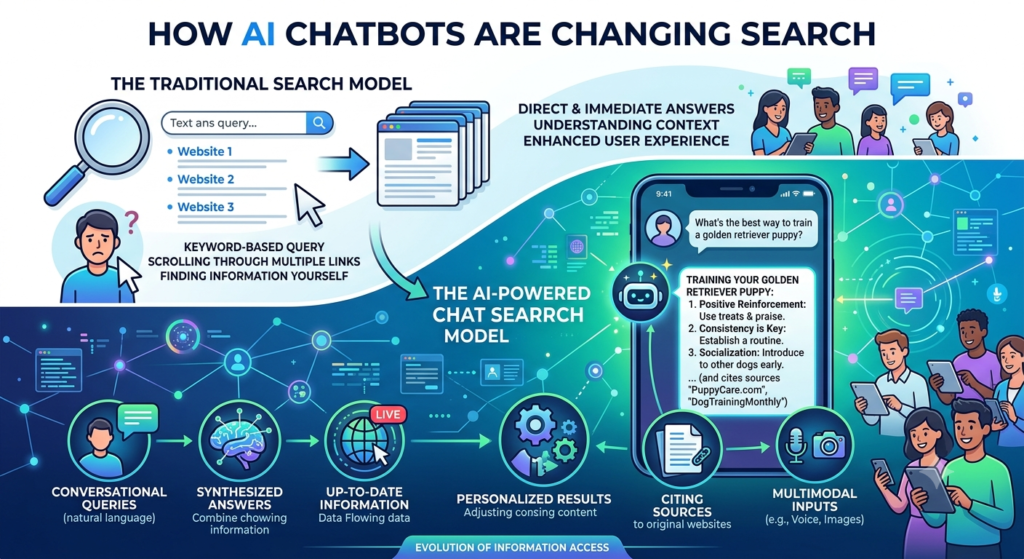
AI chatbots are changing the way people search for information online. In the past, people entered a few keywords into a search engine and opened several websites to find an answer. Today, they can ask an AI chatbot a complete question and receive a direct response within seconds.
This change is making online research more conversational, flexible, and accessible. People can ask follow-up questions, request simple explanations, compare different ideas, and explore new topics without starting a fresh search every time.
Tools such as ChatGPT, Google Gemini, and Microsoft Copilot are helping users find, understand, and organize information in new ways. Students use AI chatbots to understand difficult lessons. Professionals use them to research business problems. Everyday users rely on them for explanations, recommendations, and practical guidance.
However, AI chatbots aren’t perfect. They can make mistakes, provide outdated information, or present uncertain answers with confidence. Therefore, users still need to check important facts and consult reliable sources.
In this article, we’ll explore how AI chatbots are changing search, how their technology works, why students are adopting AI search tools, and what these developments mean for the future of online information discovery.
1. Understanding How AI Chatbots Are Changing Search and AI-Powered Search
To understand the impact of AI chatbots on online search, it’s important to know what these tools do and how they differ from traditional search engines.
What Are AI Chatbots?
AI chatbots are software applications that use artificial intelligence to understand questions and generate responses. Many modern chatbots rely on large language models, machine learning, and natural language processing.
These technologies help chatbots understand written language, identify relationships between ideas, and create responses that fit a user’s request.
For example, a traditional search might involve entering the phrase “benefits of solar energy.” The search engine then displays a list of relevant pages.
With an AI chatbot, a user might ask:
“What are the main benefits of solar energy for a small home, and how much money could it save over time?”
The chatbot can organize its answer into sections, explain the benefits, discuss costs, and suggest questions for further research.
This conversational approach makes information easier to explore. Users don’t need to know the exact keywords that a website might contain. They can describe what they want to understand in everyday language.
However, an AI-generated response isn’t automatically correct. Its quality depends on the model, the available information, the question, and whether the system uses reliable external sources.
What Is AI-Powered Search?
AI-powered search uses artificial intelligence to improve how information is found, ranked, summarized, and presented.
Traditional search engines mainly help users discover web pages. AI-powered search tools can also interpret questions, combine information, and generate summaries.
Depending on the tool, AI search may include:
- Natural-language question answering.
- Summaries of information from multiple sources.
- Context-aware follow-up questions.
- Semantic search based on meaning rather than exact wording.
- Recommendations for related topics.
- Links to sources for further reading.
For example, someone researching digital marketing could ask an AI search tool to explain search engine optimization, compare SEO with paid advertising, and identify useful beginner resources.
The system may provide an organized answer instead of requiring the user to open every result individually.
This is one reason conversational AI search is becoming an important part of the search engine evolution. It helps users move from simply finding information to understanding and applying it.
2. How AI Chatbots Are Changing Traditional Search
AI chatbots are changing search behavior in several important ways. The biggest difference is that users can now interact with information instead of only browsing a list of results.
From Keywords to Natural Conversations
Traditional search often works best when users choose clear keywords. People may need to change their wording several times to find useful results.
AI chatbots make this process more conversational.
Consider this example:
- Traditional search: “Best skills for college students.”
- AI chatbot search: “I’m a second-year college student studying business. Which digital skills should I learn to improve my chances of getting an internship?”
The second question gives the system more context. An AI chatbot can use that context to produce a more focused response.
Users can also ask questions in stages. They might first ask which skills are useful, then request free learning resources, and finally ask for a weekly study plan.
This makes search feel more like a conversation with a research assistant.
Natural language processing helps these systems interpret the meaning and structure of user questions. As a result, people can often search successfully without knowing specialized terminology.
Direct Answers Instead of Link Lists
Another major change is the growing use of AI-generated answers.
Traditional search engines generally present links to websites, videos, images, and other resources. Users then visit those sources to find the information they need.
AI answer engines can summarize relevant information directly in the search experience.
For example, a person asking about the difference between machine learning and deep learning may receive a comparison table, simple definitions, and examples.
This saves time when the goal is to understand a general concept.
However, direct answers also create a challenge. Users may stop before visiting the original websites. That can make it harder to evaluate the quality of information and may reduce website visits for some informational searches.
For this reason, reliable AI search tools should provide useful source links whenever possible. Users should open those sources when accuracy, evidence, or detailed understanding matters.
Follow-Up Questions and Context
Traditional search usually requires a new query whenever the user wants to explore another aspect of a topic.
Conversational AI search can preserve the context of a discussion.
Imagine a student researching climate change. The conversation might look like this:
- “Explain climate change in simple language.”
- “What are its main causes?”
- “How does it affect agriculture?”
- “Give me three examples from India.”
- “Summarize the topic for a classroom presentation.”
The chatbot can use earlier messages to understand the later requests.
This makes information discovery more connected. Instead of treating every search as a separate task, users can develop their understanding step by step.
Still, context isn’t unlimited. Some systems have memory or conversation-length restrictions, and they may misunderstand details from earlier messages.
Users should correct mistakes and repeat important information when necessary.
3. How AI Chatbots Are Changing Search Technology Works
AI chatbot search technology combines several methods to understand questions and produce useful answers. Different platforms use different designs, but many rely on a combination of language models, search systems, and information retrieval techniques.
Large Language Models and Natural Language Processing
Large language models, also called LLMs, are trained on large collections of text and other data, depending on the model. They learn patterns in language that help them generate responses to questions.
Natural language processing, or NLP, helps computer systems work with human language. It supports tasks such as interpreting questions, identifying important terms, and understanding relationships between words.
Transformer architecture is a major development behind many modern language models. Its attention mechanism helps models process relationships between different parts of a sequence.
These capabilities allow generative AI assistants to:
- Explain complex topics in simpler language.
- Summarize long passages.
- Compare ideas and approaches.
- Generate outlines and study notes.
- Suggest relevant follow-up questions.
However, a language model’s ability to generate a convincing answer doesn’t mean that it has verified every fact.
A model may produce an incorrect statement if its learned patterns or available context lead it in the wrong direction. This is why factual checking remains important.
Semantic Search and Information Retrieval
Semantic search technology aims to identify the meaning behind a query instead of relying only on exact keyword matches.
Suppose a user searches for “ways to reduce electricity bills at home.”
A traditional keyword-based system may focus on pages containing those exact words. A semantic search system may also identify useful content about energy-efficient appliances, insulation, smart thermostats, and household power consumption.
Information retrieval systems help locate relevant documents or passages. Ranking algorithms then estimate which results are most useful for the query.
AI-powered information retrieval can combine these processes with language models to produce a more organized response.
This approach is useful when users describe a problem in everyday language or when relevant information uses different words from the original question.
Retrieval-Augmented Generation
Retrieval-augmented generation, commonly known as RAG, combines information retrieval with text generation.
In a typical RAG workflow, the system:
- Receives a question from the user.
- Searches an available collection of documents or external sources.
- Retrieves passages that appear relevant.
- Provides those passages to a language model as context.
- Generates an answer based partly on the retrieved information.
For example, a company could build an internal AI assistant that searches approved policy documents. An employee might ask about leave rules and receive an answer based on the company’s available documentation.
RAG can help make responses more relevant to current or specialized information, but it doesn’t guarantee accuracy. The retrieval system may find the wrong passage, the source may be outdated, or the model may misinterpret the evidence.
Some AI search tools use web search and source grounding rather than a conventional RAG architecture. The exact implementation depends on the product.
4. Popular AI Search Tools and Their Uses
Several major technology platforms now offer AI-powered search or conversational information tools. Their features, source access, and availability can change over time.
ChatGPT Search
ChatGPT can help users explore topics through conversational questions, explanations, comparisons, and summaries. Its search capabilities can also help retrieve current web information when web search is available and used.
Common use cases include:
- Understanding unfamiliar subjects.
- Comparing products, services, or concepts.
- Finding starting points for research.
- Creating study plans and outlines.
- Asking follow-up questions about a topic.
For example, a student could ask ChatGPT to explain the difference between supervised and unsupervised learning, provide practical examples, and suggest questions to test their understanding.
When the tool provides sources, students should open them and verify the important claims.
Google Gemini Search
Google Gemini offers conversational AI capabilities that can help users understand topics, summarize information, and explore questions. Depending on the available features, it can work alongside Google’s broader information ecosystem.
Potential uses include:
- Exploring unfamiliar subjects.
- Understanding concepts through examples.
- Organizing ideas for assignments.
- Summarizing supported documents.
- Developing questions for further research.
Students looking for learning support may use Gemini to explain a difficult concept in simpler language or generate practice questions.
However, generated explanations should be checked against textbooks, course materials, and trusted academic sources.
Microsoft Copilot Search
Microsoft Copilot provides AI assistance across supported Microsoft products and web-based experiences. Depending on the version and account, it may support web research, summaries, and productivity tasks.
Useful applications include:
- Summarizing available information.
- Comparing options.
- Researching business topics.
- Organizing work-related information.
- Supporting document and productivity workflows.
For example, a professional preparing a presentation could use an AI assistant to develop a topic outline and identify areas that need further investigation.
The exact features available depend on the product, account, region, and current settings.
How to Choose an AI Search Tool
The best AI chatbot for finding information depends on the user’s needs.
| User need | Useful capability |
| General learning | Clear explanations and follow-up questions |
| Current information | Web search and recent source links |
| Academic research | Access to reliable publications and citations |
| Business research | Summaries, comparisons, and document support |
| Study planning | Outlines, quizzes, and structured explanations |
| Technical research | Detailed reasoning and verifiable documentation |
No single tool is best for every task. Users should evaluate the quality of answers, source transparency, privacy settings, and available features before choosing a tool.
5. Benefits of AI Chatbots for Information Search
AI chatbots offer several benefits when users need to understand information rather than simply locate a web page.
Faster Research and Better Explanations
One of the main benefits of AI chatbots for information search is speed. A user researching a broad topic can request a summary, a comparison, or a list of key concepts within one conversation. This may reduce the time spent opening unrelated pages and manually organizing notes.
For example, someone learning about electric vehicles could ask for an explanation of battery types, charging methods, maintenance, and common ownership costs.
The chatbot can organize these topics into a clear structure.
This is particularly helpful for beginners. A technical article may contain unfamiliar terms, while an AI assistant can explain those terms in simpler language.
Still, speed shouldn’t replace careful research. A quick answer may omit important details, overlook exceptions, or contain errors.
Personalized Information Discovery
AI chatbots can adapt explanations to the user’s stated needs.
A beginner might request a simple explanation. An experienced professional might ask for technical details. A student might request examples and practice questions.
This flexibility makes AI search useful across different levels of knowledge.
For example, when learning Python programming, a student could ask:
“Explain Python loops as if I’m a beginner, show two examples, and give me three practice questions.”
The chatbot can structure its response around that request.
Some AI assistants also support files, images, voice, or other input formats. These multimodal AI assistants can help users explore information beyond ordinary text, depending on their available features.
Support for Different Learning Styles
AI-powered learning can support several study activities:
- Reading: Simplifying difficult passages.
- Practice: Creating quizzes and exercises.
- Review: Summarizing key ideas.
- Planning: Breaking large tasks into smaller steps.
- Discussion: Exploring different explanations of the same topic.
These features can make study sessions more interactive.
However, users still need to think independently. If they rely on generated answers without attempting problems or checking explanations, they may remember less and develop weaker problem-solving skills.
Better Exploration of Related Topics
AI search tools can suggest connected ideas that users may not have considered.
Someone researching digital marketing might discover related subjects such as audience segmentation, conversion tracking, customer retention, and content strategy.
This supports broader knowledge discovery and helps users understand how different concepts relate to one another.
AI-powered recommendations can be useful, but they should be treated as suggestions rather than proof that a topic is relevant or important.
6. How Students Use AI Chatbots for Research
Students are an important group adopting AI chatbots. These tools can support learning, academic research, and time management when used responsibly.
Learning Difficult Topics
Students sometimes struggle with complex concepts because textbooks move too quickly or assume prior knowledge. AI chatbots for students can provide alternative explanations and examples.
For instance, a biology student learning about photosynthesis could ask for a simple explanation, a step-by-step process, and a short quiz. A mathematics student could request hints for solving an equation instead of immediately asking for the final answer.
This makes AI tutoring tools useful for independent practice.
However, students should compare explanations with their course materials. A chatbot may simplify a topic too much or explain a concept incorrectly.
Academic Research and Study Planning
AI research assistants can help students organize early research.
A student writing an assignment about renewable energy might use an AI chatbot to:
- Understand the main concepts.
- Identify possible research questions.
- Create an initial outline.
- Generate search terms for academic databases.
- Identify arguments that need evidence.
- Organize notes from sources they have read.
- Review the structure and clarity of a draft.
These activities can make the research process easier to manage.
However, students shouldn’t treat generated references as genuine without checking them. AI systems can sometimes invent article titles, authors, publication dates, or links.
For academic research, students should use reliable sources such as university libraries, peer-reviewed journals, official reports, and established academic databases.
Useful starting points include Google Scholar for scholarly literature and Purdue OWL for academic writing guidance.
AI Tools for Student Productivity
AI tools for students can support more than research.
For example, students may use them to build revision schedules, break assignments into smaller tasks, prepare flashcards, or create practice questions from permitted study material.
A student preparing for an examination could ask for a seven-day revision plan based on a list of subjects and available study hours.
The plan can then be adjusted according to difficult topics and deadlines.
These student productivity tools are most useful when they support active learning rather than replace it.
Responsible AI Use in Education
Students need to follow their institution’s rules about AI-generated work.
Good practices include:
- Use AI to understand concepts rather than copy complete assignments.
- Verify important claims using original sources.
- Cite the sources actually consulted.
- Follow course policies on AI assistance and disclosure.
- Avoid entering confidential personal or institutional information.
- Solve practice problems independently before checking the explanation.
AI for education can improve access to explanations, but genuine learning still requires effort, practice, and critical thinking.
7. AI Chatbots vs. Traditional Search Engines
AI chatbots and traditional search engines serve related but different purposes. The right choice depends on what the user wants to accomplish.
| Feature | AI chatbots | Traditional search engines |
| Main purpose | Generate conversational responses | Find and rank web pages |
| Query style | Natural-language questions | Keywords or full questions |
| Results | Explanations, summaries, and other generated content | Links, snippets, images, videos, and other results |
| Follow-up | Often maintains conversation context | Usually requires another search |
| Source checking | Depends on available citations and retrieval | Users can open individual source pages |
| Current information | Depends on search access and connected data | Can surface indexed current web pages |
| Learning support | Can adapt explanations and create practice questions | Provides access to original learning resources |
| Main risk | Incorrect or unsupported generated answers | Low-quality, misleading, or irrelevant pages |
Can AI Chatbots Replace Google Search?
For some tasks, AI chatbots can reduce the need to perform multiple separate searches. They are especially useful for explanations, summaries, brainstorming, and conversational exploration.
However, they don’t completely replace traditional search engines.
Search engines remain valuable when users need to locate official websites, compare original documents, find local businesses, access specific pages, or investigate a subject through several independent sources.
AI answers may also omit information that appears in the underlying web pages.
A practical approach is to use both methods together.
For example, a student can use a chatbot to understand a topic, a search engine to find authoritative sources, and academic databases to collect evidence for an assignment.
This combination provides convenience while preserving access to original information.
8. Limitations and Risks of AI-Powered Search
Although AI chatbots offer many benefits, they also introduce risks that users should understand.
Incorrect or Misleading Answers
AI chatbots can generate incorrect information. In AI research, this problem is often called a hallucination when a system produces unsupported or fabricated content.
An answer may sound clear and confident even when it contains errors.
This can be especially serious when researching medical, legal, financial, scientific, or other high-impact subjects.
Users should verify important claims with reliable sources and qualified professionals when appropriate.
Outdated Information
A language model may not know about recent events or developments unless the system has access to current information.
Even when web search is available, retrieved pages may be outdated or incomplete.
For current information, check publication dates, official announcements, and the original source.
Bias and Missing Perspectives
AI models learn patterns from training data and may reproduce biases present in those materials. An answer may give too much attention to one viewpoint, overlook affected communities, or leave out relevant evidence. For controversial or complex topics, consult several credible sources and compare their arguments.
Privacy and Data Security
Users should be careful when entering personal, financial, educational, or business information into AI chatbots.
Different platforms have different privacy policies, data controls, and retention practices. Users should review the relevant settings and avoid sharing confidential information unless the tool is approved for that purpose.
Reduced Critical Thinking
Relying on AI-generated answers without questioning them can weaken research habits.
To avoid this, users should ask where the information came from, look for supporting evidence, and consider alternative explanations. The goal isn’t to accept every AI answer. It’s to use AI as a tool for better investigation.
9. The Future of Search: What Comes Next?
The future of search is likely to combine conversational AI, traditional search infrastructure, and more advanced information retrieval systems.
Instead of choosing between a chatbot and a search engine, users may increasingly encounter services that combine both approaches.
More Conversational Search Engines
Conversational search engines are designed to understand questions and support follow-up discussions.
As these systems develop, they may become better at maintaining context, explaining uncertainty, and helping users refine broad questions into focused research tasks.
For example, someone planning a business project could ask an initial question, explore potential approaches, compare risks, and request supporting sources within one workflow.
The usefulness of this experience will depend on the accuracy of the information and the quality of its source links.
Multimodal AI Search
Search is no longer limited to typed text.
Some AI assistants can work with images, voice, documents, and other supported inputs. This can help users identify objects, understand diagrams, ask questions about documents, or explore information through speech.
For students, this may mean asking questions about a permitted textbook diagram. For professionals, it could mean summarizing a report or analyzing information in an uploaded document.
The available capabilities vary across platforms, and users should consider privacy before uploading sensitive material.
More Personalized and Context-Aware Search
Context-aware search systems may become better at using information from the current conversation and the user’s stated needs.
For example, someone learning web development could receive explanations suited to their experience level and current project.
Personalization can make search more useful, but it also raises questions about data collection, privacy, and transparency.
Users should have meaningful control over what information an assistant remembers or uses.
Changes in SEO and Content Discovery
AI-generated answers are also changing how businesses and publishers think about search visibility.
Content creators need to provide useful, accurate, original information that addresses real user questions. Clear explanations, trustworthy evidence, logical structure, and accessible pages remain important.
Businesses should also make important information easy to verify. This includes accurate service descriptions, author details where relevant, reliable references, and up-to-date information.
No particular format or keyword density guarantees inclusion in AI-generated answers. Search systems change, and different platforms may use different retrieval and ranking methods.
The strongest long-term strategy is to create content that genuinely helps people and supports its important claims with evidence.
A Balanced Future for AI-Powered Search
AI-powered search will likely continue to develop as language models, machine learning search systems, and information retrieval methods improve.
However, the future isn’t only about producing faster answers. It also involves improving accuracy, showing reliable sources, respecting privacy, and helping users understand uncertainty.
AI can make information easier to explore, but human judgment remains essential.
AI chatbots are changing the way people search for information by making online research more conversational, flexible, and accessible. Instead of relying only on keywords and lists of links, users can ask detailed questions, request explanations, and explore topics through follow-up conversations.
These tools can help students understand lessons, support professionals with research, and make everyday information discovery more convenient. Technologies such as large language models, natural language processing, semantic search, and retrieval-augmented generation are helping power this change.
Know More:
”FAQs”
1. What are AI chatbots?
AI chatbots are software tools that use artificial intelligence to understand user questions and generate responses. Many modern chatbots use large language models and natural language processing to explain topics, summarize information, and support conversational tasks.
2. How do AI chatbots change search?
AI chatbots change search by allowing users to ask questions in natural language and receive organized answers. They can support follow-up questions, summarize information, and help users explore related topics without starting a new search each time.
3. Can AI chatbots replace search engines?
AI chatbots can replace some individual searches, especially when users need explanations or summaries. However, traditional search engines remain useful for finding original web pages, official information, local services, and independent sources. Using both can produce better research results.
4. What is conversational search?
Conversational search is a method of finding information through a dialogue. Users ask a question, review the answer, and ask follow-up questions. The system may use the previous conversation to understand the user's next request.
5. How do large language models help people search for information?
Large language models help interpret natural-language questions and generate readable answers. When combined with search and retrieval systems, they can summarize relevant information and organize it into useful explanations. Their responses still need verification.
6. Is ChatGPT better than Google Search?
Neither is better for every task. ChatGPT can be useful for explanations, brainstorming, and conversational research. Google Search is useful for finding websites, original documents, official pages, and different sources. The best option depends on the user's goal and the features available.
7. What is AI-powered search?
AI-powered search uses artificial intelligence to improve information discovery. Depending on the system, it may interpret natural language, retrieve relevant documents, rank results, summarize information, or generate direct answers.
8. How does AI search work?
AI search may combine language models, search indexes, semantic retrieval, ranking algorithms, and answer generation. Some systems retrieve external sources before generating a response, while others rely more heavily on information learned during model training.
9. Why are students using AI chatbots?
Students use AI chatbots to understand difficult subjects, generate practice questions, organize research, plan revision schedules, and improve their writing. They should verify facts, follow academic policies, and avoid submitting generated work as their own when that violates institutional rules.
10. What is the future of search engines?
The future of search engines is likely to include more conversational interfaces, AI-generated summaries, multimodal search, and improved information retrieval. Accuracy, source transparency, privacy, and access to original information will remain important.