AI Tutors: Could Artificial Intelligence Replace Traditional Tutoring?
Education is changing fast. Students can now ask questions, practice difficult topics, and receive instant explanations with the help of artificial intelligence. These tools are known as AI tutors. They offer a new way to learn outside the traditional classroom. In the past, students who needed extra help often depended on private tutors or after-school classes. Today, a virtual tutor can explain a maths problem, help with grammar, or guide a student through a science lesson at almost any time.
But does this mean human tutors will soon become unnecessary?
Not quite. AI tutors can make learning easier, faster, and more personal, but they cannot fully replace the care, judgment, and human connection that good tutors provide. The best approach may be to combine technology with human guidance. Students can use AI for practice and quick answers while relying on teachers for deeper understanding, motivation, and personal support.
Let’s explore how AI tutoring works, what it can do well, where it falls short, and what the future may hold for students.
1. AI Tutors vs Human Tutors What Are Best?
AI tutors are digital tools that use artificial intelligence to help students understand subjects, practice skills, and solve problems.Unlike a basic search engine, an AI tutor can respond to questions in a conversational way. It may explain a concept, provide examples, create a quiz, or break a difficult task into smaller steps.
For example, a student who struggles with fractions can ask an AI tutor to explain them using simple examples. The tool can then provide practice questions and explain mistakes. Some AI education assistants also adjust their explanations based on a student’s answers. This makes learning feel more personal.
How Does AI Tutoring Work?
AI tutoring uses different technologies to respond to learners. These may include language models, recommendation systems, and intelligent tutoring systems. A typical learning session may follow these steps:
- Ask a question: The student enters a question or selects a topic.
- Receive an explanation: The AI provides an answer suited to the request.
- Practice a skill: The student completes an exercise or quiz.
- Review mistakes: The tool explains errors and suggests corrections.
- Continue learning: The student moves to another topic or practices again.
Some platforms also use learning analytics to track performance over time. For instance, if a learner repeatedly makes mistakes in algebra, an intelligent tutoring system may recommend more algebra exercises before moving to a harder topic.
However, not every AI tool tracks progress or adapts automatically. Its abilities depend on how the platform is designed.
Types of AI Tutoring Tools
AI tutors come in several forms.
- Educational chatbots: Answer questions and explain concepts through conversation.
- Intelligent tutoring systems: Guide students through structured lessons and exercises.
- Adaptive learning platforms: Adjust content or difficulty based on student responses.
- AI writing assistants: Help learners improve grammar, structure, and writing skills.
- AI-powered practice tools: Create quizzes, flashcards, and revision questions.
- Virtual tutors: Offer interactive learning experiences through digital devices.
Each type serves a different purpose. Some focus on a single subject, while others support several areas of learning. Students should choose tools based on their learning goals rather than assuming that every AI tutor offers the same features.
2. Why Is AI Tutoring Becoming Popular?
Students have different schedules, goals, and learning needs. A traditional classroom cannot always provide individual attention to every learner.
- AI tutoring offers another option.
- A student can review a lesson after school, prepare for an exam on the weekend, or ask for an explanation without waiting for the next class.
- This flexibility makes digital tutoring attractive to many families and learners.
Personalized and Self-Paced Learning
One of the biggest advantages of AI tutoring is the opportunity for self-paced learning. Some students understand a concept after one explanation. Others need several examples and more practice. AI tools can help learners explore a topic at their own speed.
Imagine two students studying English grammar. The first student understands basic sentence structure but struggles with punctuation. The second student needs help identifying nouns and verbs.
An AI tutor can provide different exercises for each learner. This supports personalized tutoring because students can focus on the areas where they need the most help.
However, personalization varies across platforms. Some tools simply respond to the latest question, while others use assessment results to recommend a structured learning path.
Instant Feedback and Learning Analytics
Traditional tutoring sessions have limited time. A student may complete homework at night and wait until the next day to ask about mistakes. AI tutors can often provide feedback immediately.
For example, a student solving a maths problem may receive a step-by-step explanation after entering an incorrect answer. This allows the learner to review the mistake while the problem is still fresh. Some platforms also use student performance tracking to identify patterns.
They may help learners understand:
- Which topics they have mastered.
- Which questions they often answer incorrectly.
- How much practice they have completed.
- Which areas need more attention.
- Whether their scores improve over time.
These insights can help students plan their studies. Still, learning analytics should be treated as useful guidance rather than a complete picture of ability. A test score alone cannot explain every learning difficulty.
Support Beyond the Classroom
AI education assistants can also help students prepare for lessons before class. A learner might ask for a simple introduction to photosynthesis before studying it at school. The classroom lesson may then feel easier to follow.
Similarly, students can use AI to summarize their own notes, generate revision questions, or practice explaining concepts in their own words. This can make independent study more organized.
The goal is not to avoid teachers. Instead, AI can help students arrive at class with better questions and a stronger understanding of the basics.
3. What Are the Advantages of AI Tutoring Systems?
The advantages of AI tutoring systems go beyond convenience. These tools can support regular practice, reduce waiting time, and make educational resources easier to access. However, their value depends on how students use them and whether the information they provide is reliable.
1. Flexible Learning at Almost Any Time
Many AI tutoring tools are available outside normal school hours. Students can study early in the morning, revise after dinner, or practice on weekends. This is useful for learners who have busy schedules or live far from tutoring centres. However, access depends on the platform, internet connection, device availability, and any usage limits.
2. More Opportunities to Practice
Learning a new skill takes practice. A student may need to solve dozens of equations before feeling confident. An AI tutor can generate additional exercises and explain different solution methods. For example, a learner can request:
- Five beginner algebra questions.
- Ten intermediate grammar exercises.
- A short quiz on the solar system.
- Practice questions based on a chapter.
- A step-by-step explanation of a difficult concept.
This makes it easier to repeat an exercise without worrying about using up a tutor’s limited session time.
3. Support for Different Learning Levels
Students in the same class may have very different levels of understanding.
An AI tutor can simplify a difficult explanation or introduce more advanced examples when requested.
For example, a student who finds a textbook explanation confusing might ask for a simpler version using everyday language.
Another learner might request a more challenging problem to test their knowledge.
This flexibility can support adaptive education, although the student still needs to check that the explanation matches the syllabus and learning objectives.
4. A Comfortable Place to Ask Questions
Some students feel embarrassed about asking basic questions in front of classmates.
AI tutors can provide a private space to practice and seek clarification.
A learner can ask the same question several times or request a different explanation without worrying about disturbing others.
This may help students build confidence.
However, a comfortable learning environment does not automatically guarantee correct answers. Students should still verify important facts and learn how to solve problems independently.
5. Potential Cost Savings
Private tutoring can be expensive, especially when students need frequent sessions.
Some AI tools offer free access or low-cost plans. This can make additional practice more affordable for certain families.
However, not every platform is free. Advanced features may require a paid subscription, and students still need access to a suitable device and internet connection.
AI tutoring should therefore be viewed as another option rather than a guaranteed replacement for every tutoring expense.
6. Help With Study Planning
AI tutors can help students divide large tasks into manageable steps.
A learner preparing for an exam might request a seven-day revision plan. The tool can suggest daily topics, practice questions, and review sessions.
Students can then adjust the plan based on their progress.
This can make study routines more organized.
Still, an AI-generated plan should account for the actual exam syllabus, available study time, and the student’s existing knowledge. A generic plan may not meet every learner’s needs.
4. What Are the Limitations of AI Tutors?
Although AI tutoring has many benefits, it also has important limitations.
Artificial intelligence does not understand every question perfectly. It can produce incorrect information, misunderstand context, or give explanations that sound convincing but contain mistakes.
Students need to understand these risks before relying on AI for their education.
Accuracy and Understanding
An AI tutor may solve a problem incorrectly or explain a concept using misleading information. This is especially important in subjects that require precise calculations, scientific evidence, or detailed interpretation.
Students should check important answers against textbooks, trusted educational websites, and teacher guidance. For reliable background information about artificial intelligence in education, visit UNESCO’s official website.
The key lesson is simple: AI can assist learning, but students should not assume every answer is correct.
Emotional Support and Human Connection
Learning is not only about information. It also involves confidence, frustration, curiosity, and motivation. A student who repeatedly fails a test may feel discouraged. A skilled human tutor can notice this change, offer encouragement, and adjust the lesson with care. AI can generate supportive messages, but it does not provide human empathy in the same way a person does.
A human tutor can also draw on experience to understand a student’s behaviour, family circumstances, and educational challenges. These qualities matter when a learner needs more than another explanation.
Privacy and Data Protection
Some AI education platforms collect information about student questions, usage, progress, or account activity. Students and parents should understand how this information is handled.
Before using a platform, check:
- What personal information it collects.
- Whether conversations are stored.
- How data may be used.
- Whether the platform offers suitable privacy controls.
- What rules apply to younger users.
Students should avoid sharing passwords, private documents, home addresses, or other sensitive information with AI tools.
Schools should also review privacy policies before adopting educational software.
Unequal Access to Technology
Not every student has a reliable internet connection, a personal laptop, or a quiet place to study. If education depends too heavily on AI tools, learners with limited access may fall further behind. Language support can also vary. Some tools perform better in certain languages or subjects than others. For AI tutoring to benefit more students, schools and education providers need to consider affordability, accessibility, language options, and support for learners with disabilities.
5. AI Tutors vs Human Tutors: Which Is Better?
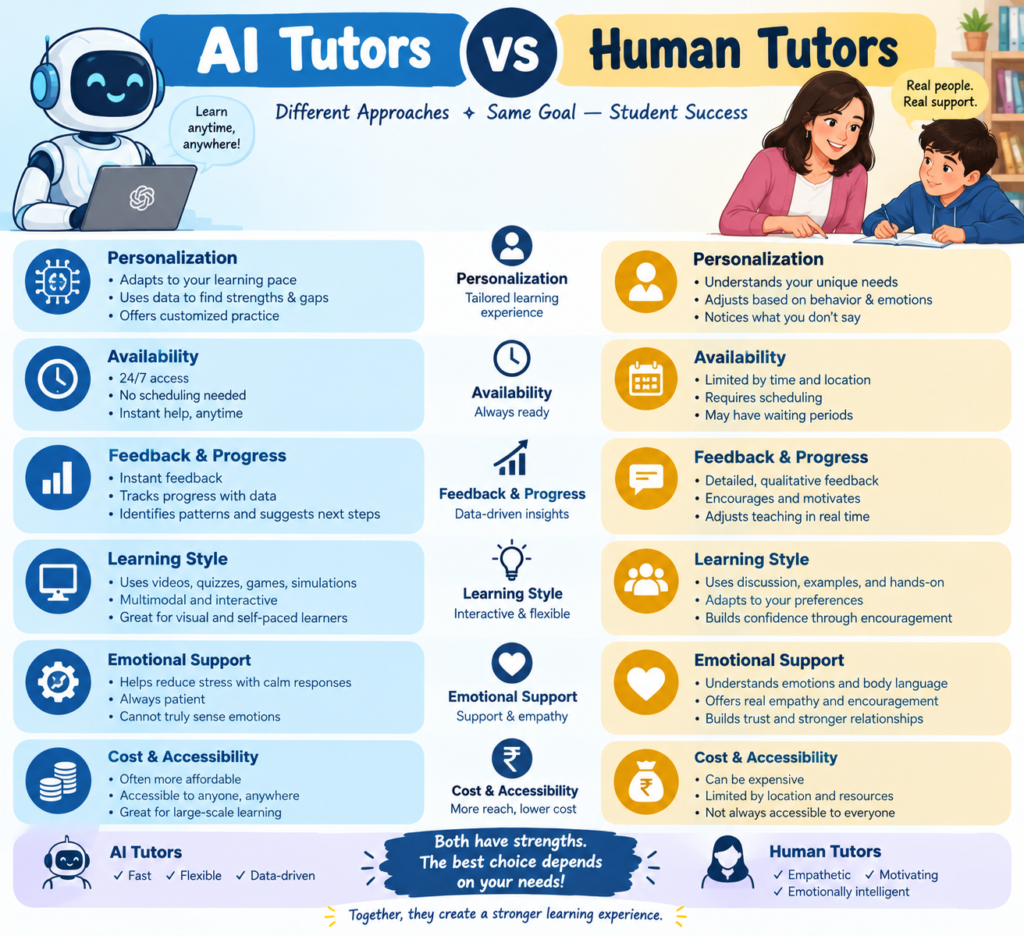
The debate around AI tutors vs human tutors often assumes that one option must replace the other. In practice, each has different strengths. AI tools are often useful for repeated practice, quick explanations, and flexible study sessions. Human tutors are especially valuable for emotional support, complex judgment, and adapting lessons to a student’s wider needs.
The right choice depends on the student, subject, budget, and learning goal.
AI Tutors vs Human Tutors: A Comparison
|
Feature |
AI tutors |
Human tutors |
|
Availability |
Often available on demand |
Depends on schedule |
|
Feedback |
Usually immediate |
May be immediate during a session |
|
Personal attention |
Depends on tool capabilities |
Can respond to personal context |
|
Emotional support |
Limited and simulated |
Human empathy and encouragement |
|
Practice questions |
Can generate many quickly |
Can create targeted exercises |
|
Accuracy |
May produce errors |
Can also make mistakes |
|
Progress tracking |
Available on some platforms |
Can assess progress through observation and tests |
|
Cost |
Free and paid options |
Usually session-based or salaried |
|
Motivation |
Reminders and prompts |
Personal encouragement and accountability |
|
Complex learning needs |
May require additional support |
Can adapt based on experience and judgment |
Neither option is perfect. Human tutors can also misunderstand students, and some AI tools provide highly structured learning experiences. The important question is which option best supports the student’s needs.
Where AI Tutors Perform Well
AI tutors are useful when students need frequent practice and fast explanations. For example, they can help with:
- Revising vocabulary.
- Practising multiplication.
- Understanding basic coding concepts.
- Creating flashcards.
- Reviewing grammar rules.
- Testing knowledge before an exam.
These activities often involve repeated questions and feedback, making them suitable for digital tools.
AI can also help students prepare questions before meeting a teacher.
Where Human Tutors Perform Well
Human tutors offer more than subject knowledge. They can notice when a student is distracted, identify signs of frustration, and change teaching methods based on personal observation.They can also challenge a learner to explain their reasoning rather than simply accept an answer.
For example, a student struggling with a complex physics concept may need a tutor to use physical objects, draw diagrams, ask follow-up questions, and observe how the student responds.
A human tutor can combine these methods and adjust the lesson in real time. Students who need structured accountability or additional personal support may also benefit from regular human sessions.
Why a Combined Approach Can Work Better
A blended learning model uses AI and human tutoring together. Students might use an AI tutor for daily practice and meet a human tutor once or twice a week to review difficult topics.
A practical example looks like this:
- The student studies a topic using a textbook.
- An AI tutor explains confusing terms.
- The student completes practice questions.
- A human tutor reviews mistakes and misunderstandings.
- The student practises independently before the next session.
This approach combines flexible digital support with human judgment.
It also helps students develop independence instead of relying entirely on either a person or a machine.
6. Can AI Replace Traditional Tutors?
So, can AI replace traditional tutors?
AI can replace so me tutoring tasks, but it cannot fully replace traditional tutoring in every situation. For some students, an AI tutor may provide enough support for basic practice, revision, and self-directed learning. Others may need a human tutor to explain complex ideas, provide motivation, or respond to specific learning difficulties.
The answer depends on the type of support required.
Subjects and Tasks Suited to AI Tutoring
AI tutoring can be particularly useful when a task has clear learning goals and students can verify the results.
Examples include:
- Mathematics: Practising equations and reviewing solution steps.
- Languages: Learning vocabulary and practising grammar.
- Science: Reviewing definitions and understanding basic processes.
- Computer science: Learning programming concepts and debugging simple errors.
- Exam preparation: Generating quizzes and revision questions.
- Writing: Improving sentence structure and identifying grammar problems.
In these areas, AI can help learners repeat tasks and explore different explanations. However, subject suitability depends on the tool’s accuracy and the level of difficulty. Advanced mathematics, scientific research, and complex programming still require careful checking.
When Students Need Human Guidance
Human support is especially valuable when a student has persistent difficulties or needs a more personal learning plan.
For example, a student may understand individual maths steps but struggle to connect them into a complete solution. A tutor can ask questions, observe the reasoning process, and identify the exact point of confusion.
Human guidance is also important when students need:
- Help building confidence after repeated failures.
- Support with motivation and study habits.
- Detailed feedback on essays and presentations.
- Guidance for complex projects.
- Individual support for learning differences.
- Preparation for oral exams or interviews.
In these situations, an AI tutor can still help, but it should not necessarily be the only source of support.
Why AI Should Support Teachers Rather Than Replace Them
Education includes academic learning, social development, critical thinking, and personal growth. Teachers and tutors help students develop these skills through discussion, collaboration, feedback, and example.
AI can support these efforts by reducing repetitive tasks and providing extra practice. It may also help teachers prepare quizzes, draft lesson materials, or identify topics that need more attention. However, educational decisions should remain under appropriate human supervision.
The goal should be better learning, not simply fewer human interactions.
7. How Can Students Use AI Tutors Effectively?
The benefits of AI-powered tutors depend on how students use them. Simply copying answers may help finish homework faster, but it does little to build understanding. Students should use AI as a learning partner rather than an answer machine.
Ask Questions That Encourage Learning
Instead of asking an AI tutor to complete an entire assignment, request a clear explanation of the difficult parts
For example, a student might ask:
- “Explain this concept using simple words.”
- “Give me three examples, starting with an easy one.”
- “Ask me questions to test my understanding.”
- “Show me where my solution went wrong.”
- “Give me a hint without revealing the final answer.”
These prompts encourage active thinking.
They also make it easier to notice whether the student truly understands the material.
Use AI for Practice, Not Just Answers
Practice is an essential part of learning.
After studying a topic, ask the AI tutor to create a short quiz. Complete it without looking at the answers, then review mistakes.
Try to explain each answer in your own words.
If the explanation feels unclear, ask for another example.
This process can improve recall and help students identify gaps in their knowledge.
Verify Important Information
AI tutors can make errors, so students should confirm important facts.
Use trusted textbooks, course materials, teacher guidance, and reliable educational sources.
When studying a topic that requires exact facts or calculations, compare the AI’s explanation with an authoritative source.
This habit builds critical thinking and reduces the risk of learning incorrect information.
Follow Academic Integrity Rules
AI should support learning without replacing a student’s own effort. Schools and universities have different rules about using AI for homework, assignments, and examinations. Students should follow the rules that apply to their course.
Responsible use includes:
- Understanding an answer before using it.
- Writing assignments in your own words.
- Disclosing AI assistance when required.
- Avoiding AI during prohibited tests.
- Never submitting generated work as your own when rules forbid it.
AI tutoring is most useful when it helps students build skills they can demonstrate independently.
Tips for Parents and Teachers
Parents and teachers can help students use AI safely and effectively.They can ask students to explain what they learned, check whether AI-generated information is correct, and discuss when human support is necessary.
They should also help students balance screen time with reading, discussion, practical activities, and independent work. A good learning plan gives students access to technology while maintaining clear goals and human guidance.
8. What Is the Future of AI Tutoring?
The future of AI tutoring will likely involve more personalized learning experiences and closer cooperation between technology and educators. As educational tools develop, they may become better at identifying learning gaps, supporting different languages, and offering explanations in multiple formats. However, progress will depend on accuracy, privacy, accessibility, and responsible design.
More Adaptive Learning Experiences
Future AI tutoring platforms may offer more flexible learning paths. A student could receive a lesson that adjusts to their progress, preferred language, and demonstrated knowledge.
For example, a learner who struggles with fractions might receive visual examples before moving to more advanced equations. Another student who masters the topic quickly could move to more challenging exercises.
Such systems could make practice more relevant, provided their recommendations are accurate and teachers can review them when needed.
Better Support for Teachers
AI may also help educators reduce repetitive work. Potential uses include drafting practice questions, creating alternative explanations, preparing revision materials, and summarizing student responses.
Teachers could then spend more time discussing ideas, supporting individual students, and planning classroom activities. These benefits are not automatic. Educators still need to check generated materials and ensure they are appropriate for the subject and age group.
More Focus on Responsible AI
As AI becomes more common in education, schools will need clear policies about privacy, fairness, accuracy, and academic honesty. Students must learn not only how to use AI but also how to question it.
They should understand that an answer can sound confident and still be wrong. The most effective education systems will likely combine digital tools with human judgment, transparent rules, and strong teaching practices.
The Future Is Likely to Be a Partnership
The future of AI tutoring does not have to be a contest between machines and people. AI can make practice more flexible and help students access explanations when they need them. Human tutors can provide encouragement, context, and deeper guidance.
Together, they may offer a stronger learning experience than either approach alone. The real measure of success will be whether students gain knowledge, build confidence, and learn to think independently.
AI Tutors Can Improve Learning, but Human Guidance Still Matters
AI tutors are changing how students study. They offer flexible access to explanations, repeated practice, quick feedback, and tools that can support personalized learning. These benefits make AI tutoring a valuable option for students who want to improve their skills and study more independently.
However, technology has limits. AI can make mistakes, misunderstand a student’s needs, and struggle to provide the human connection that many learners need. The strongest approach is to use AI for practice and support while keeping human guidance at the centre of education.
Students can use AI to explore topics, test their knowledge, and prepare questions. Human tutors and teachers can help them understand difficult ideas, stay motivated, and develop critical thinking. Ultimately, the goal is not to decide whether humans or AI are better. It is to use both wisely so students can learn more effectively, confidently, and responsibly.
Know More:
”FAQs”
1. Are AI tutors effective for students?
AI tutors can be effective for practice, revision, explanations, and immediate feedback. Their value depends on the quality of the tool and how students use it. Learners should verify important answers and seek human support when they remain confused.
2. Can AI replace traditional tutors completely?
No, not in every situation. AI can handle many routine learning tasks, but human tutors provide personal judgment, emotional support, and flexible guidance that AI cannot fully reproduce. A combined approach is often a practical choice.
3. What are the main benefits of AI-powered tutors?
The main benefits include flexible study times, quick feedback, repeated practice, personalized explanations, and potential cost savings. Some tools also provide learning analytics to help students identify areas that need improvement.
4. What are the disadvantages of AI tutoring?
AI tutors may give incorrect answers, misunderstand questions, and provide limited emotional support. Privacy concerns, unequal access to technology, and overdependence on automated answers are also important issues.
5. Are AI tutors cheaper than human tutors?
The best platform depends on the subject and learning goal. Students can explore tools such as Khan Academy, which provides educational resources and AI-supported learning features in some offerings, or general AI assistants for explanations and practice. Check current features, age requirements, privacy policies, and pricing before choosing a tool.
6. Can AI tutors help students prepare for exams?
Yes. Students can use AI tutors to generate practice questions, explain difficult topics, create revision plans, and review mistakes. They should compare the material with the official syllabus and avoid relying on AI-generated questions alone.
7. Will AI tutors replace teachers in the future?
AI may take on more routine teaching tasks, but teachers play a broader role in education. They guide discussions, support social development, assess student needs, and help learners build confidence. AI is more likely to become a teaching aid than a complete replacement for educators.
8. What are the best AI tutor platforms?
The best platform depends on the subject and learning goal. Students can explore tools such as Khan Academy, which provides educational resources and AI-supported learning features in some offerings, or general AI assistants for explanations and practice. Check current features, age requirements, privacy policies, and pricing before choosing a tool.