

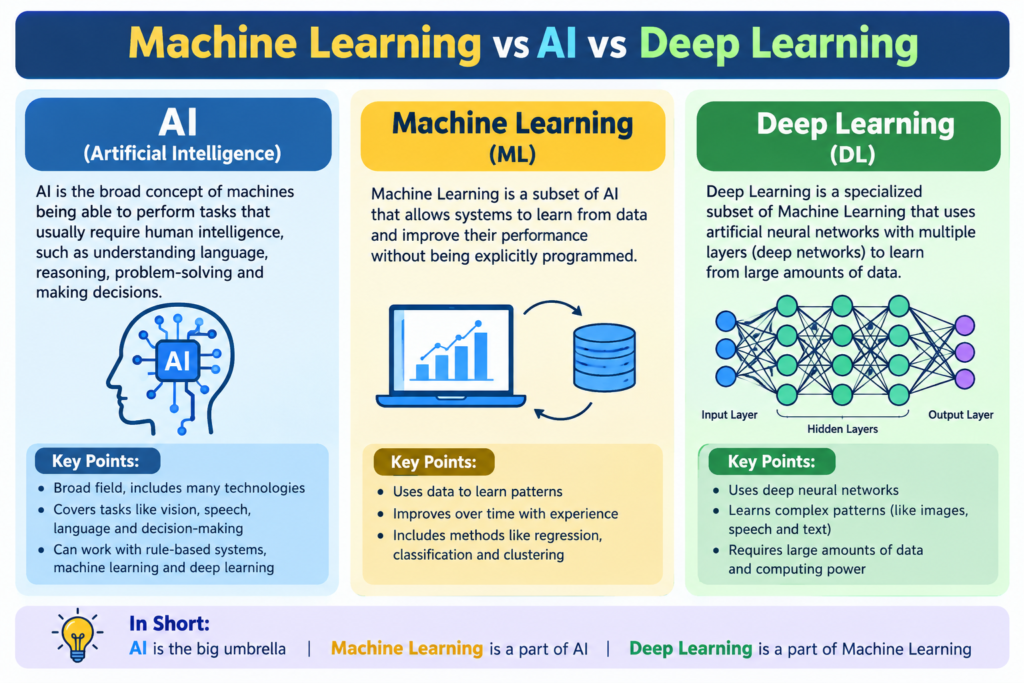
Machine Learning vs AI vs Deep Learning: Comparison
Artificial intelligence, machine learning, and deep learning are three of the most important technologies shaping the modern digital world. You may have heard these terms in news articles, college courses, job descriptions, or technology discussions. But are they really the same thing?
No. Artificial intelligence (AI), machine learning (ML), and deep learning (DL) are closely connected, but they have different meanings.
The easiest way to understand them is to think of them as levels of technology. Artificial intelligence is the broadest concept. Machine learning is a major part of AI, while deep learning is a specialized part of machine learning.
In simple terms:
AI is the big idea. ML is one way to achieve AI. DL is a more advanced way to perform machine learning using neural networks.
This guide explains AI vs ML vs DL in simple terms. It covers their differences, examples, applications, advantages, limitations, and career relevance.
AI vs ML vs DL at a Glance
Before going deeper, let’s look at the basic difference.
| Technology | Simple Meaning | Main Goal | Common Examples |
| Artificial Intelligence | Making machines perform intelligent tasks | Simulate intelligent behavior | Virtual assistants, expert systems, recommendation systems |
| Machine Learning | Teaching computers to learn patterns from data | Make predictions or decisions | Spam detection, price prediction, fraud detection |
| Deep Learning | Machine learning using large neural networks | Learn complex patterns from large data sets | Image recognition, speech recognition, generative AI |
The AI hierarchy can be understood like this:
Artificial Intelligence → Machine Learning → Deep Learning
This doesn’t mean every AI system uses ML or every ML system uses deep learning. Traditional AI can also use rules, logic, search, planning, and other techniques.
What Is Artificial Intelligence?
Artificial intelligence is the broader field of creating computer systems that can perform tasks that normally require human intelligence.
These tasks may include:
- Understanding language
- Recognizing images
- Solving problems
- Making decisions
- Planning actions
- Learning from information
- Understanding patterns
- Generating content
- Interacting with people
For example, imagine a computer system that can identify whether an email is spam. Another system may recommend a movie based on your interests. A voice assistant can understand your question and provide an answer.
All of these can be considered AI applications. AI isn’t limited to one technology. It can use different methods to solve different problems.
How Artificial Intelligence Works
An AI system usually receives information, processes that information, and produces an output.
A simple example is an AI customer-support system:
User question → AI system → Analysis → Response
The system may use natural language processing, machine learning, rules, databases, or deep learning models to produce the response.
Modern AI can also combine several technologies. For example, a smart application may use machine learning for recommendations, natural language processing for text, and deep learning for image analysis.
AI Applications in Daily Life
You probably use AI more often than you realize.
Common examples include:
- Search engines
- Voice assistants
- Recommendation systems
- Fraud detection
- Smart cameras
- Navigation applications
- Chatbots
- Translation tools
- Personalized advertising
- Generative AI tools
AI is also being used in education, healthcare, finance, manufacturing, transportation, retail, and many other industries.
The key point is simple: AI describes the larger goal of making computers perform intelligent tasks.
What Is Machine Learning?
Machine learning is a subset of artificial intelligence that allows computers to learn patterns from data and use those patterns to make predictions or decisions. Instead of programming every possible rule manually, developers give the system data and an algorithm. The algorithm learns useful patterns from that data.
For example, suppose you want to build a system that predicts house prices.
You could provide information such as:
- Location
- House size
- Number of rooms
- Property age
- Previous selling price
A machine learning model can study historical examples and learn relationships between these factors and house prices.
When new property information is provided, the model can estimate its price. This is one of the simplest ways to understand machine learning vs artificial intelligence. AI is the broader field. Machine learning is a method used to build AI systems.
How Machine Learning Works
A basic machine learning process looks like this:
Data → Training → ML Algorithm → Model → Prediction
The process usually involves several steps.
- Collect data
- Clean the data
- Prepare useful features
- Choose an ML algorithm
- Train the model
- Test the model
- Evaluate performance
- Deploy the model
- Monitor and improve it
Google’s machine learning resources also describe important stages such as feature engineering, modeling, evaluation, and deployment.
Types of Machine Learning
There are three major types of machine learning.
1. Supervised Learning
In supervised learning, the model learns from labeled examples.
For instance, you may provide thousands of emails marked as:
- Spam
- Not spam
The model learns patterns associated with each category.
Common uses include:
- Spam detection
- Sales prediction
- Customer churn prediction
- Medical classification
- Credit risk prediction
2. Unsupervised Learning
In unsupervised learning, the system works with data without predefined labels. The goal may be to discover hidden patterns or groups. For example, an online store could use customer data to discover groups of customers with similar purchasing behavior.
Common uses include:
- Customer segmentation
- Pattern discovery
- Anomaly detection
- Market research
- Data exploration
3. Reinforcement Learning
Reinforcement learning works through actions, rewards, and feedback.
The system tries different actions and learns which actions produce better results.
It can be useful in:
- Robotics
- Games
- Recommendation systems
- Autonomous systems
- Resource optimization
Machine Learning Examples
Some common machine learning examples include:
- Netflix-style recommendations
- Email spam filters
- Fraud detection
- Product recommendations
- Search ranking
- Demand forecasting
- Customer churn prediction
- Predictive maintenance
Machine learning is especially useful when large amounts of data are available and patterns need to be discovered.
What Is Deep Learning?
Deep learning is a specialized form of machine learning that uses artificial neural networks with multiple layers.
This is the main idea behind the deep learning vs machine learning comparison. All deep learning is machine learning, but not all machine learning is deep learning. Deep learning models can learn highly complex patterns from large amounts of data.
They are especially powerful for:
- Images
- Video
- Audio
- Speech
- Natural language
- Complex patterns
How Deep Learning Works
Deep learning uses structures called neural networks. A simplified neural network contains:
Input layer → Hidden layers → Output layer
The word “deep” refers to the use of multiple hidden layers.
Imagine giving a deep learning model a photograph of a dog.
The model may gradually learn different features:
Pixels → Edges → Shapes → Parts → Objects → Dog
The model can learn many of these patterns automatically from training data.
This makes deep learning different from many traditional ML approaches, where humans may need to select and prepare important features.
Deep Learning Examples
Common deep learning examples include:
- Face recognition
- Speech recognition
- Image classification
- Object detection
- Language translation
- Text generation
- Autonomous driving systems
- Medical image analysis
- Generative AI
Deep learning is also a major technology behind modern large language models and many generative AI systems.
Machine Learning vs Artificial Intelligence
The machine learning vs artificial intelligence question is one of the most common points of confusion.
The difference is mainly about scope. Artificial intelligence is the broader field. Machine learning is a subset of AI.
| Artificial Intelligence | Machine Learning |
| Broad field | Subset of AI |
| Goal is intelligent behavior | Goal is learning patterns from data |
| Can use rules and logic | Usually learns from data |
| May work without training data | Requires data for learning |
| Includes ML and other methods | Includes traditional and modern algorithms |
| Covers planning, reasoning, perception, and more | Focuses strongly on prediction and pattern learning |
For example, a rule-based expert system can be considered AI even if it doesn’t use machine learning.
So, when someone asks for the difference between machine learning and artificial intelligence, remember:
AI is the larger concept; ML is one approach used to create intelligent systems.
Machine Learning vs Deep Learning
The machine learning vs deep learning comparison is more specific because deep learning belongs to machine learning.
| Machine Learning | Deep Learning |
| Broader field within AI | Subfield of ML |
| Can use many algorithms | Mainly uses neural networks |
| Often works well with smaller data sets | Often benefits from large data sets |
| Feature engineering may be important | Can learn features automatically |
| Can work with lower computing power | Often needs more computing resources |
| Easier models can be simpler to explain | Complex models can be harder to interpret |
| Examples include decision trees and regression | Examples include CNNs and transformer-based models |
Traditional ML algorithms include:
- Linear regression
- Logistic regression
- Decision trees
- Random forests
- Support vector machines
- K-means clustering
Deep learning models include:
- Convolutional neural networks
- Recurrent neural networks
- Transformers
- Autoencoders
- Generative neural networks
The right choice depends on the problem, data, resources, and required performance.
Artificial Intelligence vs Deep Learning
The artificial intelligence vs deep learning comparison can be understood by looking at scope.
AI is the broadest concept.
Deep learning is much narrower.
Think of it like this:
AI → ML → DL
Artificial intelligence can use rules, logic, search, planning, machine learning, deep learning, and other methods.
Deep learning focuses mainly on neural-network-based learning.
For example, a simple rule-based chatbot can be AI without being deep learning.
A system that analyzes thousands of medical images using a neural network can use deep learning and therefore also fall under AI.
So, the difference between artificial intelligence and deep learning is primarily their scope and technology.
AI vs ML vs DL: Key Differences
Let’s bring everything together.
| Factor | AI | ML | DL |
| Full Name | Artificial Intelligence | Machine Learning | Deep Learning |
| Scope | Broadest | Subset of AI | Subset of ML |
| Main Focus | Intelligent behavior | Learning from data | Learning complex patterns |
| Algorithms | Rules, search, ML, logic, etc. | Regression, trees, clustering, etc. | Neural networks |
| Data Requirement | Varies | Usually required | Often large |
| Computing Need | Varies | Low to high | Often high |
| Human Feature Engineering | May vary | Often important | Often reduced |
| Common Uses | Automation and reasoning | Prediction and classification | Vision, speech, language |
| Complexity | Varies | Moderate to high | Often high |
AI vs ML vs DL Explained Simply
For beginners, use this simple example.
Imagine building a smart car.
AI is the overall goal of making the car intelligent.
ML helps the car learn from driving data and recognize patterns.
DL can help the car understand complex visual information from cameras and sensors.
Therefore:
AI is the goal and broader field, ML is a learning method, and DL is an advanced ML approach based on neural networks.
AI Hierarchy Explained
The relationship between these technologies is easier to understand as a hierarchy.
Artificial Intelligence
│
├── Rule-Based AI
│
├── Machine Learning
│ │
│ ├── Supervised Learning
│ ├── Unsupervised Learning
│ └── Reinforcement Learning
│
└── Deep Learning
│
├── Neural Networks
├── CNNs
├── RNNs
└── Transformers
This hierarchy is useful because it shows why people sometimes use these terms interchangeably even though they aren’t identical.
Where Does Generative AI Fit?
Generative AI is a type of AI that creates new content.
It can generate:
- Text
- Images
- Audio
- Video
- Code
Many modern generative AI systems rely heavily on deep learning. For example, large language models, often called LLMs, use deep neural networks to process and generate language.
Models based on the transformer architecture have become particularly important for modern language and multimodal AI systems. So, when comparing generative AI vs deep learning, remember that these terms describe different things.
Deep learning describes a technology used to build models. Generative AI describes a category of AI applications that create new content.
Generative AI, LLMs, and Deep Learning
Modern AI has made these concepts even more connected.
Large language models can process large volumes of text and generate human-like responses.
They are used for:
- Question answering
- Writing assistance
- Summarization
- Translation
- Coding
- Research assistance
- Customer support
- Content generation
The relationship can be simplified as:
AI → Machine Learning → Deep Learning → Modern foundation models → Generative AI applications
However, this isn’t a strict one-direction pipeline for every system. Different AI products can use different combinations of technologies. Transformer architecture has also changed how modern language systems process sequences and relationships within data.
This is why terms such as GPT models, LLMs, generative AI, deep learning, and natural language processing often appear together.
AI vs ML vs DL in Different Industries
These technologies are used across many industries, but their roles can be different.
AI vs ML vs DL in Education
In education, AI can support:
- Personalized learning
- Automated feedback
- Virtual tutors
- Student support
- Content recommendations
- Learning analytics
Machine learning can analyze student behavior and identify learning patterns.
Deep learning can support speech recognition, image analysis, and advanced language applications.For students, this means AI can make learning more personalized and accessible.
AI vs ML vs DL in Healthcare
Healthcare is another major area for AI applications.
AI can assist with:
- Medical decision support
- Patient management
- Scheduling
- Research
- Healthcare automation
Machine learning can help identify patterns in patient data. Deep learning can analyze medical images such as scans and X-rays.
However, healthcare AI requires careful validation, privacy protection, human oversight, and responsible deployment.
AI vs ML vs DL in Finance
Financial institutions use AI and ML for:
- Fraud detection
- Risk assessment
- Customer service
- Credit analysis
- Market analysis
- Transaction monitoring
Machine learning can identify unusual transaction patterns.
Deep learning can process more complex data and support advanced detection systems. Because financial decisions can have significant consequences, transparency, security, fairness, and human review are important.
AI vs ML vs DL for Students
If you’re a student, you don’t need to master everything at once.
Start with the basics.
Step 1: Learn AI Fundamentals
Understand:
- What AI means
- Types of AI
- AI applications
- Problem-solving
- Search and reasoning
- Basic ethics
Step 2: Learn Machine Learning
Next, understand:
- Data
- Features
- Labels
- Training
- Testing
- Model evaluation
- Supervised learning
- Unsupervised learning
- Reinforcement learning
You can then practice simple ML algorithms.
Step 3: Learn Deep Learning
After learning ML fundamentals, move toward:
- Neural networks
- Activation functions
- Backpropagation
- CNNs
- RNNs
- Transformers
- Model training
- Model evaluation
Step 4: Build Projects
Theory is useful, but projects make your knowledge stronger.
Try projects such as:
- Spam email classifier
- House price predictor
- Customer segmentation model
- Image classifier
- Sentiment analysis system
- Recommendation system
- Simple chatbot
This approach can help you understand AI vs ML vs DL for beginners without feeling overwhelmed.
AI vs ML vs DL in Data Science
Data science uses AI and ML to turn data into useful insights.
A typical workflow may look like:
Data collection → Data cleaning → Analysis → ML model → Evaluation → Business decision
Machine learning is particularly important in data science because it can help predict outcomes from historical data.
Deep learning becomes more useful when data is large and complex, especially for:
- Images
- Audio
- Video
- Text
- Natural language
Therefore, AI vs ML vs DL in data science isn’t about choosing one technology for every project.
The right method depends on the problem.
When Should You Use AI, ML, or Deep Learning?
There isn’t one technology that is always better.
Choose based on your goal.
Use Traditional AI When:
- Rules are clear
- Decisions can be represented logically
- Data is limited
- Explainability is important
- The problem doesn’t require learning from large data sets
Use Machine Learning When:
- You have useful historical data
- You need predictions
- Patterns are difficult to define manually
- The problem involves classification or forecasting
Use Deep Learning When:
- You have large amounts of data
- The data is complex
- You need advanced image or language understanding
- Traditional ML isn’t performing well enough
- You have suitable computing resources
In other words, don’t use deep learning simply because it sounds more advanced.
A simpler model may be faster, cheaper, easier to maintain, and easier to explain.
Advantages and Limitations
Each technology has strengths and weaknesses.
Artificial Intelligence
Advantages:
- Broad range of applications
- Can automate complex tasks
- Can combine different technologies
- Useful for reasoning and decision support
Limitations:
- Some AI systems can be difficult to build
- Results depend on system design
- AI may make incorrect decisions
- Responsible use is important
Machine Learning
Advantages:
- Learns patterns from data
- Useful for prediction
- Can automate classification
- Works across many industries
Limitations:
- Needs quality data
- Poor data can produce poor results
- Models can become biased
- Performance must be monitored
Deep Learning
Advantages:
- Excellent for complex patterns
- Powerful for images and language
- Reduces some manual feature engineering
- Supports many modern AI applications
Limitations:
- Can require large data sets
- Can require significant computing power
- Training can be expensive
- Models can be difficult to interpret
Common Misunderstandings About AI, ML, and DL
There are several myths worth clearing up.
Myth 1: AI and ML Are the Same
They’re not. Machine learning is one part of AI.
Myth 2: Every AI System Uses Deep Learning
Not necessarily. AI can also use rules, logic, search, planning, and other methods.
Myth 3: Deep Learning Is Always Better
Not always.
A simple ML model may be more appropriate for a small data set or a problem where interpretability matters.
Myth 4: More Data Always Means Better AI
Quality matters too.
Bad, biased, incomplete, or irrelevant data can reduce model performance.
Myth 5: AI Can Replace Human Judgment in Every Situation
AI can automate many tasks, but important decisions often require human oversight, domain knowledge, and responsible governance.
Understanding machine learning vs artificial intelligence vs deep learning doesn’t have to be complicated.
The relationship is straightforward:
Artificial Intelligence is the broadest concept.
Machine Learning is a major subset of AI.
Deep Learning is a specialized subset of machine learning.
AI focuses on creating systems that can perform intelligent tasks. Machine learning allows systems to learn patterns from data. Deep learning uses large neural networks to learn complex patterns, making it especially powerful for images, speech, language, and modern generative AI.
For students and beginners, the best approach is to learn these technologies step by step. Start with AI fundamentals, understand machine learning, and then explore deep learning. The technology will continue to change, but the basic concepts remain useful. Once you understand the relationship between AI, ML, and DL, topics such as LLMs, GPT models, generative AI, computer vision AI, natural language processing, and transformer architecture become much easier to understand.






Pingback: Beyond Job Replacement: How AI Could Change the Meaning of Work, Skills, and Human Purpose in 2026