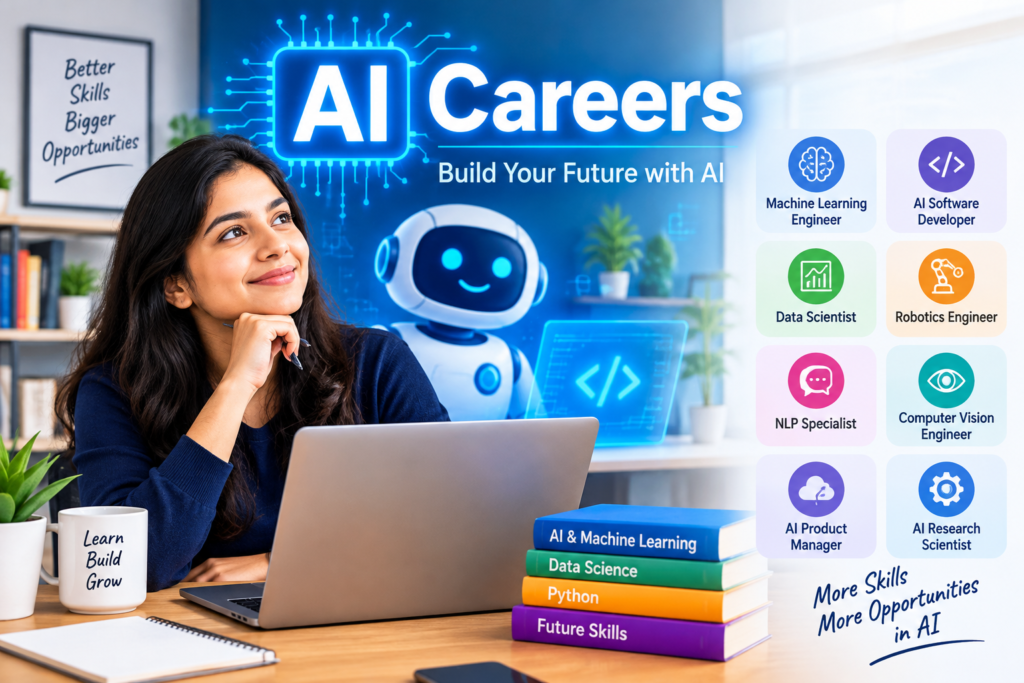
How AI Is Creating New Career Opportunities
Artificial intelligence is changing the way businesses operate, solve problems, and serve customers. Companies now use AI to analyze information, automate repetitive tasks, improve products, and make better decisions. As this technology becomes more common, it is creating new career opportunities for students, graduates, and experienced professionals.
AI careers are no longer limited to computer scientists or software engineers. Today, people can explore roles in AI development, data analysis, content creation, automation, business strategy, cybersecurity, and many other fields.
For example, a marketing professional can use AI to understand customer behavior. A healthcare specialist can use AI-powered tools to support medical research. A business graduate can help companies introduce AI into their daily operations.
These changes are opening doors for people with different educational backgrounds and professional interests.
However, getting an AI job requires more than knowing how to use a chatbot. Employers value people who can solve real problems, understand technology, communicate clearly, and apply AI responsibly.
This guide explores how AI is creating new career opportunities, the most promising jobs to consider in 2026, and the practical steps you can take to enter this growing field.
1. How AI Is Creating New Career Opportunities Understanding and How AI Is Changing the Job Market
Artificial intelligence refers to computer systems that can perform tasks that usually require human intelligence. These tasks include recognizing patterns, understanding language, generating content, and making predictions from data.
Machine learning, natural language processing, computer vision, and generative AI are important parts of this technology.
As businesses adopt these tools, their hiring needs are changing. Some tasks can now be completed faster, while other tasks require people with new technical and business skills.
Why Are AI Career Opportunities Growing?
There are several reasons behind the growing interest in artificial intelligence careers.
Business automation: Companies use AI to handle repetitive work, such as sorting documents, processing basic requests, and organizing information. This creates opportunities for people who can build, manage, and improve automated systems.
Data-driven decisions: Businesses collect large amounts of data. They need professionals who can turn that information into useful insights.
Generative AI adoption: Tools that generate text, images, code, and other content have created new needs in AI application development, quality testing, workflow design, and content operations.
Digital transformation: Organizations are updating their systems and processes. They need employees who understand both business needs and AI technology.
Responsible AI: AI systems can produce errors, expose sensitive information, or create unfair outcomes. Organizations need professionals who can assess these risks and support responsible implementation. Together, these changes are creating new opportunities across the technology sector and beyond.
How AI Is Changing Existing Careers
AI doesn’t always create a completely new job title. In many cases, it changes the skills required for an existing role.
| Traditional Role | How AI Changes the Work | Emerging Opportunity |
| Data analyst | Uses AI to speed up analysis | AI-assisted analytics specialist |
| Digital marketer | Uses AI for research and personalization | AI marketing strategist |
| Software developer | Uses AI coding assistants | AI application developer |
| Customer support agent | Uses AI-assisted response tools | AI support operations specialist |
| HR professional | Uses AI for workforce analysis | HR technology specialist |
| Business consultant | Uses AI for research and modeling | AI transformation consultant |
These examples show that career growth with AI can happen through both new jobs and the development of existing professional skills.
2. What New Careers Are Emerging Because of AI?
One of the most important changes in the AI job market is the growth of specialized roles. Companies need professionals who can build AI systems, connect them to business processes, check their outputs, and help teams use them effectively.
Some roles require advanced technical knowledge. Others focus on communication, research, product management, or business operations.
AI Engineers and Machine Learning Specialists
AI engineers build applications that use artificial intelligence. They may work on recommendation systems, language models, image recognition, or automated business processes.
Machine learning specialists focus on developing systems that learn from data. Their work can include selecting algorithms, training models, testing performance, and improving accuracy.
These careers are suitable for people who enjoy programming, mathematics, and solving complex problems.
Generative AI and Large Language Model Specialists
Generative AI can create new text, images, audio, video, and software code. Businesses use these capabilities for customer support, research, marketing, and product development.
This has increased interest in generative AI careers, including:
- Generative AI application developer
- Large language model (LLM) engineer
- AI workflow developer
- AI evaluation specialist
- Retrieval-augmented generation (RAG) developer
- AI agent application developer
These professionals help turn AI models into useful business applications. They also test results, improve reliability, and connect AI tools with company data.
Prompt Engineers and AI Workflow Designers
Prompt engineering involves designing instructions that help AI systems produce useful results. A prompt specialist may create structured instructions, test different approaches, and build reusable workflows.
However, prompt engineering isn’t limited to writing clever prompts. In many organizations, it overlaps with application development, process design, AI evaluation, and domain expertise.
For long-term career growth, professionals should combine prompting skills with another valuable skill, such as marketing, software development, research, or business analysis.
AI Consultants and Responsible AI Specialists
AI consultants help organizations identify where AI can create value. They assess business processes, recommend tools, estimate costs, and support implementation. Responsible AI specialists focus on issues such as privacy, transparency, fairness, security, and compliance.
These careers are important because companies need more than technology. They need professionals who understand how to use it safely and effectively.
Promising AI Careers to Explore in 2026
The best AI career depends on your interests, current skills, education, and preferred working style. Some positions require a technical degree, while others are accessible through relevant experience, practical projects, and focused training. Here are 15 career paths worth exploring.
1. AI Engineer
AI engineers develop software applications that use AI models. They may work with language models, recommendation systems, chatbots, or predictive tools.
Useful skills: Python, APIs, software development, model integration, and testing.
2. Machine Learning Engineer
Machine learning engineers build, train, and deploy models that learn from data.
Useful skills: Python, statistics, machine learning frameworks, data preparation, and model evaluation.
3. Data Scientist
Data scientists analyze information to identify patterns and help businesses make decisions. They may use machine learning, statistical models, and visualization tools.
Useful skills: Statistics, SQL, Python, data visualization, and critical thinking.
4. AI Researcher
AI researchers explore new methods, models, and techniques. They may work at universities, research laboratories, or technology companies.
Useful skills: Mathematics, research methods, programming, and deep learning.
5. Generative AI Developer
Generative AI developers build applications using models that generate text, images, code, and other outputs.
Useful skills: APIs, Python or JavaScript, LLM integration, evaluation, and application design.
6. LLM Engineer
LLM engineers work with large language models to create applications such as intelligent search tools, conversational assistants, and document analysis systems.
Useful skills: Model APIs, Python, embeddings, vector databases, RAG, and evaluation methods.
7. Prompt Engineer
Prompt engineers design, test, and improve instructions for AI systems. In some organizations, this work forms part of a broader AI development or operations role.
Useful skills: Clear writing, logical thinking, experimentation, and knowledge of the relevant industry.
8. AI Product Manager
AI product managers define product goals, understand user needs, coordinate technical teams, and measure product performance.
Useful skills: Product strategy, communication, data literacy, user research, and AI fundamentals.
9. AI Consultant
AI consultants help organizations select suitable tools and redesign workflows around AI.
Useful skills: Business analysis, process improvement, project management, and AI tool knowledge.
10. AI Automation Specialist
These specialists design workflows that connect AI tools with business applications. For example, they may automate document classification or lead management.
Useful skills: Workflow design, APIs, integration tools, testing, and process analysis.
11. AI Analyst
AI analysts evaluate AI performance, examine data, track results, and prepare reports for business teams.
Useful skills: Data analysis, spreadsheets, SQL, dashboards, and critical thinking.
12. AI Cybersecurity Specialist
These professionals help secure AI applications, detect unusual behavior, and reduce risks involving data, models, and system access.
Useful skills: Cybersecurity, networking, risk analysis, and AI security fundamentals.
13. AI Ethics and Governance Specialist
These specialists help organizations establish rules for responsible AI use. Their work can involve risk assessments, documentation, privacy, and regulatory requirements.
Useful skills: Policy research, analytical thinking, governance, communication, and knowledge of AI risks.
14. AI Marketing Specialist
AI marketing specialists use AI tools for audience research, content planning, campaign analysis, personalization, and performance reporting.
Useful skills: Digital marketing, SEO, analytics, content strategy, and AI-assisted research.
15. AI Trainer and Evaluator
AI trainers and evaluators assess model responses, label data, test outputs, and identify errors. Some roles require subject-matter expertise, language skills, or software knowledge.
Useful skills: Attention to detail, writing, research, quality assurance, and domain knowledge.
These roles represent different entry points into the AI industry. Before choosing one, review current job descriptions to understand the skills and qualifications employers expect.
4. Which Industries Are Creating AI Jobs?
AI is being adopted across many industries. This means artificial intelligence jobs aren’t limited to technology companies.
Healthcare and Life Sciences
Healthcare organizations use AI to support medical research, analyze medical images, manage information, and improve administrative processes.
Possible career paths include healthcare data analyst, medical AI researcher, clinical data specialist, and healthcare AI software developer.
AI systems in healthcare require careful validation and professional oversight. Technology supports qualified professionals rather than replacing the need for medical judgment.
Banking, Finance, and Insurance
Financial organizations use AI to identify unusual transactions, assess risks, analyze documents, and improve customer support.
Relevant roles include financial data scientist, fraud analytics specialist, AI risk analyst, and machine learning engineer.
These positions may require knowledge of finance, statistics, data privacy, and regulatory controls.
Education and E-Learning
Educational organizations use AI to support personalized learning, create practice materials, analyze student progress, and assist teachers with administrative tasks.
Career opportunities include educational technology developer, AI learning designer, learning analytics specialist, and instructional content specialist.
People with teaching experience can explore this field by combining their subject knowledge with AI tools.
Digital Marketing and E-Commerce
Marketing teams use AI to analyze search trends, segment audiences, generate content ideas, and improve customer experiences.
Potential roles include AI SEO specialist, marketing automation consultant, e-commerce analyst, and AI content operations specialist.
For example, an SEO professional can use AI to organize keyword research, identify content gaps, and summarize performance data. Human review remains essential for accuracy, originality, and search intent.
Manufacturing, Logistics, and Retail
AI supports demand forecasting, quality inspection, inventory planning, and supply chain optimization. Businesses may hire computer vision engineers, robotics specialists, operations analysts, and automation engineers. These careers often combine AI knowledge with engineering, logistics, or manufacturing expertise.
Agriculture, Energy, and Environmental Services
AI can support crop monitoring, resource planning, equipment maintenance, and environmental analysis. Possible roles include agricultural data analyst, geospatial AI specialist, energy forecasting analyst, and environmental data scientist.
The important point is simple: industry knowledge can be just as valuable as technical knowledge. Professionals who understand a real business problem can help organizations apply AI more effectively.
5. Essential Skills Needed for AI Careers
The skills required for AI jobs depend on the role. An AI researcher needs different expertise from an AI product manager or marketing specialist.
Still, most successful AI professionals benefit from a mix of technical ability, problem-solving, and communication.
Technical Skills
For technical AI roles, consider learning:
- Programming: Python is a useful starting point for data science and machine learning.
- Mathematics and statistics: Learn probability, basic statistics, and the mathematical ideas behind machine learning.
- Data analysis: Understand data cleaning, SQL, spreadsheets, and visualization.
- Machine learning: Study supervised learning, unsupervised learning, model evaluation, and overfitting.
- AI application development: Learn how APIs, databases, and software applications work together.
- Cloud and deployment: Explore how applications are hosted, monitored, and maintained.
You don’t need to master everything at once. Start with the skills required for your target role.
Generative AI and AI Tool Skills
Professionals should understand how to use AI tools effectively. This includes writing clear prompts, checking factual accuracy, protecting sensitive information, and evaluating outputs.
For technical roles, it may also include embeddings, vector search, RAG systems, model APIs, and AI agents. For non-technical roles, focus on workflows that improve real tasks rather than learning every tool on the market.
Human Skills That Matter
AI doesn’t remove the need for human judgment. In many roles, it increases the importance of skills such as:
- Communication and teamwork
- Creative problem-solving
- Critical thinking
- Business understanding
- Adaptability and continuous learning
- Ethical decision-making
A professional who can explain a technical problem in simple language may be more effective than someone who knows many tools but cannot work well with others.
How to Build Job-Ready AI Skills
The most effective approach is to combine learning with practical work. For example, build a simple customer support chatbot, analyze a public dataset, automate a repetitive spreadsheet task, or create an AI-assisted content research workflow.
Document what you built, why you built it, what tools you used, and how you tested the results. This makes your skills easier for employers to evaluate.
6. Can You Build an AI Career Without Coding?
Yes. Some AI career opportunities are accessible without advanced programming skills. However, the absence of a coding requirement doesn’t mean the job requires no expertise.
Businesses need people who understand their customers, processes, products, and industries.
AI Jobs for Non-Technical Professionals
| Career Path | Relevant Background | Useful Skills |
| AI marketing specialist | Marketing or communications | SEO, analytics, AI research |
| AI product coordinator | Business or product support | Planning, documentation, communication |
| AI workflow specialist | Operations or administration | Process mapping, automation tools |
| AI content editor | Writing or publishing | Editing, fact-checking, AI literacy |
| AI training specialist | Education or subject expertise | Instruction, assessment, documentation |
| AI governance assistant | Compliance or business operations | Research, policy, risk awareness |
| AI customer success specialist | Customer service or sales | Communication, troubleshooting, product knowledge |
Some employers may require technical experience even for these roles. Requirements vary by company and job level.
How to Use Your Existing Experience
Start with the work you already understand.
If you’re a teacher, explore AI-powered learning resources. If you work in marketing, learn AI-assisted analytics and campaign automation. If you have a business background, study AI implementation and process improvement.
This approach can be more practical than starting from zero in an unrelated technical field.
For people exploring AI jobs without coding experience, the best strategy is to develop strong domain knowledge and learn how AI can improve specific tasks.
7. AI Careers for Students and Fresh Graduates
Students and freshers can prepare for AI careers before they complete their education. They don’t need to wait for their first full-time job to gain practical experience. The key is to build a foundation, choose a direction, and demonstrate useful skills through projects and internships.
What Are the Best AI Jobs for Students?
Students can explore several entry-level paths, depending on their education and experience.
- AI research intern: Supports experiments, literature reviews, or data preparation.
- Data analyst intern: Works with datasets, reports, and dashboards.
- Machine learning intern: Assists with model development and evaluation.
- AI application intern: Helps build software that uses AI APIs.
- AI content evaluator: Reviews AI-generated responses for quality and accuracy.
- Automation intern: Helps document and improve business workflows.
- AI product intern: Supports product research, testing, and documentation.
Internship availability and eligibility vary. Some positions require a relevant degree or programming experience, while others emphasize analytical, language, or business skills.
A Four-Year AI Career Roadmap for Students
| Study Stage | Recommended Focus | Practical Goal |
| Year 1 | Programming, mathematics, digital literacy, and AI basics | Complete small learning projects |
| Year 2 | Data analysis, machine learning fundamentals, or a chosen specialization | Publish two practical projects |
| Year 3 | Advanced study, teamwork, internships, and open-source contributions | Gain real-world experience |
| Year 4 | Portfolio development, interview preparation, and targeted applications | Apply for suitable graduate roles |
Students from non-computer science backgrounds can adapt this roadmap to their field. For example, a finance student may focus on financial analytics, while a life sciences student may explore health data.
How to Find AI Internships
Search company career pages, university placement portals, recognized internship platforms, and professional networks.
Read each job description carefully. Check whether the position is paid, what qualifications it requires, and what work you’ll perform. Be cautious of opportunities that demand large upfront payments in exchange for guaranteed jobs or certificates.
8. How to Start a Career in AI: A Six-Step Roadmap
Starting an AI career can feel overwhelming because the field includes many technologies and job titles. A clear plan makes the process easier.
Step 1: Choose a Career Direction
Decide whether you prefer coding, data, business, marketing, research, or operations. You don’t need to make a permanent decision. Choose one area to explore for the next few months.
Step 2: Learn the Fundamentals
Build a basic understanding of AI, machine learning, generative AI, data, and responsible use. Technical learners can begin with Python and statistics. Non-technical learners can start with AI applications, process analysis, and domain-specific tools.
Step 3: Follow a Structured Course
Choose a course that matches your goal. Avoid enrolling in many courses without completing practical assignments. Look for lessons, exercises, projects, and clear learning outcomes.
Step 4: Build a Portfolio
Create two or three projects that demonstrate your ability to solve problems.
Examples include:
- A document question-answering assistant
- A dashboard that analyzes public data
- A simple AI-powered customer support tool
- An automated reporting workflow
- A content research and fact-checking process
Use public or synthetic data when possible. Don’t upload confidential company or customer information into AI tools without proper authorization.
Step 5: Gain Practical Experience
Apply for internships, entry-level positions, freelance projects, and suitable volunteer opportunities. You can also contribute to open-source projects or help a local organization solve a clearly defined problem.
Step 6: Prepare for Applications and Interviews
Update your resume to highlight relevant skills, projects, and measurable results.
Prepare to explain how your projects work, what limitations you encountered, and how you tested the output. Employers may care as much about your problem-solving process as the final result.
Consistency matters more than trying to learn every new AI tool.
9. AI Courses, Certifications, and Learning Resources
Artificial intelligence courses can help learners develop structured knowledge. However, a certificate alone doesn’t guarantee employment.
Choose learning resources based on the career you want to pursue.
Recommended Learning Resources
| Resource | Best For | What to Explore |
| Google Machine Learning resources | Beginners and technical learners | Machine learning concepts |
| Microsoft Learn | Technology professionals | AI fundamentals and practical learning paths |
| DeepLearning.AI | Learners interested in AI and deep learning | Machine learning and generative AI courses |
| Kaggle Learn | Data science beginners | Python, data analysis, and machine learning |
| Hugging Face Learn | Learners exploring modern AI models | Transformers, language models, and AI applications |
Check current course content, pricing, prerequisites, and certificate availability before enrolling.
How to Choose the Right AI Certification
Consider these questions:
- Does the course teach skills needed for your target job?
- Does it include practical exercises or projects?
- Is the provider recognized by employers in your field?
- Can you apply the learning to a real problem?
- Is the cost reasonable for your current budget?
For students, free or low-cost introductory resources can be a sensible starting point. You can invest in more advanced training once you understand which career path suits you.
10. Salary Potential and Career Growth in AI
AI jobs are often associated with strong earning potential. However, salaries vary significantly by location, industry, company, experience, and specialization.
A senior machine learning engineer may earn much more than an entry-level AI evaluator. Similarly, an experienced AI consultant with deep industry knowledge may have different earning potential from a junior technical professional.
What Influences AI Salaries?
Several factors affect compensation:
- Technical specialization: Advanced engineering and research roles may require scarce skills.
- Professional experience: Employers often pay more for people who can deliver reliable systems independently.
- Business impact: Professionals who can connect AI projects to measurable business outcomes may have stronger career prospects.
- Industry: Compensation differs across finance, healthcare, technology, manufacturing, and consulting.
- Location: Pay varies by country, city, and local labor market.
- Education and portfolio: Relevant qualifications and strong projects can help candidates demonstrate their capabilities.
High-Paying AI Jobs in 2026
Roles worth researching include AI engineer, machine learning engineer, LLM engineer, AI research scientist, AI security specialist, and experienced AI product manager.
These are potential high-paying AI jobs, not a guarantee of a particular salary. Current salary surveys and local job postings provide better estimates than a single global salary figure.
For a realistic comparison, examine at least ten recent job listings for your target role and location. Record the required skills, experience level, salary range where disclosed, and common qualifications.
How to Improve Long-Term Career Growth
Build expertise in a specific area rather than following every technology trend.
Keep improving your portfolio, learn from real projects, communicate your results, and understand the business problems behind your work.
AI tools change quickly, but the ability to learn, test ideas, and solve useful problems remains valuable.
11. Can AI Create More Jobs Than It Replaces?
AI can create new jobs, change existing roles, and reduce demand for some tasks. The overall employment impact is uncertain and will vary by industry, country, and occupation.
Some jobs involve tasks that are easier to automate. Other jobs require physical work, human relationships, professional judgment, or responsibility for complex decisions.
In many cases, AI changes part of a job rather than eliminating the entire role.
Understanding Automation and Employment
Consider a customer support team that introduces an AI assistant.
The system may handle routine questions, allowing employees to focus on difficult cases. The company might need fewer people for basic requests but more specialists to manage quality, escalation, system performance, and customer experience.
However, the outcome depends on the company’s workload, costs, business growth, and implementation choices. Not every automation project creates additional jobs.
How Workers Can Adapt
Employees can prepare for change by identifying tasks that AI may automate and developing skills that complement the technology.
Useful strategies include:
- Learn how AI tools affect your industry.
- Improve your ability to review and verify AI outputs.
- Develop communication and problem-solving skills.
- Gain experience with data and digital workflows.
- Learn a specialized skill that AI tools alone cannot deliver reliably.
- Stay informed about changes in your occupation.
Employers also have a role. Training, responsible implementation, and clear communication can help workers adapt to changing job requirements.
The goal isn’t to compete with every AI system at every task. It’s to become better at solving problems with technology while maintaining human judgment and accountability.
12. Future AI Workforce Trends to Watch
The AI job market will continue to evolve as technology improves and organizations learn where it provides real value.
Although no one can predict every future job title, several trends are worth watching.
Growth in Generative AI Applications
Companies are moving beyond basic experimentation and exploring how generative AI can support products, internal tools, customer service, and research.
This may create opportunities for application developers, LLM engineers, AI evaluators, and workflow specialists.
AI Agents and Workflow Automation
AI agents are designed to perform multi-step tasks with varying levels of autonomy. Businesses are exploring their use in research, software development, operations, and customer support.
As these systems become more widely used, organizations may need people who can design workflows, test outcomes, manage permissions, and monitor performance.
Responsible AI and Security
AI systems can introduce risks involving privacy, incorrect outputs, unfair decisions, and malicious use.
This creates a need for professionals who understand model evaluation, AI security, governance, and risk management.
AI Skills Across Non-Technical Industries
AI knowledge is becoming relevant to roles in education, finance, marketing, healthcare, logistics, and public services.
As a result, future career opportunities may increasingly favor professionals who combine AI literacy with subject expertise.
Human-AI Collaboration
The future workplace is likely to include more collaboration between people and AI systems.
People will still need to define goals, assess context, resolve difficult problems, and take responsibility for important decisions.
Workers who can use AI effectively without accepting every output blindly may be better prepared for changing job requirements.
13. How Businesses Can Support AI Career Development
AI career growth isn’t only an individual responsibility. Organizations can help workers develop the skills required for digital transformation.
Provide Practical AI Training
Companies should offer training that relates directly to employees’ work. For example, sales teams can learn AI-assisted research, while analysts can learn data automation and quality checks.
Practical learning helps employees understand both the benefits and the limitations of AI.
Create Internal Career Pathways
Employers can identify workers whose current skills transfer to new roles.
A reporting analyst may move toward analytics engineering. A customer support specialist may develop into an AI operations role. A marketing professional may specialize in AI-assisted campaign management.
These transitions can reduce the need to start an entirely new career from scratch.
Establish Responsible AI Practices
Organizations should explain which tools employees can use, what data must remain private, and how AI-generated work should be reviewed.
Clear rules help protect customers, employees, and business information.
Measure Outcomes, Not Tool Usage
Using AI isn’t a business result by itself. Organizations should evaluate whether AI improves quality, reduces unnecessary work, supports customers, or increases productivity.
This approach also helps identify which AI skills create genuine value and deserve further investment.
Prepare for the Future With AI Career Opportunities
Artificial intelligence is creating new career opportunities across technology, business, healthcare, education, finance, and many other industries. From AI engineers and data scientists to marketing specialists, consultants, and AI evaluators, there are several paths for people with different interests and backgrounds.
However, success in AI isn’t simply about learning to use the latest tool. It requires a clear career direction, relevant skills, practical experience, and the ability to solve real problems.
Students can begin with foundational learning and internships. Working professionals can add AI skills to their existing expertise. Beginners without coding experience can explore business, marketing, operations, and other roles where AI knowledge supports their work.
Start with one career path, complete a small project, and build your skills step by step. Review current job requirements and keep learning as the technology changes.
Know More:
”FAQs”
1. What career opportunities does AI create?
AI creates opportunities in machine learning, AI engineering, data science, generative AI development, AI consulting, automation, cybersecurity, product management, and AI governance. It also changes existing careers in marketing, finance, education, healthcare, and business operations.
2. How is AI changing careers?
AI automates some repetitive tasks, supports faster analysis, and changes how professionals complete their work. It also creates demand for skills such as AI application development, model evaluation, workflow automation, and responsible AI use.
3. What are the best AI jobs for students?
Students can explore AI internships, data analyst roles, machine learning internships, AI application development, AI evaluation, and automation. The best option depends on their education, interests, practical skills, and experience.
4. Can AI create more jobs than it replaces?
AI can create new jobs while reducing demand for some existing tasks. Whether it creates more jobs than it replaces depends on factors such as industry growth, technology adoption, business investment, and worker retraining. The overall effect remains uncertain.
5. Which industries are hiring AI professionals?
Technology, finance, healthcare, education, manufacturing, retail, logistics, and consulting are among the industries applying AI. Hiring demand varies by location, company, and role, so candidates should check current job listings.
6. How can beginners start a career in AI?
Beginners should choose a target role, learn the required fundamentals, complete a structured course, build practical projects, and apply for internships or entry-level jobs. They should also develop communication, critical thinking, and problem-solving skills.
7. What skills are required for AI jobs?
Technical roles may require Python, statistics, machine learning, SQL, data analysis, and software development. Non-technical roles may require AI tool knowledge, communication, business analysis, workflow design, and domain expertise.
8. Are AI careers in demand?
AI skills are receiving attention across many industries, but demand varies by role and region. Candidates should examine recent job postings and employer requirements instead of assuming every AI-related job title has strong demand.
9. What are the highest-paying AI careers?
Experienced AI engineers, machine learning engineers, LLM engineers, AI research scientists, and certain AI product leaders may earn high salaries. Actual compensation depends on expertise, experience, location, and the employer.
10. How will AI impact future employment?
AI will likely change tasks in many occupations, create some new roles, and reduce demand for certain types of work. Continuous learning, practical AI skills, and the ability to adapt will help workers respond to these changes.