
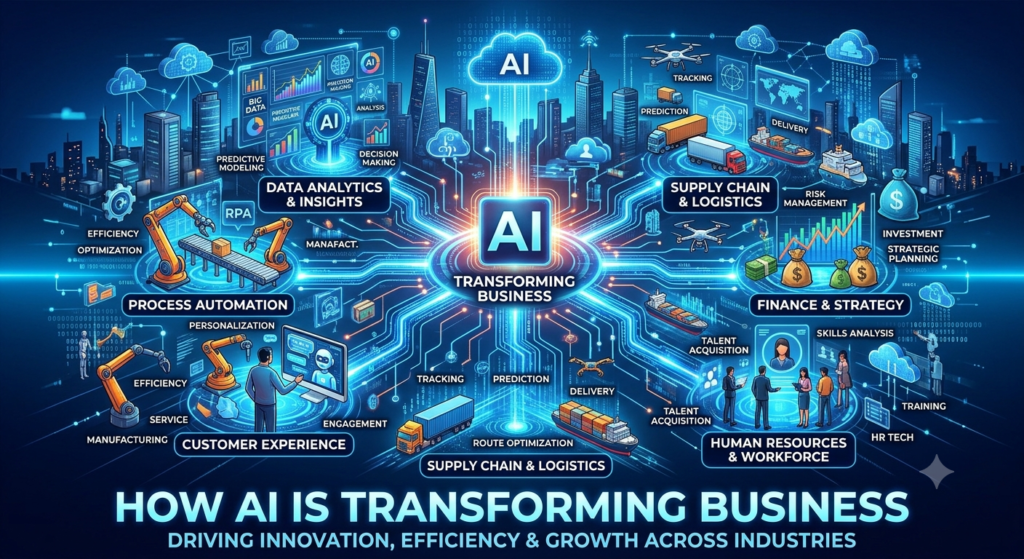
How AI Is Transforming Business Decision-Making in 2026
Every business makes decisions every day. Some decisions are small, such as choosing a meeting time. Others are more important, such as setting prices, hiring staff, launching products, or entering new markets.
In the past, many companies relied on experience, manual reports, and basic data analysis to make these choices. These methods still have value. However, modern businesses collect more data than ever before. Reviewing all this information by hand can take too much time.
This is where artificial intelligence can help.
AI decision making allows businesses to study large amounts of data, identify patterns, and find useful insights. It helps managers understand what is happening, why it is happening, and what might happen next.
Today, AI is changing how companies plan their work, manage risks, serve customers, and improve results. It can support faster decisions and help teams use their resources more wisely.
However, AI isn’t a replacement for human judgment. It works best when people combine its insights with their knowledge, experience, and understanding of business goals.
In this article, we’ll explore how AI is transforming business decision-making, the benefits it offers, the challenges companies should consider, and the steps they can take to use it effectively.
1. What Is AI Decision Making?
AI decision making is the use of artificial intelligence to analyze information, identify patterns, compare options, and support business choices. It combines data, algorithms, and machine learning to help people make informed decisions. Depending on the system, AI may also suggest actions or carry out routine tasks within approved limits.
For example, a retail company may use AI to study sales records, seasonal demand, and customer behavior. The system can estimate which products may sell well next month. Managers can then use this information to plan stock levels. In simple terms, AI helps businesses turn raw data into useful information.
How Does Artificial Intelligence Decision Making Work?
Most AI decision-making systems follow a series of steps.
- Collect data: Gather information from sales systems, websites, customer records, and other sources.
- Prepare the data: Remove errors, handle missing values, and organize the information.
- Analyze patterns: Use machine learning and other methods to identify trends and relationships.
- Generate insights: Produce forecasts, recommendations, alerts, or possible outcomes.
- Review the results: Let people assess the recommendations and check their accuracy.
- Take action: Choose a suitable action and measure the results.
- Improve the process: Use new information and feedback to improve future decisions.
The process may vary depending on the business problem. A simple system might produce a report, while a more advanced system might recommend actions based on changing conditions.
Key Technologies Behind AI Decision Making
Several technologies support AI business decisions.
|
Technology |
How It Helps Businesses |
|
Machine learning |
Finds patterns in historical and current data |
|
Predictive analytics |
Estimates future events and business outcomes |
|
Natural language processing |
Helps systems understand written or spoken language |
|
Generative AI |
Summarizes information and creates reports or recommendations |
|
Business intelligence |
Turns business data into reports and dashboards |
|
Data science |
Uses statistical methods and models to solve business problems |
These technologies can work together. For instance, a business intelligence dashboard may display a sales forecast created by a machine learning model. The goal isn’t to use every technology. It’s to choose the right tools for the business problem.
2. How AI Is Transforming Business Decision-Making
The way companies make decisions is changing because AI can process information quickly and uncover patterns that might be difficult to find through manual analysis. Here are the main ways AI is changing business decisions.
Faster Data Analysis
Traditional data analysis may require teams to collect information from several sources, prepare spreadsheets, and create reports. This process can delay important decisions.
AI can automate many of these steps. It can process large datasets, highlight unusual changes, and provide summaries that help teams understand their performance.
For example, an online store can use AI to review daily sales, advertising costs, and website activity. Managers can identify which products are gaining attention and which campaigns need improvement.
Faster analysis doesn’t guarantee better decisions, but it gives teams more time to review their options.
Better Pattern Recognition
Business data often contains patterns that aren’t easy to see. A company may notice that sales increase during certain months. However, AI analytics may help identify additional relationships between product demand, customer location, price changes, and marketing activity.
These findings can help managers understand business performance more clearly.
Still, a pattern doesn’t always prove that one event caused another. Teams should test important findings before making major changes.
More Accurate Forecasting
Business forecasting helps companies estimate future demand, costs, revenue, and resource needs. AI can use historical information and current signals to develop forecasts. These forecasts can be updated when new data becomes available.
For example, a manufacturing company can estimate demand for different products and adjust its production schedule. This may help reduce excess stock and prevent shortages. Forecast accuracy depends on the quality of the data, the model used, and changes in market conditions.
Real-Time Business Insights
Some business decisions need quick attention. AI systems can monitor selected data and alert teams when something unusual happens. A sudden drop in website conversions, a rise in support requests, or an unexpected increase in operating costs may trigger an alert.
Managers can investigate the issue and respond sooner.
This type of operational intelligence is especially useful when businesses need to monitor performance throughout the day.
Less Repetitive Work
AI can automate routine activities such as report preparation, data classification, and basic trend summaries. This reduces manual work and gives employees more time to focus on planning, problem-solving, and customer relationships.
As a result, AI can support a more efficient decision-making process without removing the need for human review.
3. Seven Powerful Benefits of AI in Business Analytics
The benefits of AI in business analytics go beyond saving time. When used carefully, AI can help businesses understand performance, manage uncertainty, and improve how they use resources.
1. Improved Decision Quality
AI can compare information from different sources and show possible options. Managers can use these insights to make decisions based on evidence rather than assumptions alone.
For example, a business considering a new product can study customer interest, sales trends, and competitor information before investing.
AI supports the decision, but managers must still consider factors that the available data may not capture.
2. Greater Operational Efficiency
AI can identify delays, repeated tasks, and inefficient processes. A logistics company might analyze delivery records to find routes that often cause delays. It can then review alternative routes and improve delivery planning. Better planning can reduce wasted time and support business optimization.
3. Lower Operating Costs
AI can help businesses identify unnecessary expenses and use their resources more effectively.
For example, a company may use demand forecasts to reduce overproduction or analyze energy usage to identify periods of high consumption. However, AI tools also have costs, including software, training, maintenance, and data preparation. Companies should measure the total cost against the value they receive.
4. Better Customer Experience
AI can help companies understand customer needs, preferences, and common problems. Businesses can use these insights to improve product recommendations, personalize communication, and identify reasons for customer dissatisfaction. When customers receive relevant information and faster support, their experience may improve.Companies must still respect customer privacy and avoid using personal information in ways customers wouldn’t reasonably expect.
5. Stronger Risk Management
AI can help detect unusual transactions, changes in customer behavior, and potential operational problems. For example, a financial team can use anomaly detection to flag transactions that require further review.
These alerts don’t automatically prove fraud or wrongdoing. Human investigation is often necessary before action is taken.
6. More Effective Resource Planning
AI can help managers estimate how much staff, stock, equipment, or budget they may need.
A service business, for example, can forecast support demand and schedule employees accordingly.
This can help teams avoid both overstaffing and understaffing.
7. New Business Opportunities
AI insights can reveal customer needs, changing demand, and gaps in existing services.
A company may discover that a specific customer group has growing demand for a product it doesn’t currently offer.
Managers can investigate the opportunity, test the idea, and decide whether it fits their business strategy.
The best results come when businesses turn insights into practical action and measure what happens next.
4. How Companies Use AI for Decision Making
AI can support many departments. Each team can use it to answer different questions and improve its daily work.
Sales and Marketing
Sales and marketing teams use AI to understand customer behavior, evaluate campaigns, and improve lead management.
AI can help answer questions such as:
- Which campaigns bring valuable customers?
- Which products may interest a particular audience?
- Which leads are more likely to become customers?
- Where should the marketing budget be adjusted?
For example, a marketing team can analyze website traffic, conversion rates, and advertising costs to identify campaigns that deserve further testing.
AI recommendations should be checked against reliable performance data. A campaign with many clicks may not generate meaningful revenue.
Finance and Accounting
Finance teams can use AI to support budgeting, cash flow forecasting, expense analysis, and anomaly detection.
A company may compare expected revenue with actual results and investigate unusual changes. AI can also help summarize financial reports and highlight areas that need attention.
Financial decisions require care. Important forecasts should be checked against assumptions, market conditions, and relevant financial controls.
Human Resources
HR teams can use AI to support workforce planning, estimate staffing needs, and summarize employee feedback.
For instance, a company may analyze workforce trends to understand where additional training could help.
However, AI used in recruitment, performance reviews, or promotion decisions can create serious fairness risks. Businesses should test these systems for bias and keep qualified people involved in consequential decisions.
Supply Chain and Operations
AI can help companies predict product demand, monitor stock, and identify supply chain risks.
A distributor may combine historical sales, supplier lead times, and seasonal trends to estimate inventory needs.
This can improve planning and reduce avoidable delays. Still, teams should account for unexpected events, such as supplier failures or sudden market changes.
Customer Service
AI chatbots and virtual assistants can answer common questions, guide customers through routine processes, and direct complex requests to human agents.
Customer service managers can also analyze support conversations to identify common complaints and areas where products need improvement.
The aim is to make support more useful, not to force every customer through an automated system.
5. Predictive Analytics and Business Forecasting
Predictive analytics is one of the most useful applications of AI in business. It uses historical data, statistical methods, and machine learning to estimate what may happen in the future.
Businesses can use predictive analytics with AI to prepare for possible outcomes rather than react only after a problem occurs.
Common Uses of Predictive Analytics
Predictive analytics can support several business activities.
|
Business Area |
Example of Predictive Analytics |
|
Sales |
Estimate future revenue |
|
Retail |
Forecast product demand |
|
Marketing |
Predict conversion likelihood |
|
Finance |
Estimate cash flow |
|
Operations |
Predict equipment failures |
|
Customer service |
Forecast support demand |
|
Human resources |
Estimate future staffing needs |
These applications can help managers plan budgets, assign resources, and prepare for changing conditions.
How Predictive Modeling Supports Decisions
Predictive modeling uses data and mathematical methods to estimate a result. Suppose a subscription business wants to understand which customers may cancel their subscriptions. It can develop a model using relevant historical data, such as usage patterns and past cancellations.
The model can identify customers who may need attention. The company can then investigate the reasons and offer suitable support.
A prediction is not a certainty. Some customers flagged by the model will stay, while others may leave without being flagged.
Businesses should evaluate model performance and check whether predictions remain reliable over time.
The Limits of Business Forecasting
Forecasts are only as useful as their assumptions and data.
A model trained on normal market conditions may struggle during a major economic shift. Missing records, outdated information, and changing customer preferences can also reduce accuracy.
For this reason, businesses should compare forecasts with actual results, test different scenarios, and update their models when needed.
AI is most valuable when it helps teams prepare for uncertainty instead of promising a perfect view of the future.
6. AI Business Intelligence and Data-Driven Decisions
Business intelligence helps companies collect, organize, and present information about their performance. Traditional business intelligence often relies on reports and dashboards, while AI can add forecasting, anomaly detection, automated summaries, and natural-language queries.
Together, these capabilities can make business information easier to explore.
From Reports to AI Insights
A traditional dashboard may show that website traffic has fallen by 15% compared with the previous week.
An AI-enabled analysis may help identify which traffic sources changed, whether the decline is linked to a specific landing page, and which other metrics moved at the same time.
The team can then investigate the cause and decide what to do.
AI insights are useful starting points, but they should not be treated as proven explanations without further analysis.
How AI Improves Business Intelligence
AI can improve business intelligence in several ways:
- Automated summaries: Turn complex reports into clear explanations.
- Anomaly detection: Highlight unusual changes in key metrics.
- Trend analysis: Identify patterns across periods or business segments.
- Forecasting: Estimate likely future performance.
- Natural-language questions: Help users explore data using everyday language.
For example, a manager may ask, “Which landing pages generated the most conversions this month?”
A suitable system can query the underlying data and present the results. The accuracy of the answer depends on the data structure, definitions, permissions, and system configuration.
Building Reliable Data-Driven Decisions
Businesses need consistent data to make meaningful comparisons.
If two teams define a conversion differently, their reports may show different results even when they use the same source data.
To avoid this problem, companies should define key performance indicators, document data sources, and review data quality regularly.
A reliable business intelligence process combines clear metrics, accurate reporting, and human interpretation.
7. AI for Strategic Business Planning
Strategic planning involves setting long-term goals and deciding how to achieve them. AI can help businesses evaluate options, understand risks, and prepare for different future conditions.
Market and Competitor Analysis
Companies can use AI tools to summarize public reports, review customer feedback, and organize market research. These insights may help identify changes in customer needs or emerging market trends.
However, AI-generated summaries can miss context or contain errors. Teams should verify important claims against original sources before using them in strategic plans.
Scenario Planning
Scenario planning helps companies explore different possible futures. For example, a business may compare what could happen if demand rises, remains stable, or falls. AI can help estimate the possible impact on revenue, inventory, and staffing.
Managers can then develop plans for each scenario. This approach makes strategic planning more flexible. Instead of depending on one forecast, businesses can prepare for several outcomes.
Smarter Investment Decisions
AI can help compare investment options by organizing relevant data, estimating possible outcomes, and highlighting risks. A company considering new equipment, software, or market expansion can use these insights to support its evaluation.
Still, AI should not make major investment decisions without proper financial review, risk assessment, and management approval. The purpose of AI for strategic business planning is to improve the quality of the discussion, not to remove accountability.
8. AI-Powered Decision Support Systems
AI-powered decision support systems help people evaluate information and choose between possible actions. These systems may combine databases, business rules, predictive models, dashboards, and recommendation engines.
For example, a delivery company may use a decision support system to compare routes based on distance, expected traffic, delivery deadlines, and vehicle capacity. The system can recommend a route, while an operations manager reviews unusual conditions before approving the plan.
AI Recommendations and Human Judgment
AI can analyze information at a scale that would be difficult for a person to handle manually. However, people understand context, values, relationships, and responsibilities in ways that automated systems may not.
A good decision-making process combines both strengths.
AI can help identify options, estimate outcomes, and flag risks. People can check assumptions, consider wider effects, and make the final choice when judgment is needed.
Choosing the Right Level of Automation
Not every decision should have the same level of automation.
|
Decision Type |
Suitable Approach |
|
Routine report generation |
High automation with basic checks |
|
Inventory alerts |
Automated alerts with staff review |
|
Marketing recommendations |
AI suggestions with human evaluation |
|
Hiring and promotion |
Strong human oversight and fairness checks |
|
Major financial commitments |
Formal review and authorized approval |
The right approach depends on the potential impact of an error, the reliability of the system, and the rules that apply to the business. Companies should establish clear limits before allowing AI systems to take action.
9. Challenges and Risks of AI Decision Making
AI offers many opportunities, but businesses need to understand its limits. A poor implementation can waste money, produce misleading results, or damage customer trust.
Data Quality Problems
AI systems depend on the information they receive. If the data is incomplete, outdated, duplicated, or inaccurate, the system may produce poor recommendations.
Businesses should clean their data, document its source, and create processes for correcting errors.
Bias and Unfair Outcomes
AI can reproduce unfair patterns found in historical data.
For example, a system trained on biased recruitment records may recommend candidates in ways that disadvantage certain groups.
Companies should test models for unfair outcomes, review important decisions, and provide ways to challenge errors.
Privacy and Security
Business data may include personal information, financial records, and confidential plans.
Companies should limit access to sensitive information, use suitable security controls, and follow applicable privacy laws.
Employees should also understand which information they can safely enter into AI tools.
High Costs and Skills Gaps
AI projects may require software, technical expertise, data preparation, training, and ongoing maintenance.
Businesses should estimate these costs before investing. Starting with a small project can help them understand the benefits without making a large initial commitment.
Overreliance on AI
An AI-generated answer can sound confident even when it’s incorrect.
Managers should verify important recommendations, question unexpected results, and compare AI outputs with other evidence.
The goal is not to trust every answer. It’s to use AI responsibly as one part of a sound decision-making process.
For practical guidance, businesses can review the NIST AI Risk Management Framework, which provides guidance for managing risks associated with AI systems.
10. How to Build an Effective AI Strategy
A clear AI strategy helps companies choose useful projects and measure their value. Businesses don’t need to automate everything at once. They can begin with a specific problem and expand after learning what works.
Step 1: Define the Business Problem
Start by identifying a problem that affects performance.
For example, a company may struggle with inaccurate demand forecasts, slow reporting, or high customer support volumes.
A clear problem makes it easier to select an appropriate AI solution.
Step 2: Set Measurable Goals
Decide what success should look like.
Possible measures include:
- Reduced report preparation time
- Improved forecast accuracy
- Lower operating costs
- Faster customer response times
- Higher conversion rates
- Fewer inventory shortages
Record current performance before introducing AI. This provides a baseline for comparison.
Step 3: Review Data Readiness
Check whether the required data is available, accurate, relevant, and legally usable.
If the data is poor, improve it before relying on advanced models.
Good data preparation often matters more than choosing a complicated AI tool.
Step 4: Choose Suitable Tools
Select technology based on the task, budget, security needs, and team skills.
Some businesses may need an existing analytics platform. Others may benefit from a custom model or an AI feature already included in their business software.
Avoid paying for features that don’t support a clear business goal.
Step 5: Run a Small Pilot
Test the solution on a limited scale.
For example, a retailer might test AI-based demand forecasting for one product category before expanding it across the business.
Compare the results with the previous process. Record errors, costs, time savings, and user feedback.
Step 6: Train Employees
Employees need to understand what the system does, what it cannot do, and when they should question its recommendations.
Training should cover data handling, verification, responsible use, and the process for reporting problems.
Step 7: Monitor and Improve
AI systems need regular review.
Track their performance, check for changing data patterns, and update processes when the business environment changes.
A successful AI strategy is an ongoing effort, not a one-time software installation.
11. The Future of AI in Business Decision-Making
AI will continue to influence how businesses collect information, evaluate options, and plan their work.
Several developments are likely to shape this area.
More Accessible Analytics
AI tools are making data analysis easier for employees who don’t have advanced technical skills.
Natural-language interfaces may help more teams ask questions about business data and explore performance without writing complex queries.
However, users still need to understand basic metrics and verify the results.
More Connected Business Systems
Businesses may increasingly connect AI with sales platforms, customer relationship management systems, finance software, and operational tools.
This can provide a broader view of business performance and reduce the need to move information manually between systems.
Strong access controls and reliable data integration will remain essential.
More Scenario-Based Planning
AI can help companies compare different plans and estimate their possible effects.
Managers may use these capabilities to test pricing changes, staffing plans, supply chain adjustments, and investment options.
The usefulness of these scenarios will depend on the quality of the underlying assumptions.
Responsible and Explainable AI
As AI becomes more involved in important decisions, businesses will need better ways to understand and review its recommendations.
Clear documentation, human oversight, regular testing, and strong governance can help build trust.
Ultimately, the future of AI business decisions will depend not only on smarter technology but also on how responsibly companies use it.
AI is changing how companies understand their performance and make decisions. It can help teams analyze large amounts of information, identify patterns, forecast future needs, and respond to business challenges more effectively.
From sales and marketing to finance, operations, and strategic planning, AI can support better use of data and resources. Predictive analytics, AI business intelligence, and decision support systems can help companies move from reactive choices toward more informed planning.
However, AI isn’t a magic solution. Its value depends on accurate data, suitable tools, clear goals, and responsible use. Human judgment remains important, especially when decisions affect people, finances, or long-term business direction.
The best way to begin is simple: identify one business problem, select a suitable AI solution, test its performance, and measure the results.
When businesses combine reliable data, useful AI insights, and human experience, they can build a stronger foundation for smarter decisions and sustainable growth.
Know More: