Artificial Intelligence Is Transforming Small Businesses
Running a small business is not easy. Owners have to manage sales, marketing, customer service, finances, employees, and daily operations. They also need to find new customers and compete with larger companies. Managing all these tasks takes time, money, and effort.
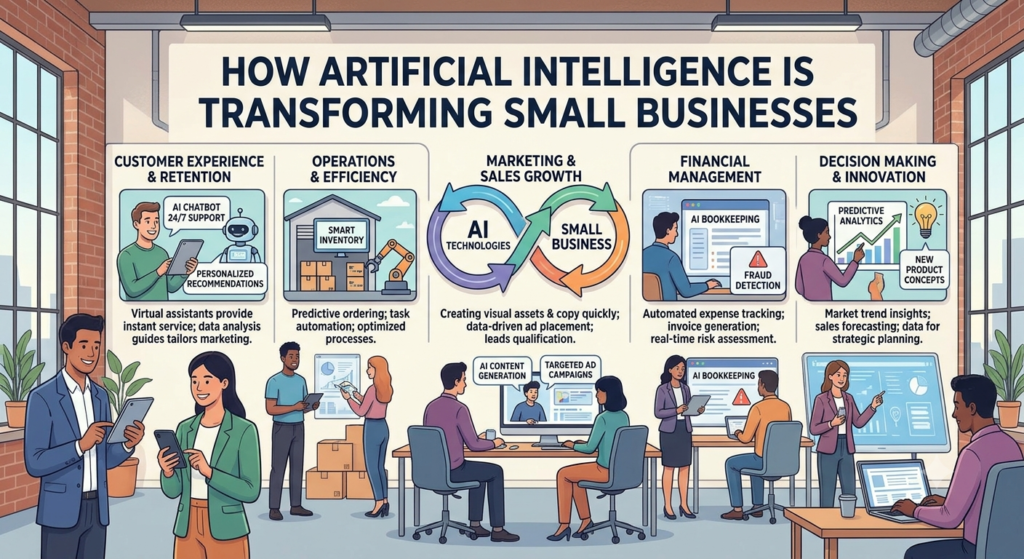
Artificial intelligence is changing how businesses handle these challenges. It gives small companies access to tools that were once available mainly to large organisations. Business owners can now use AI to write content, answer customer questions, study market trends, manage data, and automate repetitive work.
In 2027, artificial intelligence for small business will become even more important. AI tools will help entrepreneurs work faster, reduce manual tasks, and make better business decisions. They will also help small teams manage more work without increasing their operating costs.
The biggest change is not just the use of new technology. It is the way businesses plan, communicate, and serve their customers.
AI is also making digital transformation easier for small and medium-sized businesses. Owners no longer need large technology teams to start using AI. Many affordable tools can work with the software they already use.
This article explains how artificial intelligence is transforming small businesses in 2027, which AI tools entrepreneurs can explore, and how companies can use AI to improve their daily operations.
know More: AI SEO: 10 Powerful Strategies How to Optimize Content for AI Search Engines
1. Why Artificial Intelligence Is Important for Small Businesses in 2027
Small businesses often work with limited budgets and small teams. They cannot always hire experts for every department. As a result, owners and employees manage several responsibilities at the same time.
Artificial intelligence can reduce this pressure.
AI software for businesses can help with tasks such as writing emails, preparing reports, analyzing sales, creating marketing plans, and responding to customers. These tools make daily work easier and allow employees to focus on important activities.
For example, a small online store may receive hundreds of customer questions every week. Instead of answering every common question manually, the business can use an AI chatbot to provide basic information about products, delivery, and returns.
Similarly, a small marketing agency can use AI tools to research keywords, prepare content outlines, analyze competitors, and organize campaign data.
The importance of AI will continue to grow because businesses need to work faster and respond to changing customer needs.
Here are some reasons why AI matters in 2027:
- Less manual work: AI can handle repetitive tasks and save employees time.
- Better customer service: AI assistants can answer common questions quickly.
- Lower operating pressure: Small teams can manage more tasks with existing resources.
- Smarter decisions: AI can study business data and identify useful patterns.
- Improved marketing: Businesses can create targeted campaigns and understand customer interests.
- Better productivity: Employees can spend more time on planning, creativity, and customer relationships.
AI is not only for technology companies. Retail stores, restaurants, online businesses, service providers, consultants, and startups can also benefit from it.
2. How Artificial Intelligence Is Transforming Small Businesses and How AI Is Changing Daily Business Operations
One of the biggest changes in AI transformation in business is the automation of everyday activities.
Many business tasks follow the same process every day. These include sending emails, updating records, preparing invoices, scheduling meetings, and organizing customer information.
Employees spend valuable time completing these activities. Small business automation can reduce this workload.
AI-powered systems can understand information, suggest actions, and complete certain tasks with limited human input.
For example, a service company can use an automated system to collect customer enquiries, organize requests, and send them to the correct department.
A small accounting firm can use AI software to organize financial documents and identify missing information for review.
A retail business can use automated tools to track orders and send delivery updates.
These examples show how AI-driven business operations can improve daily workflows.
Intelligent Automation Saves Time
Traditional automation follows fixed instructions. Intelligent automation can also use AI to understand information and handle some situations that require basic judgement.
For example, a traditional system may send the same reply to every customer. An AI-powered system can understand different questions and prepare relevant responses.
This makes business process automation more flexible.
However, businesses should keep human approval for important activities. AI can make mistakes, misunderstand requests, or produce incorrect information.
AI Assistants Help Business Owners
AI assistants can support business owners with daily planning and communication.
They can help prepare meeting notes, summarize long documents, create task lists, and draft professional emails.
An entrepreneur can also use an AI assistant to organize ideas before launching a new product.
These AI productivity tools reduce the time spent on basic administrative work.
The result is a more organized workplace where employees can focus on activities that require experience and human judgement.
3. AI Tools for Entrepreneurs Are Becoming More Accessible
A few years ago, advanced business technology required expensive software and technical knowledge. Today, many AI tools are available through simple online platforms.
This change is making AI more accessible to startups and small businesses.
Entrepreneurs can choose tools based on their needs, budget, and business size. They do not need to purchase a complete AI system at the beginning.
Here are some popular AI platforms and their possible business applications.
ChatGPT for Small Business
ChatGPT
ChatGPT can help small business owners write emails, prepare marketing content, brainstorm product ideas, summarise documents, and research business topics.
A small business owner can use ChatGPT to create product descriptions, prepare customer communication, and develop social media content.
It can also help explain complex information in simple language.
For example, a startup founder can ask ChatGPT to prepare a basic marketing plan for a new product. The owner can review the suggestions and adjust them according to the business goals.
Microsoft Copilot for Business
Microsoft Copilot
Microsoft Copilot can support users working with Microsoft 365 applications, depending on their subscription and available features.
Businesses can use it to prepare documents, summarise emails, analyse spreadsheets, and create presentations.
For example, a sales manager can use Copilot to review spreadsheet data and identify important sales patterns.
This can make reporting and office work easier.
Google Gemini Business Use Cases
Google Gemini
Google Gemini can help businesses research topics, prepare content, analyse information, and complete supported tasks across Google’s AI products.
A small business can use Gemini to brainstorm campaign ideas, prepare business documents, and organise information.
Its integration with Google Workspace depends on the product, plan, and features available.
Other Useful AI Tools
Businesses can also explore tools for specific activities.
- Canva AI features can help create marketing designs and presentations.
- Grammarly can help improve business communication.
- HubSpot offers AI features for marketing, sales, and customer management.
- Zapier can connect supported applications and automate workflows.
- QuickBooks offers AI-supported features for financial management.
The best AI tools for small business owners depend on the problems they want to solve. A business should select tools based on real needs rather than following every new technology trend.
4. AI Is Improving Customer Service and Customer Experience
Customer service plays an important role in business growth. Customers expect quick answers, clear information, and helpful support.
However, small businesses may not have enough employees to provide support throughout the day.
AI customer service solutions can help manage this challenge.
Businesses can use AI chatbots, automated email responses, and virtual assistants to handle common customer questions.
For example, a clothing store may receive questions about:
- Product availability
- Size and colour options
- Delivery times
- Payment methods
- Return policies
- Order tracking
An AI chatbot for customer support can answer these questions using approved business information.
This allows customers to receive basic assistance without waiting for an employee.
Personalised Customer Communication
AI can also help businesses understand customer preferences.
By studying customer interactions and purchase history, AI systems can identify patterns and suggest relevant products or services.
For example, an online store can recommend products based on previous purchases or browsing activity.
A local fitness centre can send personalised membership reminders and class updates.
A travel agency can suggest suitable travel packages based on a customer’s budget and interests.
These activities support customer experience automation.
However, businesses should use customer information responsibly. They should also provide a clear way for customers to contact a human representative.
AI should make customer service more helpful, not less personal.
5. AI Is Making Marketing More Effective for Small Businesses
Marketing is one of the most useful areas for AI adoption in small businesses.
Small companies often struggle to maintain regular marketing activities. They may not have dedicated teams for SEO, social media, advertising, email marketing, and content creation.
AI tools can support these activities and reduce the time required to complete them.
AI-Powered Content Creation
Businesses can use generative AI applications to prepare:
- Blog outlines and article ideas
- Social media captions
- Email newsletters
- Product descriptions
- Website content
- Advertising copy
- Marketing campaign ideas
For example, a small digital marketing agency can use AI to organise content topics and prepare initial drafts.
The marketing team can then check the information, add original insights, and improve the content.
AI-generated content should always receive human review. Publishing unverified or repetitive content can damage customer trust and content quality.
Smarter SEO Activities
Artificial intelligence can also support search engine optimisation.
SEO professionals and small business owners can use AI to:
- Research keyword ideas.
- Group related search terms.
- Prepare content outlines.
- Identify search intent.
- Review website content.
- Generate title and meta description ideas.
- Analyse competitor content.
- Find internal linking opportunities.
AI can make SEO research faster, but it cannot guarantee search rankings.
Businesses still need useful content, a technically sound website, relevant information, and a strong understanding of their audience.
Better Advertising Campaigns
AI can help businesses study advertising performance and identify patterns in customer behaviour.
For example, an online store can use AI-powered advertising features to test different audiences, improve creative suggestions, and identify campaigns that need attention.
Business owners should review campaign results before changing their budgets.
The purpose of AI in marketing is to improve planning and execution, not to remove the need for marketing strategy.
6. Predictive Analytics Is Helping Businesses Make Better Decisions
Business owners make decisions every day. They decide how much stock to purchase, which products to promote, when to hire employees, and where to invest money.
Making these decisions without reliable information can create problems.
Predictive analytics can help businesses study past data and estimate what may happen in the future.
It uses historical information, statistical methods, and machine learning in business to identify possible trends.
For example, a retail shop can study previous sales records to estimate which products may sell more during a particular season.
A restaurant can review past orders to estimate ingredient requirements.
A service company can study customer enquiries to identify periods of higher demand.
These insights can help businesses plan their resources more effectively.
AI-Powered Decision Making
AI-powered decision making allows business owners to review large amounts of information more quickly.
AI systems can identify patterns that may be difficult to notice through manual analysis.
For example, a business intelligence dashboard can show:
- Monthly sales performance
- Customer acquisition trends
- Product demand
- Marketing campaign results
- Customer retention patterns
- Operating expenses
Business owners can use these data-driven insights to make more informed decisions.
However, predictions are not guarantees. Results depend on the quality of the data, the model, and changing market conditions.
Human experience and business knowledge remain important.
7. AI Is Helping Small Businesses Manage Finance and Accounting
Financial management is another area where AI business solutions can make a difference.
Small business owners need to track income, expenses, invoices, payments, and cash flow. Managing these activities manually can take time and lead to errors.
AI-powered accounting software can help organise financial information and support routine processes.
Some useful applications include:
- Organising invoices and receipts
- Categorising expenses
- Preparing financial summaries
- Identifying unusual transactions
- Sending payment reminders
- Supporting cash flow analysis
- Finding missing financial records
For example, a small consulting company can use accounting software to organise invoices and track unpaid payments.
A business owner can also review financial reports to understand which services generate more revenue.
Better Cash Flow Planning
Cash flow is important for every small business.
Predictive tools can analyse previous income and expenses to estimate future cash requirements.
This can help owners prepare for slow sales periods and plan upcoming expenses.
However, AI-generated financial information should be checked carefully.
Businesses should not rely on AI alone for tax decisions, legal compliance, or major financial commitments. Qualified professionals should review important financial matters.
8. AI Is Creating New Opportunities for E-Commerce Businesses
Online shopping continues to create opportunities for small businesses. However, competition is also increasing.
Small online stores need to manage product listings, customer questions, inventory, marketing, and order updates.
AI business technology can help manage many of these activities.
Personalised Product Recommendations
AI can study customer interests and suggest relevant products.
For example, an online electronics store can recommend accessories based on a customer’s previous purchase.
This can make product discovery easier.
Inventory Management
AI systems can analyse sales history and estimate future product demand.
This helps businesses plan stock levels and avoid unnecessary purchases.
Automated Customer Support
AI chatbots can provide product information, explain delivery policies, and answer common questions. This improves the shopping experience and reduces repetitive support work.
Product Content Creation
Generative AI can help prepare product descriptions, advertising messages, and category content. Business owners should review every description to ensure that product specifications, prices, and claims are correct.
For small e-commerce businesses, these applications can improve operational efficiency and support business growth.
9. AI Is Changing Hiring, Recruitment, and Employee Management
Hiring the right people is important for business success. However, recruitment can be time-consuming for small companies.
AI can support several recruitment activities.
For example, businesses can use AI to prepare job descriptions, organise applications, create interview questions, and schedule interviews.
AI tools can also help employees manage routine workplace activities.
Examples include:
- Preparing training materials
- Creating meeting summaries
- Organising employee tasks
- Drafting internal communication
- Answering common HR questions
- Preparing basic performance reports
These applications can support a digital workforce where employees and AI tools work together.
However, recruitment decisions require human judgement.
AI should not independently reject candidates or make important employment decisions without proper oversight. Hiring systems must be reviewed for fairness, accuracy, and potential bias.
The goal is to reduce administrative work while allowing people to make important decisions.
10. AI Virtual Assistants Are Supporting Business Owners
Many small business owners work without personal assistants or dedicated administrative teams.
They manage meetings, customer communication, project updates, and daily planning themselves.
AI virtual assistants can help organise these responsibilities.
For example, an AI assistant can help prepare a meeting agenda, summarise notes, draft follow-up emails, and organise tasks.
Some advanced systems can also connect with business applications to complete approved actions.
Consider a small consulting company.
Its owner may use an AI assistant to prepare a project summary, organise client feedback, and create a list of pending tasks.
Instead of starting every activity from scratch, the owner can use AI to prepare a first version and review it.
Conversational AI for business is also making it easier for employees to interact with software through everyday language.
Employees can ask questions, request summaries, and find information without learning complicated commands.
This can make smart business management more accessible.
11. Generative AI and Large Language Models Are Changing Business Workflows
Generative AI is one of the most important technologies shaping business operations.
It can create new content based on user instructions and available information.
Large language models in business can understand and generate text, summarise documents, answer questions, and assist with communication.
These capabilities are useful for companies that handle large amounts of written information.
Practical LLM Business Applications
Small businesses can explore several applications.
- Document preparation: AI can help prepare proposals, reports, business plans, and internal documents.
- Customer communication: Language models can draft replies to common customer questions.
- Market research: AI can organise research findings and summarise industry information.
- Employee support: AI assistants can answer questions using approved company documents.
- Content development: Businesses can prepare article outlines, product descriptions, and marketing ideas.
- Knowledge management: AI systems can help employees find information from company resources when properly connected and configured.
Generative AI for companies is moving beyond simple content creation. Businesses are beginning to explore systems that can connect information, support workflows, and complete specific tasks.
However, companies should protect confidential information and review AI-generated responses before using them in important business activities.
12. AI Agents and Intelligent Automation Will Shape Small Businesses in 2027
An important development to watch in 2027 is the growing use of AI agents.
An AI assistant usually responds to instructions. An AI agent can be designed to complete a sequence of tasks towards a defined goal.
For example, a business may use an AI agent to review incoming enquiries, identify their category, prepare a response, and send the request to the appropriate employee for approval.
Another example is an e-commerce workflow that checks order information, identifies delayed shipments, and prepares customer notifications.
These systems can support intelligent automation across multiple business processes.
However, not every business needs an advanced AI agent.
Simple automation may be enough for many small companies. More advanced systems can also require additional costs, integrations, testing, and security controls.
Businesses should begin with tasks that are repetitive, clearly defined, and easy to review.
13. AI Is Helping Small Businesses Compete With Larger Companies
Large companies often have bigger teams, larger budgets, and access to advanced technology.
Small businesses may find it difficult to compete with these advantages.
AI is helping reduce this gap.
A small company can now use AI software for businesses to perform activities that previously required several employees or specialised departments.
For example, a small marketing agency can use AI for research, content planning, reporting, and campaign analysis.
A small online retailer can use AI to support customer service, product recommendations, and inventory planning.
A local service provider can use AI to organise enquiries and manage customer communication.
These examples show how artificial intelligence can give small companies access to more business capabilities.
A Smaller Team Can Handle More Work
AI does not automatically make a business successful. However, it can help employees complete certain tasks faster.
A team of five people may be able to manage work that previously required more manual effort.
Employees can use AI to prepare initial drafts, organise information, and automate repetitive activities.
This allows them to spend more time on customer relationships, product quality, and business development.
More Affordable Access to Technology
Many AI tools offer free plans, entry-level subscriptions, or features within existing business software.
This gives startups and SMEs an opportunity to test AI without making a large initial investment.
Affordable AI solutions for startups and SMEs can support business growth when selected carefully.
The important thing is to choose technology that solves an actual business problem.
14. AI Transformation in Different Small Business Industries
AI does not provide the same benefits to every industry. Its applications depend on the type of business, customer needs, and daily operations.
Here are some examples of AI transforming small businesses across different industries.
Retail Businesses
Retailers can use AI to analyse sales, predict product demand, manage stock, and improve product recommendations.
A clothing store can study previous sales to understand which products may become popular during the next season.
Restaurants and Food Businesses
Restaurants can use AI to analyse order patterns, estimate ingredient requirements, and manage customer enquiries.
An AI-powered system can also help prepare menu descriptions and promotional campaigns.
Digital Marketing Agencies
Marketing agencies can use AI for keyword research, content planning, campaign analysis, and reporting.
These tools can reduce research time and help marketing teams manage multiple projects.
Healthcare Service Providers
Small healthcare practices can explore AI for appointment reminders, administrative support, document organisation, and basic patient communication.
Any use involving medical information or clinical decisions requires appropriate privacy protection and qualified professional oversight.
Education and Training Businesses
Training centres can use AI to prepare learning materials, organise student enquiries, and provide personalised learning support.
AI assistants can also help students find relevant course information.
Freelancers and Consultants
Freelancers can use AI to prepare proposals, organise projects, research clients, and draft professional communication.
This helps independent professionals manage business activities more efficiently.
Examples of AI applications across small business industries
|
Industry |
Useful AI application |
|
Retail |
Inventory forecasting |
|
Restaurants |
Demand prediction |
|
Marketing |
Content and campaign research |
|
Healthcare |
Administrative assistance |
|
Education |
Learning support |
|
Consulting |
Proposal preparation |
|
E-commerce |
Customer support |
|
Finance |
Invoice organisation |
These examples demonstrate that AI transformation is not limited to one industry. Almost every business can explore suitable AI applications.
15. Artificial Intelligence Trends Shaping Small Businesses in 2027
The development of AI is moving quickly. New tools and features are making business technology more accessible.
Here are some important artificial intelligence trends 2027 that small business owners should understand.
1. Growth of AI Agents
AI agents will become more common in business workflows. They will help complete defined tasks across connected applications.
2. More Personalised Customer Experiences
Businesses will use customer information to provide more relevant product suggestions, communication, and support.
3. AI-Powered Business Analytics
More small companies will use predictive analytics and business intelligence tools to understand sales, customer behaviour, and operational performance.
4. Conversational AI for Business
Employees and customers will increasingly interact with business software through natural language.
5. AI Integration Into Existing Software
Businesses will find more AI features inside accounting, marketing, customer management, and productivity applications.
6. Automated Customer Support
AI chatbots and virtual assistants will handle more routine customer questions, while complex issues will continue to require human support.
7. AI-Powered Cybersecurity
Small businesses will explore AI-supported security tools to identify unusual activity, detect threats, and improve monitoring.
8. Greater Focus on Responsible AI
Businesses will pay more attention to data privacy, accuracy, transparency, and human oversight.
9. AI for Predictive Business Planning
Small companies will increasingly explore AI to estimate demand, understand market changes, and plan resources.
10. AI Skills Will Become More Important
Employees will need to understand how to use AI tools, review their results, and apply them to real business tasks.
These trends suggest that AI will become a regular part of business operations rather than a separate technology used only by specialists.
However, adoption will happen at different speeds. Every business should select the developments that match its needs and resources.
16. Benefits of AI for Small Businesses
The benefits of AI for small businesses go beyond saving time.
When implemented properly, AI can improve several areas of business performance.
Here are some important benefits.
Improved productivity: AI can reduce time spent on repetitive tasks and help employees complete daily work more efficiently.
Lower administrative workload: Businesses can automate activities such as scheduling, document preparation, and routine communication.
Better customer experience: AI-powered support systems can provide quick answers and relevant information.
Smarter business decisions: Predictive analytics and data-driven insights can help owners understand business performance.
Improved marketing: AI can support content creation, audience research, and campaign planning.
Better resource management: AI can help estimate demand and organize inventory.
Faster information processing: Businesses can summarize documents, review reports, and organize large amounts of information.
More opportunities for growth: Small companies can use AI to manage additional activities without immediately expanding every department.
Better workflow optimization: AI can connect tasks and reduce unnecessary manual steps.
Stronger business innovation: Entrepreneurs can explore new products, services, and ways to serve customers.
The results depend on how businesses use AI. Simply purchasing software will not automatically improve performance.
17. Challenges of AI Adoption in Small Businesses
Although AI offers many opportunities, small businesses should understand its limitations before adopting new technology.
AI adoption in small businesses can create challenges related to cost, skills, security, and implementation.
Limited Technical Knowledge
Some business owners do not know which AI tools are suitable for their operations.
They may also struggle to understand how different applications work together.
The solution is to begin with simple tools and provide basic employee training.
Data Privacy and Security
AI tools may process customer details, financial records, employee information, and internal documents.
Sharing sensitive information with unapproved platforms can create privacy and security risks.
Businesses should check data policies, access controls, and security features before using AI software.
Incorrect AI Responses
AI systems can produce incorrect information or misunderstand instructions.
For example, a chatbot may provide outdated product information or an AI writing tool may create unsupported claims.
Human review is important, especially for financial, legal, medical, and customer-facing information.
Implementation Costs
Some advanced AI platforms require monthly subscriptions, setup fees, or additional integrations. Small companies should calculate the total cost before choosing a solution.
Employee Training
Employees need to understand how to use AI tools correctly.
Without training, businesses may purchase software but fail to receive meaningful benefits.
Too Much Dependence on AI
AI should support business operations, not control every decision.
Human judgement, creativity, communication, and experience remain important.
A balanced approach helps businesses receive the benefits of AI while reducing unnecessary risks.
18. How Small Businesses Can Start Using AI in 2027
Small businesses do not need to change their entire working system at once.
A step-by-step approach can make AI adoption easier and more affordable.
Here is a practical process that business owners can follow.
Step 1: Identify Repetitive Business Tasks
Start by identifying activities that consume too much time.
These may include:
- Answering common customer questions
- Preparing invoices
- Writing business emails
- Updating spreadsheets
- Creating marketing content
- Organizing customer enquiries
Choose tasks that are repeated frequently and have clear steps.
Step 2: Select the Right AI Tools
Explore AI tools that solve the problems you have identified.
For example, a business that spends too much time preparing documents can explore ChatGPT or Microsoft Copilot.
An online store that receives many customer questions can explore AI chatbot solutions.
A company that wants to connect different applications can explore workflow automation tools.
Do not purchase multiple subscriptions without understanding their purpose.
Step 3: Start With a Small Project
Test one AI application before expanding its use.
For example, a small business can start by using AI to prepare email drafts or organize customer enquiries.
Measure whether the tool saves time and improves work quality.
Step 4: Train Your Employees
Employees should understand how to use AI tools and check their outputs. Provide basic training on writing instructions, reviewing information, and protecting business data. Encourage employees to share useful ideas and identify new opportunities for automation.
Step 5: Measure the Results
Track the impact of AI adoption.
Useful measurements include:
- Time saved on daily tasks
- Number of automated activities
- Customer response time
- Customer satisfaction
- Operating expenses
- Employee productivity
- Sales and conversion performance
These measurements can help business owners understand whether an AI solution is providing real value.
Step 6: Expand AI Usage Gradually
Once the first application delivers positive results, explore other areas.
You can introduce AI into marketing, sales, customer support, reporting, and inventory management.
This gradual approach reduces implementation pressure and gives employees time to adapt.
19. The Future of Small Businesses: Humans and AI Working Together
The future of small businesses will not depend only on technology. It will depend on how people use technology to solve problems.
AI can process information, organise tasks, and automate repetitive work. However, businesses still need people who understand customers, develop relationships, create new ideas, and make important decisions.
Consider a small marketing agency.
AI can help the team research keywords, prepare content outlines, and analyse campaign performance. But experienced marketers still need to understand the target audience, review the strategy, and ensure that the content provides genuine value.
The same approach applies to other industries.
A restaurant can use AI to estimate food demand, but the owner still decides the menu and maintains food quality.
A retail store can use AI to recommend products, but employees still provide personal assistance when customers need it.
A consulting company can use AI to prepare reports, but consultants remain responsible for their recommendations.
This combination of human experience and AI technology can create stronger business operations.
In 2027, companies that understand this balance may be better positioned to adapt to changing customer expectations and market conditions.
20. How AI-Powered Business Growth Will Develop Beyond 2027
AI-powered business growth will depend on more than adopting the latest tools.
Businesses will need to connect technology with their long-term goals.
For example, a company that wants to improve customer retention can use AI to study customer feedback and identify common complaints.
A retailer that wants to improve profitability can use predictive analytics to understand product demand and manage inventory.
A startup that wants to increase brand awareness can use AI tools to support content research and marketing activities.
These examples show that successful AI adoption starts with a clear business objective.
As technology develops, small businesses may gain access to more advanced enterprise AI solutions through affordable cloud-based platforms and specialized software.
This could make advanced business intelligence, intelligent automation, and AI-powered decision making easier to access.
However, businesses should not adopt AI simply because competitors are using it.
They should focus on practical applications that improve customer experience, employee productivity, and business performance.
Artificial intelligence is changing how small businesses operate
Artificial intelligence is changing how small businesses operate, compete, and grow. In 2027, AI will play an increasingly important role in marketing, customer service, financial management, sales, and daily business operations.
AI tools for entrepreneurs are making advanced technology more accessible. Small companies can now use AI assistants, predictive analytics, automated customer support, and intelligent automation without building expensive systems from scratch.
The biggest advantage is the ability to save time, improve productivity, and make better use of available resources.
However, successful AI transformation in business requires proper planning. Business owners must select suitable tools, train employees, protect customer information, and review AI-generated results.
AI should not replace the human side of business. It should support employees and help them perform their work more effectively.
Small businesses that start with practical AI applications and gradually expand their use can build more flexible and efficient operations.
The future of business growth will belong to companies that combine human knowledge with the right AI business solutions.
”FAQs”
1. How does artificial intelligence help small businesses in 2027?
Artificial intelligence helps small businesses automate repetitive tasks, improve customer service, create marketing content, analyse business data, and manage daily operations. It also helps owners save time and make informed decisions.
2. What are the best AI tools for small business owners?
Some popular options include ChatGPT, Microsoft Copilot, Google Gemini, Canva, Grammarly, HubSpot, Zapier, and QuickBooks. The best tool depends on the business requirements, budget, and existing software.
3. Is AI affordable for small businesses?
Yes. Many AI tools offer free plans, affordable subscriptions, or AI features within existing software. Small businesses can start with basic applications and upgrade when they need additional features.
4. Can AI increase small business productivity?
Yes. AI can improve productivity by helping employees prepare documents, organise information, automate repetitive tasks, and manage customer communication. Results depend on the tasks selected and how effectively the tools are implemented.
5. How can small businesses use AI for customer service?
Small businesses can use AI chatbots, virtual assistants, and automated email systems to answer common questions, provide product information, share order updates, and organise customer enquiries.
6. Will AI replace employees in small businesses?
AI is more useful as a support tool for many small business activities. It can automate certain tasks, but businesses still need people for communication, creativity, customer relationships, problem-solving, and important decisions.
7. What are the biggest AI trends shaping small businesses in 2027?
Important trends include AI agents, generative AI, predictive analytics, conversational AI, intelligent automation, personalised customer experiences, AI-powered business analytics, and stronger AI security practices.
8. How can startups implement AI without a large budget?
Startups can begin with free or low-cost AI tools for content creation, research, customer support, and administrative work. They should focus on one business problem, test a suitable tool, measure its results, and expand gradually.
9. What are the risks of using AI in small businesses?
Common risks include incorrect information, data privacy issues, cybersecurity threats, biased outputs, implementation costs, and excessive dependence on automated systems. Businesses should use approved tools and maintain human oversight.
10. What is the future of AI in small business management?
AI will become more integrated into everyday business software. Small businesses will increasingly use AI assistants, automated workflows, predictive analytics, and connected applications to improve efficiency and customer experience.


