

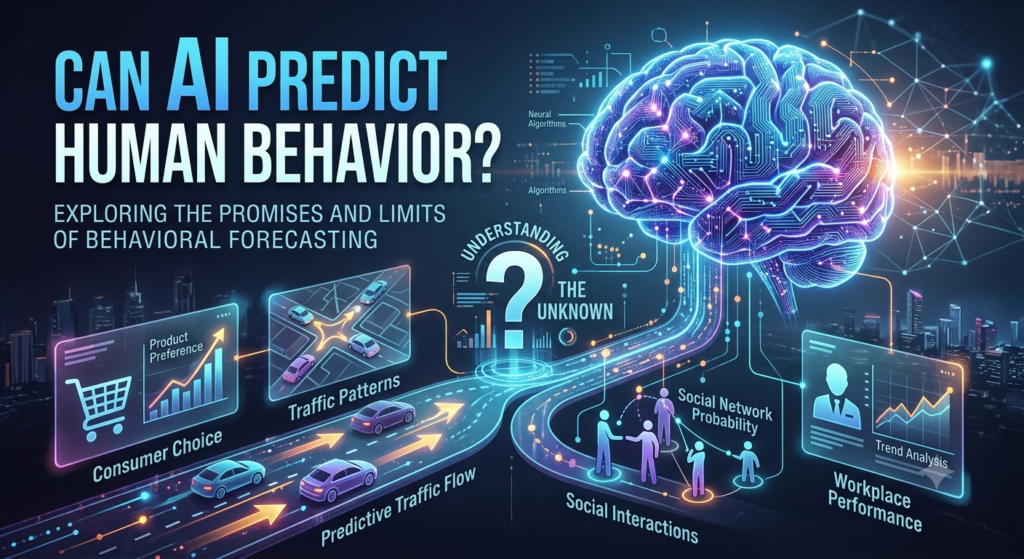
Can AI Predict Human Behavior? The Science, Limits, and Ethics of Predicting What People Will Do Next
Can AI Predict Human Behavior?
Can AI predict human behavior? Yes, to a certain extent. Artificial intelligence can study past actions, identify patterns, and estimate how people may behave in the future. However, it can’t predict every human decision with complete accuracy.
Think about your daily life. You may buy a product after seeing an online advertisement. You may watch a video because a platform recommends it. You may even change your travel plans after checking the weather. In each case, your actions create patterns that AI systems can analyze.
AI human behavior prediction uses data and machine learning to estimate the choices, actions, and responses of individuals or groups. It doesn’t require a machine to understand people exactly as humans understand one another. Instead, it learns statistical relationships between information and outcomes.
For example, an online shopping platform may predict which products you’re likely to buy. A school may use learning data to identify students who need extra support. A healthcare team may study patterns that suggest a patient could miss a follow-up appointment.
These predictions can be useful, but they aren’t guarantees.
Human decisions depend on many factors, including emotions, personal experiences, social pressure, financial conditions, and unexpected events. Even a person who knows you well can’t always predict your next move.
This raises an important question: How far can artificial intelligence go in predicting what people will do next?
To answer it, we need to examine the science behind behavioral prediction, the technology that makes it possible, and the limits that prevent AI from becoming a perfect predictor of human actions.
2. The Science Behind AI Human Behavior Prediction
The science behind predicting human behavior with AI combines psychology, cognitive science, statistics, and computer science. Each field helps explain a different part of the process.
2.1 Understanding Human Behavioral Patterns
Human behavior isn’t entirely random. People often develop habits and repeat actions in similar situations.
For instance:
- A person who exercises every morning may continue that routine.
- A shopper may prefer familiar brands when buying groceries.
- A student may study more often as an examination approaches.
- A viewer may watch videos about subjects they’ve enjoyed before.
These repeated actions create human behavioral patterns. AI systems can identify such patterns by studying large amounts of relevant data.
However, a pattern doesn’t explain everything. Someone who exercises every morning may stop because of an injury, a change in work hours, or a personal commitment.
AI can estimate what is likely to happen based on previous behavior. It can’t assume that the past will always repeat itself.
2.2 The Role of Behavioral Psychology
Behavioral psychology studies how people act and how their actions are influenced by their environment, experiences, rewards, and consequences. AI researchers can use insights from this field to develop better predictive models.
Consider a learning app. If students tend to return more often after receiving helpful feedback, a system may identify that relationship. It could then estimate which students might benefit from additional guidance.
This is an example of machine learning in psychology. The model finds relationships in data, while psychological theories can help researchers understand why those relationships might exist.
Still, correlation isn’t the same as causation. Two events may happen together without one directly causing the other.
For example, students who spend more time on a learning platform may achieve higher scores. But time spent alone doesn’t prove that the platform caused their success. Motivation, prior knowledge, and access to resources may also matter.
2.3 Cognitive Science and Human Decision-Making
Cognitive science examines how people think, remember, learn, pay attention, and make decisions.
Human decision-making involves several processes. People weigh information, recall experiences, respond to emotions, and sometimes act without careful thought.
AI can model certain parts of these processes by analyzing observable behavior. For example, a system might estimate how likely a person is to select an option after viewing particular information.
But modeling a decision isn’t the same as reproducing the human mind.
An AI system can recognize that people with certain characteristics often choose a particular option. It may not know the private thoughts, personal values, or hidden circumstances behind that choice.
This distinction is essential when evaluating AI psychology applications.
2.4 What Makes Human Behavior Difficult to Predict?
Several factors make behavioral forecasting challenging:
| Factor | Why It Matters |
| Emotions | Feelings can change decisions quickly. |
| Personal experience | Similar situations may affect people differently. |
| Social influence | Friends, family, and communities can shape choices. |
| Environment | Money, time, location, and opportunity affect actions. |
| Unexpected events | New information can change plans without warning. |
| Personal growth | Values, goals, and habits can change over time. |
The science supports a balanced conclusion: people show measurable behavioral patterns, but those patterns exist within a changing environment. AI can make useful estimates when patterns are stable and relevant data is available. Its predictions become harder when circumstances change or when an action depends on a unique personal decision.
3. How AI Predicts Human Behavior
How does AI understand human behavior? In practice, most systems don’t understand people in the full human sense. They analyze information, learn statistical patterns, and use those patterns to estimate possible outcomes.
The process generally includes data collection, preparation, model training, prediction, and evaluation.
3.1 Step One: Collecting Behavioral Data
AI systems need data that relates to the behavior they’re trying to predict.
Depending on the application, this information may include:
- Previous purchases and product preferences.
- Website visits and interactions.
- Learning progress and assessment results.
- Responses to surveys.
- Written feedback and customer service messages.
- Relevant health measurements collected with appropriate authorization.
- Historical records of travel or traffic patterns.
What data does AI use to predict behavior? The answer depends on the question being asked.
A shopping system may use purchase history. An educational system may analyze quiz results and lesson completion. A traffic model may examine vehicle counts, road conditions, and historical congestion.
The data must be relevant to the task. Collecting more personal information doesn’t automatically produce better predictions.
3.2 Step Two: Preparing the Data
Raw data often contains missing values, errors, repeated records, or information that doesn’t help answer the research question.
Before training a model, researchers usually clean and organize the information.
They may group events by time, convert text into numerical representations, remove unnecessary identifiers, and check whether the data represents the population fairly.
Poor data quality can produce misleading results. If a model learns from incomplete or unrepresentative records, its predictions may fail when applied to other people.
3.3 Step Three: Training Machine Learning Algorithms
Machine learning algorithms identify patterns in examples.
Suppose a company wants to estimate whether a customer will renew a subscription. Researchers could train a model using historical records that include previous renewals, usage frequency, support requests, and subscription details.
The model learns which combinations of features are associated with renewal or cancellation.
Once training is complete, the model can evaluate new cases and estimate the probability of a particular outcome.
This is a central part of predicting human behavior with AI.
Common techniques include decision trees, logistic regression, random forests, and gradient-boosting models. More complex tasks may use deep learning and neural networks.
3.4 Step Four: Analyzing Language, Sentiment, and Emotions
Natural language processing (NLP) allows AI systems to analyze written or spoken language.
For example, a customer service tool may identify whether a message expresses satisfaction, frustration, or confusion. Sentiment analysis can help businesses understand broad trends in customer feedback.
Emotion recognition AI attempts to estimate emotional states from signals such as voice, text, or facial movements. However, these estimates can be unreliable because expressions vary across people, cultures, and situations.
A frustrated sentence doesn’t always mean someone is generally unhappy. A smiling face doesn’t always reveal how someone feels internally.
For that reason, emotion estimates should be treated as uncertain signals rather than direct measurements of a person’s inner state.
3.5 Step Five: Generating and Testing Predictions
After training, the model produces an estimate, such as a probability, category, or forecast.
Researchers then test it against data that wasn’t used during training. They measure whether the predictions are accurate, whether errors are evenly distributed, and whether performance remains stable in real conditions.
A responsible system also needs regular evaluation because human behavior and environments can change.
The overall process looks like this:
Behavioral data
Relevant records and observations
Data preparation
Cleaning, organizing, and checking quality
Machine learning model
Learning patterns from historical examples
Behavioral prediction
Estimating likely outcomes and uncertainty
Evaluation and review
Testing accuracy, fairness, and real-world results
The key point is simple: AI predicts behavior by learning from evidence, not by knowing the future.
4. Types of AI Behavioral Prediction Models
Different prediction tasks require different tools. No single model works best for every type of human behavior analysis.
4.1 Classification Models
Classification models assign cases to categories.
Examples include predicting whether a customer is likely to renew a subscription, whether a student may need academic support, or whether a message belongs to a particular sentiment category.
These models can be useful when researchers have clear outcome labels. However, a predicted category should not be treated as a permanent description of a person.
4.2 Regression Models
Regression models estimate numerical outcomes.
A business might estimate how much a customer could spend in a future period. A transport researcher might estimate the expected number of passengers during rush hour.
Regression helps quantify relationships between variables, but its usefulness depends on the quality of the data and the assumptions behind the model.
4.3 Time-Series Forecasting
Time-series models study observations recorded over time.
They can help predict broad patterns such as public transport demand, website traffic, or the number of customer inquiries expected during a busy period.
These predictions often focus on groups rather than individual people. Forecasting a rise in demand is usually easier than predicting the exact moment when one person will make a specific choice.
4.4 Deep Learning and Neural Networks
Deep learning uses neural networks with multiple processing layers to learn complex patterns.
These methods can be useful when analyzing large datasets involving language, images, audio, or sequences of events. For instance, a recommendation system may use deep learning to estimate which content a user could find relevant.
However, complexity doesn’t guarantee accuracy. A simpler model may be easier to explain and may perform just as well on a particular task.
4.5 AI Personality Prediction and Psychological Profiling
Some systems attempt to estimate personality-related traits from surveys, language, or digital activity.
Such predictions raise important questions. Does a person’s online writing reflect their behavior in every setting? Can a short interaction reliably reveal stable personality traits?
Often, the evidence isn’t strong enough to justify confident conclusions about an individual.
Psychological profiling can also create risks if employers, advertisers, insurers, or other organizations use uncertain predictions to make important decisions about people.
| Model type | Typical use | Main limitation |
| Classification | Predicting categories or outcomes | Categories can oversimplify people. |
| Regression | Estimating numerical outcomes | Predictions depend on data and assumptions. |
| Time-series models | Forecasting behavior over time | Sudden changes can disrupt patterns. |
| Neural networks | Finding complex patterns | Decisions may be difficult to explain. |
| NLP models | Analyzing language and sentiment | Language can be ambiguous or misleading. |
The best approach depends on the goal, the evidence available, the cost of mistakes, and the level of explanation people need.
5. Real-World Examples of AI Predicting Human Behavior
AI behavior prediction is already used in several industries. Its value is clearest when the task has a measurable outcome and the system can learn from relevant, reliable data.
5.1 Online Shopping and Product Recommendations
Online retailers use predictive analytics to estimate which products customers may want to explore. A recommendation system might consider previous purchases, product views, search activity, and similarities between customer interests.
For example, someone who regularly buys fitness equipment may receive recommendations for sportswear or exercise accessories.
These systems don’t necessarily know why a person wants a product. They identify patterns associated with interest or purchasing behavior.
Recommendations can save time, but they can also narrow the range of products people see. A balanced system should allow users to discover new options rather than repeatedly showing the same types of products.
5.2 Education and Student Support
Educational institutions can use AI to identify students who may struggle with particular subjects.
A learning platform might analyze quiz results, lesson completion, assignment activity, and changes in performance. It could then flag students who may benefit from additional explanations or practice.
For example, if a student repeatedly struggles with algebra questions, an AI system could recommend simpler lessons before moving to advanced topics.
This is a useful application of AI applications in human behavior research because it focuses on observable learning patterns.
However, a low score doesn’t prove that a student lacks ability or motivation. The student may have missed lessons, experienced technical difficulties, or faced challenges outside the classroom.
AI should support teachers, not replace their understanding of individual students.
5.3 Healthcare and Preventive Support
Healthcare researchers may use predictive analytics to estimate risks related to patient care.
Depending on the validated model and available data, a system might help identify patients who are more likely to miss appointments or need additional follow-up.
Healthcare professionals can use such estimates to offer reminders, improve access, and plan support.
Yet health-related predictions require particular care. Incorrect predictions may lead to unnecessary interventions, unfair treatment, or privacy violations.
Models should be clinically evaluated, and qualified professionals should remain responsible for decisions that affect patient care.
5.4 Marketing and Customer Behavior
Businesses use AI to estimate customer interests, identify changing preferences, and forecast purchasing patterns.
For example, an online service may detect that customers who stop using a product frequently cancel their subscriptions. It could offer those customers support before they leave.
This type of AI decision prediction can help businesses respond to customer needs.
However, the same technology can be used to exploit vulnerabilities. An advertiser might try to target people during moments of emotional distress or financial pressure.
Responsible marketing should focus on relevance and usefulness rather than manipulation.
5.5 Traffic, Transport, and Public Planning
AI can forecast traffic conditions by analyzing historical road usage, current vehicle counts, weather, and planned events.
Transport authorities may use these estimates to adjust signals, improve bus schedules, or identify roads that need attention.
These applications illustrate an important distinction: predicting patterns across thousands of journeys may be more practical than predicting the exact actions of one driver.
5.6 Social Media and Digital Content
Can AI predict human behavior from social media? To some extent, yes.
Platforms can analyze interactions, viewing time, follows, searches, and other activity to estimate which posts or videos a user might engage with.
They may also identify broad trends in public discussion or estimate how content could spread through a network.
However, online activity is only a partial view of someone’s life. People may joke, share content they disagree with, or behave differently online than they do in person.
A digital profile should never be treated as a complete picture of an individual’s beliefs, personality, or intentions.
6. How Accurate Is AI at Predicting Human Behavior?
How accurate is AI at predicting human behavior? There isn’t one universal percentage that answers this question.
Accuracy depends on the behavior being studied, the data available, the prediction period, the population, and the cost of making a mistake.
Predicting whether a customer will renew a subscription may be more manageable than predicting whether that person will change careers within five years.
6.1 Probability Is Not Certainty
Imagine a model estimates that a customer has a 70% chance of renewing a subscription.
That doesn’t mean the customer definitely will renew. It means the model assigns a probability of 70% based on its data and assumptions.
If the model is well calibrated, predictions assigned a 70% probability should occur approximately 70% of the time across a sufficiently large group of comparable cases.
A probability is useful because it communicates uncertainty. It shouldn’t be presented as a fact about what an individual will do.
6.2 Why Evaluation Methods Matter
Researchers use different measures to evaluate predictive models.
| Evaluation method | What it tells us |
| Accuracy | The share of predictions that are correct. |
| Precision | How often positive predictions are correct. |
| Recall | How many actual positive cases are identified. |
| Calibration | Whether predicted probabilities match observed outcomes. |
| Error analysis | Where and how the model makes mistakes. |
No single measure is sufficient for every task. For instance, a model that predicts a rare event may achieve high overall accuracy by almost always predicting that the event won’t happen. That could make it useless for identifying the cases researchers actually care about.
6.3 Scientific Evidence and Real-World Testing
Scientific evidence for AI human behavior prediction comes from studies that test models against observed outcomes.
Researchers can train a model on historical data, evaluate it on separate data, and then test it in real-world settings.
Strong evidence requires more than a successful demonstration. Researchers should check whether results can be reproduced, whether the model works across relevant groups, and whether its performance remains reliable when conditions change.
It also matters whether a prediction offers practical value. A model might identify a pattern accurately but provide no useful information beyond what a simpler method already offers.
For a deeper introduction to responsible AI, see the National Institute of Standards and Technology’s AI Risk Management Framework.
6.4 Individual Predictions Versus Group Predictions
AI often works better when estimating broad patterns than when predicting unique personal decisions. For example, a retailer may forecast increased demand for winter clothing across a region. Predicting exactly which jacket a particular person will buy is a different and more uncertain task.
Similarly, a transport model may forecast peak travel times without knowing precisely when each commuter will leave home. The more a prediction depends on private motives, changing circumstances, or rare events, the more cautious its interpretation should be.
7. Limitations of AI in Predicting Human Behavior
Despite advances in machine learning, important limitations remain.
7.1 Human Behavior Changes Over Time
People develop new habits, learn from experience, change jobs, form relationships, and encounter unexpected challenges.
A model trained on old behavior may struggle when people’s circumstances change.
This problem is sometimes called concept drift: the relationship between the input data and the outcome changes over time.
Models therefore need monitoring and, when appropriate, retraining and independent testing.
7.2 Missing Information Can Distort Predictions
AI can only analyze the information it receives.
A customer may stop buying from a company because their income has changed. A student may stop attending online classes because their internet connection is unreliable.
If these factors aren’t represented in the data, the model may incorrectly attribute the behavior to another factor.
The result may look convincing while being based on an incomplete explanation.
7.3 Human Choices Depend on Context
The same person may behave differently in different situations.
Someone may spend freely during a celebration but carefully manage money during a difficult month. A quiet employee may speak confidently with close colleagues but remain silent during a large meeting.
Behavioral patterns don’t have the same meaning in every context.
AI systems that ignore these differences may make unreliable predictions or label people unfairly.
7.4 Bias in Training Data
Machine learning models learn from examples. If those examples contain historical inequalities or leave out important groups, the resulting model may repeat those problems.
For instance, a recruitment model trained on biased hiring decisions might learn to favor candidates who resemble people previously selected by the organization.
Algorithmic bias can affect predictions even when a model doesn’t explicitly use a sensitive characteristic.
Researchers must examine the quality and representativeness of the data, test performance across groups, and review how predictions are used.
7.5 Prediction Can Change the Behavior Being Predicted
A further challenge is that predictions can influence what happens next.
Suppose a system labels a student as unlikely to succeed. If a teacher responds by offering less attention, the student may receive fewer opportunities to improve.
The original prediction can then contribute to the outcome it claimed to forecast.
The reverse can happen too. If a model identifies a student who needs support and the student receives effective help, the predicted negative outcome may never occur.
This is why AI behavior forecasting should be treated as a tool for improving decisions, not as a fixed judgment about a person’s future.
7.6 Can AI Predict Human Behavior With 100% Accuracy?
No general-purpose AI system can reliably predict every human action with 100% accuracy.
Some highly constrained behaviors may be predictable under specific conditions. However, real life involves changing information, uncertain events, and decisions that cannot always be inferred from past data.
Even a highly accurate model can make mistakes on individual cases.
The most realistic goal isn’t perfect prediction. It’s useful, well-tested forecasting that acknowledges uncertainty and respects human choice.
8. Ethical Concerns of AI Human Behavior Prediction
The ability to predict behavior creates important ethical questions. Even when a model produces useful results, the way organizations collect data and act on predictions can affect people’s freedom, privacy, and opportunities.
8.1 Privacy and Surveillance
AI systems may analyze browsing activity, location records, online interactions, or other personal information.
When organizations collect this information without clear permission or a legitimate purpose, behavioral prediction can become a form of intrusive surveillance.
AI human behavior prediction privacy concerns include:
- Collecting more personal data than necessary.
- Using information for purposes people didn’t expect.
- Sharing behavioral profiles without proper authorization.
- Retaining personal information for too long.
- Inferring sensitive traits from seemingly ordinary activity.
Organizations should explain what information they collect, why they need it, and how they protect it.
8.2 Consent and Personal Freedom
People should have meaningful control over how their personal information is used.
For example, a person may agree to share information to receive personalized recommendations but not expect the same information to be used to evaluate their job prospects.
Consent should be clear and appropriate to the purpose. Where possible, people should be able to refuse optional tracking without losing access to essential services.
8.3 Discrimination and Unfair Treatment
Behavioral prediction can affect decisions about education, employment, insurance, lending, and access to services.
If a model makes inaccurate predictions about certain groups, people may face unfair disadvantages.
Organizations should assess whether a model is appropriate for the decision, test its performance across groups, and provide ways to challenge consequential decisions.
A prediction about a person shouldn’t automatically become a reason to deny them an opportunity.
8.4 Manipulation and Psychological Profiling
AI can help organizations understand what attracts people’s attention. That knowledge can be used to improve communication, but it can also be used to manipulate choices.
For example, a system might target a person with repeated messages designed to exploit fear or insecurity. Ethical AI should support informed choices rather than undermine them.
8.5 Explainable AI and Accountability
Explainable AI aims to make model outputs and limitations easier to understand.
People affected by significant AI-assisted decisions should receive meaningful explanations where appropriate. Organizations should also identify who is responsible for errors and how complaints can be reviewed.
A responsible approach includes:
- Collecting only necessary data.
- Testing models before deployment.
- Monitoring accuracy and fairness.
- Protecting personal information.
- Providing human review for important decisions.
- Correcting harmful or misleading outcomes.
Ultimately, responsible AI requires more than accurate predictions. It requires fair processes, transparency, accountability, and respect for human rights.
9. The Future of AI and Behavioral Science Research
The future of AI and human behavior research is promising, but progress should be measured by the quality of the evidence and the benefits people receive.
9.1 More Personalized and Helpful Predictions
AI may become better at identifying changes in learning patterns, customer needs, and other behaviors that can be measured reliably.
In education, this could mean more relevant practice activities. In healthcare, it could mean better follow-up planning. In public services, it could help officials anticipate demand.
The strongest applications will likely be those that solve specific problems rather than claim to understand every aspect of a person’s life.
9.2 Better Explainability
Future systems may offer clearer explanations of which factors influenced a prediction, how uncertain the result is, and where the model tends to fail. This could help teachers, researchers, healthcare professionals, and business teams make better-informed decisions.
However, an explanation generated by an AI system isn’t automatically correct. Explanations must be evaluated to ensure they accurately reflect how the model works.
9.3 Privacy-Preserving Behavioral Analysis
Privacy-preserving methods may help researchers learn from data while reducing exposure of personal information.
Approaches such as federated learning can allow some models to be trained across separate devices or organizations without centralizing all raw data. Other methods can limit the information revealed by statistical analysis.
These techniques can reduce certain risks, but they don’t remove every privacy concern. Their effectiveness depends on how they’re implemented.
9.4 AI as a Research Assistant, Not a Mind Reader
AI can help researchers identify patterns that would be difficult to find manually. It can support the study of learning, communication, decision-making, and social interaction.
Yet researchers must distinguish between observed behavior and explanations of that behavior.
A model may identify that two variables are associated. Further research may be needed to establish whether one causes the other, what mechanisms are involved, and whether the relationship applies in other settings.
9.5 Will AI Ever Predict Human Behavior Perfectly?
Perfect prediction of all human behavior is not a realistic expectation for current AI technology.
Future systems may become more capable within specific tasks and controlled environments. However, unpredictable events, incomplete information, changing preferences, and complex social influences will continue to create uncertainty.
The most valuable future may not be one in which AI predicts every action. It may be one in which AI helps people make better decisions while protecting their independence.
AI Can Predict Patterns, but It Cannot Know the Future
Can AI predict human behavior? Yes, within limits. Artificial intelligence can analyze human behavioral patterns, learn from past actions, and estimate possible future outcomes. These capabilities already support applications in education, healthcare, marketing, online shopping, and transport planning.
However, predicting a likely outcome isn’t the same as knowing what someone will do. Human behavior is shaped by personal experiences, changing circumstances, emotions, and decisions that may not follow previous patterns.
The limitations of AI in predicting human behavior also make ethical safeguards essential. Privacy, fairness, transparency, and human oversight should remain central to the development and use of behavioral prediction technology.
As machine learning advances, AI may become more useful in helping researchers understand behavior and helping organizations respond to people’s needs. But its predictions should remain open to review, correction, and challenge.
The bottom line: AI can help us understand what people may do next, but it shouldn’t decide who people are or what their future must be.