
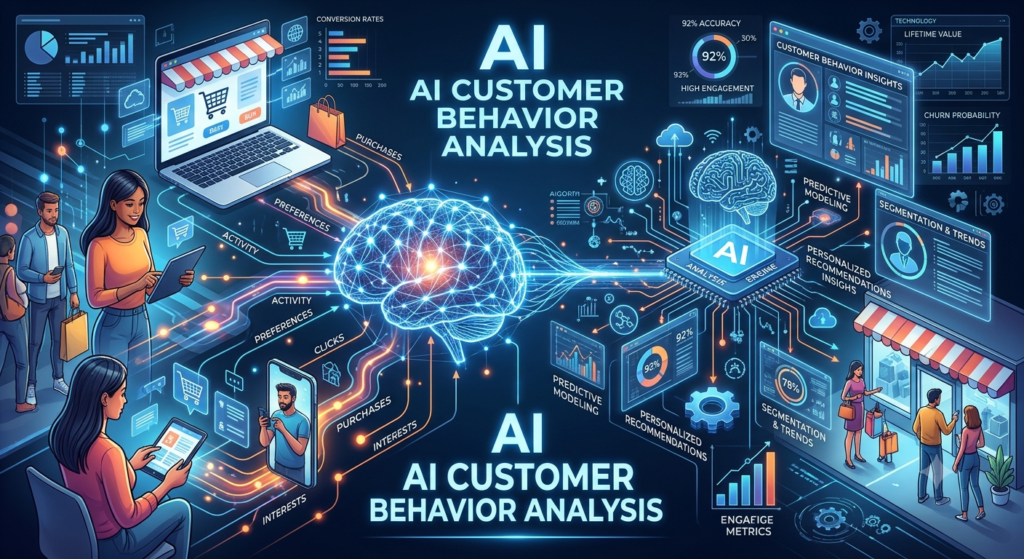
How AI Helps Marketers Analyze Customer Behavior and Purchase Patterns
Understanding customers is one of the most important parts of successful marketing. Businesses need to know what people want, what they like, how they shop, and why they choose one product over another. Without this knowledge, even a well-planned marketing campaign may fail to deliver good results.
In the past, marketers mainly used surveys, customer feedback, website reports, and sales records to understand buying behavior. These methods were useful, but they often took a lot of time. They also made it difficult to identify changes in customer preferences quickly.
Today, artificial intelligence (AI) is changing the way businesses understand their customers. Modern AI systems can process large amounts of information, identify hidden patterns, and help marketers make better decisions. This makes AI customer behavior analysis an important part of modern marketing strategies.
AI can study website visits, product searches, shopping habits, customer interactions, and previous purchases. It can also help businesses predict what customers may buy next. As a result, marketers can create more relevant campaigns, improve customer experiences, and increase sales opportunities.
For example, an online store can use AI to identify customers who regularly purchase skincare products. It can then recommend related products, send relevant offers, and predict when those customers may need another purchase.
This article explains how AI helps marketers understand customer behavior and purchase patterns, which technologies support this process, and how businesses can use AI-powered insights to improve their marketing performance.
1. Understanding Customer Behavior and Purchase Patterns
Before exploring the role of AI, it’s important to understand customer behavior and purchase patterns.
Customer behavior refers to the actions people take before, during, and after purchasing a product or service. It includes how customers discover brands, compare products, read reviews, make buying decisions, and interact with businesses.
Purchase patterns describe the habits customers follow when buying products. These patterns may include how often they purchase, how much they spend, which products they prefer, and when they usually place orders.
For example, a customer may visit an online clothing store every month, purchase during discount periods, and prefer products from a particular category. These actions create useful information for marketers.
What Is Customer Behavior Analysis?
Customer behavior analysis is the process of studying customer actions to understand their needs, interests, and preferences.
Businesses collect information from different sources, including:
- Website visits and page views.
- Product searches and clicks.
- Shopping cart activity.
- Previous purchases.
- Email interactions.
- Social media engagement.
- Customer reviews and feedback.
- Support requests and conversations.
By studying this information, marketers can understand what attracts customers and what prevents them from completing a purchase.
For instance, if many visitors leave a product page without buying, marketers can investigate the reason. The product price, missing information, slow website speed, or unclear product descriptions may affect their decisions.
What Are Purchase Patterns?
Purchase patterns show how customers behave when buying products or services over time. Some common examples include:
|
Purchase pattern |
Meaning |
Marketing opportunity |
|
Repeat purchases |
Customers buy the same product regularly |
Send timely offers |
|
Seasonal purchases |
Buying increases during certain seasons |
Prepare seasonal campaigns |
|
Discount-based purchases |
Customers prefer discounted products |
Create targeted promotions |
|
Brand loyalty |
Customers repeatedly choose one brand |
Introduce loyalty rewards |
|
Product combinations |
Customers buy related products together |
Recommend complementary products |
|
Impulse purchases |
Customers buy without long planning |
Use relevant product suggestions |
Understanding these patterns helps businesses improve their marketing intelligence and create campaigns based on actual customer interests.
2. How AI Changes Customer Behavior Analysis
Traditional marketing analysis often depends on manual research and basic reporting. However, AI can process large datasets much faster and identify relationships that may be difficult for humans to notice.
AI customer behavior analysis uses technologies such as machine learning, predictive analytics, and natural language processing to study customer activity.
These technologies help marketers move beyond simple reporting. Instead of only understanding what happened in the past, businesses can also estimate what may happen next.
Machine Learning and Customer Data
Machine learning allows computer systems to learn from data and identify patterns. For example, an e-commerce business may have thousands of customers. Each customer has different shopping habits, product preferences, and purchase histories. Machine learning can study this information and group customers according to similar behavior.
It may identify customers who:
- Frequently purchase premium products.
- Usually shop during sales.
- Browse products but rarely complete purchases.
- Regularly buy products from a specific category.
- Have not returned to the website for several months.
These findings help marketers create more useful customer segments.
Predictive Analytics
Predictive analytics uses historical information and statistical models to estimate future outcomes. For example, AI can analyze previous purchases and identify customers who are likely to purchase again within the next month.
It can also help businesses estimate:
- Which products may become popular.
- Which customers may stop purchasing.
- When customers may need product replacements.
- Which marketing campaigns may perform better.
- How demand may change during seasonal periods.
Predictive analytics doesn’t guarantee future results. However, it helps marketers make better decisions by using available evidence.
Real-Time Customer Insights
Another important advantage of AI is its ability to analyze customer activity quickly. Suppose a customer visits an online store and checks several mobile phones. The system may identify their interest and display relevant product recommendations.
This helps businesses respond to customer interactions at the right time.
Real-time information can also help marketers identify sudden changes in purchasing trends and adjust their campaigns when needed.
3. 10 Powerful Ways AI Helps Marketers Understand Customers
AI offers several practical applications for businesses. Here are ten important ways marketers can use it to understand customers and improve marketing performance.
1. Understanding Customer Shopping Habits
Every customer has different shopping habits. Some people compare several products before purchasing, while others prefer products they already know. AI can study browsing history, product clicks, searches, and previous orders to identify these habits.
For example, an online electronics store may discover that some visitors regularly compare laptop specifications before buying. Others may focus mainly on price and customer reviews. Marketers can use these insights to create different experiences for each group.
Businesses can also identify:
- Frequently viewed products.
- Popular product categories.
- Common search terms.
- Preferred shopping times.
- Average order values.
- Products often viewed together.
This information helps marketers understand what customers actually want instead of making decisions based on assumptions.
2. Predicting Future Purchases
One of the most useful applications of AI predictive analytics is purchase prediction. AI models can study previous purchases, product interests, and customer interactions to estimate what customers may buy in the future.
For example, a customer who purchases coffee every 30 days may be interested in receiving a reminder before their next expected purchase.
Similarly, an online clothing store can identify customers who frequently purchase winter products and prepare relevant recommendations before the winter season.
This approach helps businesses:
- Send relevant product reminders.
- Plan promotional campaigns.
- Improve repeat purchases.
- Recommend suitable products.
- Identify potential sales opportunities.
Machine learning for purchase prediction can make marketing campaigns more timely and relevant. However, businesses should treat predictions as estimates rather than confirmed customer intentions.
3. Improving Customer Segmentation
Not every customer has the same needs. Sending the same message to everyone may reduce campaign performance. AI can group customers according to their behavior, preferences, spending habits, and engagement levels.
For example, a business may create these customer groups:
|
Customer segment |
Behavior |
Suitable marketing strategy |
|
New visitors |
Recently discovered the brand |
Brand awareness campaigns |
|
Regular customers |
Purchase frequently |
Loyalty programs |
|
Price-sensitive customers |
Prefer discounts |
Special offers |
|
Interested visitors |
View products but don’t purchase |
Product information and reminders |
|
Inactive customers |
Haven’t purchased recently |
Re-engagement campaigns |
This type of consumer analytics helps businesses communicate with the right audience. It also reduces unnecessary marketing messages and improves campaign relevance.
4. Creating Personalized Customer Experiences
Customers are more likely to engage with content and offers that match their interests. AI helps businesses personalize website experiences, email campaigns, product recommendations, and advertisements.
For example, an online shopping platform can recommend products based on a customer’s previous activity. A visitor who regularly searches for fitness products may see related equipment, clothing, and accessories.
Personalization can also be used in email marketing.
Instead of sending the same email to every subscriber, marketers can create messages based on product interests and previous interactions.
This helps businesses improve customer engagement and create stronger relationships.
5. Analyzing the Complete Customer Journey
Customer journey analysis helps marketers understand how people move from discovering a brand to completing a purchase. A typical customer journey may include:
- Discovering a brand through Google.
- Visiting the business website.
- Reading product or service information.
- Comparing available options.
- Adding a product to the shopping cart.
- Completing a purchase.
- Returning for another purchase.
AI can study these interactions and identify common customer paths.
For example, it may discover that customers who read product reviews are more likely to complete a purchase. It may also identify pages where visitors frequently leave the website. These findings help marketers improve website content, navigation, and conversion strategies.
6. Improving Marketing Campaign Performance
AI can help marketers understand which campaigns attract customers and which campaigns fail to generate engagement.
It can analyze:
- Email open and click rates.
- Advertisement performance.
- Website conversions.
- Customer engagement metrics.
- Campaign costs.
- Sales generated from marketing activities.
For example, a company may run two advertising campaigns for the same product.
AI-supported marketing analysis can help compare audience engagement, conversion rates, and purchase behavior. Marketers can then adjust campaign targeting, messaging, and budget allocation. This supports data-driven marketing AI strategies and helps businesses make more informed decisions.
7. Identifying Customers at Risk of Leaving
Customer retention is important for long-term business growth. However, many businesses focus more on acquiring new customers than understanding why existing customers stop purchasing.
AI can help identify signs of customer inactivity.
For example, a subscription business may notice that some customers have reduced their platform usage or stopped interacting with emails.
Predictive models can use these signals to estimate the risk of customer churn.
Marketers can then create suitable retention campaigns, such as:
- Personalized offers.
- Product recommendations.
- Helpful educational content.
- Customer support follow-ups.
- Loyalty rewards.
Early identification gives businesses an opportunity to improve customer relationships before they are lost.
8. Understanding Customer Sentiment and Feedback
Customer feedback contains useful information about products, services, and brand experiences. However, manually reading thousands of reviews and comments can take considerable time.
Natural language processing (NLP) helps AI systems understand written customer feedback. It can identify positive, negative, and neutral opinions across reviews, surveys, social media comments, and support conversations.
For example, a company may receive hundreds of reviews about its delivery service. AI can help identify repeated complaints about late deliveries or damaged packages. Businesses can use these findings to improve their services and customer experiences. Sentiment analysis can also help marketers understand how customers respond to new products and advertising campaigns.
9. Improving Sales Forecasting
Sales forecasting helps businesses estimate future revenue and product demand.AI can analyze historical sales, purchasing trends, seasonal demand, and customer preferences to support more accurate forecasts. For example, an online retail business may experience higher demand during festivals or holiday seasons.
AI can study previous sales information and identify similar demand patterns.
This helps businesses plan:
- Product inventory.
- Marketing budgets.
- Promotional activities.
- Seasonal campaigns.
- Sales targets.
Although AI predictions depend on data quality and market conditions, they can provide useful support for business planning.
10. Discovering New Market Opportunities
AI can also help businesses identify opportunities they may have missed. By analyzing customer searches, product interests, feedback, and purchasing trends, AI can reveal growing customer needs. For example, a company selling fitness equipment may notice increasing interest in home workout products.
This information can help the business explore new products, services, and marketing opportunities. AI-driven consumer insights can also support competitor research and market research. However, businesses should validate these findings through customer research and real market testing before making major investments.
4. Important AI Technologies Used in Marketing Analytics
Different AI technologies work together to help marketers understand customers.
Machine Learning
Machine learning identifies patterns in customer data and improves predictions as new information becomes available. It supports customer segmentation, purchase prediction, recommendation systems, and churn analysis.
Natural Language Processing
NLP helps AI understand human language. It can analyze reviews, comments, emails, survey responses, and customer support messages. This allows marketers to identify customer opinions and common concerns.
Generative AI and Large Language Models
Generative AI tools can help marketers analyze information, summarize reports, and identify useful insights. For example, ChatGPT marketing analytics workflows can help marketers interpret exported campaign reports, organize customer feedback, and generate research summaries. LLM marketing analysis can also help identify repeated topics in customer conversations. However, marketers should check the accuracy of AI-generated findings and avoid sharing confidential customer information with tools that aren’t approved for that purpose.
Predictive Modeling
Predictive models use historical data to estimate future customer actions. They can support purchase predictions, customer lifetime value estimates, demand forecasting, and customer retention planning. Together, these technologies make customer data analytics more useful and accessible to modern marketing teams.
5. Best AI Analytics Tools for Marketing
Choosing the right AI tools depends on business size, marketing goals, available data, and budget. Here are some widely used platforms that can support marketing analysis.
|
Tool |
Main purpose |
How marketers can use it |
|
Google Analytics 4 |
Website and app analytics |
Study traffic, events, conversions, and user activity |
|
Google Looker Studio |
Data visualization |
Create marketing performance dashboards |
|
Microsoft Power BI |
Business intelligence |
Analyze marketing and sales information |
|
Tableau |
Data visualization and analytics |
Explore customer and business trends |
|
HubSpot |
CRM and marketing automation |
Track leads, customer interactions, and campaigns |
|
Salesforce |
Customer relationship management |
Understand customer activity and sales journeys |
|
Mixpanel |
Product analytics |
Analyze user behavior and product engagement |
|
ChatGPT |
AI-assisted analysis |
Summarize reports and explore marketing data |
How to Choose the Right Platform
Before selecting a customer insights platform, consider these factors:
- Business requirements: Identify whether you need website analytics, customer segmentation, sales forecasting, or campaign reporting.
- Data integration: Check whether the tool connects with your existing CRM, website, and marketing platforms.
- Ease of use: Choose a platform your marketing team can understand and manage.
- Reporting features: Look for dashboards, useful reports, and export options.
- Privacy and security: Check data protection, access controls, and applicable privacy requirements.
- Pricing: Compare subscription costs with the value the tool can provide.
For businesses starting with AI marketing analytics, combining Google Analytics 4 and Looker Studio can provide a useful foundation for website performance and customer engagement reporting.
6. Major Benefits of AI-Powered Customer Insights
AI provides several benefits when businesses use it correctly.
Better Marketing Decisions
AI helps marketers use real customer information instead of relying only on assumptions.
This makes campaign planning more informed and measurable.
Improved Customer Engagement
Personalized recommendations and relevant messages can improve customer interactions.
Customers are more likely to engage when businesses understand their interests.
Increased Marketing Efficiency
AI can automate repetitive analysis and reporting tasks.
This gives marketing teams more time to focus on strategy, content, and campaign improvements.
Better Customer Retention
Predictive analytics can help identify customers who may stop purchasing.
Businesses can use this information to improve retention campaigns.
Improved Sales Opportunities
Understanding buying behavior can help marketers identify relevant products, suitable offers, and potential repeat purchases.
Stronger Business Intelligence
AI can combine information from multiple sources to provide a clearer view of customer preferences and purchasing trends.
This supports better planning across marketing and sales teams.
7. Challenges and Limitations of AI Customer Behavior Analysis
Although AI offers many advantages, it also has limitations.
Businesses should understand these challenges before implementing AI-powered analytics.
Data Quality Problems
AI depends on accurate and relevant information.
Incomplete records, duplicate customer profiles, and incorrect tracking can produce misleading results.
Businesses should regularly review their data collection processes.
Customer Privacy
Customer data must be collected and used responsibly.
Businesses should follow applicable privacy laws, obtain consent where required, and explain how customer information is used.
They should also protect sensitive information from unauthorized access.
Incorrect Predictions
AI predictions aren’t always correct. Customer preferences can change due to market conditions, personal needs, competitors, and unexpected events. Marketers should combine AI insights with human judgment.
High Implementation Costs
Some advanced AI platforms require paid subscriptions, technical support, and employee training. Small businesses should start with tools that match their current requirements and expand gradually.
Overdependence on Automation
AI should support marketing decisions, not replace human thinking.
Marketers still need to understand their audience, review campaign results, and consider the wider business context.
8. How Businesses Can Start Using AI for Customer Analytics
Businesses don’t need a complex AI system to begin understanding customer behavior.
A step-by-step approach can make implementation easier.
Step 1: Define Your Marketing Goals
Start by identifying what you want to improve.
Your goals may include:
- Understanding website visitors.
- Increasing product purchases.
- Improving customer retention.
- Identifying high-value customers.
- Reducing abandoned shopping carts.
- Improving marketing campaign performance.
Clear goals help you choose the right analytics methods.
Step 2: Collect Relevant Customer Data
Gather information from reliable sources.
These may include website analytics, CRM records, sales reports, customer surveys, and marketing campaigns.
Make sure your tracking setup is correct and that data collection follows privacy requirements.
Step 3: Organize Your Data
Remove duplicate records and correct missing or incorrect information.
Use consistent naming conventions and tracking methods.
Well-organized information improves the quality of your analysis.
Step 4: Select Suitable AI Tools
Choose tools based on your business requirements. A small business may begin with website analytics and dashboard reporting. A larger business may need CRM integration, machine learning models, and advanced predictive analytics.
Step 5: Analyze Customer Behavior
Study customer interactions, buying decisions, website activity, and previous purchases.
Look for patterns that can support marketing improvements.
Step 6: Test Your Marketing Strategies
Use the insights to create targeted campaigns.
For example, test personalized recommendations against general product suggestions.
Compare the results to understand which approach works better.
Step 7: Measure and Improve
Track important performance indicators, including:
- Conversion rate.
- Customer acquisition cost.
- Average order value.
- Repeat purchase rate.
- Customer lifetime value.
- Customer retention rate.
- Campaign return on investment.
Review your results regularly and improve your strategy based on actual performance.
9. The Future of AI in Customer Behavior Analysis
AI will continue to influence how businesses understand customers.
As machine learning models and data platforms improve, marketers will have more opportunities to study customer needs and purchasing trends.
Several developments are worth watching.
Real-time personalization: Businesses will increasingly adjust product recommendations and marketing messages according to customer interactions.
Smarter predictive analytics: Improved models may help businesses identify purchase opportunities and customer retention risks earlier.
Conversational AI: AI assistants will help customers discover products, compare options, and receive support through natural conversations.
Multichannel customer analysis: Businesses will gain better insights by connecting website, email, mobile app, and other marketing interactions.
AI-assisted market research: Marketers will be able to summarize large amounts of feedback and identify common customer concerns more efficiently.
However, the future of marketing won’t depend on technology alone. Businesses will still need useful products, honest communication, strong customer support, and responsible data practices.
Know More:
”FAQs”
1. What is AI customer behavior analysis?
AI customer behavior analysis is the use of artificial intelligence to study customer actions, interests, preferences, and purchasing habits. It helps businesses identify patterns, understand buying decisions, and improve marketing strategies.
2. How does AI analyze customer purchase patterns?
AI analyzes information such as previous purchases, product searches, browsing activity, shopping cart behavior, and customer interactions. Machine learning models use this information to identify purchasing trends and estimate future buying behavior.
3. How can AI help marketers increase sales?
AI can help marketers understand customer needs, recommend relevant products, identify potential buyers, improve campaign targeting, and predict repeat purchases. These insights can create better sales opportunities when combined with effective marketing strategies.
4. What are the best AI tools for understanding customer behavior?
Popular tools include Google Analytics 4, Microsoft Power BI, Tableau, HubSpot, Salesforce, Mixpanel, and ChatGPT. The right choice depends on the business's data, marketing goals, technical requirements, and budget.
5. What is predictive analytics in customer behavior?
Predictive analytics uses historical customer information and statistical or machine learning models to estimate future actions. It can help businesses identify potential purchases, customer churn risks, and changes in buying behavior.
6. Can small businesses use AI marketing analytics?
Yes. Small businesses can start with affordable or free analytics tools and gradually introduce AI-powered features. They can use website reports, customer feedback, and sales records to understand their audiences and improve marketing decisions.
7. Is AI customer behavior tracking safe?
It can be safe when businesses follow applicable privacy laws and use responsible data practices. They should collect only necessary information, protect customer records, manage access carefully, and obtain consent where required.
8. Will AI replace marketers in the future?
AI is more likely to support marketers than completely replace them. It can automate data analysis and reporting, but human skills remain important for strategy, creativity, communication, and understanding customer needs.


