

Natural Language Processing: How AI Understands Human Language 2026
Have you ever asked a voice assistant a question and received an answer within seconds? Or typed a question into a search engine and found results that match what you meant, not just the exact words you used?
These experiences are powered, in part, by natural language processing, or NLP.
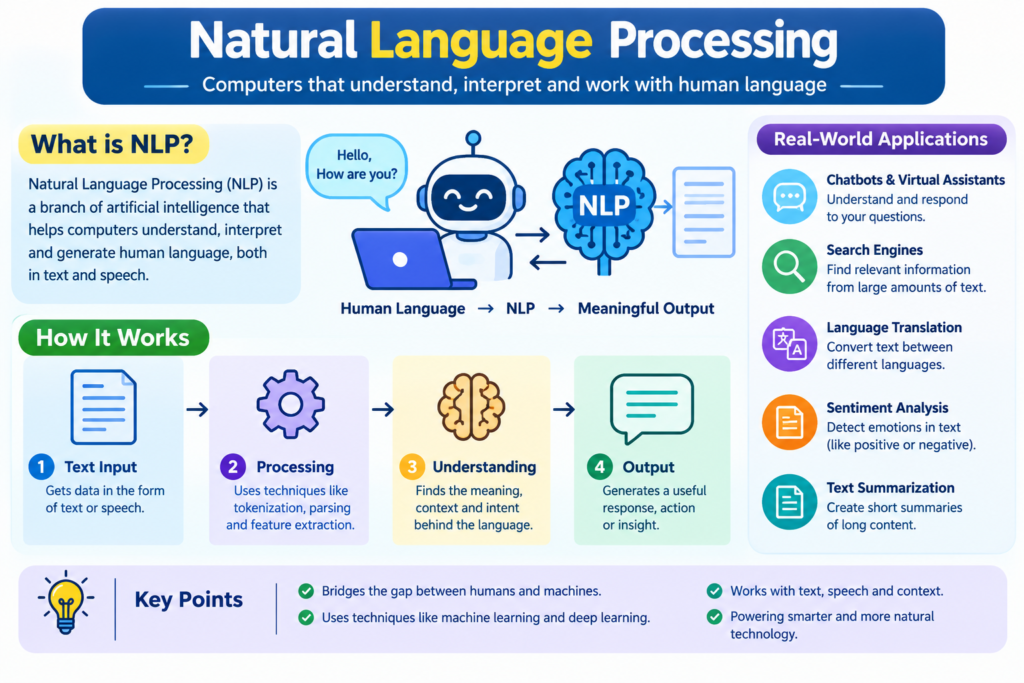
Natural language processing is a major area of artificial intelligence (AI) that helps computers work with human language. It allows machines to process text and speech, identify patterns, understand meaning, and generate useful responses.
Human language is not simple. We use slang, short forms, jokes, emotions, different accents, and words with several meanings. A sentence can also mean different things depending on its context. NLP helps AI deal with these challenges.
Today, NLP is used in search engines, chatbots, translation tools, email filters, recommendation systems, voice assistants, customer support, education platforms, and generative AI. In this simple guide, we’ll explore how AI understands human language, how NLP works, where it is used, and why it is becoming an important part of modern technology.
What Is Natural Language Processing?
Natural language processing (NLP) is a branch of artificial intelligence and computer science that helps computers process, analyze, understand, and generate human language. In simple terms, NLP acts as a bridge between people and computers.
People communicate naturally using words and speech. Computers, however, work with numbers, patterns, and structured data. NLP helps transform human language into information that an AI system can process.
For example, consider this sentence:
“I want to find a good course for learning Python.”
An NLP system may identify:
- Intent: Find a course
- Topic: Python programming
- Object: Course
- User need: Learning
- Important entities: Python
The system doesn’t simply look at individual words. Modern NLP systems try to understand how words relate to one another.
NLP combines ideas from computational linguistics, machine learning, statistics, and deep learning. Modern systems can process both written and spoken language.
Why Is NLP Important?
The amount of digital language created every day is enormous. Businesses and organizations have emails, reviews, documents, support conversations, reports, social media posts, and other text data.
Reading all this information manually can take a huge amount of time.
NLP can help analyze this information quickly.
For example, a company can use NLP to:
- Classify customer complaints.
- Detect customer sentiment.
- Find important topics.
- Extract names and locations.
- Summarize documents.
- Answer common questions.
- Search large collections of information.
This makes NLP an important part of modern AI communication and automation.
NLP and Artificial Intelligence: What Is the Connection?
NLP is closely connected to artificial intelligence.
Artificial intelligence is the broader field. It focuses on creating systems that can perform tasks that normally require human intelligence.
These tasks can include:
- Understanding language
- Recognizing images
- Making predictions
- Learning from data
- Solving problems
- Generating content
- Making decisions
NLP focuses specifically on human language.
Therefore, the role of NLP in artificial intelligence is to help AI systems communicate with people through text and speech.
For example, a chatbot AI may receive:
“Can you help me find an internship?”
NLP can help the system identify the user’s intent and important concepts. A larger AI system can then search its available information and generate a response.
NLP is also important in generative AI. Modern large language models use advanced NLP techniques to process prompts and generate text.
How Does AI Understand Human Language?
So, how does AI understand human language?
The answer isn’t as simple as teaching a computer a dictionary. AI systems learn patterns from large amounts of language data. They analyze relationships between words, phrases, sentences, and broader contexts.
A simplified process looks like this:
Human language → Processing → Representation → Pattern recognition → Meaning/intent → Response
Suppose someone says:
“The bank is near the river.”
The word “bank” could refer to a financial institution or the side of a river. The surrounding words provide context. An NLP model can use that context to determine the likely meaning.
Modern NLP systems use vector representations, word embeddings, contextual embeddings, neural networks, and transformer models to represent language mathematically.
This doesn’t mean an AI understands language exactly like a human does. Instead, it learns statistical and semantic patterns that allow it to perform language tasks effectively.
How Does Natural Language Processing Work?
NLP usually involves several stages. The exact process depends on the application and model being used.
1. Text Collection
First, an NLP system needs language data.
This could include:
- Articles
- Books
- Customer reviews
- Emails
- Search queries
- Chat messages
- Transcripts
- Social media posts
The quality of the data matters because models learn from it.
2. Text Preprocessing
Raw text can contain punctuation, spelling variations, unnecessary symbols, and other information. NLP systems may clean and prepare the data before analysis.
Common techniques include:
- Tokenization
- Lowercasing
- Stop-word processing
- Stemming
- Lemmatization
- Sentence segmentation
For example, a sentence can be divided into smaller units called tokens.
3. Language Representation
Computers cannot directly process human words in the same way people do.
Language therefore needs to be represented numerically.
Traditional systems used techniques such as Bag of Words and TF-IDF.
Modern systems often use word embeddings and contextual vector representations.
These representations help models identify relationships between words and phrases.
4. Language Analysis
The system then analyzes language patterns.
It may identify:
- Meaning
- Grammar
- Sentiment
- Intent
- Topics
- Entities
- Relationships
5. Prediction or Generation
Finally, the AI produces an output.
For example, it may:
- Classify a message
- Translate text
- Answer a question
- Generate a response
- Summarize a document
- Recommend information
This entire process allows NLP to transform unstructured language into useful information.
Machine Learning NLP: How Machines Learn Language Patterns
Machine learning NLP uses machine learning algorithms to learn patterns from language data.
Instead of writing a separate rule for every possible sentence, developers can train models using examples. For example, imagine training a system to identify spam emails.
The system may receive thousands of emails labeled:
- Spam
- Not spam
Over time, the model can learn patterns associated with spam messages.
Machine learning can support many NLP tasks, including:
- Text classification
- Sentiment analysis
- Spam detection
- Topic modeling
- Intent detection
- Named entity recognition
The quality of training data, model design, and evaluation all influence the final result.
Deep Learning NLP and Neural Networks
Modern NLP has changed significantly because of deep learning.
Deep learning uses multi-layered neural networks to learn complex patterns from data. Earlier NLP systems often depended heavily on manually designed language rules and features. Deep learning made it easier to learn representations directly from large datasets.
Deep learning NLP is used in areas such as:
- Speech recognition
- Machine translation
- Text generation
- Question answering
- Sentiment analysis
- Conversational AI
Neural networks can learn relationships between words and larger pieces of text. This became especially powerful with transformer-based architectures.
Transformer Models, BERT, GPT, and Large Language Models
One of the biggest changes in modern NLP has been the rise of transformer models.
Transformers can process relationships between words across a sequence. They use mechanisms such as attention to determine which parts of the input are important for understanding the current context. This has helped power systems such as BERT and GPT-style large language models.
BERT
BERT is designed to understand words based on the context around them. For example, the meaning of a word can change depending on the sentence. Contextual representations help models handle these differences.
GPT and Large Language Models
GPT-style models are designed to process language and generate text based on patterns learned from large datasets. Large language models can perform tasks such as:
- Answering questions
- Summarizing text
- Writing content
- Explaining concepts
- Translating language
- Extracting information
- Holding conversations
This is one reason conversational AI has become so accessible. However, an important point remains: fluent language does not always mean perfect understanding. AI systems can still produce incorrect information, misunderstand ambiguous requests, or reflect problems present in training data.
Major NLP Tasks You Should Know
NLP includes many different tasks. Understanding these tasks makes it easier to understand how language technology works.
Sentiment Analysis
Sentiment analysis identifies the emotional tone of text.
For example:
“The course was excellent and easy to follow.”
The system may classify the statement as positive.
Companies can use sentiment analysis to study:
- Customer reviews
- Social media comments
- Survey responses
- Product feedback
Named Entity Recognition
Named entity recognition (NER) identifies important entities in text.
These may include:
- People
- Companies
- Locations
- Dates
- Products
- Organizations
For example:
“Google opened a new office in Bengaluru.”
The system may identify “Google” as an organization and “Bengaluru” as a location.
Text Classification
Text classification assigns text to predefined categories.
For example:
- Complaint
- Question
- Feedback
- Request
Email spam detection is another common example.
Topic Modeling
Topic modeling helps discover major themes in large collections of text.
For example, thousands of student comments might contain topics such as:
- Courses
- Fees
- Teachers
- Exams
- Career support
Intent Detection
Intent detection tries to determine what a person wants.
For example:
“How can I reset my password?”
The intent could be password reset.
Intent detection is particularly useful in chatbot AI and customer support systems.
Text Analysis and Text Mining
Text analysis involves extracting useful information from written language.
Text mining goes a step further by discovering patterns and insights from large collections of text.
For example, a company could analyze thousands of reviews to discover:
- Common complaints
- Popular features
- Customer preferences
- Emerging topics
- Sentiment trends
This is valuable because much business information exists in unstructured text.
NLP makes it possible to turn that unstructured language into structured insights.
Examples of NLP in Daily Life
You may already use NLP several times a day without noticing it. Here are some common examples of NLP in daily life:
Search Engines
When you search for something, the search engine tries to understand your query and identify relevant results.
Modern search systems can use semantic relationships rather than relying only on exact keyword matches.
Voice Assistants
Voice assistants combine speech recognition with NLP to process spoken commands.
You might say:
“Set an alarm for 7 AM.”
The system must recognize the speech, identify the intent, understand the time, and perform the requested action.
Email Filters
Email systems can analyze messages and identify spam or suspicious content.
AI Translation
Translation tools use NLP and machine learning to convert text or speech from one language into another.
Autocomplete
When your phone predicts the next word in a message, language models are helping make that prediction.
Customer Support Chatbots
Chatbots can understand common questions and provide automated responses.
How Chatbots Use NLP
A chatbot AI needs more than a list of predefined answers.
A modern conversational AI system can use NLP to understand a user’s message, identify intent, retrieve relevant information, and generate a response.
For example:
User: “I want to know whether my application was approved.”
The system may identify:
- Intent: Application status
- Object: Application
- Action: Check status
It can then retrieve the relevant information and provide a response.
NLP helps make human-computer interaction more natural.
However, good chatbot performance also depends on other technologies, such as databases, retrieval systems, business rules, and language models.
NLP in Education: How Students Can Benefit
The applications of NLP in education are growing.
Students can use language technology for:
- Personalized learning
- Automated feedback
- Language practice
- Translation
- Question answering
- Summarization
- Study assistance
- Writing support
- Educational chatbots
For example, an NLP-powered learning system can analyze a student’s answer and provide feedback. It can also help identify common mistakes or recommend learning material.
Teachers may use text analysis to review large amounts of feedback or identify common areas where students need additional support. Still, AI should support learning rather than replace critical thinking. Students should verify important information and understand the concepts behind AI-generated answers.
NLP in Search Engines and Semantic Search
Traditional search systems often focused heavily on matching words in a query with words on a page.
Modern search is more focused on meaning and intent. This is where semantic search becomes important.
Imagine a user searches:
“best ways to learn coding as a beginner”
A semantic system can understand that the user may be looking for:
- Beginner programming courses
- Coding tutorials
- Learning paths
- Practice resources
- Programming languages for beginners
The exact words don’t have to appear in every result.
NLP can help search systems understand semantic relationships, user intent, entities, and context.
This is also important for modern AI search optimization, where content needs to answer questions clearly and demonstrate useful, trustworthy information.
NLP vs Machine Learning: What Is the Difference?
A common question is the difference between NLP and machine learning.
They aren’t competing technologies.
Machine learning is a broader approach that allows computers to learn patterns from data.
NLP is a field focused on human language.
Machine learning can be used inside NLP.
| NLP | Machine Learning |
| Focuses on human language | Focuses on learning from data |
| Works with text and speech | Works with many types of data |
| Includes language-specific tasks | Includes prediction and classification tasks |
| Uses ML and deep learning | Can be used in NLP, vision, recommendation, and more |
| Example: sentiment analysis | Example: fraud prediction |
So, NLP and machine learning are closely connected, but they aren’t the same thing.
NLP vs NLU vs NLG
These three terms are often confused.
NLP
Natural Language Processing is the broader field concerned with processing and working with human language.
NLU
Natural Language Understanding focuses on understanding meaning, intent, and context.
NLG
Natural Language Generation focuses on producing human-readable language.
A simplified example is:
User message → NLP processing → NLU understands intent → AI generates answer through NLG
These components can work together in modern conversational systems.
Benefits of Natural Language Processing
NLP provides several important benefits.
1. Faster Information Processing
AI can analyze large amounts of text much faster than a person can manually review every document.
2. Better Search
NLP can help search systems understand meaning and intent.
3. Improved Customer Support
Chatbots can answer routine questions and help users find information.
4. Automation
Repetitive language-based tasks can be automated.
5. Better Data Insights
Text mining can turn reviews, comments, and documents into useful insights.
6. More Natural Human-Computer Interaction
People can communicate with software using everyday language.
Challenges of NLP
NLP is powerful, but it isn’t perfect. Human language is full of ambiguity and complexity. Some major challenges include:
Ambiguous Words
A single word can have multiple meanings.
Slang and Informal Language
People use abbreviations, slang, emojis, and incomplete sentences.
Different Languages
Languages have different grammar, vocabulary, and cultural context.
Accents and Speech Variations
Speech recognition can struggle with accents, background noise, and unclear audio.
Context
The same sentence can mean different things depending on previous conversations.
Bias
Models can learn unwanted biases from their training data.
Incorrect AI Outputs
Generative AI systems may produce confident but incorrect information.
These challenges show why NLP requires careful testing, quality data, human review, and responsible AI practices.
The Future of NLP and AI
The future of NLP and AI is likely to focus on making machines more useful, reliable, contextual, and accessible.
Several developments are especially important.
More Natural Conversations
AI systems will continue improving their ability to maintain context across longer conversations.
Multilingual AI
Language models are increasingly being developed to work across many languages.
Better AI Search
Search systems will continue moving toward deeper semantic understanding.
More Personalized Education
AI may help create learning experiences based on a student’s goals, progress, and needs.
Voice-Based Interaction
Speech and language technologies may make voice interfaces more useful in everyday software.
Multimodal AI
Future AI systems can combine language with images, audio, video, and other forms of information.
The goal isn’t simply to make AI sound human. The bigger goal is to make technology easier and more useful for people.
NLP for Beginners: A Simple Learning Path
If you’re a student and want to learn NLP, you don’t need to understand everything at once.
Start with the basics.
Step 1: Learn Python
Python is widely used for AI and NLP projects.
Step 2: Understand Machine Learning
Learn basic concepts such as:
- Training data
- Features
- Classification
- Regression
- Model evaluation
Step 3: Learn NLP Basics
Study:
- Tokenization
- Stemming
- Lemmatization
- Text classification
- Sentiment analysis
- Named entity recognition
Step 4: Learn Deep Learning
Understand neural networks and how they process data.
Step 5: Study Transformers
Learn how attention and transformer models changed modern NLP.
Step 6: Build Small Projects
Try projects such as:
- Spam classifier
- Sentiment analyzer
- Simple chatbot
- Text summarizer
- Keyword extractor
Hands-on practice will make the concepts easier to understand.
”FAQs”
1. How does AI understand human language?
AI uses NLP techniques to process text or speech, identify patterns, represent language as numerical data, and analyze context, meaning, and intent. Modern language models use neural networks and transformer architectures to process complex language patterns.
2. What is NLP in simple words?
NLP is a technology that helps computers work with human language. It allows AI systems to read, analyze, understand, translate, and generate text or speech.
3. What is the role of NLP in artificial intelligence?
NLP gives AI systems the ability to work with human language. It supports chatbots, search engines, translation, speech recognition, sentiment analysis, text classification, and generative AI.
4. How do chatbots use NLP?
Chatbots use NLP to process user messages, identify intent, understand important information, retrieve relevant answers, and generate responses. More advanced chatbots may also use large language models and external knowledge sources.
5. What is the difference between NLP and machine learning?
NLP focuses on human language, while machine learning is a broader approach for learning patterns from data. Machine learning is one of the technologies used to build modern NLP systems.
6. What are some applications of NLP in education?
NLP can support personalized learning, language practice, automated feedback, educational chatbots, translation, summarization, question answering, and analysis of student responses.
7. How do language models work in AI?
Language models learn patterns in language from training data. They can use these patterns to predict or generate language. Modern large language models use transformer-based neural networks to process context and produce responses.
8. Is NLP difficult for beginners?
NLP can seem difficult at first because it combines language, programming, mathematics, and machine learning. However, beginners can start with basic Python, simple text-processing projects, and fundamental machine learning concepts.
9. What are examples of NLP in daily life?
Search engines, voice assistants, translation tools, email spam filters, autocomplete, chatbots, grammar tools, and recommendation systems are common examples of NLP in daily life.
10. Why is NLP important in AI?
NLP makes communication between people and computers more natural. As AI becomes part of search, education, customer service, software, and everyday tools, the ability to understand and generate language becomes increasingly important.
Natural language processing is one of the most important technologies connecting human language and artificial intelligence.
From search engines and voice assistants to chatbots, translation tools, educational platforms, and generative AI, NLP is already part of many technologies people use every day.







Pingback: The Rise of AI Doppelgängers: 11 Powerful Ways Artificial Intelligence Can Create a Digital Version of You
Pingback: Beyond Job Replacement: How AI Could Change the Meaning of Work, Skills, and Human Purpose in 2026