How AI Can Personalize Education for Every Student
Every student has a different way of learning. Some students understand new ideas quickly. Others need extra practice, simple examples, or more time. Yet, traditional classrooms often follow the same lessons, tasks, and tests for everyone. This is where personalized learning AI can make a difference. Artificial intelligence can help teachers understand student needs, adjust learning materials, and offer useful feedback. It can also help students learn at a pace that suits them.
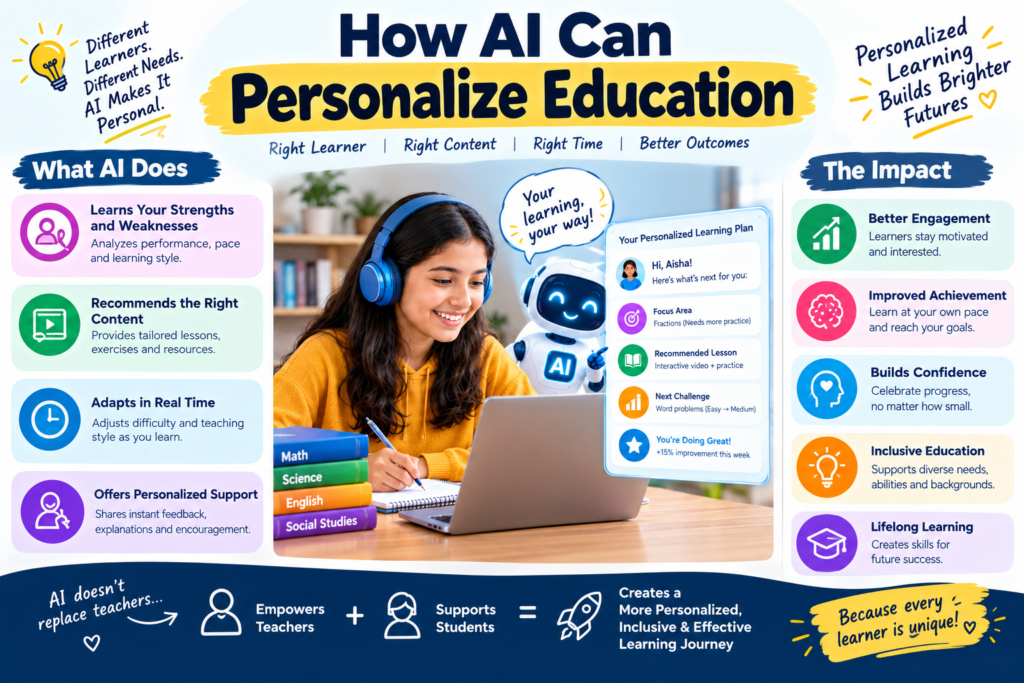
AI personalized education does not mean replacing teachers with machines. Instead, it gives teachers better tools to support each learner. Students can receive extra help when they struggle and more challenging tasks when they are ready to move ahead. For example, a student who finds fractions difficult may receive visual examples and short practice exercises. Another student who understands fractions well may move on to more advanced problems. Both students study the same subject, but their learning experiences differ.
This approach supports student-centered learning and makes education more flexible. With the right tools, schools can create custom learning paths, improve student engagement, and identify learning gaps before they grow. In this article, we’ll explore how AI personalizes education, the benefits it offers, the challenges schools should consider, and the steps educators can take to use it responsibly.
1. How AI Can Personalize Education and What Is Personalized Learning AI?
Personalized learning AI refers to the use of artificial intelligence to adapt learning activities to a student’s needs, progress, interests, and goals. In a traditional classroom, a teacher may give the same worksheet to 30 students. Some students may find it too easy, while others may struggle to complete it. An AI-powered learning system can offer different levels of practice based on each student’s progress.
The system may study quiz results, learning patterns, mistakes, and task completion. It can then suggest lessons or exercises that match the student’s current level. The goal is simple: help every student make meaningful progress.
How Traditional Learning Differs From AI Learning
Traditional teaching remains valuable, but it can be difficult to adjust every lesson for every learner in a large class. AI can help teachers manage this challenge.
|
Traditional Learning |
AI-Powered Personalized Learning |
|
Often follows a shared learning pace |
Can adjust the pace for each learner |
|
Uses common practice materials |
Can recommend different exercises |
|
Feedback may take time |
Can provide immediate feedback |
|
Learning gaps may be noticed later |
Can flag possible gaps earlier |
|
Teachers review progress manually |
Learning analytics can support progress reviews |
These differences do not mean AI is always better. A skilled teacher understands emotions, classroom relationships, and personal circumstances in ways that software may not. The strongest approach combines teacher expertise with useful technology.
How AI Understands Student Needs
AI learning platforms can collect information about student performance. Depending on the platform, this may include quiz scores, incorrect answers, time spent on tasks, and progress toward learning goals.
For instance, imagine a student who answers several multiplication questions correctly but struggles with division. The system may recommend more division practice before moving to a new topic.
This process is known as student performance analysis. It helps teachers identify areas where students may need additional support.
However, learning data must be interpreted carefully. A low score does not always mean a student lacks understanding. The student may be tired, distracted, or unfamiliar with the test format. Teachers should review the evidence before making important decisions.
2. How AI Personalizes Education for Every Student
Understanding how AI personalizes education begins with the way it responds to student progress. Instead of following one fixed route, an AI-powered system can adjust activities as a learner develops new skills.
Custom Learning Paths for Different Learners
Custom learning paths are among the most useful features of AI in personalized learning. They allow students to follow a sequence of activities based on their current knowledge and learning goals.
Consider three students learning English grammar.
- Student A understands basic sentence structure and needs advanced writing practice.
- Student B understands sentences but struggles with verb tenses.
- Student C needs help with basic grammar rules and simple examples.
A personalized learning platform can recommend different activities for each student. Student A may practise writing paragraphs, Student B may complete verb exercises, and Student C may review basic sentence patterns.
All three students work toward the same broader goal, but each receives suitable support.
AI custom learning paths for students can also change over time. As students improve, the system may recommend harder tasks. If they struggle with a new concept, it can suggest revision activities. This makes learning more flexible and helps students focus on the skills they need most.
Adaptive Lessons and Learning Materials
Adaptive learning is an approach in which learning content changes according to a student’s performance or needs. For example, an AI-powered mathematics platform may respond to an incorrect answer by offering a simpler explanation. It may then provide a worked example and a few practice questions.
A student who answers correctly may receive a more difficult problem instead. Adaptive education technology can adjust several parts of the learning experience:
- Difficulty: Questions become easier or harder as needed.
- Format: Students may receive text, diagrams, videos, or interactive exercises.
- Pace: Students can spend more time on difficult concepts.
- Practice: The system can repeat topics that need more attention.
- Revision: Students can revisit earlier lessons before a test.
These features help students learn through practice rather than simply memorizing information. Still, recommendations should match the curriculum and the student’s age. Teachers should check that the material is accurate, useful, and suitable for the lesson.
Instant Feedback and Individualized Instruction
Feedback is a major part of learning. When students understand why an answer is wrong, they have a better chance of correcting the mistake. AI tools can provide feedback immediately after a student submits an answer. Instead of displaying only a score, a system may explain the correct method and suggest another example.
For example, a student solving an algebra problem may make a mistake while moving a number from one side of an equation to the other. The system can highlight the step and offer a short explanation. This supports individualized instruction because students receive help linked to their specific errors.
AI can also help teachers prepare practice questions, simplify explanations, and develop examples for different skill levels. Teachers can review these materials before sharing them with students. The result is a learning process that offers more opportunities for practice, correction, and improvement.
3. Key Benefits of Personalized Education With AI
The benefits of personalized education with AI go beyond giving students different worksheets. When used well, AI can help improve engagement, support stronger learning habits, and make learning more accessible.
Better Student Engagement
Students are more likely to stay interested when lessons match their needs and interests.A learner who finds a lesson too difficult may feel frustrated. Another who finishes every task quickly may become bored. AI-driven educational experiences can help address both situations by adjusting the level of challenge.
For example, a science lesson about the solar system might use diagrams for a visual learner, short reading passages for another student, and interactive questions for someone who learns through practice.
These options can make lessons feel more relevant. AI can also recommend activities linked to student interests. A student who enjoys sports might practise mathematics through scores and statistics. A student interested in nature might learn measurement through examples involving plants or wildlife.
Such approaches can make abstract ideas easier to understand.
However, engagement is about more than screen time. Students also need discussion, group projects, outdoor activities, and personal interaction with teachers. AI should support these experiences rather than replace them.
Stronger Learning Outcomes
Students often struggle when they move to a new topic without understanding the basics. AI tools can help identify these gaps and recommend revision before the student moves ahead. For example, a student learning fractions may need a stronger understanding of division. A personalized system can suggest division exercises before returning to fractions.
This can reduce confusion and support gradual progress. Learning analytics also help teachers identify patterns across a class. If many students struggle with the same question, the teacher may need to explain the topic differently.
Useful learning analytics can answer questions such as:
- Which topics cause the most difficulty?
- Which students may need extra practice?
- Which activities lead to better understanding?
- Are students improving over time?
- Which skills still need attention?
These insights can guide lesson planning. They should not be treated as automatic proof of a student’s ability.
Greater Access and Flexibility
AI can help students access learning materials in different formats. Depending on the tools available, these may include text-to-speech, speech-to-text, captions, translations, and simplified explanations. These features can support learners who face language barriers or have different learning needs. They can also help students who need to review a lesson outside normal classroom hours.
For example, a student who misses a class may use an approved learning platform to review the topic and practise key skills. A student who finds a long reading passage difficult may use audio support or a shorter explanation. Personalized education can also support learners in remote areas when reliable devices, internet access, and suitable digital content are available.
Still, technology alone cannot solve every access problem. Schools need affordable devices, accessible materials, teacher training, and support for students who cannot connect regularly.
More Confidence and Independence
Students may become more confident when they can practise without worrying about making mistakes in front of others.
AI-powered practice tools can provide a private space to test ideas, review errors, and try again. This can encourage students to ask questions and take greater responsibility for their learning.
Over time, students can learn to set goals, check their progress, and choose suitable revision activities.
However, independence does not mean learning alone. Teacher guidance, family support, and peer interaction remain important parts of education.
4. How AI Learning Platforms Work
AI learning platforms use software, learning content, and student data to support teaching and learning. The exact process varies by platform, but many systems follow a similar pattern.
Step 1: Assess the Student’s Current Knowledge
The process often starts with a short quiz, an assessment, or a review of previous work.
Suppose a student begins a course on basic physics. The platform asks questions about force, motion, and energy. The answers help estimate which topics the student already understands and which may need revision.
This initial assessment gives the system a starting point. It should not be treated as a complete picture of the student’s abilities.
Step 2: Recommend Suitable Learning Activities
After the assessment, the system suggests lessons, examples, videos, or practice questions.
These learning recommendations may be based on the student’s performance, the course structure, and the skills required for the next lesson.
For example, a student who struggles with a topic may receive a short revision lesson. Another student who has mastered the topic may move to a more advanced activity.
Step 3: Track Progress Through Learning Analytics
As students complete activities, the platform may record their answers, scores, and progress.
Learning analytics turn this information into reports that teachers and students can review. These reports can reveal progress over time and highlight topics that deserve more attention.
Teachers can use this information to plan extra lessons, arrange small study groups, or change their teaching approach.
Step 4: Update the Learning Path
AI systems may use new results to adjust future activities. This creates a repeating cycle of assessment, practice, feedback, and improvement.
- Assess : Identify current knowledge and skill gaps
- Personalize : Recommend suitable lessons and practice
- Measure Progress : Review answers, mistakes, and improvement
- Adapt Again : Update activities based on new evidence
Predictive Learning: Finding Problems Early
Predictive learning uses available data to estimate possible future outcomes. In education, an AI system might identify patterns that suggest a student could struggle with an upcoming topic or fall behind in a course.
For example, repeated missed assignments and low quiz scores may indicate that a student needs support.
A teacher can then speak with the student, check for barriers, and offer help before the problem becomes more serious.
These predictions are not always correct. A student may have personal responsibilities, temporary difficulties, or technical problems that the system cannot understand. Predictive learning should therefore guide human attention, not label students or decide their futures.
Competency-Based Education
Competency-based education focuses on whether students have mastered specific skills or learning goals. Instead of moving every student forward after the same amount of time, a competency-based approach allows students to demonstrate their understanding before progressing.
AI can support this approach by recommending practice, recording progress, and identifying skills that need more work. For example, in a programming course, a student might need to demonstrate that they can write a basic function before moving to more complex code. An AI learning platform can suggest exercises and provide feedback during practice.
The teacher still needs to assess whether the student can apply the skill independently and explain the reasoning behind the solution.
5. Real-World Applications of AI in Education
AI personalization can support many subjects and age groups. Its usefulness depends on the quality of the learning materials, the needs of students, and how teachers use the technology.
AI for Different Subjects and Age Groups
Different subjects require different types of support. AI tools can help adapt explanations and practice activities to suit the learning goal.
|
Subject |
Example of AI Personalization |
Potential Benefit |
|
Mathematics |
Adjusts problem difficulty based on answers |
Builds skills step by step |
|
English |
Suggests grammar exercises and writing feedback |
Improves language practice |
|
Science |
Recommends explanations, diagrams, and quizzes |
Makes complex ideas easier to explore |
|
History |
Suggests reading materials and review questions |
Supports understanding of events |
|
Computer science |
Offers coding exercises and error explanations |
Encourages practical problem-solving |
|
Languages |
Provides vocabulary practice and conversation exercises |
Supports regular language learning |
For younger students, AI activities should be simple, age-appropriate, and supervised. They should include plenty of hands-on learning and social interaction. Older students may use AI to review difficult concepts, explore advanced topics, practise languages, or prepare for examinations.
At the college level, AI can support research planning, technical practice, and independent study. Students should still check facts, use reliable sources, and develop their own reasoning skills.
AI Support for Students With Different Needs
Individualized learning through AI can offer additional ways to access information and practise important skills. A student who struggles with reading may benefit from audio explanations. A student learning in a second language may need vocabulary support or simpler wording. Another student may need repeated practice with a particular concept.
AI tools can help provide these options when the platform supports them. Teachers can also use AI to prepare materials at different reading levels, create alternative examples, and develop extra exercises for students who need more support.
However, personalized tools should not make assumptions about students based on limited data. Their recommendations must remain flexible and open to review. For students with disabilities, accessibility features should be tested with the students who will use them. AI is not a replacement for qualified support staff, individualized accommodations, or professional guidance when those are needed.
A Practical Example: One Class, Three Learning Paths
Imagine a class of 30 students studying the water cycle. The teacher begins with a common lesson covering evaporation, condensation, and precipitation. Students then complete a short assessment.
The AI platform identifies three broad learning needs:
- Group A: Students who need to review the basic stages of the water cycle.
- Group B: Students who understand the stages but need more practice explaining them.
- Group C: Students who are ready to explore more complex topics, such as the effects of temperature on evaporation.
The teacher reviews the results and assigns suitable activities. Students work through their tasks, then take part in a shared class discussion.
This example shows how AI can support different learning paths without separating students from the classroom community.
The groups are temporary learning needs, not permanent labels. Students can move between them as their understanding changes.
6. Challenges and Ethical Concerns of AI in Education
Although AI offers many opportunities, schools should understand its limits before adopting new tools. Personalized learning works best when technology is accurate, secure, fair, and guided by educational goals.
Student Data Privacy
AI platforms may process personal information, assessment results, and learning records. Schools must understand what data a platform collects, how it uses that information, and how long it stores it.
Before adopting a tool, schools should:
- Review its privacy policy and data security practices.
- Collect only the information needed for learning.
- Follow applicable child protection and data protection rules.
- Explain data use to students and parents in clear language.
- Check whether student data is used to train external AI models.
- Limit access to sensitive records.
Students should not have to share unnecessary personal details to receive basic educational support.
Bias and Fairness
AI systems can produce unfair results if their training data, design, or recommendations do not reflect the needs of different learners. For example, a speech recognition tool may perform poorly for students with certain accents. A recommendation system may offer fewer advanced activities to students whose earlier scores were low.
Schools should test tools with different groups of learners and review whether the results are fair. AI recommendations must not become fixed judgments about a student’s potential. Students should have opportunities to improve, challenge mistakes, and receive human review.
Accuracy and Overdependence
AI systems can make errors. Some tools may provide incorrect explanations, unreliable facts, or feedback that does not match the curriculum. Students should learn to check important claims against textbooks, teachers, and trusted sources. Teachers should review AI-generated content before using it in class.
Overdependence is another concern. If students use AI to complete every task, they may miss opportunities to practise problem-solving, writing, and independent thinking. The aim should be to help students learn how to do the work, not simply produce answers for them.
The Importance of Human Teachers
Teachers understand context that AI may miss. They can notice changes in confidence, respond to emotional needs, encourage teamwork, and adapt lessons based on classroom discussions.
UNESCO’s Guidance for Generative AI in Education and Research recommends a human-centred approach that considers privacy, inclusion, fairness, and the role of educators.
This principle is essential for personalized education. AI should assist teachers, not replace their professional judgment. Schools should also ensure that students without reliable internet access or personal devices are not left behind. A useful education system must offer support to every learner, including those who cannot always use digital tools.
7. How Schools Can Implement AI Personalization
Schools do not need to change their entire teaching system overnight. They can begin with small projects, measure the results, and expand the use of AI when it provides clear educational value.
Start With Clear Learning Goals
Before choosing an AI tool, schools should identify the problem they want to solve. For example, a school may want to improve mathematics practice, support students who struggle with reading, or provide faster feedback on quizzes. Clear goals help schools select tools that meet real needs instead of adopting technology simply because it is new.
Choose Suitable AI Learning Platforms
Schools should compare AI platforms based on their educational value, safety, accessibility, and cost. Important questions include:
- Does the platform support the required curriculum?
- Can teachers review and adjust its recommendations?
- Does it protect student information?
- Can students use it on available devices?
- Does it provide useful progress reports?
- Can students access appropriate learning materials?
- Is training available for teachers and administrators?
Schools should test a platform with a small group before introducing it across the institution.
Train Teachers and Support Students
Teachers need practical training to use AI effectively. They should understand how to interpret learning analytics, review AI-generated content, identify possible errors, and explain responsible AI use to students.
Students also need clear guidance. They should know when AI assistance is allowed, how to verify information, and why they must complete their own thinking and learning.
Parents can be included through simple explanations of the school’s approach, privacy measures, and learning goals.
Measure Results and Improve the Approach
Schools should evaluate whether AI is helping students achieve meaningful progress.
Useful measures include:
- Improvement in assessment results.
- Changes in assignment completion.
- Student confidence and engagement.
- Progress toward specific learning goals.
- Teacher feedback on workload and lesson quality.
- Accessibility and participation across different learner groups.
Schools should compare results over time rather than relying on a single test or platform report.
The best approach is to keep what works, change what does not, and make decisions based on evidence.
AI is creating new opportunities to make education more flexible, accessible, and responsive to student needs. With personalized learning AI, students can receive targeted practice, useful feedback, and learning materials that match their current abilities.
Custom learning paths can help students work at their own pace. Adaptive learning can provide extra support when concepts are difficult. Learning analytics can help teachers identify gaps and make better decisions about classroom instruction.
Know More:
”FAQs”
1. What is personalized learning AI?
Personalized learning AI uses artificial intelligence to adjust lessons, practice activities, and feedback to a student's needs and progress. It helps learners focus on skills they need to improve while allowing them to move ahead when they are ready.
2. How does AI personalize education for every student?
AI can analyze assessment results, identify possible learning gaps, and recommend suitable activities. It may adjust question difficulty, suggest revision lessons, and provide immediate feedback. Teachers review these recommendations and help students follow an appropriate learning path.
3. What are the main benefits of personalized education with AI?
The main benefits include flexible learning, faster feedback, more targeted practice, improved access to learning materials, and better visibility into student progress. These benefits depend on the quality of the tool and how effectively teachers use it.
4. Can AI replace teachers in personalized education?
No. AI can support tasks such as recommending exercises, analyzing learning patterns, and preparing practice materials. Teachers remain essential for explaining complex ideas, understanding student needs, building relationships, and making important educational decisions.
5. What are AI custom learning paths for students?
AI custom learning paths are sequences of lessons and activities selected to match a student's knowledge, goals, and progress. For example, a student who struggles with fractions may receive extra practice, while another student may move to advanced mathematics problems.
6. Is AI personalized education suitable for young students?
Yes, when the tools are age-appropriate, safe, and supervised. Young students need simple explanations, active learning, social interaction, and teacher guidance. AI should complement these activities rather than replace them.
7. How does AI improve student engagement?
AI can recommend activities at a suitable difficulty level, provide quick feedback, and offer different ways to explore a topic. These features may help students stay interested and build confidence. However, meaningful engagement also depends on good teaching, motivation, and classroom interaction.
8. What are the risks of AI in personalized learning?
The main risks include student data privacy concerns, inaccurate information, biased recommendations, unequal access to technology, and overdependence on automated assistance. Schools should use secure tools, review AI outputs, train teachers, and keep humans involved in important decisions.
9. What is the difference between adaptive learning and personalized learning?
Adaptive learning changes lessons or activities based on student responses and progress. Personalized learning is broader. It can include adaptive learning, student goals, individual interests, teacher guidance, and different learning methods. Adaptive learning is one way to deliver personalized education.
10. How can schools start using AI in education?
Schools can begin by identifying one clear learning goal, choosing a suitable platform, testing it with a small group, training teachers, and measuring results. They should also review data privacy, accessibility, cost, and educational quality before expanding its use.