AI in Medical Diagnosis: Opportunities and Challenges
Artificial intelligence is changing how healthcare professionals detect diseases, interpret medical tests, and plan patient care. From identifying possible signs of cancer to analyzing eye scans, AI diagnostic tools are opening new doors for modern medicine.
However, this progress also raises important questions. Can AI diagnose diseases accurately? Will it replace doctors? How can hospitals protect patient data while using AI? This article explains the technology behind AI in medical diagnosis, its benefits, limitations, real-world applications, and future opportunities.
1. Understanding AI in Medical Diagnosis
Artificial intelligence (AI) is a technology that enables computer systems to perform tasks that normally require human intelligence. These tasks include recognizing patterns, analyzing information, making predictions, and supporting decisions.
AI in Medical Diagnosis refers to the use of AI systems to help identify diseases, interpret medical information, and support clinical decisions. These systems can analyze medical images, laboratory results, electronic health records, and other health data.
For example, a doctor may use an AI system to examine a chest X-ray for signs of lung disease. The system can highlight areas that need closer attention. The doctor then reviews those findings alongside the patient’s symptoms, medical history, and examination results. This approach combines computer-based analysis with professional medical judgment.
1.1 Technologies Behind AI Medical Diagnosis
Several technologies support AI-based medical diagnosis:
- Machine learning in healthcare: systems learn patterns from medical data and use those patterns to make predictions.
- Deep learning in medical diagnosis: layered neural networks analyze complex information, including images.
- Natural language processing: technology helps computers interpret written clinical notes and medical reports.
- Computer vision: systems analyze X-rays, MRI scans, CT scans, ultrasound images, and retinal images.
- Predictive analytics: models estimate the likelihood of certain health events from available data.
These technologies can help healthcare professionals process large amounts of information more efficiently. However, performance depends on training data, intended use, and the quality of the information supplied.
1.2 How Does AI Diagnose Diseases?
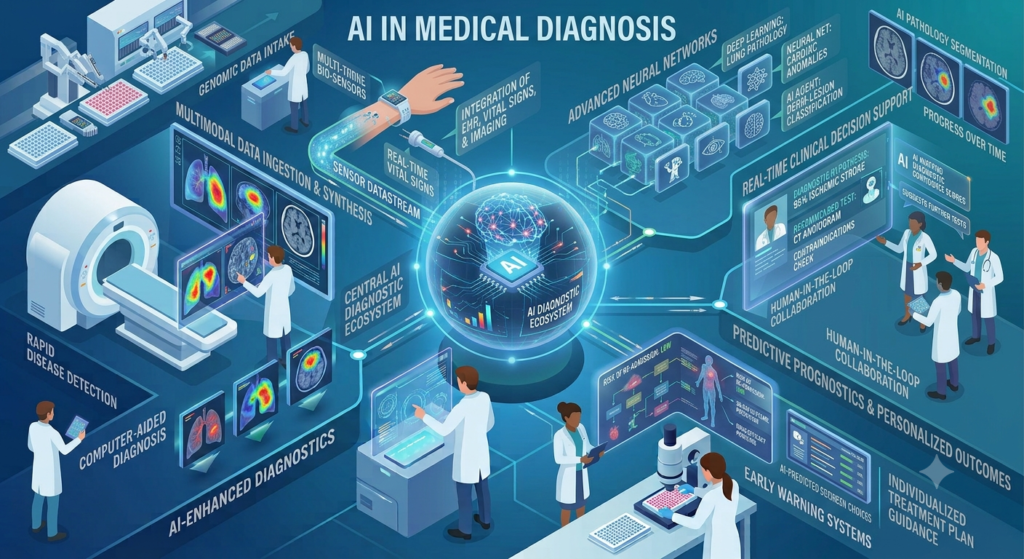
AI diagnostic systems commonly collect medical data, analyze patterns, generate findings, and provide results for clinical review. Data may include scans, test results, symptoms, and health records. Algorithms then search for relevant features and produce a score, alert, or suggested finding.
The exact process depends on the tool. Some systems detect a specific abnormality, while others estimate risk or help organize information for a clinician. AI does not automatically understand every medical condition, and its output should be interpreted within the wider clinical picture.
2. Major Applications of AI in Healthcare Diagnosis
Artificial intelligence in healthcare has applications across several medical fields. Its role is especially important when doctors need to review large datasets or identify small patterns that may be difficult to spot.
2.1 AI in Medical Imaging and Radiology
Radiologists examine X-rays, CT scans, MRI scans, mammograms, and ultrasound images to identify possible health problems. Medical imaging AI can highlight suspicious areas, identify and measure lung nodules, support assessment of certain bone injuries, detect possible signs of stroke in brain imaging, and help assess breast images during cancer screening.
For instance, an AI system may mark a small area on a lung scan that needs closer examination. This can help a radiologist focus attention on a possible abnormality. However, a highlighted area may be harmless, and a system may miss an important problem. Doctors must interpret findings in context.
2.2 AI in Pathology and Laboratory Testing
Pathologists study cells and tissue samples to diagnose diseases. AI in pathology can analyze digital slides and identify patterns associated with particular conditions. Depending on its validated purpose, it may help count cells, locate suspicious tissue, or measure features that support disease assessment.
AI may also assist laboratory teams by identifying unusual test results, flagging inconsistent data, and prioritizing samples for further review. These applications can reduce repetitive work, but qualified professionals must confirm findings when clinical judgment is required.
2.3 AI for Early Disease Detection
Early disease detection can improve the opportunity for timely treatment. AI systems may identify warning signs before a patient develops obvious symptoms, depending on the condition and available evidence. Examples include analyzing retinal images for diabetic eye disease, assessing scans for possible tumors, identifying patterns in heart rhythm data, estimating risk from health records, and flagging indicators associated with deterioration in hospital patients.
AI-based disease detection may be useful when screening large groups. Yet a risk score is not a diagnosis, and screening results often require additional testing.
2.4 AI in Personalized Medicine
Patients with the same disease may respond differently to treatment. Age, medical history, genetics, lifestyle, and other factors can influence outcomes. AI can help researchers and clinicians examine these differences and, in suitable settings, support precision medicine and personalized treatment plans.
For example, an AI model may help estimate how a patient fits a particular risk group. A clinician can use this information alongside established guidelines and the patient’s preferences. The goal is to provide useful evidence for informed decisions, not to let an algorithm choose treatment on its own.
3. Seven Powerful Benefits of AI in Medical Diagnosis
When a system is well designed and properly tested, it may improve how healthcare teams identify and manage disease.
3.1 Faster Analysis of Medical Information
Doctors work with large volumes of reports, scans, and laboratory results. AI can process certain types of information quickly and highlight findings that deserve attention. This may reduce delays in specific workflows, although total diagnosis time still depends on clinical review, further tests, and treatment availability.
3.2 Support for Early Detection
Some diseases develop gradually, with small changes appearing before obvious symptoms emerge. AI systems may identify these patterns in images, measurements, or health records. Early warnings can help clinicians decide whether further testing or closer monitoring is needed. Early detection is not guaranteed, but validated tools can strengthen selected screening processes.
3.3 More Consistent Analysis
Human performance can vary because of workload, fatigue, experience, and differences in interpretation. An AI model can apply the same analytical process to every case within its intended scope. This may help standardize tasks such as measuring structures on scans. Still, consistency does not necessarily mean correctness: a model can repeatedly make the same mistake.
3.4 Support for Clinical Decision-Making
AI in clinical decision-making can bring together information from symptoms, laboratory findings, previous diagnoses, and imaging results. A tool might suggest possible conditions, highlight missing information, or identify patients who need further assessment. Doctors remain responsible for deciding which findings are relevant and what action is appropriate.
3.5 Improved Access to Diagnostic Support
Some healthcare facilities have limited access to specialists. AI-assisted tools may help trained healthcare workers identify cases that require urgent attention or referral. For example, a validated retinal screening system may identify patients who need an eye specialist. Technology alone, however, cannot solve shortages of staff, equipment, connectivity, or medical services.
3.6 Reduced Repetitive Work
Healthcare automation can assist with selected administrative and analytical tasks, such as organizing information and preparing reports. This may allow staff to devote more time to complex cases and direct patient care. The best results occur when automated tasks are clearly defined and errors can be detected and corrected.
3.7 Better Use of Healthcare Data
AI can help identify trends across records, support research, and improve understanding of patient populations. Predictive analytics may identify groups at greater risk of complications. However, predictions must be validated and used carefully. A model trained on one hospital’s data may not perform equally well elsewhere.
4. Challenges of AI in Medical Diagnosis
Medical decisions affect human lives, so healthcare AI must meet high standards for safety, reliability, and accountability.
4.1 Data Quality and Availability
AI models learn from examples. If training data contains errors, missing information, or limited examples of certain conditions, results may be unreliable. Medical data can also be difficult to combine because hospitals use different record systems, testing methods, image formats, and reporting standards. Healthcare organizations need quality checks, representative datasets, and independent testing.
4.2 Bias and Unequal Performance
A model may work well for one patient group but perform less effectively for another if its training data is not representative. Differences in age, skin tone, sex, health conditions, equipment, and access to care can affect performance. Organizations should assess results across relevant groups, monitor performance after deployment, and investigate differences in error rates.
4.3 Diagnostic Errors and False Results
AI diagnostic tools can produce false positives and false negatives. A false positive flags a possible disease when the patient does not have it; a false negative fails to identify a disease that is present. False positives can lead to anxiety and unnecessary tests, while false negatives may delay treatment. Tools should be evaluated using suitable clinical evidence, including sensitivity, specificity, and predictive value.
4.4 Privacy and Data Security
Medical records contain sensitive personal information. AI development may involve collecting, processing, storing, and sharing data. Healthcare providers should use safeguards such as access controls, encryption, secure data handling, clear retention policies, and compliance with relevant privacy laws. The World Health Organization emphasizes human rights, accountability, transparency, and the public interest in health AI.
4.5 High Implementation Costs
Introducing AI can require software, computing resources, staff training, cybersecurity, and integration with existing systems. Hospitals should also consider maintenance, updates, licensing, monitoring, and resources needed to manage errors. A careful pilot project can help determine whether a tool offers meaningful value before wider adoption.
4.6 Lack of Transparency
Some AI models are difficult to interpret. A system may produce a prediction without making clear which factors influenced it. Healthcare providers should seek tools with useful explanations, clear documentation, defined limitations, and evidence of performance. Explanations should help clinicians assess results rather than encourage blind trust.
4.7 Legal and Ethical Responsibility
When AI contributes to an incorrect diagnosis, responsibility can be complex. Developers, healthcare organizations, clinicians, and regulators may have different duties. Organizations should establish procedures for reviewing outputs, documenting decisions, reporting incidents, and responding to failures. Ethical AI must protect patient choice and treat people as individuals, not just data points.
5. AI Diagnosis Compared With Traditional Medical Diagnosis
AI and traditional diagnostic methods have different strengths. AI can process selected datasets quickly and apply standardized analysis, while clinicians can explore context, speak with patients, conduct examinations, and reason through unusual cases. AI may struggle with unfamiliar patterns and depends on the data supplied. Traditional care also benefits from professional judgment and direct human interaction.
AI is not a complete substitute for doctors. Diagnosis may require a detailed history, physical examination, consideration of several possible conditions, discussion of uncertainty, and an understanding of patient preferences. The strongest approach is often collaborative: AI supports analysis, while healthcare professionals provide context, judgment, communication, and accountability.
6. Real-World AI Medical Diagnosis Examples
AI is already used in selected medical devices and clinical workflows. Its effectiveness depends on the intended purpose and the evidence supporting each system.
6.1 Diabetic Retinopathy Screening
Some AI systems analyze retinal photographs to identify signs of diabetic retinopathy that may require further assessment. These tools can support screening where specialist access is limited, but patients may still need a full eye examination and follow-up care.
6.2 Cancer Screening and Detection
AI systems can analyze mammograms, pathology slides, and other medical images to highlight suspicious findings. In some settings, this may help clinicians prioritize cases or assess complex images. Not every AI tool detects every type of cancer, and results depend on the system and its validation.
6.3 Heart and Cardiovascular Assessment
AI-enabled systems can analyze electrocardiograms and other cardiovascular measurements. Some tools identify patterns linked to specific heart conditions or estimate particular risks. These findings can support additional assessment, but a prediction alone does not establish that a patient has a disease.
6.4 Hospital Monitoring and Risk Alerts
Some clinical AI systems examine patient measurements and health records to flag possible deterioration. Useful alerts may prompt earlier assessment, but inaccurate alerts can create unnecessary work. Hospitals must evaluate alert quality and establish clear response procedures.
Explore the US Food and Drug Administration’s list of [AI-enabled medical devices](https://www.fda.gov/medical-devices/artificial-intelligence-enabled-medical-devices/list-artificial-intelligence-enabled-medical-devices) for examples of products and their intended uses.
7. How to Implement AI Healthcare Solutions Successfully
Hospitals need a clear plan before introducing AI diagnostic tools. They should identify a clinical need, evaluate evidence and regulatory status, train healthcare professionals, and monitor results after deployment.
Useful evaluation questions include: Has the tool been tested on similar patients? Does it work with existing equipment? What happens when it is uncertain? How are errors reported? Does it meet relevant legal requirements? A product demonstration alone is not enough to establish clinical value.
Doctors, nurses, technicians, and administrators should understand the system’s capabilities and limitations. Hospitals should monitor performance over time because results may change when patient populations, equipment, or clinical practices change.
8. The Future of AI in Medical Diagnosis
The future of AI in healthcare diagnosis may involve more connected systems, improved clinical integration, and greater support for personalized care.
8.1 Multimodal AI Systems
Newer approaches aim to combine medical images, laboratory results, clinical notes, and other health data. Such systems could help clinicians review information from different sources in one workflow. Combining more data does not automatically improve diagnosis, so every system needs evaluation for reliability and usefulness.
8.2 AI and Remote Healthcare
Remote monitoring tools collect selected health measurements outside hospitals. AI may help identify unusual patterns and signal when a patient needs attention. These systems require reliable equipment, clear escalation procedures, and access to qualified medical professionals.
8.3 Predictive Healthcare and Prevention
Predictive analytics may help identify patients who could benefit from earlier assessment or closer monitoring. A validated system may flag patterns associated with a higher risk of a complication. A clinician can then review the patient’s condition and decide whether additional care is appropriate. Increased risk does not mean a disease will definitely develop.
8.4 Responsible Innovation and Regulation
Healthcare AI needs ongoing evaluation as technology develops. Regulators, hospitals, developers, and clinicians all have a role in protecting patients. Responsible development should include clinical validation, privacy protection, transparency, fair performance, and continued monitoring. The FDA provides information about AI-enabled medical devices and their oversight.
8.5 Human-Centered Healthcare
Technology should improve patient care rather than make it less personal. AI may reduce repetitive tasks and help clinicians examine complex information, creating more time for discussions about symptoms, treatment options, concerns, and patient preferences. The goal is better care, not automation for its own sake.
Building a Smarter Future for Healthcare
AI in medical diagnosis offers important opportunities to improve how healthcare professionals analyze information, detect possible diseases, and support clinical decisions. Applications in radiology, pathology, retinal screening, and predictive analytics show how AI can contribute to selected diagnostic workflows.
At the same time, challenges such as bias, privacy, false results, cost, and accountability cannot be ignored. An AI system may make a mistake, perform poorly on unfamiliar data, or produce a prediction that requires further investigation.
The best path forward is to combine useful AI technology with qualified medical professionals, reliable clinical evidence, and strong patient protections. Healthcare organizations should select tools carefully, validate their performance, train staff, and monitor results over time.
Ultimately, the purpose of AI-powered healthcare is not to replace human care. It is to help healthcare professionals make better-informed decisions and provide safer, more timely, and more personalized care to patients.
Know More:
”FAQs”
What is AI in medical diagnosis?
AI in medical diagnosis is the use of computer systems to analyze health information and support disease detection. These systems may examine medical images, test results, and clinical records to identify patterns or suggest findings for professional review.
How is AI used in healthcare?
AI is used in medical imaging, pathology, retinal screening, cardiovascular assessment, clinical decision support, and patient monitoring. It can also help analyze healthcare data and automate selected administrative tasks.
Can AI diagnose diseases accurately?
Some AI tools perform well for specific diagnostic tasks, but accuracy varies by system, disease, patient population, and clinical setting. A tool should be validated for its intended use, and its findings should be interpreted appropriately.
4. What are the benefits of AI in medical diagnosis?
Benefits may include faster analysis, support for early disease detection, more consistent measurements, improved workflow efficiency, and better use of healthcare data. Actual benefits depend on the tool and how it is implemented.
5. What are the main challenges of AI in healthcare?
Major challenges include poor data quality, bias, false results, privacy risks, implementation costs, limited transparency, and questions about accountability. Healthcare providers must address these risks before and after introducing AI systems.
6. Will AI replace doctors in the future?
AI is unlikely to replace the full role of doctors because diagnosis involves clinical judgment, communication, physical examination, and individual patient needs. AI is better understood as a tool that can support selected medical tasks.
7. What diseases can AI detect?
Depending on the system, AI can support the detection or assessment of diabetic retinopathy, certain cancers, lung abnormalities, and selected cardiovascular problems. No single AI system can reliably detect every disease.
8. What is the future of AI in healthcare?
The future may include more personalized risk assessment, improved medical image analysis, connected monitoring systems, and tools that combine different types of health data. Progress will depend on clinical evidence, safety, fair access, and responsible implementation.