

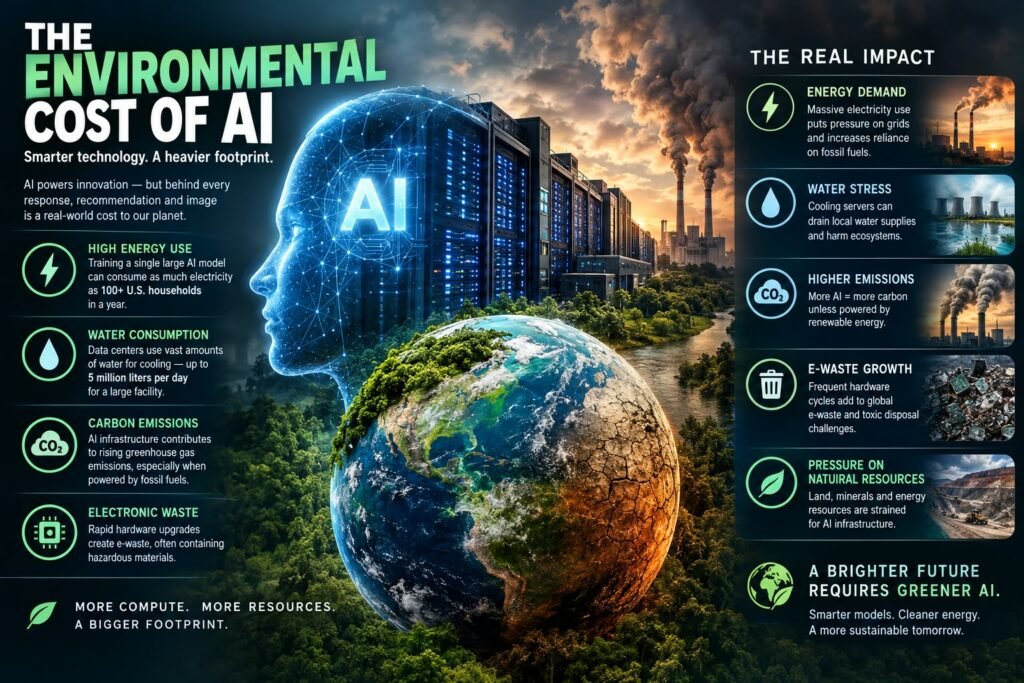
Environmental Cost of AI : Top 7 Ways to Make AI Sustainable
The Hidden Environmental Cost of AI: Can Artificial Intelligence Become Truly Sustainable?
Artificial intelligence is often seen as a tool for progress. It helps doctors detect diseases, supports students, improves business operations, and helps scientists study climate change. Yet there is another side to this technology. Every AI system depends on physical machines, electricity, water, and natural resources.
The environmental impact of AI is becoming an important issue as more people use chatbots, image generators, virtual assistants, and other intelligent tools. These systems may seem invisible, but the infrastructure behind them is very real.
According to the International Energy Agency (IEA), data centers used about 415 terawatt-hours (TWh) of electricity worldwide in 2024. This represented roughly 1.5% of global electricity consumption. The IEA projected that this figure could rise to around 945 TWh by 2030 in its base-case scenario. These figures cover data centers overall, not AI alone. However, AI is an important driver of the expected growth.
This raises an important question: can artificial intelligence continue to grow without putting too much pressure on the planet?
The answer depends on how we design, power, operate, and manage AI systems. Better technology can reduce waste, but real progress also requires clean energy, responsible hardware production, transparent reporting, and smarter use of computing resources.
1. What Is the Environmental Impact of AI?
The environmental impact of artificial intelligence refers to the effects that AI systems have on nature throughout their life cycle. These effects begin when manufacturers extract raw materials and build computer chips. They continue during model training, everyday use, equipment maintenance, and the disposal of old devices.
AI isn’t just software running on a screen. It relies on a large physical system.
How AI Systems Use Natural Resources
AI models process information through powerful computers. Many advanced systems use graphics processing units, or GPUs, to perform complex calculations quickly. These machines are often placed in large data centers.
A typical AI system can require resources at several stages:
- Electricity: Servers need power to train models and answer user requests.
- Water: Some data centers use water-based cooling to control heat.
- Raw materials: Chips, servers, batteries, and networking equipment require metals and other resources.
- Land: Data centers, power facilities, and supporting infrastructure need space.
- Manufacturing: Producing electronic equipment requires energy and can create emissions.
- Waste management: Old chips, servers, and other components eventually need repair, reuse, recycling, or disposal.
The United Nations Environment Programme (UNEP) recommends assessing the full life cycle of AI instead of looking only at electricity used during model training. Its research highlights energy, water, minerals, greenhouse gas emissions, and electronic waste as important areas of concern.
Why Does AI’s Environmental Cost Matter?
A single AI task may use relatively little energy compared with the resources needed to train and operate a large system over time. However, millions of users can make billions of requests.
The environmental cost of AI therefore depends on more than one interaction. It also depends on the size of the model, the length of its responses, the number of users, the hardware involved, and the electricity source.
For example, answering a simple question and generating a detailed video are different computing tasks. Video generation may require much more processing than a short text response.
This is why researchers need to measure actual resource use rather than assume that every AI task has the same footprint.
2. AI Energy Consumption and Carbon Emissions
Electricity is one of the most visible parts of the environmental cost of AI. Modern AI systems perform enormous numbers of calculations, and those calculations require power.
Why Do AI Data Centers Consume So Much Electricity?
Data centers contain servers, storage devices, networking equipment, backup systems, and cooling infrastructure. All these parts contribute to their total electricity demand.
AI workloads can be especially demanding because they often use many specialized chips at the same time. During training, thousands of processors may work together to learn patterns from large datasets.
The main sources of electricity use include:
- Model training: Processing data and adjusting model parameters.
- Model inference: Generating answers after a model has been trained.
- Data storage and transfer: Moving information between computers and storage systems.
- Cooling: Removing heat from servers and electronic components.
- Supporting infrastructure: Operating power systems, networking equipment, and other facilities.
Training attracts attention because it can require substantial computing resources. However, inference can become a major source of total energy use when a model serves millions of requests every day.
Training Versus Inference
| Activity | What happens? | Main environmental concern |
| Model training | A model learns from large amounts of data | High computing demand during development |
| Fine-tuning | An existing model is adapted to a specific task | Additional computing and data preparation |
| Text inference | A model generates a response | Repeated electricity use |
| Image or video generation | A model creates visual content | Potentially intensive calculations |
| AI agents | Systems perform multiple connected steps | More processing across a task |
The energy consumption of large language models varies greatly. There isn’t one reliable figure that applies to every model or every request.
Model size, hardware efficiency, response length, workload, and data center design all influence energy use. As a result, broad claims about the energy used by one chatbot question should be treated carefully unless they explain the model and measurement method.
How Does AI Contribute to Climate Change?
The link between AI and climate change largely depends on how electricity is generated.
When a data center uses electricity from coal or natural gas, its energy demand can contribute to greenhouse gas emissions. When it uses low-carbon electricity, its operational carbon footprint can be much lower.
This relationship is known as the carbon intensity of electricity.
Consider two data centers that use the same amount of electricity. One operates on a grid with a high share of fossil fuels. The other uses a cleaner electricity supply. Even with similar computing equipment, their electricity-related emissions may differ significantly.
The AI carbon footprint also includes emissions from hardware manufacturing, construction, transportation, and equipment replacement. Measuring only the electricity used during operation gives an incomplete picture.
Can AI Energy Efficiency Solve the Problem?
Improving AI energy efficiency is essential, but efficiency alone may not reduce total energy demand. For example, if a new model uses less electricity per request, a company might offer the service to more people or add new features. Total electricity use could still rise.
This is sometimes called a rebound effect: efficiency makes a service cheaper or easier to use, which can increase demand. The IEA has highlighted this tension between improving efficiency and the rapid growth of AI use.
The goal should therefore be twofold: make every AI task more efficient and ensure that the growth of AI delivers enough value to justify its resource use.
3. AI Water Consumption and the Hidden Cost of Data Centers
Electricity isn’t the only resource that matters. Water is another important part of the environmental impact of data centers. AI servers produce heat while working. If that heat isn’t removed, equipment can become less efficient or suffer damage. Some facilities use water-based cooling systems to manage temperatures.
Why Do AI Data Centers Consume Water?
Water can be used directly to cool equipment or indirectly to generate the electricity that powers a facility. Water is also required during the manufacturing of semiconductors and other electronic components.
The water footprint of AI can therefore include several sources:
- Water used in on-site cooling systems.
- Water associated with electricity generation.
- Water used in chip manufacturing.
- Water needed during the construction and maintenance of facilities.
The exact amount varies by location, climate, cooling technology, server workload, and electricity source.
How Much Water Is Used to Cool AI Data Centers?
There is no single figure that accurately describes the water use of every AI data center. Some facilities rely heavily on water-based cooling, while others use different approaches.
A facility in a hot, dry region may face very different water challenges from one in a cooler climate. Even two facilities in the same region may have different water footprints because of their design.
This matters because water stress is a local problem. A data center’s water use may have a greater effect on a community that already faces shortages than on an area with more reliable water supplies.
For India, this question deserves particular attention. As AI infrastructure expands, companies and planners need to consider local water availability, competing community needs, and the impact of long-term demand.
Practical Ways to Reduce AI Water Consumption
Data center operators can take several steps to reduce water pressure.
- Choose cooling systems suited to local climate conditions.
- Improve heat management to reduce unnecessary cooling.
- Reuse suitable water where safe and practical.
- Monitor water use and report it clearly.
- Avoid placing water-intensive facilities in highly stressed areas without proper safeguards.
- Consider water use associated with electricity generation, not only on-site consumption.
Air-based cooling and closed-loop systems may help in some situations, but no single design is best everywhere. A system that saves water may use more electricity, so operators should evaluate both impacts.
The key lesson: sustainable AI must consider local water conditions alongside energy efficiency. A data center cannot be called truly sustainable simply because its electricity use is low.
4. The Environmental Cost of AI Hardware
AI depends on advanced hardware. That includes GPUs, servers, storage devices, networking equipment, and cooling systems.
These products require raw materials, industrial processes, transportation, and energy. Their environmental impact begins long before they arrive at a data center.
Mining, Manufacturing, and Critical Minerals
Producing AI hardware requires metals and other materials used in semiconductors, circuit boards, batteries, and electronic components. Mining can damage habitats, disturb soil, pollute water, and consume energy. The scale of these effects depends on the material, extraction method, location, and environmental controls.
Manufacturing advanced chips also involves complex industrial processes. Semiconductor production requires specialized facilities, high-purity materials, and substantial energy and water resources. These factors contribute to the environmental impact of AI hardware manufacturing.
Electronic Waste From AI
AI technology evolves quickly. Companies may replace servers and accelerators to gain better performance, improve energy efficiency, or support newer models. When equipment is discarded too early, it creates electronic waste, also known as e-waste.
Electronic waste can contain valuable metals as well as substances that require careful handling. Improper disposal can harm workers and pollute the environment.
A responsible approach should prioritize:
- Maintaining and repairing equipment where possible.
- Reusing servers and components for suitable workloads.
- Extending hardware life when performance remains adequate.
- Recovering valuable materials through approved recycling systems.
- Managing hazardous components safely.
Why Lifecycle Assessment Matters
A lifecycle assessment examines the environmental impact of a product from raw material extraction to manufacturing, use, and disposal.
For AI, this means measuring both operational energy and the environmental cost of building the machines that perform the calculations. A highly efficient new chip may use less electricity during operation. However, replacing working equipment too frequently can increase manufacturing emissions and material demand.
The best choice depends on the full life cycle, not just the performance of the latest hardware.
Companies should therefore consider equipment lifespan, repair options, recycling arrangements, and total resource use when planning AI infrastructure.
5. Advantages and Disadvantages of AI for the Environment
AI has a complicated relationship with the environment. It can increase electricity demand and resource use, but it can also help people reduce waste, manage energy, and protect ecosystems.
The important question isn’t whether AI is always good or always bad. It’s whether a specific AI application creates a measurable environmental benefit that outweighs its costs.
Environmental Disadvantages of AI
The main disadvantages include:
- Higher electricity demand: Large-scale computing can place additional pressure on power grids.
- Carbon emissions: Fossil-fuel electricity and hardware manufacturing can increase greenhouse gas emissions.
- Water pressure: Some data centers require substantial cooling resources.
- Resource extraction: Advanced chips and supporting equipment depend on mined materials.
- Electronic waste: Rapid hardware replacement can increase waste.
- Uncertain impacts: Limited public data makes it difficult to measure the full footprint of many AI systems.
These concerns are especially important when AI is used for tasks that provide little real value or could be completed with simpler software.
Environmental Advantages of AI
AI can also support environmental protection in several ways.
- Smarter energy systems : AI can help forecast electricity demand, balance renewable energy supplies, detect equipment faults, and improve grid management.
- Forest and wildlife protection : AI can analyze satellite images to identify forest loss, monitor habitats, and help researchers detect environmental changes.
- Smarter agriculture : AI tools can help farmers assess crop health, plan irrigation, and use fertilizers or pesticides more carefully when supported by reliable data.
- Less industrial waste : Predictive maintenance and better production planning can reduce equipment failures, wasted materials, and unnecessary energy use.
UNEP has described how AI can support environmental monitoring, including the use of satellite analysis to identify methane emissions. However, these benefits depend on how the systems are designed and deployed.
Is AI More Harmful to the Environment Than Traditional Computing?
Not always. A traditional program that performs a simple calculation may use far fewer resources than a large AI model performing a similar task. For basic searches, sorting, calculations, or fixed rules, conventional software can often be the more efficient choice.
However, AI may provide benefits that traditional software cannot easily deliver, such as detecting complex patterns in large datasets or predicting changing conditions.
A fair comparison should examine the same task, the same quality of results, and the resources needed to achieve them.
| Factor | Traditional computing | AI computing |
| Simple calculations | Usually efficient | May require unnecessary extra processing |
| Complex pattern recognition | May need specialized rules | Can learn patterns from data |
| Energy use | Depends on the task and system | Can be high for large models and heavy workloads |
| Hardware needs | Often modest for basic tasks | May require specialized accelerators |
| Best use | Clear, predictable operations | Tasks where learning or prediction adds real value |
The lesson is simple: use the least resource-intensive tool that can do the job well.
6. Seven Powerful Ways to Make AI More Sustainable
Sustainable artificial intelligence requires action from technology companies, governments, researchers, educators, and everyday users. The aim is to reduce resource use without losing the benefits that make AI useful.
Here are seven practical ways to reduce the environmental cost of AI.
1. Power AI With Renewable Energy
Renewable energy from solar, wind, and other low-carbon sources can reduce the electricity-related carbon footprint of AI.
Companies can invest in new renewable projects, sign power purchase agreements, and improve how data centers connect to cleaner electricity grids.
However, buying renewable energy certificates doesn’t automatically mean a facility uses clean electricity at every hour. The timing, location, and quality of renewable energy supply matter.
Better planning should match computing demand with available low-carbon electricity as closely as practical. Energy storage and flexible workloads can also help. Why it matters: cleaner electricity reduces the emissions associated with running AI systems.
2. Build More Energy-Efficient AI Models
Not every task requires the largest available model.
Small language models and task-specific models can often handle focused work with fewer computational resources. Examples include classifying documents, extracting information, summarizing short texts, or answering questions about a limited subject.
Model optimization techniques can also reduce computing needs.
These include:
- Quantization, which reduces the precision used to represent model values.
- Pruning, which removes less useful model components.
- Knowledge distillation, which transfers useful behavior to a smaller model.
- Efficient model architectures, which reduce unnecessary calculations.
- Better batching, which helps process multiple requests efficiently.
The right method depends on the task. A smaller model should still be tested for accuracy, reliability, and safety.
3. Improve Data Center Cooling
Cooling systems help keep servers within safe operating temperatures. Better cooling design can reduce wasted energy and, in some cases, water consumption.
Operators can improve airflow, manage server temperatures, use heat exchangers, and consider liquid cooling for high-density workloads.
Some facilities can also reuse waste heat for nearby buildings or industrial processes. Whether this is practical depends on local demand, infrastructure, and climate.
Sustainable data centers should track both electricity and water use so that improvements in one area don’t create unnecessary harm in another.
4. Extend Hardware Life and Reduce E-Waste
Replacing hardware is not always the greenest option.
Companies should maintain equipment, repair components, reuse older servers for less demanding work, and recycle equipment through responsible channels.
Manufacturers can help by making products easier to repair and by providing clearer information about materials and recycling.
A lifecycle assessment can help businesses compare the environmental cost of keeping older hardware with the cost of manufacturing and installing new equipment.
5. Use AI Only When It Adds Value
One of the easiest ways to reduce unnecessary computing is to avoid unnecessary AI tasks.
For example, a company doesn’t need a large language model to calculate a total, check a fixed rule, or convert a measurement. A basic program may complete these tasks with fewer resources.
Users and developers can also reduce unnecessary repeated requests, limit excessive output, and avoid generating large files when a short answer will do.
This approach supports resource-efficient machine learning by focusing computing power on tasks that genuinely benefit from AI.
6. Measure and Report Environmental Impact
Companies cannot manage what they don’t measure.
AI providers should report meaningful information about electricity use, carbon emissions, water consumption, and hardware life cycles. Where possible, they should distinguish training costs from ongoing inference costs.
Useful measurements include:
| Metric | What it helps explain |
| Electricity per task | Energy needed to complete a defined workload |
| Carbon emissions | Climate impact of energy and other activities |
| Water consumption | Pressure on water resources |
| Hardware lifespan | How long equipment remains useful |
| Model efficiency | Resources needed to achieve a target level of performance |
| Recycling rate | How much discarded equipment is responsibly recovered |
There are still important gaps in environmental data for AI. UNEP has called for clearer measurement methods and stronger reporting practices to help governments and organizations assess these effects.
7. Encourage Responsible AI Development
Governments, businesses, universities, and technology providers all have a role in sustainable AI development.
Governments can establish environmental reporting standards and plan data center growth around local electricity and water conditions. Companies can set measurable sustainability goals and publish progress reports. Researchers can develop more efficient algorithms and share reproducible results.
Organizations should also ask whether an AI system needs to be built at all, whether an existing model can meet the need, and whether the expected benefits justify the environmental cost.
Green AI is about more than making models faster. It means treating energy, water, materials, and emissions as important design considerations from the beginning.
7. The Future of Sustainable Artificial Intelligence
The future of AI will depend on two developments: how quickly the technology becomes more efficient and how responsibly its use expands.
Researchers are exploring smaller models, better chips, more efficient algorithms, improved cooling systems, and new ways to manage computing workloads. These developments could lower the environmental cost of AI.
However, the growing use of AI for video generation, complex reasoning, and autonomous agents may create new resource demands. Efficiency gains are important, but they don’t guarantee that total energy consumption will fall.
What Role Will Renewable Energy Play?
Renewable energy will be central to sustainable AI development. Data centers can support the energy transition by investing in clean power, improving demand flexibility, and working with grid operators.
In some cases, AI workloads can be scheduled for times when low-carbon electricity is more readily available. This approach is known as carbon-aware computing.
For example, a non-urgent model training task could run when renewable electricity production is high, provided that the change doesn’t create other operational problems.
Yet renewable energy isn’t a complete solution. Solar panels, wind turbines, batteries, and power infrastructure also require land and materials. Responsible planning must consider these impacts alongside the benefits of cleaner electricity.
Can AI Become Carbon Neutral?
AI systems can reduce their carbon emissions through efficient hardware, smaller models, cleaner electricity, and better infrastructure.
Some companies may also use carbon removal or offsetting programs. However, these programs vary in quality, and they shouldn’t replace direct reductions in energy use and emissions.
A credible carbon-neutral claim needs a clear boundary, reliable measurement, and transparent accounting. It should also explain whether it includes hardware manufacturing, data center construction, and other parts of the supply chain.
Rather than relying on a single label, organizations should publish evidence of their actual emissions and reduction efforts.
How Can Students Contribute to Green AI?
Students don’t need expensive equipment or advanced technical skills to support AI sustainability.
Here are some useful practices:
- Use AI when it helps with a real learning or research task.
- Choose a simpler tool for basic calculations and repetitive work.
- Write clear prompts to avoid unnecessary repeated requests.
- Generate only the text, images, or videos needed for an assignment.
- Learn about renewable energy, data center cooling, and e-waste.
- Explore efficient algorithms and small language models in projects.
- Cite reliable research and distinguish measured facts from estimates.
Students can also explore green AI project topics, such as comparing model efficiency, studying data center water use, measuring the energy needs of local computing devices, or investigating electronic waste management.
Promising Research Topics for AI and Sustainability
For students preparing an environmental impact of AI essay, presentation, or research paper, these topics provide a useful starting point:
- Comparing the energy consumption of traditional computing and AI.
- The environmental impact of generative AI tools.
- Renewable energy integration in sustainable data centers.
- Small language models and energy-efficient algorithms.
- Water conservation strategies for AI infrastructure.
- Electronic waste from AI hardware and recycling solutions.
- AI applications in climate forecasting and environmental protection.
- Lifecycle assessment of artificial intelligence systems.
- Carbon-aware computing for large language models.
- Comparing the energy consumption of traditional computing and AI.
- The environmental impact of generative AI tools.
- Renewable energy integration in sustainable data centers.
- Small language models and energy-efficient algorithms.
- Water conservation strategies for AI infrastructure.
- Electronic waste from AI hardware and recycling solutions.
- AI applications in climate forecasting and environmental protection.
- Lifecycle assessment of artificial intelligence systems.
- Carbon-aware computing for large language models.
- Water used in on-site cooling systems.
- Water associated with electricity generation.
- Water used in chip manufacturing.
- Comparing the energy consumption of traditional computing and AI.
- The environmental impact of generative AI tools.
- Renewable energy integration in sustainable data centers.
- Small language models and energy-efficient algorithms.
- Water conservation strategies for AI infrastructure.
- Electronic waste from AI hardware and recycling solutions.
- AI applications in climate forecasting and environmental protection.
- Lifecycle assessment of artificial intelligence systems.
- Carbon-aware computing for large language models.
- The advantages and disadvantages of AI for the environment.Water needed during the construction and maintenance of facilities.The advantages and disadvantages of AI for the environment.The advantages and disadvantages of AI for the environment.
-
”FAQs”
1. What is the environmental impact of artificial intelligence?
The environmental impact of artificial intelligence includes electricity use, carbon emissions, water consumption, raw material extraction, hardware manufacturing, and electronic waste. The size of the impact depends on the model, workload, energy source, cooling system, and hardware life cycle.
2. Does ChatGPT use a lot of electricity?
ChatGPT requires electricity to process requests through computing infrastructure. The amount used for an individual request depends on factors such as model design, response length, and the complexity of the task. Exact figures shouldn't be assumed without reliable, model-specific measurements.
3. Why do AI data centers consume so much water?
Some AI data centers use water-based cooling to remove heat from servers. Water may also be used indirectly in electricity generation and during chip manufacturing. The amount varies by cooling technology, location, weather, and workload.
4. Is artificial intelligence environmentally sustainable?
AI can become more sustainable through efficient models, cleaner electricity, responsible hardware management, and transparent environmental reporting. However, sustainability depends on the entire life cycle and the scale of use. Not every AI application has the same environmental impact.
5. How can we reduce the carbon footprint of AI?
The main approaches include using renewable energy, improving model efficiency, selecting smaller models where appropriate, extending hardware life, reducing unnecessary computing, improving data center cooling, and measuring emissions across the supply chain.
6. What is green AI, and why does it matter?
Green AI refers to developing and using AI with a focus on reducing environmental costs. It encourages researchers and developers to consider electricity, emissions, water, and hardware resources alongside accuracy and performance.
7. Can AI help fight climate change?
Yes. AI can support climate modeling, renewable energy forecasting, methane detection, precision agriculture, and environmental monitoring. However, these benefits must be assessed against the resources required to develop and operate the systems.
8. Is generative AI sustainable in the long term?
Generative AI could become more sustainable if efficiency improves, electricity becomes cleaner, hardware lasts longer, and unnecessary computing is reduced. Its long-term sustainability will also depend on demand growth, water availability, recycling, and transparent reporting.
9. How can students use AI more sustainably?
Students can use AI for specific learning needs, avoid repeated requests that add little value, choose simpler tools for basic tasks, and limit unnecessary image or video generation. They can also study green computing and research the environmental impact of AI systems.
10. What is the future of AI and environmental sustainability?
The future will likely involve more efficient models, improved data center design, renewable energy integration, better recycling, and stronger environmental standards. Continued research and transparent measurement will be needed to ensure that technological progress also supports environmental goals.