
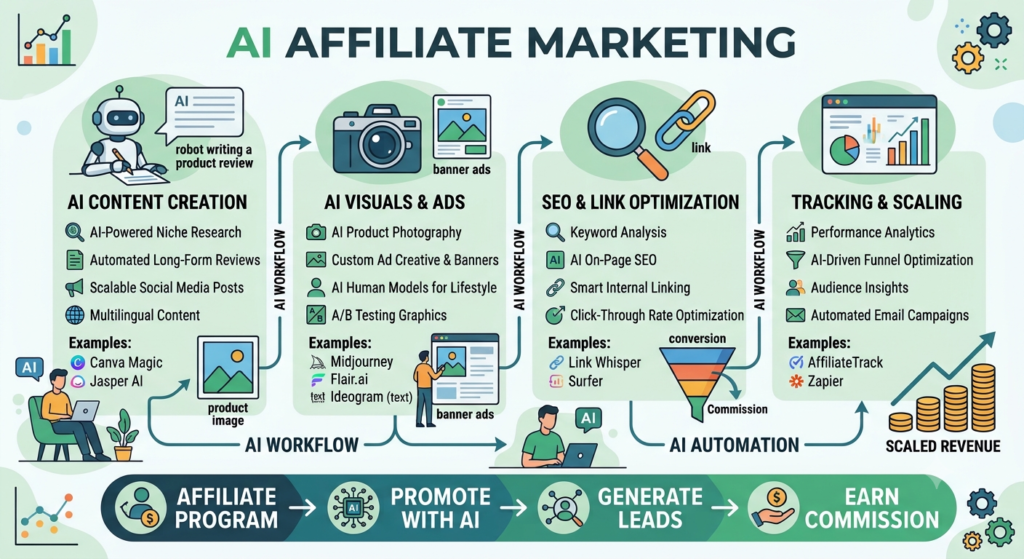
How to Use AI for Affiliate Marketing Content and Product Research
Affiliate marketing has become a popular way to earn money online. It allows people to promote products and earn commissions when customers purchase through their referral links. However, building a successful affiliate website takes time, research, and consistent content creation.
Many beginners struggle with finding profitable products, writing useful reviews, researching keywords, and creating content that attracts visitors. These tasks can take hours when done manually.
This is where AI affiliate marketing becomes useful.
Artificial intelligence can help marketers discover product opportunities, understand customer needs, generate article ideas, analyze competitors, and improve their content. It can also make daily marketing tasks easier.
However, AI isn’t a magic solution. You still need good judgment, accurate information, and a clear affiliate marketing strategy.
In this guide, you’ll learn how to use AI for affiliate marketing content and product research. You’ll also discover useful AI marketing tools, practical workflows, and ways to create content that helps readers make better purchasing decisions.
1. AI Affiliate Marketing:
Understanding
AI in affiliate marketing means using artificial intelligence software to support research, writing, SEO, product selection, and marketing activities.
Traditional affiliate marketing often requires manual research. You visit different websites, compare products, study competitors, and write articles yourself.
AI can make these activities faster.
For example, you can use an AI assistant to:
- Find profitable affiliate marketing niches.
- Generate product review ideas.
- Identify relevant keywords.
- Create article outlines.
- Compare product specifications.
- Analyze customer questions.
- Improve existing blog content.
- Develop email marketing ideas.
AI tools can process large amounts of information and organize it into useful insights. This helps affiliate marketers spend less time on repetitive tasks.
How AI Helps Affiliate Marketers
AI supports different stages of an affiliate marketing business.
|
Marketing Activity |
How AI Helps |
|
Niche research |
Identifies potential topics and audiences |
|
Product research |
Organizes product features and comparisons |
|
Keyword research |
Suggests relevant search terms |
|
Content writing |
Creates drafts and article outlines |
|
SEO optimization |
Identifies content improvement opportunities |
|
Competitor research |
Helps analyze competing content |
|
Marketing automation |
Supports repetitive marketing tasks |
For example, imagine you run an affiliate website about home appliances.
You can ask an AI assistant to identify common questions about air fryers, suggest comparison topics, and create an outline for a buying guide.
You can then verify product specifications, test products where possible, and write a helpful article.
Benefits of Using AI
There are several reasons affiliate marketers are adopting AI.
- Saves time: AI can prepare outlines, summarize information, and generate initial drafts quickly.
- Improves research: It can organize information from multiple sources and highlight useful patterns.
- Supports content consistency: AI helps maintain a regular publishing schedule.
- Generates new ideas: It can suggest article topics based on audience interests.
- Helps with SEO: AI can support keyword grouping, content structure, and optimization.
- Reduces repetitive work: Content planning and other routine tasks become easier.
Still, human review remains essential. AI-generated information may contain errors, outdated details, or unsupported claims.
2. Finding Profitable Affiliate Products With AI
Product selection plays an important role in affiliate marketing success.
Promoting a product without understanding its audience can lead to poor results. A product may offer a high commission but have limited demand.
AI product research helps marketers evaluate opportunities before investing time in content creation.
Identifying Profitable Niches
Start by selecting a niche.
A niche is a specific market or topic that attracts people with similar interests or needs.
Examples include:
- Fitness equipment.
- Home office products.
- Personal finance software.
- Beauty products.
- Online learning platforms.
- Kitchen appliances.
- Travel accessories.
- Website hosting services.
You can use AI tools to explore niche opportunities.
For example, enter this prompt into ChatGPT:
“Suggest 20 affiliate marketing niches with consistent customer demand. Explain the target audience, potential product categories, competition level, and content opportunities for each niche.”
AI can organize these ideas into a useful research list.
However, don’t choose a niche based only on AI suggestions. Check search demand, competition, available affiliate programs, and your ability to create useful content.
Analyzing Product Demand
A profitable affiliate product should have an audience that wants or needs it.
AI can help identify possible demand signals by analyzing:
- Customer questions.
- Product reviews.
- Search trends.
- Popular product categories.
- Common customer problems.
- Discussions in relevant communities.
For example, if you’re researching wireless headphones, AI can help identify common buying concerns.
These may include battery life, sound quality, comfort, microphone performance, and connectivity.
Such information can help you create relevant affiliate blog content.
Use Google Trends and keyword research platforms to validate demand. AI suggestions alone aren’t proof that a product will sell.
Evaluating Affiliate Programs
Once you’ve identified products, compare their affiliate programs.
Important factors include:
|
Factor |
What to Check |
|
Commission |
Percentage or fixed payment |
|
Cookie duration |
How long referrals are tracked |
|
Payment terms |
Minimum payout and schedule |
|
Product quality |
Customer satisfaction and reliability |
|
Brand reputation |
Trust and market recognition |
|
Conversion potential |
Likelihood of customer purchases |
AI can organize this information into comparison tables.
However, commission rates and program conditions should always be verified on the official affiliate program website.
3. Using AI for Affiliate Product Research
AI product research goes beyond finding products with high commissions.
It involves understanding the product, identifying customer needs, comparing alternatives, and discovering opportunities for useful content.
Competitor Research
Competitor research helps you understand what other affiliate marketing websites are publishing.
You can study competing articles to identify:
- Topics they cover.
- Keywords they target.
- Products they recommend.
- Questions they answer.
- Content gaps.
- Comparison formats.
AI can help summarize competitor information and suggest areas where your content could offer more value.
For example, suppose several websites publish articles about the best budget laptops.
You may discover that many articles discuss processor speed and memory but provide little information about battery life or student use.
This creates an opportunity for a more focused buying guide.
Use tools that provide reliable search results and competitor data. Don’t assume AI knows current competitor rankings without access to current information.
Product Feature Analysis
Product features influence purchasing decisions.
AI can help organize product specifications into easy-to-read tables.
For example:
|
Feature |
Laptop A |
Laptop B |
|
Processor |
Model A |
Model B |
|
RAM |
8 GB |
16 GB |
|
Storage |
256 GB |
512 GB |
|
Display |
Full HD |
Full HD |
|
Battery |
Verify specifications |
Verify specifications |
This structure helps readers compare products quickly.
Always collect specifications from official manufacturer pages or reliable product documentation.
Never allow AI to invent missing specifications.
Buyer Intent Keywords
Buyer intent keywords are search terms used by people who are considering a purchase.
Examples include:
- Best laptop for students.
- Product A vs Product B.
- Affordable wireless headphones.
- Best website hosting for beginners.
- Product A review.
- Best alternatives to Product B.
These keywords are useful because they often indicate that a reader is comparing products or looking for a buying recommendation.
AI can group keywords by search intent.
|
Keyword |
Search Intent |
|
What is affiliate marketing? |
Informational |
|
Best laptop for students |
Commercial |
|
Product A vs Product B |
Commercial |
|
Buy Product A online |
Transactional |
|
Product A official website |
Navigational |
Targeting the right intent helps you create content that matches what readers actually want.
4. Creating Affiliate Marketing Content With AI
Content is one of the most important parts of an affiliate website.
Readers visit affiliate websites because they want information, solutions, comparisons, and recommendations.
AI content creation can help you produce these materials more efficiently.
However, publishing unedited AI-generated articles isn’t a reliable content strategy.
Your content should provide accurate information, original insights, and genuine value.
Writing Product Reviews
Product reviews are a popular form of affiliate content.
A useful review should explain what a product does, who may benefit from it, its main features, advantages, disadvantages, and possible alternatives.
AI can help create a review structure.
A practical product review outline includes:
- Product introduction.
- Main specifications.
- Important features.
- Benefits and limitations.
- Target audience.
- Comparison with alternatives.
- Pricing considerations.
- Final recommendation.
You can use this prompt:
“Create an SEO-friendly product review outline for [Product Name]. Include its main features, potential benefits, limitations, ideal audience, and comparison points. Clearly identify information that needs verification.”
AI can then help prepare a first draft.
But there’s an important difference between writing a review and summarizing product information.
A genuine review should reflect actual product testing or clearly explain the research methods used. Never claim to have personally tested something when you haven’t.
Creating Product Comparison Content
Product comparison content helps readers choose between multiple options.
For example:
- Best budget smartphones.
- Laptop A vs Laptop B.
- Top website hosting services.
- Best wireless headphones for travel.
AI can help organize the comparison.
A good comparison article should include:
|
Section |
Purpose |
|
Introduction |
Explain the buying problem |
|
Product overview |
Introduce each option |
|
Feature comparison |
Highlight important differences |
|
Pricing |
Explain available price information |
|
Advantages |
Show product strengths |
|
Limitations |
Discuss possible drawbacks |
|
Recommendations |
Match products to user needs |
Avoid recommending a product simply because it offers a higher affiliate commission.
Reader trust should come before commission.
Generating Affiliate Blog Ideas
Consistent publishing requires a steady supply of useful topics.
AI can generate ideas based on your niche and audience.
For example, a fitness affiliate website could publish:
- Best resistance bands for home workouts.
- Adjustable dumbbells buying guide.
- Exercise bike comparison.
- Fitness equipment for beginners.
- Best yoga mats for daily practice.
You can also ask AI to create topic clusters.
A topic cluster contains one main subject supported by related articles.
This structure helps organize your website and develop topical coverage.
5. AI-Powered SEO Content Creation
Search engine optimization helps your affiliate website attract organic visitors.
AI can support SEO content creation by helping with keyword research, article structure, internal linking ideas, and content improvements.
Keyword Research
Keyword research helps identify what your target audience searches for online.
You can use AI to generate keyword ideas around a primary topic.
For example, if your primary keyword is “wireless headphones,” AI may suggest:
- Best wireless headphones.
- Wireless headphones for gaming.
- Budget Bluetooth headphones.
- Noise-cancelling headphones.
- Wireless headphones for office use.
Next, use keyword research tools to check search volume, competition, and search intent.
Don’t rely entirely on estimated keyword data generated by AI.
On-Page SEO
On-page SEO involves optimizing individual pages for readers and search engines.
AI can help improve:
- SEO titles.
- Meta descriptions.
- Heading structure.
- Introduction paragraphs.
- Image descriptions.
- Internal linking suggestions.
- Content readability.
For example, you can ask:
“Review this affiliate article for on-page SEO. Identify missing subtopics, unclear headings, keyword placement problems, and opportunities to improve reader experience.”
Review the recommendations before making changes.
Keywords should fit naturally into the content. Avoid repeating the same phrase unnecessarily.
Content Optimization
Content optimization improves existing articles.
Instead of publishing new content every day, review your older articles.
AI can help identify:
- Outdated product information.
- Missing questions.
- Weak introductions.
- Unclear explanations.
- Poor comparison tables.
- Missing internal links.
For example, an article about the best laptops may need updated models, specifications, and pricing information.
Updating useful content can improve its value for readers.
You should also follow Google’s official guidance on creating helpful, reliable, people-first content:
6. Best AI Tools for Affiliate Marketers
Choosing suitable AI marketing tools can make your workflow easier.
You don’t need dozens of subscriptions. Start with a few tools that solve your actual problems.
AI Writing Tools
- ChatGPT
Useful for article outlines, keyword ideas, product research assistance, content planning, and affiliate copywriting.
- Jasper
Supports marketing copy, brand messaging, and content creation.
- Grammarly
Helps improve grammar, clarity, tone, and readability.
AI Research Tools
- Perplexity
Helps research topics and discover sources for fact-checking.
- Google Trends
Helps explore search interest and compare topic popularity over time.
SEO and Automation Tools
- Semrush
Supports keyword research, competitor analysis, and SEO planning.
- Ahrefs
Helps analyze backlinks, keywords, and competing websites.
- Zapier
Connects supported apps and automates repetitive workflows.
Each tool serves a different purpose. Compare features, pricing, and limitations before choosing a subscription.
7. Building an AI Affiliate Content Workflow
A repeatable workflow makes affiliate marketing easier to manage.
Instead of starting from scratch every time, create a process that covers research, writing, optimization, and publishing.
Research to Publication
Follow these steps to create an AI affiliate content creation workflow.
Step 1: Select a topic
Choose a topic based on audience needs and niche relevance.
Step 2: Research products
Identify suitable products and collect information from official sources.
Step 3: Analyze keywords
Find informational, commercial, and transactional keywords.
Step 4: Create an outline
Ask AI to organize your topic into useful headings and subheadings.
Step 5: Prepare the first draft
Use AI writing tools to create an initial article.
Step 6: Verify information
Check specifications, prices, product availability, and other factual details.
Step 7: Add original value
Include personal experience, genuine testing, original comparisons, and helpful observations where available.
Step 8: Optimize the article
Review readability, SEO titles, headings, and internal links.
Step 9: Publish and monitor
Track search performance, clicks, and affiliate conversions.
Content Automation
Content automation helps reduce repetitive work.
You can connect different tools to organize your publishing process.
For example:
|
Task |
Possible Automation |
|
Topic planning |
Generate topic ideas |
|
Content briefs |
Create article outlines |
|
Editorial calendar |
Organize publishing dates |
|
Draft preparation |
Generate initial content |
|
Notifications |
Send publishing reminders |
|
Performance reports |
Collect available analytics |
However, don’t automate every stage.
Product recommendations, factual claims, disclosures, and final publishing decisions need human oversight.
Human Editing
Human editing is essential for high-quality affiliate content.
AI may produce content that sounds convincing but lacks real experience.
Before publishing, check:
- Are product details correct?
- Are recommendations fair?
- Are limitations explained?
- Are sources reliable?
- Does the article answer the reader’s question?
- Are affiliate links disclosed?
- Does the article contain original insights?
A good article should help someone make an informed decision, even if they don’t purchase anything.
8. Common AI Affiliate Marketing Mistakes
AI can improve productivity, but using it incorrectly can damage your website.
Here are common mistakes to avoid.
- Publishing unedited AI content
AI-generated drafts may contain errors, repetition, and generic advice. Always review them.
- Choosing products only for commissions
High commissions don’t guarantee product quality or customer satisfaction.
- Ignoring search intent
An informational article won’t always satisfy someone looking for a product comparison.
- Creating duplicate content
Publishing similar articles with slightly different keywords can weaken your content strategy.
- Using fake product reviews
Never claim personal experience or product testing that didn’t happen.
- Ignoring website performance
A slow website, confusing navigation, and poor mobile experience can reduce user satisfaction.
- Overusing automation
Automation should support your work, not replace research and editorial judgment.
- Ignoring affiliate disclosures
Readers should understand when links may earn you a commission. Follow applicable laws and affiliate program requirements.
Know More:
”FAQs”
1. How does AI help affiliate marketers?
AI helps affiliate marketers research products, discover keywords, generate content ideas, create article outlines, analyze competitors, and improve SEO. It can also support repetitive tasks, allowing marketers to focus on strategy and quality.
2. What are the best AI tools for affiliate marketing?
Popular options include ChatGPT, Jasper, Grammarly, Perplexity, Semrush, Ahrefs, and Zapier. The best choice depends on your requirements, budget, and workflow.
3. Can I use ChatGPT for affiliate marketing content?
Yes. You can use ChatGPT for product research assistance, blog outlines, product comparison structures, SEO ideas, FAQs, and article drafts. Always verify facts and add original insights before publishing.
4. Can AI write affiliate product reviews?
AI can help prepare review drafts and organize product information. However, accurate reviews require reliable evidence, verified specifications, and genuine testing or clearly explained research methods.
5. How can AI help with affiliate product research?
AI can identify niche ideas, organize product features, summarize customer feedback, suggest buying criteria, and discover comparison opportunities. Validate its suggestions with current market information.
6. Is AI-generated affiliate content good for SEO?
AI-generated content can support SEO when it provides useful, accurate, original information. Search performance depends on content quality and relevance, not simply whether AI was used.
7. Can beginners use AI for affiliate marketing?
Yes. Beginners can use AI to learn about affiliate marketing, select niches, research products, plan content, and understand SEO. Starting with a small number of tools is usually more practical.
8. How do I automate affiliate marketing content using AI?
Start by automating topic planning, content briefs, draft preparation, and publishing reminders. Keep human review for product research, factual accuracy, recommendations, and final publication.
9. Does AI guarantee affiliate marketing income?
No. AI doesn't guarantee traffic, sales, or commissions. Results depend on product selection, audience demand, content quality, website authority, competition, and marketing execution.
10. How often should I publish AI-assisted affiliate articles?
Focus on publishing useful articles consistently rather than meeting an arbitrary daily target. A few well-researched articles can offer more value than many repetitive posts.


