

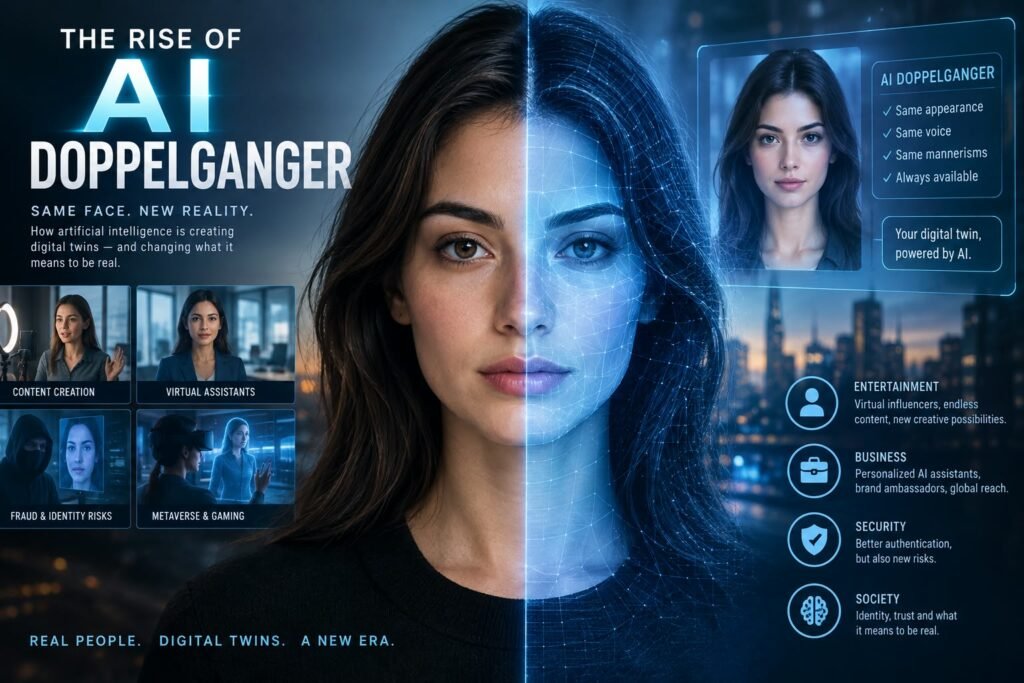
The Rise of AI Doppelgangers : 11 Powerful Ways Artificial Intelligence Can Create a Digital Version of You
AI Doppelgangers : 11 Ways AI Creates Your Digital Clone
Imagine having a digital version of yourself that can answer questions, speak in your voice, and write messages in your style. It could help you with daily tasks, share your knowledge, and even communicate with others when you’re busy.
This idea is no longer just science fiction. Thanks to generative artificial intelligence, machine learning, and digital human technology, creating an AI version of a person is becoming more realistic. These virtual copies are often called AI doppelgängers. They can use personal information, recorded speech, photos, videos, and writing samples to imitate certain parts of a person’s identity.
But there’s an important difference between copying how someone acts and actually being that person. An AI digital version of you might sound familiar and respond in a similar way. However, it doesn’t automatically have your feelings, memories, beliefs, or consciousness.
This technology offers exciting opportunities in education, business, entertainment, and personal productivity. At the same time, it raises serious questions about consent, privacy, ownership, and misuse. In this article, we’ll explore how AI doppelgängers work, how to create a digital version of yourself, and what this technology could mean for the future of human identity.
1. What Are The Rise of AI Doppelgangers?
An AI doppelgänger is a digital representation of a real person created or powered by artificial intelligence. It may imitate the person’s writing style, speaking voice, facial appearance, behavior, or conversational habits.
The term doppelgänger traditionally describes someone who looks remarkably similar to another person. In the digital world, it refers to a virtual copy that can resemble someone in appearance or behavior.
An AI doppelgänger can take several forms:
- A chatbot that answers questions in your writing style.
- A digital avatar that looks and sounds like you.
- A voice model that recreates your speech.
- A virtual assistant trained on your documents and knowledge.
- A digital human that combines facial animation, speech, and conversational AI.
The level of similarity depends on the technology, the quality of the available data, and the purpose of the model.
What Is an AI Digital Version of You?
An AI digital version of you is a software-based representation designed to reproduce selected aspects of your identity. For example, a teacher could create a virtual assistant that explains lessons using their teaching materials. A business owner could use a digital avatar to present product information. A writer could build a chatbot that answers questions based on their published work.
These systems don’t necessarily reproduce the whole person. Most are designed for a specific task. An AI clone might understand your preferred writing style without knowing your private memories. It might recreate your voice without understanding your emotions.
This distinction is essential when evaluating claims about AI personality cloning.
AI Doppelgängers vs. AI Digital Twins
The terms AI doppelgänger and AI digital twin are related, but they aren’t always interchangeable.
| Feature | AI Doppelgänger | AI Digital Twin |
| Main purpose | Imitate a person’s identity or behavior | Represent an entity or system |
| Typical data | Writing, speech, photos, videos | Sensor data, records, measurements |
| Common use | Virtual assistants and digital humans | Simulation and performance monitoring |
| Appearance | May resemble a real person | May be a dashboard, model, or 3D representation |
| Learning focus | Language, appearance, behavior | System state, performance, and changes over time |
Digital twin technology is widely used in manufacturing, engineering, and other technical fields. Human-focused digital twins can also model selected aspects of human behavior or performance.
An AI doppelgänger, by contrast, often focuses on personal resemblance and interaction. Both technologies can overlap, especially when a human digital twin includes conversational abilities.
2. How Does the Rise of AI Doppelganger Work?
Creating an AI replica of a person usually involves several technologies working together. Each one reproduces a different aspect of the person’s digital identity.
The system might use text to learn writing habits, audio to model speech, and images to create a realistic avatar.
Step 1: Collecting Personal Data
The first step is gathering information that represents the person.
This information may include:
- Emails, articles, and written messages.
- Audio recordings and voice samples.
- Photographs and video recordings.
- Public interviews and presentations.
- Personal notes and approved documents.
- Examples of communication preferences.
The system uses these materials as references or training data, depending on its design.
However, more data doesn’t always mean a better replica. Poor-quality information can create inaccurate results. Outdated documents may also cause the AI to provide incorrect answers. Personal data should be collected with clear permission and appropriate security measures.
Step 2: Learning Language and Personality Patterns
Large language models (LLMs) help an AI system understand and generate human-like text. These models learn statistical patterns from language. They can identify relationships between words, sentences, topics, and conversational styles.
When provided with suitable examples, an AI assistant may learn to produce text that resembles a person’s usual communication style.
For example, it might learn that someone prefers short explanations, uses simple language, or often explains ideas through examples.
This process is a form of personality simulation, not proof that the model has acquired the person’s actual personality.
Human behavior is complex. People respond differently depending on their emotions, relationships, environment, and experiences. An AI model can imitate patterns without fully understanding the reasons behind them.
Step 3: Building a Personalized AI Chatbot
A personalized AI chatbot provides the conversational part of a digital doppelgänger.Developers can give the chatbot instructions about the person’s tone, communication preferences, expertise, and boundaries.
They may also connect it to a collection of approved documents using retrieval-augmented generation (RAG).
RAG allows a model to retrieve relevant information from a reference library before generating an answer. This can make responses more closely reflect the person’s published work or documented knowledge.
Fine-tuning AI models is another option, although it requires suitable technical resources and training data.
For many personal projects, a chatbot connected to a well-organized knowledge library is a more practical starting point than training a model from scratch.
Step 4: Recreating Voice and Appearance
If the project requires a speaking avatar, voice cloning and visual generation can add another layer.
AI voice cloning technology analyzes speech samples to reproduce aspects of a speaker’s voice, such as tone, rhythm, and pronunciation.
AI face and video cloning tools can create an animated digital likeness from photographs or video footage.
When these technologies are combined, the result may look like a person speaking naturally on screen.
However, a realistic appearance doesn’t guarantee accurate information. A convincing digital human can still make mistakes or produce misleading statements.
Step 5: Testing and Improving the Replica
An AI doppelgänger should be tested before being used in real situations.
Testing can include questions about the person’s expertise, writing preferences, and approved information.
Developers should also check whether the system:
- Invents personal experiences.
- Gives inaccurate answers.
- Shares confidential information.
- Makes unsupported claims about the person.
- Responds appropriately when it doesn’t know something.
Clear disclosures can help people understand that they’re interacting with an AI representation rather than the real person.
3. The Key Technologies Behind AI Doppelgangers
Several technologies make digital human creation possible. They don’t all perform the same function, but they can work together to create a more complete virtual representation.
Large Language Models and Natural Language Processing
Large language models generate text based on patterns learned during training and the information supplied in a conversation.
Natural language processing (NLP) helps computer systems analyze and work with human language.
Together, these technologies support conversational AI, personalized chatbots, writing assistants, and virtual customer service representatives.
For an AI doppelgänger, they can reproduce selected language habits and respond to questions using relevant reference material.
Machine Learning Algorithms and Neural Networks
Machine learning algorithms identify patterns in data. Neural networks are computational models used in many modern AI systems, including language, image, and audio models.
Depending on the application, these systems may help recognize speech, generate images, analyze behavior, or produce realistic facial movements.
They don’t automatically understand a person’s complete identity. Their capabilities depend on the model, its training, and the information available to it.
AI Voice Cloning Technology
Voice synthesis can generate speech that resembles a particular speaker.
A voice model may learn pronunciation, rhythm, pitch, and other acoustic features from recordings.
Legitimate applications include accessibility tools, authorized dubbing, and personal voice preservation.
However, voice cloning can also be used to imitate people without permission. A familiar voice is not reliable proof of identity, so sensitive requests should be verified through a separate channel.
AI Face and Video Cloning
AI-generated human avatars can combine facial animation, synthesized speech, and visual representations of people.
Some systems animate a photograph. Others create a digital presenter from recorded footage or generate a synthetic person.
Deepfake technology and facial reenactment can make digital media appear authentic even when the person never performed the depicted action.
For this reason, creators should obtain appropriate consent, label synthetic media when necessary, and avoid misleading viewers.
Personal Data, RAG, and Fine-Tuning
Different methods can help personalize an AI system.
| Method | How It Works | Best Use |
| Prompt instructions | Defines style, role, and boundaries | Simple personalization |
| RAG | Retrieves information from approved documents | Knowledge-based digital assistants |
| Fine-tuning | Adapts a model using suitable training examples | Repeated, specialized patterns |
| Voice synthesis | Generates speech resembling a speaker | Authorized voice experiences |
| Avatar animation | Produces visual speech and facial movement | Digital presenters |
The right combination depends on the intended result.
A simple text assistant may need only instructions and reference documents. A realistic virtual human may require speech generation, visual animation, and a conversational model.
4. How to Create an AI Clone of Yourself
If you’re wondering how to create a digital version of yourself using AI, start with a clear goal. You don’t need to reproduce every part of your identity.
A focused project is often easier to build, test, and protect.
Step 1: Decide What Your AI Clone Should Do
First, define the purpose of your digital doppelgänger.
Possible goals include:
- Answering common questions about your work.
- Explaining educational topics in your preferred style.
- Creating drafts based on your writing examples.
- Presenting videos through an authorized digital avatar.
- Preserving selected stories and memories for family members.
Choose one main purpose for the first version.
For example, a professional might want an AI assistant that explains their expertise to website visitors. That goal doesn’t require voice cloning or a realistic digital face.
Step 2: Prepare Your Data
Gather information that you own or have permission to use. For a text-based AI clone, this could include articles, presentations, public talks, and approved notes.
Organize the material by topic. Remove private details, confidential business information, and sensitive records that aren’t necessary for the project.
If you want to recreate your voice, use clear recordings of your own speech. If you want a digital avatar, use images and footage that you have the right to use.
Step 3: Choose an AI Platform
Select a platform based on the features you need. A personalized chatbot platform may be enough for a text-based replica. Voice generation and avatar services are more appropriate if you want a speaking digital human.
Before uploading personal information, review the platform’s data retention policies, privacy controls, deletion options, and rules for synthetic media.
Don’t assume that every AI service handles uploaded data in the same way.
Step 4: Build Your Personalized AI Assistant
Create instructions that describe your communication style and the assistant’s purpose.
For example, your instructions might ask the system to use clear language, provide short answers, rely on approved documents, and avoid inventing personal experiences.
Connect a reference library if the platform supports RAG. If you add voice or video features, confirm that the tools support your intended use and that you control the resulting digital likeness.
Step 5: Test Accuracy and Personality
Ask the AI questions that reflect your real work, values, and communication habits.
Compare its answers with your own examples. Look for inaccurate details, unnatural language, and claims that you wouldn’t make.
You should also test questions outside its knowledge base.
A reliable AI clone should acknowledge uncertainty instead of pretending to remember events or experiences it was never given.
Step 6: Protect Your Digital Identity
Before sharing your digital replica, establish clear rules.
- Disclose that users are interacting with AI.
- Restrict access to sensitive documents.
- Use strong account security and access controls.
- Keep copies of important source files.
- Review the system regularly.
- Provide a way to report misuse or request removal.
Important: Never use someone else’s voice, face, private messages, or personal records to create an AI replica without appropriate authorization. Publicly available information isn’t automatically permission to imitate someone.
5. Real-World Uses of AI Doppelgangers
AI digital clones can support a wide range of activities. Their value depends on whether they solve a genuine problem and whether people understand their limitations.
Education and Online Learning
Teachers and subject experts can use personalized AI assistants to explain lessons, answer common questions, and provide additional practice.
For example, an instructor might create an assistant based on approved course materials. Students could use it to review a concept after class.
Digital humans may also deliver recorded lessons in multiple languages or present information in a consistent format.
However, AI tutors should support teachers rather than replace human guidance, especially when students need personal attention or emotional support.
Business and Customer Service
Companies can build virtual representatives that explain products, guide customers, and answer common questions.
An AI replica of a company founder might present approved information about a product or company history.
This could help businesses provide information outside normal working hours. It could also reduce the need to record the same basic presentation repeatedly.
Companies should clearly disclose when a digital representative is artificial and avoid suggesting that a real person personally reviewed every response.
Healthcare and Accessibility
Digital human technology may support accessibility and communication in selected settings.
Examples include personalized speech tools, virtual educational presenters, and assistants that help users navigate approved health information.
Voice preservation can also be valuable for people who may lose the ability to speak.
Still, an AI representation should not be treated as a medical professional or as a replacement for appropriate clinical care. Sensitive health data requires strong privacy protections.
Entertainment and Content Creation
Creators can use authorized digital avatars to produce videos, multilingual presentations, and interactive experiences.
A digital presenter could deliver the same educational message in several languages. A filmmaker might use synthetic media for a clearly disclosed creative project.
These tools may reduce production time, but creators must consider copyright, publicity rights, consent, and audience expectations.
Personal Knowledge and Digital Legacy
An AI assistant can organize a person’s writing, recorded stories, and documented experiences.
Family members might use such a system to explore approved memories or listen to recordings of a relative’s voice.
This can support remembrance, but the result is not the person themselves. An AI model can only work with the information available to it, and it may generate details that were never part of the original record.
6. Benefits and Risks of AI Doppelgangers
AI doppelgängers offer meaningful opportunities, but they also introduce risks that users shouldn’t ignore.
The Main Benefits
- Greater productivity
A digital assistant can handle repetitive questions and help prepare drafts, summaries, and presentations.
- Personalized learning
AI systems can adapt explanations to different skill levels and learning needs.
- Better accessibility
Authorized voice models and digital avatars may help people communicate when speaking or recording videos becomes difficult.
- Wider access to expertise
A well-designed assistant can make selected information available to more people without requiring the original person to respond to every question.
- Multilingual communication
Digital presenters can help deliver information in different languages, although translations still require review.
- Knowledge preservation
A digital library can preserve articles, recordings, and stories for future use.
The Main Risks
- Privacy violations
Personal data may expose sensitive information if it’s collected unnecessarily or stored insecurely.
- Identity fraud
Criminals may use voice cloning or synthetic video to impersonate someone and request money or confidential information.
- False statements
An AI replica may invent memories, opinions, or experiences and incorrectly attribute them to the real person.
- Loss of control
A digital likeness may be copied or reused beyond the purpose for which permission was given.
- Emotional confusion
People may mistake a convincing digital representation for an authentic interaction, particularly when the replica represents a deceased relative.
- Overreliance on AI
Users may trust a familiar-looking avatar even when its answers are inaccurate or misleading.
A Quick Comparison
| Potential Advantage | Possible Risk | Practical Safeguard |
| Faster communication | Incorrect responses | Test outputs and review sensitive answers |
| Realistic voice | Voice impersonation | Verify identity separately |
| Personalized learning | Misleading instruction | Use approved learning materials |
| Digital legacy | Emotional confusion | Disclose AI involvement clearly |
| Automated presentations | Unauthorized reuse | Set explicit usage permissions |
| Personalized knowledge | Data exposure | Minimize and secure personal data |
The best approach is to evaluate both the benefits and the risks before creating or deploying a digital clone.
7. Ethical and Legal Questions About AI Cloning
AI cloning ethics involves more than asking whether a digital replica can be created. It also requires considering who controls it, how it is used, and whether the people affected have given permission.
Consent and Digital Likeness
Consent should be clear, informed, and specific.
Someone who agrees to a voice recording for a training video hasn’t necessarily agreed to have their voice used in advertisements or financial messages.
Likewise, permission to use a photograph doesn’t automatically authorize the creation of an interactive digital human.
Good consent practices should explain:
- What information will be collected.
- What the AI replica will do.
- Where it may be used.
- Who can access or operate it.
- Whether the data can be deleted.
- How permission can be withdrawn, where applicable.
Data Ownership and Privacy
The question of who owns an AI digital identity can be complicated.
A person may control their own recordings while a platform has separate contractual rules for generated outputs, model training, or stored data.
Copyright, privacy, publicity rights, contractual terms, and other legal rules may apply differently depending on the country and situation.
Users should read the relevant terms and seek qualified legal advice for commercial or high-risk projects.
Is It Legal to Create an AI Replica of Another Person?
There isn’t one universal answer.
Legality can depend on consent, the nature of the material, commercial use, privacy expectations, copyright, publicity rights, and whether the replica is used to deceive or cause harm.
A harmless parody, a licensed digital presenter, and a fraudulent impersonation can raise very different legal issues.
In India, applicable information technology, privacy, intellectual property, and criminal laws may be relevant, depending on the circumstances. Rules can also change as governments respond to synthetic media.
For general information about digital rights and technology policy, consult the World Intellectual Property Organization (WIPO).
AI Clones of Deceased People
Creating a virtual version of a deceased person raises particularly sensitive questions.
Some families may value an interactive archive of a loved one’s stories. Others may feel that simulating the person’s voice or responses crosses a personal boundary. A digital replica might produce statements the deceased never made. It might also be used in ways that the person would not have wanted.
Where possible, people should document their wishes about recordings, digital accounts, and the future use of their likeness during their lifetime. Respect for family members, accurate disclosure, and careful control over the source material are essential.
8. The Future of Digital Humans and AI Identity
The future of AI doppelgängers will depend on advances in technology, user expectations, safety standards, and regulation.
As generative AI improves, digital humans may become more natural in conversation, more expressive in appearance, and more useful in specialized settings.
More Personalized AI Assistants
Future assistants may combine a person’s approved documents, preferences, voice, and communication style.
This could make them useful for managing knowledge, answering routine questions, and supporting work across different applications.
However, better personalization doesn’t guarantee better judgment. AI systems will still need clear limits and reliable sources.
Digital Humans in Education and Work
Virtual instructors, digital presenters, and AI-powered workplace assistants may become more common.
A subject expert could create a digital assistant that helps learners explore complex topics. A company could offer an interactive virtual guide to explain its services.
Human oversight will remain important where accuracy, trust, and accountability matter.
Could AI Create Digital Immortality?
Some people use the term digital immortality to describe preserving a person’s voice, writing, memories, or likeness through digital technology.
This idea may help families preserve stories and allow future generations to explore historical records in interactive ways.
But a digital archive is not the same as a living person. An AI replica cannot establish that it has inherited someone’s consciousness or subjective experience.
Even an extremely realistic virtual human remains a computational system whose responses depend on its design and available data.
Will AI Doppelgangers Replace Human Interaction?
AI clones may automate some routine communication, but they cannot guarantee the empathy, judgment, responsibility, and shared experience of human relationships.
They may be useful for answering common questions or delivering standard information. They are less suitable as substitutes for meaningful personal conversations or decisions that require human accountability.
The most promising future is likely to involve collaboration between people and AI rather than treating digital replicas as complete replacements for humans.
Building a Responsible Digital Future
A responsible approach to AI digital identity should include four principles:
- Transparency: Make it clear when a person is interacting with AI.
- Consent: Obtain appropriate permission before creating or using a person’s likeness.
- Security: Protect personal data, voice recordings, and identity-related information.
- Accountability: Establish who is responsible when an AI replica produces harmful or misleading content.
These principles can help people benefit from digital human technology while reducing the risk of misuse.
Are AI Doppelgangers the Next Step in Human Identity?
AI doppelgängers are changing how we think about digital identity. Modern AI can imitate aspects of a person’s writing, voice, appearance, and behavior, creating virtual representations that can communicate with other people.
These tools could support education, business, accessibility, creative work, and digital legacy projects. They may also make personal knowledge easier to preserve and share.
However, an AI digital version of you is not the same as you. It can reproduce patterns from available information, but it cannot guarantee accurate memories, authentic emotions, or genuine human consciousness.
Privacy, consent, security, and transparency must remain central to the development of this technology.
If you’re considering creating an AI clone of yourself, begin with a clear purpose and use information you have permission to share. Test the system carefully, protect your digital identity, and make its artificial nature clear to others.
The real opportunity isn’t to replace the human being. It’s to use AI responsibly to extend what people can share, teach, and preserve.
”FAQs”
1. What Is an AI Doppelgänger in Artificial Intelligence?
An AI doppelgänger is an AI-powered representation of a person. It may imitate their writing, voice, appearance, or conversational behavior using technologies such as language models, voice synthesis, and digital avatars.
It doesn't automatically reproduce the person's actual thoughts, memories, or consciousness.
2. Can Artificial Intelligence Create a Digital Version of You?
Yes. AI can create a digital representation using approved text, voice recordings, photographs, videos, and other information.
The result may be a chatbot, a speaking avatar, or a combination of these tools. Its accuracy depends on the available data, technology, and purpose.
3. Can AI Recreate Your Personality and Behavior?
AI can imitate some observable patterns in how a person writes, speaks, and responds to common situations.
However, it cannot reliably reproduce every aspect of a person's personality. Human behavior changes with context, emotions, experiences, and relationships.
An AI-generated response that sounds familiar may still differ from what the person would actually say.
4. How Can I Create an AI Clone of Yourself?
Start by choosing a purpose, such as answering questions or presenting educational content. Gather information you have the right to use, select an appropriate AI platform, and create a personalized chatbot or digital avatar.
Test the system for accuracy, protect your personal data, and clearly disclose that it's AI-generated.
5. What Are the Privacy Risks of Creating a Digital Clone With AI?
Privacy risks include unauthorized data collection, exposure of confidential information, voice impersonation, identity fraud, and unwanted reuse of your likeness.
Reduce these risks by sharing only necessary information, reviewing platform policies, securing your accounts, and using tools with clear data deletion and access controls.
6. Can an AI Clone Replicate a Person's Thoughts and Memories?
An AI system can use recorded memories, written accounts, and other documents to produce responses based on that information.
However, it cannot verify or reproduce a person's complete inner experience simply by processing their data. It may also invent details that were never recorded.
A simulation of memory should not be confused with the original person's lived experience.
7. Can AI Create a Virtual Version of a Deceased Person?
Yes, technology can combine recordings, photographs, written material, and conversational models to create a digital representation of someone who has died.
This can support remembrance, but it raises concerns about consent, emotional well-being, privacy, and the risk of generating statements the person never made.
Families should consider the person's wishes and establish clear boundaries before using such systems.
8. Will AI Digital Clones Replace Human Interaction?
AI digital clones may handle routine tasks, answer questions, and provide personalized information.
However, they don't fully replace human judgment, authentic relationships, or personal responsibility. Their most useful role is likely to be supporting people rather than replacing meaningful human interaction.