
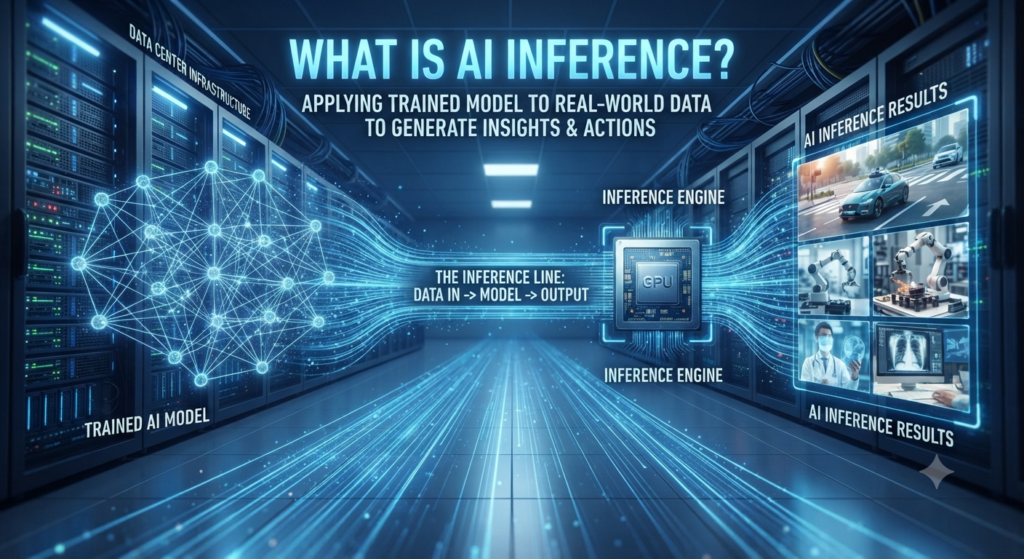
What Is AI Inference? How Artificial Intelligence Generates Answers, Predictions and Decisions
Artificial intelligence has become an integral part of modern technology, transforming how individuals and organisations communicate, access information, analyse data, and automate business operations. From intelligent chatbots and recommendation systems to autonomous vehicles and medical imaging applications, AI-powered technologies are increasingly influencing everyday life.
However, one of the most important processes behind these technologies often receives less attention than AI training itself.
This process is known as AI inference.
Whenever you ask an AI chatbot a question, receive a personalised product recommendation, translate a sentence, or use facial recognition to unlock a smartphone, an artificial intelligence system performs inference.
AI inference enables trained machine learning models to apply their learned capabilities to new information and generate meaningful outputs.
While AI training focuses on developing a model’s capabilities, inference focuses on using those capabilities in practical applications.
Understanding AI inference is essential for software developers, business professionals, students, researchers, and organisations looking to implement artificial intelligence effectively.
In this comprehensive guide, we will explore what AI inference is, how it works, its architecture, different types, advantages, challenges, optimisation techniques, and future applications.
Know More: AI Interview Preparation: 10 Powerful Ways to Ace Your Next Job Interview
What Is AI Inference?
AI inference is the process through which a trained artificial intelligence or machine learning model analyses new input data and generates predictions, classifications, recommendations, or responses.
During inference, the model applies patterns and relationships learned during training to previously unseen information.
For example, imagine an AI model trained to identify different types of animals in photographs.
During training, the model processes numerous labelled images containing dogs, cats, birds, and other animals.
Once training is complete, a user can provide a new photograph. The model analyses the image and predicts which animal it contains.
This prediction process is called AI inference.
Similarly, when a user asks a generative AI chatbot to explain a scientific concept, the model processes the question and generates an answer using its learned parameters and available context.
Common examples of AI inference include:
- Generating responses in AI chatbots
- Detecting fraudulent financial transactions
- Recognising objects in photographs
- Translating text between languages
- Recommending products and entertainment
- Predicting customer behaviour
- Classifying documents
- Generating computer code
- Analysing medical images
- Recognising spoken language
Inference is therefore the operational stage that allows artificial intelligence models to deliver practical value.
Why Is AI Inference Important?
Training an artificial intelligence model is only the beginning of its lifecycle.
A trained model becomes useful when it can process real-world information and generate meaningful outputs.
AI inference connects machine learning research with practical business applications.
|
AI Inference Function |
Importance |
|
Prediction |
Estimates future outcomes or unknown values |
|
Classification |
Assigns information to predefined categories |
|
Content Generation |
Produces text, images, audio, or other outputs |
|
Automation |
Supports repetitive business processes |
|
Personalisation |
Delivers user-specific recommendations |
|
Decision Support |
Helps professionals analyse information |
|
Real-Time Processing |
Enables immediate responses to incoming data |
Efficient inference can improve application responsiveness, reduce operational expenses, and support scalable artificial intelligence services.
For businesses operating AI-powered platforms, inference performance directly influences customer experience and infrastructure requirements.
How Does AI Inference Work?
AI inference involves several interconnected stages, beginning with input collection and ending with the delivery of a prediction or generated response.
AI inference workflow
Simplified AI inference pipeline from input processing to final output.
Step 1: Input Data Collection
The inference process begins when an application receives new information.
Depending on the application, input data may include text, photographs, video frames, audio recordings, sensor measurements, or numerical datasets.
For example, a customer support chatbot receives a written question, while an image recognition system receives a photograph.
Step 2: Data Preprocessing
Raw information must often be converted into a format suitable for the trained model.
Text-based AI systems may divide sentences into smaller units called tokens.
Image recognition systems may resize images and normalise pixel values.
Audio processing systems may convert recordings into numerical representations suitable for analysis.
Effective preprocessing helps ensure that input information matches the format expected by the model.
Step 3: Loading the Trained AI Model
The trained model must be available within the inference environment.
Its learned parameters are loaded into memory so that the system can perform the required computations.
Depending on the model’s size and architecture, inference may require a CPU, GPU, neural processing unit, or another specialised accelerator.
Step 4: Forward Propagation
Forward propagation is the process through which input information passes through the layers of a neural network.
Each layer performs mathematical operations using the model’s learned parameters.
These computations gradually transform the input into representations that support the required prediction or generated output.
Unlike conventional training, standard inference does not require updating the model’s weights through backpropagation.
Step 5: Prediction or Response Generation
After processing the input, the model generates an output.
A classification model may identify an email as spam or legitimate.
A regression model may estimate the future price of a product.
A large language model may generate a written response by predicting successive tokens.
The exact output depends on the model’s architecture and intended application.
Step 6: Post-Processing and Validation
Generated outputs may require additional processing before being delivered to users.
This can include formatting responses, applying confidence thresholds, checking structured outputs, validating calculations, and filtering inappropriate or unsupported information.
For high-risk applications, human review may also be required.
Step 7: Output Delivery
The final result is delivered to the application or user.
In real-time applications, the entire inference process may occur within milliseconds or seconds, depending on task complexity, model size, hardware, and system configuration.
AI Training vs AI Inference: What Is the Difference?
AI training and AI inference represent two distinct stages of the artificial intelligence lifecycle.
Training involves developing a model’s capabilities by learning from data. Inference involves applying those capabilities to new inputs.
Training develops model capabilities; inference applies them.
|
Comparison |
AI Training |
AI Inference |
|
Primary Objective |
Learn patterns from data |
Generate predictions or responses |
|
Input Data |
Training datasets |
New user or application data |
|
Model Parameters |
Updated during training |
Usually remain unchanged |
|
Computational Process |
Forward and backward propagation |
Primarily forward propagation |
|
Processing Time |
Hours, days, or longer |
Milliseconds to minutes, depending on task |
|
Resource Requirements |
Generally higher per training operation |
Varies by model and request volume |
|
Frequency |
Periodically or during development |
Whenever predictions are requested |
|
Main Output |
Trained AI model |
Prediction, classification, or generated content |
|
Business Purpose |
Develop AI capabilities |
Deliver practical AI services |
|
Example |
Training a chatbot |
Answering a user’s question |
For example, training an AI model is comparable to studying educational material, while inference is comparable to applying that knowledge during an examination.
Although the analogy simplifies the technical process, it illustrates the fundamental difference between learning and application.
Different Types of AI Inference
AI inference can be classified according to processing requirements, deployment environments, and application architecture.
1. Real-Time Inference
Real-time inference involves generating predictions immediately or within a predefined response-time requirement after receiving input.
It is commonly used in applications where delays could negatively affect user experience or operational performance.
Examples include fraud detection, conversational AI, industrial monitoring, and interactive recommendation systems.
Real-time inference requires efficient infrastructure and predictable response times.
2. Batch Inference
Batch inference processes multiple inputs together rather than handling every request immediately.
For example, an e-commerce company may analyse thousands of customer reviews at the end of each day to identify common complaints and satisfaction trends.
Batch processing can improve hardware utilisation and reduce operational costs for applications that do not require immediate responses.
3. Edge Inference
Edge inference occurs on devices located close to the source of information.
Instead of transmitting all data to remote servers, the AI model processes information locally.
Examples include smart cameras, smartphones, industrial sensors, and embedded computing systems.
Edge inference can reduce network dependence, improve responsiveness, and support local data processing.
4. Cloud-Based Inference
Cloud inference involves running AI models on remote computing infrastructure.
Users and applications submit requests through APIs or other network interfaces.
Cloud platforms can provide access to powerful computing resources and scalable infrastructure.
However, performance may depend on network connectivity, service availability, and provider pricing.
5. On-Device Inference
On-device inference runs AI models directly on the user’s device.
This approach is increasingly relevant for smartphones, personal computers, wearable devices, and intelligent consumer electronics.
Small language models and compressed neural networks are particularly suitable for some on-device applications.
6. Streaming Inference
Streaming inference processes continuously arriving information.
For example, an industrial monitoring system may analyse sensor measurements as they arrive to identify potential equipment failures.
In generative AI, streaming can also refer to delivering generated tokens progressively rather than waiting for the entire response to finish.
7. Distributed Inference
Distributed inference involves using multiple computing devices or servers to execute an AI model.
This approach is useful when models are too large to fit efficiently within a single device’s memory or when applications require substantial processing capacity.
Distributed inference introduces additional challenges related to communication overhead, workload coordination, and infrastructure management.
Types of AI Inference: Comparison Table
|
Inference Type |
Main Advantage |
Common Applications |
|
Real-Time Inference |
Immediate responses |
Chatbots, fraud detection |
|
Batch Inference |
Efficient bulk processing |
Reporting, document classification |
|
Edge Inference |
Processing near the data source |
Smart cameras, industrial systems |
|
Cloud Inference |
Scalable computing infrastructure |
Enterprise AI platforms |
|
On-Device Inference |
Local processing and offline support |
Smartphones, personal computers |
|
Streaming Inference |
Continuous information processing |
Live analytics, monitoring |
|
Distributed Inference |
Supports large models and workloads |
Large-scale generative AI |
These categories can overlap. For example, a real-time inference application may operate in the cloud or on an edge device.
How Does AI Inference Work in Large Language Models?
Large language models use inference to generate written responses, computer code, summaries, translations, and other language-based outputs.
When a user submits a prompt, the model first converts the text into tokens.
These tokens are processed through neural network layers to produce probability distributions over possible next tokens.
The system selects an appropriate token according to its decoding strategy and continues generating additional tokens until a stopping condition is reached.
Prefill and Decoding
LLM inference generally involves two important computational stages.
Prefill: The model processes the input prompt and establishes the context required for generation.
Decoding: The model generates output tokens, typically one after another in autoregressive language models.
How an LLM generates a sentence
Illustrative next-token prediction
Input prompt: Artificial intelligence is
Possible next tokens
transforming
45%
changing
30%
a
15%
becoming
7%
Other tokens
3%
Artificial
intelligence
is
transforming
modern
technology
.
Probabilities are hypothetical. Actual token boundaries and selection methods vary by model.
This process explains why language models can generate different responses to similar questions.
It also explains why AI-generated information is not automatically factually correct. Models may generate plausible but unsupported statements, a phenomenon known as AI hallucination.
What Is an AI Inference Engine?
An AI inference engine is a software system or runtime responsible for executing trained artificial intelligence models efficiently.
Inference engines manage the computational operations required to convert model inputs into outputs.
They may optimise memory usage, hardware acceleration, parallel processing, and model execution.
For example, an inference engine may optimise a neural network to run efficiently on a GPU or convert certain operations into formats supported by specialised processors.
Popular inference technologies include:
|
Inference Technology |
Primary Function |
|
NVIDIA TensorRT |
Optimised neural network inference |
|
ONNX Runtime |
Cross-platform model execution |
|
OpenVINO |
Optimised inference across supported hardware |
|
TensorFlow Lite / LiteRT |
Lightweight and mobile AI deployment |
|
vLLM |
Efficient large language model serving |
|
llama.cpp |
Local and optimised language model inference |
|
NVIDIA Triton Inference Server |
Production model serving |
|
PyTorch |
Model execution and deployment ecosystem |
The appropriate inference engine depends on model architecture, hardware compatibility, application requirements, and deployment environment.
Hardware Used for AI Inference
AI inference can run on various hardware architectures.
Central Processing Units (CPUs)
CPUs are widely available and can support inference for smaller machine learning models and applications with moderate processing requirements.
They are useful when specialised accelerators are unavailable or unnecessary.
Graphics Processing Units (GPUs)
GPUs are designed to perform numerous mathematical operations in parallel.
They are widely used for deep learning inference, image generation, and large language model deployment.
Tensor Processing Units (TPUs)
TPUs are specialised accelerators designed to support machine learning computations.
They can provide efficient execution for supported neural network workloads.
Neural Processing Units (NPUs)
NPUs are specialised processors designed to accelerate artificial intelligence operations.
They are increasingly integrated into smartphones, personal computers, and edge devices.
Application-Specific Integrated Circuits (ASICs)
ASICs can be designed for particular computational workloads.
Specialised AI inference chips may provide advantages in performance or energy efficiency for supported operations.
|
Hardware |
Best-Suited Applications |
Key Advantage |
|
CPU |
Lightweight models and general computing |
Accessibility |
|
GPU |
Deep learning and generative AI |
Parallel processing |
|
TPU |
Supported machine learning workloads |
Specialised acceleration |
|
NPU |
Mobile and on-device AI |
Efficient local processing |
|
ASIC |
Specialised inference workloads |
Workload-specific optimisation |
Top 10 Factors Affecting AI Inference Performance
1. Model Size
Larger models generally require more memory and computational resources.
Smaller models may offer faster inference when they can achieve the required task accuracy.
2. Hardware Capabilities
Processor architecture, memory bandwidth, available memory, and computational throughput influence inference performance.
3. Input Complexity
Long documents, high-resolution images, and complex prompts can increase processing requirements.
4. Output Length
Generative AI applications require additional computation when generating longer responses.
5. Numerical Precision
Lower-precision representations can reduce memory consumption and improve execution efficiency on compatible hardware.
6. Batch Size
Processing multiple requests together can improve throughput, although waiting for batches may increase individual request latency.
7. Network Connectivity
Cloud-based applications depend on network communication between users and inference servers.
8. Memory Bandwidth
The speed at which model weights and intermediate information move through memory can significantly influence inference performance.
9. Software Optimisation
Efficient inference engines, optimised computational kernels, and appropriate scheduling can improve model execution.
10. Concurrent User Requests
Large numbers of simultaneous requests can increase queueing delays and infrastructure requirements.
AI Inference Latency vs Throughput
Latency and throughput are two essential metrics used to evaluate AI inference systems.
Inference latency refers to the time required to process an individual request.
Inference throughput refers to the amount of work an inference system can complete within a specific period.
|
Metric |
Latency |
Throughput |
|
Meaning |
Time required per request |
Requests or tokens processed per unit of time |
|
Common Unit |
Milliseconds or seconds |
Requests/sec or tokens/sec |
|
Primary Objective |
Reduce response delays |
Increase processing capacity |
|
Important For |
Interactive applications |
Large-scale processing |
|
Example |
Answer generated in two seconds |
100 requests processed per second |
For generative AI applications, additional performance metrics include:
- Time to first token (TTFT)
- Time per output token (TPOT)
- Output tokens per second
- End-to-end response time
- Concurrent request capacity
- Cost per generated token
Businesses should balance latency and throughput according to their application requirements.
How to Calculate AI Inference Costs
AI inference costs depend on several factors, including model size, hardware infrastructure, request volume, input tokens, output tokens, and provider pricing.
For API-based language models, providers frequently calculate costs using token consumption.
Consider a hypothetical business using an AI chatbot.
AI inference cost calculator
Estimate monthly API token expenses using hypothetical prices.
Monthly requests
100,000
Average input tokens per request
800
Average output tokens per request
400
Input price / million tokens ($)
Output price / million tokens ($)
Estimated monthly inference cost
$120.00
Input: $40.00
Output: $80.00
Estimated annual cost
$1,440
Excludes hosting, retrieval, caching discounts, storage, tool usage and other infrastructure expenses.
The following table illustrates a static cost calculation.
|
Cost Factor |
Example Value |
|
Monthly Requests |
100,000 |
|
Average Input Tokens |
800 |
|
Average Output Tokens |
400 |
|
Total Monthly Input Tokens |
80 million |
|
Total Monthly Output Tokens |
40 million |
|
Assumed Input Price per Million |
$0.50 |
|
Assumed Output Price per Million |
$2.00 |
|
Monthly Input Cost |
$40 |
|
Monthly Output Cost |
$80 |
|
Total Monthly Cost |
$120 |
|
Estimated Annual Cost |
$1,440 |
These figures are hypothetical and do not represent the current pricing of a particular AI service.
For self-hosted models, organisations must also consider hardware acquisition, electricity, maintenance, engineering resources, and infrastructure utilisation.
10 Effective AI Inference Optimisation Techniques
Optimising inference can help organisations reduce costs, improve response times, and increase application scalability.
1. Model Quantisation
Quantisation reduces the numerical precision used to represent model weights or computations.
For example, converting 16-bit weights into 8-bit or 4-bit representations can reduce memory requirements.
However, excessive compression may affect model accuracy.
2. Knowledge Distillation
Knowledge distillation transfers useful capabilities from a larger teacher model to a smaller student model.
The smaller model may provide more efficient inference while retaining suitable performance for selected tasks.
3. Model Pruning
Pruning removes selected weights or structural components considered less important.
This technique can reduce model complexity, although actual speed improvements depend on hardware and software support.
4. Request Batching
Batching combines multiple inference requests for simultaneous processing.
This can improve accelerator utilisation and increase overall throughput.
5. KV Cache Optimisation
Large language models commonly use key-value caches to avoid repeatedly computing attention information for previously processed tokens.
Efficient cache management can improve generation speed and reduce unnecessary computation.
However, caches consume memory, especially when processing long conversations or numerous simultaneous requests.
6. Speculative Decoding
Speculative decoding uses a smaller draft model or another prediction mechanism to propose multiple tokens.
A target model verifies the proposed tokens.
Under suitable conditions, this approach can accelerate generation while preserving the target model’s output distribution when implemented correctly.
7. Hardware Acceleration
Deploying AI models on compatible GPUs, NPUs, TPUs, or specialised accelerators can improve computational efficiency.
8. Efficient Model Selection
Not every application requires a large general-purpose AI model.
Small language models may provide sufficient performance for specialised tasks while reducing inference expenses.
9. Prompt and Context Optimisation
Removing unnecessary information from prompts can reduce input processing requirements.
Retrieval systems can provide only the most relevant information instead of including entire documents in every request.
10. Intelligent Model Routing
Model routing directs different tasks to appropriate AI models.
Simple requests may be processed by smaller models, while complex tasks are transferred to larger models.
This approach can balance performance, accuracy, and operational costs.
Real-World Applications of AI Inference
AI Inference in Healthcare
Healthcare organisations can use inference systems to analyse medical images, classify clinical documents, identify patterns in patient information, and support administrative workflows.
AI-generated results should be evaluated by qualified healthcare professionals, particularly when they influence clinical decisions.
AI Inference in Banking and Finance
Financial institutions use machine learning inference to identify suspicious transactions, assess financial patterns, classify documents, and support customer service applications.
Real-time inference is particularly valuable when identifying potentially fraudulent transactions.
AI Inference in Education
Educational platforms can use AI inference to generate personalised learning recommendations, evaluate practice exercises, summarise educational content, and provide conversational learning assistance.
Connecting AI models with verified educational resources can improve information reliability.
AI Inference in E-Commerce
Online retailers use inference to recommend products, classify customer feedback, personalise shopping experiences, and predict inventory requirements.
These applications can help businesses improve customer engagement and operational efficiency.
AI Inference in Autonomous Vehicles
Autonomous and driver-assistance systems use inference to process information from cameras, sensors, and other vehicle systems.
These models can identify objects, estimate environmental conditions, and support driving-related decisions.
Such applications require extensive safety testing and reliable real-time performance.
AI Inference in Cybersecurity
Cybersecurity platforms can use AI inference to identify unusual network activity, classify potentially malicious files, and detect suspicious behavioural patterns.
AI-based detection should be combined with appropriate security controls and professional oversight.
AI Inference in Manufacturing
Manufacturing organisations use inference for visual quality inspection, predictive maintenance, production monitoring, and equipment performance analysis.
Edge inference can be particularly useful when industrial applications require immediate responses.
AI Inference in Digital Marketing
Digital marketing platforms use AI inference to classify customer interests, personalise advertisements, analyse campaign performance, generate content, and support marketing automation.
Reliable input data and appropriate privacy protections are essential for effective implementation.
AI Inference in SEO and Content Marketing
Artificial intelligence inference plays an important role in modern SEO workflows.
Whenever an SEO professional uses an AI tool to classify keywords, generate metadata, analyse content, or summarise performance reports, the underlying AI system performs inference.
|
SEO Activity |
AI Inference Application |
|
Keyword Clustering |
Groups related search queries |
|
Search Intent Analysis |
Predicts likely user intent |
|
SEO Title Generation |
Produces relevant title suggestions |
|
Meta Description Generation |
Creates page summary drafts |
|
Content Optimisation |
Identifies potential improvements |
|
Internal Linking |
Suggests related content |
|
Technical SEO |
Classifies website issues |
|
Competitor Analysis |
Summarises supplied competitor data |
|
SEO Reporting |
Interprets verified performance metrics |
|
Content Classification |
Assigns categories and tags |
For example, an educational website with thousands of published articles could use a lightweight AI model to classify content according to topic, search intent, and relevance.
The resulting classifications could support topical authority development, internal linking strategies, and content gap analysis.
However, AI inference does not automatically provide access to current keyword search volumes, ranking positions, or competitor traffic estimates.
These metrics must be obtained from reliable analytics and keyword research platforms.
AI Inference and Retrieval-Augmented Generation
Retrieval-Augmented Generation, commonly known as RAG, can enhance AI inference by supplying relevant external information before a model generates a response.
Instead of relying exclusively on learned parameters, a RAG-powered system retrieves information from documents, databases, or knowledge repositories.
The retrieved information becomes part of the model’s input context.
RAG-powered AI inference
This approach can improve contextual relevance and factual grounding.
For example, a customer support chatbot may retrieve the latest product documentation before performing inference and generating a response.
However, RAG adds retrieval operations and additional input context, which can increase inference latency and computational costs.
Organisations should optimise retrieval quality and context size to balance accuracy with performance.
Benefits of AI Inference
AI inference enables organisations to convert trained machine learning models into practical applications.
Its major benefits include automation, scalable information processing, personalised recommendations, improved productivity, real-time analysis, and support for data-driven decisions.
Efficient inference infrastructure can also reduce the cost of deploying artificial intelligence across multiple business functions.
For smaller organisations, optimised models and cloud-based inference services can make advanced AI capabilities more accessible without requiring substantial upfront hardware investments.
Challenges and Limitations of AI Inference
Despite its advantages, AI inference presents several technical and operational challenges.
|
Challenge |
Potential Impact |
Possible Solution |
|
High Computational Costs |
Increased operating expenses |
Model optimisation |
|
Inference Latency |
Slow user experience |
Efficient hardware and caching |
|
Memory Limitations |
Deployment difficulties |
Quantisation and smaller models |
|
AI Hallucinations |
Incorrect information |
RAG and factual verification |
|
Data Privacy |
Exposure of sensitive information |
Secure or local deployment |
|
Energy Consumption |
Increased electricity requirements |
Efficient infrastructure |
|
Scalability |
Reduced performance under heavy demand |
Load balancing and batching |
|
Model Bias |
Unfair or inconsistent outcomes |
Evaluation and monitoring |
|
Hardware Compatibility |
Limited deployment options |
Compatible inference runtimes |
|
Security Vulnerabilities |
Potential misuse or data exposure |
Access controls and security testing |
Successful AI implementation requires addressing these challenges throughout the model deployment lifecycle.
Cloud Inference vs Edge Inference
Cloud and edge inference represent two important deployment approaches.
|
Comparison |
Cloud Inference |
Edge Inference |
|
Processing Location |
Remote servers |
Near the data source |
|
Internet Requirement |
Generally required |
Can operate locally |
|
Computing Resources |
Potentially extensive |
Limited by local hardware |
|
Network Latency |
Depends on connectivity |
Often reduced |
|
Privacy |
Depends on cloud configuration |
Greater potential for local control |
|
Scalability |
Centralised infrastructure scaling |
Requires device-level management |
|
Suitable Models |
Small and large models |
Often compact or optimised models |
|
Common Applications |
Enterprise AI, generative AI |
Smart cameras, industrial systems |
Businesses should select the deployment approach based on application requirements, privacy considerations, infrastructure budgets, and acceptable response times.
Hybrid deployment can combine local processing with cloud-based capabilities.
The Future of AI Inference
As artificial intelligence adoption continues to expand, inference efficiency is likely to become increasingly important.
Future developments may focus on specialised AI processors, efficient language model architectures, advanced compression techniques, intelligent model routing, and improved memory management.
On-device AI may also become more prevalent as smartphones, personal computers, and embedded systems incorporate specialised neural processing hardware.
Small language models could support cost-efficient inference for specialised applications, while larger models remain valuable for advanced reasoning and complex tasks.
Another important area of development is energy-efficient AI infrastructure.
Organisations operating large-scale AI applications may increasingly evaluate not only model accuracy but also energy consumption, response latency, infrastructure utilisation, and cost per successful task.
The future of AI inference will likely involve a combination of cloud computing, edge intelligence, specialised hardware, and optimised machine learning models.
”FAQs”
1. What is AI inference in simple words?
AI inference is the process of using a trained artificial intelligence model to analyse new information and generate predictions, classifications, or responses.
2. What is the difference between AI training and inference?
AI training develops a model's capabilities by learning from data, while inference applies those capabilities to new inputs without normally updating the model's parameters.
3. What is an example of AI inference?
When an AI chatbot answers a question, an image recognition system identifies an object, or an online platform recommends a product, it performs AI inference.
4. What is an AI inference engine?
An AI inference engine is a software runtime or system that executes trained machine learning models and optimises the computational operations required to generate outputs.
5. What is inference latency?
Inference latency is the time required for an AI system to process a request and produce an output.
6. What is inference throughput?
Inference throughput measures the number of requests, predictions, or tokens an AI system can process within a specific period.
7. Does AI inference require a GPU?
No. AI inference can run on CPUs, GPUs, NPUs, TPUs, and other processors. The appropriate hardware depends on model size and application requirements.
8. Why is AI inference expensive?
Inference can become expensive because of computational requirements, memory consumption, hardware infrastructure, energy usage, and large request volumes.
9. How can AI inference costs be reduced?
Costs can be reduced through model quantisation, knowledge distillation, request batching, efficient model selection, caching, and infrastructure optimisation.
10. What is edge AI inference?
Edge AI inference involves processing information using AI models deployed near the source of the data rather than relying entirely on remote servers.


