
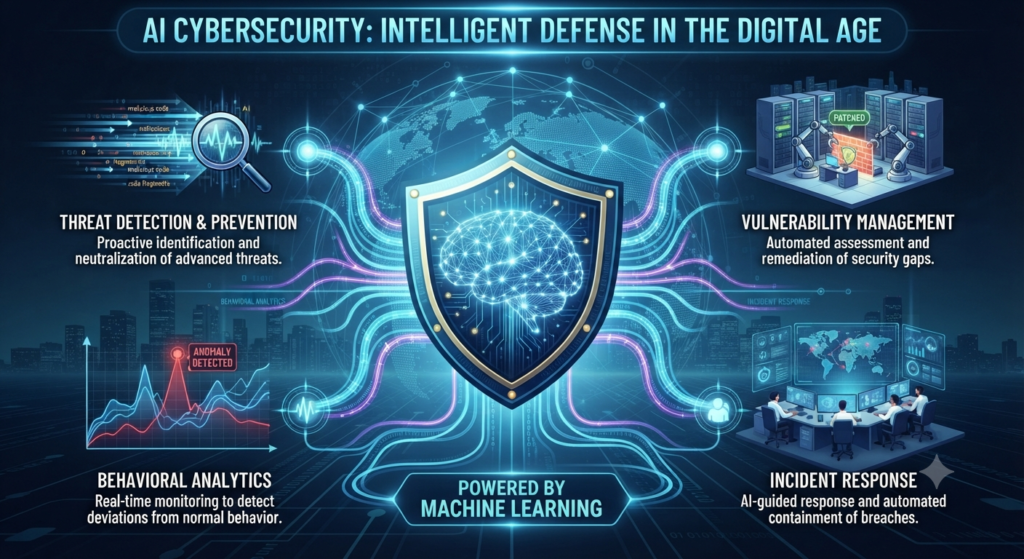
Why AI Is Becoming Important in Cybersecurity
The digital world is growing every day. Businesses now depend on websites, cloud platforms, mobile applications, and online services. They also store large amounts of customer and business data. While these technologies make work easier, they also create new security risks.
Cybercriminals are becoming smarter. They use advanced tools to steal information, spread malware, attack networks, and access private accounts. Traditional security systems often struggle to identify every threat. They may miss unusual activities or take too long to respond.
This is where AI cybersecurity is making a difference.
Artificial intelligence helps security systems study large amounts of data. It can identify unusual behavior, detect possible attacks, and support faster responses. Instead of waiting for a known threat to appear, AI systems can learn normal activity and identify actions that look suspicious.
For example, imagine an employee usually logs in from Jaipur during working hours. One night, the same account tries to access company files from another country. An AI security system can identify this unusual activity and alert the security team.
This is one example of how artificial intelligence in cybersecurity improves digital protection.
In 2027, businesses are using AI to improve network security, prevent phishing, monitor devices, and manage security risks. However, AI isn’t a complete replacement for traditional security practices or human experts.
Let’s explore how this technology is changing digital security.
Know More: How to Create Custom AI Chatbots for Your Website: Top Beginner’s Guide 2026
2. What Is AI Cybersecurity?
AI cybersecurity refers to the use of artificial intelligence technologies to protect computers, networks, applications, and digital information from cyber threats.
These technologies study security data and identify patterns that may indicate an attack. They can also help security teams investigate problems and take action.
Traditional security systems often depend on predefined rules. For example, a system may block a file because it matches a known malware signature.
AI-based systems can go further. They can study how files behave and identify suspicious actions, even when the threat is new.
How Does Artificial Intelligence Work in Cybersecurity?
AI security solutions use different technologies to understand and respond to security risks.
Some important technologies include:
- Machine learning: Helps systems learn from data and recognize patterns.
- Deep learning: Studies complex patterns using artificial neural networks.
- Natural language processing: Helps analyze emails, messages, and other text.
- Behavioral analytics: Studies user and device activities to identify unusual actions.
- Predictive analytics: Uses available information to estimate possible security risks.
- Generative AI: Helps security teams understand alerts, summarize reports, and support investigations.
These technologies work together to improve security monitoring and threat detection.
Traditional Cybersecurity vs. AI Cybersecurity
|
Comparison |
Traditional Cybersecurity |
AI Cybersecurity |
|
Threat detection |
Often uses fixed rules |
Can identify learned patterns |
|
Monitoring |
Depends on configured rules |
Can analyze large data streams |
|
Response |
Often requires manual action |
Can automate selected responses |
|
New threats |
May struggle with unknown threats |
Can identify unusual behavior |
|
Data analysis |
Limited by manual processes |
Can process large datasets |
|
Adaptability |
Requires rule updates |
Models can be updated and retrained |
|
Human involvement |
Often high |
Supports human security teams |
Both approaches are important. Businesses get stronger protection when they combine traditional security controls with intelligent security systems.
3. How AI Is Changing Cybersecurity in 2027
Artificial intelligence is changing how organizations identify, understand, and manage digital threats.
Earlier, security teams often spent hours reviewing alerts and checking system activity. Today, AI-powered security tools can help complete many of these tasks faster.
Here are some important changes.
3.1 Faster Threat Identification
AI can study network traffic, login records, and device activity. It looks for patterns that may indicate suspicious behavior.
For example, repeated failed login attempts may suggest someone is trying to access an account without permission.
AI can identify this activity and notify the security team.
3.2 Smarter Security Monitoring
Modern businesses use many applications, devices, and cloud services. Monitoring all these systems manually can be difficult.
AI supports continuous monitoring by analyzing activity across connected systems.
It can help identify unusual downloads, unexpected connections, and suspicious access requests.
3.3 Better Risk Management
Not every security alert represents the same level of danger.
AI can help prioritize alerts based on their possible impact. This allows security teams to focus on serious problems first.
For example, an unusual login to an administrative account may require more attention than a failed login to a low-risk account.
3.4 Faster Incident Response
Some AI-powered security platforms can automatically perform selected actions.
They may isolate a suspicious device, block a malicious connection, or disable a compromised account.
However, organizations should carefully control these actions. Automatic responses can also cause problems if the system makes an incorrect decision.
3.5 Improved Security Intelligence
AI can analyze information from different sources, such as security reports, network logs, and threat intelligence feeds.
This helps businesses understand new attack methods and identify possible risks before they cause serious damage.
4. How AI Threat Detection Works
AI threat detection is one of the most important applications of artificial intelligence in cybersecurity.
It helps identify suspicious activities by studying normal and unusual patterns.
A typical AI-driven threat detection process includes the following steps.
Step 1: Collect Security Data
The system collects information from different sources, including:
- Network traffic.
- User login records.
- Email activities.
- Server logs.
- Endpoint devices.
- Cloud applications.
- Firewall records.
Step 2: Study Normal Behavior
The AI model studies regular activity to understand how users, devices, and applications normally behave.
For example, it may learn how much data a server usually transfers during business hours.
Step 3: Identify Unusual Activities
The system compares new activity with learned patterns.
If something looks unusual, it may generate an alert.
This process is known as anomaly detection.
Step 4: Analyze the Threat
The system examines additional information to understand whether the activity could be dangerous.
It may consider the user’s access level, device history, location, and previous security events.
Step 5: Alert or Respond
After identifying a possible threat, the system can notify security teams.
Depending on its configuration, it may also take approved actions.
Example of AI-Driven Threat Detection
Consider an online shopping company.
Its payment server normally receives requests from approved applications. Suddenly, the system starts receiving thousands of unusual requests.
An AI security system may identify this activity as suspicious.
It can alert the security team and support further investigation. If the activity matches an approved response rule, the security platform may also help block the suspicious traffic.
This process improves the speed of cyber threat monitoring.
5. 10 Powerful Applications of AI in Cybersecurity
Artificial intelligence has many practical uses in digital security. Businesses can use it to protect their networks, applications, employees, and customers.
Here are ten important AI cybersecurity applications in 2027.
5.1 AI-Powered Malware Detection
Malware is harmful software designed to damage systems, steal information, or gain unauthorized access.
Traditional antivirus systems often use known malware signatures. However, attackers can modify harmful programs to avoid basic detection.
AI-powered malware detection systems study file behavior and identify suspicious activities.
For example, a program that suddenly tries to encrypt hundreds of files may be considered suspicious.
AI can help identify such behavior and alert security teams.
5.2 Phishing Prevention
Phishing attacks trick people into sharing passwords, payment details, or private information.
Attackers often send emails that look like messages from banks, companies, or trusted individuals.
AI can analyze email content, sender details, links, and message patterns.
It can identify warning signs such as:
- Suspicious website links.
- Unusual sender addresses.
- Requests for confidential information.
- Unexpected attachments.
- Messages that imitate trusted brands.
This helps organizations improve phishing prevention.
5.3 Intelligent Intrusion Detection
An intrusion detection system monitors networks and devices for suspicious activity.
AI improves these systems by studying traffic patterns and identifying unusual connections.
For example, if an employee’s computer starts communicating with an unknown server, the system may generate an alert.
This makes network security AI useful for organizations with large digital environments.
5.4 Behavioral Analytics
Behavioral analytics studies how people and devices use digital systems.
It creates a picture of normal activity and looks for unusual changes.
Consider an employee who normally accesses five company files each day. Suddenly, the same account downloads thousands of confidential documents.
The AI system may identify this behavior as a possible security risk.
It can then notify the security team for investigation.
5.5 Automated Security Monitoring
Large companies receive thousands of security alerts every day.
Reviewing each alert manually takes time and effort.
Cybersecurity automation helps teams organize alerts, identify common patterns, and prioritize important issues.
AI-powered monitoring can also help security professionals investigate events across different systems.
5.6 Endpoint Protection
Endpoints include laptops, desktops, mobile phones, and servers connected to a network.
Every connected device can become a possible entry point for attackers.
AI-based endpoint protection studies device activities and looks for suspicious processes.
It can help identify unusual software behavior, unauthorized access, and possible malware infections.
5.7 Cloud Security
Many organizations store important information on cloud platforms.
Cloud environments can become difficult to manage because they contain multiple users, applications, and access permissions.
AI security solutions can help monitor cloud activity and identify unusual access requests.
They can also support cloud risk assessment by highlighting possible security weaknesses.
5.8 Fraud Detection
Banks, payment companies, and online stores use AI to identify unusual financial activities.
For example, a payment system may notice several large transactions from an account that normally makes small purchases.
AI can analyze transaction patterns and flag suspicious activity.
This helps businesses reduce fraud risks and protect customers.
5.9 Vulnerability Management
A software vulnerability is a weakness that attackers may use to access a system or damage its operations.
AI can help security teams review vulnerability reports, identify important risks, and prioritize software updates.
It can also support code analysis and security testing.
However, security experts should verify important findings before making changes to business systems.
5.10 Security Incident Investigation
After a cyberattack, security teams need to understand what happened.
They must identify the entry point, affected systems, and possible data exposure.
AI can help review security logs, summarize alerts, and connect related events.
This makes incident investigation faster and more organized.
6. The Role of Machine Learning in Cybersecurity
Machine learning is an important part of modern cybersecurity AI.
It allows computer systems to learn patterns from data instead of depending only on manually written instructions.
For example, a machine learning model can study thousands of network connections. Over time, it may learn which patterns are normal and which activities look unusual.
Types of Machine Learning Used in Cybersecurity
- Supervised Learning
Supervised learning uses labeled data to train a model.
For example, security teams may provide examples of safe and malicious files. The model learns from these examples and classifies new files.
- Unsupervised Learning
Unsupervised learning works with data that doesn’t have predefined labels.
It helps identify unusual patterns and groups of similar activities.
Anomaly detection is a common application.
- Reinforcement Learning
Reinforcement learning allows a system to improve its decisions through feedback.
It may be used in controlled environments to study security strategies and improve automated responses.
Why Is Machine Learning Important?
Machine learning helps security systems:
- Recognize suspicious patterns.
- Identify unusual network behavior.
- Support malware detection.
- Improve fraud prevention.
- Analyze large amounts of security data.
- Adapt to changing activity.
However, machine learning models need good-quality data and regular evaluation. Poor training data can lead to incorrect results.
7. Major Benefits of AI in Cybersecurity for Businesses
Businesses face security risks regardless of their size or industry.
A small company may face phishing attacks, while a large enterprise may deal with ransomware, data theft, and complex network attacks.
AI can help both types of organizations improve their security processes.
7.1 Faster Security Operations
AI can process large amounts of information quickly.
This reduces the time needed to review certain security events and identify suspicious activity.
7.2 Reduced Manual Work
Security professionals often perform repetitive tasks, such as reviewing alerts and collecting information.
Automated security tools can handle some of these activities.
This allows employees to focus on more complex security problems.
7.3 Improved Threat Visibility
AI can analyze information from multiple systems.
This gives security teams a better understanding of what is happening across their digital environment.
7.4 Better Protection Against New Threats
AI can identify unusual behavior even when a threat doesn’t match a known signature.
This can help businesses investigate previously unseen attack patterns.
It doesn’t guarantee detection of every new attack, but it adds another layer of protection.
7.5 Improved Business Continuity
Cyberattacks can interrupt business operations and affect customer trust.
AI-powered monitoring and automated responses can help organizations identify incidents earlier.
Faster detection may reduce the time needed to investigate and recover from certain attacks.
7.6 More Efficient Security Spending
Businesses can use AI to prioritize high-risk activities.
This may help security teams use their time and resources more effectively.
7.7 Stronger Customer Trust
Customers expect businesses to protect their personal and financial information.
Better monitoring, access control, and threat detection can support stronger data protection practices.
Summary of Business Benefits
|
Benefit |
Business Impact |
|
Faster detection |
Helps identify suspicious activity earlier |
|
Automation |
Reduces repetitive security work |
|
Risk prioritization |
Helps focus on serious threats |
|
Better monitoring |
Improves visibility across systems |
|
Fraud detection |
Helps identify unusual transactions |
|
Incident support |
Makes investigations more efficient |
|
Data protection |
Supports stronger information security |
8. Practical AI Cybersecurity Examples Across Different Industries
The practical applications of AI in cybersecurity are not limited to technology companies.
Different industries can use AI to protect their digital operations.
Banking and Financial Services
Banks process large numbers of transactions every day.
AI systems can study transaction patterns and identify unusual activities.
They can also help detect account takeover attempts, suspicious logins, and possible payment fraud.
Healthcare
Hospitals and healthcare companies store sensitive patient information.
AI can help monitor access to medical records, identify unusual network activity, and detect possible security incidents.
This is especially important because healthcare systems often depend on connected devices and digital records.
E-commerce
Online shopping platforms manage customer accounts, payments, and order information.
AI can help identify fake accounts, suspicious transactions, and unusual login patterns.
It can also support fraud prevention.
Education
Schools, colleges, and universities use online learning platforms and student databases.
AI security tools can help identify unauthorized access and suspicious account activity.
They can also support safer digital learning environments.
IT and Software Companies
Technology companies manage source code, cloud platforms, customer data, and internal systems.
AI can support vulnerability detection, security testing, and network monitoring.
It can also help development teams identify possible security weaknesses before software is released.
Government Organizations
Government departments manage important public information and digital services.
AI can support threat intelligence, network monitoring, and incident response.
However, these systems need strong controls because government information can be highly sensitive.
9. AI Cybersecurity Tools and Solutions for Enterprises
Businesses can choose from different types of AI-powered security solutions.
The right option depends on their size, infrastructure, security requirements, and available budget.
Some major categories include:
|
Tool Category |
Main Purpose |
|
Endpoint Detection and Response (EDR) |
Monitors endpoint devices |
|
Extended Detection and Response (XDR) |
Connects security information across systems |
|
Security Information and Event Management (SIEM) |
Collects and analyzes security logs |
|
Security Orchestration, Automation and Response (SOAR) |
Automates selected security workflows |
|
Network Detection and Response (NDR) |
Monitors network activity |
|
Identity Threat Detection |
Identifies suspicious identity and access activity |
|
Cloud Security Platforms |
Monitors cloud environments |
Popular AI Security Platforms
Some well-known cybersecurity platforms include:
- Microsoft Security solutions.
- CrowdStrike Falcon.
- Google Security Operations.
- Palo Alto Networks Cortex.
- IBM Security QRadar.
- SentinelOne Singularity.
These platforms offer different security capabilities. Their features, AI functions, and automation options depend on the product and subscription.
Businesses should compare solutions before selecting one.
Important factors include:
- Security requirements.
- Compatibility with existing systems.
- Data privacy controls.
- Integration options.
- Reporting and monitoring features.
- Automation controls.
- Total ownership cost.
The best solution isn’t always the one with the most advanced AI features. It is the one that addresses the organization’s actual security needs.
10. AI Security Challenges: Risks Businesses Should Understand
Although AI provides many security benefits, it also introduces new challenges.
Organizations should understand these risks before adopting AI-powered digital security solutions.
10.1 False Security Alerts
AI systems may sometimes identify normal activities as suspicious.
These incorrect alerts are called false positives.
Too many false alerts can waste time and make it harder for security teams to identify real threats.
10.2 Poor Data Quality
AI models depend on the information used to train and operate them.
If the data is incomplete, incorrect, or outdated, the system may produce unreliable results.
Businesses should regularly review their data sources and model performance.
10.3 Data Privacy Concerns
AI security systems may process sensitive information, including employee activities, customer records, and network data.
Organizations must protect this information and follow applicable privacy requirements.
10.4 Adversarial Attacks
Attackers may try to manipulate AI systems by changing their inputs or interfering with their training data.
For example, poisoned training data may affect how a model identifies malicious activity.
Security teams should test their models and protect their data pipelines.
10.5 High Implementation Costs
Some advanced AI security solutions require expensive software, infrastructure, and skilled professionals.
Small businesses may find it difficult to adopt these technologies.
They should begin with the security problems that create the greatest risk.
10.6 Dependence on Automation
Automatic responses can be helpful, but they can also create problems.
For example, an AI system might incorrectly block an important business account.
Organizations should set clear approval rules and keep human experts involved in important decisions.
10.7 AI-Powered Cyberattacks
Cybercriminals can also use AI.
They may use generative AI to create convincing phishing messages, imitate trusted communication styles, or support malicious code development.
Therefore, AI cybersecurity must protect against both traditional attacks and AI-assisted threats.
11. AI and Human Cybersecurity Teams: Why Both Are Important
Can artificial intelligence replace cybersecurity professionals?
The simple answer is no.
AI can process information and automate selected tasks, but human experts are still needed to understand business risks, investigate complex incidents, and make important decisions.
AI systems may also misunderstand situations or produce incorrect results.
For example, an employee may access company files outside normal working hours because of an urgent business requirement.
An AI system may flag this activity as suspicious. A human security professional can review the situation and decide whether it represents a real threat.
How Humans and AI Work Together
|
AI Responsibilities |
Human Responsibilities |
|
Analyze large datasets |
Understand business context |
|
Identify unusual patterns |
Verify security alerts |
|
Support threat detection |
Investigate complex incidents |
|
Automate approved tasks |
Approve sensitive actions |
|
Summarize security reports |
Make final risk decisions |
|
Monitor system activity |
Develop security policies |
This combination creates a more balanced security approach.
AI provides speed and data analysis. Humans provide judgment, experience, and accountability.
12. How Businesses Can Build Effective AI Cyber Defense Strategies
Adopting AI without a proper plan can create unnecessary risks.
Businesses should follow a structured approach to improve their cybersecurity framework.
Step 1: Understand Existing Security Risks
Start by reviewing the organization’s current security setup.
Identify important systems, sensitive information, common attack methods, and existing weaknesses.
Step 2: Select the Right AI Security Solutions
Choose tools that solve specific problems.
For example:
- Use email security tools to improve phishing prevention.
- Use endpoint protection to monitor employee devices.
- Use network security AI to identify unusual traffic.
- Use security analytics to review system activity.
Step 3: Protect Sensitive Data
Make sure that AI systems follow suitable data protection practices.
Use encryption, access controls, secure storage, and appropriate data retention policies.
Step 4: Keep Human Oversight
AI should support security teams, not make every important decision independently.
Require human approval for sensitive actions, especially when they may interrupt business operations.
Step 5: Train Employees
Employees are an important part of cybersecurity.
Train them to identify phishing emails, use strong passwords, protect login details, and report suspicious activity.
Step 6: Test Security Systems Regularly
AI models and security tools need regular testing.
Review their accuracy, investigate false alerts, and check whether they can identify new attack patterns.
Step 7: Follow Established Security Frameworks
Organizations can use established frameworks to organize their security and risk management activities.
The National Institute of Standards and Technology provides the NIST AI Risk Management Framework.
It helps organizations identify and manage risks associated with AI systems.
13. The Future of AI Cybersecurity: Important Trends to Watch
The future of cybersecurity with artificial intelligence will involve more advanced detection, automation, and intelligent security systems.
As businesses adopt new technologies, their security requirements will continue to change.
Here are some important AI security trends to watch.
13.1 Generative AI for Security Operations
Generative AI can help security professionals understand complex alerts and summarize investigation reports.
It may also help explain technical security problems in simpler language.
For example, a security analyst can use an AI assistant to summarize hundreds of log entries and identify events that need further investigation.
However, generated results must be checked before they are used to make important security decisions.
13.2 AI-Powered Threat Intelligence
Threat intelligence involves collecting and studying information about cyber threats.
AI can help analyze security reports, identify common attack patterns, and organize threat information.
This may help organizations understand risks more quickly.
13.3 Autonomous Security Operations
Security platforms are becoming more capable of handling multiple tasks automatically.
Some systems can collect alerts, investigate suspicious activity, and recommend responses.
However, autonomous systems must have limited permissions and strong monitoring.
13.4 Better Behavioral Analytics
Future security systems may become better at understanding normal user and device behavior.
This can improve the identification of suspicious access patterns.
13.5 Stronger Cloud and Identity Security
As more businesses use cloud platforms, protecting user identities and access permissions will become increasingly important.
AI can support identity monitoring by identifying unusual login patterns and suspicious account activity.
13.6 AI-Powered Security Testing
AI can support software testing by reviewing code, identifying possible vulnerabilities, and suggesting improvements.
Development teams can use these capabilities to strengthen security during software development.
13.7 Security Against AI-Based Attacks
Businesses will also need to protect their own AI systems.
This includes securing AI models, training data, connected applications, and automated agents.
The Cybersecurity and Infrastructure Security Agency and its partners have highlighted the importance of carefully managing risks when deploying agentic AI systems.
The key lesson is clear: organizations must secure AI technology while also using it to improve cybersecurity.
14. Best Practices for Using AI in Cybersecurity
Businesses should follow some basic practices to get better results from AI security solutions.
- Start with clearly defined security goals.
- Use reliable and protected data sources.
- Keep software and security systems updated.
- Review AI-generated alerts.
- Protect sensitive information.
- Limit AI access to important systems.
- Test automated responses before using them widely.
- Monitor AI model accuracy.
- Train employees about changing cyber threats.
- Maintain a response plan for security incidents.
These practices help organizations build a safer digital environment.
AI is most effective when it works alongside strong security policies, regular updates, employee awareness, and professional supervision.
”FAQs”
1. What is AI cybersecurity?
AI cybersecurity is the use of artificial intelligence to protect digital systems, networks, applications, and information. It helps identify unusual activity, detect possible cyber threats, and support faster incident response.
2. How does AI improve cybersecurity?
AI improves cybersecurity by analyzing large amounts of data, identifying suspicious patterns, supporting threat detection, and automating selected security tasks. It helps security teams investigate incidents and prioritize important risks.
3. Can AI prevent cyberattacks?
AI can help prevent some cyberattacks by identifying suspicious activities and supporting early security responses. However, it cannot prevent every attack. Businesses still need firewalls, software updates, access controls, employee training, and other security measures.
4. What is the role of machine learning in cybersecurity?
Machine learning helps security systems learn patterns from data. It can identify unusual network traffic, suspicious login behavior, and possible malware activity. It also supports anomaly detection and threat classification.
5. Is AI cybersecurity suitable for small businesses?
Yes. Small businesses can use AI-powered email security, endpoint protection, cloud security, and monitoring tools.
They should select solutions according to their security needs and budget. Starting with basic protection is often more useful than investing in complex systems without a clear plan.


