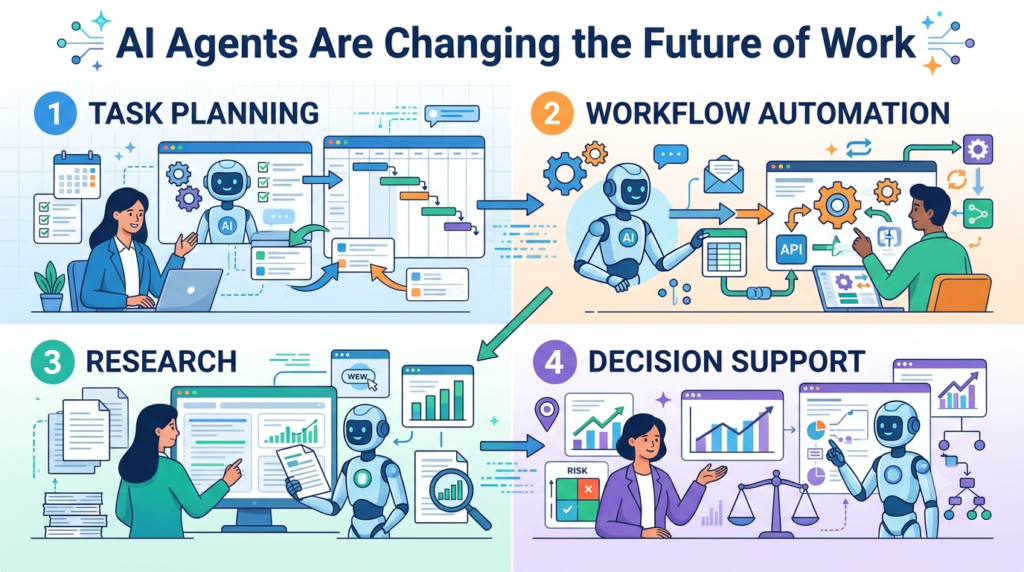
Artificial intelligence is changing the way people work and businesses operate. A few years ago, most companies used technology to store information, manage records, and complete simple tasks. Today, AI can do much more. It can understand instructions, analyze information, make plans, and complete tasks with limited human support.
One of the biggest developments in this field is the rise of AI agents. These intelligent systems can work toward specific goals. They can perform several tasks, use digital tools, and respond to changing situations. As a result, businesses are exploring new ways to use AI agents in daily operations.
From customer service to finance, marketing, human resources, and IT, AI agents are creating new opportunities for automation. They can reduce manual work, improve response times, and help employees focus on important activities.
However, this change isn’t only about replacing repetitive tasks. It’s also about improving how people and technology work together. AI agents can support employees, help managers make decisions, and improve the flow of information across departments.
So, how do AI agents work? Why are businesses adopting them? And what will the future of work look like as these systems become more advanced?
Let’s explore how AI agents are changing the future of work and business automation.
Know More: AI Code Analysis: 7 Powerful Ways How AI Helps Developers Understand Large Codebases
1. AI Agents Are Changing the Future of Work and Business Automation: Understanding
What Are AI Agents?
AI agents are software systems that use artificial intelligence to complete tasks and achieve specific goals. They can understand a request, collect information, decide what to do next, and take action.
Unlike basic software, an AI agent can respond to different situations. It doesn’t always need a person to provide instructions for every small step.
For example, imagine a customer sends a message asking about an order. A traditional system may show a tracking link. An AI agent can understand the question, check the order details, find the latest delivery information, and prepare a useful response.
This ability makes AI agents valuable for modern businesses.
Some common capabilities include:
- Understanding natural language instructions.
- Collecting and analyzing information.
- Planning tasks based on a goal.
- Using software tools and business applications.
- Completing multiple steps in a workflow.
- Checking results and responding to new information.
- Asking a human for help when necessary.
AI agents can also work with other agents. For example, one agent may collect customer information while another prepares a report. A third agent may review the results.
This approach is often called agentic AI. It allows AI systems to move beyond simple question-and-answer activities and perform more complex work.
How AI Agents Work
Understanding how AI agents work is important for businesses that want to use them effectively.
An AI agent generally follows a process. The exact design depends on its purpose, tools, and level of independence.
- Receiving a goal
The process begins when a user or business system gives the agent a task.
For example, a sales manager may ask an AI agent to identify new leads from a list of potential customers.
- Understanding the request
The agent studies the instruction and identifies the information needed to complete the task.
It may use a language model to understand the request and decide which actions are relevant.
- Planning the steps
The agent creates a plan. It may divide a large task into smaller activities.
For example, it may need to review customer records, check company websites, organize contact information, and prepare a report.
- Using tools and collecting information
AI agents can connect with approved tools, databases, websites, and business applications.
These connections help them access information and perform actions.
- Taking action
After collecting the required information, the agent performs the planned activities.
Depending on its permissions, it may update a record, create a document, send a notification, or recommend a decision.
- Checking the result
The agent can review its output and identify whether the task is complete.
If something is missing, it may repeat a step or ask a human to provide additional information.
This process makes autonomous AI agents useful for tasks that involve multiple steps.
However, autonomy doesn’t mean unlimited freedom. Businesses should set clear permissions and approval rules, especially when agents handle financial, customer, or confidential information.
AI Agents vs Traditional Automation
Traditional automation and AI agents both help businesses reduce manual work. However, they operate in different ways.
Traditional automation usually follows fixed rules. AI agents can understand goals and adjust their actions based on the information they receive.
|
Comparison |
Traditional Automation |
AI Agents |
|
Working method |
Fixed rules |
Goal-based actions |
|
Decision-making |
Predefined conditions |
Context-based reasoning |
|
Flexibility |
Limited |
More adaptable |
|
Task handling |
Usually specific tasks |
Multiple connected tasks |
|
Input |
Structured information |
Structured and natural language |
|
Changes |
Often require manual updates |
Can adjust within defined limits |
|
Human involvement |
Setup and monitoring |
Guidance, review, and approval |
|
Best use |
Repetitive workflows |
Complex and changing workflows |
For example, traditional automation can send an email whenever a customer fills out a form.
An AI agent can go further. It can understand the customer’s request, review the information, prepare a personalized response, and send it for approval.
This doesn’t mean AI agents are always better. Fixed automation is often cheaper, faster, and more reliable for simple, predictable tasks.
The best solution depends on the business problem.
2. Why AI Agents Are Becoming Important for Businesses
Growing Demand for Intelligent Automation
Modern businesses handle large amounts of information every day. Employees manage emails, customer requests, reports, meetings, documents, and internal systems.
These activities take time. They can also create delays when information needs to move between different departments.
Businesses are now looking for ways to improve these processes.
AI-powered automation offers a new approach. Instead of automating only individual tasks, companies can connect several activities through intelligent systems.
For example, a business may use an AI agent to support its customer onboarding process.
The agent could:
- Review new customer information.
- Check whether required documents are available.
- Identify missing details.
- Prepare an onboarding checklist.
- Notify the responsible employee.
- Update the customer record after approval.
This can reduce unnecessary communication and help teams complete work more efficiently.
Another important factor is the growing use of cloud software and connected business tools. Many organizations already use CRM platforms, project management applications, HR systems, and financial software.
AI agents can work with these systems when suitable integrations and permissions are available.
As a result, intelligent automation is becoming an important part of business transformation.
Benefits of AI Agents in Business
The benefits of AI agents in business go beyond saving time. They can improve the way employees access information, manage tasks, and work with customers.
Here are some important advantages.
- Better productivity
AI agents can handle repetitive activities and reduce the time employees spend on routine work.
Employees can use that time for planning, creative work, customer relationships, and problem-solving.
- Faster task completion
Some business activities involve several steps and multiple applications. An AI agent can coordinate these activities and reduce delays.
- Improved customer experience
AI agents can answer common questions, collect customer details, and provide support at different times of the day.
- Better access to information
Agents can search approved company information and organize relevant details for employees.
This can make it easier to find answers without checking several systems manually.
- Reduced operational workload
Businesses can automate suitable activities without increasing the number of manual steps.
However, the actual cost savings depend on implementation, software expenses, maintenance, and human review.
- Improved decision support
AI agents can analyze information and present useful insights. Managers can use these insights when making business decisions.
- Greater workflow flexibility
Agents can help businesses manage changing workloads. They can also support different departments through connected workflows.
AI Productivity Tools and the Digital Workforce
AI productivity tools are already changing everyday office activities. Employees use AI to summarize documents, organize information, prepare drafts, and research topics.
AI agents take this idea further.
Instead of helping with one activity at a time, they can coordinate a complete workflow.
Consider a marketing team preparing a campaign.
A group of AI agents could help with:
- Collecting market research.
- Organizing customer feedback.
- Preparing content ideas.
- Creating campaign drafts.
- Checking campaign information.
- Preparing performance reports.
Human employees would still review the content, approve important decisions, and provide creative direction.
This creates a digital workforce where people and intelligent systems share responsibilities.
The goal isn’t to remove human involvement from every process. It’s to give employees better support and reduce unnecessary manual work.
3. 7 Powerful Ways AI Agents Are Changing Business Operations
The real value of AI agents becomes easier to understand through practical applications. Businesses can use them in several departments, depending on their needs and technology infrastructure.
1. Automating Repetitive Business Tasks
Many employees spend hours completing small administrative activities.
These may include:
- Sorting emails.
- Updating spreadsheets.
- Organizing documents.
- Preparing meeting summaries.
- Creating routine reports.
- Managing task reminders.
- Updating customer records.
These activities are necessary, but they don’t always require human attention.
AI agents can help manage such tasks by understanding instructions and working with connected applications.
For example, an AI agent may review incoming emails, identify important messages, organize them by topic, and prepare suggested replies.
It can also create task reminders based on meeting discussions.
This form of task automation helps employees save time and focus on work that requires human judgment.
Businesses should still check important outputs. An incorrect update or message can create confusion if the agent operates without proper controls.
2. Improving Customer Support With Virtual AI Assistants
Customer support is one of the most useful areas for AI agents.
Customers expect quick answers. However, support teams may receive hundreds or thousands of requests every day.
Virtual AI assistants can help businesses manage common questions and provide faster responses.
For example, a customer may ask:
- Where is my order?
- How can I reset my password?
- What services does the company provide?
- How can I request a refund?
- When will my account become active?
An AI agent can understand the question and search approved company information to prepare an answer.
More advanced systems can also connect with customer databases and support platforms.
They may create support tickets, update customer details, or forward complex issues to the correct department.
This approach can improve response times and reduce pressure on support employees.
However, human support remains important for sensitive complaints, unusual problems, and situations that require empathy.
3. Transforming Human Resources
Human resource teams manage several activities throughout the employee lifecycle.
These include recruitment, onboarding, attendance, training, employee communication, and performance management.
AI agents can support many of these activities.
For example, an HR agent may:
- Organize incoming job applications.
- Identify missing application details.
- Schedule interview appointments.
- Answer common policy questions.
- Prepare onboarding checklists.
- Share training resources.
- Send reminders about required documents.
An AI agent can also help employees find information about leave policies, company benefits, and internal procedures.
This reduces repetitive communication between HR teams and employees.
However, recruitment and employee evaluation require special care. AI agents should not make important employment decisions without suitable human oversight.
Businesses must also consider fairness, privacy, and applicable employment laws.
4. Improving Sales and Marketing Activities
Sales and marketing teams work with large amounts of customer and market information.
AI agents can help organize this information and support daily activities.
In sales, an agent may review incoming leads, organize customer details, and identify which enquiries need attention.
It can also prepare follow-up messages for sales representatives.
In marketing, agents can support:
- Market research.
- Competitor analysis.
- Customer feedback analysis.
- Content planning.
- Campaign reporting.
- Email organization.
- Lead qualification support.
For example, a marketing team may use an agent to review customer feedback from different sources.
The agent can organize common questions, identify recurring problems, and prepare a summary for the marketing manager.
This helps teams understand customer needs and improve their campaigns.
AI-generated content and recommendations should always be reviewed for accuracy, originality, brand consistency, and factual reliability.
5. Supporting Data Analysis and Business Decisions
Businesses collect information from websites, applications, sales platforms, customer systems, and financial tools.
However, collecting data isn’t enough. Companies must understand what the information means.
AI agents can help with this process.
They can organize data, identify patterns, summarize results, and prepare reports.
For example, an e-commerce business may ask an AI agent to review monthly sales information.
The agent could identify:
- Products with higher sales.
- Changes in customer demand.
- Frequently returned products.
- Differences between sales channels.
- Areas that need further investigation.
Managers can use these findings to understand business performance.
AI agents can also support decision support systems by presenting relevant information before a decision is made.
Still, an AI recommendation isn’t automatically correct. Business leaders should verify important findings and consider information that may be missing from the data.
6. Improving IT Operations and Technical Support
IT departments manage complex systems, software, networks, security processes, and employee requests.
AI agents can support IT teams by automating selected technical workflows.
For example, an IT support agent may:
- Categorize employee support tickets.
- Identify common technical problems.
- Suggest troubleshooting steps.
- Search internal documentation.
- Create incident summaries.
- Notify technical teams about urgent issues.
Some systems can also help monitor applications and identify unusual activity.
This can improve response times and reduce the workload of IT support employees.
However, actions involving system access, software changes, security settings, and data deletion should have strict permissions.
An AI agent should not receive unrestricted access to important business systems.
7. Managing Supply Chains and Business Operations
Supply chain management involves several connected activities.
Businesses need to monitor inventory, manage suppliers, process orders, and coordinate deliveries.
Delays or poor communication can affect the entire operation.
AI agents can support supply chain teams by collecting information and helping coordinate routine tasks.
For example, an agent may monitor inventory records and notify employees when stock levels fall below a defined limit.
It may also organize supplier updates and prepare delivery status reports.
More advanced systems can support demand forecasting and identify possible supply chain problems.
These applications can improve operational efficiency and help businesses respond to changing conditions.
However, important purchasing, financial, and supplier decisions should follow company approval processes.
4. Enterprise AI Agents and Business Process Automation
How Enterprise AI Agents Support Large Organizations
Large organizations often have many departments and software systems. Information may be stored in different applications, making coordination difficult.
Enterprise AI agents can help connect these activities.
For example, a customer order may involve sales, finance, inventory, logistics, and customer support.
Instead of requiring employees to manually transfer information between every department, connected agents can help coordinate the workflow.
A possible process could look like this:
- A customer submits an order.
- A sales agent checks the order information.
- An inventory agent checks product availability.
- A finance agent prepares the payment status.
- A logistics agent organizes delivery information.
- A customer support agent prepares an order update.
Human approval can be added wherever the business requires it.
This approach supports intelligent business automation and can reduce communication gaps.
Enterprise AI agents are especially useful when organizations need to manage complex processes across several applications.
However, successful implementation depends on system integration, data quality, access controls, and clear business rules.
AI Workflow Automation and Process Optimization
AI workflow automation focuses on coordinating activities from beginning to end.
Traditional automation may handle one fixed step. AI agents can help manage several connected steps when the situation changes.
Consider an employee onboarding workflow.
A company may need to collect documents, create an employee account, assign training, and notify the relevant teams.
An AI agent can organize these steps and track their progress.
If a required document is missing, it can notify the employee or HR team.
If all required information is available, it can prepare the next stage for approval.
This helps improve workflow optimization.
Businesses can also use agents to identify delays and find activities that create unnecessary work.
A well-designed process should have:
- Clear objectives.
- Defined responsibilities.
- Reliable information sources.
- Approved software connections.
- Suitable access permissions.
- Human review for important actions.
- A process for handling errors.
These requirements help businesses build reliable automation instead of simply adding AI to an inefficient workflow.
Building a Digital Workforce Through Human-AI Collaboration
The future workplace may include both human employees and AI agents.
Each can contribute different strengths.
|
Human Employees |
AI Agents |
|
Creative thinking |
Information processing |
|
Emotional understanding |
Routine task execution |
|
Complex judgment |
Data organization |
|
Relationship building |
Workflow coordination |
|
Leadership |
Repetitive activity support |
|
Ethical decisions |
Decision support |
This partnership can improve productivity.
For example, a project manager may use an AI agent to organize project updates, identify delayed tasks, and prepare progress reports.
The manager can then focus on team communication, problem-solving, and project planning.
This is an important part of the future of work with AI agents.
Businesses that invest in employee training and responsible AI adoption may be better prepared for workplace changes.
5. Benefits of AI Agents in Workplace Automation
The impact of AI agents on workforce efficiency depends on how businesses implement them. When used correctly, they can create several advantages.
Better Time Management
Employees can spend less time on repetitive tasks and more time on important responsibilities.
Improved Operational Efficiency
Connected agents can reduce unnecessary manual steps and improve coordination between departments.
Faster Information Access
Employees can use AI agents to search approved company information and prepare summaries.
More Consistent Workflows
Agents can follow defined procedures and help teams complete routine activities consistently.
Better Customer Experiences
AI-powered assistants can provide faster responses and help customers find information.
Support for Business Growth
Businesses can automate suitable workflows as their workload increases. This can reduce the need to expand every administrative process manually.
However, automation doesn’t always mean lower costs. Organizations must consider software subscriptions, development, integration, monitoring, training, and maintenance.
The most useful approach is to measure the results.
Businesses can track:
- Time saved per task.
- Average response time.
- Workflow completion rates.
- Number of tasks requiring human correction.
- Customer satisfaction.
- Cost per completed process.
- Employee productivity.
These measurements help organizations understand whether their AI investments are creating real value.
6. Challenges and Risks of Autonomous AI Agents
Although AI agents offer many opportunities, they also create risks.
Businesses should understand these challenges before giving agents access to important systems.
Data Privacy and Security
AI agents may work with customer records, financial information, employee details, and confidential business documents.
Companies must control what information agents can access.
They should use secure integrations, access permissions, monitoring, and data protection policies.
Incorrect Information
AI systems can produce incorrect or misleading information.
An agent may misunderstand an instruction or use outdated information.
Businesses should verify important outputs, especially those related to finance, legal matters, health, and customer commitments.
Lack of Human Oversight
Too much autonomy can create problems.
For example, an agent with unrestricted permissions may send an incorrect message, update the wrong record, or perform an unwanted action.
Important actions should require human approval.
Integration Difficulties
Many companies use different software systems. Connecting these applications can require technical work and additional costs.
Poor integration may also lead to incomplete or incorrect information.
Employee Training
Employees need to understand how AI agents work and how to check their results.
Without proper training, teams may rely too heavily on automated recommendations.
Responsible AI Governance
Businesses should create clear policies covering:
- What agents can do.
- Which information they can access.
- Which actions need approval.
- How errors are reported.
- How activities are monitored.
- Who is responsible for the final outcome.
Responsible AI governance helps organizations use autonomous systems safely.
7. How Businesses Can Implement AI Agents Successfully
Businesses don’t need to automate every department at once.
A gradual approach is often more practical.
Step 1: Identify Repetitive Business Activities
Start by reviewing daily operations.
Find tasks that take time, involve repeated steps, or create unnecessary delays.
Examples include email sorting, document organization, reporting, and customer enquiry management.
Step 2: Select the Right AI Agent
Choose an agent based on the task.
A customer support agent may need access to a knowledge base and support platform.
A reporting agent may need access to approved business data.
The selected system should match the actual business requirement.
Step 3: Set Clear Goals
Define what the agent should achieve.
For example:
- Reduce manual data entry.
- Improve customer response time.
- Organize support requests.
- Prepare reports faster.
Clear goals make performance easier to measure.
Step 4: Connect Approved Business Tools
Connect the agent only to the applications it needs.
Use suitable permissions and avoid unnecessary access to confidential information.
Step 5: Start With a Small Pilot Project
Test the agent with a limited workflow.
Review its output, identify mistakes, and collect employee feedback.
This helps businesses understand its strengths and limitations before expanding its use.
Step 6: Train Employees
Explain how the agent works, what it can do, and when human review is necessary.
Employees should know how to report errors and handle situations that require human judgment.
Step 7: Monitor and Improve Performance
Track results regularly.
Check accuracy, time savings, operational costs, and user satisfaction.
Update the workflow when business requirements change.
A successful AI implementation is an ongoing process, not a one-time software installation.
8. The Future of Work With AI Agents
The future of AI agents is likely to involve more connected systems, improved reasoning, and greater support for complex business activities.
As technology develops, agents may become more capable of managing workflows across different departments.
Here are some important AI automation trends to watch.
More Connected AI Agents
Businesses may use multiple specialized agents that work together.
One agent could collect information, another could analyze it, and a third could prepare an action for human approval.
More Personalized Workplace Support
AI assistants may understand employee roles, project requirements, and approved business information.
This could make workplace support more relevant and useful.
Growth of Autonomous Operations
Companies may gradually allow agents to manage more routine operational activities.
However, important decisions will still need clear rules and human supervision.
Greater Demand for AI Skills
Employees may need new skills to work effectively with AI.
These may include:
- AI tool management.
- Data analysis.
- Critical thinking.
- Workflow design.
- Digital communication.
- AI output verification.
- Responsible technology use.
New Opportunities for Businesses
Small and large businesses may use AI agents to improve services, manage workloads, and support innovation.
Companies that understand their business needs and adopt AI responsibly can create better workflows.
Humans Will Remain Important
AI agents can process information and complete many digital tasks, but human employees bring creativity, empathy, leadership, and social understanding.
These qualities are important for building trust and making complex decisions.
The future workplace will likely depend on effective human-AI collaboration rather than complete independence from people.
Ultimately, the future of AI agents will depend not only on technological progress but also on how responsibly businesses use these systems.
”FAQs”
1. What are AI agents in business?
AI agents in business are intelligent software systems that can understand goals, collect information, plan activities, and complete tasks. They help organizations automate workflows, support employees, improve customer service, and manage daily operations.
2. How do AI agents work?
AI agents receive instructions, understand the required goal, and plan the steps needed to complete it. They can use connected tools and business applications to collect information and perform actions. They may also review their results and ask for human support when necessary.
3. What are the main benefits of AI agents in business?
The main benefits include improved productivity, faster task completion, better customer support, reduced manual work, improved workflow management, and better access to business information. Their actual value depends on the quality of implementation and human oversight.
4. What is the difference between AI agents and traditional automation?
Traditional automation follows predefined rules and fixed instructions. AI agents can understand goals, respond to changing information, and manage multiple connected activities. Traditional automation is often better for simple, predictable tasks, while AI agents can support more flexible workflows.
5. Can AI agents replace human employees?
AI agents can automate certain tasks, but they don't replace all human responsibilities. Employees are still important for creative thinking, leadership, emotional understanding, relationship building, and complex decisions. In many workplaces, AI will support employees rather than replace their entire roles.
6. What are some real-world examples of AI agents in business?
Examples include customer support assistants, recruitment workflow assistants, sales lead management agents, automated reporting systems, IT support agents, and inventory monitoring agents. These systems can help businesses organize information and complete routine activities.
7. Are autonomous AI agents safe for businesses?
AI agents can be useful when they operate within clear limits. Businesses should use secure integrations, restricted permissions, activity monitoring, data protection measures, and human approval for important actions. No AI system should be treated as completely error-free.
8. How can small businesses use AI agents?
Small businesses can begin with simple applications such as customer enquiry management, appointment scheduling, email organization, document preparation, and report generation. Starting with one clear business problem can help reduce implementation costs and make results easier to measure.
9. What is the future of AI agents in workplace automation?
AI agents are expected to support more complex workflows, connect different business applications, and improve workplace productivity. Their role will likely expand across customer service, marketing, HR, finance, IT, and operations. Human supervision and responsible AI practices will remain important.
10. What is agentic AI?
Agentic AI refers to AI systems that can work toward goals by planning steps, using tools, and taking actions with varying levels of independence. AI agents are a practical application of this approach. They can help automate complex activities that go beyond basic question-and-answer interactions.


