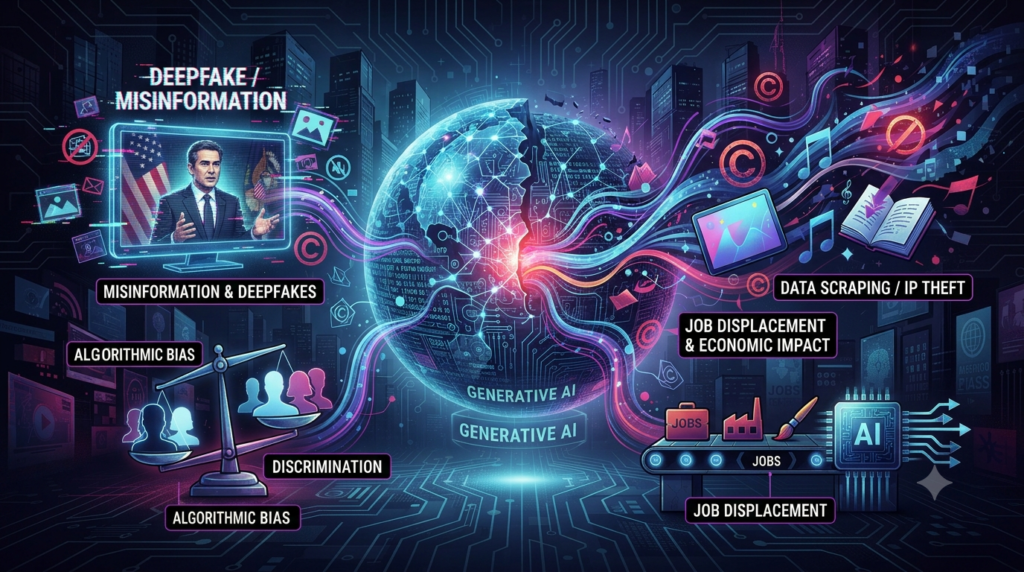
Generative AI is changing the way people create content, manage information, develop software, and communicate. Tools powered by artificial intelligence can write articles, create images, generate code, summarize documents, and answer complex questions within seconds.
Businesses are also using generative AI to improve customer support, automate daily tasks, analyze information, and increase productivity. These benefits make AI an important part of modern business operations.
However, this rapid growth comes with new challenges. The risks of generative AI go beyond incorrect answers or low-quality content. They also include data leakage, privacy violations, cyberattacks, copyright disputes, and legal problems.
For example, an employee may paste confidential company information into an AI chatbot without checking its data policy. A business may publish AI-generated content that closely resembles copyrighted material. Similarly, an attacker may use a security weakness to manipulate an AI application.
These examples show why organizations need to understand generative AI risks before using these tools at scale.
AI privacy risks, AI security risks, and AI copyright issues are now important concerns for both small businesses and large enterprises. Companies must also consider data protection in AI, regulatory compliance, and responsible AI governance.
The good news is that these risks can be managed. With clear policies, proper security controls, and regular reviews, organizations can use AI while protecting their users, employees, and business information.
This guide explains seven major generative AI risks, their possible effects, and practical ways to reduce them.
Know More: AI in Online Education: 9 Powerful Trends and Opportunities
1. Generative AI Risks: Understanding
What Is Generative AI?
Generative AI is a type of artificial intelligence that creates new content based on patterns learned from large amounts of data.
It can generate:
- Written content, reports, and summaries.
- Images, illustrations, and designs.
- Computer code and software suggestions.
- Audio, music, and video.
- Answers to questions and research summaries.
- Translations and personalized learning materials.
Popular generative AI applications include chatbots, AI writing assistants, image generators, and coding tools.
These systems use machine learning models to understand instructions and produce responses. Large language models, commonly known as LLMs, are widely used for text-based applications.
However, AI systems don’t understand every situation like humans do. They can produce incorrect information, repeat harmful patterns, or reveal information that should remain private.
Why Are Generative AI Risks Increasing?
The use of AI is growing across different industries. More employees, customers, developers, and businesses now depend on AI-powered applications.
As adoption increases, the amount of information shared with AI tools also grows.
Several factors contribute to this risk:
- Large amounts of data: AI systems process information from many sources. Poor data controls can create privacy problems.
- Third-party platforms: Businesses often depend on external AI services. Their data policies and security standards may differ.
- Human mistakes: Employees may share passwords, customer information, or internal documents without understanding the consequences.
- New cyber threats: Attackers can target AI applications through prompt injection and other security weaknesses.
- Unclear ownership: AI-generated content can create questions about copyright and intellectual property.
- Changing regulations: Businesses must understand the laws that apply to their AI activities.
Seven Major Generative AI Risks at a Glance
|
Risk |
Possible problem |
Business impact |
|
Privacy risks |
Personal data exposure |
Loss of customer trust |
|
Security risks |
Unauthorized access |
Data breaches |
|
Copyright issues |
Unlicensed content use |
Legal disputes |
|
Data protection |
Poor information handling |
Compliance problems |
|
Incorrect outputs |
False or misleading answers |
Poor decisions |
|
AI bias |
Unfair results |
Reputation damage |
|
Weak governance |
Lack of accountability |
Operational risks |
Understanding these risks is the first step toward building secure AI systems.
2. AI Privacy Risks: Protecting Personal and Confidential Information
Privacy is one of the most important concerns related to generative AI.
AI applications often process user prompts, uploaded documents, business reports, customer details, and other information. If this information isn’t handled correctly, it may create privacy problems.
2.1 Data Leakage Through AI Tools
Data leakage happens when private or confidential information becomes available to people who aren’t authorized to access it.
Imagine an employee working on a financial report. They upload an internal spreadsheet to an online AI tool and ask it to summarize the information.
The spreadsheet may contain customer names, financial records, business plans, or employee details.
If the AI service has weak privacy controls or unclear data retention practices, the organization may lose control over that information.
This is one of the major generative AI privacy concerns for businesses.
Sensitive information that requires protection includes:
- Customer names and contact details.
- Email addresses and phone numbers.
- Financial and payment information.
- Employee records.
- Business contracts.
- Internal research and development documents.
- Login credentials and security details.
Organizations should never assume that information shared with an AI tool will automatically remain private.
2.2 Personal Data Protection Challenges
Generative AI applications may process personal data during normal operations.
For example, a customer support chatbot may receive names, addresses, order details, and complaints. An AI recruitment tool may process resumes and employment information.
If this data is collected, stored, or processed without suitable safeguards, it can create privacy risks.
Businesses should understand what information an AI application collects and how it uses that information.
Important questions include:
- Does the platform store user prompts?
- Is submitted information used for model training?
- How long does the service retain data?
- Can users request data deletion?
- Who can access uploaded documents?
- Is information shared with third-party providers?
Clear answers to these questions help businesses make informed decisions.
2.3 AI Privacy Concerns in Employee Workflows
Employees often use AI to save time. However, they may not understand the risks of sharing company information.
For example, an employee might paste an internal strategy document into an AI assistant to create a presentation.
Another employee might upload a customer database to generate marketing ideas.
These actions can expose sensitive business information if the tool isn’t approved for such use.
Companies should create simple employee guidelines that explain what information can and cannot be shared.
2.4 How to Reduce AI Privacy Risks
Businesses can take several steps to improve privacy.
Use approved AI platforms: Create a list of AI tools that employees can use for business activities.
Remove personal information: Delete names, phone numbers, addresses, and other sensitive details before uploading documents.
Check privacy policies: Understand how AI providers collect, process, store, and use information.
Limit data access: Give employees access only to the information they need.
Set retention rules: Define how long AI-related information should be stored.
Train employees: Explain common privacy mistakes and safe AI practices.
Review third-party providers: Check their security controls and data protection commitments before adopting their services.
Privacy protection should be part of every AI project from the beginning.
3. AI Security Risks: Understanding New Cyber Threats
AI security is another major challenge for organizations.
Traditional software security focuses on protecting applications, databases, networks, and user accounts. Generative AI introduces additional risks because it processes natural language instructions and may connect to external tools and business systems.
These connections can create new opportunities for attackers.
3.1 Prompt Injection Attacks
Prompt injection is one of the important AI security vulnerabilities.
It happens when someone creates an instruction that manipulates an AI system into ignoring its intended behavior.
For example, an attacker may place hidden instructions inside a document that an AI assistant is asked to summarize.
The AI may follow those instructions instead of completing the original task.
Depending on the system’s permissions, this could lead to sensitive information being exposed or an unauthorized action being attempted.
Prompt injection is especially important when AI systems can access emails, files, websites, or business applications.
3.2 Unauthorized Access and Data Exposure
An AI application may connect to internal databases, customer management systems, or company documents.
If access controls are weak, users may gain access to information they shouldn’t see.
For example, a customer support assistant should only access information needed to answer a customer’s question.
It shouldn’t reveal another customer’s account details.
Businesses must use strong authentication, role-based access controls, and permission checks.
AI systems should never be trusted to manage access rights on their own.
3.3 AI-Powered Phishing and Social Engineering
Cybercriminals can use generative AI to create convincing phishing emails, fake messages, and fraudulent documents.
Traditional phishing emails often contain spelling mistakes or unusual language. AI can make these messages sound more natural and professional.
Attackers may also use AI to create personalized messages based on publicly available information.
This can increase the risk of employees clicking harmful links or sharing login details.
Organizations should improve employee awareness and use email security systems to identify suspicious activity.
3.4 Insecure AI Integrations
Businesses often connect AI tools with external applications through APIs, plugins, and automated workflows.
These integrations can create security weaknesses if they have excessive permissions.
For example, an AI assistant that can read and send emails may create serious problems if an attacker successfully manipulates it.
A secure system should follow the principle of least privilege.
This means that AI applications should receive only the permissions needed to perform their assigned tasks.
3.5 Other Important AI Security Threats
Some additional threats include:
- Training data poisoning: Attackers manipulate training or reference data to influence model behavior.
- Sensitive information disclosure: AI applications reveal private or confidential information.
- Insecure output handling: Applications use AI-generated content without checking it for harmful instructions or unsafe code.
- Model theft: Unauthorized parties attempt to access or copy proprietary AI models.
- Excessive agency: AI agents receive too much freedom to perform actions without human approval.
The OWASP GenAI Security Project identifies several important risks for large language model applications. Its guidance is useful for developers and security teams building secure AI systems.
3.6 How Businesses Can Improve Generative AI Security
Organizations should use a layered security approach.
|
Security measure |
Purpose |
|
Multi-factor authentication |
Protect user accounts |
|
Role-based access |
Restrict sensitive information |
|
Data encryption |
Protect stored and transferred data |
|
API security |
Protect connected applications |
|
Input validation |
Identify harmful instructions |
|
Output validation |
Check AI-generated responses |
|
Security testing |
Find weaknesses before deployment |
|
Activity monitoring |
Identify unusual behavior |
Security teams should also test AI applications regularly.
A system that works correctly during normal use may still fail when it receives unexpected or malicious instructions.
Testing should include real-world scenarios, not just basic questions and answers.
4. AI Copyright Issues and Intellectual Property Rights
Copyright is one of the most discussed legal challenges of generative AI.
AI tools can create articles, images, music, videos, and computer code. However, questions arise about the data used to train these systems and the ownership of their outputs.
These issues affect content creators, businesses, publishers, software developers, and artists.
4.1 Copyright Challenges in AI Training Data
Generative AI models learn patterns from large datasets.
These datasets may include books, websites, images, research papers, music, and other creative material.
Some of this material may be protected by copyright.
This raises an important question: Can copyrighted material be used to train an AI model without permission?
The answer depends on the applicable law, the nature of the use, licensing terms, and other facts.
Different countries have different legal approaches. Therefore, businesses shouldn’t assume that every use of copyrighted material for AI training is automatically permitted.
4.2 Copyright Infringement in AI-Generated Content
AI-generated content can sometimes resemble existing copyrighted work.
For example, an image generator may produce an image that closely resembles a protected illustration.
An AI writing tool may generate text that is similar to an existing article.
A coding assistant may produce code that contains material from a licensed software project.
These situations can create copyright disputes.
Using an AI tool doesn’t automatically remove copyright responsibilities.
Businesses should review generated material before publishing or distributing it.
4.3 Who Owns AI-Generated Content?
Ownership is another important AI intellectual property question.
Suppose a company uses an AI tool to create a marketing image. Can the company claim full ownership of that image?
The answer may depend on the country, the level of human contribution, the platform’s terms, and applicable copyright rules.
Some jurisdictions require human authorship for copyright protection. Others may apply different legal tests.
Businesses should review the terms of the AI platform and understand local intellectual property laws before relying on generated content for commercial purposes.
4.4 Risks to Businesses and Content Creators
AI copyright issues can affect organizations in several ways.
Legal disputes: A copyright owner may challenge the use of protected material.
Content removal: A platform may remove content following a copyright complaint.
Financial loss: Businesses may face legal costs, settlements, or other expenses.
Brand damage: Publishing material that copies another creator’s work can reduce customer trust.
Licensing problems: AI-generated code or media may contain material with licensing restrictions.
4.5 How to Reduce AI Copyright Risks
Businesses should follow these practices:
- Use AI platforms with clear commercial-use terms.
- Review the licensing conditions of generated images, videos, text, and code.
- Avoid copying protected content into AI prompts without permission.
- Check generated content for similarities to existing work.
- Keep records of important human contributions and editing decisions.
- Use licensed images, fonts, music, and other creative assets.
- Ask legal professionals to review high-risk commercial projects.
4.6 Protecting Intellectual Property When Using AI
Companies should also protect their own intellectual property.
Internal product designs, source code, business strategies, customer research, and confidential documents shouldn’t be shared with public AI tools without approval.
Businesses can create clear rules for handling proprietary information.
They should also review contracts with AI vendors to understand how submitted data and generated content may be used.
A careful approach can reduce legal risks while allowing teams to benefit from AI-powered creativity.
5. Data Protection in AI: Compliance and Legal Responsibilities
Data protection is not limited to preventing hackers from accessing information.
It also includes collecting, using, storing, sharing, and deleting information in a responsible way.
Businesses that use generative AI must understand their legal responsibilities.
5.1 Understanding AI Data Protection Requirements
AI applications may process different types of information.
Some examples include:
- Personal information.
- Employee records.
- Customer databases.
- Financial information.
- Health-related information.
- Business documents.
- Website and application activity.
Organizations should identify the data they process and determine which privacy and security rules apply.
For example, the European Union’s General Data Protection Regulation (GDPR) includes requirements for handling personal data.
In India, the Digital Personal Data Protection Act, 2023, is an important part of the country’s personal data protection framework. Organizations should review applicable rules and current implementation requirements.
5.2 Important Principles of Responsible Data Processing
Businesses should follow several basic principles.
Purpose limitation: Collect and use information for clear and lawful purposes.
Data minimization: Collect only the information needed for a specific task.
Transparency: Explain how personal data is collected and processed.
Security: Protect information through suitable technical and organizational controls.
Accountability: Maintain records and assign responsibility for data protection.
Data retention: Keep information only for the required period.
These principles help organizations reduce data protection risks.
5.3 Generative AI Compliance Challenges
Generative AI compliance can be difficult because AI systems often involve multiple providers and data sources.
A business may use one provider for its AI model, another for cloud hosting, and a third for customer information.
This makes it important to understand where data travels and who is responsible for protecting it.
Organizations should review:
- AI provider agreements.
- Privacy policies.
- Data processing agreements.
- Data storage locations.
- Third-party access.
- Security certifications and controls.
- Data deletion procedures.
- Incident reporting processes.
Compliance should be considered before an AI system is introduced, not after a problem occurs.
5.4 Legal Risks of AI Adoption
Legal risks can arise when AI tools are used without proper review.
For example, an organization may use an AI system to screen job applications. If the system produces unfair results, the company may face legal and reputation concerns.
Similarly, an AI chatbot may provide incorrect financial or medical information.
Businesses should consider the legal impact of AI-generated decisions, especially in sensitive areas.
Human review is important when an AI system affects people’s rights, finances, employment, or access to services.
5.5 Building a Strong Compliance Process
A practical compliance process should include:
- Identify all AI tools used by the organization.
- Understand what information each tool processes.
- Review the provider’s data policies.
- Identify applicable privacy and industry regulations.
- Document security and privacy controls.
- Assign clear responsibility to relevant teams.
- Review compliance regularly.
A strong compliance process protects both the organization and the people whose information it handles.
6. AI Governance Risks: Building Responsible AI Systems
AI governance refers to the policies, processes, and responsibilities used to manage AI systems.
It helps businesses decide how AI should be developed, purchased, tested, and used.
Without proper governance, even a technically secure AI system can create serious problems.
6.1 Lack of Clear AI Policies
Many organizations allow employees to use AI tools without providing clear instructions.
This can lead to inconsistent practices.
One employee may use AI to summarize confidential documents, while another may upload customer information into an unapproved application.
A company-wide AI policy should explain:
- Which tools employees can use.
- What information can be shared.
- Which tasks require human approval.
- How generated content should be reviewed.
- Who is responsible for AI-related incidents.
- How AI performance should be monitored.
Policies should be simple enough for employees to follow.
6.2 Bias and Unfair AI Decisions
AI systems learn patterns from their training data.
If the data contains unfair patterns, the model may reproduce them.
For example, an AI recruitment system may favor certain types of applicants because of patterns in its training data.
This can create unfair outcomes.
Businesses should test AI systems for bias and evaluate their results across different user groups.
Human oversight is particularly important when AI supports decisions involving people.
6.3 Incorrect Information and Overreliance
Generative AI can produce answers that sound confident but contain errors.
This is often called an AI hallucination.
For example, an AI tool may provide an incorrect legal reference, an outdated statistic, or a fictional research source.
If employees accept every AI response without checking it, the business may make poor decisions.
AI should support human work rather than replace critical thinking.
Important information should be checked against reliable sources.
6.4 Establishing AI Accountability
Every AI system should have a responsible owner.
This person or team should understand the system’s purpose, limitations, risks, and expected performance.
Organizations should also define responsibilities for:
- Data protection teams.
- IT and cybersecurity teams.
- Legal and compliance teams.
- Business managers.
- AI developers.
- End users.
Clear accountability makes it easier to identify problems and respond quickly.
6.5 Using an AI Risk Management Framework
Businesses can use established frameworks to guide their AI governance activities.
The National Institute of Standards and Technology (NIST) published its Artificial Intelligence Risk Management Framework: Generative Artificial Intelligence Profile in July 2024.
It provides guidance to help organizations identify and manage risks across the generative AI lifecycle.
The framework can help organizations build more trustworthy AI systems through structured risk management.
7. Generative AI Risks for Businesses: Real-World Impact
Generative AI risks affect businesses of different sizes.
A small company may face privacy problems because employees use free AI tools. A large enterprise may face complex security challenges because AI systems connect with multiple internal platforms.
The scale may differ, but the need for responsible AI use remains the same.
7.1 Financial Risks
A data breach or copyright dispute can create unexpected expenses.
Businesses may need to pay for investigations, legal support, system recovery, and customer communication.
AI-generated errors can also lead to financial losses if employees use incorrect information in important decisions.
7.2 Reputation Risks
Trust is an important part of every business relationship.
If customers learn that their personal information was shared without suitable protection, they may stop using the company’s services.
Similarly, publishing misleading or copied AI-generated content can harm a company’s reputation.
Businesses should treat customer trust as a key part of their AI strategy.
7.3 Operational Risks
AI systems may produce incorrect results, become unavailable, or fail because of poor integrations.
For example, a company using AI to process customer requests may experience delays if the system provides incorrect answers.
Organizations should maintain backup processes and ensure that employees can handle important tasks without depending entirely on AI.
7.4 Risks Across Different Industries
|
Industry |
Possible AI risk |
Recommended control |
|
Healthcare |
Exposure of patient data |
Strict privacy controls |
|
Banking |
Financial data leakage |
Strong access management |
|
Education |
Student information exposure |
Approved AI tools |
|
Recruitment |
Unfair candidate screening |
Human review |
|
Software development |
Vulnerable generated code |
Code security testing |
|
Marketing |
Copyright disputes |
Content review |
|
E-commerce |
Incorrect customer responses |
Response verification |
7.5 Why Small Businesses Should Also Care
Some small businesses believe that AI governance is only necessary for large enterprises.
That’s not true.
Even a small organization may handle customer records, employee information, payment details, and confidential documents.
A basic AI policy, approved tools, employee training, and access controls can make a meaningful difference.
Businesses don’t need a complicated system to start managing AI risks. They need clear rules and consistent practices.
8. Best Practices for Reducing Generative AI Risks: 7 Powerful Steps
Understanding risks is important, but taking action is even more important.
The following seven practices can help organizations improve AI privacy, security, copyright protection, and compliance.
Step 1: Create a Clear AI Usage Policy
Develop a written policy that explains how employees should use generative AI.
Include approved tools, restricted information, review requirements, and reporting procedures.
Make sure every employee understands the rules.
Step 2: Protect Sensitive Business Information
Never share passwords, payment details, confidential customer records, or proprietary documents with unapproved AI tools.
Remove personal information before submitting documents whenever possible.
Use enterprise services with suitable data protection controls when business information must be processed.
Step 3: Choose Secure and Reliable AI Providers
Before selecting an AI platform, review its security and privacy practices.
Check data retention, training usage, access controls, encryption, and third-party sharing.
Also review its service agreement and commercial-use conditions.
Step 4: Review AI-Generated Content
Don’t publish every AI-generated response without checking it.
Verify important facts, statistics, references, and legal statements.
Check images, text, and code for possible copyright or licensing concerns.
Human review helps improve quality and reduce risk.
Step 5: Strengthen Access Controls
Use multi-factor authentication and role-based permissions.
Give AI applications access only to the information they need.
Review API permissions and remove access that is no longer required.
Step 6: Train Employees Regularly
Employees should understand the risks of generative AI.
Training should cover privacy, phishing, prompt injection, copyright, and responsible AI use.
Use practical examples so employees can identify common mistakes in their daily work.
Step 7: Monitor and Review AI Systems
AI risks can change as tools, models, and business requirements evolve.
Organizations should regularly review their AI applications.
Monitor unusual activity, test security controls, check data access, and update policies when needed.
Quick AI Risk Management Checklist
|
Action |
Expected benefit |
|
Create an AI policy |
Consistent usage |
|
Review provider terms |
Better data protection |
|
Limit sensitive inputs |
Reduced data leakage |
|
Use strong authentication |
Improved security |
|
Check generated content |
Fewer copyright and accuracy issues |
|
Train employees |
Better risk awareness |
|
Conduct regular audits |
Stronger AI governance |
These steps can help businesses build secure AI systems without slowing down innovation.
9. The Future of Generative AI: Balancing Innovation and Safety
Generative AI will continue to influence business operations, education, healthcare, software development, and communication.
New AI applications will create more opportunities for automation and productivity.
At the same time, privacy, security, and copyright challenges will continue to evolve.
Businesses will need better tools to identify data leakage, prevent unauthorized access, and monitor AI-generated content.
AI governance will also become more important as organizations use AI in critical business processes.
9.1 More Focus on Enterprise AI Security
Businesses are likely to place greater importance on secure AI environments.
Private deployments, stronger access controls, and better data management can help organizations protect confidential information.
Companies will also need to review the security of external AI providers.
9.2 Better Privacy and Data Protection Controls
AI platforms may introduce more advanced privacy features.
These could include improved data retention controls, stronger encryption, better permission management, and clearer user choices.
However, businesses must still review these features instead of assuming that every platform offers the same protection.
9.3 Stronger AI Governance and Compliance
Organizations will need clear policies for AI development and adoption.
Legal teams, security professionals, and business leaders will play important roles in managing AI-related responsibilities.
Responsible AI practices can help companies maintain trust while adopting new technologies.
9.4 Human Oversight Will Remain Important
AI can complete many tasks quickly, but human judgment remains essential.
People must review important decisions, verify sensitive information, and take responsibility for the results.
The most effective approach is to combine AI capabilities with human experience.
Generative AI should be treated as a helpful tool, not an unquestionable source of truth.
Use Generative AI with Confidence and Responsibility
Generative AI offers many opportunities to improve productivity, creativity, and business performance. However, these benefits also come with responsibilities.
The major generative AI risks include privacy violations, data leakage, cybersecurity threats, copyright challenges, and compliance problems.
Businesses must understand how AI tools collect, process, store, and use information. They should also protect intellectual property, review generated content, and establish clear governance policies.
A responsible AI strategy doesn’t mean avoiding new technology. It means using technology with the right safeguards.
Organizations should start with approved tools, employee training, strong access controls, data protection policies, and regular security reviews.
As AI continues to develop, businesses that balance innovation with safety will be better prepared for the future.
”FAQs”
Q1. What are the risks of generative AI?
The main generative AI risks include data leakage, privacy violations, cybersecurity threats, copyright disputes, incorrect information, bias, and regulatory compliance problems.
These risks can affect individuals and businesses. Proper security controls, human review, and clear AI policies can help reduce them.
Q2. What are the biggest AI privacy risks?
The biggest AI privacy risks include sharing personal information with unapproved platforms, storing confidential prompts, exposing customer data, and allowing unauthorized access to sensitive documents.
Users should review platform privacy policies and avoid submitting confidential information without approval.
Q3. How does generative AI affect data security?
Generative AI can affect data security when users upload confidential information or connect AI tools to internal systems.
Weak access controls, prompt injection, insecure integrations, and poor data management can increase the risk of unauthorized disclosure.
Organizations should use approved platforms and apply strong security controls.
Q4. Can AI-generated content violate copyright?
Yes. AI-generated content may create copyright concerns if it reproduces or closely resembles protected material.
The legal position depends on the content, the applicable law, licensing terms, and the circumstances of its creation and use.
Businesses should review generated material before publishing it.
Q5. How can businesses protect sensitive data when using AI tools?
Businesses can protect sensitive data by using approved AI services, removing personal information, limiting access, reviewing privacy policies, and training employees.
They should also establish rules about what information employees can share with AI applications.
Q6. Is generative AI safe for business use?
Generative AI can be used safely for many business activities when suitable safeguards are in place.
Companies should assess their risks, select reliable providers, protect confidential information, review AI outputs, and maintain human oversight.
No AI tool should be treated as completely risk-free.
Q7. What is AI governance, and why is it important?
AI governance refers to the policies and processes used to manage AI systems responsibly.
It helps organizations control privacy, security, accuracy, fairness, and compliance risks.
Good governance also creates accountability and improves trust in AI-powered applications.
Q8. What are the legal challenges of generative AI adoption?
Legal challenges include copyright ownership, intellectual property rights, personal data protection, licensing, transparency, and responsibility for AI-generated decisions.
The exact requirements depend on the country, industry, and intended use of the AI system.
Businesses should seek legal advice for high-risk applications.
Q9. What is the best way to reduce generative AI security risks?
The best approach is to use multiple security controls.
These include strong authentication, limited access permissions, input and output validation, secure APIs, regular testing, and employee training.
Organizations should also monitor AI applications for suspicious activity.
Q10. Why is human oversight important in generative AI?
AI systems can produce inaccurate, biased, or misleading information.
Human oversight helps identify these problems before they affect customers or business operations.
People should review important AI-generated content and remain responsible for critical decisions


