Artificial intelligence is changing the way businesses work. Companies now use AI to understand customers, automate tasks, analyze information, improve products, and make faster decisions. From chatbots and recommendation systems to hiring software and financial tools, AI has become an important part of modern business operations.
However, the growth of AI also brings serious questions. Can businesses trust every AI decision? How can they prevent unfair treatment? Who is responsible when an AI system makes a mistake? What happens to the personal information that AI tools collect?
These questions make AI ethics and responsible AI important business priorities.
AI systems can process large amounts of data and find patterns faster than humans. Yet, they don’t always understand the real-world effects of their decisions. Poor-quality data, weak security, hidden bias, and a lack of human control can create problems for customers, employees, and organizations.
For example, an AI hiring tool may reject qualified candidates because its training data contains unfair patterns. A customer service chatbot may provide incorrect information. An automated financial system may treat two similar customers differently without a clear reason.
These problems can affect trust, business performance, and legal compliance.
Responsible artificial intelligence helps companies reduce these risks. It encourages organizations to build and use AI systems that are fair, transparent, secure, and accountable.
This guide explains the meaning of AI ethics, the importance of responsible AI in business, ten major ethical challenges, and practical steps organizations can take to use artificial intelligence safely.
Know More: How AI Is Changing Software Developer Jobs: 9 Powerful Trends
1. AI Ethics and Responsible AI: Information
Understanding AI Ethics
AI ethics refers to the principles and values that guide how artificial intelligence is designed, developed, and used.
It focuses on making sure AI systems respect people, protect their rights, and avoid causing unnecessary harm.
In simple terms, AI ethics asks businesses to consider whether their AI systems are making decisions in a fair and responsible way.
For example, a company using AI to screen job applications should ensure that its system evaluates candidates based on relevant skills and qualifications. It shouldn’t unfairly reject people because of their gender, age, location, or background.
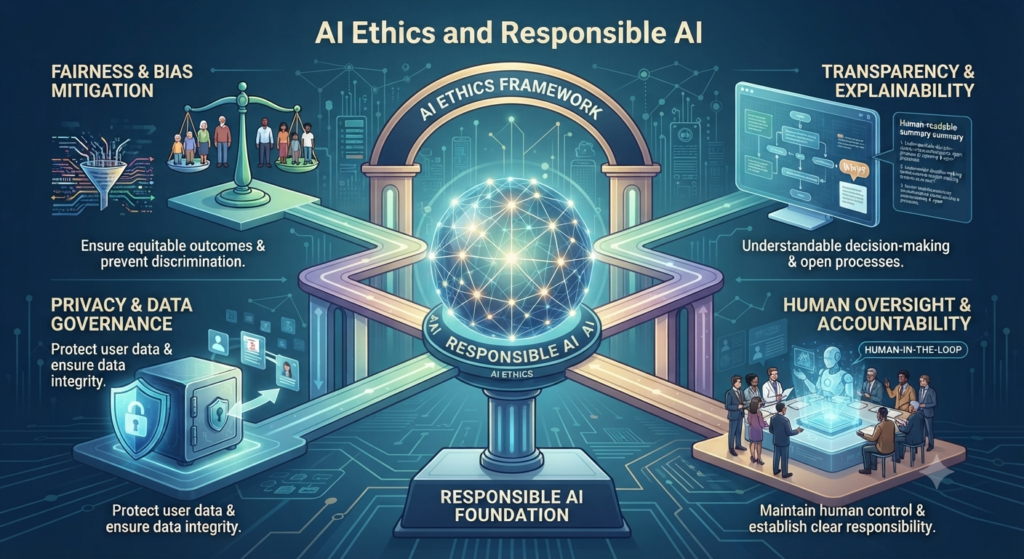
AI ethics covers several important areas:
- Fairness in automated decisions.
- Protection of personal and sensitive data.
- Transparency in AI-generated results.
- Human control over important decisions.
- Accountability for AI-related mistakes.
- Security and reliability of AI systems.
- Respect for individual rights.
These principles help organizations make better decisions when introducing artificial intelligence into their operations.
What Is Responsible AI in Business?
Responsible AI refers to the practical approach businesses use to apply ethical principles throughout the AI lifecycle.
It means creating AI systems that deliver business value while considering their impact on people, society, and the environment.
Responsible AI isn’t limited to the development stage. It covers the complete process, including:
- Planning an AI project.
- Collecting and preparing data.
- Developing and training AI models.
- Testing model performance.
- Deploying AI applications.
- Monitoring results.
- Improving systems when problems appear.
For example, a company using AI for customer support should check whether its chatbot provides accurate answers, protects customer information, and allows users to contact a human representative when needed.
This is the difference between simply adopting AI and adopting it responsibly.
Core Principles of Ethical AI
Businesses can use several principles to guide ethical AI development.
|
Principle |
Meaning |
Business Example |
|
Fairness |
AI should avoid unfair discrimination |
Testing hiring tools for bias |
|
Transparency |
AI decisions should be understandable |
Explaining automated loan decisions |
|
Accountability |
People and organizations must take responsibility |
Assigning ownership of AI systems |
|
Privacy |
Personal data must be protected |
Limiting access to customer information |
|
Security |
AI systems should resist attacks and misuse |
Protecting AI models from unauthorized access |
|
Human oversight |
People should remain involved in important decisions |
Human review of sensitive AI decisions |
|
Reliability |
AI should work consistently and safely |
Regular testing of automated systems |
Together, these principles create a strong foundation for trustworthy AI.
2. Why AI Ethics Is Important for Companies
AI adoption can improve productivity, reduce costs, and support better business decisions. However, these benefits can disappear when organizations ignore ethical concerns.
Responsible AI helps businesses balance innovation with responsibility.
Building Customer Trust
Customers want to know how businesses use their information. They also expect companies to treat them fairly.
When organizations explain how AI works and protect personal data, customers are more likely to trust their services.
For example, an online shopping platform may use AI to recommend products. If it clearly explains its data practices and allows customers to manage their preferences, it can create a better customer experience.
Trust is difficult to build but easy to lose. Ethical AI practices help protect it.
Protecting Brand Reputation
An AI-related mistake can quickly damage a company’s reputation.
Imagine a financial company using an automated system that unfairly rejects applications. If customers discover that the system produces biased results, they may lose confidence in the organization.
The problem may also attract public criticism and regulatory attention.
A strong AI ethics framework helps companies identify risks before they become major issues.
Supporting Legal and Regulatory Compliance
AI regulations are developing across different countries and industries.
Businesses may need to follow rules related to:
- Personal data protection.
- Automated decision-making.
- Consumer rights.
- Data security.
- High-risk AI applications.
- Record keeping and transparency.
For example, the European Union’s AI Act introduces requirements based on the level of risk associated with AI systems.
Organizations should understand the laws that apply to their operations, customers, and markets.
Improving Decision-Making
AI can support decisions, but its results aren’t automatically correct.
Ethical AI encourages companies to check data quality, test model performance, and involve qualified people in important decisions.
This can reduce mistakes and improve the quality of business operations.
Encouraging Long-Term Innovation
Responsible innovation creates a better environment for sustainable AI adoption.
Instead of focusing only on speed, businesses consider safety, fairness, privacy, and long-term effects.
This approach can help companies develop products that customers feel comfortable using.
3. 10 Critical AI Ethics Challenges Businesses Must Understand
AI creates many opportunities, but it also introduces risks that businesses must manage. The following ten challenges deserve special attention.
1. Algorithmic Bias and Unfair Decisions
Algorithmic bias occurs when an AI system produces unfair results for certain individuals or groups.
This can happen when training data contains historical discrimination, lacks diversity, or does not represent the people affected by the system.
For example, an AI recruitment tool trained on historical hiring records may learn to favor certain candidate profiles. As a result, qualified applicants from other backgrounds may receive lower scores.
This creates fairness concerns and can expose businesses to legal and reputational risks.
How businesses can reduce AI bias:
- Use diverse and representative training data.
- Test models with different user groups.
- Review historical data for unfair patterns.
- Monitor model results after deployment.
- Include human reviewers in sensitive decisions.
- Update models when unfair outcomes appear.
AI bias mitigation should be an ongoing process, not a one-time activity.
2. Data Privacy and Protection
AI systems often require large amounts of information to operate effectively.
This information may include customer details, employee records, financial information, location data, and personal preferences.
If businesses collect or use this information without proper safeguards, they can create serious privacy risks.
For example, an employee might enter confidential company information into a public AI chatbot. The information could then be exposed through an inappropriate use of the service.
Businesses should follow strong data privacy practices.
These include:
- Collecting only necessary information.
- Getting consent where required.
- Limiting access to sensitive data.
- Using encryption and secure storage.
- Removing personal details when possible.
- Reviewing third-party AI providers.
- Establishing clear data retention policies.
Companies should also understand applicable privacy laws before processing personal information.
3. Lack of AI Transparency
Some AI models work like black boxes. They produce results without providing a clear explanation of how those results were reached.
This creates a problem when businesses use AI for important decisions.
For example, a customer may want to understand why an automated system rejected a loan application. If the company cannot explain the decision, the customer may feel unfairly treated.
AI transparency helps users understand when AI is being used and what role it plays.
Businesses can improve transparency by:
- Informing users when they interact with AI.
- Providing understandable explanations.
- Documenting model limitations.
- Keeping records of important decisions.
- Explaining the purpose of AI applications.
Explainable AI can help organizations understand model behavior and provide clearer information to affected users.
4. Lack of Accountability
Who is responsible when an AI system causes harm?
This is one of the most important questions in artificial intelligence ethics.
An AI system cannot take legal or business responsibility in the same way a human organization can. Responsibility must therefore be assigned to people and organizations.
For example, if an AI chatbot gives customers incorrect financial information, the company cannot simply blame the software.
It should investigate the problem, correct the information, and improve its safeguards.
Businesses should establish clear accountability through:
- Assigning owners to AI projects.
- Defining employee responsibilities.
- Maintaining decision records.
- Creating complaint and reporting channels.
- Establishing procedures for correcting errors.
- Reviewing AI performance regularly.
Clear accountability makes it easier to identify problems and take corrective action.
5. Security Risks and AI Misuse
AI systems can become targets for cyberattacks and unauthorized access.
Attackers may attempt to manipulate training data, extract sensitive information, or trick AI models into producing harmful outputs.
Generative AI also creates new security concerns. For example, employees may unknowingly share confidential information with external AI tools.
Businesses should treat AI security as part of their wider cybersecurity strategy.
Important security measures include:
- Strong access controls.
- Regular vulnerability testing.
- Secure model development.
- Monitoring unusual activity.
- Protecting training datasets.
- Reviewing third-party AI services.
- Creating incident response plans.
Security testing should continue after deployment because new threats can appear over time.
6. Intellectual Property and Copyright Concerns
AI systems can generate text, images, code, and other content. However, the ownership and permitted use of AI-generated material can be complex.
Businesses may also use third-party AI tools that process copyrighted or confidential material.
For example, a marketing team might generate an image that closely resembles protected creative work. This could create legal and reputational concerns.
Organizations should create clear policies for AI-generated content.
They should also:
- Review the terms of AI services.
- Check ownership and licensing conditions.
- Avoid uploading confidential material without authorization.
- Review generated content before publishing.
- Keep records of important content sources.
- Seek legal advice when necessary.
Responsible AI development requires businesses to respect intellectual property rights.
7. Overdependence on Artificial Intelligence
AI can make tasks faster, but relying on it too heavily can weaken human judgment.
For example, a business may allow an AI system to approve customer complaints automatically. If employees stop reviewing unusual cases, genuine customer problems may go unnoticed.
AI should support human decision-making rather than replace it in every situation.
Companies should identify tasks where human judgment is essential.
They should also train employees to recognize AI limitations and question results that appear incorrect.
8. Incorrect Information and Unreliable Outputs
Generative AI tools can sometimes produce incorrect information with a confident tone.
These incorrect outputs are often called AI hallucinations.
For businesses, this can create serious problems.
An AI assistant might provide an incorrect product specification, invent a source, or give outdated information to a customer.
To reduce this risk, companies should:
- Check important AI-generated information.
- Use trusted and updated data sources.
- Test AI systems before launch.
- Apply human review to sensitive content.
- Monitor error rates.
- Clearly communicate limitations.
AI-generated information should never be treated as automatically accurate.
9. Changing AI Regulations and Compliance Requirements
AI regulations differ across countries and continue to develop.
Businesses operating in multiple markets may need to manage different legal requirements.
For example, the EU AI Act follows a risk-based approach. Certain AI applications face stricter requirements because of their potential impact on people’s safety and fundamental rights.
Companies may also need to consider privacy laws, consumer protection rules, employment requirements, and sector-specific regulations.
This creates challenges for legal, technical, and compliance teams.
Organizations should maintain an updated record of AI applications, assess their risks, and review applicable regulations regularly.
10. Environmental and Social Impact
Training and operating large AI systems can require significant computing resources.
This can increase energy use and create environmental concerns.
AI can also affect employment, workplace skills, and access to opportunities.
For example, automation may reduce the need for certain repetitive tasks while increasing demand for new technical skills.
Businesses should consider these wider effects when planning AI adoption.
They can encourage responsible innovation by:
- Choosing efficient AI models.
- Avoiding unnecessary computing tasks.
- Monitoring resource consumption.
- Supporting employee training.
- Considering the social impact of automation.
- Making AI tools accessible to different user groups.
Responsible AI should benefit businesses while considering its impact on society.
4. AI Governance and Compliance: Building a Strong Framework
Understanding ethical challenges is only the first step. Businesses also need a clear system for managing AI risks.
This is where AI governance becomes important.
What Is AI Governance?
AI governance refers to the policies, roles, processes, and controls that guide how an organization develops, purchases, deploys, and monitors AI systems.
A strong AI governance framework ensures that AI projects follow business goals, ethical principles, and applicable legal requirements.
It also helps organizations identify who is responsible for each stage of the AI lifecycle.
Key Components of an AI Governance Framework
|
Component |
Purpose |
Example |
|
AI policies |
Define acceptable AI use |
Employee AI usage guidelines |
|
Risk assessment |
Identify possible harm |
Reviewing automated hiring tools |
|
Data governance |
Protect information quality and privacy |
Data access controls |
|
Model testing |
Check accuracy and fairness |
Bias testing before deployment |
|
Human oversight |
Keep people involved in important decisions |
Manual review of high-impact outcomes |
|
Documentation |
Maintain clear records |
Model cards and audit reports |
|
Monitoring |
Identify problems after deployment |
Regular performance reviews |
|
Incident management |
Respond to AI-related problems |
Reporting and correction process |
These components help organizations manage AI throughout its lifecycle.
Important AI Governance Standards and Regulations
Businesses can use established frameworks and regulatory guidance to develop their responsible AI strategies.
- NIST AI Risk Management Framework
The National Institute of Standards and Technology developed the AI Risk Management Framework to help organizations manage risks associated with AI.
Its four main functions are:
- Govern: Establish policies and responsibilities.
- Map: Understand the AI system and its context.
- Measure: Assess and analyze risks.
- Manage: Address identified risks.
The framework provides a practical approach to building trustworthy AI systems.
Official resource: https://www.nist.gov/itl/ai-risk-management-framework
- European Union AI Act
The EU AI Act introduces a risk-based regulatory approach.
It distinguishes between different levels of AI risk and establishes requirements for certain AI applications.
Businesses that develop or use AI in markets covered by the regulation should assess their obligations carefully.
Official resource: https://digital-strategy.ec.europa.eu/en/policies/regulatory-framework-ai
- OECD AI Principles
The OECD AI Principles promote trustworthy AI that respects human rights and democratic values.
They emphasize areas such as transparency, robustness, accountability, and inclusive growth.
Official resource: https://oecd.ai/en/ai-principles
- ISO/IEC 42001
ISO/IEC 42001 provides requirements for establishing and improving an AI management system.
It can help organizations create structured processes for responsible AI management.
Businesses should select frameworks and standards based on their size, industry, risk profile, and regulatory environment.
5. How Businesses Can Ensure Ethical AI Use
A responsible AI strategy should include practical actions that employees and management teams can follow.
The following steps can help organizations introduce responsible AI implementation across their operations.
Step 1: Create an AI Usage Policy
Start by defining how employees can use AI tools.
The policy should explain:
- Which AI tools are approved.
- What information employees can share.
- Which tasks require human approval.
- How AI-generated content should be checked.
- Who is responsible for reporting problems.
A clear policy reduces confusion and prevents unsafe AI usage.
Step 2: Identify and Assess AI Risks
Not every AI application carries the same level of risk.
A recommendation engine may have a different risk profile from an AI system used in recruitment or financial decisions.
Businesses should assess each application based on:
- The type of information it processes.
- The people affected by its decisions.
- The possible consequences of errors.
- The level of human involvement.
- Applicable legal requirements.
High-impact applications should receive more careful testing and monitoring.
Step 3: Use Reliable and Representative Data
AI performance depends heavily on the quality of its data.
Incomplete, outdated, or biased information can produce unreliable results.
Organizations should review data sources, check accuracy, and identify gaps in representation.
They should also document where data comes from and how it is used.
Step 4: Include Human Oversight
Human oversight is essential when AI affects important decisions.
Employees should have the ability to review questionable results, correct errors, and intervene when necessary.
For example, an AI hiring system can help organize applications, but qualified human reviewers should remain involved in important recruitment decisions.
The level of human oversight should match the potential risk.
Step 5: Test AI Systems Before Deployment
Businesses should not release AI systems without proper testing.
Testing should cover:
- Accuracy.
- Fairness.
- Security.
- Privacy.
- Reliability.
- Explainability.
- Performance across different user groups.
Organizations should also test how systems behave when they receive unexpected or poor-quality information.
Step 6: Monitor AI Performance Continuously
AI systems can change in performance over time.
New data, changing customer behavior, software updates, and external conditions can affect results.
Businesses should regularly monitor their systems and investigate unexpected outcomes.
A monitoring process should include performance checks, incident reporting, user feedback, and periodic reviews.
Step 7: Train Employees on Responsible AI
Technology alone cannot create an ethical AI environment.
Employees need to understand how AI works, where it can fail, and what responsibilities they have when using it.
Training should cover:
- AI basics.
- Data privacy.
- AI bias.
- Security risks.
- Responsible prompt usage.
- Fact-checking AI outputs.
- Company AI policies.
Regular training can help employees use AI more confidently and safely.
6. Responsible AI Best Practices for Organizations
Responsible AI is not a one-time project. It requires continuous attention from leadership, technical teams, legal departments, and employees.
Here are practical best practices organizations can follow.
Establish Clear Ownership
Every AI application should have an accountable owner.
This person or team should understand the system’s purpose, risks, performance, and responsibilities.
Maintain AI Documentation
Businesses should document important details about their AI systems.
This may include:
- Business purpose.
- Data sources.
- Model limitations.
- Testing results.
- Risk assessments.
- Approval records.
- Monitoring activities.
Good documentation makes reviews and audits easier.
Apply Privacy by Design
Privacy should be considered before an AI application is developed or purchased.
Organizations should collect only necessary information and use appropriate security measures.
Make AI Decisions Understandable
Businesses should explain AI involvement when it affects users.
They should provide clear information about the purpose of the system and offer ways to question or review important decisions where appropriate.
Review Third-Party AI Providers
Many businesses use external AI platforms instead of building their own models.
Before selecting a provider, organizations should review its security practices, data handling policies, contractual terms, reliability, and compliance support.
Create an AI Incident Response Process
Businesses should have a clear process for responding to AI-related problems.
This process should explain how employees report incidents, who investigates them, how affected users are supported, and how corrective actions are recorded.
Measure Responsible AI Performance
Organizations should define measurable indicators to understand whether their AI governance efforts are working.
|
Measurement Area |
Example Indicator |
|
Fairness |
Differences in outcomes across user groups |
|
Accuracy |
Model error rate |
|
Privacy |
Number of data protection incidents |
|
Security |
Identified vulnerabilities |
|
Transparency |
Percentage of systems with clear documentation |
|
Accountability |
Percentage of AI systems with assigned owners |
|
Human oversight |
Percentage of high-risk decisions reviewed by people |
These measurements can help businesses improve their AI practices over time.
7. The Future of AI Ethics and Responsible AI
Artificial intelligence will continue to influence business operations, customer experiences, and workplace processes.
As AI tools become more advanced, responsible AI will become even more important.
Businesses will need to focus on several developing areas.
Greater Demand for AI Transparency
Customers and regulators will increasingly expect organizations to explain how AI affects important decisions.
Clear communication and understandable documentation will become valuable business practices.
Stronger AI Governance
Companies will need more structured processes to manage AI risks.
AI governance may become a regular part of enterprise risk management, similar to cybersecurity and data protection.
Increased Human-AI Collaboration
Rather than replacing human judgment completely, many organizations will use AI to support employees.
This approach can combine the speed of automation with human experience, creativity, and responsibility.
More Focus on AI Safety
As AI systems become more powerful, organizations will need to consider security, reliability, misuse, and unexpected behavior.
Testing and monitoring will remain essential.
Responsible Innovation as a Competitive Advantage
Businesses that build trustworthy AI systems may gain stronger customer confidence and more sustainable growth opportunities.
Ethical AI isn’t simply a technical requirement. It can become an important part of business strategy.
”FAQs”
1. What is responsible AI in business?
Responsible AI in business means developing and using artificial intelligence in a fair, transparent, secure, and accountable way. It ensures that AI systems support business goals while protecting customers, employees, and other affected individuals.
2. Why is AI ethics important for companies?
AI ethics is important because it helps businesses prevent unfair decisions, protect personal information, reduce legal risks, and build customer trust. It also supports responsible innovation and long-term business growth.
3. What are the biggest challenges of implementing responsible AI?
The main challenges include algorithmic bias, data privacy, lack of transparency, unclear accountability, cybersecurity threats, unreliable outputs, and changing AI regulations. Businesses must address these issues through governance, testing, and continuous monitoring.
4. How can businesses ensure ethical AI use?
Businesses can ensure ethical AI use by creating clear policies, assessing risks, using reliable data, testing models for bias, protecting personal information, maintaining human oversight, and monitoring AI performance.
5. What is an AI governance framework?
An AI governance framework is a structured set of policies, responsibilities, procedures, and controls that guide the development and use of artificial intelligence. It helps organizations manage AI risks and maintain ethical and regulatory standards.
6. What is algorithmic bias in artificial intelligence?
Algorithmic bias occurs when an AI system produces unfair results because of biased training data, poor model design, or unsuitable assumptions. It can affect hiring, lending, healthcare, and other business decisions.
7. What is the difference between AI ethics and AI governance?
AI ethics focuses on the principles that should guide artificial intelligence, such as fairness, privacy, and accountability. AI governance provides the policies, roles, and processes that help organizations apply those principles in practice.
8. How does AI transparency improve customer trust?
AI transparency helps customers understand when AI is being used, what information it processes, and how its decisions affect them. Clear explanations and appropriate review options can improve confidence in business services.
9. What role does human oversight play in responsible AI?
Human oversight allows people to review AI decisions, identify mistakes, and intervene when necessary. It is especially important when AI systems affect employment, finances, safety, or individual rights.
10. What are the best practices for building trustworthy AI systems?
The best practices include using quality data, testing for bias, protecting privacy, documenting model behavior, maintaining human oversight, applying security controls, and monitoring systems after deployment.


