
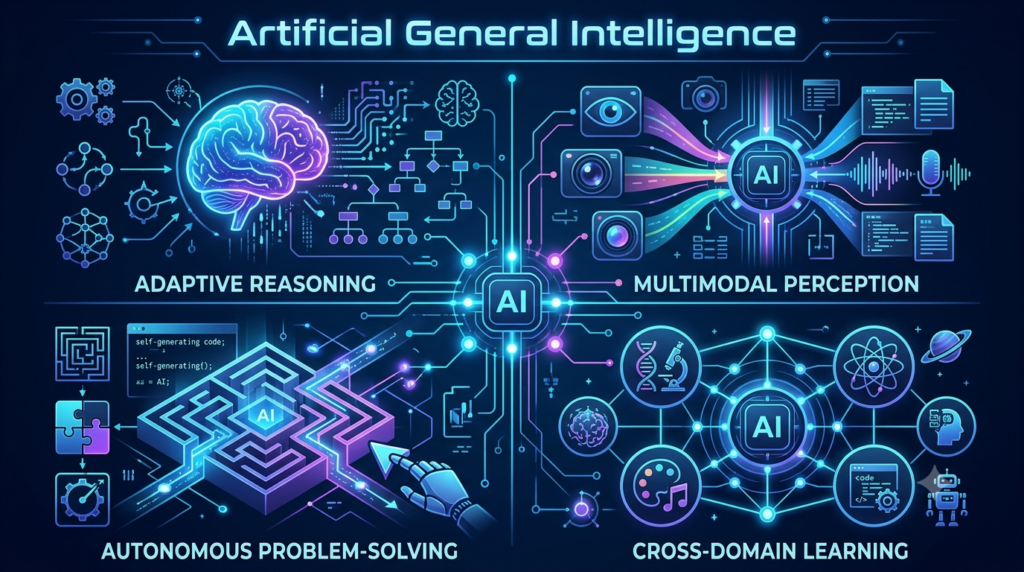
Artificial General Intelligence (AGI): What It Means for the Future of Technology
Technology is changing the world faster than ever. Artificial intelligence already helps people write content, analyze information, create images, and solve complex problems. However, the next major step could be something much bigger: Artificial General Intelligence (AGI).
AGI represents a new stage in the evolution of artificial intelligence. It aims to create intelligent systems that can learn, understand, reason, and solve different types of problems. Unlike today’s specialized AI tools, AGI could perform a wide range of intellectual tasks without needing separate training for every activity.
Imagine a computer system that can help doctors discover new treatments, support teachers in classrooms, develop software, conduct scientific research, and solve business problems. It could understand new situations and apply its knowledge across different fields.
This is the central idea behind general AI.
The future of artificial general intelligence could transform industries, improve productivity, and open new opportunities for innovation. At the same time, it raises important questions about safety, employment, privacy, and human control.
In this article, we’ll explore what AGI means, how it works, how it differs from current AI, and what it could mean for the future of technology.
1. What Is Artificial General Intelligence?
Artificial General Intelligence is a form of advanced artificial intelligence designed to perform intellectual tasks across many different areas.
In simple terms, AGI refers to a machine’s ability to learn and solve problems in a way that resembles general human intelligence.
Today’s AI tools usually focus on specific activities. For example, one system may recognize faces, another may translate languages, and another may recommend products.
AGI aims to go beyond these limitations.
An AGI system could potentially understand a new problem, learn the skills needed to solve it, and apply its knowledge to a different situation.
The goal is not simply to make computers faster. It is to develop systems that can adapt, reason, and learn across different environments.
There is no single definition of AGI accepted by every researcher. Experts also disagree about the exact tests needed to confirm that a system has achieved general intelligence.
IBM+1
Understanding Human-Level AI
Human-level AI is one of the main ideas behind AGI development.
Human intelligence allows people to perform many different tasks. A person can learn a language, understand mathematics, make decisions, solve problems, and use past experiences in new situations.
An AGI system aims to demonstrate similar flexibility.
For example, consider a person who knows how to manage a business. That person may use the same problem-solving skills to manage a project, organize a team, or plan a budget.
A general AI system should ideally demonstrate similar knowledge transfer.
Important abilities associated with human-level AI include:
- Learning: Understanding new information and developing new skills.
- Reasoning: Examining information and reaching logical conclusions.
- Problem-solving: Finding solutions to unfamiliar challenges.
- Adaptability: Adjusting to new situations without complete retraining.
- Memory: Using previous knowledge and experiences.
- Planning: Organizing tasks to achieve long-term goals.
- Decision-making: Comparing different options before taking action.
These abilities could make AGI more flexible than traditional intelligent systems.
How AGI Technology Works
AGI technology is still an active research area. There is no proven formula for building a system with complete human-level general intelligence.
However, researchers are exploring several technologies that could contribute to its development.
- Advanced machine learning
Machine learning allows computers to identify patterns and improve their performance using data.
Advanced machine learning could help future AGI systems learn from different types of information and develop new skills.
- Neural networks
Neural networks are computing systems inspired by certain features of the human brain.
They contain connected processing units that learn patterns from data. Modern deep learning systems use large neural networks to process language, images, audio, and other information.
- Cognitive computing
Cognitive computing focuses on systems that can process information, understand context, and support complex decisions.
It could help future AGI systems combine information from different sources.
- Machine reasoning
Machine reasoning allows an AI system to examine facts, understand relationships, and reach conclusions.
This ability is important because intelligence requires more than identifying patterns. A system must also handle unfamiliar problems.
- Adaptive learning systems
Adaptive learning systems can adjust their behavior when they receive new information.
This could allow AGI to develop skills over time and respond to changing situations.
Key Characteristics of AGI
The following characteristics help explain what researchers hope to achieve.
|
Characteristic |
Meaning |
Example |
|
General learning |
Learning across different subjects |
Learning science and business |
|
Reasoning |
Understanding logical relationships |
Solving unfamiliar problems |
|
Adaptability |
Adjusting to new conditions |
Working with new software |
|
Memory |
Using previous information |
Applying past lessons |
|
Planning |
Managing complex tasks |
Organizing a research project |
|
Autonomy |
Completing tasks with limited guidance |
Managing a defined workflow |
|
Knowledge transfer |
Applying existing skills elsewhere |
Using mathematics in engineering |
These features could help artificial general intelligence become a major development in the future of technology.
One important point is worth remembering: AGI does not automatically mean artificial consciousness. A machine could potentially perform general intellectual tasks without having feelings or subjective experiences.
2. AGI vs AI: Understanding the Key Differences
Artificial intelligence is already part of everyday life. People use AI-powered search engines, digital assistants, recommendation systems, and automated business tools.
However, AGI and today’s AI systems are not the same.
The main difference is the range of tasks they can perform.
Traditional AI is generally designed for specific purposes. AGI aims to develop broader intelligence that can work across many different areas.
Narrow AI vs General AI
Narrow AI is also called weak AI. It performs tasks within a defined area.
For example, a voice assistant can understand spoken commands, but it may not independently understand and manage every task that a human can perform.
A recommendation engine can suggest products based on customer behavior. However, it cannot automatically become a doctor, engineer, or business manager.
General AI aims to overcome these limitations.
Consider the following comparison.
|
Feature |
Narrow AI |
Artificial General Intelligence |
|
Main purpose |
Specific tasks |
General intellectual tasks |
|
Learning |
Usually task-focused |
Broad and flexible |
|
Adaptability |
Limited |
Expected to be high |
|
Problem-solving |
Defined areas |
Different subject areas |
|
Knowledge transfer |
Often limited |
Expected to be strong |
|
Human-level intelligence |
Not generally achieved |
Main development goal |
|
Current status |
Widely available |
Not established as achieved |
For example, an AI writing tool can prepare an article based on instructions. An AGI system could potentially research a topic, understand its business purpose, prepare the article, evaluate its results, and adjust the strategy.
This example describes a possible future capability, not a proven feature of current AI systems.
AGI vs Artificial Superintelligence
Another important concept is Artificial Superintelligence (ASI).
AGI and ASI are related, but they describe different levels of intelligence.
AGI refers to artificial intelligence that can perform a broad range of intellectual tasks at approximately human-level capability.
ASI refers to a hypothetical system that exceeds human intelligence by a significant margin.
|
Technology |
Intelligence Level |
Main Goal |
|
Narrow AI |
Specialized intelligence |
Complete specific tasks |
|
AGI |
General human-level intelligence |
Handle a wide range of tasks |
|
ASI |
Beyond human-level intelligence |
Exceed human capabilities |
For example, an AGI system might help researchers develop a new scientific theory.
An ASI system could potentially discover solutions that are beyond the capabilities of individual human researchers or even large research teams.
However, ASI remains hypothetical. Its development would also raise serious questions about safety and control.
Understanding these differences helps businesses and individuals avoid confusing advanced AI products with actual artificial general intelligence.
3. How AGI Development Is Progressing
AGI development is one of the most challenging areas of modern computer science.
Researchers are working to improve machine learning, reasoning, memory, problem-solving, and autonomous intelligence.
Modern AI systems have made significant progress in language processing, image recognition, programming, and information analysis. However, strong performance in several tasks does not automatically demonstrate general intelligence.
An intelligent system must also handle unfamiliar situations and apply its knowledge reliably.
Machine Learning and Neural Networks
Machine learning is an important foundation of modern AI research.
It allows systems to learn patterns from information instead of depending only on fixed instructions.
Deep learning takes this approach further by using large neural networks with multiple processing layers.
These networks can identify complex relationships in large datasets.
For example, a neural network trained on medical images may learn to identify certain patterns that help doctors review scans.
However, developing AGI will likely require more than increasing the size of existing models.
Researchers are exploring systems that can:
- Learn from fewer examples.
- Transfer knowledge between different tasks.
- Understand complex relationships.
- Improve their reasoning abilities.
- Remember useful information over time.
- Work with different types of data.
- Adapt to new environments.
Combining these abilities could support the development of next generation AI technology.
Cognitive Computing and Machine Reasoning
Cognitive computing explores how machines can process information and support activities that require human-like thinking.
Machine reasoning is especially important for AGI.
A system that only identifies patterns may struggle when it faces a problem that is different from its training examples.
Reasoning allows a system to examine available information and work through possible solutions.
For example, imagine an AI system helping a company reduce delivery costs.
It may need to examine:
- Product demand.
- Delivery locations.
- Fuel costs.
- Available vehicles.
- Delivery schedules.
- Customer requirements.
It would then need to compare different plans and recommend a suitable solution.
This type of intelligent decision-making could become more advanced as AGI research develops.
Major AGI Development Challenges
Despite significant progress, several challenges remain.
- General reasoning
Creating systems that can reason across different subjects remains difficult. Strong performance in one area does not guarantee reliable performance in another.
- Learning from limited information
Humans can often understand a new concept after seeing only a few examples. Machines may require much larger datasets.
- Memory and context
Future AGI systems may need reliable long-term memory to remember information, connect past experiences, and complete complex projects.
- Real-world understanding
Understanding language is not the same as understanding the physical world. Machines must handle context, cause and effect, and changing environments.
- Computing resources
Training advanced AI models can require substantial computing power, energy, infrastructure, and financial investment.
- Safety and alignment
An advanced system must follow human intentions and operate within clearly defined boundaries.
- Reliable evaluation
Researchers need dependable methods to measure general intelligence. No single benchmark currently provides universal proof of AGI.
Google DeepMind has proposed frameworks that assess AGI through both the range of tasks a system can perform and the level of performance it achieves.
Google DeepMind+1
These challenges show why AGI development requires continued scientific research rather than simply building larger AI models.
4. 7 Powerful AGI Applications in Future Industries
The future of artificial general intelligence could create new opportunities across many industries.
Unlike specialized AI, which usually supports defined activities, AGI could potentially connect knowledge from different fields to solve complex problems.
The following applications represent possible future use cases. They should not be understood as capabilities that current AGI products already provide.
1. Healthcare and Medical Research
Healthcare could become one of the most important areas for AGI applications.
Medical professionals work with large amounts of information, including patient records, medical images, laboratory results, and research papers.
An advanced AGI system could potentially examine different sources of information and help medical teams make better decisions.
Possible applications include:
- Supporting medical research.
- Identifying patterns in patient information.
- Helping researchers discover new medicines.
- Supporting personalized treatment planning.
- Improving medical data analysis.
- Assisting with complex medical simulations.
For example, a future AGI system could study a disease from multiple perspectives. It might examine genetic information, previous medical research, and treatment results to suggest new research directions.
Doctors would still need to review important decisions.
The goal should be to support medical professionals, not remove human responsibility from healthcare.
2. Education and Personalized Learning
Education could also benefit from advanced artificial intelligence.
Every student learns differently. Some understand concepts through examples, while others prefer diagrams, practical exercises, or detailed explanations.
An AGI-powered learning system could potentially adjust lessons according to individual learning needs.
Possible applications include:
- Personalized learning plans.
- Interactive teaching assistants.
- Language learning support.
- Automatic practice exercises.
- Individual progress analysis.
- Career and skill recommendations.
For example, a student struggling with mathematics could receive simple explanations, additional examples, and practice questions.
If the student improves, the system could introduce more advanced topics.
Such adaptive learning systems could make education more flexible and accessible.
Teachers would continue to play an important role in guidance, motivation, and student development.
3. Business and Workplace Automation
Businesses may experience major changes through AGI technology.
Companies regularly manage marketing, sales, finance, customer service, operations, and human resources.
An advanced intelligent system could potentially understand how these departments work together.
For example, a business could use AGI to:
- Analyze market opportunities.
- Research customer requirements.
- Prepare business reports.
- Support marketing strategies.
- Identify operational problems.
- Improve customer communication.
- Coordinate complex workflows.
Consider an e-commerce company.
An AGI system could potentially examine customer behavior, identify product demand, review inventory, and recommend changes to marketing campaigns.
This could reduce manual work and improve business efficiency.
However, companies would need clear approval processes, data protection policies, and human oversight before allowing advanced systems to make important decisions.
4. Science and Engineering
Scientific research often requires experts to examine complex problems and test different ideas.
AGI could potentially support research teams by connecting information from several scientific fields.
Possible applications include:
- Material discovery.
- Climate research.
- Engineering simulations.
- Space exploration.
- Scientific data analysis.
- New technology development.
For example, researchers working on clean energy could use advanced intelligent systems to study materials, compare energy storage methods, and identify possible improvements.
AGI could also help engineers test designs through computer simulations before building physical products.
This could reduce research time and support faster innovation.
5. Finance and Intelligent Decision Making
The financial industry depends on accurate information and careful decision-making.
Banks, investment companies, and financial service providers already use specialized AI for fraud detection, customer support, and risk analysis.
Future AGI applications could connect different financial activities.
Potential uses include:
- Financial risk assessment.
- Fraud pattern detection.
- Customer financial support.
- Market research.
- Business forecasting.
- Financial planning assistance.
For example, an AGI system could examine market conditions, business performance, economic reports, and customer behavior to prepare a detailed financial analysis.
However, financial decisions involve uncertainty. Human review and regulatory compliance would remain essential.
6. Transportation and Smart Cities
Transportation systems involve roads, vehicles, public transport, traffic signals, and urban planning.
AGI could potentially help cities coordinate these systems more effectively.
Future applications may include:
- Traffic management.
- Public transport planning.
- Route optimization.
- Smart infrastructure management.
- Transportation research.
- Emergency response coordination.
For example, an intelligent system could analyze traffic conditions and recommend changes to traffic signals.
It could also help urban planners understand how new roads or transport routes might affect a growing city.
These developments could improve transportation efficiency and support better urban planning.
7. Cybersecurity and Digital Protection
Cybersecurity threats continue to change as businesses become more dependent on digital systems.
Traditional security tools often focus on detecting known threats or unusual activity.
Advanced AGI systems could potentially analyze complex security events and connect information from different sources.
Possible applications include:
- Identifying unusual network behavior.
- Supporting threat analysis.
- Reviewing security reports.
- Finding weaknesses in software.
- Improving incident response.
- Helping security teams investigate attacks.
For example, an advanced system could examine network activity, software logs, and user behavior to identify signs of a possible security incident.
However, the same capabilities could also be misused by attackers.
Therefore, strong access controls, testing, and security policies will be essential.
5. Benefits of AGI for Businesses and Society
Artificial general intelligence could create benefits that extend beyond technology companies.
Its ability to work across different fields may improve productivity, research, education, and public services.
Here are some potential advantages of AGI.
Improved Productivity
AGI could help people complete complex tasks more efficiently.
Instead of using several separate tools, employees may be able to work with one intelligent system that understands different business requirements.
This could save time and allow employees to focus on strategic activities.
Faster Scientific Discovery
Scientific research can take years because researchers must collect information, test ideas, and review results.
Advanced intelligent systems could help analyze large datasets and identify new research opportunities.
This may support progress in medicine, energy, agriculture, and engineering.
Better Decision-Making
Businesses often make decisions using information from multiple departments.
AGI could potentially connect these sources and provide a broader understanding of business conditions.
This could support more informed planning.
Personalized Services
Future AGI systems could understand individual requirements and provide more relevant services.
Examples include personalized education, customer support, financial guidance, and digital assistance.
Greater Accessibility
Advanced AI systems could make certain services easier to access.
People may receive language support, learning assistance, and information services without depending entirely on specialized resources.
New Business Opportunities
AGI could encourage the development of new products, services, and industries.
Startups may use intelligent systems to explore new markets, develop software, and improve customer experiences.
The following table summarizes some possible benefits.
|
Area |
Potential Benefit |
|
Business |
Higher productivity |
|
Healthcare |
Faster research |
|
Education |
Personalized learning |
|
Science |
Improved discovery |
|
Finance |
Better analysis |
|
Transportation |
Smarter planning |
|
Society |
Improved access to services |
However, these benefits will depend on how safely and responsibly AGI systems are developed and introduced.
6. Risks and Ethical Challenges of AGI
Although AGI offers exciting possibilities, its development also creates serious concerns.
A system with broad capabilities could influence important areas of human life. Therefore, safety and responsible development must remain central priorities.
Employment and Workforce Changes
One major concern is the impact of AGI on employment.
Advanced automation could change how businesses organize their work.
Some repetitive activities may require fewer human workers. At the same time, new jobs may emerge in AI development, system supervision, cybersecurity, research, and technology management.
Workers may need to develop new skills to remain competitive.
Businesses and governments should invest in training and education to support workforce transitions.
Privacy and Data Protection
AGI systems may need access to large amounts of information to complete different tasks.
This creates concerns about personal data, confidential business information, and unauthorized access.
Organizations should establish clear policies covering:
- Data collection.
- User consent.
- Information storage.
- Access permissions.
- Data security.
- Information sharing.
Strong privacy practices will be important for maintaining public trust.
Bias and Unfair Decisions
AI systems can produce biased results when their training data contains unfair patterns.
For example, an automated recruitment system could make unfair recommendations if it learns from biased historical hiring data.
Future AGI systems must be tested to identify and reduce these problems.
Human oversight will be especially important in healthcare, recruitment, education, and financial services.
Security and Misuse
Advanced AI systems could be misused to create harmful content, develop cyberattacks, or automate dishonest activities.
This makes cybersecurity an important part of AGI research.
Developers must consider how systems can be protected from misuse and unauthorized access.
Human Control and Accountability
Another important question is who should be responsible when an advanced AI system makes a harmful decision.
Companies must establish clear accountability structures.
High-impact decisions should include suitable human review, documented processes, and ways to challenge incorrect results.
The National Institute of Standards and Technology provides guidance on identifying and managing AI-related risks through its AI Risk Management Framework.
NIST+1
Responsible development will help ensure that future AI technology benefits people rather than creating unnecessary harm.
7. The Future of Artificial General Intelligence
The future of artificial general intelligence is one of the most discussed topics in technology research.
Researchers are exploring new approaches to learning, reasoning, memory, and autonomous problem-solving.
However, predicting the exact arrival of AGI is difficult.
There is no universally accepted definition or test that can confirm when AGI has been achieved.
Some researchers expect continued progress through advanced machine learning and larger models. Others believe major improvements in reasoning, learning, and real-world understanding may require new technical approaches.
AGI Technology Trends
Several technology trends could influence future AGI development.
- Multimodal intelligence
Future AI systems may become better at understanding text, images, audio, and video together.
This could help machines understand information in more flexible ways.
- Advanced reasoning
Research into machine reasoning may improve the ability of AI systems to solve unfamiliar problems.
- Autonomous intelligence
Future systems may become better at planning and completing complex tasks with limited human guidance.
However, greater autonomy will also require stronger safety measures.
- Improved memory
Long-term memory could allow intelligent systems to retain useful information and maintain context across complex projects.
- Human-AI collaboration
AI systems may increasingly work alongside people in research, business, education, and creative activities.
- Responsible AI development
Safety testing, transparency, fairness, and accountability will become increasingly important as AI capabilities improve.
- AI-powered scientific research
Advanced AI may help researchers analyze data, develop hypotheses, and explore scientific questions.
These trends could contribute to next generation artificial intelligence, although none guarantees that AGI will emerge.
How Close Are We to Achieving AGI?
There is no reliable date for achieving AGI.
Today’s AI systems can perform many impressive tasks. They can generate text, write code, analyze images, summarize documents, and support complex research activities.
However, these abilities do not prove that general human-level intelligence has been achieved.
Some important limitations remain:
- Systems can produce incorrect information.
- Reasoning may fail in unfamiliar situations.
- Long-term planning can be unreliable.
- Learning new skills may require additional training.
- Understanding real-world context remains challenging.
- Performance can vary across different tasks.
Researchers are also developing new methods to measure progress.
For example, Google DeepMind’s research on measuring progress toward AGI explores cognitive abilities and the need for better evaluations.
blog.google+1
The most useful approach is to evaluate AI systems through their actual capabilities rather than relying on marketing claims or predictions.
AGI may become an important milestone in technology, but reaching it will require scientific progress, careful testing, and responsible development.


