
What Is Retrieval-Augmented Generation (RAG) in AI? A Complete Guide
Artificial intelligence has significantly transformed how businesses, researchers, students, and technology professionals access information and solve complex problems. Large language models have become increasingly capable of generating human-like responses, creating content, analysing documents, and automating business processes.
However, traditional generative AI models have several limitations. They may generate inaccurate information, struggle with recent developments, or provide responses that are not supported by reliable sources.
One of the most promising approaches to addressing these challenges is Retrieval-Augmented Generation (RAG).
Retrieval-Augmented Generation combines the language generation capabilities of artificial intelligence with information retrieved from external knowledge sources. Instead of relying entirely on previously learned information, RAG enables AI systems to access relevant documents, databases, and knowledge repositories before generating responses.
This approach can improve factual accuracy, contextual relevance, transparency, and overall reliability.
From enterprise chatbots and customer support platforms to educational applications and intelligent search engines, RAG has become an important component of modern AI architecture.
In this comprehensive guide, we will explore what Retrieval-Augmented Generation is, how it works, its architecture, advantages, limitations, implementation process, and real-world applications.
Know More: 15 Best AI Tools for Content Creators in 2027 to Boost Creativity
Retrieval-Augmented Generation Guide: What is it?
Retrieval-Augmented Generation is an artificial intelligence framework that enhances generative AI models by retrieving relevant information from external knowledge sources before generating responses.
The concept combines two fundamental processes:
- Retrieval: Finding relevant information from external knowledge repositories.
- Generation: Using a language model to generate responses based on retrieved information and user instructions.
Traditional large language models primarily generate responses using patterns and knowledge acquired during training. RAG extends this capability by providing additional information at the time a question is asked.
For example, imagine an employee asks an AI assistant about their company’s latest leave policy.
A traditional AI model might provide a general explanation of employee leave policies. However, a RAG-powered AI assistant can retrieve the company’s actual HR policy document and generate a response based on its contents.
This makes the response more relevant to the employee’s specific organisation.
The term Retrieval-Augmented Generation became widely recognised following the publication of the research paper Retrieval-Augmented Generation for Knowledge-Intensive NLP Tasks in 2020.
Today, RAG is widely used in AI-powered knowledge management, intelligent search, document analysis, and enterprise automation.
Why Is Retrieval-Augmented Generation Important?
Large language models are powerful, but they cannot automatically access every piece of information available in the world. Their knowledge depends on training data, available context, and any external tools integrated into the application. This creates several challenges, including outdated information, limited domain-specific knowledge, inaccurate responses, and AI hallucinations. RAG helps address these limitations by connecting AI systems with relevant information sources.
|
Traditional AI Challenge |
How RAG Helps |
|
Outdated information |
Retrieves updated knowledge |
|
AI hallucinations |
Provides supporting source material |
|
Limited domain knowledge |
Accesses specialised documents |
|
Generic responses |
Generates context-specific answers |
|
Limited transparency |
Can provide source references |
|
Expensive knowledge updates |
Allows knowledge repositories to be updated independently |
|
Lack of business context |
Connects AI with organisational information |
These advantages make RAG particularly valuable for applications requiring accurate and context-aware information.
How Does Retrieval-Augmented Generation Work?
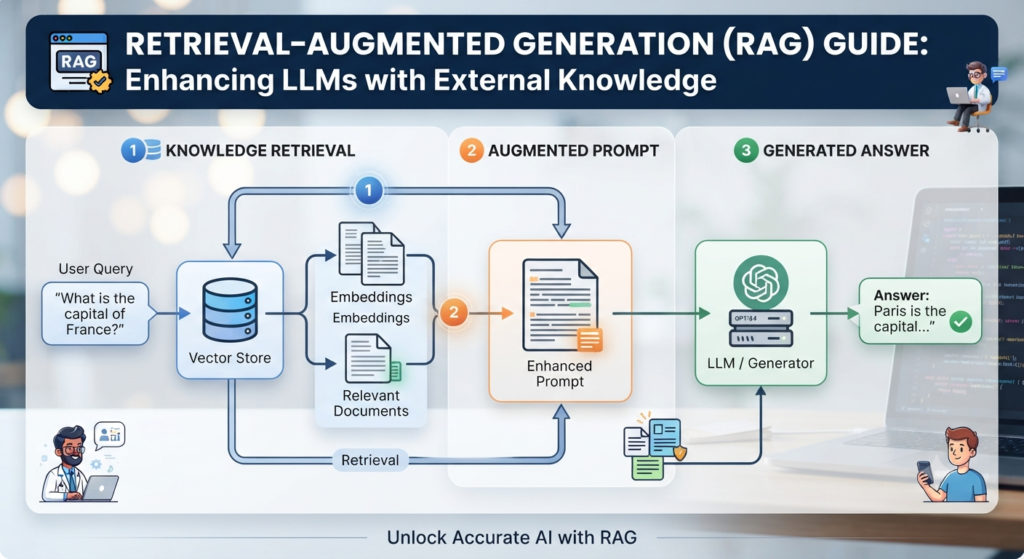
The RAG workflow generally involves several interconnected stages. When a user submits a question, the system searches an external knowledge repository for relevant information. The retrieved content is then combined with the original question and provided to a language model. The language model uses this information to generate a response.
Retrieval-Augmented Generation architecture
A simplified vector-based RAG workflow from user query to grounded response.
Step 1: Knowledge Collection
The first stage involves collecting relevant information from trusted sources.
These sources may include company documents, websites, product manuals, research papers, databases, PDFs, and internal knowledge repositories.
The quality of the collected information directly influences the reliability of the RAG system.
Organisations should ensure that their knowledge sources are accurate, relevant, regularly updated, and appropriately authorised.
Step 2: Document Processing and Chunking
Large documents are generally divided into smaller sections called chunks.
For example, a 100-page employee handbook may be divided into individual sections covering attendance, leave policies, employee benefits, and workplace regulations.
Chunking helps the retrieval system identify specific information without processing entire documents for every question.
The appropriate chunk size depends on document structure, model capabilities, and application requirements.
Step 3: Creating Vector Embeddings
An embedding model converts textual information into numerical representations known as vectors. These vectors represent semantic relationships between words, sentences, and concepts. For example, the phrases “annual leave policy” and “employee vacation rules” may have similar vector representations despite using different words.
This enables AI systems to retrieve information based on meaning rather than relying exclusively on exact keyword matches.
Step 4: Storing Information in a Vector Database
The generated embeddings are stored in a vector database or another searchable index.
Vector databases are designed to support efficient similarity searches across large collections of numerical representations.
Each stored vector is typically associated with its original text and relevant metadata, such as document title, publication date, department, or access permissions.
Step 5: Processing the User Query
When a user submits a question, the system processes the input and may convert it into a vector embedding.
The retrieval engine compares the query with indexed information to identify relevant content.
Some advanced systems also rewrite ambiguous queries, apply metadata filters, or combine semantic search with traditional keyword search.
Step 6: Retrieving Relevant Information
The retrieval engine selects relevant document chunks based on similarity scores and other ranking signals.
Advanced RAG systems may use reranking models to improve the quality of retrieved information.
Selecting appropriate source material is essential because irrelevant or inaccurate documents can negatively affect the generated response.
Step 7: Generating an Augmented Prompt
The retrieved information is combined with the original user question and relevant system instructions. This creates an augmented prompt containing additional factual context.
The language model may also receive instructions to answer only from the supplied documents, provide references, or acknowledge when sufficient information is unavailable.
Step 8: Generating the Final Response
The large language model processes the augmented prompt and generates a context-aware response. Depending on the implementation, the response may include source citations, document links, supporting evidence, or explanations.
The final answer should still be evaluated for accuracy because retrieval does not guarantee correct interpretation.
Key Components of RAG Architecture
A typical Retrieval-Augmented Generation system consists of several important components.
|
Component |
Function |
|
Knowledge repository |
Stores original information |
|
Document loader |
Extracts information from files and sources |
|
Text splitter |
Divides documents into manageable chunks |
|
Embedding model |
Converts text into numerical vectors |
|
Vector database |
Stores and searches embeddings |
|
Retriever |
Identifies relevant information |
|
Reranker |
Improves retrieval relevance |
|
Prompt builder |
Combines questions and retrieved context |
|
Large language model |
Generates responses |
|
Evaluation system |
Measures accuracy and performance |
Each component contributes to the effectiveness of the overall RAG pipeline.
A poorly configured retrieval system can reduce answer quality even when the underlying language model is highly capable.
Different Types of Retrieval-Augmented Generation
RAG systems can be implemented using different architectural approaches depending on application requirements.
1. Naive RAG
Naive RAG represents a basic retrieval and generation workflow.
The system retrieves relevant document chunks and directly provides them to a language model.
This approach is relatively straightforward to implement and may be suitable for simple knowledge-based applications.
However, it can struggle with complex queries, irrelevant documents, and inconsistent retrieval quality.
2. Advanced RAG
Advanced RAG incorporates additional techniques to improve retrieval and generation performance.
These techniques may include query rewriting, metadata filtering, document reranking, context compression, and improved chunking strategies.
Advanced RAG is useful for applications involving extensive knowledge repositories and complex information requirements.
3. Modular RAG
Modular RAG uses interchangeable components that can be independently configured and updated.
Developers can combine different embedding models, retrieval engines, databases, and language models.
This architecture provides greater flexibility and can support multiple business applications within a shared infrastructure.
4. Graph RAG
Graph RAG incorporates graph-based representations of information and relationships.
Instead of relying exclusively on document similarity, the system can explore connections between entities, concepts, organisations, and events.
This approach can be useful for complex research questions and information requiring relationships across multiple documents.
5. Agentic RAG
Agentic RAG incorporates AI agents that can make decisions about how information should be retrieved.
An agent may determine whether additional searches are necessary, select appropriate tools, refine questions, or retrieve information from multiple repositories.
Although this approach can improve flexibility, it also introduces additional complexity, computational costs, and security considerations.
6. Multimodal RAG
Multimodal RAG retrieves information from different data formats, including text, images, tables, audio, and video.
For example, a technical support assistant may retrieve information from product manuals, diagrams, and instructional videos.
Multimodal retrieval is particularly valuable in industries where important information is not exclusively stored as text.
RAG vs Traditional Large Language Models
Retrieval-Augmented Generation differs from standalone language models in several important ways.
|
Feature |
Traditional LLM |
RAG-Powered LLM |
|
Knowledge source |
Training data and supplied context |
Training data plus retrieved information |
|
Information updates |
May require additional training or tools |
Knowledge repository can be updated |
|
Domain-specific responses |
Depends on training and prompts |
Can retrieve specialised documents |
|
Hallucination risk |
Varies by model and task |
Can be reduced with reliable retrieval |
|
Source references |
Not inherently grounded |
Can reference retrieved documents |
|
Infrastructure |
Relatively straightforward |
Additional retrieval infrastructure |
|
Response latency |
Generally fewer processing stages |
Additional retrieval may increase latency |
|
Business customisation |
Prompting or model adaptation |
External business knowledge integration |
The choice between traditional language models and RAG depends on the intended application.
Creative writing and general brainstorming may not require retrieval, whereas enterprise knowledge management often benefits from access to verified internal information.
RAG vs Fine-Tuning: Which Is Better?
Fine-tuning and Retrieval-Augmented Generation are two different approaches to improving AI performance.
Fine-tuning involves additional training of an existing model using specialised datasets.
RAG provides relevant external information during response generation without necessarily modifying the model’s parameters.
|
Comparison |
RAG |
Fine-Tuning |
|
Primary objective |
Improve knowledge access |
Adapt model behaviour |
|
Model parameters |
Usually unchanged |
Updated during training |
|
Knowledge updates |
Update external documents |
May require additional training |
|
Source citations |
Easier to implement |
Not inherent |
|
Training requirement |
Usually not required for the LLM |
Required |
|
Implementation cost |
Depends on retrieval infrastructure |
Depends on training resources |
|
Best suited for |
Knowledge-based applications |
Specialised behaviour and tasks |
|
Flexibility |
High for changing information |
High for consistent task adaptation |
For example, a customer support chatbot that needs access to frequently updated product policies may benefit from RAG.
However, a model that needs to consistently follow a specialised communication style or output format may benefit from fine-tuning.
Organisations can also combine both approaches to achieve better application-specific performance.
Top 10 Benefits of Retrieval-Augmented Generation
1. Improved Factual Accuracy
RAG provides language models with relevant source material before generating responses.
This can improve factual accuracy compared with relying exclusively on learned information, particularly when retrieved documents are reliable.
2. Reduced AI Hallucinations
AI hallucinations occur when models generate inaccurate or unsupported information.
RAG can reduce hallucinations by grounding responses in retrieved knowledge.
However, it cannot completely eliminate them because retrieval and generation errors may still occur.
3. Access to Updated Information
Organisations can update external knowledge repositories without retraining the entire language model.
This makes RAG useful for applications involving frequently changing information, including product documentation, company policies, and educational announcements.
4. Better Domain-Specific Knowledge
RAG enables general-purpose language models to access specialised information.
Healthcare organisations, financial institutions, educational platforms, and technology companies can connect AI applications with relevant domain-specific repositories.
5. Greater Transparency
RAG applications can include references to retrieved documents.
This allows users to examine the original information and evaluate whether generated responses accurately represent the source material.
6. Flexible Knowledge Management
Different knowledge repositories can be connected to a shared AI application.
Organisations can maintain separate collections for human resources, customer support, technical documentation, and other departments.
7. Potential Cost Efficiency
Updating an external knowledge repository may be more economical than repeatedly retraining a large language model.
However, organisations must also consider embedding generation, database infrastructure, retrieval operations, and model inference costs.
8. Improved Customer Support
RAG-powered assistants can retrieve relevant product information, troubleshooting guides, and service policies.
This can help customer support teams provide more consistent and context-aware responses.
9. Enhanced Employee Productivity
Employees can use RAG applications to search extensive internal documentation through natural language questions.
This may reduce the time spent manually locating policies, procedures, and technical information.
10. Scalable AI Applications
RAG architecture can support growing knowledge repositories and multiple business applications.
With appropriate infrastructure and access controls, organisations can extend AI capabilities across different departments.
Real-World Applications of RAG in AI
Retrieval-Augmented Generation has practical applications across numerous industries.
RAG in Education
Educational platforms can use RAG to develop intelligent learning assistants that retrieve information from textbooks, study materials, examination guidelines, and academic resources.
For example, a student preparing for an entrance examination could ask questions about eligibility criteria or syllabus requirements.
A RAG-powered assistant could retrieve information from relevant official documents before generating an answer.
This approach can improve the reliability of educational information when the underlying documents are accurate and updated.
RAG in Healthcare
Healthcare organisations can use RAG to help qualified professionals search medical literature, clinical guidelines, and internal documentation.
Such systems can support information retrieval but should not replace professional medical judgement.
Strict privacy, security, and verification requirements are essential when handling sensitive healthcare information.
RAG in Banking and Finance
Financial institutions can integrate RAG with product documentation, regulatory guidelines, internal policies, and financial reports.
Employees may use these systems to locate relevant information about banking procedures or compliance requirements.
Financial decisions and regulated advice still require appropriate professional oversight.
RAG in E-Commerce
E-commerce platforms can use RAG to develop intelligent shopping assistants.
These assistants may retrieve product specifications, availability information, return policies, and customer support documentation.
Customers can receive more relevant responses based on the retailer’s actual product catalogue.
RAG in Software Development
Software developers can use RAG-powered coding assistants connected to technical documentation, source code repositories, and internal development guidelines.
This helps developers find relevant API documentation, understand existing code, and identify implementation requirements.
Generated code should still be tested before deployment.
RAG in Human Resource Management
HR departments can connect AI assistants with employee handbooks, company policies, benefits documentation, and onboarding materials.
Employees can ask questions about workplace procedures and receive answers based on approved company information.
Access controls are important to prevent unauthorised retrieval of confidential employee records.
RAG in Legal Research
Legal professionals can use RAG to retrieve relevant statutes, judgments, contracts, and regulatory documents.
The system can assist with preliminary research and document summarisation.
However, legal interpretations and citations must be independently verified by qualified professionals.
RAG in Digital Marketing and SEO
Digital marketing teams can connect AI systems with keyword research reports, website analytics, competitor research, content guidelines, and existing website content.
A RAG-powered content assistant can retrieve relevant information before suggesting article outlines or content updates.
This can improve consistency and reduce unsupported claims in AI-assisted content creation.
How RAG Can Improve SEO and Content Creation
Retrieval-Augmented Generation offers several opportunities for website owners, SEO professionals, and content marketing teams.
A RAG-powered content system can access existing website articles, editorial guidelines, keyword research documents, and verified industry information.
Before generating a new article, the system can retrieve related published content to identify overlapping topics and potential internal linking opportunities.
This approach can support several SEO activities:
|
SEO Activity |
Potential RAG Application |
|
Keyword research |
Retrieve verified keyword datasets |
|
Content planning |
Identify gaps in existing topic coverage |
|
Internal linking |
Find contextually relevant articles |
|
Content optimisation |
Retrieve existing editorial guidelines |
|
Content auditing |
Compare related website articles |
|
Content updates |
Identify information requiring revision |
|
Technical SEO |
Retrieve website audit documentation |
|
SEO reporting |
Summarise verified performance data |
For example, an educational website publishing articles about artificial intelligence could maintain a searchable repository of all existing AI articles.
Before developing new content, the system could retrieve related articles and identify potential keyword cannibalisation.
However, RAG does not directly guarantee higher search engine rankings. Content quality, originality, technical accessibility, relevance, and user satisfaction remain important considerations.
Popular Tools and Technologies for Building RAG Systems
Developers can choose from various frameworks, databases, and AI models when building RAG applications.
|
Tool |
Primary Function |
|
LangChain |
AI application development and orchestration |
|
LlamaIndex |
Data indexing and knowledge retrieval |
|
Haystack |
Search and RAG pipelines |
|
Pinecone |
Managed vector database |
|
Weaviate |
Vector search and database |
|
Qdrant |
Vector similarity search |
|
Chroma |
Embedding storage and retrieval |
|
FAISS |
Efficient vector similarity search |
|
Hugging Face |
AI models and development libraries |
|
Elasticsearch |
Keyword, vector and hybrid search |
The appropriate technology depends on application scale, budget, privacy requirements, technical expertise, and infrastructure preferences.
How to Build a Retrieval-Augmented Generation System
Building a RAG application requires careful planning and implementation.
Step 1: Define the Application Objective
Identify the specific problem the AI system should solve.
For example, the objective may be to develop a customer support chatbot, an educational assistant, or an internal document search application.
Clear objectives help determine appropriate knowledge sources and performance requirements.
Step 2: Collect and Prepare Data
Gather relevant documents and remove outdated, duplicated, or unreliable information.
Convert documents into suitable formats and preserve useful metadata.
Step 3: Select an Embedding Model
Choose an embedding model that performs effectively for the intended language, industry, and document types.
The embedding model should be evaluated using representative search queries.
Step 4: Configure a Searchable Knowledge Repository
Select an appropriate vector database or search platform.
Configure indexing, metadata filters, access permissions, and document update procedures.
Step 5: Develop the Retrieval Pipeline
Implement the process that retrieves relevant information for each user query.
Experiment with chunk sizes, similarity search, hybrid retrieval, and reranking to improve performance.
Step 6: Integrate a Large Language Model
Connect the retrieval pipeline with a suitable language model.
Create prompts that clearly instruct the model to use retrieved information and avoid unsupported claims.
Step 7: Evaluate the System
Test the application using representative questions.
Measure retrieval relevance, response accuracy, citation quality, response time, and operational costs.
Step 8: Deploy and Monitor
Deploy the application within an appropriate infrastructure environment.
Continuously monitor performance, update knowledge sources, review user feedback, and address security vulnerabilities.
Challenges and Limitations of RAG
Despite its advantages, Retrieval-Augmented Generation introduces several technical and operational challenges.
|
Challenge |
Description |
Possible Solution |
|
Poor retrieval quality |
Irrelevant information is retrieved |
Improve search and reranking |
|
Incorrect source data |
Retrieved documents contain errors |
Validate knowledge sources |
|
Increased latency |
Retrieval adds processing time |
Optimise indexing and caching |
|
Infrastructure costs |
Databases and models require resources |
Monitor and optimise usage |
|
Context limitations |
Too much retrieved information |
Apply context compression |
|
Data privacy |
Sensitive information may be exposed |
Implement access controls |
|
Prompt injection |
Malicious instructions appear in retrieved content |
Treat retrieved content as untrusted data |
|
Knowledge maintenance |
Documents become outdated |
Establish update procedures |
|
Evaluation complexity |
Accuracy depends on multiple components |
Use structured evaluation frameworks |
Organisations should evaluate these challenges before implementing RAG in production environments.
How to Evaluate RAG Performance
Evaluating a RAG system requires more than checking whether generated answers sound convincing.
Developers should evaluate both the retrieval process and the generation process.
Important performance metrics include:
|
Evaluation Metric |
What It Measures |
|
Recall@K |
Whether relevant information appears among retrieved results |
|
Precision@K |
Proportion of retrieved results that are relevant |
|
Context relevance |
How closely retrieved information matches the question |
|
Faithfulness |
Whether generated claims are supported by retrieved information |
|
Answer correctness |
Whether the final answer is factually correct |
|
Citation accuracy |
Whether references support the associated claims |
|
Response latency |
Time required to generate a response |
|
Cost per query |
Operational expense associated with each request |
Human evaluation remains valuable, especially for specialised applications where automated metrics may not capture important contextual details.
Best Practices for Implementing RAG
Successful RAG implementation requires a combination of reliable information, effective retrieval, secure infrastructure, and continuous monitoring.
Organisations should prioritise the following practices:
- Use authoritative and regularly updated knowledge sources.
- Select document chunking strategies based on content structure.
- Combine semantic and keyword search where appropriate.
- Implement metadata filtering and document reranking.
- Provide source references whenever possible.
- Encourage models to acknowledge insufficient information.
- Apply appropriate access controls and data protection measures.
- Monitor retrieval quality and response accuracy.
- Establish document update and deletion procedures.
- Include human oversight for high-risk applications.
These practices can help improve the reliability and long-term effectiveness of RAG-powered applications.
The Future of Retrieval-Augmented Generation
Retrieval-Augmented Generation is expected to remain an important component of enterprise artificial intelligence and knowledge-based applications.
Future developments may focus on more intelligent retrieval mechanisms, multimodal information processing, graph-based reasoning, automated evaluation, and agent-driven research workflows.
Smaller language models combined with efficient retrieval systems may also create opportunities for cost-effective AI applications.
As organisations increasingly adopt artificial intelligence, connecting language models with reliable and specialised information will remain a valuable approach.
However, successful adoption will depend on more than model capabilities. Data governance, security, evaluation, infrastructure efficiency, and responsible implementation will continue to play important roles.
”FAQs”
1. What does RAG stand for in AI?
RAG stands for Retrieval-Augmented Generation. It is an AI framework that combines external information retrieval with language model generation.
2. What is the main purpose of RAG?
The main purpose of RAG is to improve the relevance, factual grounding, and contextual accuracy of AI-generated responses by providing relevant external information.
3. Is RAG a machine learning model?
RAG is generally an architectural approach rather than a single machine learning model. It combines retrieval components, knowledge repositories, and generative AI models.
4. Does RAG require model training?
RAG does not necessarily require additional training of the underlying language model. However, some implementations may train or fine-tune retrieval components.
5. What is a vector database in RAG?
A vector database stores numerical representations of information and enables similarity searches to identify relevant content for user queries.
6. Is RAG better than fine-tuning?
RAG is often more suitable for accessing frequently changing knowledge, while fine-tuning is useful for adapting model behaviour. The appropriate approach depends on application requirements.
7. Can RAG eliminate AI hallucinations?
No. RAG can reduce hallucinations by providing supporting information, but inaccurate retrieval and incorrect interpretation may still produce unreliable responses.
8. Can RAG work without a vector database?
Yes. RAG can use traditional keyword search, relational databases, graph databases, APIs, and other information retrieval mechanisms.
9. Can RAG improve SEO?
RAG can support SEO activities such as content research, internal linking, content auditing, and factual verification. However, it does not directly guarantee improved search engine rankings.
10. Is RAG suitable for small businesses?
Yes. Small businesses can use RAG to develop customer support assistants, product information systems, and internal knowledge management applications.


