AI-Powered Career Development: Skills Professionals Need to Stay Competitive
Artificial intelligence is changing the way people work. It is influencing how businesses hire employees, manage teams, solve problems, and deliver services. From marketing and finance to healthcare and education, AI is becoming part of everyday professional life.
This change is creating new career opportunities. However, it is also changing the skills employers expect from their teams. Professionals who depend only on traditional skills may find it harder to keep up with new workplace demands.
This is where AI-powered career development becomes important. It helps professionals understand changing job requirements, identify skill gaps, and prepare for future opportunities. It also encourages people to combine technical knowledge with human abilities such as creativity, communication, and critical thinking.
AI doesn’t mean that every professional needs to become a programmer or data scientist. Instead, people need to understand how AI works, where it can help, and how to use it responsibly in their own fields.
According to the World Economic Forum’s Future of Jobs Report 2025, 39% of workers’ existing skill sets are expected to change or become outdated between 2025 and 2030. The report also identifies AI and big data, technological literacy, creative thinking, and lifelong learning among the skills growing in importance.
These changes show why professional development must become a continuous process.
Whether you’re a fresh graduate, an experienced employee, or a business leader, developing future-ready skills can help you remain valuable in a changing workplace.
Let’s explore the essential skills, learning strategies, and career development opportunities that can help professionals succeed in the age of artificial intelligence.
Know More: AI Google Ads Copy: How to Use AI to Write High-Converting in 2026
1. AI-Powered Career Development Skills: Understanding
AI-powered career development is the process of using artificial intelligence, digital tools, and personalized learning methods to improve professional skills and career opportunities.
Traditional career development often follows a fixed path. Employees attend training sessions, complete courses, gain experience, and wait for promotion opportunities.
However, modern careers are changing faster. New technologies are creating new job roles, while some existing responsibilities are becoming automated.
AI can make career planning more flexible and personal.
For example, AI-based career tools can help professionals:
- Identify skills required for their target jobs.
- Compare their current abilities with industry requirements.
- Find suitable online courses.
- Improve resumes and professional profiles.
- Prepare for job interviews.
- Explore new career opportunities.
- Track learning progress.
Why Is AI Career Growth Important?
AI career growth is important because technology is changing the way organizations operate.
Businesses now use AI to analyze information, automate routine work, support customer service, and improve decision-making. Employees who understand these tools can often complete tasks more efficiently.
Consider a marketing professional.
In the past, they might have spent several hours researching keywords, analyzing competitors, and preparing reports. Today, AI tools can assist with research, data analysis, and content planning.
The professional still needs to understand the audience, check the information, develop a strategy, and make decisions.
The difference is that AI can reduce repetitive work and create more time for important activities.
Key Benefits of Career Development With AI
|
Benefit |
How It Helps Professionals |
|
Personalized learning |
Finds learning resources based on skill gaps |
|
Better career planning |
Helps identify suitable career paths |
|
Faster research |
Supports information gathering and analysis |
|
Improved productivity |
Reduces repetitive tasks |
|
Interview preparation |
Provides practice questions and feedback |
|
Skill assessment |
Helps identify areas for improvement |
|
Career flexibility |
Supports transitions into new roles |
AI-powered career development isn’t limited to technical professionals. Teachers, accountants, designers, managers, marketers, and customer service employees can also benefit.
The main goal is simple: learn how to use technology to improve your work while developing skills that machines cannot easily replace.
2. How AI Is Changing Career Development Opportunities
Artificial intelligence is changing career development in several ways. It is influencing job requirements, employee training, recruitment, and workplace performance.
Understanding these changes can help professionals make better career decisions.
2.1 Personalized Professional Learning
Traditional training programs often provide the same learning material to every employee.
However, people have different strengths, weaknesses, and career goals.
AI-powered learning platforms can recommend courses based on an individual’s knowledge, progress, and learning needs.
For example, a project manager who wants to move into a technology leadership role may need to improve their understanding of data analytics, automation, and AI project management.
An AI learning platform can suggest relevant courses and practice activities.
This makes professional skill development more focused.
2.2 New Career Opportunities
AI is creating demand for new skills and specialized job roles.
Some growing areas include:
- AI and machine learning.
- Data analytics.
- Cybersecurity.
- AI product management.
- Automation consulting.
- AI governance.
- Digital transformation.
- Cloud computing.
At the same time, traditional professions are also changing.
For example, finance professionals may need stronger data analysis skills. Human resource professionals may need to understand AI recruitment tools. Marketing professionals may need experience with AI-based research and automation.
This means career growth isn’t limited to entering a completely new industry. Professionals can also improve their existing roles by developing relevant digital skills.
2.3 Smarter Recruitment and Career Planning
Many organizations use digital recruitment systems to manage applications and identify suitable candidates.
AI can help recruiters organize resumes, compare qualifications, and support candidate assessments.
Professionals can use AI tools to improve their job applications by identifying missing skills, preparing role-specific resumes, and practicing interview questions.
However, AI-generated recommendations aren’t always correct. Candidates should review their applications and make sure their experience and qualifications are presented honestly.
2.4 Improved Workplace Productivity
AI tools can support everyday tasks such as:
- Preparing meeting summaries.
- Organizing documents.
- Analyzing spreadsheets.
- Drafting reports.
- Researching industry trends.
- Creating presentations.
- Managing routine communication.
When employees use these tools properly, they can spend more time on problem solving, planning, and collaboration.
2.5 Continuous Skill Development
In the past, many professionals considered education complete after earning a degree or professional qualification.
Today, lifelong learning is becoming essential.
AI and digital transformation are changing business requirements. Professionals must regularly review their skills and learn new methods.
The World Economic Forum’s Future of Jobs Report 2025 provides useful insights into changing job requirements and the skills employers expect to become more important.
The message is clear: career development should continue throughout a person’s working life.
3. 11 Essential Skills Professionals Need to Stay Competitive in the AI Era
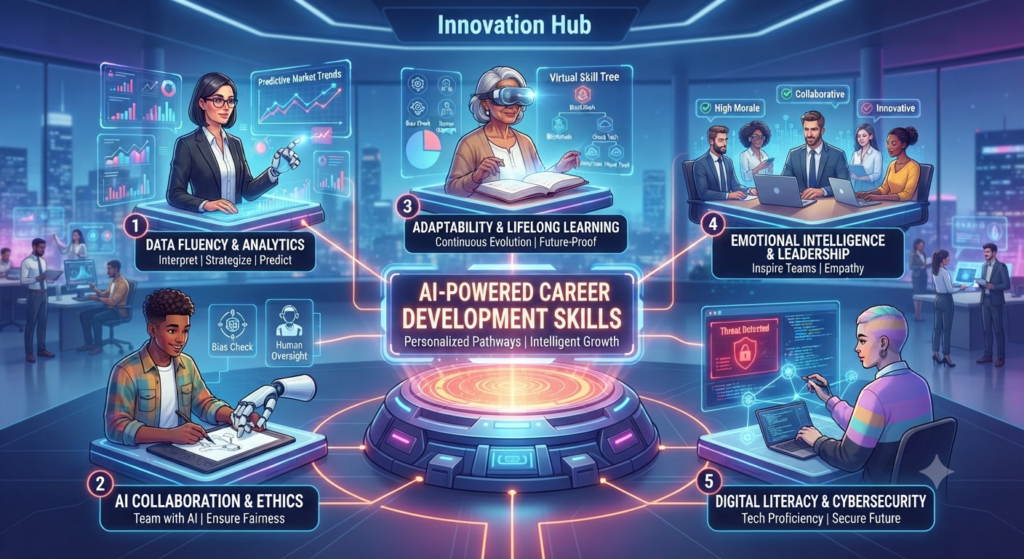
The best skills professionals need to stay competitive in the AI era include a mix of technical knowledge, analytical abilities, and human strengths.
Learning to use AI is important, but it isn’t enough. Professionals must also know how to evaluate information, communicate clearly, solve problems, and make responsible decisions.
Here are 11 important skills to develop.
3.1 AI Literacy and Tool Management
AI literacy means understanding the basic functions, benefits, and limitations of artificial intelligence.
Professionals should know how to use AI tools for tasks related to their jobs.
For example:
- Marketers can use AI for research and campaign planning.
- Accountants can use AI-assisted tools to organize financial information.
- HR professionals can use AI to support workforce planning.
- Designers can use AI for creative exploration.
- Managers can use AI to summarize information and prepare reports.
You don’t need advanced technical knowledge to start.
Begin by learning how AI tools work, what information they need, and how to check their output.
The goal is to use AI as a work assistant rather than depend on it for every decision.
3.2 Data Literacy and Analysis
Data literacy is the ability to understand, interpret, and use information.
Businesses collect large amounts of data from customers, employees, websites, and business operations.
AI can process this information, but professionals must understand what the results mean.
For example, a marketing employee may use analytics tools to study website traffic. They should know how to identify important trends, understand user behavior, and recommend improvements.
Important data skills include:
- Reading charts and reports.
- Understanding basic statistics.
- Identifying patterns.
- Comparing performance.
- Checking data quality.
- Drawing logical conclusions.
Learning spreadsheet tools and basic data visualization can be a good starting point.
3.3 Critical Thinking
Critical thinking means examining information before accepting it as correct.
AI tools can generate answers quickly. However, their responses may contain errors, outdated information, or incomplete explanations.
Professionals should ask questions such as:
- Is this information accurate?
- Does the result make sense?
- What evidence supports this conclusion?
- Are there other possible explanations?
- What could happen if this recommendation is followed?
Critical thinking is especially important in finance, healthcare, management, research, and business planning.
AI can provide suggestions, but human judgment remains essential.
3.4 Problem-Solving Skills
Problem-solving is the ability to understand an issue, identify its cause, and find a suitable solution.
AI can help professionals examine information and explore possible solutions. However, real workplace problems often involve people, budgets, deadlines, and business priorities.
For example, if a company experiences a drop in customer satisfaction, an AI tool may help analyze feedback.
But employees must understand the actual reasons behind the problem and decide which changes will improve the customer experience.
Strong problem-solving skills help professionals turn information into useful action.
3.5 Adaptability and Flexibility
Technology changes quickly. Tools that are popular today may become less important in the future.
Adaptability means being willing to learn new systems, change working methods, and accept new responsibilities.
Professionals who resist every workplace change may struggle to grow.
You can improve adaptability by:
- Trying new digital tools.
- Learning from workplace feedback.
- Taking part in new projects.
- Exploring different responsibilities.
- Staying informed about industry changes.
Adaptability is not about following every new trend. It is about understanding which changes matter and responding effectively.
3.6 Emotional Intelligence
Emotional intelligence is the ability to understand and manage your own emotions while recognizing the feelings of others.
AI can analyze language and identify patterns in communication, but human relationships require empathy and understanding.
Professionals with strong emotional intelligence can:
- Manage workplace conflicts.
- Build positive relationships.
- Listen to colleagues.
- Handle difficult conversations.
- Support team members.
- Respond calmly under pressure.
These abilities are important for managers, team leaders, customer service professionals, and employees who work with clients.
3.7 Communication and Collaboration
Good communication helps people share ideas, explain problems, and work toward common goals.
AI can help prepare emails, reports, and presentations. However, professionals still need to understand their audience and communicate with clarity.
Modern workplaces often include remote teams, international clients, and employees from different professional backgrounds.
This makes collaboration even more important.
Focus on improving:
- Written communication.
- Verbal communication.
- Active listening.
- Presentation skills.
- Team coordination.
- Professional feedback.
Clear communication helps turn technical knowledge into meaningful business results.
3.8 Creativity and Innovation
Creativity is the ability to develop new ideas and find different ways to solve problems.
AI tools can generate suggestions, images, designs, and written content. However, professionals need to decide which ideas are useful and how to apply them.
For example, a business owner may use AI to explore marketing ideas. They must still understand customer needs, brand identity, and market conditions.
Creative thinking is valuable in product development, advertising, design, education, and business strategy.
3.9 Digital and Technical Skills
Digital skills are becoming important across almost every profession.
Employees don’t need to master every technology. Instead, they should understand the digital tools used in their industry.
Useful skills may include:
- Cloud-based software.
- Digital collaboration platforms.
- Cybersecurity awareness.
- Automation tools.
- Basic programming.
- Digital analytics.
- AI-powered applications.
For technical professionals, deeper knowledge of programming, cloud computing, machine learning, and cybersecurity can create additional opportunities.
For non-technical professionals, understanding digital workflows and automation may be more relevant.
3.10 Leadership and Decision-Making
Leadership is not limited to people with managerial titles.
Professionals demonstrate leadership when they take responsibility, guide colleagues, solve problems, and make informed decisions.
AI can provide reports and recommendations, but leaders must consider business goals, employee needs, and potential risks.
Strong leadership skills include:
- Strategic thinking.
- Decision-making.
- Team management.
- Conflict resolution.
- Accountability.
- Clear communication.
As workplaces adopt more AI tools, leaders must also help employees understand changes and use technology responsibly.
3.11 Lifelong Learning and Self-Management
Lifelong learning means continuously improving your knowledge and abilities.
In an AI-driven workplace, learning shouldn’t happen only when an employer introduces a new training program.
Professionals should take responsibility for their own development.
Useful learning activities include:
- Completing online courses.
- Reading industry reports.
- Attending webinars.
- Practicing new tools.
- Participating in professional communities.
- Working on personal projects.
- Learning from experienced colleagues.
Self-management is equally important. Set clear learning goals, manage your time, and track your progress.
A consistent learning routine can create better results than studying many topics without a clear direction.
4. AI Skills and Human Skills: Finding the Right Balance
One of the biggest mistakes professionals can make is focusing only on technical skills.
AI knowledge is valuable, but professional success also depends on human abilities.
Technology can help employees complete tasks faster. Human skills help them understand why those tasks matter.
Consider a simple example.
An AI tool can prepare a customer service response. However, an employee must decide whether the response is appropriate, respectful, and suitable for the customer’s situation.
Both capabilities are important.
Technical Skills vs Human Skills
|
Technical Skills |
Human Skills |
|
AI tool usage |
Critical thinking |
|
Data analysis |
Decision-making |
|
Automation |
Problem-solving |
|
Programming |
Creativity |
|
Cybersecurity |
Ethical judgment |
|
Digital literacy |
Communication |
|
Machine learning knowledge |
Emotional intelligence |
The World Economic Forum’s 2025 research highlights this balance. Analytical thinking was identified as a core skill by 69% of surveyed employers. Resilience, flexibility, and agility were identified by 67%, while leadership and social influence were identified by 61%.
These findings suggest that employers value both technological knowledge and human capabilities.
Why Human Judgment Still Matters
AI systems work with data, instructions, and patterns. They don’t automatically understand every workplace situation.Huma n professionals bring experience, context, empathy, and responsibility. For this reason, professionals should focus on three areas:
- Learn how to use AI tools.
- Develop strong human and analytical abilities.
- Apply both skills to real workplace challenges.
This combination can help employees become more effective and valuable members of their organizations.
5. AI-Driven Career Growth Strategies for Professionals
Learning new skills is only one part of career development. Professionals must also know how to apply those skills to achieve meaningful career progress.
Here are practical career advancement strategies for the age of artificial intelligence.
5.1 Identify Your Career Goals
Start by understanding where you want your career to go.
Do you want a promotion? Are you planning to move into another department? Do you want to become a specialist or a team leader?
Clear goals make learning more focused.
Instead of trying to learn every available AI tool, select skills that support your professional direction.
5.2 Perform a Personal Skill Assessment
Review your current abilities and compare them with the requirements of your target role.
For example, someone planning to become a digital marketing manager may need:
- Marketing strategy.
- Data analytics.
- AI-assisted research.
- Team communication.
- Project management.
- Budget planning.
Create a list of skills you already have and those you need to improve.
This will help you identify your learning priorities.
5.3 Use AI Tools to Improve Productivity
Explore tools that support your daily responsibilities.
Start with simple activities such as preparing summaries, organizing information, or analyzing basic data.
As your confidence improves, explore more advanced applications.
Always verify important information before using AI-generated results in professional work.
5.4 Build a Strong Professional Portfolio
A professional portfolio provides evidence of your abilities.
Certificates can show that you completed training, but practical work demonstrates how you apply knowledge.
You can include:
- Completed projects.
- Data analysis reports.
- Research documents.
- Design samples.
- Automation workflows.
- Case studies.
- Professional presentations.
A portfolio can help employers understand your strengths beyond your resume.
5.5 Develop Industry Knowledge
AI tools cannot replace the value of understanding your industry.
A finance professional should understand financial regulations. A marketer should understand customer behavior. A healthcare worker should understand patient care.
Combine AI knowledge with industry experience.
This makes your skills more useful and relevant.
5.6 Build Professional Relationships
Networking can help you discover job opportunities, learn from experienced professionals, and understand industry expectations.
Connect with people in your field through professional communities, events, webinars, and online platforms.
Share useful knowledge and participate in discussions.
Strong professional relationships can support long-term career growth.
6. Upskilling and Reskilling for the Future Workplace
Upskilling and reskilling are important parts of modern career development.
Although these terms are related, they have different meanings.
Upskilling means improving skills for your current job or career path.
Reskilling means learning new skills to move into a different role or professional area.
Both approaches help professionals respond to changing workplace demands.
When Should Professionals Upskill?
Upskilling is useful when:
- Your industry introduces new technologies.
- Your current role requires additional digital knowledge.
- You want to qualify for a promotion.
- Your organization adopts AI-based systems.
- You want to improve workplace performance.
For example, a content writer may learn AI-assisted research, search engine optimization, and content analytics to improve their existing role.
When Should Professionals Reskill?
Reskilling may be necessary when:
- Your current role is changing significantly.
- You want to enter a new industry.
- Your existing skills are becoming less relevant.
- You want to explore a different career direction.
For example, an administrative professional interested in data analytics may learn spreadsheets, statistics, visualization, and basic SQL.
Practical Ways to Learn New Skills
|
Learning Method |
Main Advantage |
|
Online courses |
Flexible learning |
|
Professional certifications |
Structured knowledge |
|
Workplace training |
Practical job-related experience |
|
Mentorship |
Guidance from experienced professionals |
|
Personal projects |
Real-world practice |
|
Webinars |
Exposure to new industry trends |
|
Professional communities |
Networking and knowledge sharing |
The best learning method depends on your goals, available time, and current knowledge.
You don’t need to spend hours studying every day. Even 30 minutes of focused learning can help you make steady progress.
7. Building an AI-Powered Career Growth Roadmap
A career growth roadmap turns professional goals into clear actions.
Without a plan, people often collect certificates and try different tools without knowing whether those activities support their career.
The following roadmap provides a simple approach.
Step 1: Understand Your Current Position
Review your education, work experience, technical knowledge, and professional strengths.
Identify the responsibilities you perform well and the areas where you need improvement.
Ask yourself:
- Which tasks do I perform confidently?
- Which digital tools do I understand?
- What feedback have I received?
- Which skills are important in my industry?
- What type of role do I want next?
Step 2: Research Future Workplace Skills
Study job descriptions, industry reports, and professional requirements.
Look for skills that appear regularly in your target roles.
Pay attention to AI literacy, data analysis, adaptability, communication, and problem-solving.
Don’t follow trends blindly. Focus on skills that match your career direction.
Step 3: Select Three Priority Skills
Choose three skills to develop first.
For example:
- AI tool management.
- Data literacy.
- Communication.
Learning a small number of skills at a time makes progress easier to manage.
Step 4: Choose Suitable Learning Resources
Find courses, tutorials, books, and practical learning materials.
Use AI tools to explain difficult topics, create practice questions, and organize your study schedule.
However, rely on trusted learning resources for important technical and professional knowledge.
Step 5: Apply Your Knowledge
Practice is essential.
Create a project, improve a workplace process, or use a new tool to complete a real task.
For example, a marketing professional could prepare a keyword research report using AI-assisted research and analytics tools.
This creates practical evidence of learning.
Step 6: Measure Your Progress
Review your progress every month.
Track:
- Courses completed.
- Skills developed.
- Projects finished.
- Tools learned.
- Feedback received.
- New responsibilities achieved.
Adjust your plan when your career goals or industry requirements change.
A Simple 90-Day Career Development Plan
|
Timeline |
Main Focus |
Expected Outcome |
|
Days 1–15 |
Assess skills and career goals |
Clear development priorities |
|
Days 16–30 |
Learn AI and digital basics |
Better technology awareness |
|
Days 31–45 |
Improve analytical and communication skills |
Stronger professional abilities |
|
Days 46–60 |
Complete practical projects |
Work samples and experience |
|
Days 61–75 |
Build a portfolio and update resume |
Improved professional profile |
|
Days 76–90 |
Seek feedback and explore opportunities |
Clear next career steps |
This roadmap is flexible. You can adjust it based on your experience, industry, and available time. The important thing is to keep learning and apply new knowledge to real situations.
8. Challenges in AI-Powered Career Development and How to Overcome Them
Although AI creates many learning and career opportunities, professionals may face several challenges.
Understanding these barriers can help you prepare better.
8.1 Fear of Job Replacement
Many employees worry that AI will replace their jobs.
This concern is understandable because some repetitive tasks can be automated.
However, automation can also change job responsibilities and create demand for new skills.
How to overcome it:
Learn which tasks in your profession are likely to change. Develop skills that support more complex work, such as problem-solving, communication, decision-making, and AI management.
8.2 Lack of Technical Knowledge
Some professionals feel that AI is too complicated.
They may believe that learning AI requires programming or advanced mathematics.
However, many AI tools are designed for everyday users.
How to overcome it:
Start with basic applications. Learn how to write clear instructions, review AI responses, and use relevant digital tools.
Build your knowledge gradually.
8.3 Information Overload
There are thousands of online courses, tutorials, and AI applications.
Trying to learn everything can create confusion.
How to overcome it:
Select learning resources based on your career goals. Focus on a few important skills instead of following every new trend.
8.4 Privacy and Accuracy Concerns
AI tools can produce incorrect information or expose sensitive data if used carelessly.
Professionals must understand workplace policies and data protection requirements.
How to overcome it:
- Avoid entering confidential company information into unapproved tools.
- Verify important AI-generated information.
- Check sources before sharing research.
- Follow organizational data policies.
- Use human review for important decisions.
8.5 Lack of Time for Learning
Working professionals often have limited time because of daily responsibilities.
How to overcome it:
Create a realistic learning schedule. Set aside a short period each day or dedicate a few hours each week.
Consistency matters more than the number of hours spent studying.
9. The Future of AI in Professional Development
AI will continue to influence how people learn, work, and develop their careers.
Future professional development may become more personalized, flexible, and closely connected to workplace needs.
Several trends are worth watching.
9.1 Personalized AI Learning Assistants
AI learning assistants may help professionals identify knowledge gaps, recommend courses, and provide practice exercises.
They can also explain complex subjects in simpler language.
This could make learning more accessible to people with different levels of experience.
9.2 AI-Based Skill Assessment
Organizations may increasingly use digital assessments to understand employee capabilities.
These assessments can help identify training needs and support workforce planning.
However, skill assessments should be fair, transparent, and reviewed by people.
9.3 Growth of Hybrid Job Roles
Many future roles may combine traditional industry knowledge with AI and digital skills.
For example:
- AI-powered marketing specialists.
- Data-driven HR professionals.
- Digital finance analysts.
- AI-assisted healthcare administrators.
- Technology-focused project managers.
These roles show why combining professional experience with technology knowledge is important.
9.4 Greater Importance of Human Skills
As AI takes on more routine tasks, human capabilities may become even more valuable.
Creativity, leadership, empathy, communication, and ethical judgment will remain important in workplaces where people must make complex decisions.
9.5 Continuous Learning as a Career Requirement
Professional learning will become an ongoing responsibility.
Employees who regularly update their skills may find it easier to adapt to new roles and technologies.
Organizations will also need to support learning through training, mentorship, and practical experience.
The future of work isn’t simply about knowing how to use AI. It’s about understanding how technology and human abilities can work together to create better results.
Build a Future-Ready Career With AI and Human Skills
Artificial intelligence is changing professional development and creating new expectations across industries. Professionals must understand these changes and prepare for the skills required in modern workplaces.
AI-powered career development provides a practical way to identify skill gaps, explore learning opportunities, improve productivity, and plan long-term career growth.
However, technical knowledge alone isn’t enough.
Professionals also need critical thinking, adaptability, communication, creativity, emotional intelligence, and leadership skills. These abilities help people use technology effectively and make better decisions.
The best approach is to combine AI knowledge with industry experience and continuous learning.
Start by identifying your career goals. Choose relevant skills, practice with suitable tools, and apply what you learn to real projects.
You don’t need to master every new technology at once. Small, consistent improvements can make a meaningful difference over time.
The future belongs to professionals who are willing to learn, adapt, and grow. By developing the right combination of digital and human skills, you can build a stronger career and remain competitive in an AI-driven workplace.
”FAQs”
1: What skills are needed in the age of AI?
Professionals need a combination of technical and human skills. Important abilities include AI literacy, data literacy, critical thinking, problem-solving, adaptability, communication, emotional intelligence, creativity, and lifelong learning.
2: How is AI changing career development?
AI is making career development more personalized and technology-focused. It can help professionals identify skill gaps, find relevant courses, prepare for interviews, improve productivity, and explore new career opportunities
3: What are the top AI-related skills professionals need?
Some important AI-related skills include:
1. Understanding AI tools.
2. Writing effective AI prompts.
3. Data analysis.
4. Automation awareness.
5. Digital literacy.
6. Cybersecurity awareness.
7. Evaluating AI-generated information.
8. Responsible AI usage.
4: Do professionals need coding skills to work with AI?
No. Not every professional needs programming knowledge. Many AI applications can be used without coding. However, basic programming can be useful for technical roles and professionals who want to work with automation, data science, or machine learning.
5: How can AI help with professional growth?
AI can support professional growth by recommending learning resources, explaining difficult topics, identifying skill gaps, preparing interview questions, and helping professionals organize their work.
6: What are the best future-proof career skills?
No skill can guarantee permanent career security. However, several abilities are likely to remain valuable. These include critical thinking, adaptability, communication, creativity, leadership, AI literacy, data analysis, problem-solving, and lifelong learning
7: What is the difference between upskilling and reskilling?
Upskilling means improving your existing skills to perform better in your current role or advance within your field. Reskilling means learning new skills to move into a different role or career area. Both approaches help professionals adapt to changing job requirements.
8: How can I create an AI-powered career growth roadmap?
Start by identifying your career goals and assessing your current skills. Next, research the requirements of your target role, select important skills, and choose suitable learning resources. Practice through real projects, build a professional portfolio, and review your progress regularly. A structured 90-day plan can help you get started.


