
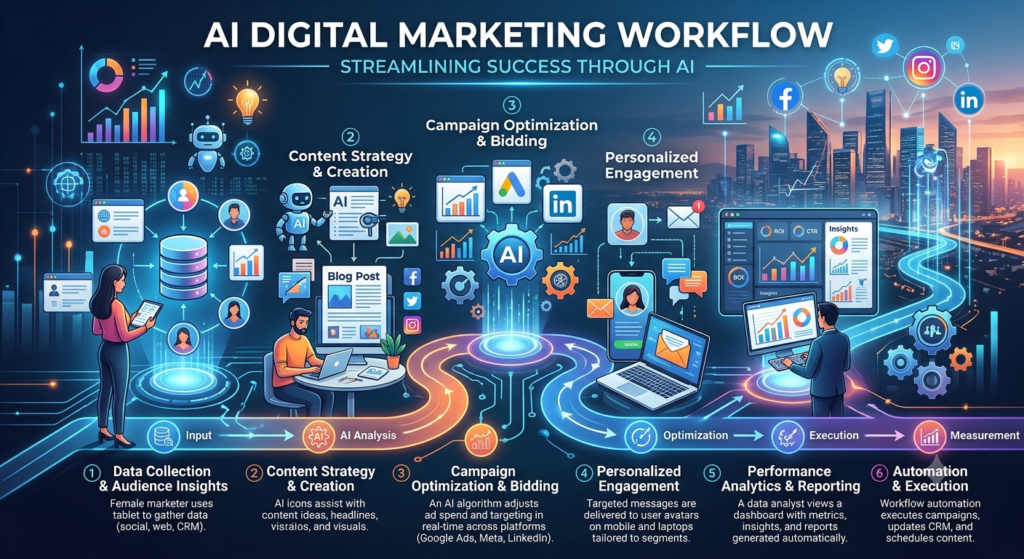
How to Build an AI-Powered Digital Marketing Workflow from Research to Reporting
Digital marketing has changed rapidly in recent years. Businesses no longer depend only on manual research, content creation, and campaign tracking. Artificial intelligence now helps marketing teams complete these tasks faster and make better decisions.
However, using different AI tools doesn’t automatically create an effective marketing system. Businesses need a clear process that connects research, planning, content creation, campaign execution, analytics, and reporting.
This is where an AI digital marketing workflow becomes important.
An AI-powered marketing system connects different marketing activities into one organized process. It helps teams collect data, understand customers, create useful content, manage campaigns, and measure results. Instead of handling every task manually, marketers can use automation to reduce repetitive work and focus on strategy.
For example, a marketing team can use AI to research competitors, find keyword opportunities, prepare content calendars, create campaign drafts, analyze website traffic, and generate performance reports.
The goal isn’t to replace marketers. It’s to help them work smarter.
In this guide, we’ll explain how to build an AI-powered digital marketing workflow from research to reporting. You’ll also learn about useful AI tools, automation methods, important performance metrics, and practical ways to build a scalable marketing system.
Know More: AI Image Generators: How Effectively They Work and How Effectively to Use Them in 2026
What Is an AI Digital Marketing Workflow?
An AI digital marketing workflow is a structured process that uses artificial intelligence and automation to manage different marketing activities.
It connects several tasks, including:
- Market and competitor research
- Audience analysis
- Keyword research
- Marketing strategy development
- Content planning and creation
- SEO optimization
- Social media management
- Paid advertising
- Email marketing
- Marketing analytics
- Automated reporting
Traditional marketing often requires separate tools and manual work for each activity. An AI-powered marketing workflow connects these activities and reduces unnecessary steps.
For example, consider a business that wants to increase organic website traffic.
Its marketing team can follow this process:
- Use AI tools to identify customer interests and search trends.
- Research competitors and find keyword opportunities.
- Create a content strategy based on search intent.
- Generate content briefs and initial drafts.
- Review and publish high-quality content.
- Track organic traffic and keyword performance.
- Generate reports and identify improvement opportunities.
Each stage provides useful information for the next stage.
This creates an end-to-end AI marketing process instead of a collection of unrelated activities.
How Does an AI-Powered Workflow Work?
An effective workflow generally follows five basic stages:
|
Stage |
Activity |
Role of AI |
|
Research |
Market, audience, and competitor analysis |
Finds patterns and opportunities |
|
Planning |
Strategy and campaign planning |
Organizes data and suggests priorities |
|
Execution |
Content and campaign creation |
Automates repetitive tasks |
|
Measurement |
Analytics and performance tracking |
Identifies trends and changes |
|
Optimization |
Reporting and improvements |
Provides insights and recommendations |
The process becomes more effective when all stages share accurate data.
Why Businesses Need AI Marketing Automation
Marketing teams handle many activities every day. These activities include researching keywords, preparing content, managing campaigns, checking analytics, and creating reports.
Doing everything manually can consume valuable time.
AI marketing automation helps businesses manage repetitive tasks while maintaining a consistent marketing process.
Here are some important benefits.
1. Saves Time and Reduces Manual Work
AI can help marketers complete research, organize information, prepare content outlines, and summarize performance data.
For example, instead of manually reviewing dozens of competitor pages, marketers can use AI to organize important information and identify common topics.
The final analysis should still be checked by a human.
2. Improves Marketing Productivity
An AI marketing assistant can support different marketing activities.
It can help with:
- Preparing keyword clusters
- Creating content briefs
- Drafting email campaigns
- Generating social media ideas
- Summarizing analytics reports
- Organizing campaign information
This allows marketers to spend more time on planning, creativity, and decision-making.
3. Supports Better Marketing Decisions
Marketing decisions should depend on reliable information rather than assumptions.
AI analytics can help identify patterns in customer behavior, website traffic, campaign performance, and conversion data.
For example, marketers can compare traffic sources and identify which channels bring visitors who are more likely to convert.
This supports a data-driven marketing strategy.
4. Creates Consistent Marketing Operations
A documented marketing process helps teams follow the same steps.
Every campaign can follow a standard structure:
Research → Planning → Creation → Execution → Measurement → Optimization.
This makes marketing operations easier to manage, especially when multiple people work on different activities.
5. Supports Business Growth
As a business grows, marketing activities become more complex.
An organized AI-powered marketing workflow can support additional campaigns, content requirements, channels, and reporting needs without increasing manual work at the same rate.
However, automation should grow alongside quality checks, data security, and human supervision.
Key Components of an AI Marketing Framework
Before building an automated system, businesses need to understand its main components.
A complete AI marketing framework should connect the following areas.
|
Component |
Purpose |
Example Activity |
|
Research |
Understand the market |
Competitor analysis |
|
Strategy |
Set marketing goals |
Campaign planning |
|
Content |
Develop useful content |
Blog and social media creation |
|
Automation |
Reduce repetitive work |
Email sequences |
|
Campaign Management |
Manage marketing channels |
Cross-channel campaigns |
|
Analytics |
Measure results |
Traffic and conversion analysis |
|
Reporting |
Present performance |
Automated dashboards |
These components should work together.
For example, research findings should influence content planning. Content performance should be measured through analytics. Reporting should then help marketers improve future campaigns.
This connection is the foundation of an effective AI marketing process.
Step 1: Start with AI-Powered Market Research
Research is the foundation of every successful marketing campaign.
Without proper research, businesses may target the wrong audience, create irrelevant content, or spend money on campaigns that don’t support their goals.
An AI-powered marketing workflow should begin with reliable market research.
Competitor and Audience Research
Start by identifying your main competitors. Study their websites, services, content strategies, keyword rankings, and social media activities. AI tools can help organize competitor information and identify common marketing themes.
For example, you can use ChatGPT to analyze competitor information and prepare a comparison table. Your research should cover:
- Competitor business models
- Main products and services
- Target audiences
- Website structure
- Content topics
- Search visibility
- Marketing channels
- Customer feedback
Audience research is equally important.
Understand what your potential customers want, what problems they face, and what information they search for before making a decision.
You can use customer surveys, website analytics, search queries, and customer support conversations as research sources.
AI can help organize this information into customer segments and identify repeated questions.
However, don’t treat AI-generated assumptions as verified customer insights. Validate important findings using actual customer data.
Keyword Research and Search Intent
Keyword research helps businesses understand what their audience searches for online. AI can support keyword research by grouping related terms, identifying topic relationships, and organizing keywords according to search intent.
For example, consider a company offering digital marketing services.
Its keyword groups may include:
|
Keyword Group |
Example Keywords |
Search Intent |
|
Informational |
What is digital marketing? |
Learning |
|
Commercial |
Best digital marketing services |
Comparing |
|
Transactional |
Hire digital marketing agency |
Buying |
|
Navigational |
Agency brand name |
Finding a brand |
You can use SEO tools to collect keyword data, search volume, competition, and ranking information. Then, use AI to organize the keywords into meaningful clusters.
A good keyword research process includes:
- Identify the main business topics.
- Collect relevant keywords.
- Group keywords by search intent.
- Find related questions and long-tail keywords.
- Compare competitor keyword coverage.
- Prioritize keywords based on business relevance.
- Create a content plan.
This creates a strong foundation for an AI-powered content research workflow.
Step 2: Build a Data-Driven AI Marketing Strategy
Research provides information, but strategy determines what to do with it.
An AI marketing strategy should connect business goals with audience needs and available marketing resources.
Start by defining clear objectives.
For example:
- Increase organic website traffic.
- Generate more qualified leads.
- Improve landing page conversions.
- Increase email engagement.
- Reduce customer acquisition costs.
- Improve brand visibility.
Each objective should have a measurable target.
For instance, a business may aim to increase organic traffic by 20% over six months. The team can then build a strategy around keyword targeting, content improvements, technical SEO, and link building.
Create a Marketing Action Plan
Use research findings to prepare a structured action plan.
|
Marketing Goal |
Required Activity |
Success Metric |
|
Increase organic traffic |
SEO and content optimization |
Organic sessions |
|
Generate leads |
Landing page improvements |
Conversion rate |
|
Improve brand awareness |
Social media campaigns |
Reach and impressions |
|
Increase engagement |
Email marketing |
Click-through rate |
|
Improve campaign results |
Campaign optimization |
Cost per conversion |
AI can help organize tasks, suggest ideas, and prepare initial plans. However, marketers should decide which activities deserve priority.
Use Customer Journey Mapping
Customer journey mapping helps businesses understand how people interact with a brand. A typical customer journey includes four stages.
Awareness: Customers discover a business through search engines, social media, or advertisements.
Consideration: They compare solutions, read articles, and explore services.
Decision: They evaluate pricing, reviews, features, and other important factors.
Retention: Existing customers receive support, updates, and relevant communication.
AI can help analyze customer behavior across these stages.
For example, analytics data may show that visitors read service pages but leave before submitting an inquiry.
The marketing team can investigate the issue and improve page content, calls to action, or user experience. This makes the marketing strategy more relevant to actual customer needs.
Step 3: Automate Content Planning and Creation
Content is one of the most important parts of digital marketing.
Businesses use blogs, landing pages, videos, emails, and social media posts to attract and engage customers.
However, creating useful content consistently requires research, planning, writing, editing, and optimization.
Content automation can make this process more organized.
Build an AI-Powered Content Research Workflow
Start by creating a content calendar.
Your calendar should include:
- Target keyword
- Search intent
- Content topic
- Content format
- Target audience
- Publication date
- Assigned writer
- Content status
- Internal linking opportunities
AI tools can help turn keyword research into content ideas.
For example, suppose your business targets the keyword “AI marketing automation.”
You can identify related topics such as:
- Benefits of AI marketing automation
- AI tools for marketing teams
- Automated email marketing
- AI-powered campaign management
- Marketing analytics and reporting
These topics can become individual articles or parts of a larger content cluster.
Create Content with Generative AI
Generative AI tools can help marketers prepare content outlines, article drafts, product descriptions, email campaigns, and social media content.
A ChatGPT marketing workflow can include the following steps:
- Provide the target keyword and search intent.
- Share relevant audience information.
- Request a detailed article outline.
- Identify important subtopics.
- Generate an initial draft.
- Review facts and supporting information.
- Edit the content for clarity and originality.
- Optimize headings, metadata, and internal links.
- Publish after editorial approval.
A GPT-powered workflow can also help convert one content asset into multiple formats.
For example, a detailed blog post can provide ideas for a LinkedIn article, email newsletter, short social media posts, and a video script.
This saves time while maintaining a consistent message across channels.
Maintain Content Quality and Human Review
Automation shouldn’t mean publishing everything generated by AI.
High-quality content needs accurate information, useful examples, clear explanations, and original insights.
Before publishing, check:
- Factual accuracy
- Search intent
- Readability
- Originality
- Grammar
- Keyword relevance
- Internal links
- External references
- Brand tone
- User value
Google’s guidance focuses on helpful, reliable, people-first content rather than whether content was produced using AI.
Read Google’s official guidance on creating helpful, reliable, people-first content.
Human review helps ensure that content is useful, trustworthy, and aligned with business goals.
Step 4: Automate Campaign Management
After research and content planning, the next stage is campaign execution.
Businesses often manage multiple channels, including search engines, email, social media, and paid advertising.
Managing every channel separately can create unnecessary work.
AI campaign management helps teams organize campaign activities and improve efficiency.
Build a Campaign Automation Process
Start by defining the purpose of each campaign.
For example:
- Brand awareness
- Website traffic
- Lead generation
- Product promotion
- Customer retention
Next, identify the target audience, marketing channel, budget, content, and success metrics.
AI tools can help prepare campaign drafts, organize audience segments, and analyze historical performance.
For email marketing, automation can trigger messages based on customer actions.
For example:
A visitor downloads an ebook. The system sends a confirmation email, followed by relevant educational content. If the visitor shows interest in a product, the system may send additional information.
This creates a more organized customer experience.
Use Cross-Channel Campaign Automation
Cross-channel campaigns allow businesses to reach audiences through multiple platforms.
For example, a product launch may include:
|
Channel |
Marketing Activity |
AI Support |
|
Website |
Landing page |
Content suggestions |
|
Search |
SEO content |
Keyword analysis |
|
|
Promotional emails |
Draft generation |
|
Social Media |
Social posts |
Content repurposing |
|
Paid Ads |
Advertising campaigns |
Performance analysis |
The main goal is to maintain a consistent message across channels.
AI can help identify which content formats and channels perform well with different audience segments. Still, each platform requires its own creative approach and quality checks.
Step 5: Use AI for Marketing Operations
Marketing operations connect people, processes, tools, and data.
Without a clear operational structure, even the best automation tools can create confusion.
An effective AI marketing process should define how tasks move between team members and systems.
Create Standard Operating Procedures
Standard operating procedures, or SOPs, explain how important marketing tasks should be completed.
For example, a blog publishing SOP may include:
- Keyword research
- Competitor analysis
- Content brief preparation
- Article writing
- Editorial review
- SEO optimization
- Image preparation
- Publishing
- Performance tracking
Each task should have a responsible person and a clear deadline.
This reduces confusion and helps new team members understand their responsibilities.
Connect Marketing Tools
A good AI workflow for digital marketing teams should connect the tools they already use.
For example:
- Google Analytics 4 for website analytics
- Google Search Console for organic search performance
- Semrush or Ahrefs for SEO research
- ChatGPT for research and content assistance
- Looker Studio for reporting
- Zapier or Make for workflow automation
Not every business needs every tool.
Choose tools based on actual requirements, available budget, data access, and team skills.
The goal is to create a connected marketing system rather than adding more software without a clear purpose.
Step 6: Implement AI Analytics and Performance Tracking
A marketing campaign isn’t complete when content is published or an advertisement goes live.
Businesses must measure performance to understand whether their activities are producing useful results.
AI analytics helps marketers identify trends, compare performance, and discover opportunities.
Track Important Marketing Metrics
Start by identifying the metrics that connect directly to business goals.
|
Marketing Area |
Important Metrics |
|
SEO |
Clicks, impressions, CTR, average position |
|
Website Traffic |
Users, sessions, traffic sources |
|
Content Marketing |
Views, engagement, conversions |
|
Email Marketing |
Open rate, click rate, conversions |
|
Paid Advertising |
CPC, CPA, ROAS |
|
Lead Generation |
Leads, qualified leads, conversion rate |
|
Customer Retention |
Repeat purchases, retention rate |
Don’t track every available metric without a reason.
Choose metrics that help answer important business questions.
For example:
- Which channel generates the most qualified visitors?
- Which landing pages produce the highest conversions?
- Which content topics attract organic traffic?
- Where do visitors leave the customer journey?
- Which campaigns provide the best return?
Analyze Customer Behavior
AI can help identify patterns in website and campaign data.
For example, marketers may discover that mobile users visit a website frequently but complete fewer registrations than desktop users.
This finding can lead to further investigation of mobile page speed, forms, navigation, and user experience.
Similarly, AI may help identify changes in traffic patterns or unusual campaign performance.
However, data quality is essential.
Make sure analytics events are configured correctly, duplicate tracking is avoided, and conversions are measured consistently.
For more accurate analysis, connect website analytics with CRM and advertising data where possible.
This creates better marketing intelligence and supports more reliable decisions.
Step 7: Build an AI Reporting and Optimization System
Reporting turns marketing data into useful business information. Without proper reporting, teams may struggle to explain campaign performance or identify areas that need improvement.
AI reporting automation helps reduce manual reporting work and makes performance reviews more consistent.
Create an AI Reporting Dashboard for Marketers
A marketing dashboard should present the most important information in a simple format.
For example, a dashboard can include:
- Traffic Overview
Display total users, new users, sessions, and traffic sources.
- Organic Search Performance
Track clicks, impressions, CTR, average position, and landing page performance.
- Campaign Performance
Compare campaign reach, engagement, leads, and conversions.
- Content Performance
Identify top-performing pages, content engagement, and organic traffic trends.
- Conversion Performance
Measure form submissions, registrations, purchases, and other important actions.
- Audience Insights
Understand audience location, devices, traffic sources, and engagement behavior.
Tools such as Looker Studio can help combine data from supported sources into visual dashboards.
AI tools can then assist with summarizing the results.
Automate Marketing Reports
A simple reporting automation process can follow these steps:
- Collect data from connected marketing platforms.
- Organize the information into dashboards.
- Compare current results with previous periods.
- Identify major changes.
- Generate a summary of important findings.
- Prepare recommendations for improvement.
- Share the report with relevant team members.
For example, an AI reporting assistant can help explain why organic traffic increased or why conversions declined.
However, recommendations should be checked against the actual data.
AI may identify a correlation without proving its cause.
Turn Reporting into Optimization
Reporting should lead to action.
Suppose a report shows that a blog receives many impressions but has a low click-through rate.
The marketing team can review the page title, meta description, search intent, and competing search results.
Similarly, if a landing page receives traffic but produces few leads, the team can investigate its content, design, loading speed, and conversion process.
This creates a continuous improvement cycle:
Measure → Analyze → Identify Problems → Take Action → Measure Again.
This is how businesses turn marketing performance tracking into long-term growth.
Best AI Tools for Building a Digital Marketing Workflow
Different tools support different stages of the marketing process.
The right combination depends on business needs, budget, and technical requirements.
Here are some useful options.
|
Tool |
Main Purpose |
Marketing Application |
|
ChatGPT |
AI assistance |
Research, content, and analysis |
|
Google Analytics 4 |
Website analytics |
Traffic and conversion tracking |
|
Google Search Console |
Search performance |
Organic clicks and impressions |
|
Semrush |
SEO research |
Keywords and competitor analysis |
|
Ahrefs |
SEO analysis |
Backlinks and keyword research |
|
Looker Studio |
Data visualization |
Marketing dashboards |
|
Zapier |
Workflow automation |
Connecting applications |
|
Make |
Process automation |
Multi-step marketing workflows |
|
HubSpot |
CRM and marketing |
Lead and customer management |
|
Mailchimp |
Email marketing |
Automated email campaigns |
ChatGPT Marketing Workflow
ChatGPT can support several marketing tasks within one process.
For example, marketers can use it to:
- Research content topics.
- Organize keyword clusters.
- Prepare marketing briefs.
- Draft email campaigns.
- Analyze supplied performance data.
- Summarize campaign reports.
- Generate optimization ideas.
The quality of the output depends on the quality of the information and instructions provided.
AI Workflow Builder
An AI workflow builder helps connect different applications and automate tasks.
For example, a business can create a workflow that sends a notification when a new lead enters its CRM.
Another workflow may collect form submissions, organize customer information, and send a confirmation email. Before connecting applications, review permissions, privacy requirements, and data handling rules.
How to Build a Scalable AI Marketing Workflow
A scalable marketing system should work even when the number of campaigns, customers, and content requirements increases.
Start with a small process and improve it over time.
Follow these recommendations:
- Define clear objectives.
Decide what the marketing workflow should achieve. Focus on traffic, leads, sales, engagement, or retention.
- Document existing processes.
Understand how your team currently handles research, content, campaigns, and reporting.
- Identify repetitive tasks.
Find activities that consume time but don’t require complex human decisions.
- Select suitable AI tools.
Choose tools that solve specific problems instead of adopting every new AI platform.
- Connect data sources.
Make sure important marketing information can be accessed and analyzed consistently.
- Introduce human approval.
Set review points for content, campaign budgets, customer communication, and important business decisions.
- Measure workflow performance.
Track time saved, task completion, campaign results, and data accuracy.
- Improve continuously.
Review the process regularly and update it when business requirements change.
Example of an End-to-End AI Marketing Workflow
Consider a small digital marketing team that wants to increase organic leads.
Its complete workflow may look like this:
|
Stage |
Activity |
Expected Output |
|
Research |
Competitor and keyword analysis |
Keyword opportunities |
|
Planning |
Marketing strategy |
Content roadmap |
|
Content |
AI-assisted article creation |
Reviewed content |
|
SEO |
On-page optimization |
Search-ready pages |
|
Publishing |
Website publishing |
Live content |
|
Tracking |
GA4 and GSC monitoring |
Performance data |
|
Reporting |
Looker Studio dashboard |
Marketing report |
|
Optimization |
Content and campaign improvements |
Better performance |
This structure creates a repeatable system. As the business grows, it can add new channels, more content formats, advanced analytics, and additional automation.
Common Mistakes to Avoid When Using AI Marketing Automation
AI can improve marketing productivity, but poor implementation can create new problems. Avoid these common mistakes.
1. Depending Completely on AI
AI-generated content and recommendations aren’t always accurate. Always review important information before publishing or making business decisions.
2. Using Too Many Tools
Adding too many platforms can create data duplication, higher costs, and unnecessary complexity. Start with the tools that solve your most important problems.
3. Ignoring Data Quality
Incorrect tracking can lead to misleading reports.
Check analytics configurations, event tracking, conversion definitions, and data sources regularly.
4. Publishing Content Without Review
Content should provide real value to readers.
Review facts, originality, search intent, and readability before publication.
5. Automating Without a Clear Strategy
Automation doesn’t fix a weak marketing plan.
Define business objectives and processes before introducing automation.
6. Ignoring Customer Privacy
Marketing teams should handle customer information responsibly.
Use appropriate access controls, follow applicable privacy laws, and avoid sharing confidential customer information with unauthorized AI services.
7. Focusing Only on Automation
The purpose of automation isn’t simply to complete more tasks.
It should improve the quality, consistency, and results of marketing activities.
Future of AI-Powered Digital Marketing
AI will continue to influence how businesses plan and manage their marketing activities.
New tools are making it easier to analyze large amounts of information, generate content ideas, and automate repetitive tasks.
Several developments are likely to shape the future of marketing.
More Intelligent Marketing Assistants
AI marketing assistants will increasingly support research, campaign planning, content preparation, and reporting.
They can help marketers move between different tasks without starting each process from scratch.
Better Predictive Analytics
Predictive analytics can help businesses identify possible changes in customer behavior and campaign performance.
For example, historical data may help estimate which customer groups are more likely to engage with a campaign.
These predictions should be tested against actual results.
More Connected Marketing Systems
Marketing teams will continue to connect analytics platforms, CRM systems, advertising tools, and content management systems.
This can reduce information gaps and support better marketing operations.
Greater Focus on Personalization
Businesses can use customer behavior and preferences to create more relevant communication.
However, personalization should respect customer privacy and provide genuine value.
Smarter Automated Reporting
AI reporting tools will continue to make it easier to summarize performance data and highlight important changes.
Marketers will still need to verify findings and decide which actions make business sense.
The future of digital marketing will likely depend on a balance between automation, reliable data, human creativity, and strategic thinking.
”FAQs”
1. What is an AI digital marketing workflow?
An AI digital marketing workflow is a structured system that uses artificial intelligence and automation to manage marketing activities. It connects research, planning, content creation, campaign management, analytics, and reporting. It helps businesses reduce repetitive work and improve marketing efficiency.
2. How do I build an AI-powered marketing workflow?
Start by defining your business goals. Then conduct market and keyword research, prepare a marketing strategy, organize content planning, automate repetitive campaign tasks, and connect analytics tools. Finally, create reporting dashboards and use performance data to improve the process.
3. Which AI tools are best for digital marketing?
Popular tools include ChatGPT for research and content assistance, Semrush for SEO research, Google Analytics 4 for website tracking, Looker Studio for reporting, Zapier for automation, and HubSpot for CRM and marketing activities. The best combination depends on your requirements and budget.
4. Can AI automate the complete digital marketing process?
AI can automate or support many marketing activities, including research, content planning, email campaigns, data analysis, and reporting. However, strategy, creative direction, fact-checking, quality control, and important business decisions still require human involvement.
5. What is the difference between AI marketing and marketing automation?
Marketing automation uses software to perform repetitive tasks based on predefined rules. AI marketing uses artificial intelligence to analyze information, generate content, recognize patterns, and support decisions. Combining both can create more flexible and intelligent marketing workflows.
6. How does AI improve marketing reporting?
AI can help collect, organize, summarize, and interpret marketing data. It can identify performance changes, highlight unusual patterns, and suggest areas for further investigation. When combined with reporting platforms, it can reduce manual reporting work.
7. Is AI marketing suitable for small businesses?
Yes. Small businesses can use affordable AI tools to support keyword research, content creation, social media planning, email marketing, and reporting. They can begin with a few essential tools and expand their workflow as their marketing requirements grow.
8. How can businesses measure the success of AI marketing automation?
Businesses can measure success through time saved, task completion rates, organic traffic, lead generation, conversion rates, customer engagement, and campaign return on investment. They should also monitor data accuracy and content quality.
9. What is the role of ChatGPT in a digital marketing workflow?
ChatGPT can assist with keyword clustering, content outlines, competitor research summaries, email drafts, campaign ideas, and marketing report explanations. It works best when marketers provide clear instructions, reliable information, and relevant business context.
10. How can I make my AI marketing workflow scalable?
Create standard processes, document responsibilities, connect relevant tools, automate repetitive tasks, and establish human review points. Track performance regularly and improve the workflow as your business grows.


