
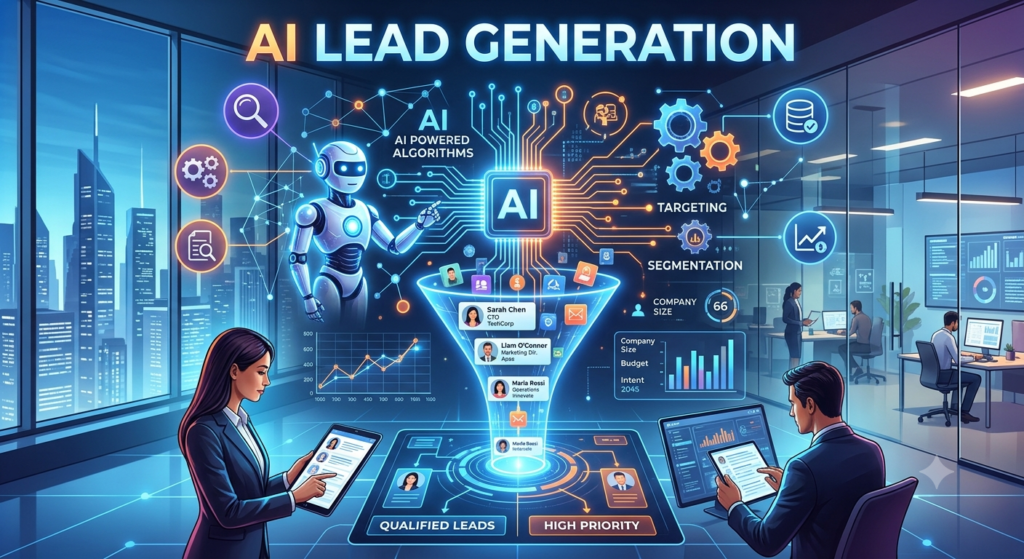
How AI Can Help Businesses Automate Lead Generation and Lead Qualification
AI Lead Generation: Introduction
Finding new customers is one of the biggest challenges for any business. Companies need a steady flow of potential customers to grow, increase sales, and stay ahead of competitors. However, traditional lead generation takes time. Sales teams often spend hours searching for prospects, checking contact details, sending emails, and following up with people who may never buy.
This is where AI lead generation can make a real difference.
Artificial intelligence helps businesses find potential customers, understand their needs, and identify people who are more likely to purchase. It can also automate repetitive sales tasks. As a result, employees can spend more time building relationships and closing deals.
Today, companies of all sizes are using AI for lead generation. From small startups to large B2B organizations, businesses are discovering better ways to attract and manage potential customers.
AI can study customer behavior, analyze website activity, organize sales data, and predict buying interest. It can also support automated lead generation through intelligent software and connected marketing systems.
But AI isn’t just about finding more contacts. The real goal is finding better prospects. In this article, we’ll explore how AI can help businesses automate lead generation and lead qualification, which tools they can use, and how they can build an effective sales process.
Know More: AI Image Generators: How Effectively They Work and How Effectively to Use Them in 2026
Understanding AI Lead Generation and Lead Qualification
Before exploring the benefits, it’s important to understand how these two processes work.
What Is AI Lead Generation?
AI lead generation is the use of artificial intelligence to identify, attract, and collect information about potential customers.
Traditional methods depend heavily on manual research. A salesperson may search online directories, visit company websites, or collect contact information from different sources.
AI makes this process faster.
It can analyze large amounts of information, identify potential buyers, and help businesses find people who match their target audience.
For example, imagine a company selling accounting software to small businesses. Its ideal customers may include business owners, finance managers, and accounting professionals.
AI prospecting tools can help identify companies that fit these requirements. Marketing automation systems can then organize prospects and support relevant campaigns.
Common AI lead generation activities include:
- Finding potential customers.
- Identifying target companies.
- Collecting and organizing prospect information.
- Analyzing customer interests.
- Identifying buying signals.
- Supporting personalized marketing campaigns.
- Automating initial customer communication.
The main advantage is simple: businesses can spend less time searching and more time selling.
What Is AI Lead Qualification?
AI lead qualification is the process of determining whether a potential customer is suitable for a business. Not every person who visits a website is ready to purchase. Some visitors are researching, while others are comparing products. A smaller group may already be looking for a solution. AI can help identify these differences.
It analyzes factors such as:
- Customer interests.
- Website visits.
- Email engagement.
- Product searches.
- Company information.
- Previous interactions.
- Purchase history.
- Responses to marketing campaigns.
Using these signals, AI can estimate how likely someone is to become a customer.
This process is known as AI lead scoring. For example, a person who visits a pricing page several times, downloads a product guide, and requests a demo may show stronger buying interest than someone who only reads a general blog post.
AI helps sales teams recognize this difference.
How AI Changes Traditional Sales Processes
Traditional sales processes often involve separate activities. Marketing teams generate leads, sales representatives review them, and customer service teams handle later communication. This separation can create delays. AI connects these activities through CRM automation and sales funnel automation.
|
Traditional Process |
AI-Powered Process |
|
Manual prospect research |
Automated prospect identification |
|
Manual data entry |
Automated lead enrichment |
|
Basic lead scoring |
Predictive lead scoring |
|
Generic emails |
Personalized communication |
|
Manual follow-ups |
Lead nurturing automation |
|
Manual reporting |
Automated performance analysis |
This doesn’t mean people become unnecessary. Instead, AI handles repetitive work while employees focus on decisions, conversations, and relationships.
How AI Automates Lead Generation
One of the biggest advantages of AI is its ability to automate different stages of customer acquisition.
Businesses no longer need to manage every activity manually. AI systems can collect information, identify prospects, organize data, and support marketing campaigns.
Here are some important ways AI makes the process easier.
1. AI Lead Generation :Automated Prospecting
Prospecting is the process of finding people or companies that may need your products or services.
It can be time-consuming, especially for B2B companies that target specific industries or job roles.
AI prospecting tools help businesses identify suitable prospects using available business information and search signals.
For example, a company selling HR software may want to reach:
- Human resource managers.
- Business owners.
- Recruitment agencies.
- Growing companies.
- HR consultants.
AI tools can help organize prospects according to these characteristics.
Some systems also support automated prospecting by identifying companies that match a defined customer profile.
However, businesses should always check the accuracy and permitted use of collected contact information.
2. Customer Data Analysis
Customer data contains valuable information about buying behavior.
However, collecting data isn’t enough. Businesses must understand what it means.
AI can analyze different data points and identify patterns that may be difficult to notice manually.
For example, it can help businesses understand:
- Which pages attract potential customers.
- Which products receive the most attention.
- Which campaigns generate inquiries.
- Which customer groups respond best.
- Which activities often happen before a purchase.
These insights support better marketing decisions.
Machine learning for sales can also help identify patterns in previous customer interactions.
Over time, businesses can use these findings to improve their campaigns and attract more relevant prospects.
3. Intelligent Customer Segmentation
Not every customer has the same needs.
A student searching for an online course may have different requirements from a working professional looking to improve their skills.
Customer segmentation helps businesses divide audiences into smaller groups based on shared characteristics.
AI can make this process more accurate.
It can analyze customer interests, previous purchases, browsing activity, and engagement patterns.
Businesses can then create separate campaigns for different audience groups.
For example:
- New visitors can receive introductory information.
- Interested visitors can receive product guides.
- Returning visitors can receive relevant offers.
- Existing customers can receive upgrade suggestions.
This improves customer communication and supports conversion optimization.
4. AI-Powered Content and Campaigns
Content plays an important role in business lead generation.
People often discover businesses through blog posts, search engines, social media, videos, and email campaigns.
Generative AI can help marketing teams create content ideas, email drafts, advertisements, and landing page copy.
It can also help personalize messages for different customer groups.
For example, a software company may create different email campaigns for small businesses, agencies, and large organizations.
AI can help adjust the message according to each audience’s needs.
However, human review remains important. AI-generated content should be checked for accuracy, originality, brand consistency, and usefulness. The best approach combines AI efficiency with human creativity.
How AI Improves Lead Qualification
Generating leads is only the first step. Businesses must also understand which prospects deserve immediate attention. This is where intelligent lead qualification becomes valuable. AI can evaluate customer information, analyze buying signals, and help sales teams prioritize their work.
5. Predictive Lead Scoring
Lead scoring assigns a value to potential customers based on their likelihood of becoming buyers. Traditional scoring systems often use fixed rules.
For example:
- Visiting a pricing page: 10 points.
- Downloading a product guide: 5 points.
- Requesting a demo: 20 points.
- Opening a marketing email: 2 points.
AI lead scoring can go further.
It can analyze historical sales data and identify patterns associated with successful conversions. This allows predictive lead scoring systems to estimate which prospects are more likely to purchase.
For example, an AI system may discover that companies with a particular size, industry, and level of product engagement often become customers.
It can then assign higher scores to similar prospects.
The benefits include:
- Better sales prioritization.
- Faster follow-ups.
- Improved sales productivity.
- Less time spent on unsuitable prospects.
- More informed sales decisions.
However, lead scores should be treated as decision-support signals, not guarantees of a purchase.
6. Customer Intent Analysis
Customer intent refers to what a person wants to achieve or purchase. Understanding customer intent is important because people at different stages of the buyer journey need different information.
Someone searching for basic product information may be at the research stage. Someone comparing prices may be closer to making a decision. AI can analyze available signals to estimate buying interest.
These signals may include:
- Product page visits.
- Pricing page activity.
- Search behavior.
- Email responses.
- Demo requests.
- Repeated website visits.
- Product comparison activity.
This process helps businesses understand which prospects may be sales-ready. Customer intent analysis also supports more relevant communication. Instead of sending the same message to everyone, businesses can respond according to customer interests.
7. Automated Lead Enrichment
A lead record may contain only basic information, such as a name and email address. Sales teams often need additional details before contacting that person. Lead enrichment helps complete customer records with relevant information from permitted and reliable sources.
Depending on the software and available data, this may include:
- Company name.
- Industry.
- Job title.
- Business size.
- Website.
- Location.
- Business category.
AI-powered lead management can help organize this information and identify incomplete records.
Better information allows sales representatives to prepare for conversations.
For example, a salesperson contacting a marketing agency may want to understand its services and business size before suggesting a software solution.
This makes communication more relevant.
Businesses should also follow privacy laws and data protection requirements when collecting or enriching personal information.
8. Intelligent Lead Nurturing
Not every prospect is ready to purchase immediately.
Some people need additional information before making a decision.
Lead nurturing automation helps businesses maintain communication with these prospects.
AI can support this process by identifying customer interests and suggesting suitable messages.
For example:
- A visitor downloads a free guide.
- The system records the interaction.
- The visitor receives a relevant educational email.
- Further communication shares useful product information.
- A prospect showing strong buying interest is referred to the sales team.
This creates a more organized buyer journey.
AI can also help adjust communication according to engagement.
If a prospect stops responding, the system may reduce unnecessary messages. If the prospect requests a demo, it can notify the sales team.
The aim isn’t to send more emails. It’s to send useful information at the right time.
Benefits of AI Sales Automation for Businesses
AI sales automation offers several advantages when implemented correctly.
1. Saves Time and Reduces Manual Work
Sales professionals often spend a large part of their day performing administrative tasks.
AI can automate repetitive activities such as data entry, prospect organization, follow-up reminders, and lead scoring.
This gives employees more time for meaningful customer conversations.
2. Improves Lead Quality
More leads don’t always mean more sales.
Businesses need prospects who match their products, budget, and services.
AI helps identify suitable prospects using customer information and buying signals.
This can improve the overall quality of the sales pipeline.
3. Supports Faster Customer Responses
Customers often contact multiple businesses before making a purchase.
A slow response can cause a company to lose an opportunity.
AI chatbots and automated communication systems can provide initial responses at any time.
They can answer common questions, collect basic information, and direct suitable prospects to the sales team.
4. Improves Sales Pipeline Optimization
A sales pipeline shows how potential customers move through the buying process.
AI can help businesses identify delays and understand where prospects stop engaging.
For example, a company may discover that many prospects request product demonstrations but don’t complete the purchase.
This information can help the company review its pricing, product presentation, or follow-up process.
5. Supports Better Business Decisions
AI systems can analyze sales information and identify useful trends.
Managers can use these insights to understand campaign performance, customer behavior, and sales opportunities.
However, decisions should also consider business experience and customer feedback.
6. Helps Businesses Scale
A small sales team may struggle to manage hundreds or thousands of prospects manually.
Automated lead generation allows businesses to handle larger volumes of information without increasing administrative work at the same rate.
This can support business growth while keeping processes organized.
Best AI Tools for Lead Generation and Lead Qualification
Choosing the right software is important. Different businesses have different requirements, budgets, and sales processes.
Here are some popular platforms worth exploring.
|
AI Tool |
Main Purpose |
Suitable For |
|
HubSpot |
CRM, marketing automation, lead management |
Small and medium businesses |
|
Salesforce Einstein |
AI insights, sales forecasting, lead scoring |
Growing and enterprise businesses |
|
Apollo.io |
B2B prospecting and sales intelligence |
B2B sales teams |
|
Clay |
Data enrichment and prospect research workflows |
Sales and growth teams |
|
Zoho CRM |
CRM automation and sales management |
Small and medium businesses |
|
Intercom |
AI customer communication and support |
Online businesses |
|
6sense |
Account intelligence and buying intent |
B2B marketing teams |
How to Choose the Right Software
Before purchasing lead qualification software, consider these factors:
- Business requirements: Choose software that solves your actual sales problems.
- Integration: Check whether the platform connects with your existing CRM and marketing systems.
- Ease of use: Employees should be able to understand and operate the software.
- Pricing: Compare subscription costs, contact limits, and additional charges.
- Data quality: Check how the platform collects, verifies, and updates information.
- Reporting: Choose a platform that provides useful performance reports.
- Privacy: Review its data handling practices and available compliance controls.
For more information, explore the official Salesforce Einstein platform.
Remember that the best AI tools for lead generation depend on your business model. A startup may need affordable CRM automation, while a large organization may require advanced predictive analytics.
How Small Businesses Can Use AI for Lead Generation
AI isn’t only for large companies. Small businesses can also use affordable tools to improve customer acquisition. In fact, automation can be especially useful when a small team has limited time and resources.
Here are some practical strategies.
1. Start With a Clear Target Audience
Before using AI, identify your ideal customers.
Consider their age group, location, industry, interests, problems, and purchasing needs.
A clear target audience helps AI systems produce more relevant results.
2. Automate Website Inquiries
Add an AI chatbot to your website.
It can answer common questions, collect inquiry details, and direct visitors toward suitable products or services.
For example, a travel agency can use a chatbot to collect information about destinations, travel dates, and group sizes.
3. Use AI for Email Marketing
AI can help create personalized email campaigns.
Businesses can divide customers into different groups and send useful information based on their interests.
However, marketing emails should follow applicable consent and privacy requirements.
4. Connect AI With Your CRM
A CRM stores information about customers and sales activities.
Connecting AI tools with a CRM can simplify lead organization, follow-ups, and reporting.
This creates a more connected sales process.
5. Measure Results Regularly
Track important metrics such as:
- Number of leads generated.
- Percentage of qualified leads.
- Lead-to-customer conversion rate.
- Cost per lead.
- Response time.
- Sales cycle length.
- Customer acquisition cost.
These numbers help businesses understand whether their automation strategy is working.
How to Implement an AI-Powered Lead Qualification Process
Businesses should introduce AI step by step rather than automating everything at once.
A practical implementation process looks like this.
Step 1: Identify Your Sales Challenges
Find the tasks that consume the most time.
For example, your team may struggle with prospect research, customer follow-ups, or lead prioritization.
Start with the biggest problem.
Step 2: Define Lead Qualification Rules
Decide what makes a prospect valuable to your business.
Consider budget, requirements, location, company size, purchasing timeline, and product suitability.
These rules help establish a useful qualification framework.
Step 3: Select Suitable AI Software
Compare different platforms according to your requirements.
Avoid choosing software simply because it offers many features.
Focus on tools that solve your actual problems.
Step 4: Connect Your Data Sources
Connect your website, CRM, email marketing platform, and other relevant systems.
Make sure information moves correctly between platforms.
Step 5: Create Automated Workflows
Build workflows for lead collection, enrichment, scoring, and follow-ups.
For example, a new inquiry can automatically enter the CRM and receive an initial response.
If the prospect meets your qualification criteria, the system can notify a salesperson.
Step 6: Test the System
Run a small test before applying automation across your entire business.
Review whether leads are being scored correctly and whether messages are relevant.
Step 7: Monitor and Improve
AI systems require regular monitoring.
Compare their predictions with actual sales results.
Update scoring rules and workflows when customer behavior or business requirements change.
Challenges of AI Lead Generation and How to Avoid Them
Although AI offers many benefits, businesses should understand its limitations.
1. Incorrect or Incomplete Data
AI results depend heavily on data quality.
Incorrect information can lead to poor prospect identification and unreliable scoring.
Solution: Regularly review customer records and use reliable data sources.
2. Lack of Human Interaction
Automated messages can feel impersonal when businesses depend on them too much.
Customers still value genuine conversations and individual attention.
Solution: Use AI for routine communication but involve people in important sales discussions.
3. High Software Costs
Some advanced platforms can be expensive, especially for startups.
Solution: Begin with affordable tools and expand as your business grows.
4. Privacy and Security Risks
Customer information must be handled responsibly.
Businesses should understand applicable privacy regulations, obtain consent where required, and protect sensitive information.
Solution: Select trustworthy providers and establish clear data handling policies.
5. Overdependence on Automation
AI can make incorrect predictions or misunderstand customer needs.
Solution: Keep human review in important decisions, especially when evaluating high-value customers.
”FAQs”
1. What Is AI Lead Generation?
AI lead generation uses artificial intelligence to identify, attract, and organize potential customers. It can analyze customer behavior, find suitable prospects, automate research, and support marketing campaigns.
2. How AI Qualifies Leads Automatically?
AI qualifies leads by analyzing information such as website activity, customer interests, company details, email engagement, and buying signals. It uses this information to estimate which prospects are most likely to purchase.
3. Can AI Generate High-Quality Leads?
Yes. AI can help businesses identify prospects who match their target customer profile. It can also analyze buying intent and historical sales patterns. However, lead quality depends on data accuracy, targeting, and the business's qualification criteria.
4. What Are the Best AI Tools for Lead Qualification and Lead Scoring?
Popular options include HubSpot, Salesforce Einstein, Apollo.io, and Zoho CRM. Each platform offers different capabilities. Businesses should compare features, pricing, integrations, and data quality before choosing one.
5. How Does AI Reduce Manual Lead Qualification Efforts?
AI can automatically organize customer records, analyze engagement, assign lead scores, and identify promising prospects. This reduces repetitive work and allows sales representatives to focus on qualified opportunities.
6. Is AI Lead Generation Suitable for Small Businesses?
Yes. Small businesses can use AI chatbots, CRM systems, email automation, and prospecting tools to simplify their sales processes. They can begin with basic automation and add advanced features as their needs grow.
7. How Does Generative AI Help Sales Teams?
Generative AI can help sales teams prepare emails, create product descriptions, summarize customer conversations, research prospects, and suggest personalized communication. Human review is still important to maintain accuracy and trust.
8. Does AI Replace Human Sales Representatives?
No. AI can automate repetitive tasks and support sales decisions, but human representatives remain important for negotiation, relationship building, problem-solving, and complex customer requirements.
9. How Can Businesses Use AI to Improve Lead Conversion Rates?
Businesses can use AI to identify sales-ready prospects, personalize communication, respond faster, and improve follow-up timing. They should also monitor conversion data and regularly improve their sales process.
10. What Is the Difference Between AI Lead Generation and AI Lead Qualification?
AI lead generation focuses on finding and attracting potential customers. AI lead qualification focuses on evaluating those prospects and identifying which ones are more likely to become paying customers. Both processes work together to improve sales performance.


