
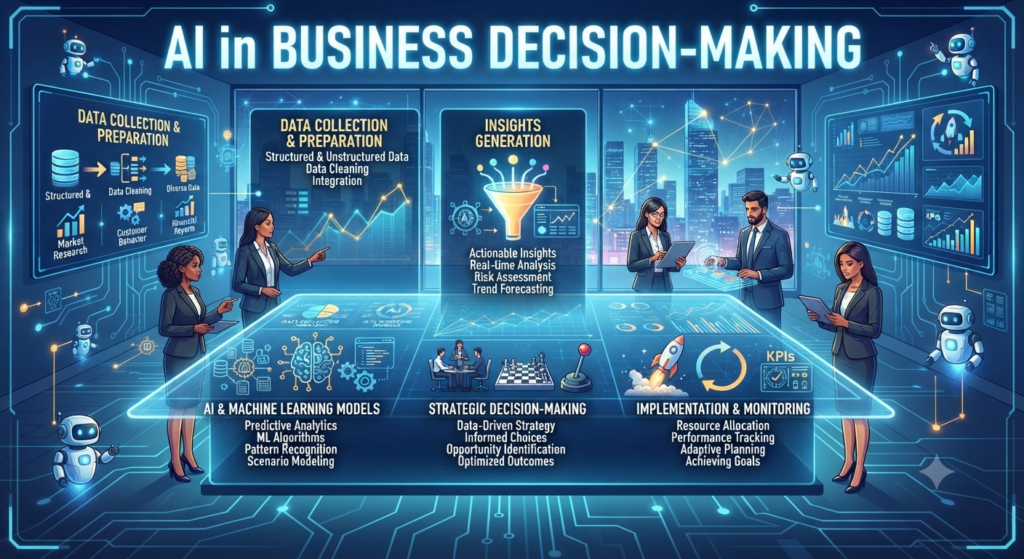
AI in Business Decision-Making: How Data and Automation Improve Growth
Making the right business decision isn’t always easy. Every company faces important choices about customers, sales, marketing, finance, employees, and future investments. A single wrong decision can waste money, reduce productivity, and slow business growth.
In the past, many businesses made decisions using personal experience, basic reports, and manual research. These methods still have value, but they can take time and may not provide the complete picture.
Today, things are changing. Artificial intelligence (AI) is helping businesses understand information, identify patterns, and make better decisions.
AI in business decision making uses data, machine learning, predictive analytics, and automation to help companies choose the right actions. It allows business leaders to understand what’s happening, predict what may happen next, and plan their next steps.
For example, an online store can use AI to understand customer buying habits. A manufacturing company can predict equipment problems before they happen. A marketing team can identify which campaigns are bringing the most customers.
These examples show how AI can turn ordinary business information into useful insights.
AI isn’t just for large companies. Small businesses, startups, and growing organizations can also use AI tools to improve their daily operations.
In this article, we’ll explore how AI improves business decisions, how data and automation support growth, and how companies can use AI to build better business strategies.
Know More: How to Use AI for Affiliate Marketing: 7 Powerful Strategies for Content and Product Research
1. Understanding AI in Business Decision-Making
AI in business decision-making refers to the use of artificial intelligence technologies to analyze information and support business choices.
It helps companies process large amounts of data, identify useful patterns, and understand possible outcomes.
Instead of checking hundreds of reports manually, business teams can use AI to find important information faster.
For example, a sales manager may want to know why monthly sales have dropped. AI can analyze sales records, customer behavior, product performance, and market changes. It can then highlight possible reasons for the decline.
The manager can use these insights to decide what to do next.
How Does AI Support Business Decisions?
AI supports business decisions through several technologies.
- Machine Learning
Machine learning allows computer systems to learn from data. It identifies patterns and uses past information to make predictions.
Businesses can use machine learning to predict customer demand, identify sales opportunities, and understand buying behavior.
- Predictive Analytics
Predictive analytics uses historical data and statistical models to estimate future results.
For example, a retail company can predict which products may sell more during a holiday season.
- Natural Language Processing
Natural language processing helps AI understand human language.
Businesses can use it to analyze customer reviews, support messages, emails, and survey responses.
- Generative AI
Generative AI can create reports, summarize information, answer questions, and support business research.
Tools such as ChatGPT can help managers understand business information and prepare initial strategic recommendations.
- Automated Analytics
Automated analytics reduces the need for repeated manual reporting. It can collect information, update dashboards, and highlight changes in important business metrics.
Traditional Decision-Making vs. AI-Based Decision-Making
|
Factor |
Traditional Decision-Making |
AI-Based Decision-Making |
|
Data analysis |
Mostly manual |
Automated and assisted |
|
Speed |
Can take more time |
Often faster |
|
Data processing |
Limited by manual effort |
Handles large datasets |
|
Forecasting |
Based on experience and basic reports |
Uses predictive models |
|
Reporting |
Manual report preparation |
Automated reporting |
|
Pattern detection |
Depends on human analysis |
Identifies complex patterns |
|
Decision support |
Personal experience and reports |
Data insights and predictions |
|
Scalability |
Requires more manual work |
Can scale with data and systems |
AI doesn’t replace human judgment. Instead, it gives decision-makers more information to work with. The best results come when businesses combine human experience with reliable AI insights.
2. Why Businesses Need AI for Better Decisions
Modern businesses work in a competitive environment. Customer expectations change, new competitors enter the market, and technology continues to develop.
Companies that depend only on outdated reports may struggle to respond to these changes.
AI helps businesses understand their current performance and identify opportunities for improvement.
Here are some important reasons why companies are adopting AI.
Faster Business Decisions
Time matters in business. A delayed decision can result in lost customers, missed opportunities, or higher operating costs.
AI can analyze information much faster than manual research in many situations.
For example, a sales team can use AI to identify high-potential leads. Instead of checking every lead individually, the team can focus on customers who are more likely to purchase.
This saves time and improves sales productivity.
Better Accuracy
Business decisions based on incomplete information can create problems.
AI can compare information from different sources and identify patterns that may be difficult to notice manually.
For example, a finance team can analyze expenses, revenue, and payment records to identify unusual spending.
However, AI results depend on the quality of the data and the model. Human review is still important.
Reduced Operating Costs
AI automation can reduce repetitive work.
Businesses can automate activities such as:
- Preparing regular reports.
- Sorting customer inquiries.
- Tracking sales performance.
- Managing inventory information.
- Organizing business data.
- Monitoring important performance indicators.
Employees can then spend more time on planning, problem-solving, and customer relationships.
Better Customer Understanding
Customers leave useful information through purchases, website visits, reviews, and support interactions.
AI can analyze this information to identify customer preferences.
For example, an online business can understand which products customers view most often and which products they purchase together.
This information can help businesses improve product recommendations and marketing campaigns.
Improved Risk Management
Every business faces risks.
These may include financial losses, changing customer demand, supply chain problems, or cybersecurity threats.
AI-based decision support systems can monitor relevant information and highlight unusual patterns.
For example, a bank can use AI to identify transactions that may require additional fraud checks.
This helps teams investigate potential problems earlier.
3. How AI Improves Business Decision-Making
AI improves business decisions by connecting data analysis with practical business actions.
It doesn’t simply provide numbers. It can help explain patterns, estimate future outcomes, and identify areas that need attention.
Let’s understand the main ways AI supports this process.
Data Collection and Analysis
Businesses collect information from many sources, including:
- Websites and mobile applications.
- Customer relationship management systems.
- Sales platforms.
- Marketing campaigns.
- Financial software.
- Customer support systems.
- Inventory management platforms.
Manually combining all this information can be difficult.
AI data analysis can help organize and process information from connected sources.
For example, an e-commerce company can combine website traffic, customer orders, and product returns to understand its overall performance.
Identifying Hidden Patterns
Some business patterns aren’t easy to identify through basic reports.
AI can analyze large datasets and identify relationships between different activities.
For example, a company may discover that customers who visit a particular product page several times are more likely to purchase within the next few days.
This insight can help the marketing team create more relevant campaigns.
Real-Time Analytics
Traditional reporting often depends on information collected over a specific period.
Real-time analytics allows businesses to monitor selected activities as new information becomes available.
For example, an online retailer can track:
- Current sales.
- Product demand.
- Website activity.
- Customer orders.
- Inventory levels.
If a product starts selling faster than expected, the company can respond by adjusting stock levels.
Predictive Modeling
Predictive modeling uses historical information to estimate future outcomes.
It can support business forecasting in areas such as sales, customer demand, expenses, and market performance.
For example, a company can use previous sales records to estimate next quarter’s revenue.
These predictions aren’t guaranteed results. They are estimates that help managers prepare for different possibilities.
Automated Recommendations
AI can recommend possible actions based on business information.
For example, an AI system may identify that a particular marketing campaign has a high customer acquisition cost.
It may recommend reviewing the campaign’s audience, budget, or conversion performance.
The marketing manager can then evaluate the recommendation and decide whether to make changes.
Better KPI Tracking
Key Performance Indicators (KPIs) help businesses measure progress.
AI-powered dashboards can monitor important KPIs and highlight unusual changes.
Common business KPIs include:
|
Business Area |
Important KPIs |
|
Sales |
Revenue, conversion rate, average order value |
|
Marketing |
Cost per lead, customer acquisition cost, ROI |
|
Finance |
Profit margin, cash flow, operating expenses |
|
Customer Support |
Response time, resolution rate, customer satisfaction |
|
Operations |
Productivity, delivery time, operating cost |
|
HR |
Employee retention, hiring time, workforce productivity |
When businesses monitor the right KPIs, they can identify problems earlier and make informed decisions.
4. The Role of AI Business Intelligence in Modern Companies
Business intelligence (BI) helps companies collect, organize, and understand business information.
Traditional business intelligence tools mainly focus on reporting, dashboards, and data visualization.
AI takes this process further by adding predictive analysis, automated insights, and intelligent recommendations.
AI business intelligence combines business intelligence with artificial intelligence to help companies understand performance and identify future opportunities.
How AI Improves Business Intelligence
AI improves business intelligence in several ways.
Automated Data Analysis: AI can process business information and identify important changes without requiring employees to check every report manually.
Better Data Visualization: AI-powered systems can help users understand complex information through charts, graphs, and dashboards.
Predictive Insights: Businesses can use predictive analytics to estimate future sales, demand, and customer behavior.
Natural Language Queries: Some AI-powered BI platforms allow users to ask questions in everyday language.
For example, a manager might ask, “Which product generated the highest revenue last month?”
The system can analyze the available data and provide a relevant answer.
Popular Business Intelligence Tools
Companies can use different platforms depending on their needs.
|
Tool |
Business Use |
|
Microsoft Power BI |
Business dashboards and reporting |
|
Tableau |
Data visualization and analytics |
|
Google Looker Studio |
Marketing and website performance reporting |
|
Qlik Sense |
Business analytics and data exploration |
|
Microsoft Fabric |
Data management and analytics |
|
Google BigQuery |
Large-scale data analysis |
These tools offer different capabilities. Some provide advanced AI features, while others focus more on reporting and data visualization.
Businesses should select tools based on their data sources, reporting needs, budget, and technical requirements.
Example: Using AI Business Intelligence for Growth
Imagine a company that sells software services.
The company receives leads through its website, advertisements, social media, and referrals.
Its management team wants to understand which channels generate the best business opportunities.
An AI-powered business intelligence system can help analyze:
- Lead sources.
- Lead conversion rates.
- Customer acquisition costs.
- Sales cycle duration.
- Revenue generated by each channel.
The management team can use these insights to decide where to invest more resources.
This is how artificial intelligence and business intelligence can support better strategic planning.
5. Predictive Analytics and Business Forecasting
Business forecasting helps companies prepare for future situations.
However, predicting future business performance can be difficult because customer demand, market conditions, and competition continue to change.
Predictive analytics helps businesses make more informed estimates using historical data, current information, and statistical models.
How Predictive Analytics Works
Predictive analytics generally follows four steps.
Step 1: Collect Data
The business collects relevant information, such as sales records, customer details, product performance, and market information.
Step 2: Prepare Data
The information is checked for missing values, errors, and inconsistencies.
Step 3: Build Predictive Models
Statistical methods and machine learning models analyze historical patterns.
Step 4: Generate Predictions
The system produces estimates that managers can use during business planning.
Business Applications of Predictive Analytics
|
Application |
How AI Helps |
|
Sales forecasting |
Estimates future sales |
|
Customer behavior |
Predicts possible customer actions |
|
Inventory planning |
Estimates product demand |
|
Financial planning |
Supports revenue and expense forecasting |
|
Market analysis |
Identifies changing market patterns |
|
Customer retention |
Identifies customers who may stop using a service |
AI-Powered Forecasting for Companies
Consider a retail company that experiences higher demand during certain months.
In previous years, the company relied on basic sales reports to plan inventory.
Now, it uses AI forecasting solutions to analyze historical sales, seasonal demand, product performance, and other relevant information.
The system estimates which products may experience higher demand.
The company can use these estimates to plan stock purchases and reduce the risk of overstocking or running out of products.
Why Forecasting Matters for Business Growth
Good forecasting supports:
- Better financial planning.
- Improved inventory management.
- More effective resource allocation.
- Reduced operational uncertainty.
- Better investment decisions.
- Stronger strategic business planning.
Still, predictive models can make mistakes. Unexpected events and sudden market changes may affect their results.
Businesses should review predictions regularly and avoid treating them as guaranteed outcomes.
6. AI and Automation: Driving Business Growth
AI and automation work together to improve business operations.
Automation handles repetitive activities, while AI adds the ability to analyze information and support more complex tasks.
This combination can improve productivity and support growth optimization.
Automating Repetitive Business Tasks
Many employees spend time completing tasks that follow the same process every day.
AI-powered automation can help reduce this workload.
Examples include:
- Automatically categorizing customer inquiries.
- Generating routine business reports.
- Sending customer follow-up messages.
- Organizing incoming business information.
- Identifying duplicate records.
- Summarizing meetings and documents.
Employees can focus on tasks that require creativity, communication, and critical thinking.
Improving Sales Performance
AI can help sales teams understand customer interests and identify promising opportunities.
For example, a CRM system with AI capabilities can analyze previous customer interactions and help prioritize leads.
Sales representatives can use this information to plan follow-ups and improve customer communication.
Improving Marketing Performance
Marketing teams generate large amounts of data from advertising platforms, websites, email campaigns, and social media.
AI analytics can help businesses understand:
- Which campaigns generate more leads.
- Which audiences respond better.
- Which landing pages convert visitors.
- Which marketing channels offer better returns.
- Which customer segments need different messages.
These insights help marketing teams improve their campaigns.
Improving Operational Efficiency
AI can help companies monitor daily operations and identify areas where resources are being wasted.
For example, a logistics company can analyze delivery routes and traffic information to improve route planning.
A manufacturing business can use predictive maintenance to identify equipment that may need attention.
These applications can improve productivity and reduce unnecessary costs.
Building AI-Driven Business Growth Strategies
Businesses can use AI to develop growth strategies through a simple process:
- Identify the main business growth objective.
- Collect relevant business information.
- Analyze customer and market behavior.
- Identify areas with growth potential.
- Use predictive analytics to evaluate possible outcomes.
- Implement selected strategies.
- Track results using KPIs.
- Improve the strategy based on performance.
AI provides useful information, but business leaders must decide which opportunities match their goals and available resources.
7. AI Applications Across Different Business Departments
AI isn’t limited to one business function. Different departments can use it to improve performance and make better decisions.
AI in Marketing
AI helps marketing teams analyze customer behavior, campaign performance, and market trends.
Common applications include:
- Customer segmentation.
- Content research.
- Campaign performance analysis.
- Audience targeting.
- Marketing automation.
- Conversion prediction.
For example, a marketing team can use AI analytics to understand which audience groups generate the highest conversion rates.
AI in Sales
Sales teams can use AI to identify potential customers and improve lead management.
AI tools can help with lead scoring, sales forecasting, customer analysis, and sales reporting.
This allows sales managers to focus on opportunities that are more likely to generate revenue.
AI in Finance
Finance departments can use AI to analyze financial records and support better planning.
Common applications include:
- Expense analysis.
- Cash flow forecasting.
- Fraud detection.
- Financial reporting.
- Budget planning.
- Risk assessment.
AI can help finance teams identify unusual transactions and monitor spending patterns.
AI in Human Resources
HR teams can use AI to support workforce planning and administrative tasks.
Examples include resume screening assistance, workforce analytics, employee training recommendations, and hiring trend analysis.
However, recruitment decisions must be monitored carefully to prevent unfair bias and discrimination.
AI in Customer Support
Customer support teams can use AI chatbots and automated systems to handle common questions.
AI can also help analyze customer feedback and identify recurring problems.
For example, if customers frequently report an issue with a particular service, AI-based analysis can highlight the trend.
The support team can investigate the problem and improve the service.
AI in Supply Chain Management
AI can support demand forecasting, inventory planning, supplier analysis, and delivery optimization.
These applications help companies manage resources more effectively and respond to changing demand.
8. Generative AI and LLMs in Business Intelligence
Generative AI is creating new opportunities for businesses to understand information and prepare decisions.
Large Language Models (LLMs) can process natural language and help users interact with business information through questions and instructions.
Generative AI for business intelligence can make data analysis easier for people who don’t have advanced technical skills.
ChatGPT for Business Analysis
ChatGPT can support business analysis in several ways.
For example, managers can use it to:
- Summarize business reports.
- Organize market research.
- Compare business strategies.
- Prepare SWOT analyses.
- Generate questions for business planning.
- Explain business metrics.
- Create initial forecasting scenarios.
However, ChatGPT should not be treated as an automatic source of verified business facts. Important figures and recommendations should be checked against reliable data.
GPT-Powered Analytics
GPT-powered analytics combines language models with business data and analytics systems.
For example, a company may connect an AI assistant to an approved business reporting system.
A manager can ask:
“Compare our sales performance across the last three months.”
The system can retrieve relevant information, summarize the results, and explain important changes.
This can make business reporting more accessible.
AI Strategic Planning Tools
AI strategic planning tools can help business leaders organize information and explore different business scenarios.
They may support:
- Competitor research.
- Market trend analysis.
- Business opportunity identification.
- Revenue planning.
- Customer segmentation.
- Risk assessment.
Important Considerations When Using LLMs
Businesses should follow a few basic rules:
- Use reliable and approved data sources.
- Avoid sharing confidential information with unauthorized AI tools.
- Check important calculations and facts.
- Review AI-generated recommendations.
- Follow company data protection policies.
- Keep humans involved in important business decisions.
LLM business insights can save time, but they should support business expertise rather than replace it.
9. Major Benefits of AI in Business Decision-Making
AI offers several benefits when implemented with clear business objectives.
|
Benefit |
Business Impact |
|
Faster analysis |
Reduces time spent reviewing information |
|
Better forecasting |
Helps companies prepare for future demand |
|
Improved productivity |
Reduces repetitive manual tasks |
|
Better customer insights |
Supports customer-focused strategies |
|
Cost optimization |
Helps identify unnecessary expenses |
|
Risk identification |
Highlights unusual patterns and possible problems |
|
Better planning |
Supports informed strategic decisions |
|
Performance monitoring |
Improves KPI tracking |
Better Use of Business Resources
AI helps businesses understand how they use their money, time, and employees.
Managers can identify activities that consume resources without delivering enough value.
They can then adjust budgets and workflows.
Improved Competitive Advantage
Businesses that understand their customers and markets can respond more effectively to changes.
AI can support competitor analysis, customer research, and market trend analysis.
This information helps companies identify new opportunities.
More Scalable Operations
As a company grows, its data and operational requirements also increase.
AI-based systems can help businesses process larger amounts of information without increasing every manual activity at the same rate.
This can support long-term growth.
10. Challenges of Using AI for Business Decisions
Although AI offers many advantages, businesses should understand its limitations before adopting it.
Poor Data Quality
AI systems depend on the information they receive.
If business data is incomplete, outdated, or incorrect, the results may also be unreliable.
Companies should regularly review and clean their data.
Data Privacy and Security
Business data may include customer details, financial records, and confidential information.
Companies must use appropriate security controls and follow applicable privacy laws.
Implementation Costs
Some AI systems require investment in software, infrastructure, integration, and employee training.
Small businesses should begin with solutions that address clear business problems.
Lack of Employee Skills
Employees may not understand how to use AI tools effectively.
Training is important to help teams understand AI results, identify mistakes, and use technology responsibly.
Overdependence on AI
AI can provide recommendations, but it doesn’t always understand the full business situation.
Human experience, industry knowledge, and ethical judgment remain important.
Bias and Incorrect Predictions
AI models may produce biased or inaccurate results.
Businesses should test their systems, review their outputs, and monitor performance over time.
11. How to Implement AI in Your Business Strategy
Companies don’t need to introduce every AI technology at once.
A step-by-step approach is more practical and easier to manage.
Step 1: Identify Your Business Goals
Start by identifying what you want to improve.
Your objectives may include:
- Increasing sales.
- Reducing operating expenses.
- Improving customer satisfaction.
- Improving forecasting.
- Increasing employee productivity.
- Understanding customer behavior.
Choose one or two clear objectives first.
Step 2: Review Available Business Data
Identify the data your company already collects.
This may include sales information, website analytics, customer records, financial data, and operational reports.
Check whether the information is accurate, accessible, and properly organized.
Step 3: Select the Right AI Tools
Choose tools based on your business requirements.
For example:
|
Business Requirement |
Possible Tool Category |
|
Business reporting |
Power BI, Tableau |
|
Website analytics |
Google Analytics 4 |
|
Data analysis |
AI analytics platforms |
|
Customer management |
AI-enabled CRM |
|
Customer support |
AI chatbots |
|
Forecasting |
Predictive analytics software |
|
Content assistance |
Generative AI tools |
Avoid purchasing expensive software without understanding how it will support your business goals.
Step 4: Start With a Small Project
Choose one business process for your first AI project.
For example, a company may begin by automating monthly performance reports.
Measure how much time the process takes before and after implementation.
This helps determine whether the solution provides real value.
Step 5: Train Your Employees
Employees should understand how the AI system works and how to use its outputs.
Training should cover data handling, limitations, accuracy, and human review.
Step 6: Track Performance
Measure the results using relevant KPIs.
For example:
- Time saved through automation.
- Improvement in conversion rates.
- Reduction in operating expenses.
- Improvement in forecast accuracy.
- Customer satisfaction changes.
Step 7: Improve and Expand
Review the results regularly.
If the first project provides value, consider expanding AI applications to other departments.
This gradual approach helps companies build a practical artificial intelligence business strategy.
12. The Future of AI in Business Decision-Making
AI technology is developing quickly, and its role in business planning is expected to grow.
Companies are exploring new ways to combine machine learning, automation, generative AI, and real-time analytics.
Several trends may shape the future of business decisions.
More Accessible AI Analytics
AI analytics tools are becoming easier for non-technical employees to use.
Businesses may increasingly allow managers to ask questions about reports using natural language.
This can reduce the gap between business teams and technical teams.
AI Agents and Automated Workflows
AI agents can perform selected tasks across connected systems, depending on their permissions and design.
For example, an AI agent may collect performance data, prepare a summary, and notify a manager when a specific metric changes.
Human approval should remain part of important workflows.
Better Predictive Intelligence
Improvements in machine learning may help businesses develop more useful forecasting models.
Companies can use these models to study demand, customer behavior, financial performance, and market changes.
Personalized Business Insights
Future AI systems may provide recommendations based on a company’s industry, business model, and performance data.
This could help managers identify opportunities that are more relevant to their specific operations.
Greater Focus on Responsible AI
As businesses use more AI systems, data protection, transparency, accountability, and fairness will become increasingly important.
Organizations will need clear rules for how AI systems access information and influence decisions.
For additional guidance, businesses can explore the NIST AI Risk Management Framework.
The future of AI in business decision-making won’t depend only on advanced technology. It will also depend on how responsibly companies use it.
AI is changing how businesses collect information
AI is changing how businesses collect information, analyze performance, and plan for the future.
From predictive analytics and automated reporting to intelligent business intelligence systems, artificial intelligence provides companies with new ways to understand their operations and identify growth opportunities.
AI in business decision making helps organizations move beyond basic reporting and use data to support smarter business strategies.
”FAQs”
1. What is AI in business decision-making?
AI in business decision-making is the use of artificial intelligence, machine learning, and data analytics to support business choices. It helps companies analyze information, identify patterns, predict outcomes, and improve strategic planning.
2. How does AI improve business decision-making?
AI improves business decision-making by analyzing large amounts of information, identifying useful patterns, and supporting predictions. It can help companies make faster decisions, improve forecasting, reduce repetitive work, and understand customer behavior.
3. What are the benefits of AI in decision-making?
The main benefits include faster data analysis, better forecasting, improved productivity, cost optimization, customer insights, risk identification, and better resource planning.
4. What is AI business intelligence?
AI business intelligence combines artificial intelligence with traditional business intelligence tools. It helps companies analyze business information, generate insights, monitor performance, and support data-driven decisions.
5. How can small businesses use AI for business growth?
Small businesses can use AI for customer support, sales analysis, marketing automation, financial reporting, inventory planning, and customer research. They can start with affordable tools that solve specific business problems.
6. Can ChatGPT help with business decision-making?
Yes. ChatGPT can help summarize reports, analyze supplied information, prepare business research, compare strategies, and organize ideas. However, important facts, calculations, and recommendations should be checked before making business decisions.
7. What is the difference between AI analytics and predictive analytics?
AI analytics is a broad term for using artificial intelligence to analyze business information and generate insights. Predictive analytics is a specific approach that uses historical data and models to estimate future outcomes.
8. Will AI replace human business decision-makers?
No. AI can automate analysis and provide recommendations, but important decisions still require human judgment, experience, creativity, and responsibility. AI works best as a decision-support system.
9. How can companies implement AI in their business strategy?
Companies can begin by identifying business goals, reviewing available data, selecting suitable AI tools, starting with a small project, training employees, and measuring performance. They can expand their AI applications as they gain experience.


