Starting a business used to require a lot of people, money, and time. Entrepreneurs needed employees for marketing, customer support, sales, accounting, content creation, and daily management. They also needed office space, equipment, and other resources.
Today, things are changing.
Artificial intelligence (AI) is making it easier to start and manage a business with fewer people. A single founder can now use AI tools to write content, answer customer questions, manage emails, study competitors, and automate daily tasks.
This doesn’t mean that people are no longer important. Instead, AI helps people complete more work in less time.
An AI-powered business uses artificial intelligence, software, and automated systems to manage different business activities. It allows entrepreneurs to reduce manual work and focus on important decisions.
For example, a small online company can use AI to create marketing content, answer common questions, organize customer information, and manage sales activities. The founder can handle business planning and customer relationships instead of doing every small task manually.
This approach is useful for solopreneurs, freelancers, consultants, and startup founders.
The best part? You don’t need to build a large company from day one. You can start with one useful product or service, use affordable AI business tools, and add more systems as your business grows.
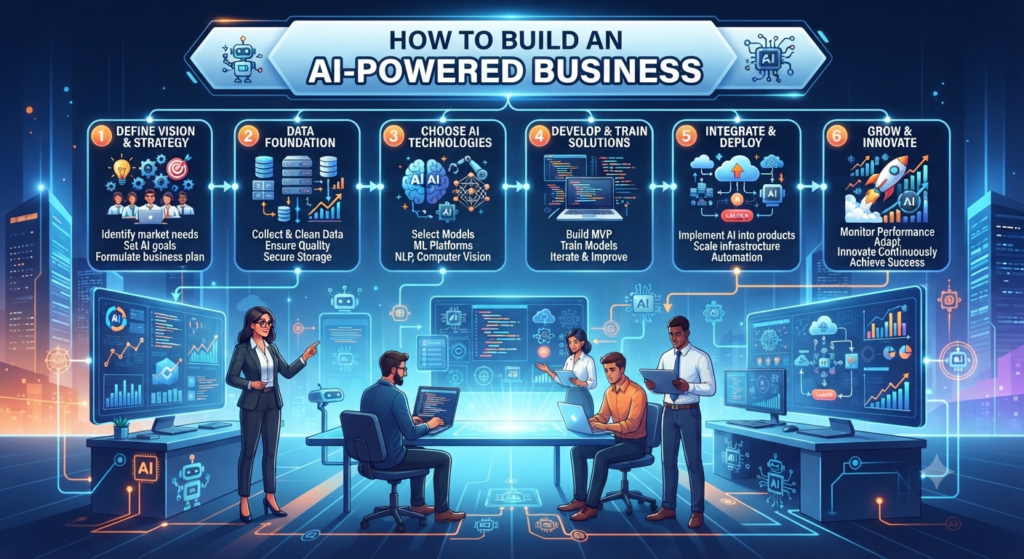
In this guide, we’ll explain how to build an AI-powered business without hiring a large team. You’ll learn how to choose a business model, select useful tools, automate operations, attract customers, and create a business that can grow over time.
Know More: AI in Sales: 10 Powerful Ways Artificial Intelligence Can Increase Conversions
1. How to Build an AI-Powered Business ?
An AI-powered business uses artificial intelligence to improve how a company works. It combines human skills with AI software to complete tasks faster and manage operations more efficiently.
Traditional businesses often depend on employees for most daily activities. An AI-driven business uses software to handle repetitive tasks and support important decisions.
For example, consider a small digital marketing agency.
A traditional agency may need separate employees for:
- Content writing
- Keyword research
- Social media management
- Email marketing
- Customer support
- Reporting
A smaller agency can use AI tools to support many of these activities. One person can manage several workflows with the help of automation.
However, AI doesn’t replace every role. Human judgment, creativity, communication, and industry knowledge remain important.
How Does an AI Business Work?
An AI business usually combines three important elements:
- Artificial Intelligence: AI helps create content, analyze information, understand customer questions, and generate ideas.
- Automation Software: Automation connects different applications and moves information between them without repeated manual work.
- Human Management: The business owner reviews results, makes decisions, handles complex problems, and maintains customer relationships.
These three elements create a practical system for running lean business operations.
Key Benefits of an AI-Powered Business
|
Benefit |
How It Helps |
|
Lower operating costs |
Reduces the need for repetitive manual work |
|
Faster execution |
Completes routine tasks more quickly |
|
Better productivity |
Allows founders to manage more activities |
|
Easy scalability |
Supports growth without adding employees for every task |
|
Improved customer service |
Provides faster responses to common questions |
|
Better decision-making |
Helps analyze business information |
An AI-powered business doesn’t have to be a technology company. A consulting firm, online store, educational platform, or marketing agency can also use AI. The main goal is simple: use technology to make business operations more effective.
2. Why You Don’t Need a Large Team to Start a Business
One of the biggest challenges for new entrepreneurs is managing business costs.
Hiring employees requires salaries, training, equipment, management, and other expenses. For a startup with limited funding, these costs can become difficult to manage.
AI offers another approach.
Instead of hiring someone for every small activity, founders can use AI assistants and automated business systems to handle routine work.
Lower Startup Costs
Imagine starting a content marketing business.
You may need help with research, writing, editing, social media, and reporting. Hiring separate employees for each activity can become expensive.
With AI tools, you can support these tasks through one connected workflow.
For example:
- Use ChatGPT for content research and first drafts.
- Use Grammarly for writing assistance.
- Use Canva for visual content.
- Use Google Analytics for performance analysis.
- Use automation software to organize repetitive tasks.
You still need to review the work. But you don’t have to complete every activity manually.
Faster Business Operations
AI can reduce the time spent on repetitive activities.
For example, an automated lead management system can collect customer details, organize leads, and send follow-up emails.
Without automation, someone may need to complete these steps manually.
This gives the founder more time to focus on sales, product development, and customer relationships.
More Flexibility for Founders
A large team often needs regular meetings, task assignments, and communication.
A lean business model can reduce these management requirements.
Founders can use project management software, AI copilots, and automated reminders to organize daily work.
This approach is particularly useful for:
- One-person businesses
- Freelancers
- Small agencies
- Online service providers
- Digital product creators
- Early-stage startups
Focus on Skills Instead of Headcount
A successful business doesn’t depend only on the number of employees.
It also depends on the value of its products, customer experience, and ability to solve problems.
A founder with strong industry knowledge and the right AI business tools can build a useful service with limited resources.
The key is to identify which tasks need human attention and which tasks can be supported by automation.
3. Choose the Right AI Startup Business Model
Before investing in software, decide what kind of business you want to build.
Your business model should solve a real problem. AI should help deliver the solution, not become the entire reason customers buy from you.
Here are some business models that can work well for solo founders.
AI-Powered Digital Marketing Agency
A digital marketing agency helps companies improve their online presence.
You can use AI for:
- Keyword research
- Content planning
- SEO analysis
- Social media content
- Email campaigns
- Marketing reports
A small team or solo founder can manage several clients with a well-organized workflow.
However, clients still expect original ideas, accurate research, and measurable results. AI-generated content should always receive human review.
AI Content Creation Business
Businesses need articles, website content, newsletters, product descriptions, and social media posts.
You can create a content service using generative AI business tools.
Your services might include:
- Blog writing
- Website content
- Content optimization
- Email newsletters
- Social media calendars
- Content editing
The best approach is to combine AI speed with human expertise.
AI Automation Consulting
Many small businesses waste time on repetitive tasks.
You can help them automate activities such as:
- Lead collection
- Appointment scheduling
- Email notifications
- Customer data organization
- Invoice reminders
- Internal reporting
This business model is useful because companies often need help connecting different software applications.
AI-Powered Online Education
You can build an online learning business around a specific skill or subject.
AI can help with course outlines, lesson planning, quizzes, learning materials, and student support.
You can sell recorded courses, downloadable resources, or subscription-based learning services.
AI-Powered SaaS Business
Software as a Service (SaaS) allows customers to access software through the internet.
You can build a small software product that solves one specific problem.
Examples include:
- AI email assistants
- Automated report generators
- Customer support assistants
- Content planning applications
- Business document generators
You don’t need to build a large platform immediately. Start with one useful feature and improve it based on customer feedback.
Comparing Different AI Business Models
|
Business Model |
Initial Requirements |
Revenue Opportunity |
|
Digital marketing agency |
AI tools and marketing knowledge |
Monthly service fees |
|
Content creation |
Writing and research skills |
Project or monthly fees |
|
Automation consulting |
Workflow and software knowledge |
Setup and maintenance fees |
|
Online education |
Subject expertise and learning content |
Course sales and subscriptions |
|
AI SaaS |
Product development skills |
Recurring subscriptions |
Choose a model based on your skills, market demand, and available resources.
4. Find a Business Problem That AI Can Solve
Choosing the right problem is more important than choosing the latest AI tool.
Many entrepreneurs make the mistake of building a product first and searching for customers later.
A better approach is to understand what customers need.
Start With Market Research
Look for problems that people or businesses face regularly.
For example:
- Small companies struggle to manage customer inquiries.
- Freelancers spend too much time preparing proposals.
- Online stores receive repeated customer questions.
- Marketing teams spend hours creating reports.
- Consultants manually organize client information.
These problems may create opportunities for AI-powered solutions.
Validate Your Business Idea
Before spending money on development, test your idea.
Follow these steps:
- Identify your target customers.
- Study existing solutions.
- Talk to potential customers.
- Understand their biggest problems.
- Create a simple service or product.
- Collect feedback.
- Improve the solution.
You can use AI for market research and competitor analysis, but don’t depend entirely on generated information.
Check customer feedback, industry reports, and real market conditions.
Build a Minimum Viable Product
A Minimum Viable Product (MVP) is a basic version of your product that solves the main customer problem.
For example, if you want to create an AI customer support service, don’t start by developing a complete customer service platform.
Start with a simple assistant that answers common questions using approved business information.
Test it with a few customers. Improve its accuracy and usability before adding more features.
This reduces development costs and helps you avoid building unnecessary features.
5. Build Your AI Business Technology Stack
Once you’ve selected a business model, choose tools that support your daily operations.
You don’t need dozens of applications. Start with a small set of reliable tools.
Essential AI Business Tools
|
Tool |
Main Purpose |
Example Uses |
|
ChatGPT |
AI assistant |
Research, writing, planning, analysis |
|
Claude |
AI assistant |
Document analysis and writing support |
|
Canva |
Design platform |
Social media graphics and presentations |
|
Grammarly |
Writing assistance |
Grammar and clarity |
|
Zapier |
Workflow automation |
Connecting applications |
|
Make |
Automation platform |
Multi-step business workflows |
|
Notion |
Workspace management |
Documents and task organization |
|
HubSpot |
CRM |
Customer and lead management |
The tools listed above serve different purposes. You don’t need to purchase all of them. Choose applications based on your actual business requirements.
Use ChatGPT for Business Automation
ChatGPT can support many daily business activities.
For example, you can use it to:
- Draft customer emails.
- Prepare business proposals.
- Generate content ideas.
- Summarize long documents.
- Analyze spreadsheet information.
- Create standard operating procedures.
- Develop customer support responses.
You can also explore GPT business applications and AI assistants for specific workflows.
However, avoid sharing confidential customer information or sensitive business data unless the tool and your settings are appropriate for that use.
Explore No-Code AI Tools
No-code AI tools allow entrepreneurs to build simple applications and workflows without writing large amounts of code.
For example, automation platforms can connect a website form to a CRM and send an automatic confirmation email.
You can also use no-code tools to build internal dashboards and simple AI-powered applications.
These tools are especially helpful for founders who don’t have a technical team.
Choose Tools Based on Business Needs
Before subscribing to any software, consider:
- Monthly pricing
- Available features
- Data privacy
- Integration options
- Ease of use
- Customer support
- Scalability
Avoid purchasing multiple tools that perform almost identical tasks.
A small, well-connected technology stack is often better than a complicated collection of applications.
6. Automate Daily Business Operations
AI business automation is one of the most useful ways to reduce manual work.
It allows different applications to communicate and complete tasks based on predefined rules.
For example, when a customer fills out a website form, an automated system can save the information, send a confirmation email, and notify the business owner.
Automate Lead Management
Lead management is important for almost every business.
You can create a simple automated process:
- A customer visits your website.
- The customer fills out a contact form.
- The information enters your CRM.
- The customer receives a confirmation email.
- The sales team receives a notification.
- A follow-up task is created.
This process reduces the chances of missing important inquiries.
Automate Email Marketing
Email marketing can require a lot of repeated work.
You can use automation to send:
- Welcome emails
- Product updates
- Appointment reminders
- Follow-up messages
- Newsletter campaigns
AI can help draft email content and suggest subject lines.
However, review all messages before sending them. Keep your emails relevant and follow applicable privacy and marketing rules.
Automate Reporting
Business owners need regular reports to understand performance.
You can automate reports for:
- Website traffic
- Sales performance
- Customer acquisition
- Marketing campaigns
- Revenue
- Customer support activity
For example, Google Analytics can collect website activity, while reporting software can display important information in dashboards.
AI can help summarize the results and identify areas that need attention.
Create an AI Workflow Management System
A good workflow should have a clear starting point, action, and final result.
Consider this example:
|
Workflow Stage |
Automated Activity |
|
Customer inquiry |
Collect customer details |
|
Lead creation |
Save information in CRM |
|
First response |
Send confirmation |
|
Lead qualification |
Organize customer requirements |
|
Follow-up |
Create reminder |
|
Conversion |
Update sales status |
Start with simple workflows. Test each step before connecting more applications. Remember, automation should reduce work, not create new problems.
7. Use AI for Marketing and Sales
A business needs customers to grow. Marketing and sales are therefore important areas where AI can help small teams compete.
AI-Powered Content Marketing
Content marketing helps businesses attract people through useful information.
AI tools can support:
- Topic research
- Keyword clustering
- Content calendars
- Article outlines
- Social media captions
- Email newsletters
- Content performance analysis
However, don’t publish AI-generated articles without checking them.
Good content should include original insights, accurate information, useful examples, and clear answers to customer questions.
Improve SEO With AI
Search engine optimization can involve several time-consuming activities. AI can support keyword research, competitor analysis, content organization, and technical documentation.
For example, you can use AI to organize keywords into topic clusters and identify content gaps.
But AI recommendations should not replace real SEO analysis. Check search intent, competition, website performance, and actual search data before making changes.
Automate Social Media Management
Social media requires regular publishing and audience interaction.
You can use AI tools to:
- Generate content ideas.
- Prepare captions.
- Create post variations.
- Organize publishing calendars.
- Summarize engagement data.
You can also schedule approved posts through social media management software.
Make sure the content reflects your brand voice. Avoid publishing repetitive or misleading AI-generated posts.
Use AI for Sales Activities
AI can support sales teams by organizing leads and preparing customer communication.
For example, it can help create:
- Sales email drafts
- Product descriptions
- Proposal templates
- Meeting summaries
- Lead qualification questions
- Follow-up reminders
The founder should still manage important sales conversations and understand customer requirements.
AI can make the process faster, but trust is built through useful communication and reliable service.
8. Build an AI-Powered Customer Support System
Customer support is another area where small businesses can save time. Customers often ask similar questions about pricing, delivery, products, services, and account access.
An AI assistant can help answer these questions.
Create an AI Customer Support Assistant
Start by collecting your business information.
This may include:
- Frequently asked questions
- Product details
- Service information
- Pricing policies
- Delivery information
- Return policies
- Contact details
Use approved information to configure your support assistant.
The assistant should answer only questions it can handle reliably.
Use AI Chatbots
An AI chatbot can respond to common customer questions through a website or messaging platform.
For example, a visitor may ask about your services.
The chatbot can explain available services, collect contact information, and direct complex inquiries to the business owner.
This creates a more organized customer experience.
Keep Human Support Available
Not every problem should be handled by AI.
Customers may need help with:
- Payment disputes
- Account security
- Complex technical problems
- Complaints
- Sensitive personal information
Create a clear process for transferring these conversations to a human.
A good customer support system combines fast automated responses with human assistance when needed.
9. Manage Finance and Administration With AI
Business owners must also manage invoices, expenses, records, and administrative work.
These tasks may not generate direct revenue, but they are necessary for running a company.
AI and automation can make them easier.
Automate Invoice Management
You can use accounting software to prepare invoices, record payments, and send reminders.
For example:
- Create invoices using standard templates.
- Send invoices automatically after approved transactions.
- Notify customers about upcoming payment dates.
- Organize payment records.
- Generate monthly summaries.
Always review financial records and confirm important transactions.
Track Business Expenses
Expense management tools can help organize business spending.
You can categorize expenses such as:
- Software subscriptions
- Marketing costs
- Hosting expenses
- Business travel
- Equipment
- Professional services
AI may help identify patterns in spending, but final accounting and tax decisions should be reviewed by qualified professionals.
Improve Business Administration
AI assistants can also help with everyday administration.
They can draft meeting summaries, prepare documents, organize tasks, and create standard operating procedures.
This allows founders to spend less time on paperwork.
10. Build a Virtual Workforce With AI Assistants and Agents
One of the most interesting developments in AI entrepreneurship is the idea of a virtual workforce.
A virtual workforce uses AI assistants, automation software, and digital tools to support different business functions.
Instead of hiring an employee for every activity, founders can create separate AI-supported workflows.
What Are AI Agents for Entrepreneurs?
AI agents are systems designed to perform tasks toward a specific goal.
Depending on their configuration, they may use tools, access approved information, and complete multiple steps.
For example, an AI research agent may:
- Search approved information sources.
- Collect relevant information.
- Organize findings.
- Prepare a summary.
- Send the results for human review.
AI agents for entrepreneurs can support research, customer service, reporting, and internal operations. However, their permissions should be limited.
Don’t allow an agent to make important financial, legal, or customer-related decisions without suitable controls.
Examples of AI Employee Alternatives
|
Business Function |
AI-Supported Alternative |
|
Research assistant |
AI research assistant |
|
Content assistant |
Generative AI writing tools |
|
Customer support |
AI chatbot |
|
Marketing assistant |
AI marketing workflows |
|
Administrative assistant |
AI scheduling and document tools |
|
Sales assistant |
CRM automation |
|
Reporting assistant |
Automated analytics summaries |
These are support systems, not complete replacements for skilled employees.
Create Clear Responsibilities
Every AI assistant should have a specific purpose.
For example, your content assistant should not automatically publish articles or change website settings. Give each tool clear instructions, approved information sources, and defined permissions. This makes your automated business systems easier to manage.
11. Create Scalable Business Systems
Starting a business with AI is only the first step. Your next goal should be building systems that can support growth.
A business becomes easier to scale when important activities follow clear and repeatable processes.
Document Your Workflows
Create simple instructions for important business activities.
For example, document how you:
- Respond to customer inquiries
- Prepare proposals
- Publish website content
- Process orders
- Handle customer complaints
- Review monthly performance
These documents are called Standard Operating Procedures (SOPs).
They help you maintain consistent quality as your business grows.
Build Repeatable Processes
Avoid creating a new process every time you complete a task. Instead, develop templates and workflows. For example, a consulting business can use one proposal template, one customer onboarding process, and one reporting format. AI can help prepare these documents and keep information organized.
Focus on Recurring Revenue
Recurring revenue can make business planning easier.
Depending on your business model, you can offer:
- Monthly service packages
- Software subscriptions
- Membership programs
- Ongoing consulting
- Maintenance services
- Educational subscriptions
The important thing is to provide ongoing value. Don’t introduce subscriptions simply because they appear attractive. Customers should have a clear reason to continue paying.
Know When to Hire People
A lean business doesn’t mean you should never hire employees. As your customer base grows, you may need human support for activities that require specialist skills, judgment, or personal attention.
Consider hiring when:
- Customer service demand becomes difficult to manage.
- Work quality starts declining.
- You need specialist knowledge.
- Revenue can support the additional cost.
- Important tasks are consistently delayed.
Use AI to make your team more productive, not to avoid necessary human expertise.
12. Common Mistakes to Avoid When Building an AI Business
AI can make entrepreneurship easier, but it doesn’t guarantee success. Many startups fail because they focus too much on technology and not enough on customers.
Here are some common mistakes to avoid.
Depending Completely on AI
AI can produce incorrect information, outdated recommendations, and poor-quality content.
Always review important outputs.
Use human judgment for business strategy, customer communication, and important decisions.
Buying Too Many AI Tools
More software doesn’t always mean better productivity.
Multiple subscriptions can increase expenses and make workflows complicated.
Start with a few tools that solve real problems.
Ignoring Customer Needs
A business must solve a genuine problem. Don’t build an AI product simply because a technology is popular. Talk to customers and understand what they are willing to pay for.
Ignoring Data Security
Business information and customer details must be handled carefully.
Follow these practices:
- Use strong passwords.
- Enable multi-factor authentication.
- Limit software permissions.
- Avoid sharing confidential data unnecessarily.
- Review privacy policies.
- Keep important information backed up.
Expecting Immediate Results
Building a profitable business takes time. You need to test your offer, attract customers, improve the product, and develop a reliable sales process. AI can speed up certain activities, but it cannot replace consistent effort and good business decisions.
13. Measure the Performance of Your AI-Powered Business
You should measure your business performance regularly.
Without tracking results, it’s difficult to understand whether your tools and automation systems are creating real value.
Here are some useful metrics.
|
Metric |
What It Measures |
|
Customer Acquisition Cost (CAC) |
Cost of acquiring a customer |
|
Customer Lifetime Value (CLV) |
Estimated value of a customer over time |
|
Conversion Rate |
Percentage of visitors or leads who take action |
|
Monthly Recurring Revenue (MRR) |
Recurring monthly revenue |
|
Customer Retention Rate |
Percentage of customers who continue |
|
Operating Cost |
Cost of running the business |
|
Task Completion Time |
Time required to complete business activities |
Review Automation Performance
Track how much time your automated systems save.
For example, compare the time required to process customer inquiries before and after introducing an AI assistant.
Also check error rates and customer satisfaction.
An automation system is useful only when it improves the process.
Improve Your Business Based on Data
Review your performance every month.
Identify which services generate revenue, which workflows waste time, and which tools are worth their cost.
Remove unnecessary subscriptions and improve weak processes.
This creates a better foundation for long-term growth.
”FAQs”
1. Can I build an AI-powered business without hiring employees?
Yes. You can start an AI-powered business without employees by using AI assistants, automation software, and digital business tools.
For example, a solo founder can manage content creation, lead management, customer communication, and reporting with suitable applications.
However, you may need human experts or employees as your business grows.
2. What are the best AI tools for solopreneurs?
Some useful tools include ChatGPT for research and writing, Canva for design, Grammarly for editing, Zapier for automation, Make for workflow management, and Notion for organizing business activities.
The best combination depends on your business model and budget.
3. How much money do I need to start an AI business?
The cost depends on the type of business you want to build.
A service-based business may require only a computer, internet connection, basic software subscriptions, and marketing expenses.
A SaaS business may require additional development, hosting, testing, and maintenance costs.
Start with essential tools and increase spending when your business generates revenue.
4. What is the best AI startup business model for beginners?
Service-based businesses are often a practical starting point.
Examples include AI content services, digital marketing, workflow automation consulting, and business research services.
These models allow beginners to start with limited resources and learn directly from customers.
5. Can AI agents run a business automatically?
AI agents can support many business activities, such as research, customer communication, reporting, and task management.
However, they shouldn't operate without supervision.
Business owners need to review important outputs, control permissions, protect customer data, and handle complex decisions.
6. How can I use ChatGPT for business automation?
You can use ChatGPT to draft emails, prepare reports, summarize documents, create content plans, organize research, and develop business workflows.
You can also connect supported automation platforms to move information between applications.
Always review important information before using it in your business.
7. Is it possible to start a business with AI and no employees?
Yes. Many digital business models can begin with one founder and AI-supported operations.
For example, you can start a consulting service, content business, online education platform, or small digital agency.
The key is to choose a service you understand and use automation to manage repetitive work.
8. Will AI replace employees in small businesses?
AI may automate some repetitive tasks and change how employees work.
However, many business activities still require human judgment, creativity, communication, and specialist knowledge.
A better approach is to use AI to support people and improve productivity.
9. How do I create a scalable business with artificial intelligence?
Start by solving one customer problem. Build a simple product or service, automate repetitive activities, document your workflows, and measure business performance.
As demand increases, improve your systems and hire people when human expertise is needed.
10. What are some profitable AI business ideas for solo founders?
Potential business ideas include AI automation consulting, AI-powered content services, chatbot development, niche SaaS applications, online education, AI-assisted market research, and digital marketing services.


